
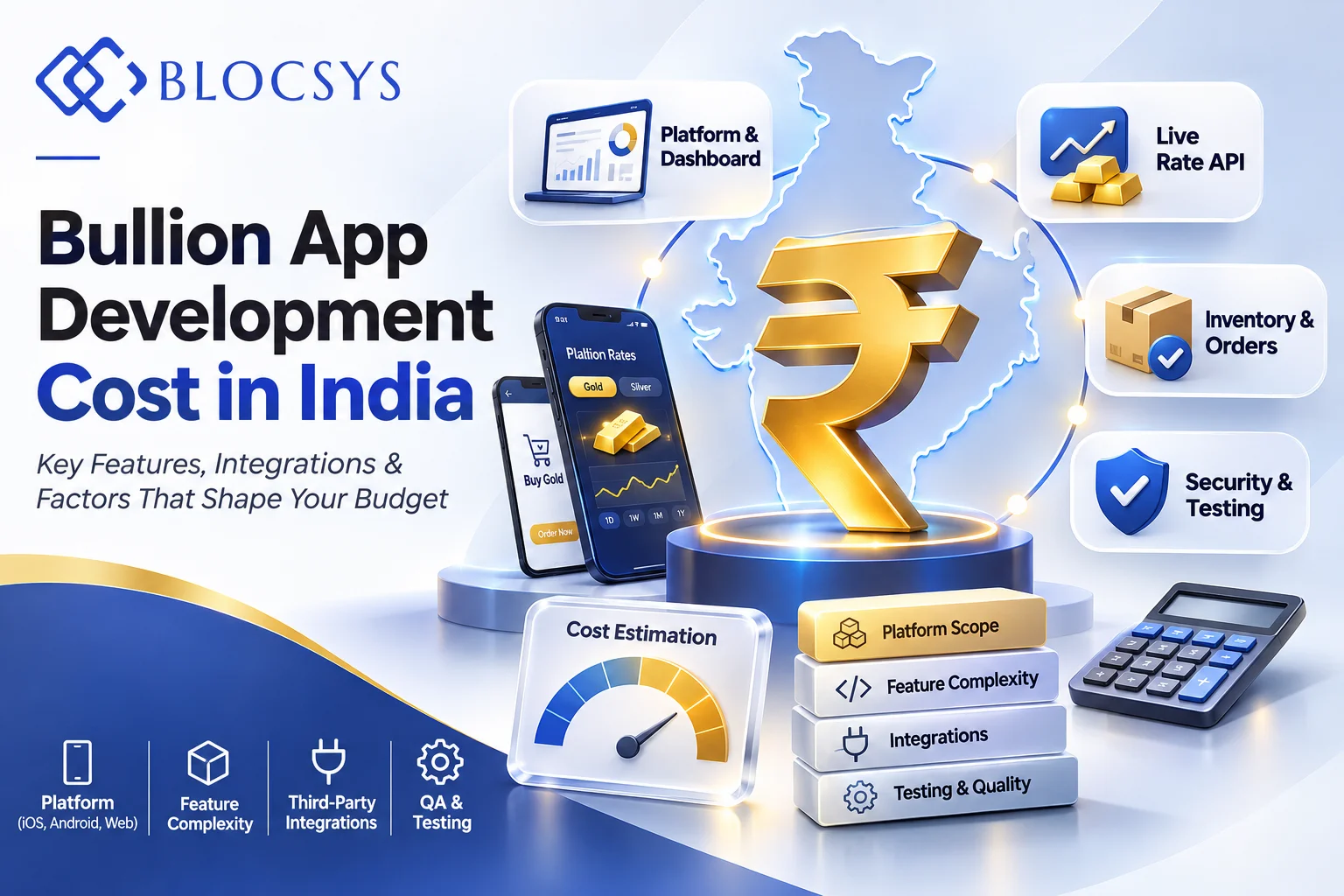
Bullion App Development Cost in India: Features, Technology and Pricing Factors
If you’re running a bullion business and thinking about going digital, you’ve probably already searched for a straight answer on Bullion App Development Cost in India. Here’s the honest truth: there isn’t one number that fits every dealer. The final figure depends on your business model, the features you need, the platforms you choose and how deep your integrations go. Before you approach any digital gold and silver app development partner, it helps to understand what actually drives the budget.
Bullion businesses in India range from single-city rate display services to multi-branch wholesale trading operations. Consequently, their application needs look completely different. A gold wholesaler sending live rates to retail jewellers has very different requirements compared to a bullion dealer managing hundreds of B2B customers, inventory and payment reconciliation. That’s exactly why your Bullion App Development Cost in India estimate should start with your business model, not a generic feature list.
How Much Does It Cost to Develop a Bullion App in India?
There’s no universal, verified market price for bullion application development. However, the cost generally scales with three things: platform count, feature depth and integration complexity. A basic rate-display app with limited functionality requires far less engineering effort than a full trading and dealer management platform with live pricing, order booking and ERP connectivity.
Industry pricing references for custom mobile and web application development in India, published by platforms like Clutch and GoodFirms, typically place small-to-mid complexity apps in a wide range, while enterprise-grade platforms with multiple integrations sit considerably higher. These are illustrative industry patterns, not fixed quotes for bullion software specifically. Your actual bullion application development charges will depend on your confirmed scope.
Here’s the practical way to think about it: your Bullion App Development Cost in India moves up as you add live market data feeds, multiple user roles, payment gateways and backend complexity. It moves down when you launch with a focused MVP and expand later. That’s the real lever you control.
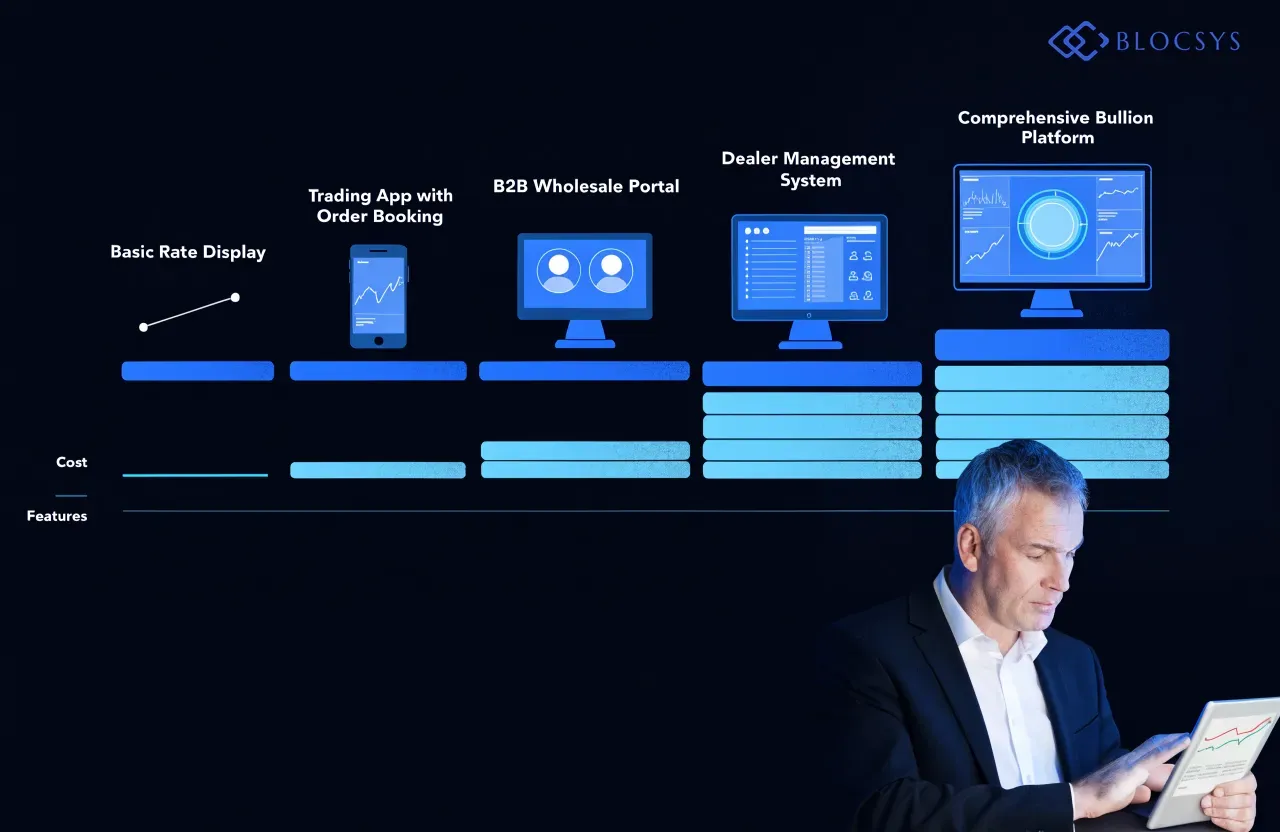
Different Types of Bullion Applications and Their Development Costs
Not every bullion app serves the same purpose. Understanding where your idea fits helps you avoid overpaying for features you don’t need yet, or underestimating what a trading platform actually requires.
Basic Gold and Silver Rate Application
This is the simplest model. It displays live gold and silver rates, sometimes with purity-based and city-wise pricing. There’s minimal backend logic, no order booking and limited user accounts. It’s the lowest-effort option on the spectrum, and therefore the lowest Bullion App Development Cost in India category.
Bullion Trading Application
This adds customer accounts, order booking, transaction history and payment integration. Customers can view live rates and place orders directly. Naturally, this requires more backend work, secure authentication and transaction logging, pushing the budget higher than a rate-only app.
B2B Wholesale Bullion Platform
Here you’re serving dealers and wholesale customers rather than retail buyers. Expect tiered pricing, credit limits, bulk order workflows and dealer-specific rate visibility. The Bullion Trading App Development Cost rises because of multi-user hierarchy and custom business logic.
Bullion Dealer Management Application
This combines inventory tracking, customer management, order processing and reporting into one system. It’s built for internal operations as much as customer-facing trading, so the Bullion Dealer App Development Cost reflects added backend and admin dashboard work.
Comprehensive Bullion Business Platform
This merges trading, wholesale, inventory and dealer management into a single ecosystem, often with ERP and accounting connectivity. It’s the most resource-intensive model and sits at the top end of Bullion Software Development Cost estimates.
A rate-display app and a dealer management platform might look similar on a pitch deck, but they’re built on entirely different backend foundations. Treating them as the same project is where most budget surprises come from.
Feature-Wise Cost Breakdown of Bullion App Development
Rather than quoting one price for “a bullion app,” it’s more useful to look at feature-wise cost factors. Each feature adds a different amount of development effort, and some matter more for certain business models than others.
- Customer registration and login: Essential for almost every app type; moderate effort for secure authentication.
- Gold and silver rate display: Core feature; relatively simple when static, more complex when live.
- Live market price API integration: Advanced feature requiring reliable data feeds and real-time updates.
- Purity-based rate management: Adds business logic for 24K, 22K, 18K and silver variants.
- City-wise rate management: Useful for multi-branch dealers; increases backend configuration work.
- Customer account management: Essential for trading and wholesale apps; includes profile, KYC-linked fields and history.
- Online order booking: Advanced feature with pricing locks, confirmations and order states.
- Order tracking and transaction history: Builds customer trust; requires structured transaction logging.
- Dealer and wholesale customer portals: Advanced, with role-based pricing visibility.
- Inventory management: Optional for trading apps, essential for dealer management platforms.
- Payment gateway integration: Essential for transactional apps; adds provider setup and reconciliation logic.
- Admin dashboard and reporting: Essential for any business-facing application.
- Notifications and communication: Moderate effort; covers SMS, email and push alerts.
- Role-based access and permissions: Advanced, needed when multiple staff or dealer tiers use the system.
We can’t assign a fixed price to each feature here, since actual effort depends on your chosen technology, team structure and project scope. What we can say confidently: every additional advanced feature adds development time, and therefore increases your Bullion App Development Pricing, more than an optional one would.
How Platform Selection Affects Bullion App Development Cost
Your platform choice is one of the biggest cost levers in the entire project. Android bullion app development alone is different from building Android, iOS and a web portal together.
Android bullion app development usually comes first for Indian businesses, given Android’s dominant market share domestically. iOS bullion app development adds separate testing, design adjustments and App Store compliance work, which increases the total budget. A web-based bullion trading platform adds browser compatibility and responsive design requirements.
If you need admin dashboards, dealer portals and customer-facing apps running on a shared backend, that’s where things get genuinely multi-platform. Shared backend architecture helps control costs because business logic isn’t duplicated across platforms. However, each additional frontend still needs its own UI, testing cycle and maintenance stream going forward.
Technology Stack and Backend Development Costs
Behind every bullion app, there’s a backend doing the heavy lifting: processing rate updates, managing orders, authenticating users and generating reports. We’re not going to prescribe one “correct” stack here, because the right choice depends on your scale, team and long-term plans.
Frontend development covers the mobile and web interfaces users interact with directly. Backend services handle business logic, rate calculations and order processing. Database design matters more than people expect; bullion transactions involve financial precision, so schema planning takes real care.
API architecture determines how your rate feeds, payment systems and third-party tools talk to each other. Cloud infrastructure choices affect uptime and scalability. Authentication and role-based access protect sensitive customer and pricing data.
A simple rate-display app needs a lightweight backend. A scalable bullion trading or dealer management system needs a backend built for concurrent users, transaction integrity and future growth. That difference in planning effort is a major reason Bullion Software Development Cost varies so widely between projects.
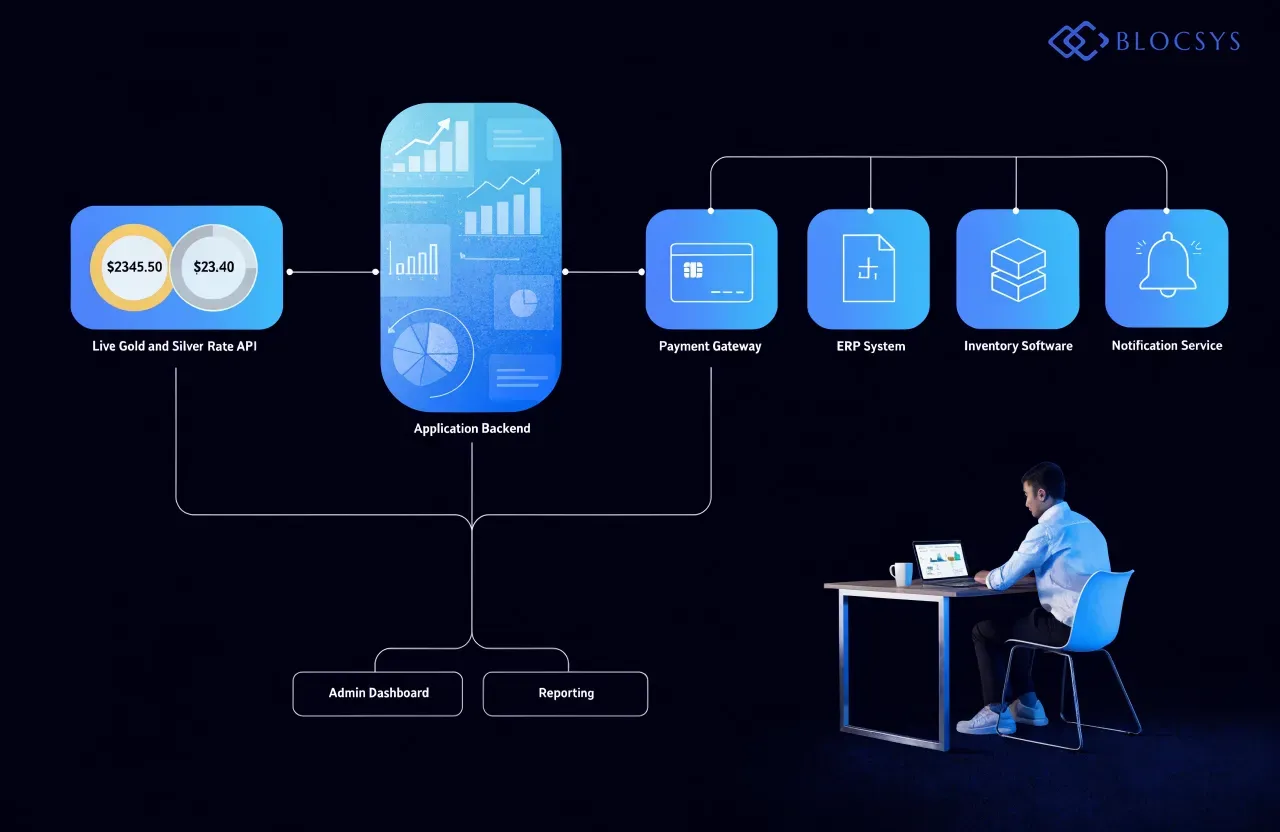
Integration Costs in Bullion Application Development
Integrations add real value, but they also add real cost, both upfront and ongoing. Here’s what typically needs connecting.
Live gold and silver price API integration cost depends on your chosen data provider’s subscription model and update frequency. Market data providers often charge separately from your development partner, so this is a recurring expense, not a one-time fee. Gold and silver rate API integration also needs development work to map that data correctly into your app.
Payment gateway integration cost includes setup, transaction fees charged by the provider and ongoing compliance maintenance. ERP and accounting software integration connects your app to existing business systems, which can require custom middleware depending on what systems you already run. Bullion inventory management software integration adds stock synchronization logic. SMS, email and push notification services usually bill on usage volume. Customer verification services, where used, add their own per-check charges.
Each provider prices differently, so it’s worth checking official documentation for current rates before you finalize your Gold Trading App Development Cost estimate.
Security, Testing and Quality Assurance Costs
A bullion application handles pricing data, customer records, orders and financial transactions. That means security and testing aren’t optional line items, they’re core to the budget.
Authentication and role-based permissions prevent unauthorized access to pricing or customer data. Data protection practices, API security and encrypted transaction records all need dedicated development attention. Audit trails help dealers track who placed, modified or approved an order, which matters for internal accountability.
Backups and disaster recovery planning protect against data loss. Application testing and performance testing confirm the app behaves correctly under real usage, especially during high-volume rate update windows. It’s worth being clear here: this security work is purely software-side. It doesn’t cover physical bullion custody, vault security or regulatory compliance, which remain separate business responsibilities.
Hidden and Ongoing Costs of Running a Bullion Application
Development is just the beginning. Once your app launches, several recurring costs kick in, and businesses often underestimate these when planning their Bullion App Development Cost in India.
Bullion app hosting cost depends on your cloud provider and the traffic your app handles; official pricing documentation from providers like AWS, Azure or Google Cloud is the best place to check current rates. API subscriptions for live pricing data bill separately, usually monthly or based on call volume. Payment gateway charges typically apply per transaction.
Bullion app maintenance cost covers bug fixes, operating system updates, security patches and feature upgrades. Monitoring and technical support ensure uptime, especially important for an app customers rely on for real-time pricing. Treat these as distinct from your initial development spend. Many businesses budget only for launch and get caught off guard by month-two hosting and API bills.
Factors That Increase or Reduce Bullion App Development Costs
Several decisions directly shift your budget up or down. Here’s what matters most.
- Number and complexity of features you include at launch.
- Whether you need Android, iOS, web, or all three together.
- How many user roles your system supports (customer, dealer, admin, staff).
- Custom pricing logic and unique business workflows.
- Live market data integrations and how many data points you track.
- ERP and accounting connectivity requirements.
- Backend architecture and how much scalability you plan for.
- Security and testing depth required for your transaction volume.
- Project timeline and whether you need faster delivery.
- Ongoing support expectations after launch.
The smartest way to control your Bullion App Development Cost in India is to launch with essential features first. Add advanced functionality like ERP connectivity or multi-city rate management in a second phase, once you’ve validated demand.
Custom Bullion App Development vs Ready-Made Software: Cost Considerations
Custom Bullion App Development gives you full ownership, flexibility to add features as your business grows, and freedom to integrate whatever systems you already use. However, it requires a larger upfront investment compared to ready-made or white-label solutions.
Ready-made software often costs less initially, but usually comes with recurring licensing fees, limited customization and dependency on the vendor’s roadmap. If your workflows are standard, that might work fine. If you need custom pricing logic, dealer hierarchies or ERP connectivity, you’ll likely hit walls quickly.
Scalability is another factor. Custom platforms can grow with your business, while white-label tools may force you into a costlier migration later. Neither option is universally cheaper; it genuinely depends on your business requirements, growth plans and how much control you want over your own platform.
How to Plan a Realistic Budget for Bullion App Development
Here’s a practical framework you can actually use.
First, define your application model: are you building a rate app, a trading platform, a wholesale portal or a full dealer management system? Second, list your essential features separately from “nice-to-have” ones. Third, decide your platforms: Android first, or Android and iOS together, plus a web admin dashboard.
Fourth, map out required integrations: pricing API, payment gateway, ERP, notifications. Fifth, plan for security and testing from day one, not as an afterthought. Sixth, estimate ongoing costs like hosting and API subscriptions, and set aside a portion of your budget for post-launch improvements.
Here’s a quick example: a bullion dealer could launch a Minimum Viable Product with live rates, customer accounts and basic order booking. Once customers adopt it, they could add wholesale pricing tiers, inventory sync and ERP integration in phase two. This staged approach keeps your custom bullion software pricing manageable while still building toward a comprehensive platform.
Bullion App Development Services Offered by Blocsys
Blocsys works with bullion dealers, gold wholesalers and precious metal businesses to plan and build applications tailored to their actual operations, not a generic template. Services include custom mobile and web application development, backend architecture, admin dashboard development, third-party API integrations and database design.
For businesses exploring rate-focused applications specifically, Blocsys also offers Bullion Rate App Development as a dedicated starting point. If your roadmap includes blockchain-backed asset tracking or tokenized bullion ownership down the line, Blocsys’s broader trading platform experience, including work on OTC Trading Platform Development, can inform how your bullion platform is architected for future expansion.
The team can help you map your required features, choose the right technology stack and plan integrations around your realistic budget, whether you’re starting with a basic rate app or a full dealer management platform.
Why Choose Blocsys for Bullion App Development?
Blocsys positions itself as a technology development partner for bullion dealers, gold wholesalers, silver traders and precious metal businesses navigating this exact decision. Its relevant capabilities span Android and iOS development, web-based bullion trading platforms, backend systems, admin dashboards and third-party integrations.
Before any cost discussion happens, Blocsys works with you to define project scope clearly. That’s because the right development approach, not a generic quote, is what determines whether your investment actually matches your business needs.
If you want a sense of how project scope typically shapes software budgets more broadly, the Software Development Cost Estimator is a useful starting reference point before a detailed bullion-specific conversation.
Conclusion – Plan Your Bullion App Development Budget with Confidence
Your Bullion App Development Cost in India ultimately comes down to application type, feature depth, platform count, integration complexity and ongoing operational needs. A basic rate app and a comprehensive dealer management platform simply aren’t comparable projects, and their budgets shouldn’t be either.
Rather than chasing a single fixed number, prioritize your essential features, decide your platforms and plan your integrations before you request a quote. That’s how you get an estimate that actually reflects your business, not a generic average.
Planning to develop a custom bullion application for your business? Connect with Blocsys to discuss your required features, technology, integrations and development scope, and explore a suitable application development approach.
Frequently Asked Questions
Here are direct answers to the questions we hear most often about Bullion App Development Cost in India.
How much does it cost to develop a bullion app in India?
It depends entirely on your app type, features, platforms and integrations. A basic rate-display app costs far less than a trading or dealer management platform. There’s no single verified industry-wide price; you need a project-specific assessment.
What is the cost of developing a basic gold and silver rate application?
Basic rate apps require minimal backend logic and fewer integrations, making them the lowest-cost option in the bullion app category. Costs rise once you add live API feeds, city-wise rates or purity-based pricing.
How much does a custom bullion trading application cost?
Trading apps need customer accounts, order booking, payment integration and transaction history, which adds considerably more development effort than a rate-only app. The exact Bullion Trading App Development Cost depends on your specific feature list.
Which features increase bullion app development costs?
Live market data integration, multi-role dealer portals, inventory management, ERP connectivity and payment gateways are the biggest cost drivers. Each adds backend complexity beyond a simple display app.
Does Android and iOS development increase the total project budget?
Yes. Building for both platforms means separate UI work, testing cycles and app store compliance, even with a shared backend. Many businesses start with Android bullion app development and add iOS later.
How much does live gold and silver price API integration cost?
This includes both a provider subscription fee and development work to integrate the feed. Provider pricing varies, so check official documentation for current rates before budgeting.
What are the ongoing maintenance costs of a bullion application?
Expect recurring hosting, API subscriptions, payment gateway charges, bug fixes and security updates. These are separate from your one-time development spend and should be budgeted independently.
Is custom bullion app development more expensive than ready-made software?
Usually upfront, yes. But ready-made software often carries recurring licensing fees and limited customization. The cheaper long-term option depends on your scale and growth plans.
How long does it take to develop a custom bullion application?
Timelines vary with scope and complexity, much like cost does. A basic rate app takes considerably less time than a full dealer management platform with multiple integrations.
Can Blocsys provide a customised bullion app development estimate?
Yes. Blocsys reviews your required features, platforms and integrations first, then helps you plan a development approach suited to your actual business scope and budget.
Ready to move beyond theory and build an intelligent platform that delivers real-world value? Blocsys Technologies specialises in engineering enterprise-grade AI and blockchain solutions for the fintech, Web3, and digital asset sectors. Connect with our experts today to discuss your vision and chart a clear path from concept to a secure, scalable reality.
