Bullion Trading App Development: Online Order Booking and Customer Management Features
If you run a bullion business in India, you already know how orders come in. A phone call from a jeweller in Surat. A WhatsApp message from a wholesaler in Delhi. A walk-in customer asking for today’s rate on 24K gold. Each channel works on its own, but together they create chaos. This is exactly where Bullion Trading App Development comes in — it brings scattered order requests and customer records into one connected system.
Many dealers manage this manually even today, and it’s not necessarily wrong. However, as order volumes grow, tracking who ordered what, at which rate, and whether payment or delivery is pending becomes harder. Staff juggle multiple phones. Customer details sit in notebooks or spreadsheets. Order confirmations happen over voice calls that nobody can verify later.
A custom bullion trading application changes this by giving customers a structured way to submit purchase or sale requests, and giving dealers a centralised dashboard to review, confirm, and track every transaction. Let’s explore how online order booking and customer management actually work inside such a platform, and why more bullion businesses across Indian cities are evaluating digital gold and silver app development as part of their growth plan.
What Is a Bullion Trading App with Online Order Booking?
A bullion trading app with online order booking lets registered customers view relevant gold and silver rates and submit purchase or sale requests through a mobile or web interface, instead of calling the dealer directly.
Customers log in, check the rate for their required purity, enter the quantity they want, and submit the request. The dealer then reviews it, confirms or adjusts it, and moves it forward in the system. Order status stays visible to both sides throughout.
Here’s an important distinction. A rate-display app only shows prices — it doesn’t let anyone transact. A true Bullion Trading App Development project includes order forms, request submission, dealer approval workflows, and status tracking. That’s what separates a simple price ticker from an actual ordering platform.
In precious metal trading, the real operational pain isn’t the price feed — it’s reconciling who asked for what, at which rate, and whether that request was actually honoured. An app that only shows rates solves half the problem.
How Does Online Bullion Order Booking Work?
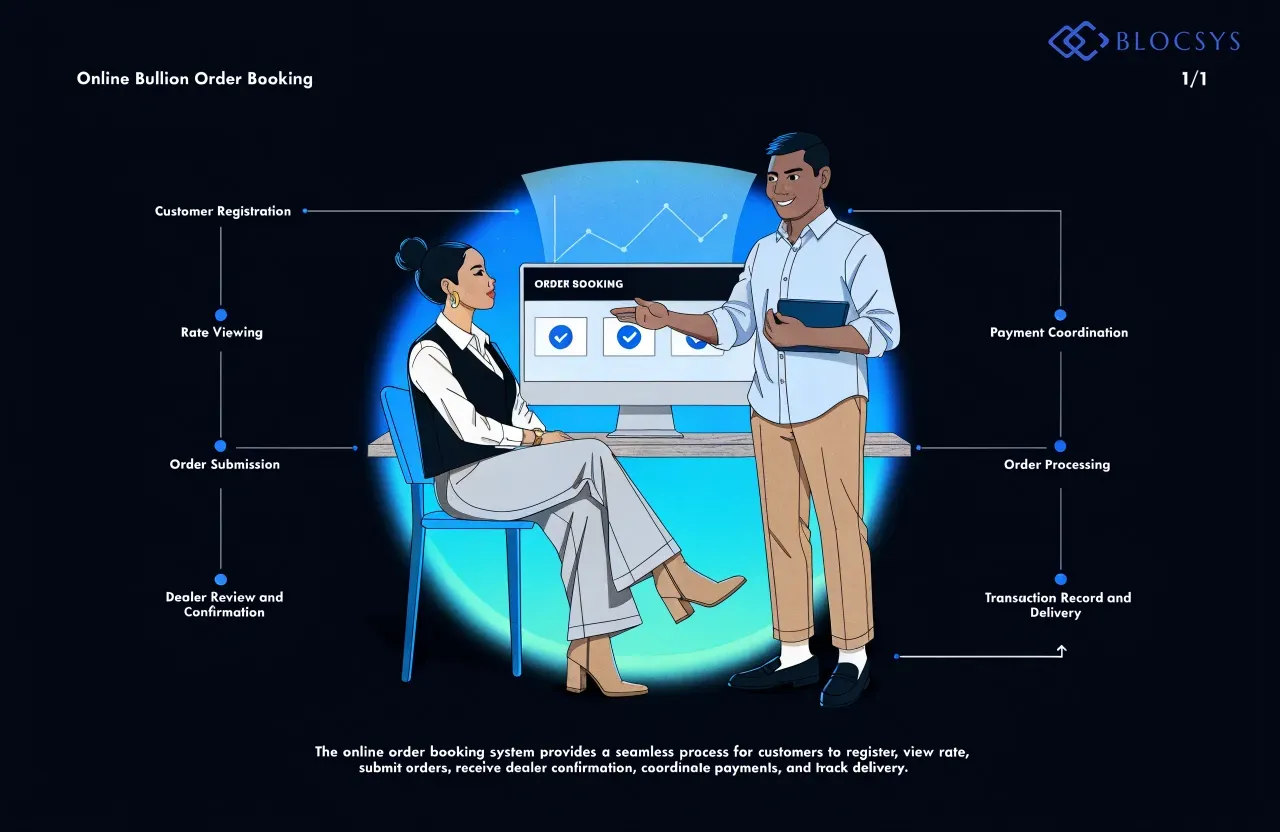
Online bullion order booking follows a defined sequence: registration, rate viewing, order submission, dealer review, confirmation, and transaction tracking — payment and physical delivery happen separately, coordinated through the dealer.
Let’s walk through a practical example. Suppose a jewellery retailer in Ahmedabad wants to buy 500 grams of silver.
- The retailer registers on the dealer’s app and logs in with their business credentials.
- They view the current gold and silver order processing rates displayed for their customer category.
- They select silver, choose the purity, and enter 500 grams as quantity.
- They submit the purchase request, which creates an order record with a timestamp.
- The dealer’s admin team reviews the request and confirms it, sometimes adjusting the rate if market movement occurred.
- Once confirmed, payment or settlement is coordinated separately — this could be bank transfer, cash, or credit terms, depending on the business relationship.
- The order then moves through processing, and the dealer updates its status as it progresses toward completion.
- Finally, a transaction record gets generated, and physical delivery or pickup is arranged.
Notice that submitting a request isn’t the same as completing a transaction. Confirmation, payment, and delivery are distinct steps. A well-built Bullion Order Booking App Development approach keeps these stages clearly separated so nobody assumes an order is “done” prematurely.
Essential Online Order Booking Features for Bullion Trading Apps
An effective order booking experience needs more than a basic form. Here’s what typically matters most to dealers and customers alike.
- Metal and purity selection — customers choose gold or silver and the exact purity category, such as 24K, 22K, or 999 silver.
- Quantity and weight input — orders are entered in grams or kilograms, matching how Indian bullion trade actually operates.
- Displayed rates with validity — the app shows the rate at the time of viewing, along with how long that rate stays valid before refreshing.
- Order summary before submission — customers see metal, purity, quantity, and estimated value before confirming their request.
- Purchase and sale request types — customers can request to buy or sell, depending on what the dealer supports.
- Booking confirmation — once the dealer approves, the customer receives a clear confirmation with a reference number.
- Cancellation rules — orders can be cancelled only within a defined window, set according to the dealer’s own policy.
- Status tracking — customers can check progress anytime instead of calling to ask “what happened to my order.”
Each of these features reduces back-and-forth communication. Consequently, dealers spend less time clarifying order details over the phone and more time actually processing transactions.
Customer Management Features for Bullion Dealers
Bullion Customer Management Software organises every customer’s profile, order history, and communication record in one place, rather than scattering this information across registers, spreadsheets, and personal contacts.
This matters more than it sounds. A dealer serving fifty regular wholesale buyers and hundreds of occasional customers can’t rely on memory or loose notes forever. Here’s what a proper system typically covers.
- Customer registration and profiles — business name, GSTIN where applicable, contact details, and location.
- Individual and wholesale categories — retail customers and B2B buyers are tagged differently, since their workflows differ.
- Account history — every past order, confirmed or cancelled, tied to that customer’s profile.
- Purchase and sale records — a running log of what each customer has bought or sold through the platform.
- Customer-specific pricing — where the dealer offers negotiated rates or margins to certain accounts, the system can reflect that automatically.
- Communication history — notes, calls, or messages logged against the customer, so any staff member can pick up context quickly.
- Activity reports — dealers can see which customers order frequently and which accounts have gone quiet.
- Role-based access — not every staff member needs to see every customer’s commercial terms.
This is fundamentally different from a basic contact list. A contact directory stores names and numbers. A Bullion Order Management System connects that contact to every order, every rate they were offered, and every conversation that shaped the relationship.
B2B Wholesale Customer and Dealer Account Management
B2B wholesale account management in a bullion app lets jewellery retailers, distributors, and regular buyers register as business accounts, get approved by the dealer, and place repeat orders under terms specific to their relationship.
Think about how a gold wholesaler in Mumbai works with twenty regular jewellery manufacturers. Each one may have a slightly different arrangement — some order weekly, others monthly; some get better rates due to volume, others don’t.
A B2B bullion trading application handles this by letting dealers:
- Approve or reject new wholesale account registrations.
- Assign specific pricing or margin adjustments per account, where the business model supports it.
- Set order limits for certain customer categories, if required.
- Enable repeat ordering, so regular buyers don’t re-enter details every time.
- Control staff-level permissions for who can approve large wholesale orders.
Not every bullion business runs on credit accounts, and payment terms vary widely across the trade. A good dealer portal doesn’t assume one model fits everyone — it should be configurable to match how your business actually operates, whether that’s advance payment, partial settlement, or approved credit limits for trusted partners.
Order Tracking, Notifications and Transaction History
Order tracking lets customers and dealers follow a request through defined statuses — received, under review, confirmed, processing, completed, or cancelled — so nobody has to call and ask for an update.
Here’s a simple status table showing how this typically flows in practice.
| Status | What It Means | Who Acts Next |
|---|---|---|
| Request Received | Customer has submitted a purchase or sale request | Dealer reviews it |
| Under Review | Dealer is checking rate, quantity, or availability | Dealer confirms or contacts customer |
| Confirmed | Order accepted at agreed rate and terms | Payment or settlement coordination begins |
| Processing | Transaction and delivery arrangements underway | Dealer’s operations team |
| Completed | Transaction finished, record generated | None — stored in history |
| Cancelled | Order withdrawn within allowed window | None — stored in history |
Notifications keep both sides informed without manual follow-up. A customer gets alerted the moment their order is confirmed, or if the rate shifted before approval. Order status notifications remove the guesswork that otherwise comes from waiting on a callback.
Transaction history, meanwhile, gives customers a downloadable record of every completed order — useful for their own accounting and for resolving any dispute later. Dealers benefit equally, since every order reference ties back to a verifiable digital record rather than a handwritten note.
Admin Dashboard for Customer and Order Management
An admin dashboard gives dealers a single screen to review incoming orders, approve or reject requests, update statuses, and generate reports across their entire customer base.
Instead of checking three WhatsApp groups and a notebook, staff can filter orders by customer type, date range, or status. They can search for a specific wholesale buyer’s history in seconds. Furthermore, activity logs show which staff member approved which order, adding accountability that manual processes often lack.
For multi-branch bullion businesses, this becomes even more useful. A dealer with outlets in Jaipur, Chennai, and Pune can manage customer accounts and orders centrally, while still letting branch staff handle their own regional customers through role-based permissions.
Live Gold and Silver Rates in Order Booking Applications
Rates displayed during order booking are typically pulled from a pricing API and refreshed periodically, showing separate buy and sell prices adjusted for purity and the dealer’s own margin.
Reference points like LBMA pricing and domestic benchmarks such as MCX settlement data influence how Indian dealers set their rates, though every business applies its own adjustments on top.
Here’s something worth being clear about: market prices move constantly, sometimes within minutes. If a customer submits an order at one rate, and the dealer confirms it a few minutes later, the rate may have shifted. A well-designed system should flag this rather than silently applying the old price — the dealer decides whether to honour the original rate, request reconfirmation, or apply the updated one. Orders aren’t automatically executed at whatever rate was on screen at submission time.
Payment and Business System Integrations
Bullion trading applications can connect with payment gateways, accounting software, ERP systems, and notification services, though the exact integrations needed depend on each dealer’s existing setup.
Payment gateway integration, for instance, can support advance payments or partial settlements for confirmed orders. However, this is separate from the order booking step itself — placing an order is a request; the payment transaction is a distinct event that happens once terms are agreed.
Similarly, connecting the app to accounting or ERP software can save double data entry, syncing confirmed transactions directly into the dealer’s books. These integrations aren’t mandatory for every business — some dealers prefer manual reconciliation, and that’s a valid choice too.
Bullion Trading App Development Services Offered by Blocsys
This is where Blocsys fits into the picture. As a software development company, Blocsys builds custom mobile and web applications tailored to how bullion dealers actually take orders and manage customers.
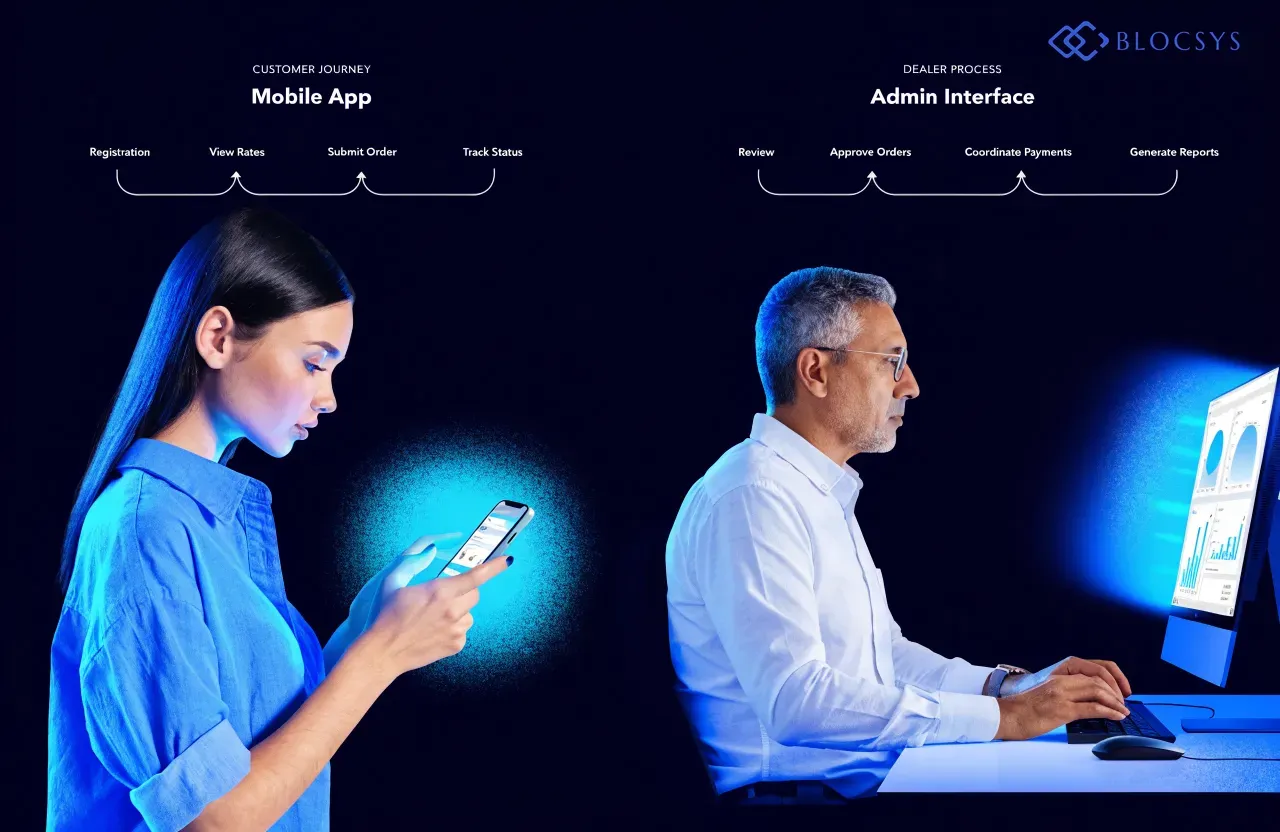
That includes customer-facing apps for order booking, dealer-side admin dashboards, backend systems for managing accounts and transactions, and API integrations connecting rate feeds, payment gateways, or existing business software.
Rather than offering a one-size-fits-all product, Blocsys works through each business’s specific order lifecycle — how customers register, how wholesale accounts get approved, how orders move from request to confirmation — and builds the application around that workflow. You can see the broader scope of this work on the digital gold and silver app development service page.
How Much Does Bullion Trading App Development Cost?
Development cost for a bullion trading app depends on how many modules you need — customer app, dealer portal, admin dashboard, notifications, integrations — and how complex your order and customer workflows are.
A basic order booking app with customer registration and simple status tracking costs less than a platform with wholesale account management, customer-specific pricing, payment gateway integration, and ERP connectivity. Testing, security hardening, and ongoing maintenance add further cost beyond the initial build.
It’s also worth separating development cost from running cost. Hosting, third-party rate API subscriptions, and payment gateway transaction fees are ongoing expenses, not one-time development charges. For a tailored estimate, Blocsys’s Software Development Cost Estimator can give you a starting reference point before a detailed scoping discussion.
Why Choose Blocsys for Bullion Trading App Development?
Blocsys works as a technology development partner for bullion dealers, gold wholesalers, silver traders, and jewellery businesses looking to digitise their order booking and customer management operations.
The team builds custom mobile and web applications, backend systems, admin dashboards, and third-party integrations, aligning every module with how the client’s business actually processes orders — not a generic template. Whether you need a straightforward Bullion Dealer App Development build or a more layered B2B platform with multiple customer categories, the application gets structured around your real order lifecycle, from first request to completed transaction.
Blocsys doesn’t claim to operate or own any bullion trading platform itself — its role is building the software that bullion businesses run on, scaled to each client’s own operations.
Conclusion – Simplify Bullion Order Booking and Customer Management with a Custom Application
Bringing order requests and customer records into one connected system doesn’t eliminate the human side of bullion trading — it organises it. Customers get a clear way to submit requests and track progress. Dealers get a structured view of every account, every order, and every pending confirmation.
That’s the real value behind Custom Bullion Trading App Development: fewer missed messages, clearer records, and a smoother path from enquiry to completed transaction. The right feature set depends entirely on your own workflow, your customer categories, and how your business actually handles payment and delivery.
Looking to simplify online bullion order booking and customer management for your business? Connect with Blocsys to discuss a customised mobile or web application designed around your trading workflows — start with the digital gold and silver app development page to see where a conversation might lead.
Frequently Asked Questions
Here are direct answers to the questions we hear most often about Bullion Trading App Development.
What is a bullion trading app with online order booking?
It’s an application where registered customers can view bullion rates and submit purchase or sale requests digitally, instead of calling or messaging the dealer directly.
The dealer reviews each request through an admin interface before confirming it.
How does online order booking work in a bullion application?
Customers register, check rates, select metal and quantity, and submit a request. The dealer reviews, confirms, and moves it through processing to a completed transaction.
Payment and delivery happen as separate, coordinated steps after confirmation.
What customer management features should a bullion trading app include?
Look for customer profiles, wholesale categorisation, order history, customer-specific pricing where applicable, communication logs, and role-based access for staff.
These features go well beyond a basic contact list.
Can bullion dealers manage wholesale customers through a mobile application?
Yes. Dealer account management features let you approve wholesale registrations, assign negotiated pricing, and track repeat orders from business customers like retailers and distributors.
Can customers place both gold and silver orders through one application?
Yes, a Gold and Silver Trading App Development build typically supports both metals, with separate purity options and rate displays for each.
How can customers track their bullion order status?
Through status updates such as received, under review, confirmed, processing, and completed, visible on their account dashboard along with push or SMS notifications.
Can a bullion trading app support customer-specific pricing?
Yes, where the dealer’s business model requires it. The system can apply negotiated rates or margins to specific wholesale accounts automatically.
Can bullion applications integrate payment gateways and accounting software?
Yes, though integration needs vary by business. Payment gateways handle settlement for confirmed orders, while accounting or ERP integration syncs transaction records into existing books.
How much does it cost to develop a bullion order booking application?
Cost depends on the modules required — customer app, dealer portal, admin dashboard, integrations — plus testing and ongoing maintenance. A detailed scoping conversation gives the most accurate figure.
Can Blocsys develop a custom bullion trading app with customer management features?
Yes. Blocsys builds custom mobile and web applications covering order booking, wholesale customer management, admin dashboards, and relevant integrations, tailored to each dealer’s workflow.
Ready to move beyond theory and build an intelligent platform that delivers real-world value? Blocsys Technologies specialises in engineering enterprise-grade AI and blockchain solutions for the fintech, Web3, and digital asset sectors. Connect with our experts today to discuss your vision and chart a clear path from concept to a secure, scalable reality.