
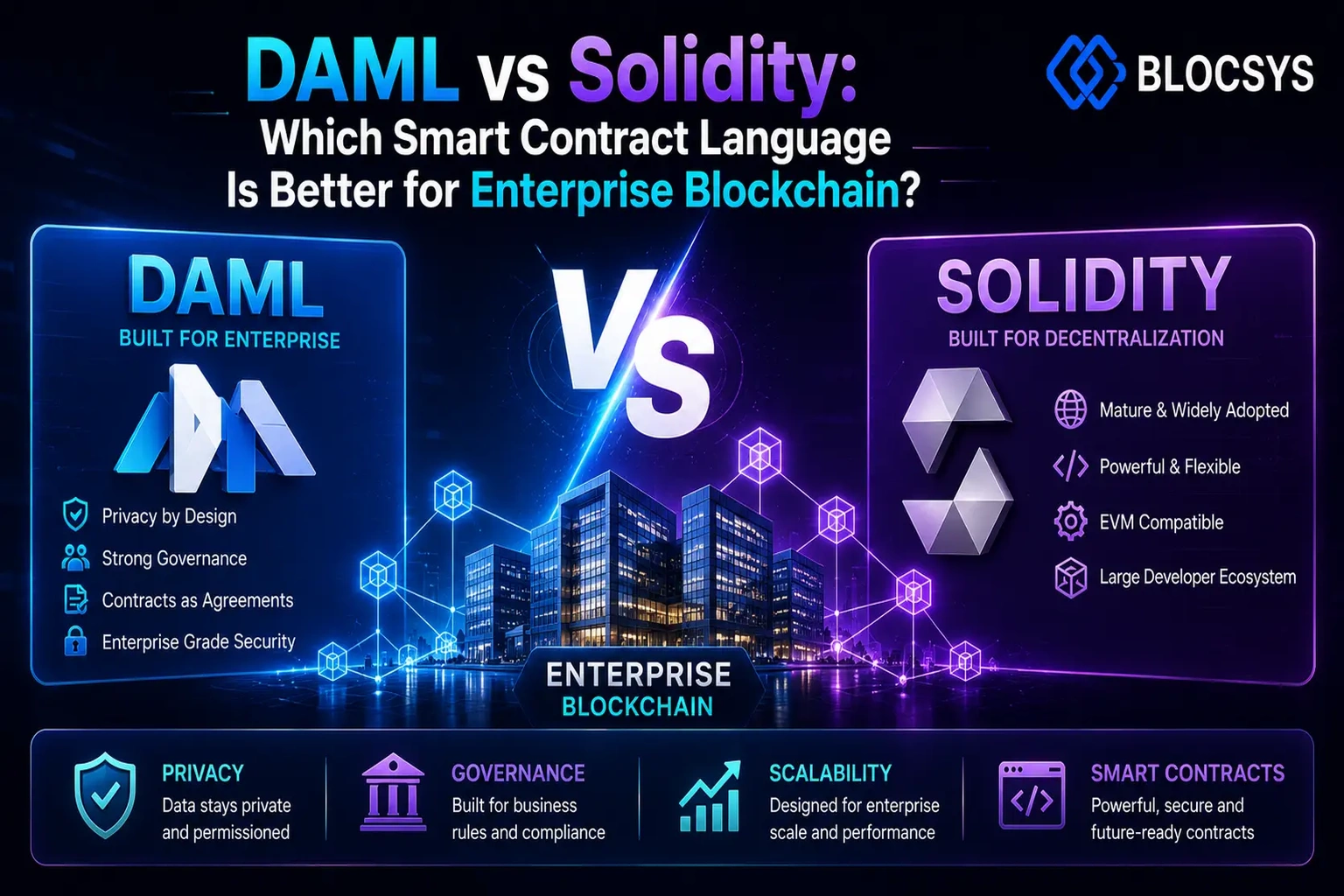
DAML vs Solidity: Which Smart Contract Language Better for Enterprise Blockchain
Teams researching daml smart contracts usually aren’t comparing syntax. They’re deciding what kind of platform they’re building. A CTO at a fintech, exchange, or digital asset firm reaches this question once the architecture stops being theoretical. The product now has named counterparties, compliance obligations, internal approval flows, and data that can’t sit in a universally visible state.
At that point, the core issue isn’t which language reads better. It’s whether your smart contract model matches the business process you need to run. DAML and Solidity represent two very different operating assumptions, and this guide breaks down where each one wins.
Table of Contents
- The Enterprise Smart Contract Dilemma
- What Is DAML? Full Form, Core Concepts, and DAML Smart Contracts Explained
- What Is Solidity? On-Chain Execution First
- Canton Network Overview: How It Relates to DAML
- Core Architectural Differences That Define Enterprise Suitability
- DAML vs Solidity Head-to-Head Comparison Table
- Privacy, Compliance, and Governance Capabilities
- Ecosystem and Interoperability
- Low-Latency Settlement and Trading Use Cases
- Alternatives to Canton Network With Lower Integration Overhead
- DeFi-Specific Smart Contract Language Options
- Vendor Comparison for Enterprise Smart Contract Tooling
- How Blocsys Drives Enterprise Blockchain Innovation
- Frequently Asked Questions
The Enterprise Smart Contract Dilemma
An enterprise smart contract decision usually starts with a misleading question. Teams ask, “which language is better?” The useful question is narrower: which language fits the privacy model, governance model, and ecosystem your business needs?
That matters because DAML and Solidity optimize for different worlds. Solidity is the dominant language for public-chain execution. DAML, however, is designed for structured, multi-party workflows where roles and controlled visibility are central. For a tokenized consumer product, public composability may be the point. For post-trade processing or institutional tokenization, public visibility becomes the problem.
Practical rule: if your application requires different parties to see different parts of the same workflow, you’re not just choosing a language. You’re choosing a disclosure model.
Strong enterprise decisions start with the operating model, then select the language. Open participation and Ethereum-native composability point toward Solidity. Permissioned counterparties and controlled data sharing point toward DAML.
What Is DAML? Full Form, Core Concepts, and DAML Smart Contracts Explained
DAML stands for Digital Asset Modeling Language. It’s a smart contract language built specifically for multi-party business logic rather than general-purpose computing. Instead of writing code that simply executes on a shared ledger, developers writing daml smart contracts model rights, obligations, and permissions as first-class concepts in the language itself.
The core concepts behind the daml smart contract language include templates (the blueprint for an agreement), signatories (parties who must authorize an action), observers (parties allowed to see a contract without acting on it), and choices (the specific actions a party can exercise). Together, these primitives let a contract encode who can do what, and who gets visibility into the result.
DAML models agreements first
DAML’s enterprise value comes from abstraction over the underlying ledger and portability across platforms. It can run across enterprise environments, including database-backed deployments and permissioned ledgers, while Solidity stays tied primarily to account-based public-chain models such as Ethereum.
That design changes how teams think about the application. In DAML, a contract isn’t just executable code. It’s closer to a structured agreement between named parties, with defined actions and visibility rules. It starts from the business process, not from the chain, which is also why many enterprise buyers first encounter Blocsys’ guide to the DAML language for enterprise smart contracts before evaluating vendors.
What Is Solidity? On-Chain Execution First
Solidity is the dominant smart contract language for Ethereum and the wider EVM ecosystem. It’s best understood as the language of public-chain programmability. Teams use it to build DeFi protocols, token contracts, NFT systems, and DAO logic, where shared state and open composability are features, not liabilities.
Solidity’s architectural assumptions differ sharply from DAML’s. Contracts deploy into an environment where state is typically global to the chain, and developers define permission logic through the contract’s own code patterns. That doesn’t make Solidity less capable — it makes it optimized for a different kind of product. If your roadmap depends on public liquidity and EVM tooling, Solidity gives you the shortest path.
Canton Network Overview: How It Relates to DAML
The Canton Network is a privacy-enabled interoperability network built specifically to run DAML-based applications across institutions. Rather than forcing every participant onto one shared, fully visible ledger, Canton lets separate institutions operate their own synchronization domains while still transacting atomically with each other.
DAML serves as the business logic layer on top of Canton. In practical terms, that means teams model private, role-aware contract behavior while preserving interoperability across enterprise systems. The appeal isn’t public transparency — it’s coordinated execution without unnecessary disclosure, which matters greatly for regulated finance.
Why Canton Network matters for enterprise blockchain platforms
For enterprise blockchain platforms handling tokenized assets, settlement, or custody, Canton offers something public chains can’t: atomic cross-institution transactions without full data exposure. Firms in the USA, UK, Europe, UAE, and Singapore increasingly evaluate Canton specifically because it lets regulated entities interoperate without collapsing into one universally visible database.
Core Architectural Differences That Define Enterprise Suitability
The decisive difference between DAML and Solidity isn’t syntax. It’s the underlying contract model. DAML uses a UTXO-style contract model with built-in party-based visibility. When a contract changes, the old contract archives and a new one is created, and only signatories, observers, and controllers see the relevant data. This design reduces accidental data leakage in multi-party business processes.
Why the contract model changes system design
A practical analogy helps here. DAML behaves more like a chain of discrete agreements — each state transition creates a new contractual fact. Solidity, by contrast, behaves more like a shared application account with mutable state that persists on-chain and changes according to the functions users call.
For enterprise architecture, that distinction has real consequences:
- Data exposure differs: DAML scopes visibility at the contract level. Solidity applications on public chains usually expose state broadly unless privacy gets engineered externally.
- Audit semantics differ: DAML’s archive-and-create pattern maps cleanly to business event progression. Solidity’s model is powerful, but teams often must impose business meaning onto lower-level state transitions.
- Permission logic lives in different places: DAML treats roles and parties as native concerns. Solidity teams commonly express permissions through application logic and surrounding infrastructure.
What that means for enterprise architecture
With DAML, confidentiality and least-privilege access sit embedded in the contract model itself. With Solidity, those concerns usually sit one layer higher, spanning contract code, network topology, and application permissions. That doesn’t mean DAML wins universally — it means DAML aligns better when the enterprise problem is governed workflow coordination rather than public composability. See Blocsys’ view on public vs private blockchain design for a useful companion comparison.
DAML vs Solidity Head-to-Head Comparison Table
This daml vs solidity breakdown covers the four dimensions enterprise teams weigh most: privacy, interoperability, performance, and ecosystem.
| Dimension | DAML | Solidity |
|---|---|---|
| Privacy | Native, sub-transaction level disclosure to only relevant parties | Broad visibility by default; privacy engineered above the language |
| Interoperability | Runs on Canton Network, databases, and permissioned ledgers | Tied closely to EVM-compatible chains |
| Performance | Optimized for low-latency settlement between known counterparties | Throughput bound by public network consensus and gas limits |
| Ecosystem | Smaller, finance-focused, growing through Canton Network partners | Large, mature, extensive DeFi and tooling ecosystem |
Comparing Privacy, Compliance, and Governance Capabilities
Privacy is where the DAML versus Solidity decision turns commercial rather than purely technical. DAML supports permissioned multi-party projects and can break transactions into sub-transactions revealed only to the parties who need to know. That’s a core fit for financial workflows requiring confidentiality and role-based visibility.
DAML fits controlled disclosure workflows
For a regulated enterprise, selective disclosure isn’t an abstract preference — it’s how the organization avoids over-sharing sensitive data while still coordinating across institutions. That makes DAML a strong fit for:
- Bilateral or multi-party settlement: participants interact within one process without every party seeing all underlying data.
- Compliance-sensitive tokenization: ownership, transfer rights, and observer roles align with legal boundaries.
- Inter-organization processes: counterparties, custodians, and oversight roles operate on the same workflow without one universally visible state.
Solidity requires a privacy strategy above the language
Solidity can still support enterprise systems, and many teams run EVM-compatible stacks in permissioned environments. However, the language itself doesn’t natively solve selective visibility the way DAML does. That shifts the workload: privacy and role-scoped access must be engineered through platform architecture instead. For some products that’s acceptable; for others it becomes an ongoing maintenance burden. Implementation risk usually sits in workflow design, which is where enterprise smart contract development support becomes relevant.
Ecosystem and Interoperability: DAML on Canton vs Solidity on EVM
A language doesn’t operate in isolation — it inherits the strengths and trade-offs of its ecosystem. For Solidity, that ecosystem is the EVM universe: large, battle-tested, and developer-friendly. For products needing public-chain integrations and mature tooling, that matters enormously.
The ecosystem trade-off is strategic
For DAML, the strategic advantage lies in deployment flexibility. It can run on permissioned ledgers and even standard databases such as PostgreSQL, while supporting cross-ledger interoperability through Canton Network. This lets enterprises prototype and deploy the same business logic across database-backed and distributed-ledger environments, which lowers integration risk considerably.
A regulated enterprise platform benefits more from infrastructure optionality than from public network effects. If the organization may need to move between database-backed deployments, permissioned ledgers, or consortium structures, DAML’s runtime abstraction becomes commercially useful. See Blocsys’ work on enterprise blockchain solutions in Europe and Canton Network use cases for finance.
Low-Latency Settlement and Trading Use Cases for Ledger-Based Platforms
One of the strongest arguments for DAML and Canton Network centers on low-latency settlement trading. Traditional post-trade settlement runs on batch cycles measured in days. Ledger-based platforms compress that to near real time by letting counterparties atomically finalize a trade the moment terms match.
Practical use cases include:
- Repo and securities lending: collateral moves atomically with cash, cutting counterparty risk windows.
- FX settlement: payment-versus-payment structures settle instantly instead of waiting on correspondent banking cycles.
- Tokenized money market funds: subscriptions and redemptions settle same-day rather than T+2.
- Intraday margining: exchanges and clearinghouses recalculate exposure continuously rather than at end of day.
These scenarios need both privacy and speed simultaneously — exactly the combination DAML’s contract model targets. Solidity-based public chains can achieve similar throughput on specialized rollups, but usually at the cost of transaction-level privacy.
Alternatives to Canton Network With Lower Integration Overhead
Canton Network isn’t the only path to permissioned, DAML-style coordination. Teams weighing integration cost should also consider:
- Hyperledger Fabric: a channel-based permissioned ledger with lower operational complexity for teams already using Java or Go.
- R3 Corda: built specifically for financial agreements, with a similar point-to-point privacy model to DAML but a different runtime and tooling stack.
- Database-backed DAML deployments: running the daml smart contract language directly on PostgreSQL or Aurora, skipping distributed-ledger infrastructure entirely for early-stage products.
- Permissioned EVM sidechains: for teams wanting Solidity familiarity with restricted validator sets and private transaction pools.
Each alternative trades some interoperability for simpler infrastructure. Therefore, the right choice depends on whether cross-institution atomic settlement is a near-term requirement or a future-phase goal.
DeFi-Specific Smart Contract Language Options
Not every institutional team needs DAML’s privacy model. Some are building DeFi-adjacent products where composability with existing liquidity matters more than confidentiality. In that case, language options extend beyond Solidity:
- Solidity: the default for EVM chains, with the deepest tooling and audit ecosystem.
- Vyper: a Python-like alternative to Solidity, favored for simpler security auditing.
- Rust (via Solana or CosmWasm): chosen for higher-throughput DeFi applications outside the EVM.
- Move (Aptos, Sui): designed around resource-oriented programming, aimed at reducing common asset-handling bugs.
Moreover, teams building hybrid products sometimes run DAML for the regulated settlement layer while using Solidity or Move for a public-facing liquidity layer. That combination is becoming more common as tokenization programs mature.
Vendor Comparison for Enterprise Smart Contract Tooling
Choosing a language is only half the decision. Enterprise teams also need to evaluate tooling vendors:
| Vendor/Platform | Language | Best fit |
|---|---|---|
| Digital Asset (Canton Network) | DAML | Regulated multi-party settlement |
| ConsenSys tooling (Truffle/Infura) | Solidity | Public EVM development |
| R3 Corda | Kotlin/Java-based DSL | Financial agreement networks |
| Hyperledger Fabric | Go/JavaScript chaincode | Permissioned consortium networks |
Firms comparing vendors should weigh delivery track record alongside language fit. Blocsys’ blockchain consulting partner guide outlines the evaluation criteria in more depth.
How Blocsys Drives Enterprise Blockchain Innovation
Most enterprise teams don’t struggle to understand the headline difference between DAML and Solidity. They struggle to translate that difference into a buildable platform. How should workflow roles be modeled? Which data belongs in shared state? Can an existing EVM design adapt, or does it need a redesign around party-based visibility?
What enterprises usually need from an implementation partner
- Workflow modeling: turning legal and operational rules into executable smart contract behavior.
- Platform selection: deciding whether to optimize for EVM composability or DAML-style controlled workflows.
- Integration design: connecting smart contract logic to internal systems, reporting, and identity.
- Risk reduction: confirming privacy and governance get solved in the right layer of the stack.
Blocsys provides blockchain and AI infrastructure engineering for teams building digital asset platforms and enterprise smart contract applications.
When to bring in specialist support
A sound implementation process won’t push DAML or Solidity as a default answer. It maps the language choice to the business process, governance model, and target ecosystem.
Bring in specialist help early if you have regulated counterparties, you’re moving from pilot to production, or you’re comparing DAML and Solidity for a board-level investment decision. If you need execution support after the architecture decision, hire blockchain developers through Blocsys for delivery planning and build support.
Frequently Asked Questions
What is DAML in simple terms?
DAML is a smart contract language built for multi-party business workflows. It models rights, obligations, and visibility directly in the contract logic, making daml smart contracts well suited to enterprise systems where participants need different permissions and views.
What is the difference between DAML and Solidity?
The core difference is architectural. DAML models business agreements between parties with controlled visibility. Solidity models on-chain execution in EVM environments with account-based state and broad public compatibility.
How does Canton Network use DAML?
Canton Network runs DAML as its business logic layer, letting institutions transact atomically across separate synchronization domains without exposing full transaction data to every participant.
Is DAML better than Solidity for low-latency settlement trading?
Yes, in most regulated settlement scenarios. DAML’s contract model supports privacy and atomic finality simultaneously, which fits low-latency settlement trading better than public EVM chains that expose transaction data broadly.
Can Solidity contracts move directly into DAML?
Usually not. Teams typically need to redesign the application around parties, visibility, and workflow semantics rather than translate code line by line.
If you’re evaluating daml smart contracts, Canton Network, or a broader enterprise blockchain architecture, Blocsys Technologies can help your team assess fit, reduce design risk, and move from concept to production with the right smart contract model for your business.
