
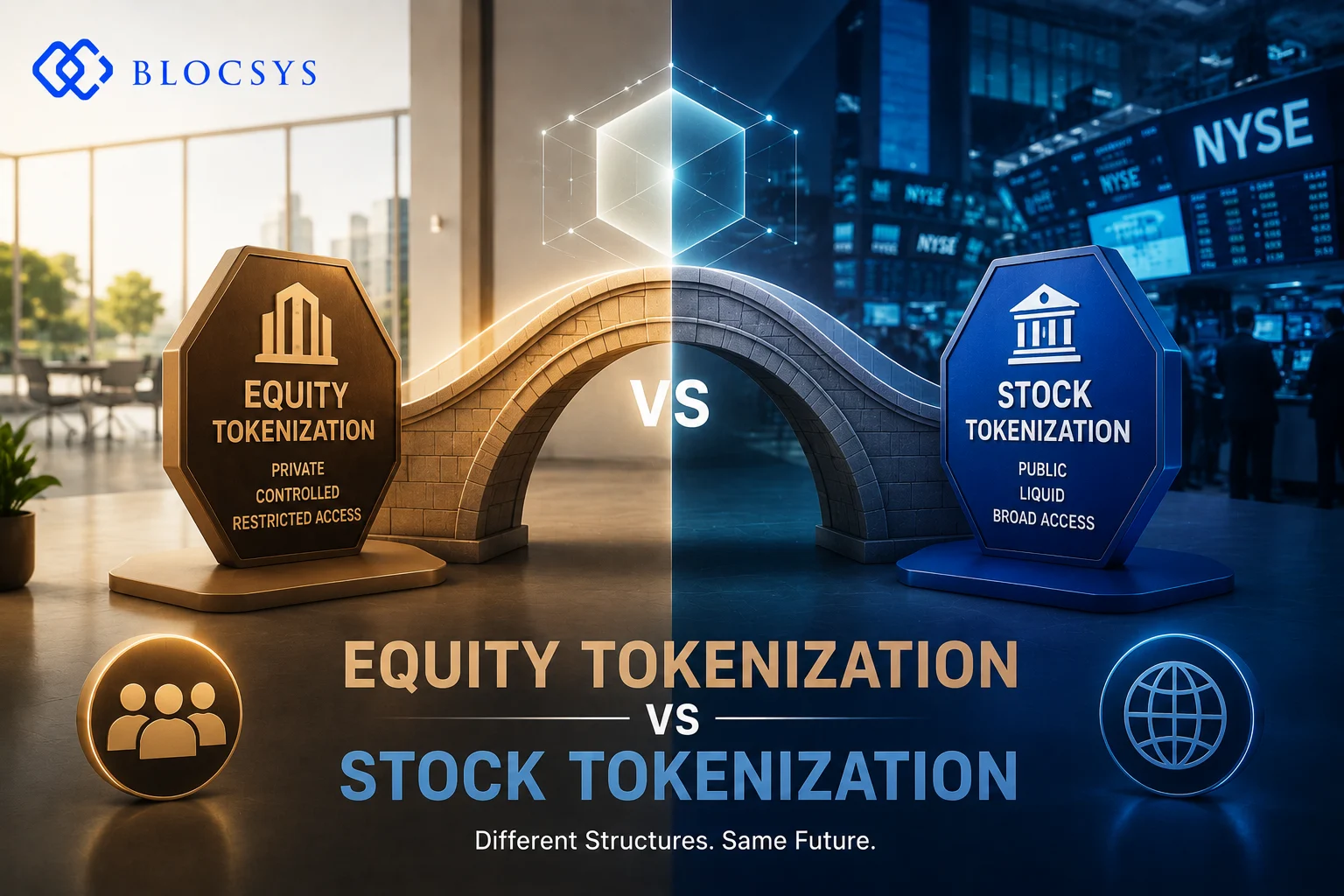
Equity Tokenization vs Stock Tokenization: Understanding the Key Differences
Equity Tokenization vs Stock Tokenization is one of the most searched comparisons in digital securities today, and for good reason. Both terms get thrown around like they mean the same thing, but they don’t. Equity tokenization usually refers to representing ownership in a private company on a blockchain, while stock tokenization typically applies to publicly traded shares. If you’re a fintech leader, asset manager, or startup founder exploring blockchain-based ownership, that distinction matters more than most articles admit. At Blocsys, we build enterprise tokenization infrastructure, and this guide walks you through what separates equity tokenization from stock tokenization, including ownership rights, transferability, liquidity, and compliance. If you’re already thinking about implementation, our Equity Tokenization Platform Development team can help you scope the technical and regulatory path forward.
What Is Equity Tokenization?
Equity tokenization converts ownership stakes in a company into digital tokens recorded on a blockchain. Think of it as a digital share certificate that lives on-chain instead of in a filing cabinet. Each token represents a fractional or full claim to equity, often tied to voting rights, dividends, or profit-sharing terms defined in the company’s governing documents.
Private companies, startups, and even real estate holding structures use this model most often. Unlike public markets, there’s no centralized exchange requirement. Instead, ownership records move to a blockchain ledger, and smart contracts can automate investor onboarding, transfer restrictions, and compliance checks.
Here’s the key point: equity tokenization doesn’t change what equity legally is. It changes how that equity is recorded, transferred, and managed. The underlying security laws governing private equity still apply, whether the shares sit in a spreadsheet or a smart contract.
What Is Stock Tokenization?
Stock tokenization refers to creating a blockchain-based digital representation of an existing, publicly traded stock. A tokenized version of a listed company’s share doesn’t replace the original stock; it mirrors it, usually through a custodial or synthetic structure.
Investors holding tokenized stocks typically gain price exposure and, in some structures, economic rights similar to the underlying share. However, direct shareholder voting rights and certain legal protections don’t always transfer automatically. That depends entirely on how the issuer structures the token.
Several regulated platforms in Europe and Switzerland already offer tokenized versions of major listed equities, subject to local securities frameworks. The US market remains more cautious, given SEC scrutiny around synthetic securities exposure. Consequently, stock tokenization models vary significantly by jurisdiction.
Tokenizing a public stock and tokenizing private equity solve two completely different problems. One digitizes access to an already-liquid asset. The other builds liquidity and structure where none existed before. Treating them as interchangeable is where most tokenization projects go wrong.
Equity Tokenization vs Stock Tokenization: Core Comparison
So, what’s the real difference between equity tokenization and stock tokenization? The short answer: equity tokenization creates the primary ownership record for private shares, while stock tokenization represents an already-existing public security. That’s a meaningful distinction for compliance, custody, and investor rights.
Let’s break the Equity Tokenization vs Stock Tokenization comparison into a clear table, since businesses evaluating both models need a side-by-side view before choosing an approach.
| Factor | Equity Tokenization | Stock Tokenization |
|---|---|---|
| Underlying Asset | Private company shares or membership interests | Publicly traded, exchange-listed stock |
| Ownership Record | Blockchain often becomes the primary or supporting ledger | Token typically mirrors an off-chain custodial holding |
| Investor Access | Usually limited to accredited or qualified investors | Can be broader, depending on jurisdiction and issuer rules |
| Liquidity Source | Built through tokenization itself, secondary markets are emerging | Inherits liquidity from existing public markets |
| Regulatory Path | Private placement and securities exemption frameworks | Securities law plus custody and market-making rules |
This table captures the core Equity Tokenization vs Stock Tokenization differences, but real-world structuring gets more detailed depending on jurisdiction and investor base.
![Equity Tokenization vs Stock Tokenization — [Flow diagram comparing two tokenization paths: Private Company Shares → Cap Table Digitization → Smart Contract Issuance → Investor Onboarding (Equity Tokenization) versus Listed Stock → Custodial Holding → Token Minting → Exchange Distribution (Stock Tokenization)]](https://s3.blocsys.com/blocsys/blog-images/1787702547063-1756f967e2d22508.webp)
Key Differences in Ownership and Investor Rights
Ownership rights are where Tokenized Equity vs Traditional Stocks discussions get interesting. Traditional public shares come with well-established shareholder protections under securities law. Tokenized equity in a private company depends heavily on how the token is legally structured against the company’s operating agreement or shareholder agreement.
Equity tokens can carry voting rights, information rights, and pro-rata claims on distributions. However, none of that happens automatically just because a token exists. The legal wrapper matters more than the technology.
Tokenized stocks, on the other hand, often represent economic exposure without full shareholder rights. Some structures use derivative-like agreements or depositary receipts. That’s a meaningful gap between Equity Tokens vs Tokenized Stocks that investors frequently overlook.
Private Equity Tokenization vs Stock Tokenization: What Changes for Investors
Private Equity Tokenization vs Stock Tokenization comes down to access and control. In private equity tokenization, investors often gain direct cap table representation. In stock tokenization, investors typically gain synthetic or custodial exposure to a listed asset they don’t directly control.
This distinction affects everything downstream: how dividends get distributed, how votes get cast, and how disputes get resolved. Businesses building either model need clear legal documentation before writing a single line of smart contract code.
Issuance and Transferability
Issuance looks very different across these two models. Private companies issuing equity tokens typically work through securities exemptions, such as Reg D or Reg S in the US, or equivalent private placement rules in the EU and UK. Public stock tokenization, meanwhile, requires coordination with custodians, market makers, and often a regulated broker-dealer.
Transferability also diverges sharply. Equity tokens frequently include programmable transfer restrictions, like lock-up periods, accredited investor checks, and right-of-first-refusal clauses, all enforced through smart contracts. Tokenized stocks generally aim for smoother transferability, since the goal is often to mirror public market liquidity as closely as possible.
Here’s the practical takeaway: don’t assume transferability rules from one model apply to the other. They rarely do.
Liquidity and Trading
Liquidity is arguably the biggest reason companies explore tokenization in the first place. Traditional private equity is notoriously illiquid. Selling a stake in a startup can take months of negotiation. Tokenized Equity vs Traditional Stocks comparisons often highlight this exact pain point.
Equity tokenization aims to solve that by enabling secondary trading on regulated alternative trading systems or licensed digital securities exchanges. That said, liquidity isn’t automatic. It depends on investor demand, exchange listings, and regulatory approval for secondary transfers.
Stock tokenization, by contrast, inherits liquidity from the underlying public market. A tokenized version of a widely traded stock benefits from existing price discovery and trading volume. The tokenization layer adds settlement speed and accessibility rather than creating liquidity from scratch.
Tokenized Stocks vs Equity Tokens: Trading Behavior
Tokenized Stocks vs Equity Tokens behave differently once they hit a trading venue. Tokenized stocks often trade close to real-time market price, since arbitrage keeps them aligned with the underlying share. Equity tokens trade based on private valuation rounds, investor sentiment, and negotiated secondary pricing, which can be far less predictable.
Settlement and Custody
Settlement speed is one of blockchain’s clearest advantages. Traditional stock settlement in the US moved to T+1 in 2024, while private equity transfers can still take weeks of legal paperwork. Blockchain-based settlement can compress that timeline to minutes or hours, depending on the network and compliance checks involved.
Custody, though, requires careful thought. Tokenized stocks usually need a regulated custodian holding the underlying shares, with tokens acting as a claim against that custody arrangement. Equity tokens for private companies may use smart contract-based custody combined with a transfer agent or registered agent maintaining the official cap table.
Regulators in the US, UK, and EU increasingly expect qualified custodians for digital securities. Switzerland’s DLT Act and Germany’s eWpG framework both address custody explicitly for tokenized instruments, giving issuers clearer operating rules than many other jurisdictions.
Regulatory and Compliance Considerations
Regulatory treatment of Equity Tokenization vs Stock Tokenization varies enormously by country, and this is where generic advice becomes dangerous. Let’s go jurisdiction by jurisdiction.
In the United States, both models generally fall under securities law. The SEC treats most tokenized equity and tokenized stock offerings as securities, requiring registration or a valid exemption. In the European Union, MiCA covers crypto-assets broadly but explicitly excludes instruments already classified as financial instruments under MiFID II, meaning tokenized stocks and equity typically stay under traditional securities regulation.
The UK applies its existing securities framework through the FCA, with a Digital Securities Sandbox launched to test tokenized market infrastructure. Switzerland offers one of the clearest paths through its DLT Act, which recognizes ledger-based securities directly. Germany‘s Electronic Securities Act (eWpG) permits crypto securities registers for both equity and debt instruments.
Meanwhile, Singapore‘s MAS regulates tokenized securities under existing capital markets rules, and the UAE, through ADGM and VARA, has built specific digital securities frameworks attracting tokenization pilots. Canada and Australia both apply existing securities law to tokenized instruments, with regulators issuing guidance rather than entirely new statutes.
The consistent theme: no jurisdiction treats tokenization as a way around securities compliance. It’s a delivery mechanism, not a loophole.
Blockchain Infrastructure for Tokenized Ownership
Behind every tokenized share sits a technical stack that has to handle far more than minting tokens. Ownership records, transfer logic, investor whitelisting, and compliance checks all need to work together reliably.
Smart contracts enforce the rules: who can hold a token, when it can transfer, and what happens during corporate actions like dividends or buybacks. Well-designed Smart Contract Development makes these controls auditable and consistent, rather than dependent on manual back-office processes.
Investor dashboards, KYC/AML integration, and custody connections round out the infrastructure. Public blockchain networks offer transparency and interoperability, while permissioned networks give issuers more control over data privacy and access. Choosing between them depends on your investor base and regulatory obligations, not on which option sounds more advanced.
![Equity Tokenization vs Stock Tokenization — [Architecture diagram showing tokenized ownership infrastructure: Investor KYC/AML Verification → Smart Contract Compliance Layer → Token Ledger (Ownership Records) → Custody & Transfer Agent Integration → Investor Dashboard]](https://s3.blocsys.com/blocsys/blog-images/1787702549101-f4d80ff2d69b2837.webp)
Use Cases for Tokenized Equity and Stocks
Startups use equity tokenization to open funding rounds to a broader base of accredited investors while keeping cap table management clean and auditable. Real estate sponsors use similar structures to fractionalize ownership in commercial properties, a model closely related to Real World Asset Tokenization.
Public markets are experimenting too. Some brokerages now offer tokenized versions of major US stocks to international investors who otherwise face access barriers. Corporate debt issuers are following a similar path, and platforms built for Corporate Bond Tokenization show how the same infrastructure extends beyond equity into fixed income.
Family offices and private equity funds are also testing tokenized fund interests, giving limited partners faster reporting and, eventually, secondary liquidity options that traditional fund structures rarely offer.
Challenges and Future Opportunities
Tokenization isn’t a solved problem yet. Secondary market liquidity for private equity tokens remains thin, since it depends on licensed trading venues that are still maturing in most jurisdictions. Cross-border investor onboarding adds friction, especially when KYC standards differ between the US, EU, and Asia-Pacific markets.
Interoperability is another open question. Tokens issued on one blockchain don’t always move easily to another, and custody standards are still converging across regions. These are real, current limitations, not just growing pains that disappear on their own.
That said, momentum is building. Regulatory sandboxes in the UK, EU, and UAE are actively testing tokenized market infrastructure. As settlement rails and custody standards mature, expect broader institutional adoption, though timelines will vary by market and remain subject to regulatory approval.
How Blocsys Can Enable Equity Tokenization
Building a tokenization platform involves more than deploying a smart contract. You need investor onboarding, compliance controls, custody integration, and a system that can scale as your investor base grows.
Blocsys designs and builds this infrastructure end-to-end. Our Equity Tokenization Platform Development service covers cap table digitization, smart contract-based transfer rules, investor dashboards, and compliance automation tailored to your target jurisdictions. We also support broader Blockchain Development Services for teams building custody, trading, or settlement layers around tokenized securities.
If you’re comparing build approaches or estimating budget, the Software Development Cost Estimator gives you a starting point before scoping a full engagement.
Why Choose Blocsys
We’ve built enterprise blockchain infrastructure across tokenization, RWA, and financial technology, and we understand that Equity Tokenization vs Stock Tokenization isn’t just a technical decision, it’s a legal and operational one. Blocsys works alongside your legal and compliance teams rather than replacing them, translating regulatory requirements into working smart contracts and platform architecture.
Good tokenization architecture doesn’t force a legal structure onto the technology. It builds the technology around the legal structure that already exists. Get that order backwards, and you’ll be re-architecting the platform after launch.
From smart contracts to investor management systems, we help companies, financial institutions, and fintech teams move from concept to a secure, scalable platform, without ever claiming to replace proper legal or regulatory counsel.
Frequently Asked Questions
Here are direct answers to the questions we hear most often about Equity Tokenization vs Stock Tokenization.
What is equity tokenization?
Equity tokenization is the process of representing ownership in a company, usually a private one, as digital tokens on a blockchain, with each token tied to a defined equity stake and its associated rights.
What is stock tokenization?
Stock tokenization creates a blockchain-based digital representation of an already publicly traded share, typically backed by a custodial holding of the underlying stock rather than issuing new equity.
What is the difference between equity tokenization and stock tokenization?
Equity tokenization digitizes private company ownership at the point of issuance, while stock tokenization mirrors an existing public security through a custodial or synthetic structure, which changes how ownership, rights, and compliance work in each case.
Does tokenized equity provide the same ownership rights as traditional shares?
It can, but only if the token is legally structured to carry those rights; tokenized equity inherits its rights from the underlying agreement, not automatically from the blockchain technology itself.
How do tokenized stocks differ from tokenized equity?
Tokenized stocks generally offer price exposure to a listed asset without full shareholder rights, while tokenized equity in a private company can include direct cap table representation, voting rights, and distribution claims.
Can private companies tokenize their equity?
Yes, private companies in the US, EU, UK, and other markets can tokenize equity through recognized securities exemptions or frameworks, though the specific legal path depends on the jurisdiction and investor base.
Can publicly traded stocks be tokenized?
Yes, several regulated platforms in Europe and Switzerland already offer tokenized versions of listed stocks, while the US maintains a more cautious regulatory stance on these structures.
How does blockchain support tokenized ownership?
Blockchain provides a shared, tamper-resistant ledger for ownership records, while smart contracts automate transfer rules, compliance checks, and investor management without relying entirely on manual back-office processes.
What are the regulatory considerations for tokenized equity and stocks?
Regulatory treatment varies by country, and issuers must comply with existing securities laws in jurisdictions like the US, UK, EU, Switzerland, Germany, UAE, Singapore, Canada, and Australia, since tokenization doesn’t remove securities law obligations.
What features should an equity tokenization platform include?
A strong platform needs investor onboarding and KYC/AML checks, smart contract-based transfer restrictions, cap table management, custody integration, compliance reporting, and secure investor dashboards.
How much does it cost to build an equity tokenization platform?
Cost depends on compliance scope, custody integration, and platform complexity; using the Software Development Cost Estimator gives you a realistic starting range before a full project scope.
Why choose Blocsys for equity tokenization development?
Blocsys combines enterprise blockchain engineering with practical experience in tokenized securities, smart contracts, and compliance-ready architecture, helping businesses build platforms without overpromising on regulatory outcomes.
Equity Tokenization and Stock Tokenization Differences at a Glance
To sum up the Equity Tokenization vs Stock Tokenization debate: equity tokenization builds new ownership infrastructure for private companies, while stock tokenization extends access to assets that already trade publicly. Both use similar technology, but they solve different problems for different investors.
Understanding the Difference Between Equity Tokenization and Stock Tokenization helps you choose the right structure from day one, rather than retrofitting compliance and custody after launch. Whether you’re a startup, a financial institution, or an asset manager, that early clarity saves real time and cost.
Ready to move forward? Blocsys can help you design and build the right platform for your model. Explore our Equity Tokenization Platform Development services and let’s talk about what your investor base and jurisdiction actually require.
Ready to move beyond theory and build an intelligent platform that delivers real-world value? Blocsys Technologies specialises in engineering enterprise-grade AI and blockchain solutions for the fintech, Web3, and digital asset sectors. Connect with our experts today to discuss your vision and chart a clear path from concept to a secure, scalable reality.
