
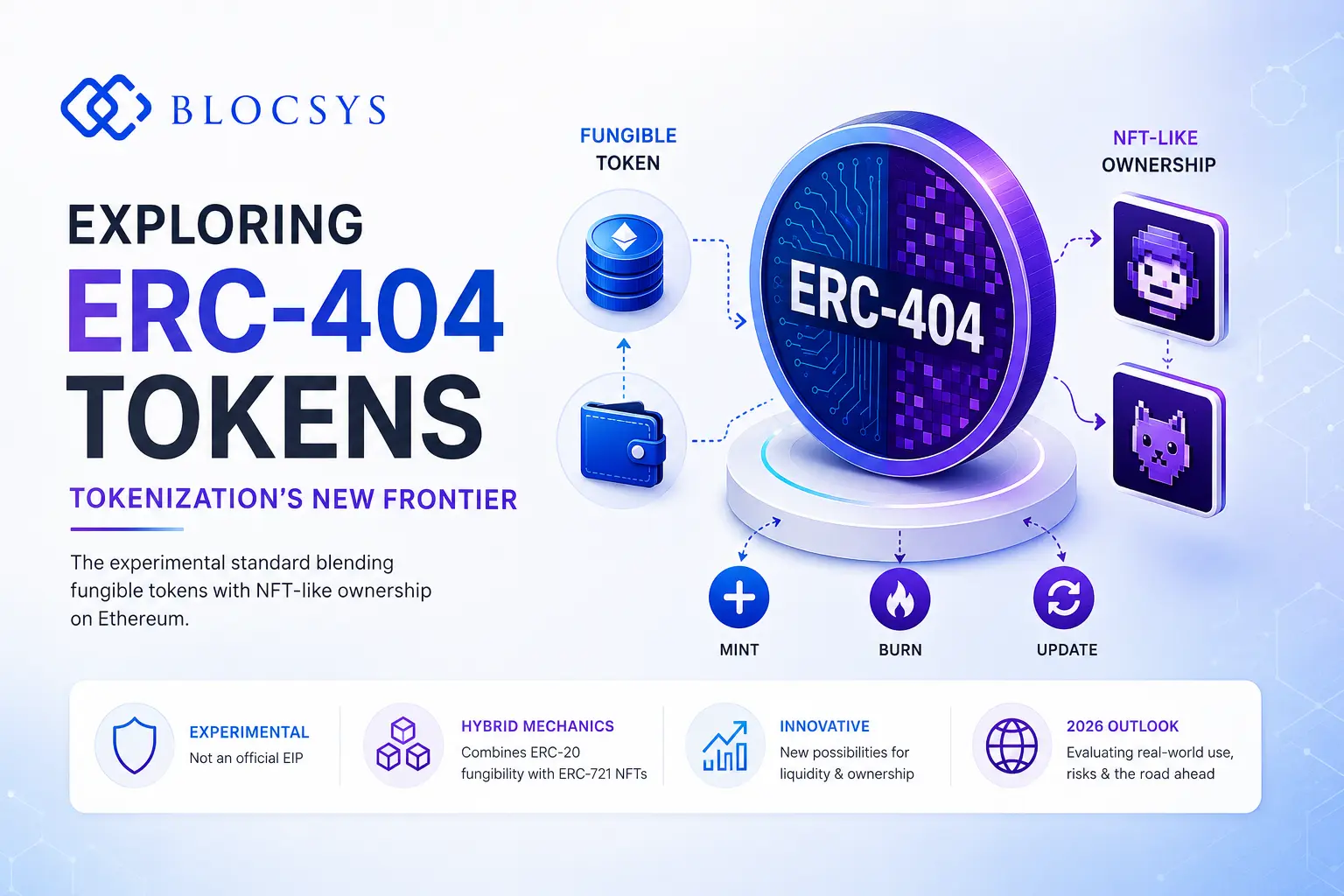
ERC-404 grabbed headlines across the Ethereum ecosystem in early 2024, and developers are still asking what it actually means for tokenization today. At its core, ERC-404 is an experimental, community-built token framework that tries to blend fungible-token behavior with NFT-like ownership in a single smart contract system. It isn’t an official Ethereum Improvement Proposal, and it never went through the EIP standardization process. If you’re evaluating hybrid token architecture for a real project, or you’re simply trying to understand where ERC-404 fits next to ERC-20, ERC-721, and ERC-1155, this guide walks through the mechanics, the trade-offs, and the current 2026 outlook. We’ll also touch on where Blocsys’s Smart Contract Development team sees genuine opportunity versus where the hype outran the engineering.
What Is ERC-404, Exactly?
ERC-404 is an unofficial, experimental token standard that pairs an ERC-20-style fungible balance with automatically minted and burned ERC-721 NFTs. Anonymous developers using the pseudonym “ctrl” introduced it in February 2024 alongside a collection called Pandora. The name deliberately echoes existing Ethereum standards, but that’s a branding choice, not a technical designation.
Here’s the important distinction: ERC-20, ERC-721, and ERC-1155 are all documented Ethereum Improvement Proposals, reviewed and finalized through Ethereum’s formal governance process. ERC-404 never went through that process. It’s a custom smart contract pattern, not a ratified standard, and you shouldn’t present it to clients or stakeholders as an Ethereum-endorsed token type.
That distinction matters more in 2026 than it did in 2024. Back then, the novelty carried the narrative. Now, developers and enterprises want to know whether a token architecture is production-ready, audited, and interoperable, not just clever.
Why ERC-404 Attracted Attention in 2024
When Pandora launched, its market capitalization reportedly climbed past $80 million within weeks, according to contemporaneous market reporting from early 2024. That figure is historical data from a speculative launch period, not a benchmark for what hybrid tokens deliver today. Traders were drawn to the idea that buying fungible units could automatically mint or burn associated NFTs, creating a new kind of semi-fungible trading experience.
The appeal was straightforward. NFT markets in 2023 and early 2024 struggled with thin liquidity. Fungible tokens trade easily on automated market makers; NFTs typically don’t. ERC-404 promised a bridge between the two worlds. However, promise and proven infrastructure are different things, and that gap is exactly what this article unpacks.
How the ERC-404 Concept Works
Understanding ERC-404 requires looking past the marketing and into the mechanics. The contract tracks a fungible balance, similar to an ERC-20 token, while simultaneously managing a pool of NFT IDs. Every time a wallet’s fungible balance crosses a whole-unit threshold, the contract mints or burns an NFT tied to that wallet.
Say a user buys 0.5 of a token, then buys another 0.5. Once their balance hits 1.0, the contract mints an NFT to their address. Sell part of that balance below 1.0, and the contract burns the NFT. Consequently, NFT ownership becomes a byproduct of fungible token balance rather than a separate, deliberate action.
This linkage is what made ERC-404 conceptually interesting to Solidity developers. It’s also what made it complicated. The contract has to handle transfer logic, minting, burning, and NFT ID reassignment in a single atomic operation, and doing that safely, especially under gas constraints, is genuinely hard.
Hybrid token designs look elegant in a whitepaper and get messy fast in production. Every additional state transition inside one contract is another surface for bugs, gas spikes, and unexpected interactions with marketplaces that were never built to expect an NFT to vanish mid-transaction.
The Relationship Between Fungible Balances and NFTs
Unlike ERC-721, where each NFT has its own deliberate mint event, ERC-404’s NFTs appear and disappear as a side effect of token transfers. That’s a meaningfully different ownership experience. A collector holding an NFT under this model could lose it simply because someone else’s transaction shifted their fractional balance below a whole unit, depending on the specific implementation’s rules around which addresses are exempt from NFT mechanics.
Redemption logic also varies by implementation since there’s no single reference contract. Some versions preserve NFT identity across mint and burn cycles; others reshuffle IDs from a pool. Metadata consistency, therefore, becomes an implementation detail rather than a guarantee, which is a real concern for any project that needs unique digital collectibles.
ERC-404 vs ERC-20, ERC-721, and ERC-1155
- ERC-20
Type: Fungible
Official EIP Status: Finalized standard
Best Fit: Currencies, governance tokens, utility tokens - ERC-721
Type: Non-fungible
Official EIP Status: Finalized standard
Best Fit: Unique collectibles, deeds, one-of-one digital assets - ERC-1155
Type: Multi-token (fungible + non-fungible in one contract)
Official EIP Status: Finalized standard
Best Fit: Gaming items, semi-fungible assets, batch transfers - ERC-404
Type: Experimental hybrid (unofficial)
Official EIP Status: Not a ratified EIP
Best Fit: Experimental fractional NFT concepts, research, case studies
Why Novelty Isn’t a Design Requirement
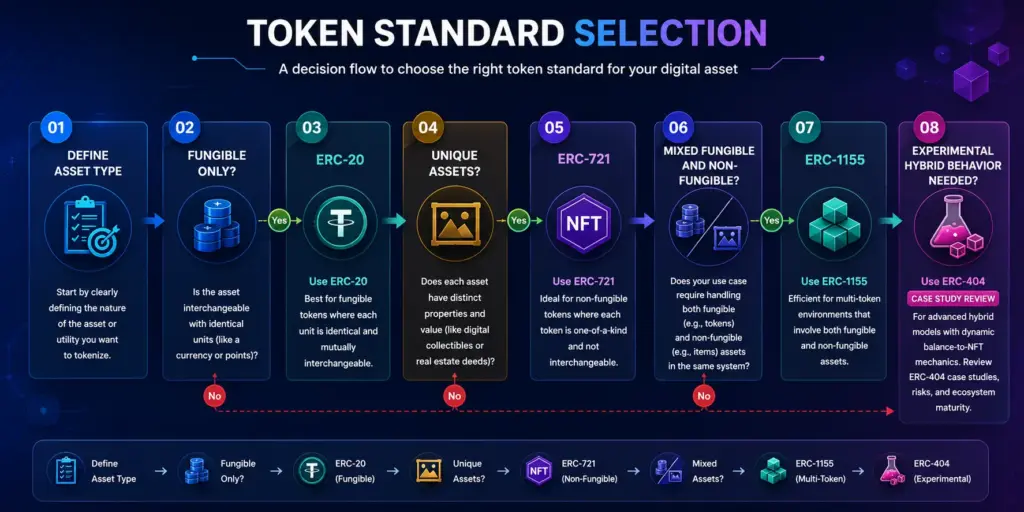
Here’s a principle worth repeating to any team evaluating token standards: pick the architecture that matches your asset’s actual behavior, not the one generating the most social media attention. ERC-20 handles pure fungibility well. ERC-721 handles unique ownership well. ERC-1155 handles mixed portfolios efficiently. ERC-404 tries to do something none of them were designed for, and that ambition comes with real engineering cost.
![[Flow diagram showing ERC-404 balance-to-NFT mechanics Fungible Transfer Initiated → Balance Threshold Check → NFT Mint or Burn Triggered → NFT Pool Updated → Metadata Reassigned → Transaction Finalized]](https://blocsys.com/wp-content/uploads/2024/02/Flow-diagram-showing-ERC-404-balance-to-NFT-mechanics-Fungible-Transfer-Initiated-→-Balance-Threshold-Check-→-NFT-Mint-or-Burn-Triggered-→-NFT-Pool-Updated-→-Metadata-Reassigned-→-Transaction-Finalized-1024x512.webp)
Potential Benefits of Hybrid Token Architectures
To be fair, the hybrid token concept isn’t without merit as an architectural idea. Programmable ownership, where a token’s fungible and non-fungible characteristics interact dynamically, opens interesting design space for gaming assets, membership tiers, and experimental DeFi-linked NFTs.
- Flexible asset representation that shifts between fungible and non-fungible states based on holder behavior
- Composability with automated market makers, since fungible units can theoretically trade more easily than individual NFTs
- Novel collectible experiences where partial ownership visually and functionally changes an asset’s representation
- A useful case study for teams researching programmable ownership models before committing to production architecture
These benefits are conceptual rather than proven at scale. Interest in fractional ownership and NFT liquidity is real and growing, but it doesn’t automatically follow that any particular token design delivers it. Deep liquidity comes from market makers, trading volume, and integrated infrastructure, not from a smart contract’s internal accounting logic alone.
NFT Fractionalization and Liquidity: Separating Concept From Reality
NFT fractionalization is a genuinely useful idea. Splitting ownership of a high-value digital asset among multiple holders can lower entry barriers and, in theory, improve price discovery. ERC-404 tapped into that demand, but it’s worth being precise about what it actually delivers.
A token design doesn’t create liquidity by itself. Liquidity comes from active market makers, deep order books, and integrated exchange infrastructure. Existing fractionalization platforms already handle this through vault-based models, where an NFT gets locked in a contract and ERC-20 shares are issued against it, without needing implicit mint-and-burn cycles tied to a balance threshold.
Moreover, price stability is a separate problem entirely. Nothing about hybrid token mechanics prevents volatility, and fragmented liquidity across multiple ERC-404-style contracts, each with its own implementation quirks, can actually make markets less efficient, not more.
Where ERC-404 Tokens Are Actually Used
In practice, ERC-404 tokens have appeared mostly in experimental and speculative collectible projects, not in enterprise-grade production systems. Reasonable, current use cases include:
- Experimental digital collectibles exploring dynamic fractional display
- Research prototypes for programmable ownership mechanics
- Gaming asset experiments where item states shift between bundled and individual representations
- Community and membership tokens testing novel access-tier logic
None of these should be confused with regulated financial products. If a project markets ERC-404 tokens as fractional ownership of real estate, equity, or other regulated assets, that’s a compliance red flag, not a feature. Legally recognized ownership depends on jurisdiction, custody structure, and investor protections, not on which token standard a smart contract references.
Security Considerations for ERC-404 Smart Contracts
Security review matters more for hybrid contracts than for standard implementations, precisely because the logic is more intricate. Key risk areas include:
- Reentrancy risks: combined mint, burn, and transfer operations create more entry points for reentrancy attacks if not carefully guarded
- Token accounting inconsistencies: rounding errors or edge cases in threshold logic can desynchronize fungible balances from NFT counts
- Approval mechanisms: ERC-20-style approvals interacting with ERC-721-style ownership can create unexpected permission gaps
- Access control: exemption lists (addresses excluded from automatic NFT mint and burn) need careful, auditable governance
- External protocol interactions: DEXs, lending platforms, and marketplaces built for standard tokens may mishandle automatic NFT events
- Upgradeability: any proxy pattern layered onto this already-complex logic multiplies the audit surface
None of this means ERC-404 is inherently insecure. It means the added logic requires more thorough testing and review than a standard-compliant contract typically does. Formal audits, extensive test coverage, and testnet simulation across realistic transaction patterns aren’t optional here; they’re the baseline.
Limitations and Challenges of the ERC-404 Token Standard
Let’s be direct about where hybrid token architecture runs into real friction.
Ecosystem and Standardization Gaps
Because ERC-404 was never finalized as an EIP, there’s no single canonical implementation. Different projects wrote different versions, with different rules around exemptions, ID reassignment, and metadata handling. That fragmentation creates real interoperability problems. Wallets, marketplaces, and indexing tools built around ERC-20 and ERC-721 assumptions don’t always handle ERC-404’s implicit mint and burn events correctly.
Gas Costs and Complexity
Combined fungible and non-fungible logic in a single transaction generally costs more gas than a simple ERC-20 or ERC-721 transfer. On Ethereum mainnet, that’s a real consideration for any application expecting frequent trading activity. Layer 2 deployment can mitigate this, but it doesn’t eliminate the underlying architectural overhead.
Long-Term Maintenance
Unofficial standards without an active governance body carry maintenance risk. There’s no formal specification to reference when onboarding new developers, no guaranteed backward compatibility, and no ecosystem-wide commitment to supporting the pattern long-term. That’s a meaningful concern for any enterprise planning multi-year infrastructure.
ERC-404 and Real-World Asset Tokenization
It’s worth separating hybrid token mechanics from the broader, and much larger, conversation around real-world asset tokenization. Tokenizing equity, bonds, real estate, or carbon credits involves legal ownership structures, custody arrangements, regulatory compliance, identity verification, and transfer restrictions. None of that gets solved by choosing a particular Ethereum token pattern.
A hybrid smart contract might represent fractional interests technically, but it doesn’t create legally enforceable ownership rights on its own. That requires proper legal wrappers, jurisdiction-specific compliance, and often coordination with regulated custodians. Blocsys’s Real World Asset Tokenization work, and its Asset Tokenization Platform, are built around that full picture rather than around any single token standard’s novelty.
For businesses exploring equity specifically, the compliance and cap-table considerations are substantial enough that a purpose-built Equity Tokenization Platform Development approach, using established, audited token standards, tends to serve investors and issuers better than an experimental hybrid contract ever could.
Is ERC-404 Suitable for Production Applications?
For most enterprise and commercial use cases, no, not as a primary architecture. The lack of formal standardization, fragmented marketplace support, and elevated security surface make it a risky foundation for anything handling significant value or regulated assets.
That said, dismissing the underlying concept entirely would miss the point. As a case study in programmable ownership, ERC-404 has genuine educational value. Development teams researching next-generation NFT experiences, or exploring how fungible and non-fungible logic might someday coexist more safely, can learn a lot from studying what worked and what didn’t.
Additionally, secondary market liquidity, as noted earlier, isn’t guaranteed simply because an asset is tokenized. Interoperability gaps between platforms add friction. Institutions considering real world asset tokenization development should budget time and resources for these operational realities rather than assuming a purely technical rollout.
Alternatives to ERC-404 Worth Considering
Depending on what you’re actually trying to build, these paths generally offer more maturity and support:
- ERC-1155 for semi-fungible assets and gaming items that need both batch efficiency and mixed token types
- ERC-721 with a vault-based fractionalization layer for splitting ownership of a unique NFT without embedding fractional logic into the core token contract
- ERC-3643 and similar permissioned token standards for regulated, compliance-heavy asset tokenization
- Custom ERC-20 structures with off-chain legal wrappers for tokenized securities and equity, where compliance requirements dominate the design
Each of these has an established track record, active tooling support, and clearer audit precedent than an unofficial hybrid pattern.
The 2026 Outlook for Hybrid Token Architectures
Where does this leave hybrid token design heading into the rest of 2026? The experimentation ERC-404 sparked hasn’t disappeared, it’s just matured. Newer community efforts, including variations sometimes labeled ERC-404-inspired or “DN-404” style contracts, have tried to address some of the original gas and accounting issues. However, none of these have achieved formal EIP status either.
What’s changed is the industry’s posture toward novelty. In 2024, a clever mechanism was enough to generate attention and capital. In 2026, developers, investors, and enterprises want audited, interoperable, and maintainable infrastructure first. Programmable ownership as a concept remains genuinely promising, especially for gaming, membership assets, and next-generation collectibles, but the path forward runs through refined, standards-aligned implementations rather than through reviving experimental 2024 contracts wholesale.
If your team is exploring what programmable, hybrid, or fractional ownership could look like for your platform, working with a partner experienced in Smart Contract Development from the earliest design stage helps you separate genuinely useful architecture from short-lived trends.
Frequently Asked Questions
Here are direct answers to the questions we hear most often about ERC-404 and hybrid token standards.
What is ERC-404?
ERC-404 is an experimental, unofficial token framework that combines ERC-20-style fungible balances with automatically minted and burned ERC-721-style NFTs. It was introduced in February 2024 by anonymous developers and isn’t a ratified Ethereum Improvement Proposal.
How does ERC-404 work?
An ERC-404 contract tracks a fungible token balance and automatically mints an NFT whenever a wallet’s balance crosses a whole-unit threshold. Selling below that threshold triggers a burn. This links fungible transfers directly to NFT ownership changes within a single smart contract.
Is ERC-404 an official Ethereum standard?
No. ERC-404 never went through Ethereum’s formal EIP review and finalization process. It’s a community-created smart contract pattern, distinct from finalized standards like ERC-20, ERC-721, and ERC-1155, and shouldn’t be described as an official Ethereum standard.
How is ERC-404 different from ERC-20 and ERC-721?
ERC-20 handles pure fungible tokens, and ERC-721 handles unique non-fungible tokens, each as separate, finalized standards. ERC-404 tries to merge both behaviors into one contract, with NFTs minting and burning based on fungible balance thresholds rather than through deliberate mint transactions.
What are ERC-404 tokens used for?
Current use cases are largely experimental: digital collectibles with dynamic fractional display, research into programmable ownership, and speculative gaming asset prototypes. They aren’t widely used in enterprise-grade or regulated financial applications.
Can ERC-404 tokens be fractionalized?
ERC-404’s mechanics create a form of technical fractionalization by linking fungible balances to NFT ownership. However, this doesn’t equal legally recognized fractional ownership of a real-world asset, which requires proper legal structuring separate from any token standard.
Does ERC-404 improve NFT liquidity?
Not automatically. Liquidity depends on market makers, trading volume, and exchange integration, not on token architecture alone. ERC-404’s fungible component can make trading easier in theory, but fragmented implementations across different projects can actually split liquidity rather than concentrate it.
What are the risks of ERC-404 tokens?
Key risks include smart contract complexity, inconsistent implementations across projects, limited marketplace and wallet support, elevated gas costs, and security concerns around reentrancy, token accounting, and access control. Formal audits are essential before any production use.
Is ERC-404 suitable for production applications?
Generally, no, for enterprise or regulated use cases. Its unofficial status, fragmented ecosystem support, and added technical complexity make established standards like ERC-1155 or vault-based fractionalization models safer choices for production systems.
What are the alternatives to ERC-404?
ERC-1155 handles semi-fungible and mixed token types with finalized-standard support. Vault-based fractionalization pairs ERC-721 with ERC-20 shares without embedding fractional logic in the core contract. Permissioned standards like ERC-3643 suit regulated, compliance-heavy asset tokenization.
Where This Leaves Your Tokenization Strategy
ERC-404 deserves credit for pushing the conversation around programmable ownership and NFT liquidity forward. However, it remains an experimental, unofficial pattern, and treating it as production-ready infrastructure carries real technical and compliance risk. Established standards like ERC-20, ERC-721, and ERC-1155 still cover the vast majority of real business needs, with far stronger tooling, audit history, and marketplace support behind them.
If you’re weighing hybrid token architecture, fractional ownership models, or a broader tokenization strategy for equity, real estate, or digital collectibles, get the underlying engineering right from day one. Blocsys builds secure, standards-aligned Smart Contract Development and Equity Tokenization Platform Development solutions tailored to what your asset actually requires, not to whichever token pattern is trending. Curious what your project would realistically cost to build? Check the Blocsys Cost Estimator Tool for a grounded starting point.
Ready to move beyond theory and build an intelligent platform that delivers real-world value? Blocsys Technologies specialises in engineering enterprise-grade AI and blockchain solutions for the fintech, Web3, and digital asset sectors. Connect with our experts today to discuss your vision and chart a clear path from concept to a secure, scalable reality.
