
A proof of concept has worked, leadership has approved the production roadmap, and the CTO now needs a team that can handle smart contracts, protocol infrastructure, security reviews, compliance workflows, and ongoing operations. The internal engineering group may understand the business problem, but it often can’t hire specialised blockchain talent quickly enough to turn a promising pilot into a dependable enterprise platform.
This guide is for CTOs, CIOs, product leaders, banks, fintechs, exchanges, Web3 companies, and technology businesses across the US, UK, Europe, UAE, Singapore, Germany, Switzerland, Canada, Australia, and India. It explains how Blocsys builds a dedicated blockchain development team, how the operating model differs from generic outsourcing, and what buyers should evaluate before they hire blockchain developers or launch an enterprise Web3 development programme. For broader context on architecture and implementation, see this enterprise blockchain solutions guide.
Table of Contents
- Why Enterprise Blockchain Projects Need a Dedicated Team
- What a Dedicated Blockchain Development Team Actually Does
- The Talent Market That Shapes Enterprise Team Building
- How Blocsys Assembles a Dedicated Blockchain Team
- Roles and Expertise Inside an Enterprise Blockchain Squad
- Choosing the Right Engagement Model for Your Project
- Security, Compliance, and Production Readiness Standards
- Why Blocsys and How to Start a Dedicated Engagement
- Frequently Asked Questions
- What is a dedicated blockchain development team?
- Why do enterprises choose dedicated Web3 developers?
- How is a dedicated team different from staff augmentation?
- Can a dedicated blockchain team work with an existing engineering department?
- Which blockchain platforms can an enterprise team support?
- What should smart contract development include?
- How does enterprise Web3 development handle compliance?
- Is India suitable for blockchain development outsourcing?
- Can a company hire blockchain developers without creating a local entity in India?
- What enterprise use cases suit a dedicated blockchain team?
- How does a team support blockchain security after launch?
- Why should an enterprise consider Blocsys?
Why Enterprise Blockchain Projects Need a Dedicated Team
A bank may have proved that a smart contract automates part of a workflow, or that a wallet and settlement interface connects to a blockchain network. After leadership approves production, the delivery lead can find gaps that a pilot concealed: no protocol engineer, no specialist smart contract reviewer, and no owner for node operations or on-chain monitoring.
A dedicated blockchain development team provides continuity through that transition. It is a cross-functional squad aligned to one product roadmap, sharing delivery responsibility and building knowledge of the client’s architecture over time. Unlike a rotating pool of freelancers or a vendor that walks away after delivery, the squad retains context and remains accountable as the product changes.
That operating model matters because enterprise blockchain work continues after the first release. Trading infrastructure, tokenised assets, compliance systems, and digital wallets require integration, security maintenance, incident response, governance, and controlled change management in production. A blockchain team therefore needs the operating discipline of a production delivery team, with compliance and security integrated into its daily work.
Practical rule: Move from internal hiring to a partner-led squad when the roadmap depends on specialised roles, production security, multi-system integration, and continuing ownership.
A dedicated model generally fits when:
- The pilot has become a product: The team needs a roadmap, backlog, release process, and post-launch ownership.
- Specialist coverage is missing: Smart contract development, protocol engineering, DevOps, QA, and security require distinct capability.
- The platform is regulated: Compliance and audit requirements must shape delivery from discovery through operation.
- The architecture will evolve: A trading, tokenization, or settlement platform needs consistent technical decisions across releases.
For broader architecture and implementation context, see this enterprise blockchain solutions guide.
What a Dedicated Blockchain Development Team Actually Does
A dedicated blockchain development team is a long-running, cross-functional delivery unit embedded in an enterprise roadmap. The squad typically combines blockchain architects, smart contract developers, protocol engineers, backend and frontend Web3 developers, DevOps, QA, security specialists, a project manager, and product leadership. Each person has a defined responsibility, while the group shares sprint objectives and release accountability.
The model works because the team retains context. Engineers understand why a contract was designed in a particular way, which enterprise system owns a data field, how wallet permissions are governed, and which controls a compliance team expects before deployment. That context is difficult to preserve when a project rotates contractors or divides delivery across unrelated vendors.
A procurement team should ask for concrete operating artefacts rather than accepting the label “dedicated team”:
- Code access and ownership: The client should have appropriate access to repositories, build pipelines, documentation, and deployment records.
- A shared delivery system: The backlog, acceptance criteria, sprint results, risks, and decisions should be visible to the client.
- Security evidence: Review records, test results, threat models, and audit hand-offs should form part of the delivery trail.
- Operational accountability: The agreement should clarify support, incident response, maintenance, and knowledge transfer.
This is different from Blockchain Development, which covers custom blockchain development services for enterprises, startups, and governments using public, private, and hybrid blockchain networks. A dedicated squad is the operating structure that can deliver and maintain that kind of work over an extended roadmap.
The Talent Market That Shapes Enterprise Team Building
Enterprise team design starts with a supply problem. Blockchain demand and specialised talent do not grow at the same pace. India’s fintech blockchain market was valued at USD 101.39 million in 2024 and is projected to reach USD 2,008.85 million by 2033, implying a 39.35% CAGR during 2025 to 2033, according to 6Wresearch’s India fintech blockchain market data. That growth reflects a shift from experiments toward production work in smart contracts, identity, compliance, and settlement.
The available workforce remains narrow. An industry report identified approximately 5,000 blockchain-capable developers among roughly two million software developers in India, with another 10,000 potentially trainable and 30,000 exposed through adjacent backend roles. It also found ITES represented 60% of blockchain talent recruitment, computer software 28%, and financial services 3%, with Bengaluru as the leading talent hub, as described in the IMARC India fintech blockchain market report.
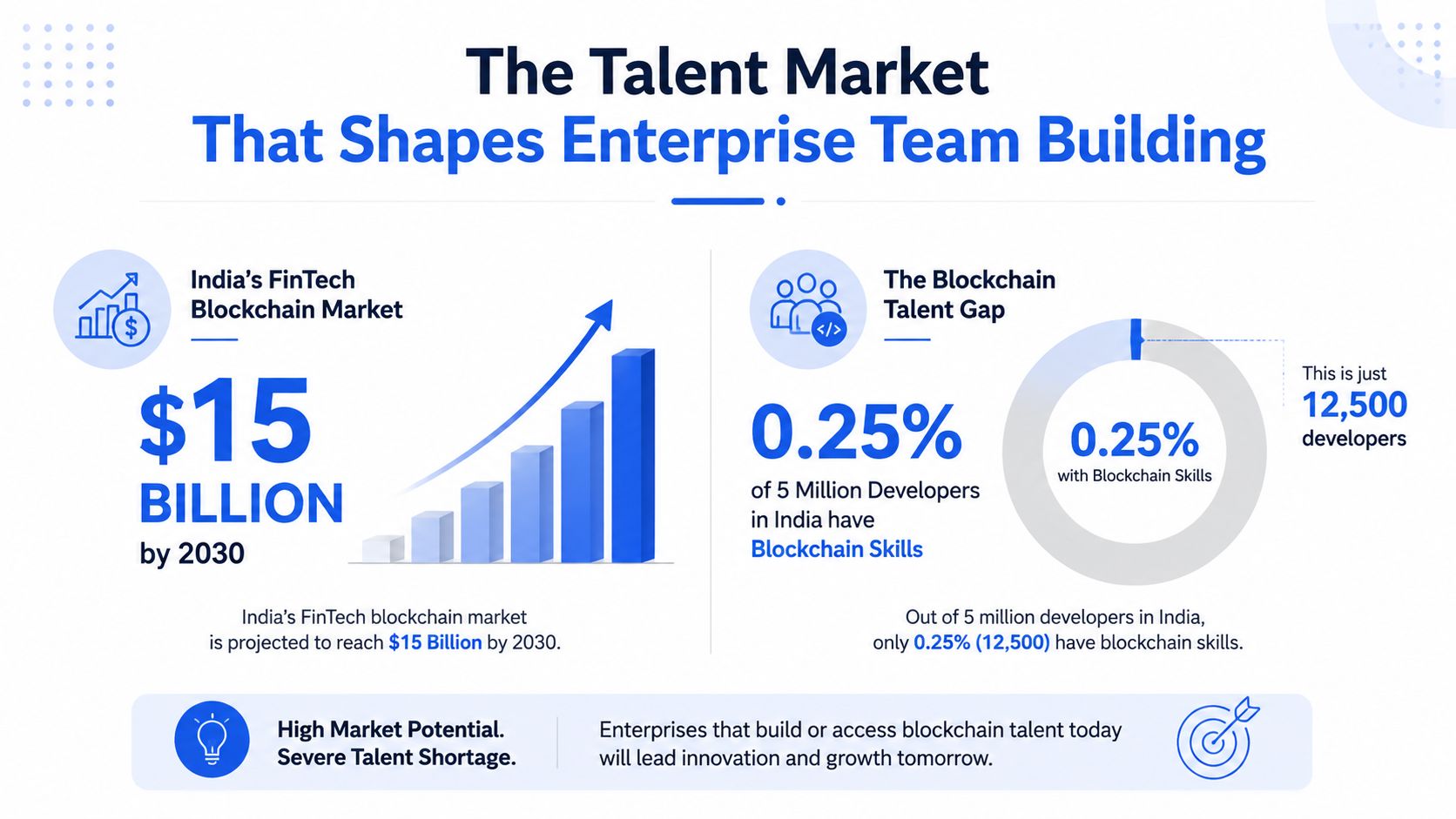
A separate study reports the same bottleneck: 5,000 technically equipped developers, 10,000 potentially trainable fintech professionals, and 30,000 adjacent backend engineers requiring extensive upskilling in India. For enterprise delivery, that means combining ready-to-deploy specialists with a planned path for developing adjacent talent, as outlined in the India blockchain talent report.
India can support distributed delivery, but capacity is uneven. The India Web3 Sector Report says India contributed the highest number of new Web3 developers in 2024, accounts for 8% of the world’s full-time Web3 developers and 12% of the total Web3 developer base, and added 17% of new Web3 developers worldwide in 2024. Buyers in India and overseas therefore need an operating model that combines senior expertise, specialised review, training, and retention. Employer of Record arrangements, local employment requirements, and compliance ownership also need to be settled before hiring begins. Blocsys’s analysis of blockchain talent challenges examines those constraints in more detail.
How Blocsys Assembles a Dedicated Blockchain Team
Blocsys starts with the product and operating environment, not with a list of available developers. The first conversation maps the business objective, jurisdictions, current systems, blockchain network requirements, security expectations, release constraints, and the roles the client already has in-house.
Step one maps the delivery problem
The discovery output should define the first production boundary. For a tokenization platform, that may include issuance, permissions, wallet flows, investor records, compliance integrations, and reporting. For a trading product, it may include matching, custody, liquidity, APIs, risk controls, and on-chain settlement.
The team then maps the roles required across architecture, smart contracts, backend, frontend, infrastructure, QA, security, product, and project management. The map distinguishes core roles from shared specialists, which prevents a common mistake: assigning one generalist to several responsibilities that require different review standards.
Step two tests technical and working fit
Sourcing can draw from Blocsys’s available talent and partner networks, but the selection process needs to be more demanding than a conventional software hire. Technical review should examine repository quality, contract design, testing habits, protocol understanding, deployment experience, and the engineer’s ability to explain security trade-offs.
A useful external reference for hiring managers is this Web3 talent acquisition guide, particularly when a company is comparing direct recruitment with partner-led team formation. Blocsys also checks communication style, overlap with the client’s working hours, documentation habits, and comfort with regulated delivery.
Step three creates shared context
Onboarding begins with access, architecture walkthroughs, threat-model review, environment setup, backlog refinement, and an initial delivery sprint. The client’s product owner should see how the squad communicates, estimates work, raises risks, and handles review comments before the team enters a high-risk release.
Blocsys can also combine a dedicated model with IT staff augmentation services when the client needs targeted capacity rather than a complete squad. For a real-world asset programme, the relevant product context may include Tokenization Platform Development, which covers secure and compliant platforms for RWAs, securities, real estate, commodities, and digital assets using enterprise blockchain technology.
Roles and Expertise Inside an Enterprise Blockchain Squad
A productive squad is not defined by headcount. It is defined by whether every critical delivery stage has a clear owner.
The blockchain architect establishes the network model, contract boundaries, data flows, integration approach, and upgrade strategy. The architect works during discovery and design, then remains involved as the product meets performance, governance, and compliance constraints.
Smart contract developers implement business logic in the relevant contract language, which may include Solidity, Rust, Move, or Cairo. Their work covers issuance, permissions, settlement, custody rules, DeFi mechanics, and upgrade controls. They also need disciplined testing and audit preparation.
Protocol engineers handle consensus-related concepts, networking, mempool behaviour, node interactions, and chain-specific infrastructure. They become especially important when the product depends on validators, custom network behaviour, interoperability, or high-throughput transaction processing.
Backend Web3 engineers build indexers, RPC integrations, event pipelines, APIs, databases, and services that connect on-chain activity to enterprise systems. Frontend Web3 developers create wallet connections, dApps, dashboards, administrative controls, and transaction interfaces that users can understand and operate safely.
Delivery ownership by stage
- Discovery and architecture: Architect, product lead, project manager, compliance stakeholders.
- Build: Smart contract, protocol, backend, frontend, and integration engineers.
- Infrastructure: DevOps engineers manage nodes, environments, CI/CD, observability, and release controls.
- Validation: QA specialists run unit, integration, regression, fuzz, and where appropriate formal verification activities.
- Security and launch: Security specialists coordinate threat modelling, audit preparation, vulnerability management, key controls, and monitoring.
- Operation: DevOps, security, backend, and product owners manage incidents, upgrades, reporting, and roadmap changes.
A project manager and account lead keep decisions visible, while the product owner protects business priorities. This composition lets a squad flex around tokenization, trading, document verification, DeFi, or enterprise applications without pretending that one generalist can cover every risk surface.
Choosing the Right Engagement Model for Your Project
Procurement teams often compare suppliers by daily rate first. That order creates confusion because the commercial model determines control, continuity, ownership, and operational responsibility. The right question is whether the engagement matches the product’s uncertainty and expected lifespan.
| Model | Control | IP & Ownership | Best Fit |
|---|---|---|---|
| Dedicated team | High client control over roadmap, priorities, and sprint decisions | Defined client ownership and repository access should be contractually clear | Ongoing enterprise Web3 products, trading infrastructure, tokenization, and platform operations |
| Staff augmentation | Client directs individual contributors within its own team | Usually aligned to the client’s systems, but responsibility is distributed | Filling a specific skill gap inside an established engineering organisation |
| Fixed-scope build | Control is concentrated around agreed deliverables and change requests | Ownership transfers according to the statement of work | A bounded prototype, audit, integration, or narrowly defined MVP |
| Managed delivery | Provider owns more delivery coordination and execution responsibility | Ownership and handover terms need careful definition | Organisations that want an external team to manage execution against agreed outcomes |
A dedicated team generally offers the strongest roadmap control and continuity, but it requires active client participation. A product owner, technical decision-maker, and compliance contact still need to be available. Staff augmentation gives more direct control over individual engineers, yet the client must supply architecture, management, and coordination.
Fixed-scope delivery can be efficient when the requirements are stable. It becomes uncomfortable when protocol choices, regulatory interpretations, integrations, or security findings change the work. Managed delivery reduces day-to-day coordination for the client, but buyers need to examine how decisions, quality gates, and post-launch support are governed. Cost predictability varies across all four models, and public benchmarks don’t reflect the differences between regions, protocols, security requirements, and integration depth.
For a broader partner-selection framework, buyers can review blockchain consulting services in 2026.
What the dedicated rhythm looks like
A Blocsys-led squad should feel integrated into the client’s engineering organisation, not parked beside it. A typical operating rhythm includes:
- Shared backlog: The client product owner and squad refine requirements in Linear or Jira.
- Sprint delivery: The team plans a two-week cadence, demonstrates completed work, and records decisions.
- Daily coordination: Stand-ups run across agreed time-zone overlap, with asynchronous updates for distributed participants.
- Code discipline: GitHub or GitLab pull requests, peer review, automated checks, and controlled merge permissions protect the codebase.
- Security gates: High-risk contract changes, infrastructure modifications, and release candidates receive explicit review before deployment.
- Operational alerts: PagerDuty-style alerts, on-chain monitors, logs, and dashboards support incident response.
- Roadmap governance: Monthly reviews examine delivery, risks, dependencies, staffing, and the next product horizon.
Blocsys should fit into an existing CI/CD environment where practical. A client shouldn’t be forced to replace its toolchain just because a partner has a preferred stack. The upgrade is operational clarity, not unnecessary platform change.
Security, Compliance, and Production Readiness Standards
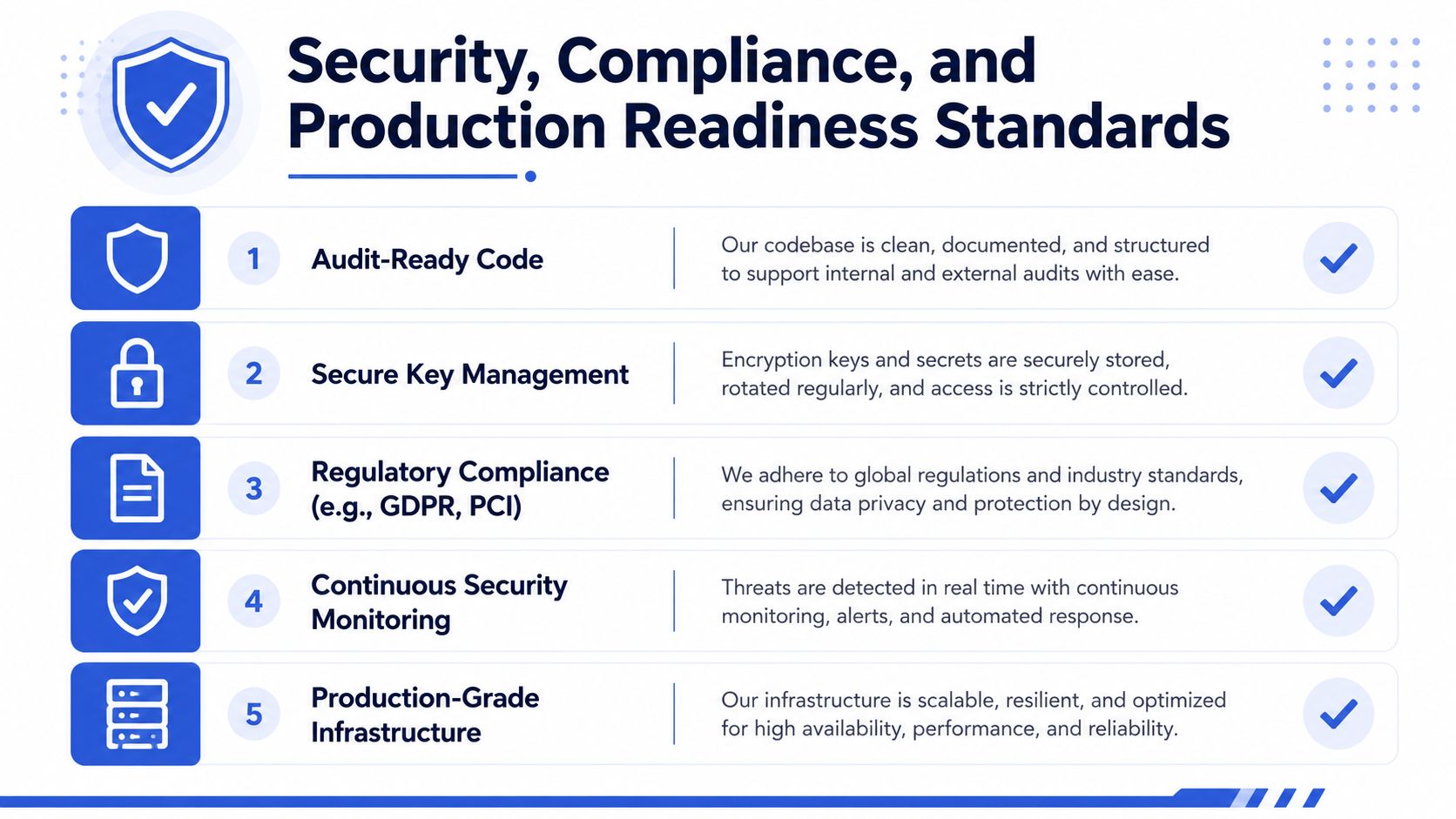
Enterprise blockchain delivery fails when teams treat security as a final audit rather than a property of the whole lifecycle. A production squad should connect architecture, coding, testing, deployment, compliance, and monitoring from the beginning.
The control set changes by jurisdiction and product. A bank issuing a tokenised instrument in the UK or Europe may use the spelling tokenisation, while a US team may describe the same design as tokenization. The engineering responsibility is the same: translate legal and compliance requirements into permissions, records, workflows, disclosures, monitoring, and controlled operations.
Controls that belong in the delivery model
- Audit-ready code: Maintain requirements traceability, design decisions, test evidence, review history, deployment records, and known-risk registers.
- Smart contract review: Use peer review, threat modelling, automated analysis, adversarial testing, and an external audit hand-off where the product requires it.
- Access controls: Apply least-privilege permissions to repositories, cloud environments, nodes, deployment pipelines, administrative interfaces, and operational dashboards.
- Secrets and key management: Protect credentials through managed secrets systems and use multi-signature custody or equivalent approval controls for sensitive deployment keys.
- Compliance integration: Connect KYC and AML workflows, transaction monitoring, reporting, identity controls, and record retention to the product architecture where applicable.
- Production monitoring: Watch for anomalous transactions, failed jobs, unusual contract activity, infrastructure faults, and suspicious access patterns after launch.
The smart contract auditing guide is useful for turning contract review into an explicit workstream rather than an informal checklist.
Use cases that justify dedicated ownership
A real-world asset, corporate bond, carbon credit, or precious metals platform needs continuity across legal requirements, asset records, issuance logic, custody, permissions, and reporting. Fragmented hiring often leaves those decisions scattered across engineers who don’t share enough context.
The same applies to DeFi trading and spot markets, OTC platforms, hybrid trading and prediction markets, decentralised traded funds, and cross-chain swaps. These products combine contracts with liquidity, pricing, settlement, wallet security, APIs, monitoring, and user-facing controls. A dedicated team preserves the design relationship between those layers.
Compliance and document verification systems benefit from the same approach because audit trails, identity workflows, permissions, and enterprise integrations must remain consistent. Telegram mini-apps can provide a Web3 entry point, but they still require secure wallet interactions, backend controls, monitoring, and a clear path into the broader product architecture.
A CPO can use a simple test. If the product will continue adding assets, chains, markets, users, integrations, or regulatory controls, a dedicated squad is usually more appropriate than a one-off build. If the requirement is narrow and stable, a fixed-scope pilot may be a better first step.
Why Blocsys and How to Start a Dedicated Engagement
Blocsys builds enterprise squads around three operating requirements: access to India-rooted capability across blockchain, Web3, AI, and enterprise software; delivery practices suited to fintechs, exchanges, and digital asset businesses; and a staffing model that can adjust as the product moves from a focused pilot toward broader delivery. Smart contracts and infrastructure need to work with compliance, security, and operational controls from the start.
Enterprise buyers can assess the proposed team through evidence:
- Architecture ownership: Can the team explain network selection, contract boundaries, APIs, wallets, data flows, and integration constraints in terms of the target product?
- Specialist coverage: Are smart contract, backend, DevOps, QA, security, and product responsibilities assigned to named roles?
- Delivery transparency: Will the client have access to repositories, backlog status, review records, risks, and release evidence?
- Production readiness: Does the engagement cover audits, key management, monitoring, incident response, maintenance, and governance?
- Commercial flexibility: Can the provider support staff augmentation, a dedicated team, or full project delivery as requirements change?
A proposed squad should also fit the client’s employment and operating setup. For teams based in India or distributed globally, the buyer should clarify whether Blocsys employs the specialists directly, whether an Employer of Record is required, how local employment obligations are handled, and who owns access, equipment, and offboarding. Legal, compliance, and information-security stakeholders should join discovery early rather than review the delivery model after staffing has begun.
The Blocsys service catalogue includes crypto trading platform development, OTC trading platforms, prediction markets, hybrid trading and prediction markets, Telegram mini-apps, document verification, carbon tokenization, corporate bond tokenization, and decentralised traded funds. Each use case still requires its own feasibility, architecture, compliance, and delivery assessment.
Answers enterprise buyers usually need
What does a dedicated blockchain development team cost?
There is no reliable universal figure. Cost depends on the roles, seniority, blockchain platform, integration scope, security work, regulatory requirements, delivery duration, and support model. Request a role-based proposal that separates core squad capacity from shared architecture, security, QA, and operational support.
How quickly can a dedicated team start?
Start time depends on the role mix, technical stack, required seniority, time-zone overlap, and screening process. A credible provider should identify available specialists, sourcing needs, technical vetting, and the outputs expected from the onboarding sprint before agreeing to a start date.
Who owns the intellectual property and code?
The contract should define ownership of repository access, work product, documentation, deployment assets, and handover obligations. Confirm treatment of open-source dependencies, third-party components, confidential information, and post-termination access.
How does Blocsys support regulated delivery?
Blocsys structures squads around security review, access control, testing, audit preparation, compliance coordination, deployment governance, and post-launch monitoring. Banks and fintechs should involve their legal, compliance, and information-security teams during discovery. Prepare the target use case, current architecture, jurisdictional constraints, and expected team interfaces before scheduling that conversation.
Frequently Asked Questions
What is a dedicated blockchain development team?
A dedicated blockchain development team is a cross-functional group assigned to one client’s product roadmap. It can include architects, smart contract developers, protocol engineers, backend and frontend Web3 developers, DevOps, QA, security specialists, and project leadership. Unlike a freelancer pool, the team retains product context and supports continuing delivery.
Why do enterprises choose dedicated Web3 developers?
Enterprises choose dedicated Web3 developers when a product needs specialist knowledge, sustained ownership, and coordination across blockchain infrastructure and conventional software. The model suits platforms involving smart contracts, wallets, APIs, DeFi, digital assets, tokenisation, compliance workflows, or multi-chain integrations that can’t be managed reliably through disconnected contractors.
How is a dedicated team different from staff augmentation?
Staff augmentation supplies individual contributors who work inside the client’s existing structure. A dedicated team is assembled as a coordinated delivery unit with shared goals, role coverage, sprint routines, technical ownership, and operational accountability. Staff augmentation fits a defined internal gap, while a dedicated squad fits a broader product roadmap.
Can a dedicated blockchain team work with an existing engineering department?
Yes. The squad can use the client’s repositories, CI/CD pipelines, collaboration tools, cloud environments, architecture standards, and release procedures. The engagement should define ownership boundaries clearly so that internal engineers and partner engineers know who approves designs, reviews contracts, handles incidents, and maintains documentation.
Which blockchain platforms can an enterprise team support?
The right platform depends on the product’s decentralisation needs, access model, transaction requirements, ecosystem integrations, governance, and regulatory context. A discovery process should compare public, private, permissioned, and hybrid approaches instead of selecting a chain purely because it is popular or familiar to one developer.
What should smart contract development include?
Smart contract development should include business-rule analysis, contract architecture, access permissions, upgrade strategy, testing, peer review, threat modelling, deployment controls, and monitoring. The team should also document which logic belongs on-chain and which belongs in backend services, databases, identity systems, or compliance infrastructure.
How does enterprise Web3 development handle compliance?
Compliance is translated into product and operational controls. Depending on the use case, those controls may include identity verification, KYC and AML workflows, permissioned access, transaction monitoring, reporting, record retention, approval policies, and audit evidence. Legal and compliance specialists must validate the requirements for each target jurisdiction.
Is India suitable for blockchain development outsourcing?
India offers a substantial Web3 and software talent base, but specialist depth is uneven and concentrated. A suitable outsourcing model therefore needs senior technical leadership, structured vetting, training for adjacent talent, retention planning, time-zone coordination, and clear intellectual property and security controls. Location alone doesn’t guarantee enterprise readiness.
Can a company hire blockchain developers without creating a local entity in India?
The operating model needs to address employment, payroll, tax, intellectual property, data protection, and compliance responsibilities. Depending on the arrangement, an Employer of Record or another compliant local engagement structure may be relevant. Buyers should obtain jurisdiction-specific legal advice before selecting a hiring or outsourcing path.
What enterprise use cases suit a dedicated blockchain team?
Dedicated squads commonly fit tokenised real-world assets, corporate bonds, digital asset platforms, crypto trading, OTC markets, DeFi applications, prediction markets, document verification, carbon systems, wallets, interoperability, and enterprise blockchain integrations. The strongest candidates have a continuing roadmap rather than a single isolated feature.
How does a team support blockchain security after launch?
Post-launch support can include infrastructure monitoring, on-chain anomaly detection, incident response, dependency updates, access reviews, contract change controls, regression testing, and release governance. The exact operating model should define alert ownership, escalation paths, response expectations, maintenance responsibilities, and communication with the client’s security team.
Why should an enterprise consider Blocsys?
Blocsys provides dedicated blockchain teams and enterprise Web3 development support for organisations building secure digital asset, trading, tokenization, compliance, and custom blockchain applications. The evaluation should begin with the client’s roadmap, architecture, required roles, risk controls, and engagement model, then translate those needs into a customized team proposal.
A dedicated blockchain development team is not a faster way to add engineers. It is an operating model for preserving technical context, specialist coverage, security discipline, and product ownership while an enterprise moves from proof of concept to production. Enterprises, financial institutions, fintechs, startups, and Web3 businesses can start by preparing their target use case, current architecture, required launch boundary, preferred time-zone overlap, and compliance constraints for a discovery conversation.
Blocsys Technologies offers dedicated blockchain development teams, enterprise Web3 development, smart contract development, DeFi development, RWA solutions, and custom Web3 applications for organisations that need structured delivery beyond a pilot. Visit Blocsys Technologies to discuss your roadmap, request a custom team proposal, or identify the right next step for hiring blockchain developers and scaling production delivery.
