
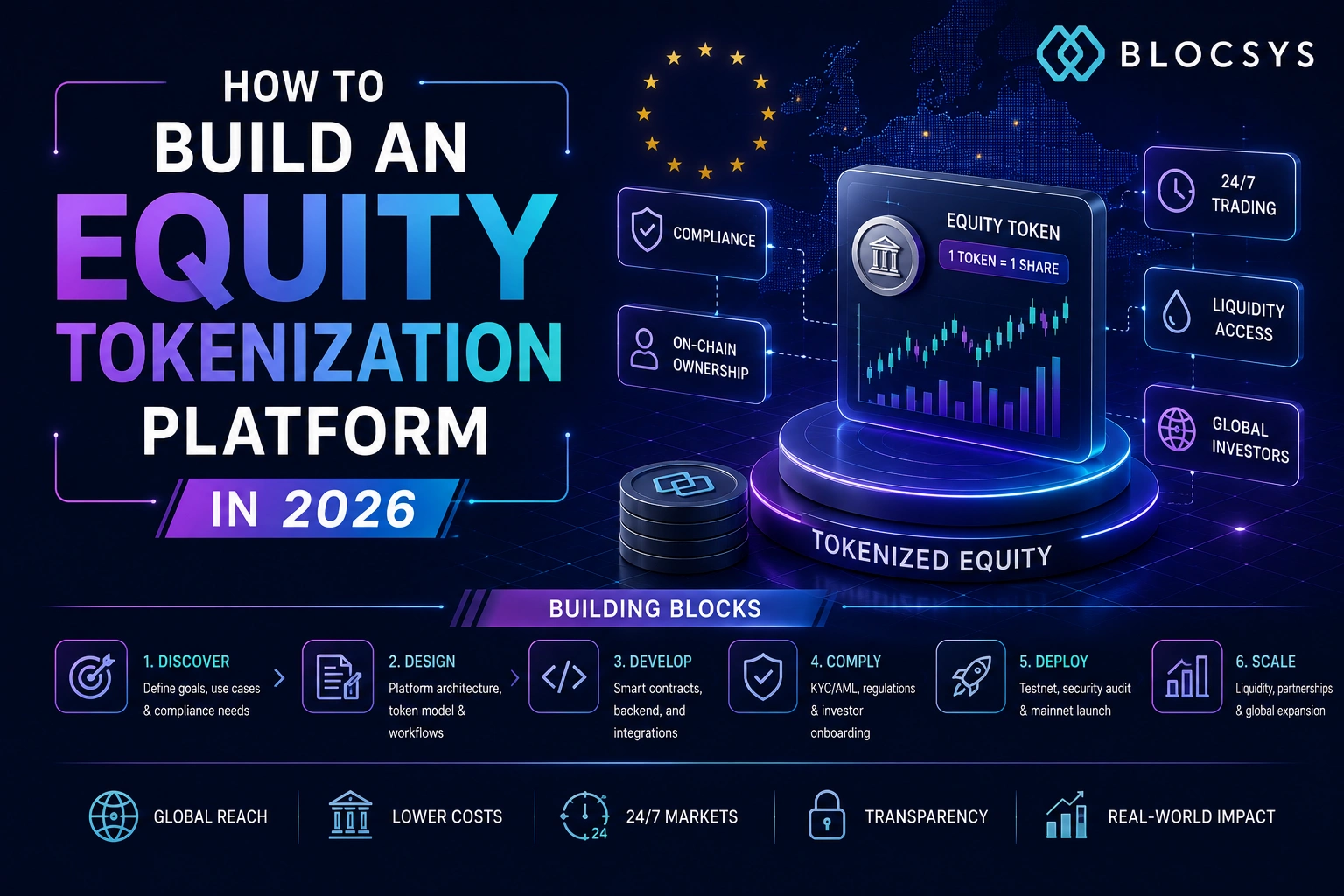
How to Build an Equity Tokenization Platform: Complete Development Guide 2026
If you’re exploring how to raise capital, manage ownership, or open up private markets without the usual paperwork headaches, you’ve probably run into the term “equity tokenization” more than once this year. An equity tokenization platform is the infrastructure that lets businesses convert shares or ownership rights into blockchain-based tokens, then issue, manage, and trade them within a compliant framework. Whether you’re a fintech founder, a CTO at an investment firm, or a compliance officer weighing your next move, this guide walks through what it actually takes to build one in 2026. We’ll also point you toward Equity Tokenization Platform Development resources along the way, since Blocsys works with teams tackling exactly this problem.
What Is an Equity Tokenization Platform?
An equity tokenization platform is a software system that issues, manages, and settles digital tokens representing equity or equity-linked rights in a company. These platforms combine blockchain infrastructure, smart contracts, identity verification, and compliance controls to support the full lifecycle of a security token, from issuance through secondary trading. In practice, the token might represent legal share ownership, an economic interest, or a contractual right tied to an underlying security, depending on how the issuer structures the offering.
That distinction matters more than most people realize. Not every tokenized equity product grants the holder direct legal title to shares. Some tokens represent synthetic exposure or a contractual claim against the issuer. Others are structured as direct book-entry ownership recorded on-chain. The legal structure depends on jurisdiction, issuer intent, and the specific rights attached to the token — so it’s worth getting proper legal counsel before you assume equivalence to traditional share ownership.
How Equity Tokenization Works
Equity tokenization converts ownership or economic rights in a company into digital tokens recorded on a blockchain ledger. Instead of maintaining ownership records in spreadsheets or paper certificates, the company issues tokens that represent shares, and those tokens carry programmable rules for transfer, compliance, and reporting.
Here’s how the process typically unfolds. The issuer defines the underlying asset — common shares, preferred equity, or a special purpose vehicle holding equity. Legal counsel structures the offering under applicable securities law. Then a technology partner builds or deploys the smart contracts that mint tokens according to that legal structure, embedding transfer restrictions, investor eligibility checks, and reporting logic directly into the code.
Consequently, every subsequent action — a transfer, a dividend distribution, a corporate action — gets executed through the smart contract rather than manual back-office processing. This doesn’t eliminate legal work; it automates the operational layer sitting on top of it.
Why Businesses Tokenize Equity
Companies pursue tokenized equity for a handful of practical reasons, not because it’s trendy. First, programmable compliance reduces manual reconciliation — transfer restrictions and eligibility rules live inside the smart contract rather than a spreadsheet somewhere. Second, cap table records update automatically as tokens move, which cuts down on the errors that plague traditional equity administration.
Additionally, tokenization can widen the pool of eligible investors for private offerings, subject to the applicable securities exemption and investor qualification rules in each jurisdiction. It doesn’t automatically create liquidity — secondary trading still depends on a functioning market, licensed venues, and willing counterparties. However, the infrastructure at least makes trading technically possible in a way legacy paper-based systems never allowed.
The mistake we see most often is founders treating tokenization as a marketing move rather than an infrastructure decision. The token is just the wrapper — the real work is getting the legal structure, custody model, and compliance engine right before a single share gets minted.
Key Components of an Equity Tokenization Platform
Building a functional equity tokenization platform means assembling several interdependent systems. Skip one and the whole structure gets shaky. Here’s what a serious build typically requires.
| Component | Function |
|---|---|
| Blockchain Infrastructure | Underlying ledger for issuing and recording tokens |
| Smart Contracts | Automates issuance, transfer restrictions, and corporate actions |
| Investor Onboarding & KYC/AML | Verifies investor identity and eligibility before token access |
| Digital Wallets & Custody | Secures private keys and token holdings for issuers and investors |
| Cap Table Management | Tracks ownership in real time as tokens transfer |
| Compliance Engine | Enforces jurisdiction-specific transfer and holding rules |
| Trading & Settlement Layer | Supports primary issuance and, where applicable, secondary trading |
Choosing the Right Blockchain
Blockchain selection shapes everything downstream — cost, throughput, interoperability, and how easily regulators and auditors can review activity. Public networks like Ethereum offer broad tooling support and liquidity access, while permissioned or enterprise chains give issuers tighter control over validator participation and data visibility.
Many institutions lean toward Ethereum-compatible networks or permissioned consortium chains for security token issuance, largely because of mature tooling and established token standards. That said, the “right” chain depends on your regulatory jurisdiction, investor base, and whether you need public transparency or restricted access. There’s no universal answer here — it genuinely depends on your use case.
Smart Contracts and Token Standards
Security tokens generally build on standards like ERC-1400, ERC-1404, or ERC-3643, each designed to embed compliance logic — transfer restrictions, whitelisting, and forced transfers for regulatory events — directly into the token contract. Unlike a plain ERC-20 token, these standards assume the issuer needs ongoing control over who can hold and transfer the asset.
Smart Contract Development for security tokens differs meaningfully from typical DeFi contract work. You’re not just optimizing for gas efficiency; you’re encoding legal constraints that must hold up under audit and regulatory scrutiny. If you’re evaluating vendors, ask specifically about their experience with Smart Contract Development for regulated securities, not just general blockchain projects.
Investor Onboarding, KYC/AML, and Identity Verification
How does KYC/AML work in equity tokenization? Every investor typically completes identity verification, accreditation checks where required, and anti-money-laundering screening before receiving tokens. The platform then binds that verified identity to a wallet address, so the smart contract can enforce eligibility at the point of transfer — not just at initial purchase.
This “on-chain identity binding” is what separates a compliant security token platform from a generic crypto wallet. Investors get vetted once, and the compliance layer references that status for every future transaction involving that wallet. Furthermore, jurisdictions differ sharply on accreditation thresholds, so the onboarding flow needs configurable rules rather than a one-size-fits-all checklist.
Identity verification providers typically integrate via API, checking government ID documents, biometric data, and sanctions lists. Getting this wrong creates real regulatory exposure, so it’s an area where cutting corners tends to backfire.
Digital Wallets and Custody Infrastructure
Custody is where a lot of equity tokenization projects underestimate the engineering lift. Investors need wallets that are secure enough to protect institutional-grade assets, yet usable enough that non-technical investors won’t lose access to their holdings.
Most enterprise-grade equity tokenization platforms use multi-party computation (MPC) or multi-signature custody models rather than single-key wallets. This reduces single-point-of-failure risk and aligns with how regulated custodians typically structure digital asset safekeeping. Some issuers partner with licensed third-party custodians; others build custody in-house, which requires significant security investment and, in many jurisdictions, specific licensing.
Self-custody remains an option for sophisticated investors, but institutional buyers generally expect a custodial arrangement that mirrors traditional securities safekeeping standards.
Cap Table Management and Primary Issuance
Cap table management on a tokenization platform means the ownership ledger updates automatically whenever tokens move, rather than requiring manual entry after each transaction. This gives issuers real-time visibility into ownership concentration, investor eligibility status, and outstanding token supply.
Primary issuance is the initial token minting and distribution to investors, typically structured around a specific securities exemption or registered offering. The platform handles subscription agreements, payment processing, and token delivery in a coordinated workflow — ideally with an audit trail that satisfies both regulators and auditors down the line.
Building the Equity Tokenization Platform Architecture
A well-designed equity tokenization platform architecture separates concerns across distinct layers: the blockchain layer for settlement, the application layer for investor and issuer interfaces, the compliance layer for rule enforcement, and the integration layer connecting to banking rails, custodians, and identity providers.
This modular approach matters because regulatory requirements shift, and you don’t want to rebuild your entire smart contract layer every time a jurisdiction updates its rules. Separating compliance logic from core token mechanics gives you room to adapt without redeploying everything from scratch.
Secondary Trading and Transfer Restrictions
Secondary trading of tokenized securities depends on more than technical capability — it requires a licensed venue or alternative trading system in most jurisdictions, plus investor eligibility checks at every transfer point. The smart contract can block an ineligible transfer automatically, but the platform still needs a compliant venue for that trading to legally occur.
In the US, secondary trading of security tokens generally involves an SEC-registered alternative trading system (ATS) or broker-dealer, per SEC guidance on digital asset securities. In the EU, the Markets in Crypto-Assets Regulation (MiCA), which became fully applicable across the bloc in December 2024, primarily governs crypto-assets that aren’t classified as financial instruments — meaning many tokenized securities instead fall under existing frameworks like MiFID II, alongside the EU’s DLT Pilot Regime for market infrastructure testing. Switzerland’s DLT Act and Singapore’s Payment Services Act and Securities and Futures Act create their own distinct pathways. None of these frameworks are interchangeable, so mapping your specific token structure to the right regime is essential.
Compliance and Regulatory Considerations
How are equity tokenization platforms regulated? Regulatory treatment depends on the token’s economic rights, the issuer’s jurisdiction, the investor base, and the specific offering structure. A token representing direct equity ownership sold to US investors under Regulation D faces different requirements than one issued under Regulation S to non-US investors, or one structured under an EU prospectus exemption.
Consequently, there’s no single “tokenization law” that governs every deployment. Instead, existing securities regulation typically applies to the token based on its underlying rights — the technology doesn’t change the legal classification of the asset itself. Working with securities counsel in each target jurisdiction isn’t optional; it’s foundational to the whole build.
Security Best Practices for Tokenized Securities
Security for an equity tokenization platform spans smart contract audits, custody architecture, infrastructure hardening, and operational controls. Smart contracts handling real equity value need independent third-party audits before mainnet deployment — this isn’t a step to compress under deadline pressure.
Beyond code audits, consider penetration testing on the application layer, role-based access controls for administrative functions, and incident response planning for key compromise scenarios. Multi-signature governance over contract upgrade functions also reduces the risk of a single compromised credential causing catastrophic loss. Given how much value security tokens can represent, treating security as an ongoing program rather than a one-time checkbox tends to separate durable platforms from ones that don’t survive their first incident.
Enterprise Use Cases for Equity Tokenization
Consider a hypothetical scenario: a private equity firm holding a portfolio of illiquid growth-stage companies wants to offer accredited investors fractional exposure to a fund position. By tokenizing fund interests, the firm could structure smaller minimum investments, automate investor eligibility checks through smart contracts, and maintain a real-time cap table across the fund’s investor base. This is illustrative, not a description of an actual deployment — but it reflects the kind of structural problem tokenization is often positioned to address.
Similarly, a mid-market private company considering an internal liquidity program for employee shareholders might use a tokenization platform to facilitate periodic tender windows, with transfer restrictions built into the token itself rather than managed through manual legal review each cycle. Corporate treasuries exploring adjacent instruments, like tokenized debt, often evaluate Corporate Bond Tokenization Platform Development alongside their equity tokenization strategy, since the underlying compliance and custody infrastructure overlaps significantly.
Equity Tokenization Platform Development Process
What does the actual build process look like? Most Equity Tokenization Platform Development engagements follow a similar sequence, though the depth of each phase varies by issuer complexity and jurisdiction.
- Legal structuring and securities exemption analysis with jurisdiction-specific counsel
- Blockchain and token standard selection based on compliance and interoperability needs
- Smart contract development and independent security audit
- KYC/AML and identity verification integration
- Custody architecture design and wallet infrastructure build
- Cap table and investor portal development
- Primary issuance workflow testing
- Secondary trading venue integration, where applicable
- Post-launch monitoring, reporting, and compliance maintenance
Realistically, this isn’t a project you rush. Between legal structuring and smart contract auditing alone, serious platforms often take several months of coordinated work across legal, technical, and compliance teams before any tokens get minted.
Development Cost Factors
Cost varies widely based on blockchain choice, custody model, jurisdictional complexity, and whether you’re building custom infrastructure or using a Tokenization Platform Development partner’s existing framework. Rather than quoting a generic number that won’t reflect your actual project, it’s more useful to run your specifics through the Blocsys Cost Estimator Tool, which accounts for your chosen features, compliance scope, and integration requirements.
Challenges and Risks to Plan For
Regulatory uncertainty remains the biggest variable. Rules around digital securities continue evolving across major markets, and what’s compliant today may need adjustment as guidance matures. Liquidity is another honest challenge — tokenization creates the technical possibility of trading, but it doesn’t guarantee buyers and sellers show up. Interoperability between different tokenization platforms and custody providers also remains fragmented, which can complicate cross-platform transfers.
Additionally, integration with legacy banking and settlement systems takes real engineering effort. Wire transfers, fiat on/off ramps, and traditional custodian relationships don’t disappear just because a token exists — they need to connect seamlessly with the new infrastructure.
Future Trends in Equity Tokenization for 2026
Institutional interest in tokenized real-world assets has grown steadily, with major asset managers and financial institutions running pilots across tokenized funds, treasuries, and private equity structures in recent years, according to reporting from firms tracking institutional blockchain adoption. Whether this translates into broad secondary market liquidity for equity tokens specifically remains to be seen — it’s a developing trend, not a settled outcome.
We’re also seeing growing interest in interoperability standards that let tokenized securities move between different blockchain networks without losing their compliance metadata. Meanwhile, regulatory sandboxes in the UAE, Singapore, and Switzerland continue giving issuers structured pathways to test tokenization models under regulatory supervision, which suggests regulators are actively working toward clearer frameworks rather than leaving the space undefined.
Why Work With Blocsys on Equity Tokenization Platform Development
Blocsys builds enterprise-grade blockchain infrastructure for issuers, financial institutions, and digital asset businesses navigating exactly the technical and structural questions covered in this guide. As an Enterprise Blockchain Development Company, our team works across smart contract architecture, custody integration, compliance tooling, and cap table systems needed for a functioning security token platform.
If you’re evaluating a broader tokenization strategy beyond equity, our work spans Real World Asset Tokenization and adjacent instrument types, giving issuers a consistent technical foundation across asset classes. Every engagement starts with understanding your legal structure and investor base first — the technology gets built around that, not the other way around.
Frequently Asked Questions
Here are direct answers to the questions we hear most often about equity tokenization platform development.
What is an equity tokenization platform?
An equity tokenization platform is a blockchain-based system that issues, manages, and settles digital tokens representing equity or equity-linked rights in a company. It combines smart contracts, KYC/AML checks, custody infrastructure, and cap table management to support the full lifecycle of a security token, from issuance through potential secondary trading, within an applicable regulatory framework.
How does equity tokenization work?
Equity tokenization works by converting ownership or economic rights into blockchain tokens through a legally structured offering. Issuers define the underlying asset, structure the deal under applicable securities exemptions, then deploy smart contracts that mint tokens embedding transfer restrictions and investor eligibility rules. Every subsequent transfer or corporate action executes through that same smart contract logic.
What are tokenized equities?
Tokenized equities are digital tokens representing ownership or economic exposure to a company’s shares, recorded on a blockchain ledger. Depending on the offering structure, a tokenized equity may grant direct legal share ownership or a contractual right tied to an underlying security. The exact rights attached depend entirely on how the issuer and legal counsel structured the specific token.
How do equity tokens represent ownership?
Equity tokens represent ownership through a legal agreement paired with on-chain records that reflect the token holder’s position. The token itself is a technical representation; the actual ownership rights come from the underlying legal documentation governing the offering. Some structures grant direct book-entry share ownership, while others represent contractual or economic rights instead.
What features should an equity tokenization platform include?
A functional equity tokenization platform needs smart contract issuance logic, KYC/AML and identity verification, custody and wallet infrastructure, real-time cap table management, transfer restriction enforcement, and reporting tools for compliance and audit purposes. Secondary trading integration matters too, where the issuer plans to support post-issuance liquidity through a licensed venue.
How are equity tokenization platforms regulated?
Regulatory treatment depends on the token’s underlying rights, issuer jurisdiction, investor type, and offering structure rather than any single universal rule. In the US, securities exemptions like Regulation D or Regulation S typically apply; in the EU, frameworks like MiFID II and the DLT Pilot Regime often govern tokenized securities specifically, separate from MiCA’s crypto-asset scope. Jurisdiction-specific legal review is essential.
What technologies are used to build an equity tokenization platform?
Equity tokenization platforms typically combine a blockchain network (public, permissioned, or hybrid), smart contracts built on standards like ERC-1400 or ERC-3643, identity verification APIs, MPC or multi-signature custody systems, and an application layer connecting investors, issuers, and compliance teams. Integration with banking rails and fiat on/off ramps rounds out the technical stack.
How does KYC/AML work in equity tokenization?
KYC/AML in equity tokenization verifies investor identity, checks accreditation status where required, and screens against sanctions and watch lists before granting token access. The platform binds verified identity to a wallet address, so the smart contract can enforce eligibility rules automatically at every future transfer, not just at initial onboarding.
How much does it cost to build an equity tokenization platform?
Cost depends on blockchain selection, custody model, regulatory complexity, and whether you build custom infrastructure or adapt an existing framework. Because these variables shift significantly by project, generic cost figures aren’t reliable — running your specific requirements through the Blocsys Cost Estimator Tool gives a far more accurate, project-specific estimate.
What security considerations should businesses evaluate before launching an equity tokenization platform?
Businesses should prioritize independent smart contract audits, secure custody architecture using MPC or multi-signature models, role-based access controls, and incident response planning for key compromise events. Ongoing security monitoring matters as much as pre-launch testing, since tokenized securities represent real financial value that attracts sustained attacker interest over time.
Getting Started
Building an equity tokenization platform touches legal structuring, smart contract engineering, custody design, and compliance operations all at once. None of these pieces work well in isolation — they need to be designed together from day one. If your organization is evaluating tokenized equity, reaching out to a team experienced in Equity Tokenization Platform Development early in the process tends to save significant rework down the line. Blocsys works alongside issuers, financial institutions, and digital asset businesses to design infrastructure that fits their specific legal structure and investor base, not a generic template. If you’re ready to scope your project, get in touch to discuss your requirements and next steps.
Ready to move beyond theory and build an intelligent platform that delivers real-world value? Blocsys Technologies specialises in engineering enterprise-grade AI and blockchain solutions for the fintech, Web3, and digital asset sectors. Connect with our experts today to discuss your vision and chart a clear path from concept to a secure, scalable reality.
