
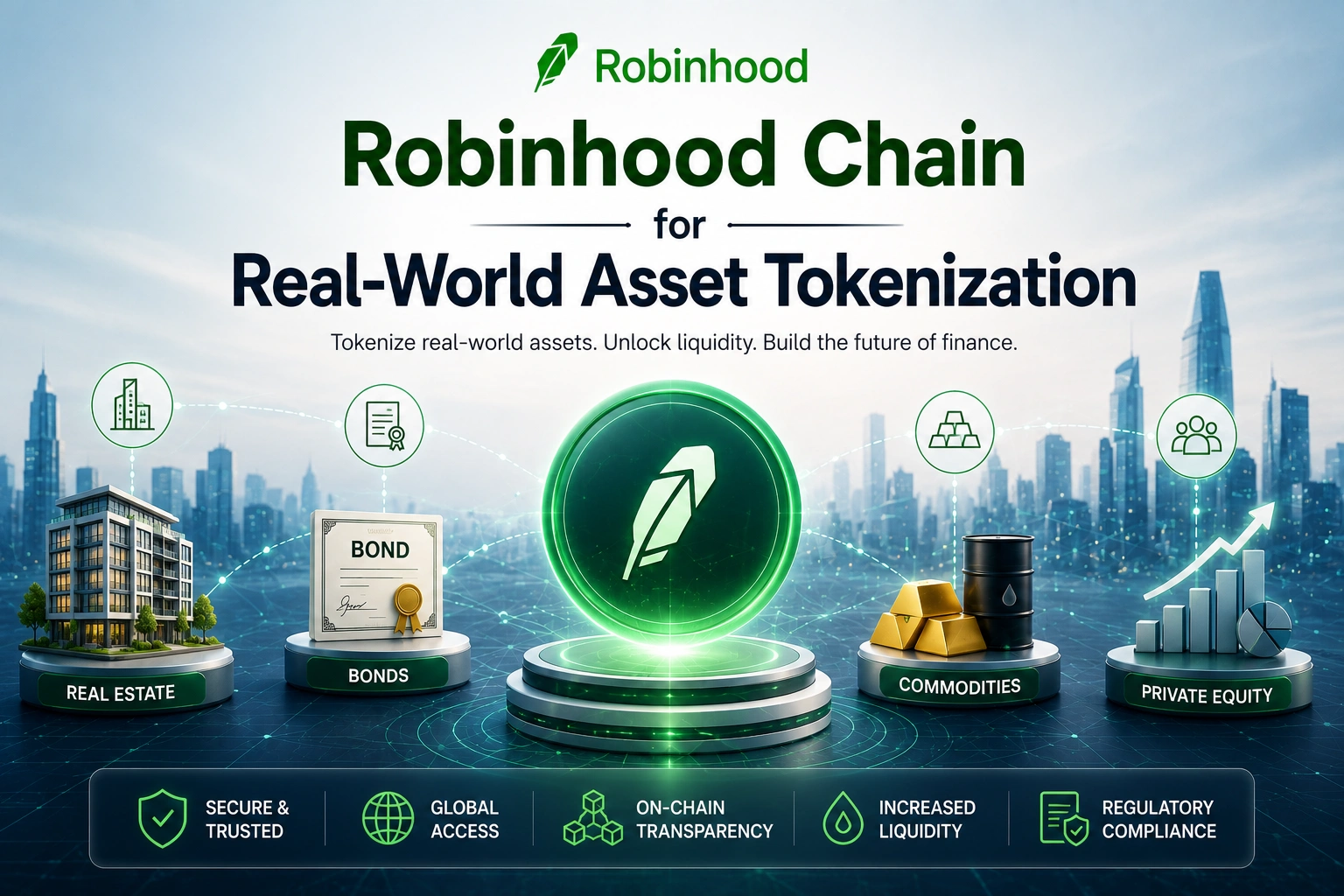
The global financial system is on the cusp of a major upgrade, and Robinhood Chain is emerging as a critical piece of the new infrastructure. For enterprises, banks, and asset managers in the US, UK, and Europe, understanding this shift is no longer optional. This guide explains how Robinhood Chain’s unique architecture is set to transform capital markets by tokenizing real-world assets (RWAs), providing a clear path for institutional adoption.
We will move beyond the hype to deliver practical, enterprise-grade insights. This article is for financial executives, technology leaders, and compliance officers who need to understand not just the what, but the how: how Robinhood Chain works, how it compares to alternatives, and how your organization can strategically implement it to gain a competitive edge. By the end, you’ll have a clear framework for leveraging this technology to modernize settlement, enhance liquidity, and build the future of finance.
Thinking about the cost of your own platform? Use our Software Development Cost Estimator for an initial projection.
Table of Contents
- What is Robinhood Chain and Why Does It Matter for Capital Markets?
- How Does Robinhood Chain Work? A Look Under the Hood
- Robinhood Chain Architecture: Built for Enterprise Finance
- Robinhood Chain Layer 2 Explained
- Blockchain Infrastructure for Tokenized Assets: A New Paradigm
- Smart Contracts for Tokenized Stocks, Bonds, and Digital Securities
- DeFi Infrastructure Development on an Enterprise Scale
- Blockchain Interoperability Solutions: Connecting the Islands of Finance
- Future Trends: A 24-Month Outlook for the On-Chain Financial Ecosystem
- Why Choose Blocsys for Your Enterprise Blockchain and Tokenisation Journey?
- Frequently Asked Questions (FAQs)
- How does Robinhood Chain work?
- What is the Robinhood Chain architecture?
- What is Robinhood Chain Layer 2 explained simply?
- What is the advantage of using an Ethereum Layer 2 for financial applications?
- How do smart contracts for tokenized stocks work?
- What are blockchain interoperability solutions?
- How does Robinhood Chain differ from a public blockchain like Ethereum?
- What is the business value of building a DeFi infrastructure?
- What are the development costs for an RWA tokenisation platform?
- Why should my business partner with Blocsys?
What is Robinhood Chain and Why Does It Matter for Capital Markets?
Robinhood Chain is a specialized Layer 2 blockchain built on Ethereum, designed specifically for the issuance, trading, and settlement of tokenized real-world assets. Unlike general-purpose blockchains, its architecture is optimized for the high-throughput, low-cost, and regulatory-compliant operations required by financial institutions.
For capital markets in the US, UK, Europe, and other financial hubs like Singapore and the UAE, this matters immensely. It addresses long-standing inefficiencies in traditional finance, such as slow settlement times (T+1 or T+2), high intermediary costs, and fragmented liquidity across borders. By moving asset settlement onto a transparent, programmable, and efficient blockchain layer, Robinhood Chain paves the way for a more integrated and accessible global financial ecosystem.
How Does Robinhood Chain Work? A Look Under the Hood
Robinhood Chain operates by processing and batching transactions off the main Ethereum network before settling them back to Ethereum’s highly secure Layer 1. This “rollup” approach is the key to its performance. By bundling thousands of transactions into a single proof submitted to Ethereum, it dramatically reduces gas fees and accelerates settlement finality, moving closer to the ideal of T+0.
For an enterprise, this means tokenized securities can be traded with the speed of digital assets while retaining the security and finality of the world’s largest smart contract platform. The chain’s sequencer—the component that orders and batches transactions—is optimized for financial use cases, ensuring predictable performance and cost, which is essential for business planning and ROI calculation.
Robinhood Chain Architecture: Built for Enterprise Finance
The Robinhood blockchain infrastructure is not a generic solution; it’s a purpose-built stack for regulated finance. Its architecture is composed of distinct layers that work together to provide security, scalability, and compliance.
- Execution Layer (Proprietary L2): This is where transactions for tokenized assets are processed. It’s designed for high throughput and low latency, enabling activities like high-frequency trading and instant settlement of tokenized ETFs and money market funds.
- Settlement Layer (Ethereum L1): Robinhood Chain inherits its security from Ethereum. Batched transactions are finalized on the Ethereum mainnet, providing an immutable and tamper-proof record of ownership and settlement that is trusted globally.
- Compliance & Identity Layer: Integrated directly into the protocol are hooks for KYC/AML verification and transfer restrictions. This allows issuers to enforce regulatory rules (like those from the SEC, FCA, or under MiCA) at the smart contract level, automating compliance across jurisdictions.
This modular architecture ensures that institutions can build compliant and performant financial products without sacrificing the core benefits of decentralization and security.
Robinhood Chain Layer 2 Explained
The core innovation of Robinhood Chain is its function as an Ethereum Layer 2 for financial applications. Originally exploring an Arbitrum-based solution, Robinhood pivoted to a proprietary L2 to gain finer control over transaction finality, gas costs, and the integration of regulatory primitives.
This L2 uses a rollup technology—likely an Optimistic Rollup or a zk-Rollup—to achieve its scalability.
- Optimistic Rollups assume transactions are valid by default and use a “fraud-proof” system to challenge and revert invalid transactions. This offers excellent compatibility with Ethereum’s tooling.
- ZK-Rollups (Zero-Knowledge Rollups) use cryptographic “validity proofs” to prove that every transaction in a batch is valid without revealing the underlying data. This provides faster finality and potentially higher security guarantees.
For a deeper dive into these technologies, see our expert guide on zkEVM vs Optimistic Rollup explained. The choice of rollup technology directly impacts the platform’s performance, cost, and finality guarantees—all critical evaluation criteria for enterprise adoption.
Blockchain Infrastructure for Tokenized Assets: A New Paradigm
Traditional financial infrastructure is a complex web of custodians, clearinghouses, and transfer agents, leading to delays and costs. A dedicated blockchain infrastructure for tokenized assets, like Robinhood Chain, collapses this stack into a single, unified ledger.
This offers several key advantages for institutions:
- Reduced Counterparty Risk: With near-instant settlement (T+0), the risk of a counterparty defaulting before a trade is finalized is virtually eliminated.
- Increased Capital Efficiency: Funds are not locked up for days in the settlement process, freeing up capital for other investments or operational needs.
- 24/7/365 Markets: Digital assets can be traded around the clock, unconstrained by traditional banking hours, opening up new opportunities for global liquidity.
- Automated Corporate Actions: Dividends, stock splits, and shareholder voting can be programmed directly into the smart contracts of the tokenized assets, reducing administrative overhead and errors.
Smart Contracts for Tokenized Stocks, Bonds, and Digital Securities
Smart contracts are the engine of an on-chain financial ecosystem. For tokenized assets, they are more than just simple code; they are programmable legal and financial agreements. Robinhood Chain supports advanced smart contracts that can handle the complexities of regulated securities.
Tokenized Stocks, Bonds, and ETFs
- Tokenized Stocks USA: In the US, tokenized stocks must adhere to SEC regulations. Smart contracts can embed logic to ensure only accredited investors can hold certain assets or to automate the filing of required reports. Read our in-depth guide: Stock Tokenisation Explained.
- Tokenized Treasury Bonds & ETFs: These assets are ideal for tokenization due to their standardized nature. Smart contracts can automate interest payments for bonds or manage the creation/redemption process for ETFs, making these products more efficient and accessible. Explore our services for Corporate Bond Tokenisation.
- Tokenization UK & Digital Securities Europe: In the UK and Europe, platforms must navigate FCA rules and the EU’s MiCA regulation. Smart contracts can be designed to comply with the DLT Pilot Regime, enabling compliant cross-border distribution of digital securities.
Smart contracts built on standards like ERC-3643 can enforce compliance automatically, ensuring that only eligible wallets can receive assets and that transfers adhere to jurisdictional rules. For more, see our ERC-3643 Token Standard Explained for RWA Tokenisation.
DeFi Infrastructure Development on an Enterprise Scale
While DeFi is often associated with open, permissionless protocols, its core principles are being adapted for institutional use. Robinhood Chain provides the DeFi infrastructure development framework needed to build enterprise-grade financial applications.
This includes building an on-chain financial ecosystem with components like:
- Decentralized Exchanges (DEXs): For automated and transparent trading of tokenized assets.
- Lending & Borrowing Protocols: Allowing institutions to use their tokenized assets as collateral to borrow capital.
- Money Markets: Such as tokenized money market funds that offer a stable, yield-bearing instrument for corporate treasuries.
By building these services on a compliant and scalable L2, institutions can leverage the efficiency of DeFi without the regulatory risks of public, anonymous protocols.
Blockchain Interoperability Solutions: Connecting the Islands of Finance
No single blockchain will rule them all. The future of finance is multi-chain, and blockchain interoperability solutions are essential. Robinhood Chain is built with this reality in mind, designed to connect with other Ethereum L2s, private consortium chains, and even traditional financial systems (TradFi).
This is achieved through:
- Bridges: Secure protocols that allow assets to be moved between different blockchains.
- Cross-Chain Messaging: Standards that let smart contracts on different chains communicate with each other.
- API Gateways: That connect the on-chain world with off-chain systems like core banking platforms and custody solutions.
For enterprises, this means assets tokenized on Robinhood Chain won’t be siloed. They can be moved to where liquidity is deepest or integrated into broader financial workflows, ensuring long-term flexibility and preventing vendor lock-in.
Understanding the evolving regulatory landscape is crucial. See this useful external resource for legislative context on market structure: prediction event on crypto market structure. And for risk frameworks, see this coverage: BatchData risk management coverage.
Enterprise RWA Infrastructure Decision Matrix
The choice of blockchain infrastructure is a strategic one. This matrix helps clarify the trade-offs.
| Evaluation Criteria | Robinhood Chain | Alternative Enterprise L2s | Consortium Blockchains |
|---|---|---|---|
| Regulatory Adaptability | Protocol-level compliance hooks for SEC, FCA, MiCA | Tunable jurisdictional behaviour and custody models | Strict closed-membership governance for data residency |
| Developer Tooling | Ethereum-aligned with ERC standards and DeFi primitives | Mature SDKs with financial workload optimisations | Specialised enterprise toolkits requiring custom integration |
| Interoperability | Retail brokerage rail integration with multi-L2 bridge patterns | API-driven adapters for core banking and post-trade systems | Private integrations with sovereign ledger interfaces |
| Total Cost of Ownership | Shared sequencer and gas-efficiency reduce fixed costs | Variable gas models with potential custom hosting costs | Higher upfront capital but lower certain legal risks |
| Exit Optionality | Open migration paths and multi-chain porting strategies | Cross-chain portability with varying tooling maturity | Limited portability requiring careful exit planning |
Robinhood Chain offers a compelling balance for institutions seeking to access public liquidity pools while maintaining strict regulatory compliance. Alternative L2s provide more customization, while consortium chains excel in private, controlled environments.
For deeper context on how European institutions approach these decisions, read our guide on enterprise blockchain solutions in Europe and Canton Network use cases for finance.
Future Trends: A 24-Month Outlook for the On-Chain Financial Ecosystem
The tokenisation space is evolving rapidly. Here are the key trends enterprises should monitor over the next 12-24 months:
- Maturation of Interoperability: Cross-chain communication protocols will become standardized, making the movement of assets between chains like Robinhood Chain and other L2s seamless and secure.
- Expansion of Tokenized Asset Classes: Beyond stocks and bonds, we’ll see significant growth in tokenized private credit, real estate, and carbon credits, opening up previously illiquid markets.
- AI-Driven Compliance and Risk Management: AI models will be used for real-time transaction monitoring, automated compliance checks, and sophisticated risk modeling within on-chain ecosystems.
- Regulatory Harmonization: While still fragmented, jurisdictions like the US, UK, and EU will continue to converge on key principles for digital asset regulation, providing greater clarity for institutional players.
- Focus on Modular Blockchain Architecture: Platforms will increasingly adopt a modular design, separating execution, settlement, and data availability layers. This allows for greater flexibility and specialization. Learn more about modular blockchain architecture for scalable networks.
Why Choose Blocsys for Your Enterprise Blockchain and Tokenization Journey?
Navigating the transition to an on-chain financial world requires a partner with deep expertise in both enterprise technology and financial market structure. Blocsys is a premier Enterprise Blockchain Development Company specializing in building the secure, scalable, and compliant infrastructure that modern finance demands.
Our expertise spans the entire stack:
- Robinhood Chain Development & Ethereum Layer 2 Solutions: We build custom applications and infrastructure on leading L2s, optimized for your specific business needs.
- RWA Tokenisation & Digital Asset Platforms: We guide you through the entire process of asset tokenisation, from legal structuring and smart contract development to platform launch and liquidity provision. Explore our services for building an Asset Tokenization Platform.
- DeFi Development for Institutions: We design and build enterprise-grade DeFi protocols for trading, lending, and yield generation, complete with robust risk management and compliance controls. We can help you build everything from a Crypto Trading Platform to an OTC Trading Platform.
- Smart Contract Development & Auditing: Our team develops secure, efficient, and formally verified smart contracts for mission-critical financial applications.
- Enterprise Consulting: We provide strategic guidance to banks, asset managers, and fintechs on adopting blockchain technology, ensuring your initiatives deliver tangible business value and a strong ROI.
Partner with Blocsys to build the future of your financial operations. We have the technical prowess and industry insight to help you execute your vision effectively, from pilot to full-scale production.
Ready to modernize your capital market infrastructure? Contact Blocsys today to discuss your enterprise blockchain, RWA tokenization, and DeFi development needs with our experts.
How UK Businesses Can Tokenise Real-World Assets
In the UK, businesses and financial institutions are exploring blockchain infrastructure to tokenise real-world assets such as securities, funds, and other financial instruments. Tokenising these assets can create digital ownership records, streamline settlement, and support more efficient asset transfers across financial markets. As UK adoption of blockchain-based financial infrastructure develops, tokenise strategies can help businesses explore new models for issuing, managing, and transferring real-world assets while considering regulatory and compliance requirements.
Robinhood Chain and RWA Tokenization Opportunities in GIFT City
GIFT City adds another important dimension to the growing adoption of real-world asset tokenization across financial markets. As businesses explore blockchain networks for representing and managing tokenized assets, the choice of infrastructure becomes important for supporting secure transactions, efficient asset management, and institutional requirements. Robinhood Chain can be considered within this broader tokenization landscape as businesses evaluate blockchain infrastructure for expanding RWA solutions in emerging financial hubs such as GIFT City.
Frequently Asked Questions (FAQs)
How does Robinhood Chain work?
Robinhood Chain is an Ethereum Layer 2 solution that processes transactions off the main Ethereum chain to increase speed and reduce costs. It bundles, or “rolls up,” many transactions into a single proof that is then settled on Ethereum’s secure Layer 1. This architecture is specifically designed for high-frequency financial activities like trading tokenized stocks and ETFs.
What is the Robinhood Chain architecture?
The architecture consists of three main layers: an Execution Layer (the proprietary L2) for fast transaction processing, a Settlement Layer (Ethereum L1) for ultimate security and finality, and an integrated Compliance & Identity Layer. This modular structure allows it to deliver performance, security, and regulatory adherence for institutional finance.
What is Robinhood Chain Layer 2 explained simply?
Think of it as an express lane for financial transactions on the Ethereum highway. By handling transactions in this separate but connected lane, it avoids the traffic jams (high fees and slow speeds) of the main highway, while still benefiting from its security. It’s optimized for the specific needs of tokenized assets.
What is the advantage of using an Ethereum Layer 2 for financial applications?
An Ethereum Layer 2 offers the best of both worlds: the unparalleled security and decentralization of the Ethereum mainnet, combined with the low costs and high throughput needed for financial applications. This makes it possible to build scalable, enterprise-grade systems without compromising on trust and security.
How do smart contracts for tokenized stocks work?
Smart contracts for tokenized stocks are digital agreements that automatically enforce the rules of ownership and transfer. They can be programmed to restrict transfers to accredited investors, automate dividend payments, and ensure compliance with SEC, FCA, or MiCA regulations, all on a transparent and immutable ledger.
What are blockchain interoperability solutions?
These are technologies like bridges and cross-chain messaging protocols that allow different blockchains to communicate and transfer assets between them. For an enterprise, this is crucial as it prevents assets from being locked into a single ecosystem and ensures flexibility for future integrations with other platforms and financial networks.
How does Robinhood Chain differ from a public blockchain like Ethereum?
While it builds on Ethereum, Robinhood Chain is a specialized, purpose-built Layer 2. It offers lower fees, faster settlement, and built-in compliance features tailored for regulated financial assets. Public Ethereum is a general-purpose platform, whereas Robinhood Chain is an optimized solution for institutional and retail finance.
What is the business value of building a DeFi infrastructure?
For an enterprise, building a DeFi infrastructure on a compliant chain like Robinhood Chain enables new revenue streams and massive efficiency gains. It allows for the creation of automated market makers, lending protocols for tokenized assets, and yield-generating products, all with lower overhead and greater transparency than traditional systems.
What are the development costs for an RWA tokenization platform?
Costs vary based on complexity, but a pilot project can range from low-six to mid-seven figures. Key cost drivers include smart contract development and auditing, regulatory compliance integration, custody solutions, and building a user-friendly interface. Partnering with an experienced firm like Blocsys can help optimize costs and accelerate time-to-market.
Why should my business partner with Blocsys?
Blocsys is an expert Enterprise Blockchain Development Company with proven experience building secure, scalable, and compliant financial infrastructure. We offer end-to-end services, from strategic consulting and Robinhood Chain development to RWA tokenisation and DeFi protocol creation, ensuring your project is a technical and commercial success.
