
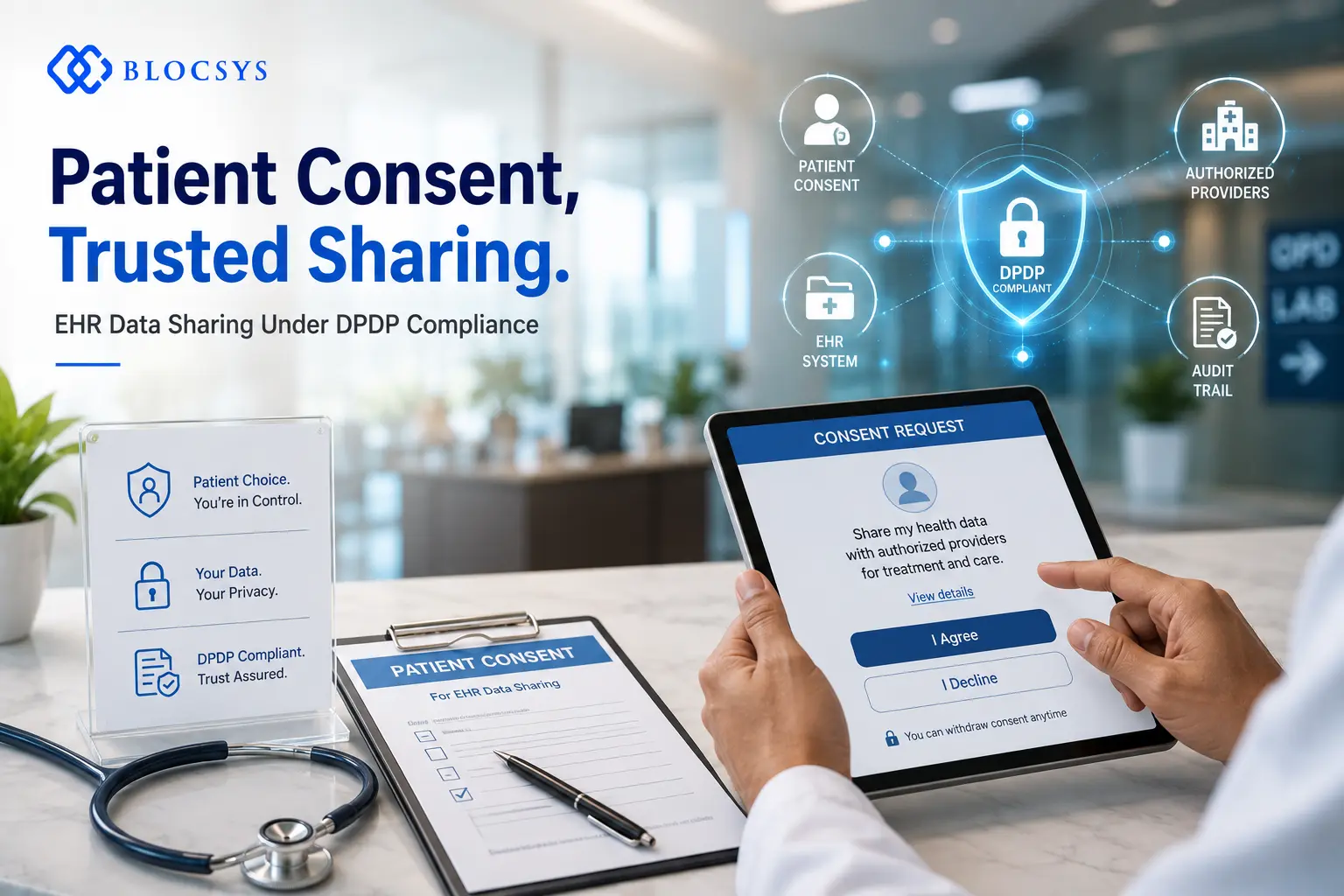
Patient Consent and EHR Data Sharing: DPDP Compliance Considerations for Hospitals
Every hospital in India runs on data. Lab results move to doctors, prescriptions move to pharmacies, and billing details move to insurance providers. This constant movement is what we call EHR data sharing, and it’s exactly why patient consent has become a board-level concern rather than a back-office checkbox. With the Digital Personal Data Protection Act now shaping how healthcare organizations handle personal data, hospitals need a clear, practical understanding of what’s required. If you’re building or upgrading your hospital’s digital backbone, a well-designed Hospital Management System is often where this compliance work actually begins.
In this guide, we’ll walk through what patient consent means inside electronic health record systems, why it matters under the DPDP framework, and how hospitals can manage EHR data sharing responsibly. We’ll also look at practical workflows involving labs, pharmacies, and insurers, and where Blocsys fits into building this kind of infrastructure.
What Is Patient Consent in EHR Systems?
Patient consent, in simple terms, is permission. It’s the patient’s agreement to let a hospital collect, store, or share their health information for a specific purpose.
Inside an Electronic Health Record system, consent isn’t a single event. It’s ongoing. A patient might consent to share records with their cardiologist but not with a third-party wellness app. That’s a meaningful distinction, and your systems need to respect it.
Consent in EHR environments typically covers several things: what data is collected, who can view it, how long it’s retained, and whether it can be shared outside the hospital. Each of these needs to be traceable, not just assumed.
Consent isn’t a signature on an admission form. It’s a living record of what a patient agreed to, when, and for what purpose — and hospitals that treat it as a one-time formality are the ones that struggle most when data sharing gets questioned.
Why Consent Isn’t Just a Formality Anymore
Historically, many Indian hospitals treated consent as paperwork. A form got signed at admission, and that was that. However, digital health records changed the equation entirely.
Once records exist digitally, they can be copied, transmitted, and accessed instantly. Therefore, consent needs to keep pace with how easily data now travels between departments, labs, and external partners.
Why Patient Consent Matters Under the DPDP Framework
The Digital Personal Data Protection Act, 2023 (DPDP Act) is India’s primary data protection law. It applies to any organization, including hospitals, that processes personal data of individuals in India.
Under the DPDP Act, healthcare data is treated as personal data, and in many cases, sensitive personal data. This means hospitals are classified as “Data Fiduciaries” — entities responsible for determining how and why personal data is processed. Patients are the “Data Principals” whose data is being handled.
The DPDP Act requires that consent be free, specific, informed, unconditional, and unambiguous. Vague forms or bundled consent clauses won’t hold up. Consequently, hospitals need consent language that’s clear about purpose, not buried in legal jargon.
DPDP Act Healthcare Requirements Hospitals Should Know
A few provisions are especially relevant for hospitals managing electronic health records:
- Notice must be given to patients before or at the time data is collected, explaining what data is collected and why.
- Consent can be withdrawn at any time, and withdrawal must be as easy as giving consent.
- Data should only be used for the purpose it was collected for, unless separately consented.
- Patients have the right to access, correct, and request erasure of their data, subject to legal retention requirements.
- Hospitals must implement reasonable security safeguards to prevent data breaches.
It’s worth being precise here: the DPDP Act sets legal obligations, but it doesn’t prescribe exact technical architectures. That’s where hospital data governance and IT strategy come in — translating legal requirements into working systems.
How EHR Data Sharing Works in Hospitals
EHR data sharing happens constantly, even in a single patient visit. A doctor orders a test, a lab processes it, results flow back into the record, and a pharmacy fills a prescription based on that same record.
Understanding this flow matters because each handoff is a point where consent and access control decisions apply.
Broadly, EHR data sharing falls into three categories: internal sharing between hospital departments, sharing with external healthcare partners like labs and diagnostic centers, and sharing with third parties such as insurers or government health programs.
![EHR Data Sharing — [Flow diagram showing EHR data sharing pathway: Patient Consent Capture → Department Access Request → Role-Based Verification → Data Transfer via Secure API → Audit Log Entry]](https://s3.blocsys.com/blocsys/blog-images/1787788929253-3ed4ead2dff110c8.webp)
Internal vs External EHR Data Sharing
Internal EHR data sharing usually moves faster because it happens within one governance boundary. A nurse, a doctor, and a billing clerk might all access the same record, but each sees only what their role requires.
External EHR data sharing is different. Once data leaves the hospital’s own systems, additional safeguards apply — data processing agreements, encryption in transit, and often, explicit patient consent for that specific transfer.
Patient Consent and Authorized Data Access
Who should see a patient’s record? The honest answer is: only people who need it for a specific, legitimate purpose.
This principle, sometimes called “need-to-know” access, is central to both good hospital data governance and DPDP compliance for hospitals.
Authorized access typically includes the treating doctor, nursing staff involved in care, relevant department heads, and billing staff for administrative purposes. Anyone outside this circle should require a specific reason and, in many cases, explicit consent.
Building Consent Management Around Real Clinical Workflows
A consent management system works best when it mirrors how care actually happens. For example, a patient referred from general medicine to cardiology should have a clear, logged consent trail showing that transfer was authorized.
Without this, hospitals end up with either overly restrictive access — frustrating clinicians — or overly loose access, which creates compliance risk. Neither extreme works well in practice.
DPDP Considerations for Sharing EHR Data
When hospitals share EHR data, several DPDP-related questions come up. Is the sharing within the scope of original consent? Is the recipient authorized to receive sensitive personal data? Is there a legitimate use, or is this a new purpose requiring fresh consent?
Hospitals also need to think about cross-border data transfers. The DPDP Act allows the government to restrict transfer of personal data to certain countries, so hospitals working with cloud vendors or research partners abroad need to check current restrictions.
Purpose Limitation in EHR Data Sharing
Purpose limitation means data collected for one reason shouldn’t be reused for another without consent. A patient’s diagnostic report shared for treatment shouldn’t automatically be used for research or marketing.
This is a legal principle, not just a technical setting. However, systems can help enforce it — by tagging data with its original purpose and flagging mismatched requests before they happen.
Data Security and Access Controls
Security and consent go hand in hand. Consent tells you who’s allowed to access data; access controls make sure only those people actually can.
Role-based access control (RBAC) is the standard approach here. Doctors get clinical data access, billing staff get financial data access, and IT administrators get system-level access without needing to view clinical notes.
EHR Security Measures Hospitals Should Prioritize
A few technical controls consistently make a difference: encryption of data at rest and in transit, multi-factor authentication for system logins, regular access reviews, and network segmentation between clinical and administrative systems.
These are recommended technical practices, not automatic proof of legal compliance. Hospitals still need documented policies, staff training, and periodic audits to meet DPDP obligations fully.
Consent Management and Audit Trails
What happens when a patient asks, “who accessed my records last month?” A hospital without audit trails can’t answer that question with confidence.
Audit trails record who accessed what data, when, and why. They’re essential for DPDP Act healthcare compliance because they provide evidence of authorized access — and just as importantly, evidence of unauthorized attempts.
![EHR Data Sharing — [Flow diagram showing consent lifecycle: Consent Capture → Digital Storage → Access Verification Against Consent → Periodic Consent Review → Withdrawal Handling → Audit Log Update]](https://s3.blocsys.com/blocsys/blog-images/1787788929354-72a85ffb70bf7778.webp)
How a Consent Management System Supports EHR Data Sharing
A dedicated consent management system tracks consent status per patient, per purpose, and per recipient. When a lab requests a report, the system checks whether valid consent exists before the transfer happens.
This reduces manual back-and-forth between departments. Additionally, it gives compliance officers a single place to review consent status instead of chasing paper trails across departments.
EHR Integration With Labs, Pharmacies and Other Systems
Modern hospitals rarely operate as isolated systems. Labs, pharmacies, diagnostic centers, and sometimes external specialists all need access to relevant patient data.
Healthcare interoperability standards, like HL7 and FHIR, allow these systems to exchange data in structured, consistent formats. This matters because inconsistent data formats create both operational friction and security gaps.
Practical Example: Lab-to-EHR Data Flow
Consider a patient getting bloodwork done. The order originates in the EHR, travels to the lab system, and results flow back automatically once testing completes.
At each step, access should be limited to what’s necessary. The lab doesn’t need the patient’s full medical history — just enough context to process the test correctly.
Pharmacy and Prescription Data Sharing
Similarly, when a doctor issues a prescription, the pharmacy system needs medication details, not the patient’s entire diagnostic history.
This is data minimization in action — sharing only what’s needed for a specific task, which directly supports DPDP compliance for hospitals.
Third-Party Data Sharing and Healthcare Interoperability
Insurance providers, government health schemes, and referral hospitals often need patient data too. Each of these relationships should be governed by clear data processing agreements.
Hospitals should verify that third parties have adequate security measures before sharing sensitive personal data. This isn’t optional diligence — it’s a practical extension of the hospital’s own accountability under the DPDP Act.
Insurance Providers and Diagnostic Centers as Authorized Partners
When a patient submits an insurance claim, the insurer typically needs specific treatment and billing details. Hospitals should share exactly that, not the entire medical record.
Diagnostic centers working as external partners should be treated similarly — data sharing agreements, defined data scope, and documented consent all reduce risk on both sides.
Common Compliance Challenges for Hospitals
Most hospitals face similar hurdles when trying to align EHR data sharing with DPDP requirements. Let’s look at the recurring ones.
Fragmented Systems and Inconsistent Consent Records
Many hospitals still run multiple systems that don’t talk to each other well — one for admissions, another for billing, another for lab management. Consent captured in one system often doesn’t sync with others.
This fragmentation makes it hard to answer basic compliance questions quickly, which becomes a real problem during audits or patient requests.
Manual Consent Processes That Don’t Scale
Paper-based consent forms are still common in India. However, they don’t scale well when data needs to move digitally across departments and partners.
Digitizing consent capture is a practical step, though it needs proper design — not just scanning paper forms into a database.
Balancing Clinical Speed With Compliance Requirements
Doctors need fast access to patient data, especially in emergencies. Consequently, overly rigid consent systems can slow down care when speed matters most.
The solution isn’t removing controls — it’s designing them intelligently, with emergency access provisions that are still logged and reviewed afterward.
Building a Privacy-Aware Hospital Data Infrastructure
So, how should hospitals actually approach this? Start with data mapping — understanding what data exists, where it’s stored, and who accesses it.
From there, build consent capture into patient-facing workflows, not as an afterthought. Layer in role-based access controls, encryption, and audit logging as core system features, not add-ons.
Data Minimization and Retention as Governance Principles
Data minimization means collecting only what’s necessary for care. Retention policies mean not keeping data indefinitely once its purpose is served, unless legally required.
Both principles reduce risk. Less data stored means less exposure if something goes wrong, and clearer retention rules make DPDP compliance easier to demonstrate.
How Blocsys Can Help
Building privacy-aware healthcare infrastructure takes more than good intentions — it takes the right technical foundation. Blocsys works with hospitals, clinics, and diagnostic centers to design secure, interoperable systems that support consent management, role-based access, and audit-ready data workflows.
Our Hospital Management System is built with modular access controls, structured data flows, and integration capabilities for labs, pharmacies, and insurance partners. We also draw on our broader technology work — including AI/ML Development Services for intelligent access anomaly detection, and Blockchain Development Services for tamper-evident audit trails where hospitals need that extra layer of traceability.
To be clear, we build the technical infrastructure that supports DPDP-aligned practices. Legal compliance itself depends on your hospital’s policies, staff training, and documented processes working alongside the technology.
Future of EHR Data Governance in India
India’s healthcare data landscape is moving toward greater standardization. The Ayushman Bharat Digital Mission and related interoperability initiatives are pushing hospitals toward structured, shareable digital records.
As these frameworks mature, hospitals with strong consent management and access control foundations will adapt faster than those still relying on fragmented, paper-heavy systems.
Why Scalable EHR Data Sharing Infrastructure Matters Now
Waiting until enforcement tightens is a risky strategy. Building scalable, well-governed EHR data sharing infrastructure now gives hospitals room to adapt as rules and guidance evolve.
Moreover, patients increasingly expect transparency about how their data is used. Hospitals that get ahead of this build trust, not just compliance.
Why Choose Blocsys
Blocsys brings enterprise-grade healthcare software experience, combined with deep expertise in secure data architecture, interoperability, and emerging technologies like blockchain and AI. We understand that hospitals need systems that work for clinicians first, while still meeting governance and privacy requirements.
From Hospital Management System Development to custom EHR-related infrastructure, our team designs with security, scalability, and real-world clinical workflows in mind. If you’re evaluating what a project like this might cost, our Software Development Cost Estimator is a useful starting point.
Frequently Asked Questions
Here are direct answers to the questions we hear most often about patient consent and EHR data sharing.
What is patient consent in an EHR system?
Patient consent in an EHR system is the patient’s informed agreement to let a hospital collect, store, or share their health data for a specific, defined purpose. It’s not a one-time formality — it needs to be trackable across every department and system that touches the record.
How does the DPDP Act affect patient data in hospitals?
The DPDP Act classifies hospitals as Data Fiduciaries responsible for how patient data is processed, and patients as Data Principals with rights over their own data. Hospitals must obtain clear consent, limit data use to the stated purpose, and implement reasonable security safeguards.
What are the key DPDP considerations when sharing EHR data?
Key considerations include verifying that sharing falls within the original consent scope, confirming the recipient is authorized, applying data minimization, and maintaining audit trails of every transfer. Cross-border transfers also need extra scrutiny under current DPDP provisions.
How should hospitals manage patient consent digitally?
Hospitals should use a consent management system that captures consent per purpose and per recipient, allows easy withdrawal, and syncs consent status across departments. This avoids the gaps that happen when consent lives only on paper forms.
Who can access patient EHR data?
Access should be limited to people with a legitimate clinical or administrative need — treating doctors, relevant nursing staff, and billing personnel, typically enforced through role-based access controls. Anyone outside that circle needs a specific, documented reason.
How can hospitals control third-party access to patient records?
Hospitals should use data processing agreements with third parties like insurers and diagnostic centers, share only the minimum data needed for that specific purpose, and verify the third party’s own security practices before granting access.
What security controls should hospitals use for EHR data sharing?
Recommended controls include encryption at rest and in transit, multi-factor authentication, role-based access, and network segmentation between clinical and administrative systems. These are technical safeguards that support, but don’t replace, documented compliance policies.
How can consent and EHR sharing be tracked through audit trails?
Audit trails log who accessed a record, when, and for what purpose, alongside consent status at the time of access. This creates a verifiable history hospitals can reference during compliance reviews or patient inquiries.
How does healthcare interoperability affect patient data privacy?
Interoperability standards like HL7 and FHIR let systems exchange data in structured formats, which actually improves privacy when paired with proper access controls — since data moves in defined, auditable channels instead of ad hoc file transfers.
Can hospital management software support DPDP-related privacy controls?
Yes, hospital management software can include features like consent tracking, role-based access, and audit logging that support DPDP-aligned practices. However, software alone doesn’t guarantee legal compliance — that also depends on hospital policy and staff practices.
How much does it cost to build a secure hospital management system?
Costs vary based on features, integrations, and scale, ranging from mid-range budgets for smaller clinics to significantly higher investment for multi-specialty hospital networks. The Software Development Cost Estimator can give you a tailored estimate based on your requirements.
Why choose Blocsys for healthcare software development?
Blocsys combines enterprise healthcare software experience with expertise in security, interoperability, and emerging technology, helping hospitals build systems designed around real clinical workflows and privacy-aware architecture from the ground up.
Conclusion
Patient consent and EHR data sharing aren’t separate concerns — they’re two sides of the same governance challenge. Getting this right under the DPDP Act means combining clear legal understanding with practical, well-designed systems.
Hospitals that invest in consent management, access controls, and audit-ready infrastructure now will be far better positioned as India’s healthcare data rules continue to evolve.
If your hospital is ready to build this kind of foundation, Blocsys can help you design a Hospital Management System that’s built for secure, privacy-aware EHR data sharing from day one. Reach out to start the conversation, or use our Software Development Cost Estimator to plan your next step.
Ready to move beyond theory and build an intelligent platform that delivers real-world value? Blocsys Technologies specialises in engineering enterprise-grade AI and blockchain solutions for the fintech, Web3, and digital asset sectors. Connect with our experts today to discuss your vision and chart a clear path from concept to a secure, scalable reality.
