
Private Equity Tokenization Development in Germany: Regulations, Process & Enterprise Guide (2026)
Tokenized Private Equity is quickly becoming the standard for how German enterprises, fund managers, and family offices structure private market investments. If you’ve been watching the shift from paper-based share certificates to blockchain-native ownership records, you already know Germany sits at the center of this movement. At Blocsys, we build compliant, enterprise-grade platforms that turn illiquid private equity holdings into digitally tradable, fractional assets. This guide walks you through the regulatory landscape, the technical architecture, and the practical roadmap for launching an equity tokenization platform in Germany, and why now is the right moment to move.
What Is Private Equity Tokenization?
Private equity tokenization means converting ownership rights in a private company, fund, or investment vehicle into digital tokens on a blockchain. Each token represents a fractional, legally recognized claim on equity, similar to a traditional share, but issued and transferred electronically instead of on paper.
Unlike public equities, private equity has historically been slow-moving, illiquid, and limited to accredited investors with deep pockets. Tokenized Private Equity changes that equation. It lets issuers fractionalize large holdings, automate compliance checks, and open secondary liquidity channels that simply didn’t exist before. That’s the core promise of Private Equity Tokenization Development: turning static ownership into programmable, transferable digital securities.
Why Germany Is Becoming a Hub for Tokenized Private Equity Markets
Germany didn’t stumble into blockchain finance by accident. Regulators, banks, and institutional investors have spent years building the legal scaffolding needed for digital securities to function at enterprise scale. The result is a jurisdiction where Private Equity Tokenization Germany isn’t a gray-area experiment anymore, it’s a recognized, licensable business activity.
Several factors explain this momentum. First, Germany’s banking sector is one of the largest in Europe, giving tokenization platforms access to serious institutional capital. Second, BaFin has published clear guidance on how digital securities fit within existing financial law. Third, German asset managers are actively seeking alternatives to illiquid fund structures, and Blockchain Private Equity offers exactly that. Consequently, more founders and CTOs are asking how to build compliant platforms rather than whether tokenization is legitimate.
Business Benefits of Private Equity Tokenization
Why should a private equity firm or enterprise bother rebuilding its issuance stack around blockchain rails? The answer comes down to efficiency, access, and transparency.
- Fractional ownership: Investors can buy smaller stakes, expanding your investor base beyond ultra-high-net-worth individuals.
- Faster settlement: Smart contracts settle transfers in minutes instead of weeks of manual paperwork.
- Automated compliance: KYC/AML rules, transfer restrictions, and investor eligibility checks execute automatically on-chain.
- Secondary liquidity: Tokenized shares can move through regulated secondary markets, something traditional cap tables rarely support.
- Lower administrative costs: Digital cap tables replace spreadsheets, notaries, and manual reconciliation.
Together, these benefits explain why Germany Private Equity Tokenization has moved from pilot projects into production-grade platforms across asset managers, venture funds, and even family offices.
Germany’s Leadership in Private Equity Tokenization and Digital Securities
Germany has quietly built one of Europe’s most mature legal environments for blockchain-based finance. It didn’t happen overnight, but through deliberate legislative work, particularly the Electronic Securities Act, known locally as EWpG. This law gave digital securities the same legal standing as paper-based instruments, something few jurisdictions had achieved by the time it passed.
Institutional adoption followed quickly. German banks, custodians, and crypto securities registrars now operate under a framework where BaFin Digital Securities oversight is well understood, not experimental. BaFin licenses crypto securities registrars, supervises token issuers, and applies existing securities law to digital instruments rather than forcing companies into regulatory limbo.
Enterprise interest has grown alongside this clarity. Asset managers, private equity houses, and fintech startups increasingly view Germany as the place to launch compliant tokenized products, not just experiment with them. Digital Securities Germany initiatives now span corporate bonds, fund units, and private equity stakes, backed by real registrars and real custodians.
For enterprises evaluating where to build, Germany offers something rare: a regulatory framework that’s actually finished, tested in practice, and trusted by institutional capital. That maturity is precisely why Private Equity Tokenization Development Germany has become a serious enterprise category rather than a niche experiment.
BaFin Regulations and the Electronic Securities Act (eWpG)
If you’re planning a tokenization platform, you can’t skip the regulatory homework. Germany’s approach centers on two pillars: BaFin supervision and the eWpG legal framework.
How BaFin Oversees Digital Securities Germany
BaFin, Germany’s Federal Financial Supervisory Authority, treats tokenized securities under the same principles as traditional financial instruments. That means issuers must consider prospectus requirements, investor protection rules, and licensing obligations depending on how the token is structured and distributed.
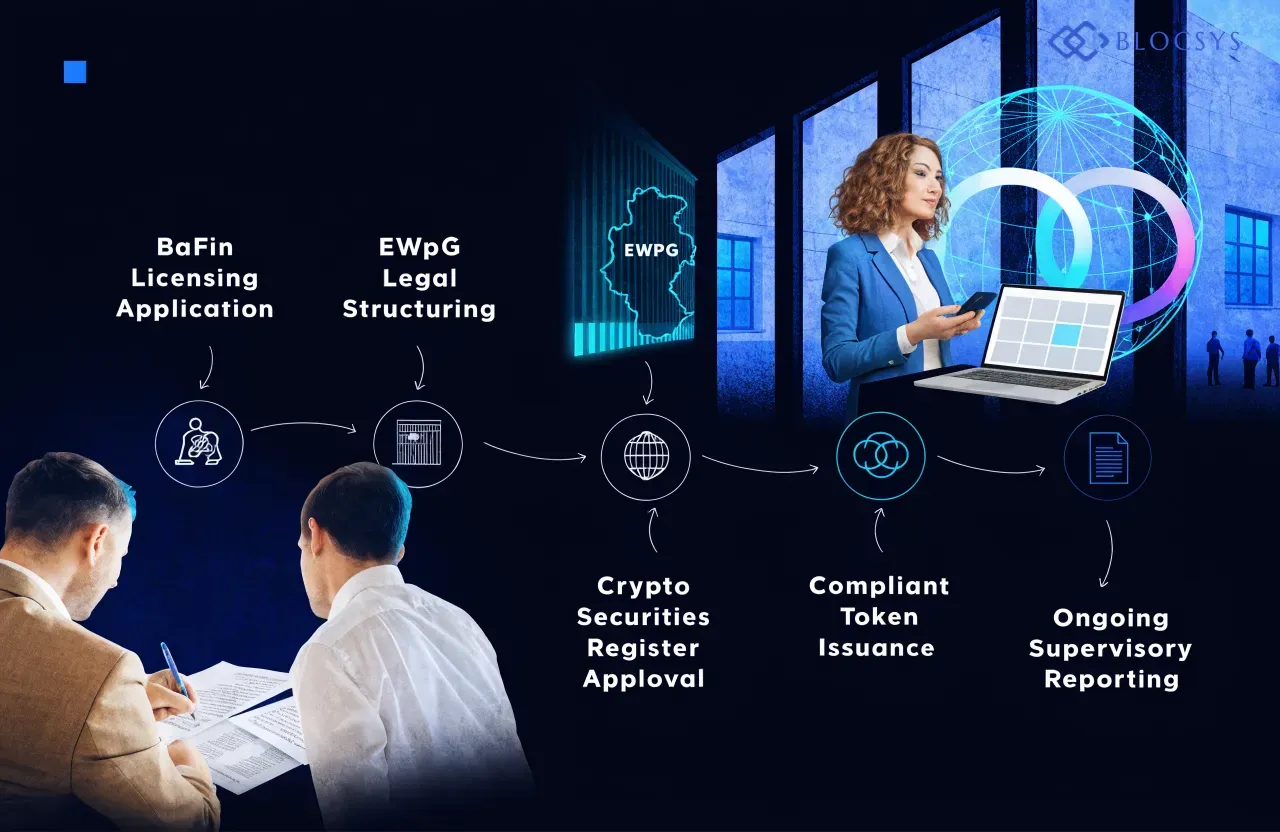
Additionally, entities that maintain crypto securities registers need explicit authorization from BaFin. This isn’t a rubber-stamp process. Applicants must demonstrate robust IT security, governance controls, and operational resilience before they’re approved to register digital securities on a blockchain.
EWpG and Crypto Securities Registers
The Electronic Securities Act, introduced in 2021 and expanded in subsequent amendments, legally recognizes electronic securities without requiring a physical certificate. Under EWpG, issuers can register bonds, fund units, and, increasingly, equity-like instruments in a blockchain-based crypto securities register.
This matters enormously for Private Equity Tokenization Development because it gives digital tokens the same enforceability as traditional share certificates. Investors aren’t holding a symbolic representation, they’re holding a legally binding claim recorded on distributed ledger technology.
Germany didn’t just legalize digital securities, it built the infrastructure around them. That’s the difference between a jurisdiction that tolerates tokenization and one that’s actually engineered for it.
Enterprise Platform Architecture for Tokenized Private Equity Solutions
Building a Tokenized Private Equity platform isn’t just about deploying a smart contract. It requires a full stack that connects legal structuring, blockchain infrastructure, and investor-facing applications into one coherent system.
Must-Have Platform Features
A serious enterprise platform typically includes:
- Token issuance engine supporting multiple share classes and jurisdictions
- KYC/AML and investor accreditation workflows
- Cap table management with real-time ownership tracking
- Smart contract-based transfer restrictions and lockup enforcement
- Investor dashboards for portfolio visibility and reporting
- Wallet integration supporting custodial and non-custodial options
- Dividend and distribution automation
- Governance modules for shareholder voting and corporate actions
- Compliance reporting aligned with BaFin and EWpG requirements
Every one of these components needs to talk to each other seamlessly. That’s exactly the kind of architecture our team designs when clients approach us for Equity Tokenization Platform Development, combining legal compliance with production-grade blockchain engineering.
Investor Onboarding and KYC/AML
Here’s the thing about tokenized markets: liquidity means nothing without trust. Investor onboarding has to be fast enough to keep users engaged, yet rigorous enough to satisfy German and EU anti-money-laundering law.
Modern platforms handle this through automated identity verification, sanctions screening, and accreditation checks that run before an investor ever touches a token. Once verified, an investor’s wallet is whitelisted at the smart contract level, meaning only compliant, approved wallets can hold or transfer tokens. This automation removes the manual bottleneck that traditionally slowed private equity subscriptions down to weeks.
Consequently, issuers get faster capital raises, and investors get a smoother, digital-first experience that feels closer to opening a modern brokerage account than filling out private placement paperwork.
Cap Table Management and Smart Contracts
Cap tables have long been the messiest part of private equity administration. Spreadsheets get outdated, ownership disputes arise, and reconciling investor records across multiple funding rounds becomes a full-time job.
Smart contracts solve this by making the cap table itself the source of truth. Every issuance, transfer, and buyback updates automatically on-chain, with a complete audit trail. There’s no ambiguity about who owns what, because the blockchain record is the record.
Moreover, smart contracts can enforce complex rules programmatically: vesting schedules, transfer restrictions, right-of-first-refusal clauses, and investor eligibility limits all execute without manual intervention. For enterprises managing multiple funds or share classes, this level of automation dramatically reduces administrative overhead and legal risk.
Private Equity Token Issuance Lifecycle
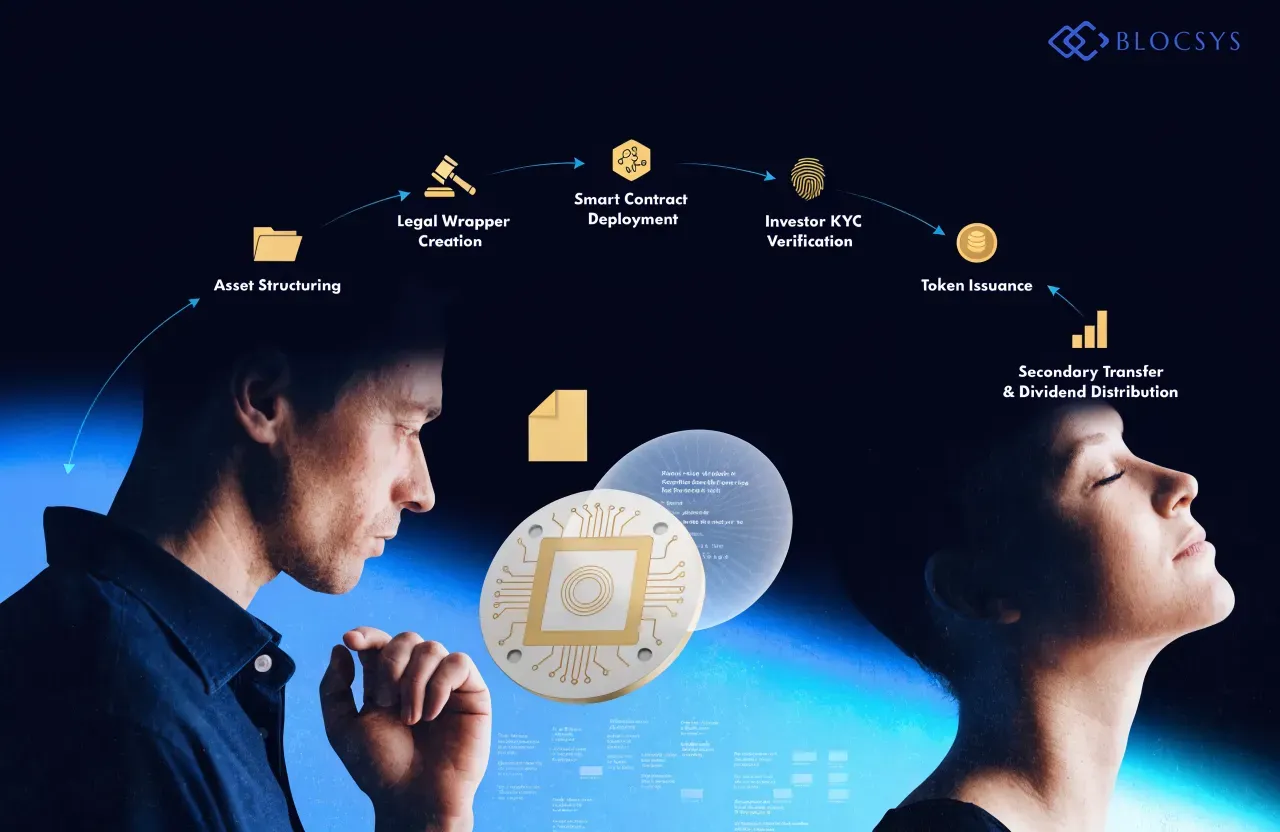
Token issuance follows a fairly predictable sequence, though each stage carries real technical and legal weight. It typically starts with asset structuring, where the underlying equity is wrapped into a legally compliant vehicle recognized under German law.
Next comes valuation and legal documentation, followed by smart contract deployment on a permissioned or public blockchain, depending on the issuer’s compliance strategy. After deployment, tokens are minted and distributed to verified investor wallets. Finally, the platform manages ongoing lifecycle events: dividend payouts, voting rights, buybacks, and eventual redemption or exit events.
Getting each step right matters. A poorly structured issuance can create legal exposure down the line, which is why enterprises increasingly work with specialized tokenization platform development partners rather than building this in-house from scratch.
Corporate Actions, Dividend Distribution & Governance
Once tokens are live, the real operational work begins. Corporate actions like dividend payments, share splits, and buybacks need to happen accurately across potentially thousands of token holders.
Automated dividend distribution is one of the most compelling use cases for Blockchain Private Equity. Instead of manually calculating and wiring payments to each investor, smart contracts distribute proceeds proportionally and instantly based on on-chain ownership records. Governance works similarly: shareholder votes can be tallied transparently and immutably, giving investors confidence that outcomes reflect actual ownership stakes rather than manual tabulation.
This level of automation isn’t just convenient, it’s a competitive advantage. Funds that can prove faster, more transparent distributions attract more institutional capital.
Blockchain Infrastructure and Security Best Practices
Security isn’t optional when you’re handling regulated financial instruments. Enterprise tokenization platforms need multiple layers of protection: audited smart contracts, multi-signature wallet controls, role-based access management, and continuous monitoring for suspicious on-chain activity.
Additionally, infrastructure decisions matter a lot. Should you build on a public chain, a permissioned consortium network, or a hybrid model? Each choice affects transaction costs, privacy, and regulatory alignment with BaFin’s supervisory expectations. Our teams at Blockchain Development typically recommend hybrid architectures for regulated private equity products, balancing transparency with investor privacy requirements.
Penetration testing, third-party smart contract audits, and disaster recovery planning round out a genuinely enterprise-ready security posture. Skipping these steps isn’t a shortcut, it’s a liability waiting to surface.
Implementation Roadmap for Private Equity Tokenization Development Germany
So, how does a typical engagement actually unfold? Most enterprise rollouts follow a phased approach:
- Phase 1 – Legal & Regulatory Assessment: Structuring the offering under EWpG and confirming BaFin licensing requirements.
- Phase 2 – Platform Architecture Design: Defining smart contract logic, cap table structure, and integration points.
- Phase 3 – Development & Smart Contract Deployment: Building the issuance engine, investor portal, and admin dashboards.
- Phase 4 – Compliance Integration: Wiring in KYC/AML providers and transfer restriction logic.
- Phase 5 – Pilot Launch: Testing with a limited investor group before full public rollout.
- Phase 6 – Scale & Secondary Market Enablement: Opening trading channels and expanding investor access.
Timelines vary, but enterprises typically move from kickoff to pilot launch within four to seven months, depending on regulatory complexity and integration scope.
Enterprise Use Cases: Real-World Blockchain Private Equity Examples
Theory is fine, but let’s talk about how this actually plays out. Private equity firms use tokenization to fractionalize large fund stakes, letting smaller institutional investors participate in deals that once required multi-million-euro minimums. Venture capital firms use it to give limited partners real-time visibility into portfolio performance instead of quarterly PDF reports.
Family offices increasingly tokenize direct holdings to simplify inheritance planning and cross-border transfers. Meanwhile, fintech startups are building entirely new secondary marketplaces where tokenized fund units trade among accredited investors. Even corporate treasuries are exploring tokenized equity structures for employee ownership programs, replacing clunky option pools with programmable, transparent token grants.
These aren’t hypothetical scenarios anymore. They’re active development projects across Germany, Switzerland, Luxembourg, and increasingly the UAE and Singapore, wherever regulators have created workable frameworks for digital securities.
Comparison Table: Traditional PE vs Tokenized Private Equity
| Aspect | Traditional Private Equity | Tokenized Private Equity |
|---|---|---|
| Minimum Investment | Typically high, often €100,000+ | Fractional, can start far lower |
| Settlement Time | Weeks, involving manual paperwork | Minutes to hours via smart contracts |
| Liquidity | Very limited, long lock-up periods | Enabled through regulated secondary markets |
| Cap Table Accuracy | Manual, prone to errors | Automated, real-time on-chain records |
| Compliance Checks | Manual review processes | Automated KYC/AML enforcement |
| Dividend Distribution | Manual calculation and payment | Automated via smart contracts |
As the table shows, Tokenized Private Equity doesn’t just digitize existing processes, it fundamentally restructures how private markets operate.
The Future of Private Equity Tokenization in Germany (2026 and Beyond)
Looking ahead, expect deeper integration between tokenized securities and traditional banking rails. German custodians are already building bridges between crypto securities registers and conventional settlement systems, which should reduce friction for institutional adoption even further.
Furthermore, cross-border interoperability is gaining traction. As Switzerland, Luxembourg, and the Netherlands align their digital securities frameworks, tokenized private equity products issued in Germany may soon trade seamlessly across neighboring markets. That’s a meaningful shift for asset managers thinking beyond domestic fundraising.
Artificial intelligence is also entering the picture, powering smarter compliance automation, predictive investor matching, and real-time risk scoring for tokenized portfolios. Enterprises that build flexible, AI-ready infrastructure now will have a clear edge as these capabilities mature.
Why Choose Blocsys for Private Equity Tokenization Development
Blocsys builds compliant, enterprise-grade tokenization infrastructure for private equity firms, asset managers, and fintech companies across Germany and beyond. We combine regulatory awareness of BaFin and EWpG requirements with hands-on blockchain engineering experience, covering everything from asset tokenization platform design to real world asset tokenization and smart contract development.
Whether you’re a startup founder exploring your first tokenized fund or an enterprise CTO modernizing legacy fund administration, our team delivers full-stack solutions, from legal structuring support through to investor dashboards and secondary market enablement. If you’re ready to move forward, our Equity Tokenization Platform Development services are built specifically for this moment.
Tokeniser for Private Equity in Germany
A tokeniser can help German enterprises, fund managers, and family offices convert private equity interests into blockchain-based digital assets while supporting transparent ownership records and streamlined transfers. For businesses exploring private equity tokenisation in Germany, a tokeniser should support secure asset issuance, investor management, compliance requirements, and efficient settlement. Choosing the right tokeniser infrastructure can therefore help enterprises build scalable and regulation-aware digital asset platforms.
Frequently Asked Questions
Here are direct answers to the questions we hear most often about Private Equity Tokenization Development in Germany.
What is private equity tokenization in Germany?
Private equity tokenization in Germany refers to converting ownership interests in private companies or funds into blockchain-based digital tokens, recognized as legally binding securities under the Electronic Securities Act (EWpG). Each token represents a fractional, verifiable claim on the underlying equity.
Germany’s regulatory framework, overseen by BaFin, allows these tokens to carry the same legal weight as traditional paper certificates. This makes Germany Private Equity Tokenization a practical, compliant alternative to conventional private placement structures for enterprises seeking broader investor access and faster settlement.
How does private equity tokenization work?
The process starts by structuring the underlying equity into a legally compliant vehicle, then deploying smart contracts that mint digital tokens representing fractional ownership. Investors complete KYC/AML verification, after which tokens are distributed to whitelisted wallets.
From there, the platform manages the full lifecycle: transfers, dividend distributions, governance votes, and eventual redemption. Smart contracts automate compliance rules like transfer restrictions and investor eligibility, so ownership records stay accurate without manual reconciliation across the entire Tokenized Private Equity structure.
Why is Germany becoming a leader in private equity tokenization?
Germany built clear legal foundations early, particularly through the eWpG, which gave digital securities the same enforceability as traditional instruments. BaFin’s supervisory clarity around crypto securities registers gave institutions the confidence to launch real products, not just pilots.
Add in Germany’s deep banking infrastructure and growing enterprise appetite for alternative investment structures, and you get a jurisdiction where Private Equity Tokenization Development Germany has matured faster than in many neighboring markets, without regulatory ambiguity slowing adoption down.
What are the benefits of tokenizing private equity?
Tokenization brings fractional ownership, faster settlement, automated compliance, and secondary liquidity to a historically illiquid asset class. Investors gain access to deals that once required massive minimum commitments, while issuers reduce administrative overhead through digital cap tables and automated dividend distribution.
For enterprises, Tokenized Private Equity also improves transparency and auditability. Every transaction lives on an immutable ledger, reducing disputes and simplifying regulatory reporting, something traditional spreadsheet-based cap tables simply can’t match at scale.
Which regulations govern private equity tokenization in Germany?
Two frameworks matter most: the Electronic Securities Act (eWpG), which legally recognizes blockchain-based securities without physical certificates, and BaFin’s supervisory rules governing crypto securities registrars, licensing, and investor protection.
Depending on structure and distribution, issuers may also need to consider prospectus requirements and EU-wide securities regulations. Working with legal and technical partners familiar with Digital Securities Germany requirements early in the process helps avoid costly restructuring later.
What role does BaFin play in private equity tokenization?
BaFin supervises the entities that maintain crypto securities registers, ensuring they meet strict IT security, governance, and operational resilience standards before authorization. It also applies existing securities law principles to tokenized instruments rather than creating a separate, disconnected regime.
In practice, this means BaFin Digital Securities oversight gives issuers and investors confidence that tokenized private equity products meet the same investor protection standards as traditional financial instruments, which is a major reason institutional capital keeps flowing into this space.
What features should a private equity tokenization platform include?
A strong platform needs token issuance capabilities, automated KYC/AML, real-time cap table management, smart contract-based transfer restrictions, investor dashboards, wallet integration, dividend automation, and governance modules for shareholder voting.
Compliance reporting aligned with BaFin and EWpG requirements is essential too. Enterprises should treat these as baseline requirements, not optional add-ons, when evaluating vendors for Private Equity Tokenization Development, since missing components often mean costly rework later.
How secure are blockchain-based private equity tokenization platforms?
Security depends heavily on implementation. Enterprise-grade platforms use audited smart contracts, multi-signature wallet controls, role-based access management, and continuous on-chain monitoring to detect suspicious activity before it causes damage.
Third-party security audits and penetration testing should happen before any public launch. When built correctly, Tokenized Private Equity platforms can actually offer stronger security and auditability than traditional paper-based systems, since every transaction is permanently recorded and traceable.
How much does it cost to develop a private equity tokenization platform in Germany?
Costs vary widely based on scope, from a focused MVP with core issuance and KYC features to a full enterprise platform with governance, secondary trading, and multi-jurisdiction compliance. Legal structuring costs under EWpG also factor into the total budget.
Rather than guessing, most enterprises start with a scoping consultation and use tools like the Software Development Cost Estimator to get a realistic budget range before committing to a full build.
Why should enterprises choose Blocsys for private equity tokenization platform development?
Blocsys combines deep blockchain engineering experience with genuine understanding of German regulatory requirements, including BaFin licensing considerations and eWpG-compliant token structuring. We’ve built tokenization infrastructure spanning equity, bonds, and real-world assets for enterprise clients.
Beyond technical delivery, we support founders and CFOs through the entire journey, from legal structuring conversations to post-launch platform scaling. If you want a partner that understands both the blockchain and regulatory sides, our Hire Blockchain Developers team is ready to help.
Tokenized Private Equity isn’t a distant trend anymore, it’s an active, regulated, and increasingly mainstream way to structure private capital in Germany. Whether you’re a private equity firm looking to expand your investor base or a fintech founder building the next generation of digital asset platforms, the infrastructure and legal clarity now exist to make this real. Reach out to Blocsys to discuss your Equity Tokenization Platform Development project, and let’s build something that’s genuinely enterprise-ready, compliant, and built for where private markets are heading.
Ready to move beyond theory and build an intelligent platform that delivers real-world value? Blocsys Technologies specialises in engineering enterprise-grade AI and blockchain solutions for the fintech, Web3, and digital asset sectors. Connect with our experts today to discuss your vision and chart a clear path from concept to a secure, scalable reality.
