
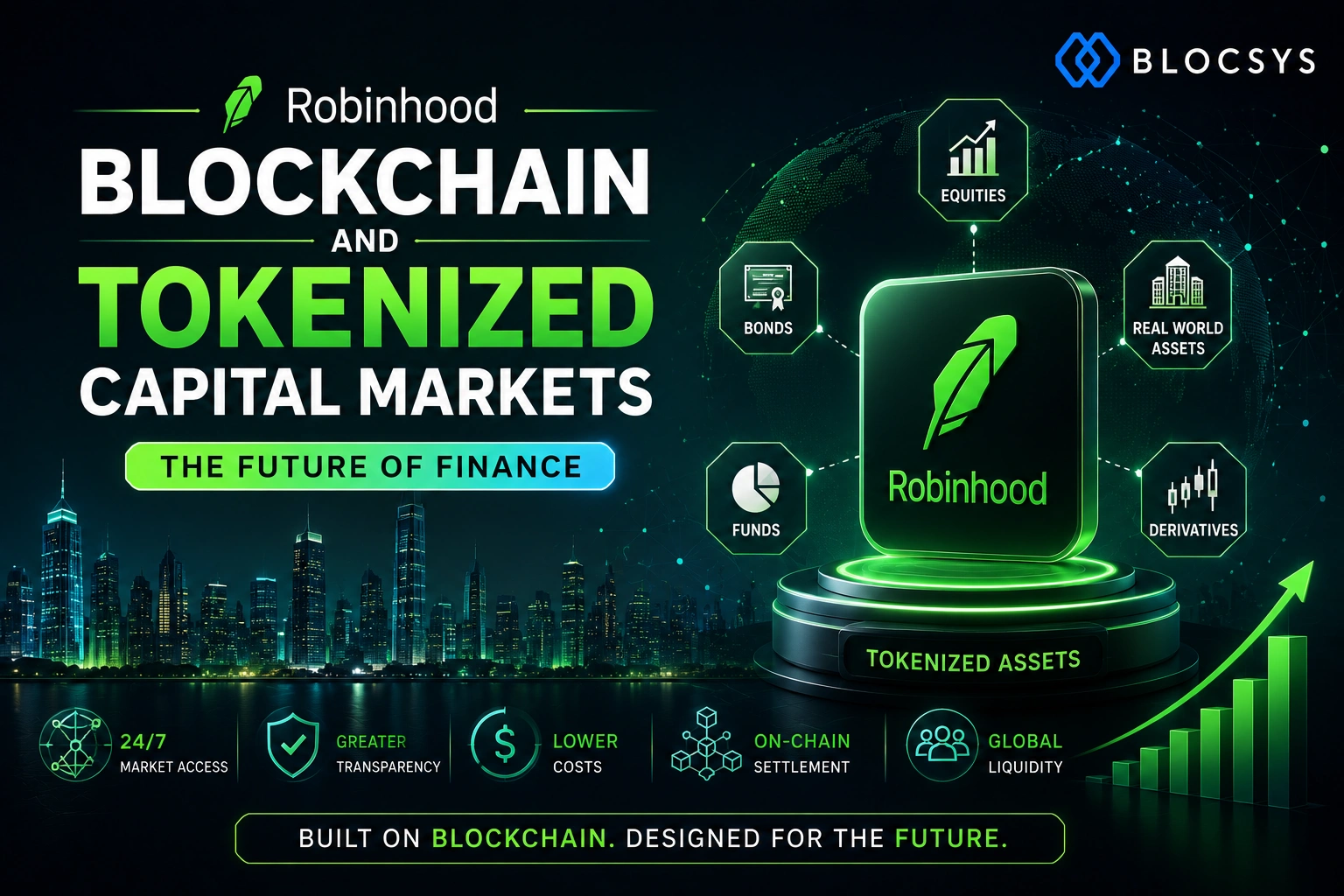
Robinhood Blockchain and the Future of Tokenized Capital Markets
Capital markets have run on the same basic plumbing for decades: central depositories, clearinghouses, transfer agents, and a settlement cycle that still takes days for many assets. That’s starting to shift. Robinhood Blockchain has become one of the more closely watched examples of a retail-facing brokerage building its own blockchain infrastructure for tokenized assets, and it’s worth understanding what that actually means before you assume it changes everything overnight. If you’re evaluating how tokenized capital markets fit into your own roadmap, our Robinhood Blockchain Development Services team works through exactly these questions with financial institutions and fintech teams every week.
This piece looks at what tokenized capital markets are, how issuance, settlement, custody, and trading could move on-chain, and where Robinhood Blockchain realistically fits into that picture. We’ll separate confirmed capabilities from roadmap items and future possibilities, because that distinction matters a lot more than the marketing usually suggests.
A Simple Definition: Robinhood Blockchain and Tokenized Capital Markets
Robinhood Blockchain, publicly announced by Robinhood as “Robinhood Chain,” is a layer-2 network built on Arbitrum’s technology stack, designed to support tokenized assets including equities and crypto-linked products. Tokenized capital markets refer to the broader shift of issuing, trading, settling, and holding financial instruments such as equities, bonds, and funds as digital tokens on blockchain infrastructure rather than through purely paper or centralized database records. Both concepts are connected but not identical — one is a specific piece of infrastructure, the other is an industry-wide trend.
What Is Robinhood Blockchain, Exactly?
Robinhood announced its own blockchain network in 2025, built using Arbitrum Orbit technology, positioned to eventually host tokenized stocks, ETFs, and other financial products. According to Robinhood’s own announcements, the network is designed as a layer-2 chain, meaning it settles transactions with the security backing of Ethereum while processing activity faster and at lower cost than Ethereum’s base layer.
Here’s the important nuance: Robinhood’s initial tokenized stock offering for EU customers launched on Arbitrum’s existing infrastructure, not on Robinhood Chain itself. Robinhood Chain was described as the next step, intended to eventually host these tokenized products natively. That’s a meaningful distinction, and it’s one that gets glossed over a lot in casual coverage.
The gap between “announced a chain” and “migrated live financial products onto it” is where most tokenization projects actually live or die. Infrastructure announcements move fast; regulated asset migration moves at the pace of compliance, custody agreements, and market infrastructure readiness.
Confirmed Capabilities vs. Roadmap Items
As of now, publicly confirmed elements include the Arbitrum Orbit-based architecture, the stated goal of supporting tokenized equities and other real-world assets, and Robinhood’s broader push into tokenized stock trading for European customers. Planned or roadmap-stage elements include full migration of tokenized products onto Robinhood Chain, expanded self-custody functionality, and broader institutional access. Treat anything beyond the confirmed architecture and initial product launch as directional, not delivered.
Why Financial Institutions Are Exploring Tokenized Capital Markets
So why does any of this matter to a bank, asset manager, or securities issuer? Traditional capital markets involve a long chain of intermediaries — custodians, transfer agents, clearing corporations, and multiple reconciliation steps between them. Each handoff adds time, cost, and operational risk.
Tokenization offers a way to represent ownership, transfer rights, and settlement instructions in a single programmable record. That doesn’t automatically make markets faster or cheaper, though. Benefits depend heavily on network design, legal enforceability of the token, and whether counterparties actually adopt the same rails.
Institutions like the Depository Trust & Clearing Corporation (DTCC) and various central banks have run pilots exploring tokenized settlement specifically because current post-trade infrastructure still relies on batch processing and multi-day cycles for some asset classes. That’s the real motivation — not novelty, but operational friction that’s been expensive for a long time.
Traditional Capital Markets vs. Tokenized Capital Markets
It helps to see the comparison directly rather than in the abstract. Here’s how the core functions differ conceptually:
| Function | Traditional Capital Markets | Tokenized Capital Markets |
|---|---|---|
| Issuance | Paper or centralized registry records | Smart contract-based token issuance |
| Ownership records | Held by transfer agents and depositories | Recorded on distributed ledger, often permissioned |
| Settlement | T+1 or T+2 cycles, multiple intermediaries | Potentially near-instant, dependent on network design |
| Custody | Regulated custodian banks | Digital wallets, often alongside regulated custodians |
| Compliance | Manual and periodic checks | Programmable rules embedded in smart contracts |
Notice that tokenized capital markets don’t eliminate regulated intermediaries in this table — custodians, compliance officers, and legal structures still show up. They just operate differently, often with more automation layered underneath them.
How Blockchain Capital Markets Infrastructure Actually Works
Let’s break down the mechanics without the hype. Blockchain capital markets infrastructure typically touches six areas: issuance, ownership and transfer, settlement, custody, collateral management, and post-trade operations. Each one behaves a little differently once you move it on-chain.
Tokenized Securities Issuance
Issuing a security on-chain means creating a smart contract that defines the token’s supply, transfer rules, and any embedded rights, such as dividend distribution or voting. This doesn’t replace the legal work of structuring a security offering. It sits on top of it. You still need the underlying legal agreement, the issuer’s disclosures, and jurisdiction-specific securities compliance before a single token gets minted.
Ownership and Transfer Management
On-chain ownership records can update in near real time when a transfer executes, rather than waiting for a batch reconciliation between multiple parties. However, whether that record is legally authoritative depends entirely on the jurisdiction and how the token is structured. In some markets, the blockchain record supplements a traditional register; in others, regulatory frameworks are still catching up to recognize it as the primary source of truth.
Blockchain Settlement
Blockchain settlement can, in theory, compress the traditional multi-day cycle into something closer to instant, atomic settlement — meaning the asset and payment change hands simultaneously. Whether that actually happens depends on network throughput, whether both legs of the trade (cash and security) live on the same or interoperable chains, and whether regulators permit that settlement finality for the given asset class. It’s a real capability, not a guaranteed outcome.
Robinhood Blockchain’s Role in Institutional Capital Market Infrastructure
Where does Robinhood Blockchain sit among all this? Right now, it’s positioned primarily around Robinhood’s own tokenized product line, particularly tokenized equities offered to European users. That’s a retail-facing use case first, not a full institutional settlement network in current form.
That said, the underlying architecture — layer-2, Arbitrum-based, designed for programmable financial assets — is the same category of infrastructure institutions look at when evaluating blockchain capital markets projects generally. The interesting question for enterprise readers isn’t “will Robinhood Blockchain become the institutional standard,” it’s “what architectural patterns is it demonstrating that are relevant to my own tokenization strategy.”
Consequently, we’d frame Robinhood Blockchain less as a finished institutional platform and more as a live case study in how a consumer fintech company approaches Layer-2 infrastructure for tokenized assets. Enterprises building parallel or competing infrastructure can learn from its architecture choices without assuming it’s already serving institutional custody or settlement functions at scale.
Robinhood Blockchain Development Considerations for Enterprises
If your organization is exploring similar Robinhood Blockchain development patterns — a dedicated layer-2 network for tokenized financial products — a few technical questions come up consistently: How do you handle asset interoperability with existing chains? What’s your approach to regulatory-compliant token standards? And how do you structure custody so digital wallets align with existing custodian relationships rather than replacing them entirely? Our Blockchain Development team fields these questions constantly from institutions evaluating their own tokenization architecture.
How Smart Contracts Support Tokenized Financial Assets
Smart contracts are the programmable logic that makes tokenized securities behave differently than a simple digital certificate. A well-structured smart contract can enforce transfer restrictions automatically — for example, blocking a transfer to a wallet that hasn’t passed KYC, or restricting a security token to accredited investors only, depending on the offering’s legal structure.
That programmability extends to corporate actions too. Dividend distribution, interest payments on tokenized bonds, and voting rights can all execute through contract logic rather than manual processing. This is genuinely useful, but it also means the contract’s code needs rigorous auditing since bugs in a financial smart contract carry real monetary consequences. Our Smart Contract Development practice treats security auditing as a non-negotiable step, not an afterthought.
Custody, Collateral, and Digital Wallets in Tokenized Markets
Custody is one of the areas where tokenized capital markets still lean heavily on traditional structures. Institutional-grade digital asset custody typically requires regulated custodians, multi-signature wallet architecture, and insurance arrangements — none of which disappear just because an asset is tokenized. If anything, custody gets more nuanced, since private key management introduces a new operational risk category that didn’t exist with paper certificates.
Collateral management is another area worth watching. Tokenized assets can theoretically be posted as collateral more efficiently, since ownership transfer can be near-instant and programmable. But that only works if the counterparty accepts the token as valid collateral under existing margin and risk frameworks, and if the legal enforceability of that collateral arrangement is settled under relevant jurisdiction. This is exactly why we built out dedicated Real World Asset Tokenization frameworks that account for these legal and operational dependencies rather than treating tokenization as a purely technical exercise.
Interoperability with Existing Financial Systems
No tokenized capital markets network operates in isolation. Interoperability — the ability for one blockchain network to communicate with another, and for blockchain systems to connect with legacy banking rails — is arguably the biggest unsolved technical challenge in this space. Robinhood Blockchain, built on Arbitrum’s technology, benefits from Ethereum’s broader interoperability ecosystem, but connecting tokenized securities to traditional payment rails, existing custodians, and legacy clearing systems still requires deliberate integration work.
This is where a lot of tokenization projects stumble. It’s straightforward to issue a token. It’s much harder to make that token move seamlessly between a bank’s core system, a custodian’s ledger, and a public or permissioned blockchain without manual reconciliation somewhere in the chain.
Regulatory Landscape for Tokenized Securities and Digital Securities
Regulatory treatment of tokenized securities depends on the underlying asset, the rights attached to the token, the issuer, and the jurisdiction — there’s no single global rulebook. In the European Union, the Markets in Crypto-Assets Regulation (MiCA) governs crypto-asset service providers, while the EU’s DLT Pilot Regime allows regulated testing of blockchain-based trading and settlement for certain financial instruments. In the United States, tokenized securities generally fall under existing securities law, meaning a tokenized share is still subject to the same disclosure and registration requirements as its traditional counterpart, as enforced by the SEC.
The UK’s Financial Conduct Authority has run its own Digital Securities Sandbox to test blockchain-based settlement under supervised conditions. Singapore’s Monetary Authority and Switzerland’s FINMA have each published guidance addressing token classification. None of these frameworks apply uniformly to every tokenized asset — always get jurisdiction-specific legal review before structuring an offering.
Enterprise Adoption Opportunities and Realistic Use Cases
Let’s look at a hypothetical, illustrative scenario to ground this. Imagine a mid-sized private equity firm wants to offer fractional ownership in a fund to accredited investors through tokenized fund units. The tokenization model would involve issuing security tokens representing limited partnership interests, embedding transfer restrictions that enforce accredited investor status, and connecting the token registry to the fund administrator’s existing records.
The blockchain application here isn’t about eliminating the fund administrator — it’s about giving investors a faster, more transparent way to see their position and transfer it (subject to lock-up terms) without a manual paperwork cycle. Expected value includes reduced administrative overhead and faster secondary transfers, though actual liquidity still depends on finding willing buyers, since tokenization doesn’t create a market by itself. This is illustrative only — not a real deployment — but it reflects the kind of use case enterprises are genuinely evaluating today.
Where Institutional Blockchain Infrastructure Adds the Most Value
Post-trade operations tend to be where institutional blockchain infrastructure shows the clearest value, because reconciliation between multiple parties is exactly the kind of redundant, manual process a shared ledger can reduce. Our work on Permissioned Blockchain Infrastructure for Capital Market Post-Trade Operations focuses specifically on this — giving counterparties a shared, permissioned view of trade status instead of each side maintaining separate records that need constant reconciliation.
Benefits and Limitations of Capital Markets Tokenization
Capital markets tokenization brings real advantages: programmable compliance, faster theoretical settlement, and more granular fractional ownership. However, it doesn’t automatically deliver liquidity, and it doesn’t remove the need for regulated intermediaries in most jurisdictions. A tokenized bond still needs a legal issuer, a governing prospectus, and often a licensed distributor.
Limitations worth noting include fragmented liquidity across multiple chains, regulatory uncertainty in cross-border scenarios, and the operational reality that legacy financial institutions move slowly when adopting new settlement rails. Consequently, most realistic near-term deployments look like hybrid models — blockchain infrastructure running alongside, not instead of, traditional systems.
Implementation Considerations and Risks
Before greenlighting a tokenization project, enterprises should map out a few things clearly: which jurisdiction’s securities laws apply, how custody will be structured, whether the token standard supports the compliance rules you need, and how you’ll handle interoperability with counterparties who aren’t on the same chain. Security auditing for smart contracts isn’t optional — a single vulnerability in a contract governing millions in tokenized assets is a catastrophic failure mode, not a minor bug.
Document integrity matters too, particularly for KYC and compliance records tied to tokenized offerings. Our Blockchain Document Verification System for Secure Digital Proof addresses exactly this kind of tamper-proof record-keeping need for regulated environments.
Why Blocsys Is a Trusted Enterprise Blockchain Development Company
We’ve spent years building enterprise-grade blockchain infrastructure across tokenization, smart contracts, and institutional-facing platforms. As an Enterprise Blockchain Development Company, Blocsys works with financial institutions, fintech companies, and digital asset businesses on projects ranging from Corporate Bond Tokenization to Equity Tokenization Platform development and Institutional OTC Crypto Trading Platform builds.
If you’re exploring how Robinhood Blockchain’s architecture applies to your own tokenized capital markets strategy, our team can walk through the technical and regulatory tradeoffs specific to your asset class and jurisdiction. For teams that need dedicated capacity rather than a project-based engagement, our Dedicated Blockchain Engineering Teams plug directly into your existing roadmap. And if cost is the open question right now, use our Cost Estimator Tool for a project-specific figure rather than relying on generic industry numbers that rarely match your actual scope.
The Future of Tokenized Capital Markets
Where does this go from here? Expect continued fragmentation in the short term — multiple chains, multiple regulatory sandboxes, and competing standards — before real consolidation happens. Robinhood Blockchain represents one path among several major players exploring dedicated infrastructure for tokenized assets, alongside traditional financial institutions running their own pilots.
The winners in tokenized capital markets likely won’t be defined by which chain is fastest. They’ll be defined by which platforms solve interoperability, regulatory compliance, and custody credibly enough that institutional capital actually feels comfortable moving onto them. That’s a harder problem than technology alone, and it’s why enterprises exploring this space need partners who understand both the blockchain architecture and the capital markets context around it. If you’re ready to start scoping a project, our Robinhood Blockchain Development Services page is a good starting point for a focused conversation.
Frequently Asked Questions
Here are direct answers to the questions we hear most often about Robinhood Blockchain and tokenized capital markets.
What is Robinhood Blockchain?
Robinhood Blockchain, also called Robinhood Chain, is a layer-2 network built using Arbitrum’s technology stack, announced by Robinhood to support tokenized financial products such as equities. It’s designed to eventually host tokenized assets natively, though Robinhood’s initial tokenized stock offering for EU customers launched using Arbitrum’s existing infrastructure rather than the dedicated chain itself. The distinction between announced architecture and live migration matters when evaluating its current maturity.
What are tokenized capital markets?
Tokenized capital markets refer to the practice of issuing, trading, settling, and holding financial instruments like equities, bonds, and funds as digital tokens on blockchain infrastructure rather than through purely centralized databases or paper records. This can affect issuance, ownership tracking, settlement speed, and custody, though the extent of change depends on network design, legal frameworks, and how widely counterparties adopt the same infrastructure.
How can Robinhood Blockchain support tokenized capital markets?
Robinhood Blockchain could support tokenized capital markets by providing dedicated layer-2 infrastructure for issuing and transferring tokenized equities and related products. Its Arbitrum-based architecture inherits Ethereum’s security model while aiming for lower transaction costs. However, its current scope is centered on Robinhood’s own product line rather than serving as broad institutional market infrastructure, so its role in wider capital markets is still developing.
Why are financial institutions exploring tokenized capital markets?
Financial institutions are exploring tokenized capital markets because current settlement cycles, often T+1 or T+2, involve multiple intermediaries and manual reconciliation that add cost and operational risk. Tokenization offers programmable settlement and ownership tracking that could reduce friction, though actual gains depend on adoption, legal enforceability, and whether counterparties operate on interoperable infrastructure rather than isolated networks.
How does blockchain improve capital market infrastructure?
Blockchain can improve capital market infrastructure by consolidating fragmented ownership and settlement records into a shared, programmable ledger, reducing reconciliation between multiple parties. It enables smart contracts to automate compliance checks and corporate actions like dividend distribution. That said, blockchain doesn’t automatically deliver faster settlement or lower costs; those outcomes depend on network throughput, legal structure, and integration with existing custodians and payment rails.
What assets can be tokenized in capital markets?
Capital markets can tokenize equities, corporate and government bonds, private fund interests, real estate, and other real-world assets. Each asset class carries different regulatory treatment depending on the rights attached to the token and the jurisdiction involved. Tokenized securities representing equity or debt typically fall under existing securities law, while other tokenized assets may face different classification depending on local crypto-asset or financial market regulation.
How do smart contracts support tokenized securities?
Smart contracts support tokenized securities by encoding transfer restrictions, compliance rules, and corporate actions directly into the token’s logic. For example, a contract can automatically block transfers to non-KYC-verified wallets or distribute dividends proportionally to token holders. This programmability adds efficiency, but it also raises the stakes on smart contract security, since coding errors in financial contracts can cause direct monetary loss.
What are the regulatory considerations for tokenized capital markets?
Regulatory considerations depend on the underlying asset, token structure, issuer, and investor type, and they vary significantly by jurisdiction. Frameworks like the EU’s MiCA and DLT Pilot Regime, the UK’s Digital Securities Sandbox, and existing US securities law all apply differently depending on the offering. There’s no single regulation covering all tokenized assets globally, so jurisdiction-specific legal review is essential before any issuance.
What challenges do enterprises face when adopting tokenized capital market infrastructure?
Enterprises commonly face challenges around interoperability between blockchain networks and legacy financial systems, unclear or evolving regulatory treatment across jurisdictions, custody arrangements for digital assets, and smart contract security auditing. Liquidity fragmentation is another real concern, since tokenization alone doesn’t guarantee active secondary markets. Successful adoption usually requires hybrid models that connect blockchain infrastructure to existing custodians and compliance systems rather than replacing them outright.
How can businesses build a tokenized capital markets platform?
Businesses building a tokenized capital markets platform need to define the legal structure of the asset first, then select a blockchain architecture that supports compliant token standards, custody integration, and interoperability with counterparties. Smart contract security auditing and regulatory review should happen before launch, not after. Working with an experienced Hire Blockchain Developers partner familiar with capital markets compliance can meaningfully reduce implementation risk.
Tokenized capital markets are still taking shape, and Robinhood Blockchain is one visible data point in a much larger shift toward programmable financial infrastructure. If your organization is weighing whether to build on existing rails, a dedicated layer-2 network, or a hybrid approach, it helps to talk through the tradeoffs with a team that’s built this kind of infrastructure before. Reach out to Blocsys to discuss Enterprise Blockchain Development, Tokenization Platform Development, or Digital Asset Platform Development suited to your specific asset class, jurisdiction, and timeline — and if you’re weighing costs, run your numbers through our Cost Estimator Tool before committing to a scope.
Ready to move beyond theory and build an intelligent platform that delivers real-world value? Blocsys Technologies specialises in engineering enterprise-grade AI and blockchain solutions for the fintech, Web3, and digital asset sectors. Connect with our experts today to discuss your vision and chart a clear path from concept to a secure, scalable reality.
