
Robinhood Blockchain and the Rise of Tokenized Securities: How On-Chain Assets Are Reshaping Global Finance
Robinhood Blockchain has quickly become one of the most talked-about developments in capital markets. It signals something bigger than one company’s product launch. Wall Street, Web3 builders, and regulators are all watching how tokenized securities move from pilot projects to live infrastructure. If you’re a founder, CTO, or capital markets executive trying to make sense of this shift, you’re not alone. At Blocsys, we work with financial institutions and fintech teams building on-chain asset platforms, and we’ve watched interest in this space accelerate fast in 2026. This article breaks down what Robinhood Blockchain actually is, why tokenized securities matter, and how enterprises can build their own tokenized asset infrastructure through a proven tokenization platform development approach.
What Is Robinhood Blockchain?
Robinhood Blockchain refers to the trading platform’s expanding push into blockchain-based infrastructure, including its own layer-2 network often called Robinhood Chain. The goal is simple: let users trade tokenized stocks, ETFs, and other assets around the clock, without relying entirely on traditional exchange rails.
Robinhood first tested tokenized equities in Europe, offering users exposure to US stocks through blockchain-issued tokens. That move wasn’t just a marketing stunt. It showed a large, publicly traded brokerage was willing to bet real infrastructure on on-chain assets.
Here’s why that matters. When a company with millions of retail users starts issuing tokenized securities, it forces the rest of the industry to pay attention. Consequently, brokerages, exchanges, and asset managers now face pressure to evaluate their own blockchain strategy.
Robinhood Chain and Its Role in Tokenized Trading
Robinhood Chain is designed as a blockchain built specifically for financial products rather than general-purpose crypto activity. Think of it as purpose-built rails for tokenized stocks, derivatives, and eventually other regulated assets.
Unlike public chains built for anonymous peer-to-peer transfers, Robinhood Chain aims to support compliant trading, custody, and settlement. That distinction matters a lot for institutional adoption, since compliance officers rarely accept “just use Ethereum” as a full answer.
Robinhood Blockchain isn’t really about crypto speculation anymore. It’s a signal that traditional brokerages now see tokenization as core market infrastructure, not a side experiment.
Understanding Tokenized Securities and On-Chain Assets
Tokenized securities are digital representations of real financial instruments, issued and tracked on a blockchain. A tokenized stock, for example, represents ownership or economic exposure to an underlying share, recorded through smart contracts instead of paper certificates or siloed ledgers.
On-chain assets go further than equities. Bonds, real estate, private credit, funds, and commodities can all be tokenized. This broader category, often called Real World Asset (RWA) tokenization, is what’s driving serious institutional money into blockchain finance.
So what actually changes when an asset moves on-chain? Quite a lot, honestly.
- Ownership records live on a shared, tamper-resistant ledger.
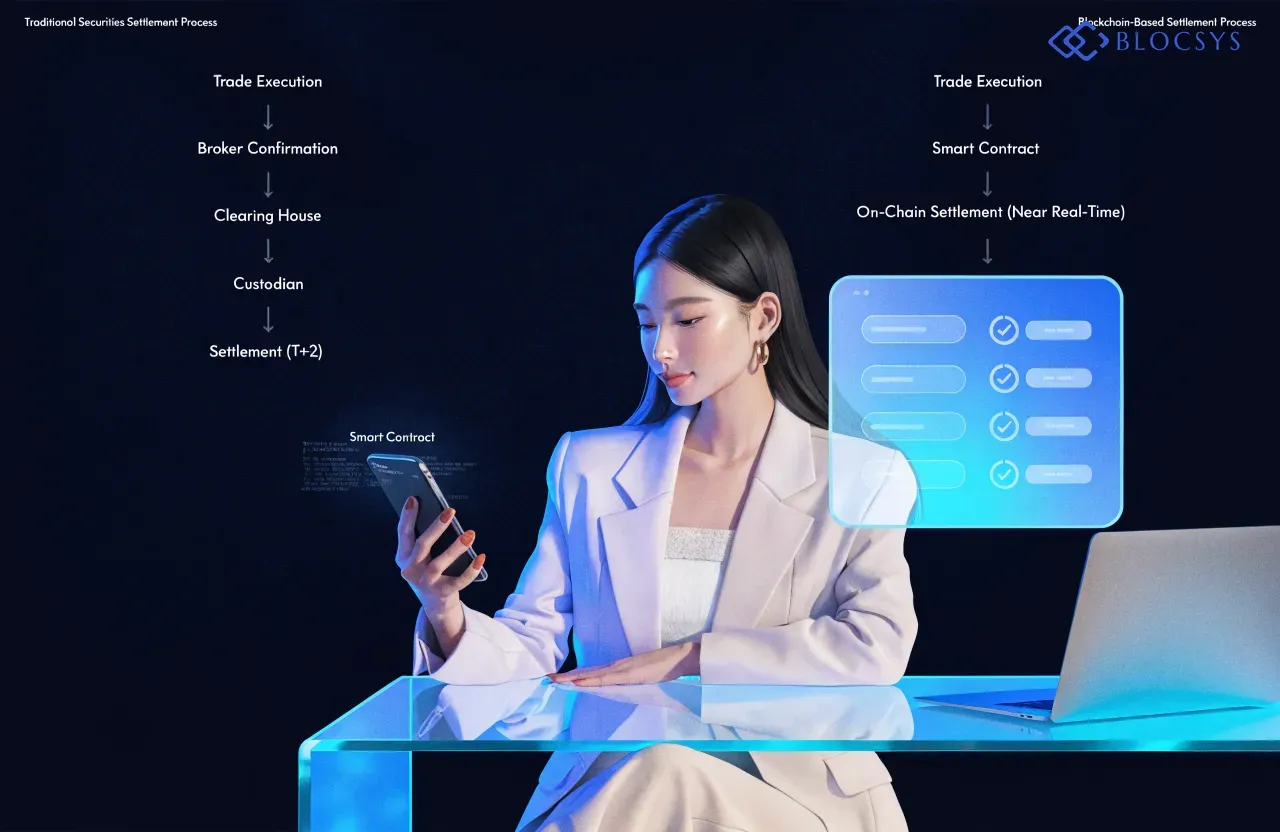
- Settlement can happen in near real time instead of T+1 or T+2.
- Fractional ownership becomes far easier to manage.
- Cross-border investors can access assets without heavy intermediary chains.
Digital securities aren’t a replacement for regulation, though. They still need proper legal structuring, custody arrangements, and disclosure frameworks. Tokenization changes the plumbing, not the underlying securities law.
Why Robinhood’s Blockchain Initiative Matters for Global Finance
Robinhood Blockchain matters because it validates something skeptics doubted for years: that mainstream, regulated platforms can offer tokenized securities at scale. That validation ripples across the entire industry.
Furthermore, Robinhood’s move puts pressure on competitors. Brokerages in the US, UK, Europe, UAE, and Singapore are now asking the same question internally: do we build tokenized infrastructure, or do we risk losing market share to platforms that already have it?
This is where things get interesting for enterprise decision-makers. Robinhood tokenized securities aren’t just a retail product. They’re a proof point that blockchain capital markets can operate within existing regulatory frameworks while still delivering faster settlement and broader access.
Robinhood Blockchain Strategy vs Traditional Brokerage Models
Traditional brokerages depend on layers of custodians, clearing houses, and settlement intermediaries. Each layer adds cost, delay, and operational risk. Robinhood’s blockchain strategy attempts to compress that stack.
That said, this shift doesn’t happen overnight. Legacy infrastructure, regulatory approval, and investor trust all take time to build. Still, the direction is clear, and other institutions are watching closely.
Current Market Trends and Institutional Adoption
Institutional adoption of tokenized securities has moved past pilot programs. Major asset managers now run tokenized money market funds. Global banks have issued tokenized bonds. Stock exchanges in Europe and Asia are testing tokenized listing frameworks.
According to industry estimates circulating in 2026, the tokenized asset market is projected to reach well into the trillions over the next several years, with RWA tokenization leading much of that growth. Even conservative estimates point to hundreds of billions in tokenized value already on-chain across bonds, funds, and private credit.
Why the sudden momentum? A few forces are converging at once:
- Clearer regulatory guidance in jurisdictions like the EU, UK, Switzerland, and UAE.
- Institutional-grade custody solutions reducing operational risk.
- Robinhood Blockchain and similar initiatives proving retail-scale demand.
- Enterprise blockchain infrastructure maturing beyond experimental phases.
Dubai and Singapore, in particular, have positioned themselves as tokenization-friendly hubs, actively courting fintech firms building digital securities platforms. That regulatory openness is accelerating global adoption in ways US markets are still catching up to.
Major Drivers Behind Blockchain-Powered Capital Markets
Several forces are pushing capital markets toward blockchain infrastructure. It’s not just one trend, it’s a convergence.
Settlement Efficiency and Liquidity
Traditional settlement cycles tie up capital and create counterparty risk. Blockchain-based settlement can compress that window dramatically, freeing up liquidity that would otherwise sit idle during processing delays.
Fractional Ownership and Access
Tokenized stocks and tokenized assets allow investors to own fractions of high-value instruments, from real estate to private equity. That opens markets previously reserved for institutional or high-net-worth investors.
24/7 Global Trading
Unlike traditional exchanges bound by regional trading hours, blockchain capital markets can theoretically operate continuously. This matters enormously for cross-border investors in Asia, the Middle East, and Europe trying to access US-listed assets.
We’ve seen firsthand how enterprises underestimate this demand until they start building. Once a platform supports round-the-clock settlement, user expectations shift permanently.
Benefits of Tokenized Securities for Enterprises and Investors
Enterprises exploring tokenized securities platforms typically care about a specific set of outcomes. Let’s walk through the practical benefits.
- Faster settlement: Smart contracts can execute trades and settle ownership changes in minutes rather than days.
- Lower operational cost: Fewer intermediaries mean reduced reconciliation and clearing expenses.
- Broader investor access: Fractional ownership and cross-border rails widen the addressable investor base.
- Transparent audit trails: Every transaction is recorded on-chain, simplifying compliance reporting.
- Programmable compliance: Smart contracts can enforce KYC/AML rules and transfer restrictions automatically.
Investors benefit too, obviously. Digital securities offer easier portfolio diversification, quicker liquidity access through secondary markets, and clearer ownership verification.
Tokenized Securities vs Traditional Securities
How exactly do tokenized securities differ from the traditional model? The table below breaks it down.
| Factor | Traditional Securities | Tokenized Securities |
|---|---|---|
| Settlement Time | T+1 to T+2 days | Near real-time to minutes |
| Ownership Record | Centralized registries | Blockchain-based ledger |
| Trading Hours | Limited to exchange hours | Potentially 24/7 |
| Fractional Ownership | Limited or complex | Native and programmable |
| Cross-Border Access | Multiple intermediaries | Direct on-chain access |
| Compliance Enforcement | Manual and periodic | Automated via smart contracts |
This comparison explains why so many enterprises are re-evaluating legacy infrastructure. Tokenized stocks aren’t just faster versions of old products, they’re structurally different at the settlement layer.
Blockchain Infrastructure Powering Digital Securities
Behind every tokenized securities platform sits a stack of infrastructure decisions: which blockchain, what custody model, and how compliance gets enforced. Getting these choices right early saves enormous rework later.
Enterprise tokenization platforms generally rely on permissioned or hybrid blockchain networks, smart contract frameworks for issuance and transfer logic, and integration layers connecting to custodians, banks, and KYC providers. Robinhood Chain follows this same pattern, prioritizing compliance-ready architecture over open, anonymous access.
Our team at Blocsys builds this exact stack for clients through our Real World Asset Tokenization services, combining smart contract architecture with custody and compliance integrations tailored to each jurisdiction.
Smart Contracts and Compliance Automation
Smart contracts do the heavy lifting in tokenized securities platforms. They handle issuance, enforce transfer restrictions, distribute dividends, and manage investor whitelists automatically.
Compliance automation is where things get technically demanding. A properly built smart contract needs to check investor accreditation status, enforce jurisdictional transfer limits, and maintain audit logs, all without manual intervention. This is precisely the kind of work our Smart Contract Development team handles for tokenized asset clients.
Investor Onboarding, KYC, and AML in Tokenized Markets
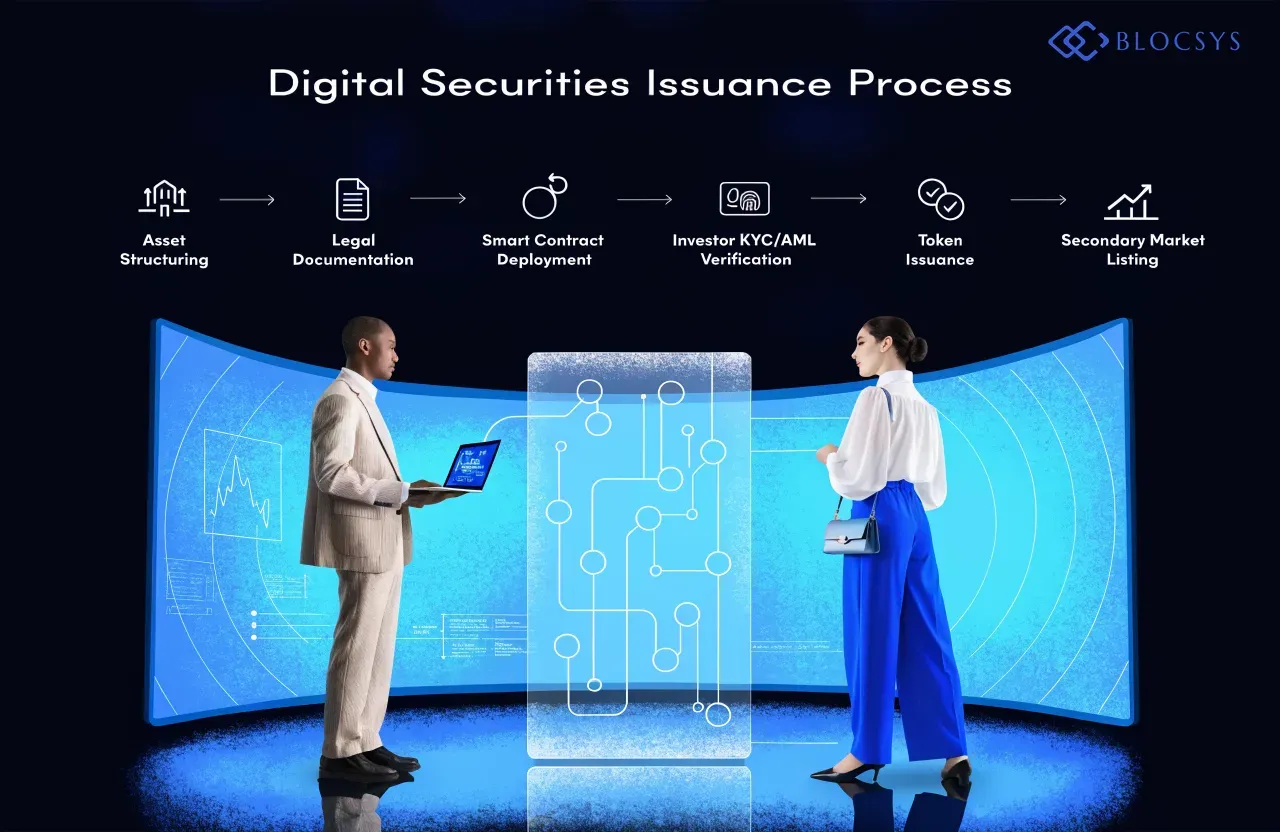
You can’t build a compliant tokenized securities platform without solid onboarding infrastructure. Investors need identity verification, accreditation checks, and jurisdictional screening before they ever touch a token.
Modern platforms increasingly automate this through on-chain identity credentials, meaning a verified investor doesn’t need to repeat KYC for every new asset on the same platform. That’s a meaningful efficiency gain for both platforms and users.
Additionally, AML monitoring needs to run continuously, not just at onboarding. Transaction monitoring tools flag unusual patterns across wallets, helping platforms stay ahead of regulatory expectations in the US, UK, and EU alike.
Regulatory and Compliance Considerations
Regulation remains the biggest variable in tokenized securities adoption. The SEC, FCA, ESMA, and regulators across Dubai and Singapore all treat tokenized securities as securities first, tokens second. That means existing securities law still applies.
Enterprises need to think about several regulatory layers simultaneously:
- Securities registration or exemption requirements in each target jurisdiction.
- Custody rules for digital assets, which vary significantly by region.
- Cross-border transfer restrictions and investor eligibility rules.
- Ongoing reporting obligations for issuers and platform operators.
Robinhood’s approach in Europe, working within MiFID-adjacent frameworks, shows one path forward. However, every enterprise still needs jurisdiction-specific legal counsel alongside its technology partner.
Enterprise Implementation Roadmap for Tokenized Securities
So how does an enterprise actually get from idea to live tokenized securities platform? Here’s the roadmap we typically walk clients through.
- Step 1 – Asset and market assessment: Identify which assets to tokenize and which investor base you’re targeting.
- Step 2 – Regulatory structuring: Work with legal counsel to define the compliant issuance structure.
- Step 3 – Blockchain selection: Choose infrastructure that fits compliance, scalability, and cost needs.
- Step 4 – Smart contract development: Build issuance, transfer, and compliance logic into audited contracts.
- Step 5 – Custody and onboarding integration: Connect KYC/AML providers and digital custody solutions.
- Step 6 – Secondary market enablement: Set up trading, liquidity pools, or exchange listings.
- Step 7 – Launch and ongoing compliance monitoring: Maintain reporting, audits, and platform upgrades.
This is exactly the process our team follows through tokenization platform development engagements, from initial architecture through post-launch support.
Real-World Use Cases Across Financial Services
Tokenized securities aren’t theoretical anymore. Several concrete use cases are already live or in advanced pilot stages across financial services.
Asset managers are tokenizing money market funds to offer faster redemption and settlement. Real estate firms are fractionalizing commercial property to widen their investor pool. Private credit funds are using tokenization to improve liquidity for traditionally illiquid instruments.
Exchanges, meanwhile, are exploring tokenized listing frameworks alongside traditional order books. For teams building trading infrastructure, our Crypto Trading Platform Development and OTC Trading Platform Development services support exactly this kind of hybrid market structure.
Post-trade operations are getting a rework too. Our Permissioned Blockchain Infrastructure for Capital Market Post-Trade Operations work with financial institutions shows how much friction disappears when reconciliation moves on-chain.
Robinhood’s Blockchain Strategy and the Future of Tokenized Capital Markets
Where does Robinhood Blockchain go from here? Expect expansion beyond equities into tokenized ETFs, potentially fixed income, and broader international access. Robinhood Chain positions the company to control more of its own settlement infrastructure rather than depending entirely on third parties.
More importantly, Robinhood’s moves are pushing the entire industry forward. Competing brokerages, exchanges, and fintech platforms across the US, Europe, and Asia are accelerating their own blockchain roadmaps in response. That competitive pressure is good for the market overall.
AI integration is entering this picture too. AI-driven compliance monitoring, portfolio construction, and risk scoring are increasingly layered on top of tokenized asset infrastructure, creating smarter, more responsive digital securities platforms.
Challenges and Future Opportunities
None of this comes without challenges. Regulatory fragmentation across jurisdictions remains a real obstacle. Liquidity for newly tokenized assets can be thin initially. Interoperability between different blockchain networks still needs work.
That said, the opportunity outweighs the friction for most enterprises willing to move early. Organizations building tokenized infrastructure now position themselves ahead of competitors still relying on legacy rails. Early movers also get to shape emerging standards rather than react to them later.
Why Blocsys Is the Ideal Enterprise Tokenization Platform Development Partner
Building a compliant, scalable tokenized securities platform requires more than writing smart contracts. It demands deep understanding of capital markets, custody, regulatory frameworks, and enterprise-grade security.
Blocsys has spent years building blockchain financial infrastructure for brokerages, asset managers, and fintech innovators. Our Asset Tokenization Platform solutions cover everything from issuance to secondary trading, backed by our Dedicated Blockchain Engineering Teams and Real World Asset Tokenization Developers.
Whether you need a full Blockchain Development Company partner, want to Hire Blockchain Developers or Hire Web3 Developers, or need document integrity solutions through our Blockchain Document Verification System, our team builds infrastructure that meets institutional standards from day one.
Tokenized Securities and Digital Asset Opportunities in GIFT City
GIFT City can be a relevant setting for businesses exploring tokenized securities and blockchain-based financial infrastructure. On-chain securities can provide digital representations of financial assets while supporting functions such as ownership management, asset transfers, transaction processing, and recordkeeping. For businesses evaluating tokenized securities solutions, these capabilities can help shape digital asset platforms suited to the evolving financial ecosystem in GIFT City.
Frequently Asked Questions
Here are direct answers to the questions we hear most often about Robinhood Blockchain and tokenized securities.
What is Robinhood Blockchain and how does it work?
Robinhood Blockchain is the brokerage’s blockchain infrastructure initiative, including Robinhood Chain, built to support tokenized stock trading and settlement. It issues tokenized versions of securities that trade on-chain, allowing faster settlement and broader access than traditional brokerage rails. The infrastructure focuses on compliance-ready architecture rather than open, anonymous crypto rails.
What are tokenized securities and why are they gaining popularity?
Tokenized securities are blockchain-based digital representations of real financial instruments like stocks, bonds, or funds. They’re gaining popularity because they offer faster settlement, fractional ownership, and easier cross-border access compared to traditional securities. Institutional adoption from major asset managers and brokerages like Robinhood has also validated the model at scale, driving broader confidence across capital markets globally.
How are tokenized securities different from traditional securities?
Traditional securities settle through centralized clearing houses over one to two days, while tokenized securities can settle near real-time through smart contracts. Ownership records move from centralized registries to blockchain ledgers, enabling programmable compliance and native fractional ownership. Trading hours also expand, since blockchain networks aren’t bound by regional exchange schedules the way traditional markets are.
What are the benefits of tokenized securities for investors and financial institutions?
Investors gain faster liquidity access, fractional ownership of high-value assets, and transparent audit trails. Financial institutions benefit from reduced operational costs, automated compliance enforcement, and expanded access to global investor pools. Settlement efficiency also frees up capital that would otherwise sit tied up during multi-day clearing cycles, improving overall capital efficiency across trading operations.
How does blockchain improve securities trading and settlement?
Blockchain replaces multi-party clearing processes with a shared, tamper-resistant ledger that all parties can trust. Smart contracts execute trades and update ownership automatically, cutting settlement time from days to minutes. This reduces counterparty risk, lowers reconciliation costs, and creates transparent, auditable transaction histories that regulators and institutions can verify instantly.
What compliance requirements apply to tokenized securities platforms?
Tokenized securities remain subject to existing securities law in each jurisdiction, including registration, investor accreditation, and custody rules. Platforms need KYC/AML verification, transfer restriction enforcement, and ongoing reporting obligations. Regulators in the US, UK, EU, UAE, and Singapore all treat tokenized instruments as securities first, meaning compliance can’t be treated as an afterthought during development.
How can enterprises launch a tokenized securities platform?
Enterprises should start with regulatory structuring and legal counsel, then move into blockchain selection, smart contract development, and custody integration. Partnering with an experienced tokenization platform development team helps avoid costly architecture mistakes. A phased rollout, starting with a single asset class before expanding, typically reduces risk and speeds up time to market.
Which blockchain is best for tokenized securities development?
There’s no single best blockchain, it depends on compliance needs, transaction volume, and target investor base. Permissioned or hybrid networks often suit regulated securities better than fully public chains. The right choice balances scalability, cost, interoperability, and how easily compliance logic can be embedded into smart contracts for your specific asset class.
How much does it cost to build a tokenized securities platform?
Costs vary widely based on asset complexity, regulatory scope, and platform features, ranging from focused pilot projects to full-scale institutional platforms. Key cost drivers include smart contract development, custody integration, compliance automation, and secondary market infrastructure. Getting a tailored estimate from an experienced development partner is the most reliable way to plan your budget accurately.
Why should enterprises choose Blocsys for tokenized securities platform development?
Blocsys combines deep blockchain engineering expertise with real understanding of capital markets, custody, and regulatory frameworks. Our teams have built Real World Asset Tokenization platforms, smart contracts, and trading infrastructure for financial institutions across multiple jurisdictions. We handle the full lifecycle, from architecture through launch and ongoing support, giving enterprises a dependable path into blockchain capital markets.
Final Thoughts on Robinhood Blockchain and the On-Chain Future
Robinhood Blockchain represents a turning point, not a novelty. It shows tokenized securities can operate at scale within regulated markets, and that shift is reshaping how enterprises think about capital markets infrastructure.
Whether you’re a brokerage exploring tokenized stocks, an asset manager considering fund tokenization, or a fintech startup building the next digital securities platform, the opportunity window is open right now. Waiting means watching competitors capture that early advantage instead.
Ready to build your own tokenized securities platform? Visit Blocsys to talk with our team about tokenization platform development, smart contract engineering, and enterprise blockchain infrastructure built for real capital markets.
Ready to move beyond theory and build an intelligent platform that delivers real-world value? Blocsys Technologies specialises in engineering enterprise-grade AI and blockchain solutions for the fintech, Web3, and digital asset sectors. Connect with our experts today to discuss your vision and chart a clear path from concept to a secure, scalable reality.
