
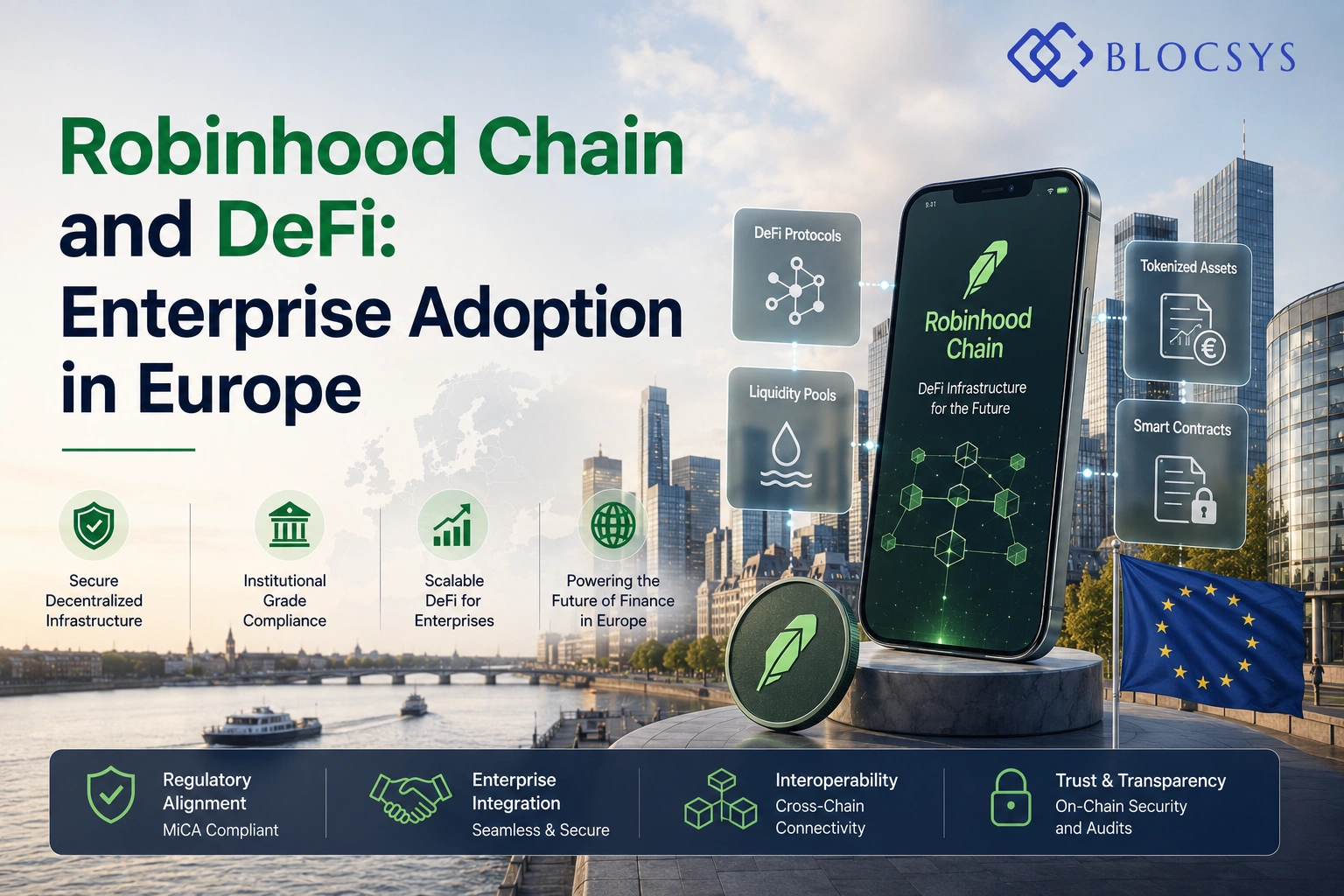
Robinhood Chain and the Future of Decentralized Finance (DeFi): Enterprise Adoption in Europe and Singapore
Robinhood Chain is emerging as one of the more closely watched Layer-2 blockchain initiatives in the trading and fintech world, and enterprises across Europe and Singapore are paying attention. Decentralized finance has moved well past its retail-speculation phase, and now boardrooms are asking a different question: how do we build compliant, scalable financial infrastructure on-chain? If you’re evaluating Robinhood Blockchain Development Services or exploring enterprise DeFi more broadly, this guide walks through what Robinhood Chain actually is, how enterprise DeFi adoption is unfolding in these two regions, and what technical and regulatory factors matter most.
We’ve worked with fintech teams, digital asset businesses, and financial institutions long enough to know that “blockchain strategy” conversations have changed. It’s no longer about whether to explore DeFi. It’s about how to do it without breaking compliance, security, or user trust. Let’s get into it.
What Is Robinhood Chain? A Simple Definition
Robinhood Chain is a Layer-2 blockchain network built on Arbitrum technology, announced by Robinhood Markets as infrastructure to support tokenized assets, on-chain trading, and expanded crypto services. Decentralized finance (DeFi) refers to financial applications built on blockchain networks that run through smart contracts rather than centralized intermediaries. Enterprise adoption, in this context, means organizations integrating blockchain-based financial infrastructure into regulated, real-world operations rather than isolated pilot projects.
Robinhood first previewed its Layer-2 network at an event in Cannes in mid-2025, positioning it as the backbone for tokenized stocks and broader on-chain trading activity, initially for European users. As of now, the network has moved through testing phases, and Robinhood has publicly discussed plans to migrate its tokenized equity offerings onto this infrastructure over time. Readers should treat the migration timeline and full production rollout as evolving rather than fixed, since public statements from Robinhood have described phased plans rather than a single completed launch.
Why Robinhood Chain Matters Beyond Retail Trading
Here’s why this matters to enterprise readers rather than just retail traders. A regulated fintech brand building public Layer-2 infrastructure signals something bigger: mainstream financial institutions are willing to build, not just partner with, blockchain networks. That’s a meaningful data point for CTOs and CIOs weighing whether enterprise blockchain has crossed from experimental to strategic.
“When a publicly traded brokerage builds its own Layer-2 network instead of just issuing tokens on someone else’s chain, it tells you institutional appetite for owning the infrastructure layer is real, not theoretical.”
Understanding Decentralized Finance for Enterprise Contexts
DeFi applications replace traditional intermediaries, think clearinghouses, custodians, and settlement agents, with smart contracts that execute automatically according to programmed rules. For enterprises, this doesn’t mean removing all oversight. Instead, it means rebuilding financial workflows on programmable, auditable infrastructure while retaining compliance controls.
Enterprise DeFi typically layers permissioned access, identity verification, and reporting tools on top of decentralized applications. This is different from fully permissionless retail DeFi. Institutions want the transparency and settlement efficiency of blockchain rails without abandoning regulatory obligations. That distinction shapes almost every architecture decision discussed later in this article.
Why Enterprises Are Exploring DeFi Right Now
Several forces are converging at once. Traditional settlement systems still involve multi-day cycles for certain asset classes. Tokenization offers faster settlement potential, though actual speed depends heavily on network design and legal finality requirements in each jurisdiction. Additionally, institutions are watching competitors experiment with tokenized funds, bonds, and equities, and nobody wants to be left explaining a missed market shift to their board.
Consequently, enterprise DeFi development company engagements have grown steadily as fintech firms and banks look for partners who understand both blockchain architecture and financial compliance. It’s a narrow skill set, and that’s exactly why specialized Blockchain Development Company partners have become valuable rather than optional.
Why Europe and Singapore Are Leading Enterprise Blockchain Markets
Europe and Singapore didn’t become enterprise blockchain hubs by accident. Both regions built clear regulatory frameworks earlier than most, and that clarity reduces legal risk for institutions considering DeFi infrastructure.
In the European Union, the Markets in Crypto-Assets Regulation (MiCA), which became fully applicable across member states in December 2024, gives crypto-asset service providers a harmonized licensing framework. Switzerland’s FINMA has also long provided defined guidance for token classification under its DLT framework. Meanwhile, Singapore’s Monetary Authority of Singapore (MAS) has run structured initiatives like Project Guardian, a collaborative program testing asset tokenization and DeFi protocols with financial institutions, since 2022. These frameworks give enterprises something rare in blockchain: predictability.
Current DeFi and Enterprise Adoption Trends
Market data backs up what we’re seeing in enterprise conversations. According to the Boston Consulting Group and ADDX research on asset tokenization, the tokenized asset market has been projected to reach into the trillions of dollars by the early 2030s under various growth scenarios, though such long-range projections vary widely by methodology and shouldn’t be read as guaranteed outcomes.
MAS reported that Project Guardian has expanded to include more than a dozen financial institutions testing use cases across fixed income, foreign exchange, and asset management since the initiative’s launch. Meanwhile, MiCA’s phased implementation across the EU has pushed dozens of crypto-asset service providers toward formal licensing rather than operating in regulatory gray zones. These are confirmed regulatory and program developments, not adoption guarantees, but they show institutional infrastructure is being actively built, tested, and formalized.
Robinhood Chain’s Position in This Broader Shift
Robinhood Chain enters this landscape at an interesting moment. It’s not the first institutional-adjacent Layer-2 network, but its backing by a publicly listed, regulated brokerage gives it a different credibility profile than purely crypto-native projects. Enterprises evaluating Robinhood Chain DeFi capabilities are essentially asking whether a regulated entity’s infrastructure choices offer a lower-risk path into tokenized finance.
| Factor | Traditional Financial Infrastructure | Enterprise DeFi (e.g., Robinhood Chain-style Layer-2) |
|---|---|---|
| Settlement | T+1 or T+2 in most markets | Near-instant to same-day, depending on network and legal finality rules |
| Intermediaries | Clearinghouses, custodians, brokers | Smart contracts with optional permissioned oversight |
| Transparency | Siloed record-keeping | Shared, auditable ledger state |
| Access hours | Market hours, regional | Continuous, subject to platform rules |
| Regulatory oversight | Long-established frameworks | Evolving frameworks (MiCA, MAS guidance, FINMA) |
Robinhood Chain Architecture and Layer-2 Infrastructure
Robinhood Chain runs as a Layer-2 network built using Arbitrum’s technology stack, which means it inherits security guarantees from Ethereum while processing transactions off the main chain for lower costs and faster throughput. That’s a common pattern in enterprise blockchain design right now, borrow base-layer security, optimize the execution layer.
What makes this relevant for enterprise architects is the modular approach. Layer-2 networks let institutions customize throughput, gas economics, and permissioning without abandoning the security assumptions of a battle-tested base chain. Whether Robinhood Chain ultimately supports third-party enterprise applications beyond Robinhood’s own products remains something to watch rather than a confirmed capability at this stage.
Smart Contracts for Enterprise DeFi Applications
Smart contracts are the operational core of any enterprise DeFi platform. They encode rules for asset issuance, trading, settlement, and compliance checks directly into executable code. For institutions, this means fewer manual reconciliation steps and a single source of truth for transaction logic.
However, smart contract risk is real. Poorly audited code has caused significant losses across the DeFi sector historically. That’s why enterprise-grade Smart Contract Development requires rigorous auditing, formal verification where appropriate, and staged deployment rather than a single big-bang launch. Don’t skip this step. Ever.
Blockchain Wallets and Enterprise Onboarding
Wallet infrastructure is often the most underestimated part of enterprise blockchain projects. Institutions need custody solutions that satisfy internal risk teams, external auditors, and regulators simultaneously. That usually means multi-signature controls, hardware security modules, and clear key-recovery procedures.
For enterprise onboarding specifically, self-custody wallets designed for consumers rarely meet institutional requirements. Organizations typically need role-based access, transaction approval workflows, and integration with existing treasury systems. Teams building this layer often work with specialists who can Hire Blockchain Developers experienced in institutional custody architecture rather than retrofitting consumer wallet SDKs.
Decentralized Applications Built for Institutional Use
Institutional DeFi applications differ from retail DApps in a few important ways. They usually include permissioned pools, KYC/AML gating at the smart contract or middleware level, and reporting hooks that feed compliance systems automatically. Think of it as DeFi with guardrails built in from day one, not bolted on afterward.
Robinhood Chain’s eventual role here will depend on whether it opens its infrastructure to broader institutional application development or remains focused primarily on Robinhood’s own product suite. That’s an open question worth monitoring closely over the next few quarters.
Tokenization and Digital Assets on Robinhood Chain
Tokenization converts ownership rights in real-world or financial assets into blockchain-based tokens. Robinhood has publicly stated intentions to use its Layer-2 network to support tokenized equities and expand tokenized asset offerings, building on tokenized stock products it initially launched for EU customers in mid-2025 through partnerships and its own infrastructure.
For enterprises watching this space, tokenized equities raise specific legal questions around securities classification, cross-border investor eligibility, and custody of the underlying reference asset. These aren’t solved problems industry-wide; they’re active regulatory conversations happening in parallel across the EU, UK, Switzerland, and Singapore. Organizations exploring similar offerings should look closely at frameworks like Real World Asset Tokenization, Corporate Bond Tokenization, or Equity Tokenization Platform development before committing to a specific asset class.
Institutional DeFi Use Cases Across Industries
Let’s talk practical applications, since abstract architecture discussions only go so far.
- Banking: Trade finance settlement using smart contracts to reduce paperwork-driven delays between counterparties.
- Fintech and payments: Cross-border payment rails using stablecoins or tokenized deposits for near-instant settlement, subject to local licensing.
- Investment management: Tokenized fund shares with automated compliance checks for investor eligibility.
- Insurance: Parametric insurance products that trigger payouts automatically based on verified on-chain data feeds.
- Asset management: On-chain portfolio strategies with transparent, auditable execution history.
One realistic scenario: a mid-sized European asset manager wants to offer fractional access to corporate bonds for smaller institutional clients. By working with a DeFi Development Company, they could pilot a permissioned tokenization platform under MiCA-aligned custody rules, testing settlement speed improvements before a full-scale rollout. This is a hypothetical scenario meant to illustrate the pattern, not a confirmed deployment.
Robinhood Chain’s Enterprise DeFi Potential in Singapore
Singapore’s regulatory posture, particularly through Project Guardian, makes it a natural sandbox environment for testing tokenized asset infrastructure. Should Robinhood Chain expand institutional access beyond its core retail offering, Singapore’s established DeFi pilot ecosystem gives it a plausible early testing ground. That said, no confirmed Robinhood Chain Singapore deployment has been publicly announced as of this writing, so treat this as a market opportunity rather than an existing rollout.
Blockchain Interoperability and Governance Mechanisms
No enterprise wants to get locked into a single chain permanently. Interoperability, the ability for assets and data to move between different blockchain networks, matters enormously for institutions building multi-year infrastructure strategies. Cross-chain bridges, standardized token protocols, and shared settlement layers all factor into this.
Governance is equally important. Who controls protocol upgrades? Who can pause transactions during an incident? For enterprise DeFi, governance usually blends decentralized voting mechanisms with defined administrative controls, since fully permissionless governance rarely satisfies institutional risk committees. Robinhood Chain, as a corporate-backed network, likely retains more centralized governance control than fully decentralized public chains, which itself is a tradeoff worth evaluating against your organization’s risk tolerance.
Security Best Practices for Enterprise DeFi
Security can’t be an afterthought here. Enterprise DeFi platforms need multiple layers: audited smart contracts, real-time monitoring for anomalous transactions, multi-signature treasury controls, and incident response plans specific to blockchain infrastructure.
Additionally, third-party security audits should happen before and after major protocol upgrades, not just at initial launch. DeFi protocols that skip ongoing audits have historically been the ones hit hardest by exploits. If you’re building institutional-grade infrastructure, treat security spending as core budget, not optional overhead.
Regulatory and Compliance Considerations in Europe and Singapore
Regulatory treatment varies significantly by asset type and jurisdiction, so generalizations can be misleading. In the EU, MiCA governs crypto-asset service providers and certain token issuances, but it doesn’t cover every DeFi activity uniformly, fully decentralized protocols without an identifiable issuer fall into more ambiguous territory. Switzerland’s FINMA applies its own token classification guidance separately from EU rules. The UK’s Financial Conduct Authority has been developing its own crypto-asset regime distinct from MiCA following Brexit.
In Singapore, MAS regulates digital payment token services under the Payment Services Act, and has published specific guidance discouraging retail access to certain DeFi-related products while supporting institutional pilots through Project Guardian. Enterprises should always confirm current licensing requirements with qualified legal counsel in each target jurisdiction, since these frameworks continue evolving and this article doesn’t constitute regulatory advice.
Enterprise Implementation Roadmap
So, how should an organization actually start? Here’s a practical sequence we typically recommend:
- Define the specific business problem, settlement speed, transparency, cost reduction, and confirm blockchain genuinely solves it.
- Map regulatory requirements for your target jurisdictions before writing a single line of code.
- Choose infrastructure, whether that’s Robinhood Chain-style Layer-2 networks, alternative chains, or hybrid permissioned systems.
- Build and audit smart contracts through staged testnet deployment.
- Pilot with a limited institutional user group before full production rollout.
Throughout this process, working with an experienced Dedicated Blockchain Engineering Team reduces the risk of architectural missteps that become expensive to fix later.
Challenges and Risks Enterprises Should Evaluate
DeFi adoption isn’t risk-free. Smart contract vulnerabilities, regulatory uncertainty, liquidity fragmentation across chains, and integration complexity with legacy financial systems all present real challenges. Furthermore, public perception of DeFi still carries baggage from past exploits and volatility events, which means internal stakeholder education matters as much as the technology itself.
Future Opportunities and Where Blocsys Fits In
Looking ahead, we expect enterprise DeFi in Europe and Singapore to keep maturing alongside regulatory clarity. Robinhood Chain’s trajectory, if it expands beyond Robinhood’s own product ecosystem, could become a meaningful reference architecture for other regulated fintechs considering their own Layer-2 strategy. Institutions that start building compliance-aware DeFi capability now will have a real advantage over those waiting for perfect certainty that may never fully arrive.
This is where Blocsys comes in. As an Enterprise Blockchain Development Company, we help fintech firms, banks, and digital asset businesses design and build DeFi platforms, tokenization systems, and blockchain wallet infrastructure that hold up under real regulatory and security scrutiny. Whether you need Hire Web3 Developers support for a specific build or full-scope architecture consulting, our team has hands-on experience across institutional custody, smart contract auditing readiness, and cross-chain interoperability design.
If cost planning is part of your evaluation process, we’d suggest starting with a project-specific estimate rather than relying on generic industry figures, since DeFi platform costs vary enormously based on scope, chain choice, and compliance requirements. Reach out through our Robinhood Blockchain Development Services page to discuss your specific use case and get accurate scoping for your Robinhood Chain or broader enterprise DeFi initiative.
PONS and Permissionless Token Markets on Robinhood Chain
The emergence of pons highlights another direction for Robinhood Chain: creating more accessible on-chain markets where users can participate without relying on centralized intermediaries. Rather than focusing on institutional securities, pons enables users to interact with newly created tokens through blockchain-based liquidity pools and wallet-controlled transactions. Its use of WETH-based trading pools connects token launches with immediate market activity, while the underlying on-chain events provide data that applications can use to track launches and trades. This type of infrastructure can contribute to a broader DeFi environment on Robinhood Chain by making token creation, liquidity, and market participation programmable components that developers can incorporate into decentralized financial applications
Frequently Asked Questions
Here are direct answers to the questions we hear most often about Robinhood Chain and enterprise DeFi adoption.
What is Robinhood Chain?
Robinhood Chain is a Layer-2 blockchain network built on Arbitrum technology, developed by Robinhood Markets to support tokenized assets and expanded on-chain trading services. It was first previewed in 2025 as infrastructure intended to eventually host Robinhood’s tokenized stock offerings and related crypto services, initially with a European focus.
As of now, Robinhood has described a phased rollout rather than a single completed launch, so enterprises should track official Robinhood announcements for the current production status rather than assuming full deployment.
What is decentralized finance (DeFi)?
Decentralized finance refers to financial services, lending, trading, asset management, and payments, built on blockchain networks using smart contracts instead of centralized intermediaries like banks or brokers. Transactions execute automatically according to code, and records stay on a shared, auditable ledger.
For enterprises, DeFi doesn’t necessarily mean removing all oversight. Institutional DeFi platforms often add permissioned access and compliance layers on top of decentralized infrastructure, blending automation with regulatory controls that regulated financial institutions require.
How could Robinhood Chain support enterprise DeFi?
Robinhood Chain could support enterprise DeFi by providing Layer-2 infrastructure for tokenized asset issuance, faster settlement, and lower transaction costs compared to base-layer Ethereum. Its backing by a regulated brokerage may also offer institutions a lower-risk entry point into blockchain-based trading infrastructure.
Whether Robinhood Chain opens to third-party enterprise applications beyond Robinhood’s own products remains unconfirmed. Organizations should monitor official announcements before building dependent infrastructure on assumptions about future access.
Why is enterprise DeFi adoption growing in Europe?
Enterprise DeFi adoption in Europe is growing largely because MiCA, fully applicable since December 2024, gives crypto-asset service providers a harmonized regulatory framework across EU member states. This reduces legal uncertainty that previously slowed institutional blockchain projects.
Additionally, countries like Switzerland and Luxembourg have long-established digital asset guidance through regulators like FINMA, creating multiple credible entry points. Combined, this regulatory clarity has made European markets more attractive for enterprise DeFi Europe initiatives than in prior years.
Why is Singapore becoming an important DeFi and blockchain market?
Singapore has built structured institutional pilot programs, most notably MAS’s Project Guardian, which has tested tokenization and DeFi protocols with more than a dozen financial institutions since 2022. This gives enterprises a regulator-supported environment for controlled experimentation.
The Monetary Authority of Singapore also maintains clear licensing rules under the Payment Services Act, which helps fintech companies and digital asset businesses plan compliant deployments. That combination makes enterprise DeFi Singapore initiatives feel lower-risk than in markets lacking similar regulatory infrastructure.
What benefits can enterprises gain from DeFi?
Enterprises exploring DeFi are typically after faster settlement, greater transaction transparency, reduced reliance on manual reconciliation, and new product opportunities like tokenized funds or bonds. Actual settlement speed and cost benefits depend heavily on specific network architecture and legal finality requirements, so results vary by implementation.
Beyond efficiency, DeFi infrastructure gives institutions an auditable, shared source of truth across counterparties, which can reduce disputes and reconciliation overhead compared to siloed traditional systems.
How do smart contracts support enterprise DeFi applications?
Smart contracts encode financial logic, such as trade settlement rules, compliance checks, or automated payouts, directly into executable blockchain code. This removes manual processing steps and creates a consistent, auditable record of how transactions were executed.
For enterprise use, smart contracts require rigorous security auditing before deployment, since flawed code has caused significant losses across the DeFi sector historically. Enterprise-grade smart contract development typically includes formal testing, staged rollout, and ongoing audits after upgrades.
What industries can benefit from enterprise DeFi?
Banking, fintech, payments, investment management, trade finance, insurance, and digital asset management have all shown active interest in enterprise DeFi applications. Use cases range from tokenized bond settlement to cross-border payment rails and parametric insurance triggers.
Adoption maturity varies significantly by industry and jurisdiction. Financial institutions in regulated markets like the EU and Singapore tend to move through structured pilots before full production deployment, rather than adopting DeFi infrastructure all at once.
How can businesses estimate the cost of building a DeFi platform?
DeFi platform development costs vary widely based on blockchain choice, smart contract complexity, wallet infrastructure, compliance integration, and audit requirements. There’s no single reliable industry-wide figure that applies across projects.
Rather than relying on generic estimates, businesses should get a project-specific scoping assessment. Blocsys offers guidance through its Robinhood Blockchain Development Services page, where teams can discuss specific requirements and receive accurate, scope-based cost estimates.
What security and regulatory considerations should enterprises evaluate before adopting DeFi?
Enterprises should evaluate smart contract audit coverage, custody and wallet security architecture, and incident response readiness before launching any DeFi platform. Security can’t be treated as a one-time checkbox, ongoing audits matter especially after protocol upgrades.
On the regulatory side, requirements differ by asset type and jurisdiction. MiCA, FINMA guidance, UK FCA rules, and MAS’s Payment Services Act all apply differently depending on the specific token, service, and legal classification involved. Enterprises should confirm current requirements with qualified legal counsel before launch.
Wrapping Up
Robinhood Chain represents one signal among several that regulated financial institutions are ready to build, not just experiment with, blockchain infrastructure. Whether it becomes a broadly accessible enterprise platform or stays focused on Robinhood’s own products, the underlying trend, tokenization, Layer-2 scaling, and institutional DeFi, isn’t slowing down in Europe or Singapore.
For organizations ready to move from research to real implementation, working with a partner that understands both blockchain architecture and financial compliance makes the difference between a stalled pilot and a production-ready platform. That’s exactly where our team focuses. Explore how Robinhood Blockchain Development Services from Blocsys can help you scope, build, and secure your enterprise DeFi initiative, and let’s talk about what your organization actually needs to move forward with confidence.
Ready to move beyond theory and build an intelligent platform that delivers real-world value? Blocsys Technologies specialises in engineering enterprise-grade AI and blockchain solutions for the fintech, Web3, and digital asset sectors. Connect with our experts today to discuss your vision and chart a clear path from concept to a secure, scalable reality.
