
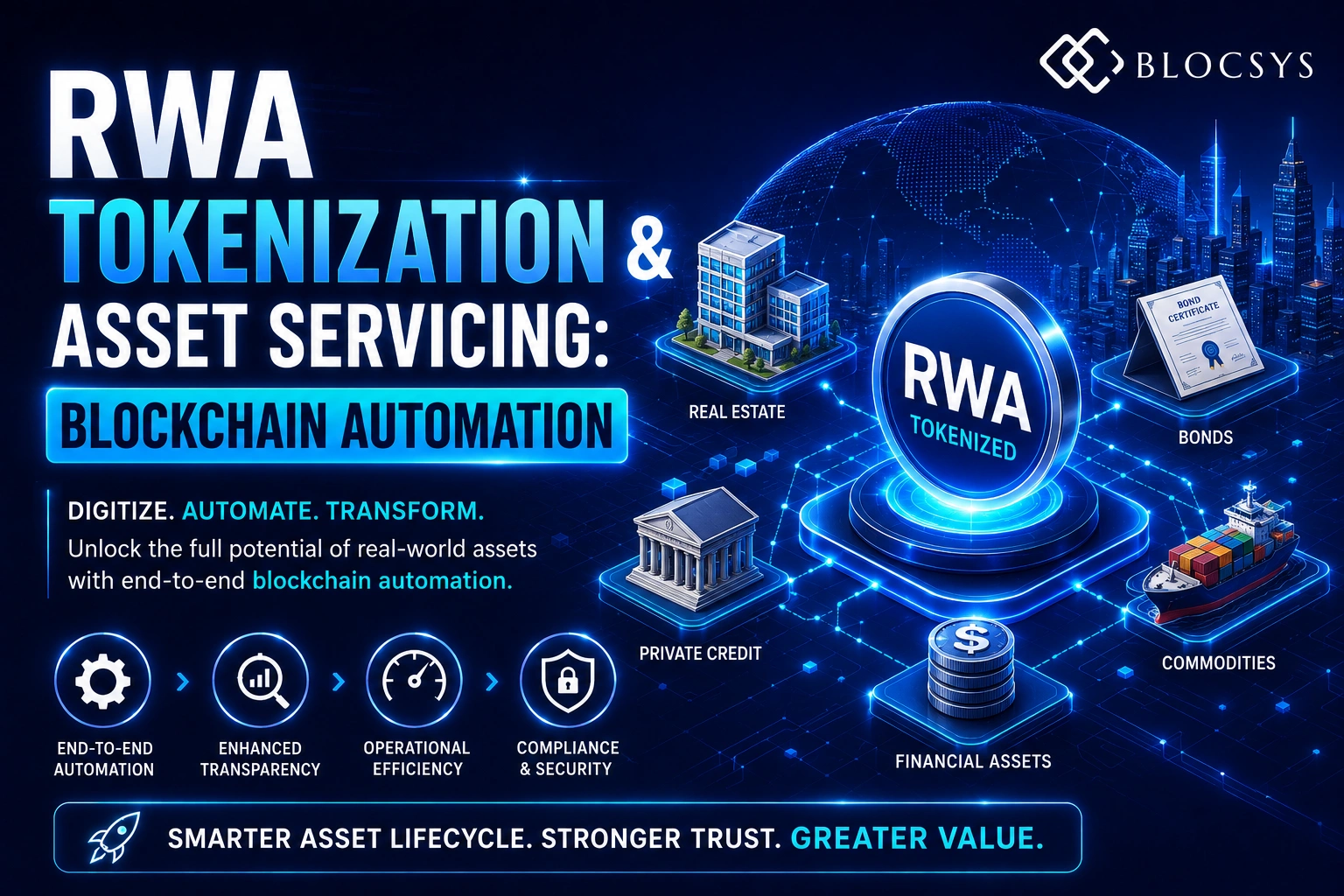
RWA Tokenization and Asset Servicing: How Blockchain Can Automate the Post-Issuance Lifecycle
Tokenizing a real-world asset feels like the finish line. It isn’t. Once a bond, fund share, or property token hits an investor’s wallet, the real operational work begins. That’s where RWA asset servicing comes in, and it’s the part of tokenization most conversations skip. This guide walks through what happens after issuance, why manual processes still slow institutions down, and how blockchain infrastructure can automate the lifecycle from ownership updates to redemptions. If you’re evaluating a Real World Asset Tokenization partner, understanding post-issuance servicing should shape that decision just as much as the token launch itself.
What Happens After an RWA Is Tokenized?
Issuance creates the token. It doesn’t manage what happens next.
Once tokens are distributed to investors, the asset still needs ongoing administration. Ownership records need updating. Income needs distributing. Compliance checks need running on every transfer. Reports need generating for regulators and auditors.
This is the post-issuance phase, and it typically lasts far longer than the issuance event itself. A tokenized bond might trade, pay coupons, and report for years before maturity. A tokenized real estate fund could run for a decade.
Therefore, the systems supporting this phase matter more than the systems that created the token in the first place.
What Is RWA Asset Servicing?
RWA asset servicing refers to the ongoing operational management of a tokenized real-world asset after it has been issued. It covers ownership updates, distributions, transfers, redemptions, corporate actions, compliance monitoring, and reporting.
Think of it as the digital equivalent of traditional custodial and transfer agent functions, except built on blockchain rails instead of legacy back-office systems.
Traditional asset servicing relies on spreadsheets, batch processing, and multiple intermediaries reconciling records against each other. Tokenized asset servicing replaces much of that with programmable infrastructure. Smart contracts execute predefined rules automatically, while blockchain ledgers keep a single, shared source of truth across all parties.
That said, automation handles the mechanics — it doesn’t replace legal obligations or human judgment where regulation requires it.
The biggest misconception in tokenization is that issuance is the hard part. It isn’t. Servicing thousands of investors across jurisdictions, correctly and continuously, is where platforms actually get tested.
Why Post-Issuance Lifecycle Management Matters
Here’s why this stage deserves more attention than it usually gets: errors compound. A missed distribution, a stale ownership record, or a delayed compliance check doesn’t just cause one problem. It cascades into reconciliation headaches, investor complaints, and potential regulatory exposure.
Additionally, institutions scaling beyond a pilot tokenization project quickly discover that manual servicing doesn’t scale with them. What works for fifty investors breaks down at five thousand.
Effective tokenized asset lifecycle management reduces this risk by embedding rules directly into the asset’s infrastructure. Consequently, fewer processes depend on someone remembering to run a report or manually verify an investor’s accreditation status before a transfer.
Key RWA Asset Servicing Workflows
Post-issuance servicing isn’t one task. It’s a set of interconnected workflows that need to work together consistently. The core workflows include:
- Ownership and investor record maintenance
- Distributions and income payments
- Transfers between eligible investors
- Redemptions and maturity settlement
- Corporate actions and lifecycle events
- Compliance monitoring and reporting
- Reconciliation and audit trail maintenance
Let’s look at how each of these functions in practice, and where automation genuinely changes the operational picture.
How Automated RWA Asset Servicing Handles Ownership Records
Ownership updates are the foundation everything else builds on. Get this wrong, and distributions, votes, and reporting all break downstream.
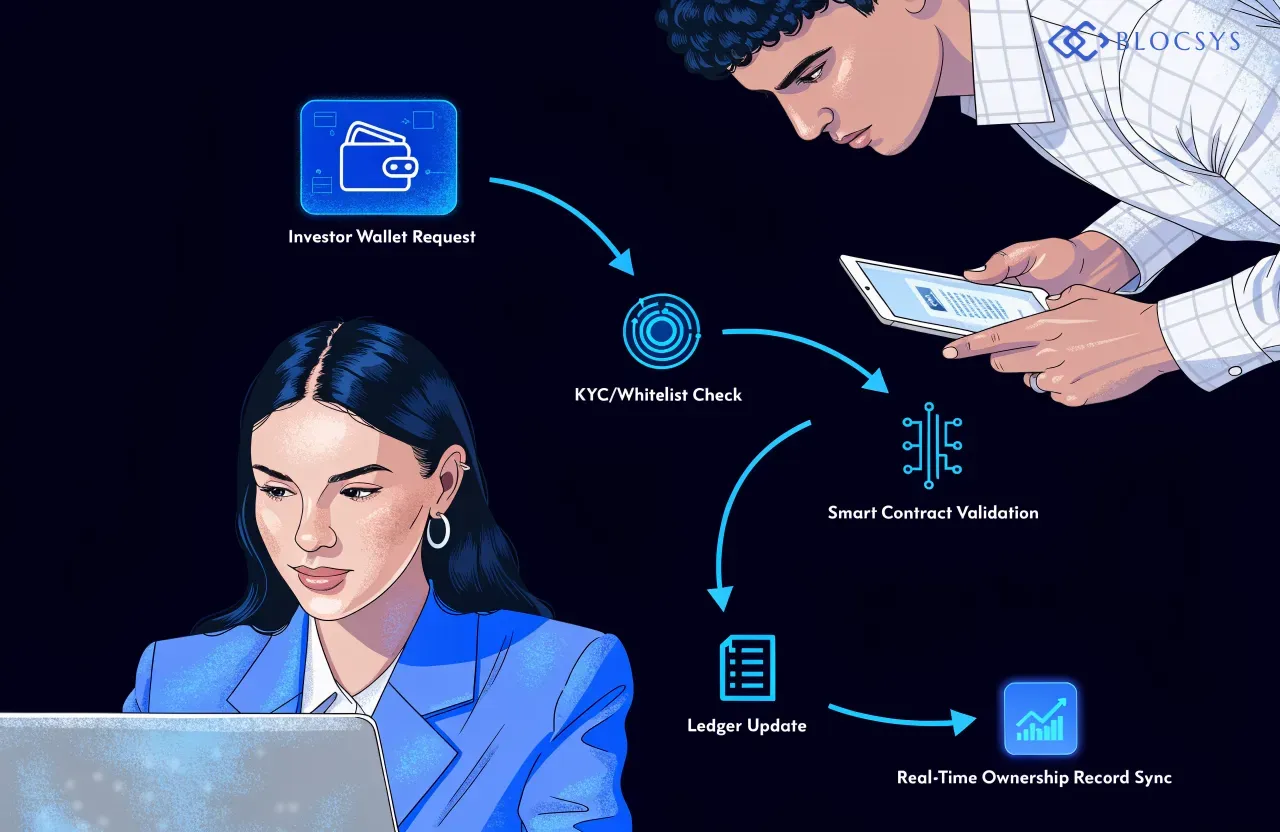
On a blockchain-based RWA tokenization platform, ownership lives on-chain. When a token moves from one wallet to another, the ledger updates instantly and immutably. There’s no separate registry to reconcile against a transfer agent’s database days later.
However, on-chain movement alone isn’t enough. Platforms still need to map wallet addresses to verified investor identities, particularly for regulated securities. This is where identity verification, whitelisting, and KYC status checks integrate directly into the transfer logic itself.
Distributions and Income Payments
Distributions are where automation shows its value most clearly. Tokenized bonds pay coupons. Real estate tokens pay rental income. Funds pay dividends. Each of these events used to require manual calculation and batch payment runs.
With smart contracts, distribution logic gets written once and executes automatically. The contract calculates each holder’s pro-rata share based on their token balance at a specific record date, then pushes payment directly to their wallet.
This matters for commodities and private-market assets too. A tokenized private credit fund, for example, can distribute interest income to hundreds of investors simultaneously, without a manual payment file being generated and checked by three different teams.
Why Digital Asset Servicing Reduces Distribution Errors
Manual distribution processes fail in predictable ways: wrong record dates, outdated holder lists, rounding errors across large investor pools. Digital asset servicing built on blockchain infrastructure removes several of these failure points because the record date snapshot and payment calculation both reference the same on-chain data.
Still, someone needs to fund the distribution wallet and verify the payment amount against the underlying asset’s actual cash flow. Automation executes the workflow — it doesn’t generate the money.
Transfers and Redemptions
Transfers sound simple until you factor in compliance. A tokenized security can’t just move from wallet A to wallet B. It has to check that the receiving wallet is eligible to hold that asset under relevant securities rules.
Smart contracts can enforce this automatically through transfer restrictions coded directly into the token standard. If a wallet isn’t whitelisted, or if a jurisdictional rule blocks the transfer, the transaction simply reverts.
Redemptions work similarly but trigger at maturity or upon investor request. A tokenized bond reaching maturity, for instance, can automatically calculate final payment amounts and burn the corresponding tokens once settlement completes. This is a core part of automated asset lifecycle management — reducing the operational gap between an event occurring and the resulting action being executed.
Comparing Manual vs. Automated Post-Issuance Servicing
| Process | Manual Servicing | Blockchain-Automated Servicing |
|---|---|---|
| Ownership updates | Batch reconciliation, days of lag | Real-time, on-chain |
| Distributions | Manual calculation and payment files | Smart contract-triggered payouts |
| Compliance checks | Manual review per transfer | Automated whitelist and rule enforcement |
| Audit trail | Assembled from multiple systems | Continuous, immutable ledger record |
Corporate Actions and Lifecycle Events
Corporate actions add complexity that many tokenization discussions gloss over. Stock splits, buybacks, early redemptions, covenant changes, voting events — these all need to be reflected accurately across every token holder’s position.
Unlike a straightforward distribution, corporate actions often require conditional logic. A partial redemption might apply only to certain token classes. A voting event might weight results by holding period, not just balance.
This is where RWA lifecycle management infrastructure needs genuine flexibility, not just a fixed set of predefined triggers. Platforms handling corporate bonds or equity-linked tokens, in particular, need contract architecture built to accommodate these events from day one, not bolted on afterward. Our work on Corporate Bond Tokenization and Equity Tokenization Platform development reflects exactly this requirement.
Compliance and Reporting in RWA Asset Servicing
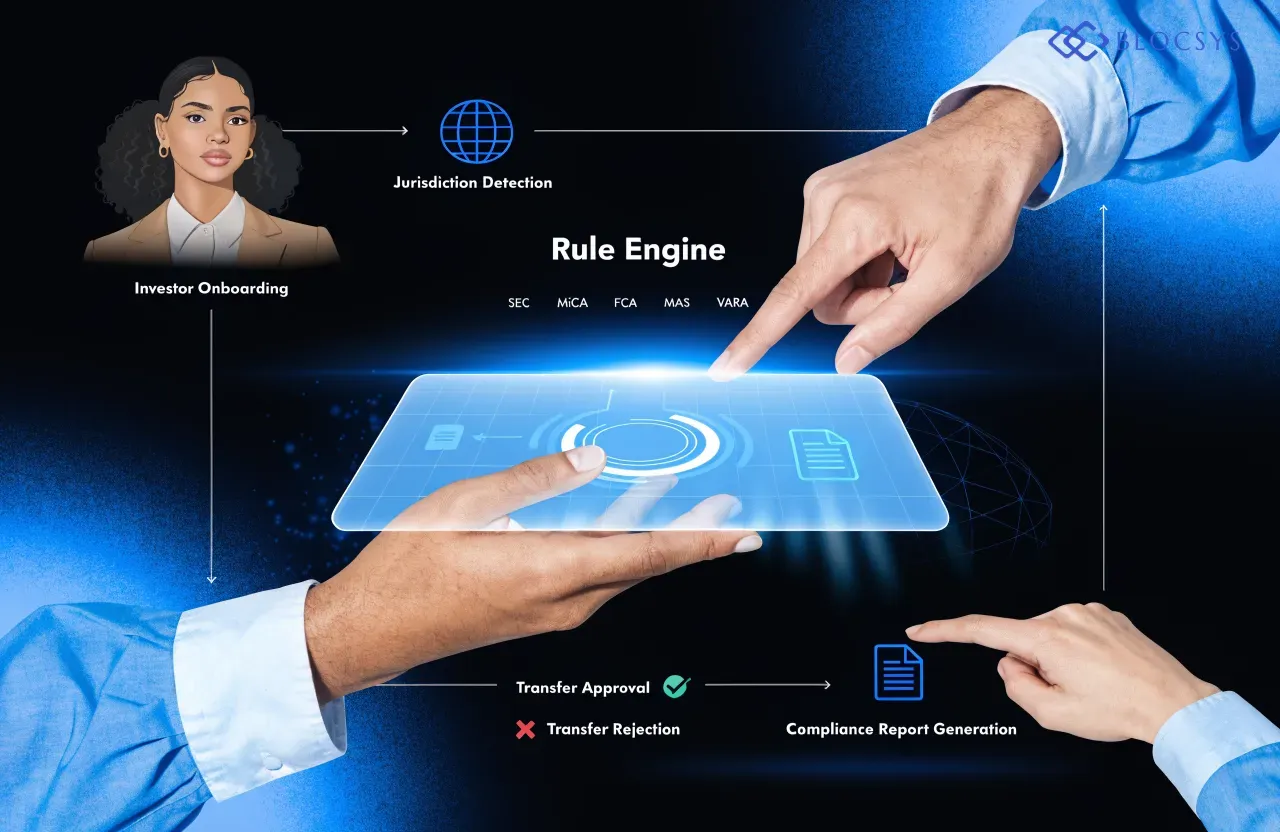
Compliance doesn’t end at issuance. It runs continuously throughout an asset’s life, and it varies significantly by jurisdiction.
In the US, tokenized securities typically fall under SEC frameworks, requiring ongoing transfer restrictions and reporting obligations. Europe’s MiCA regulation adds its own disclosure and operational requirements for crypto-assets, while individual EU states may layer on national rules.
The UK’s FCA takes a comparably principles-based approach, whereas Switzerland’s FINMA and Germany’s BaFin apply more prescriptive frameworks around tokenized securities and crypto custody. Singapore’s MAS and the UAE’s ADGM and VARA regimes have each built dedicated digital asset frameworks, and Canada and Australia are steadily formalizing their own guidance too.
Consequently, a platform built for global investor bases needs compliance logic that adapts per jurisdiction, not a single hardcoded rule set. Automated monitoring can flag ineligible transfers and generate audit-ready reports, but interpreting new regulatory obligations still requires legal and compliance expertise. Blockchain doesn’t replace your compliance team — it gives that team better tools.
Reconciliation, Custody, and Audit Trails
Reconciliation used to mean comparing records across a custodian, transfer agent, and fund administrator, hoping the numbers matched. On a shared blockchain ledger, there’s one record everyone references. That alone eliminates a huge share of traditional reconciliation work.
Custody still matters enormously, though. Institutional investors need assurance that private keys and token controls meet enterprise security standards, whether through qualified custodians, multi-signature wallets, or regulated digital asset custody providers.
Audit trails, meanwhile, become a natural byproduct of blockchain infrastructure. Every transfer, distribution, and ownership change is timestamped and permanent. Auditors get verifiable history instead of assembled evidence from disconnected systems. This is one of the clearest advantages blockchain asset servicing offers over legacy back-office models.
Blockchain and Smart Contract Automation Behind RWA Asset Servicing
What actually makes this automation possible? Smart contracts.
A smart contract is self-executing code deployed on a blockchain that runs automatically once its conditions are met. In asset servicing, this means distribution logic, transfer restrictions, and redemption triggers all live inside auditable, tamper-resistant code rather than someone’s manual process document.
Smart Contract Development for regulated assets requires more rigor than typical DeFi contracts, though. Upgradability, emergency pause mechanisms, and role-based permissions all need careful design so the asset can still respond to legal or operational changes after deployment.
Where RWA Asset Servicing Still Needs Human Oversight
Smart contracts execute rules. They don’t interpret ambiguous situations, resolve legal disputes, or make judgment calls during a covenant breach. Automation handles the repetitive, rule-based work — humans still own the exceptions.
Integrating RWA Servicing With Existing Financial Systems
No institution operates in a blockchain-only world. Tokenized asset infrastructure needs to talk to existing fund administration systems, core banking platforms, and reporting tools.
APIs are the connective tissue here. A well-built RWA tokenization platform exposes APIs that let existing systems pull ownership data, trigger distributions, or ingest compliance reports without requiring a full back-office rebuild.
This matters enormously for banks and asset managers who’ve invested heavily in existing infrastructure. They don’t need to replace everything. They need tokenization infrastructure that plugs into what already works. Platforms like our Decentralized Traded Funds (DTF) Platform demonstrate how on-chain asset management can integrate with broader financial workflows rather than operating in isolation.
Challenges and Limitations of Automated Asset Servicing
Automation isn’t magic, and claiming otherwise does the industry a disservice. Several real limitations remain:
- Legal enforceability of on-chain records still varies by jurisdiction
- Off-chain data feeds (oracles) introduce dependency risk for corporate actions
- Smart contract bugs can have outsized financial consequences
- Regulatory frameworks are still evolving in several markets
- Cross-chain and cross-platform interoperability remains limited
These aren’t reasons to avoid automation. They’re reasons to work with a development partner who understands both the technology and the regulatory landscape it operates within.
How Blocsys Can Automate RWA Asset Servicing
Blocsys builds the infrastructure institutions need to manage tokenized assets from issuance through the full post-issuance lifecycle. That includes RWA Tokenization Platform Development, smart contracts for distributions and redemptions, investor management systems, automated compliance workflows, and APIs that integrate with your existing financial stack.
Whether you’re tokenizing corporate bonds, equity, real estate, or fund shares, we design the servicing layer alongside the issuance layer, not as an afterthought. Explore our full Asset Tokenization Platform capabilities or start with Real World Asset Tokenization to see how the complete lifecycle fits together.
Why Choose Blocsys for RWA Asset Servicing
Blocsys combines Blockchain Development Services experience with deep familiarity in regulated financial infrastructure. We understand that a tokenization platform’s real test happens after launch, when distributions, transfers, and compliance checks run continuously at scale.
Our teams support custody integration, reporting automation, and jurisdiction-specific compliance logic across the US, Europe, UK, UAE, Singapore, and beyond. If you need dedicated engineering capacity, our Dedicated Blockchain Engineering Teams can embed directly with your existing technology function.
Curious what a project like this costs? Try our Software Development Cost Estimator for a project-specific estimate.
Frequently Asked Questions
Here are direct answers to the questions we hear most often about RWA asset servicing.
What is RWA asset servicing?
RWA asset servicing is the ongoing management of a tokenized real-world asset after issuance. It covers ownership updates, distributions, transfers, redemptions, corporate actions, compliance monitoring, and reporting throughout the asset’s life.
What happens after a real-world asset is tokenized?
After tokenization, the asset enters its post-issuance phase. This includes maintaining investor records, processing income distributions, handling transfers between eligible holders, managing corporate actions, and generating compliance reports until maturity or full redemption.
How does blockchain automate tokenized asset lifecycle management?
Blockchain automates lifecycle management through smart contracts that execute distribution, transfer, and redemption logic automatically once predefined conditions are met. The shared ledger also keeps ownership records synchronized in real time, reducing manual reconciliation.
Does blockchain eliminate the need for compliance teams?
No. Blockchain automates rule enforcement and reporting, but interpreting new regulations, resolving disputes, and making judgment calls still require human compliance expertise. Automation supports the compliance function, it doesn’t replace it.
How much does it cost to build an RWA tokenization platform with asset servicing?
Cost depends on asset class, jurisdictional compliance requirements, custody integration, and the scope of automated workflows needed. Use the Blocsys Cost Estimator Tool for a project-specific figure.
Which asset types benefit most from automated post-issuance servicing?
Bonds, funds, real estate, commodities, and private-market assets all benefit, particularly those with recurring income distributions, multiple corporate action types, or large investor bases where manual servicing doesn’t scale efficiently.
Why should we choose Blocsys for RWA tokenization and asset servicing?
Blocsys designs the full lifecycle, not just the issuance event. We build smart contracts, investor management systems, compliance workflows, and integrations that support your tokenized assets from launch through ongoing servicing, across US, European, and global regulatory environments.
Conclusion
Issuance gets the attention. Servicing determines whether a tokenized asset actually works at scale. Every distribution, transfer, and compliance check after launch either builds investor trust or erodes it.
Getting RWA asset servicing right requires infrastructure built specifically for that ongoing operational reality, not just a token minting event. If you’re planning a tokenization project and want the post-issuance lifecycle handled properly from day one, explore Real World Asset Tokenization with Blocsys and let’s talk about what your asset actually needs to run smoothly for years, not just at launch.
Ready to move beyond theory and build an intelligent platform that delivers real-world value? Blocsys Technologies specialises in engineering enterprise-grade AI and blockchain solutions for the fintech, Web3, and digital asset sectors. Connect with our experts today to discuss your vision and chart a clear path from concept to a secure, scalable reality.
