
Why SaaS-Based Tokenization Platforms Are Replacing Custom Blockchain Development in 2026
If you’re an enterprise executive or CTO weighing how to launch a tokenization product, you’ve probably noticed the ground shifting under you. Custom blockchain builds used to be the only serious option. Not anymore. A SaaS Tokenization Platform Development Company can now get you from concept to live product in weeks, not years, without the infrastructure headaches that sank so many early Web3 projects. That’s why enterprises, fintechs, and asset managers across the US, UK, UAE, Singapore, and Europe are choosing cloud-native platforms over ground-up development. Companies like Blocsys have built their entire business around this shift, offering a SaaS Platform that removes the guesswork from enterprise blockchain infrastructure.
This article breaks down exactly why that’s happening, what a SaaS tokenization platform actually looks like under the hood, and how it stacks up against custom development across cost, security, compliance, and speed.
What Is a SaaS Tokenization Platform, Really?
A SaaS tokenization platform is pre-built infrastructure that lets you issue, manage, and trade digital assets without writing blockchain code from scratch. Think of it as enterprise software delivered through the cloud, except instead of managing spreadsheets or CRM data, you’re managing tokenized equity, bonds, real estate, or commodities.
Instead of hiring a blockchain team to architect smart contracts, set up nodes, and build compliance modules from zero, you subscribe to a platform that already has all of it. You configure it. You brand it. You launch it.
Here’s the distinction that matters most: a Cloud-Based Tokenization Platform handles the infrastructure layer, while you focus on your business logic and go-to-market strategy. That’s a fundamentally different engineering relationship than custom blockchain development, where you own every layer of the stack.
Core Components of a Modern Tokenization SaaS Stack
Most enterprise-grade platforms share a common architecture. You’ll typically find:
- Token issuance and lifecycle management modules
- Smart contract templates for equity, debt, real estate, and commodities
- Multi-tenant account isolation for issuers, investors, and administrators
- API layers for KYC/AML, custody, and payment integrations
- Compliance engines mapped to jurisdictional regulations
- Dashboards for reporting, analytics, and audit trails
Together, these pieces form what we’d call an Enterprise SaaS Tokenization Platform — a system built for institutional-grade reliability, not a proof-of-concept demo.
Why Enterprises Are Walking Away From Custom Blockchain Development
Let’s be honest about what custom blockchain development actually involves. You need blockchain architects, smart contract auditors, DevOps engineers, compliance specialists, and a project timeline that stretches across quarters. Many enterprises that started this path in 2022 and 2023 are still finishing it in 2026.
Custom builds also carry hidden costs that rarely show up in the initial proposal. Security audits alone can run into six figures. Ongoing node maintenance requires dedicated infrastructure teams. Every regulatory change means another engineering sprint. Consequently, what looked like a cost-effective build often becomes a multi-year financial commitment.
We’ve watched enterprises spend eighteen months building custom blockchain infrastructure, only to realize a compliant SaaS platform would have gotten them to market in a quarter. The build-versus-buy math almost never favors starting from zero anymore.
Additionally, custom infrastructure ages fast. Blockchain networks upgrade, security standards shift, and regulatory frameworks evolve constantly. A team that built a platform in-house now owns every future upgrade too. That’s not a one-time cost — it’s a permanent engineering tax.
The Limitations That Keep Showing Up
Across dozens of enterprise conversations, the same pain points surface again and again:
- Long development timelines that delay revenue generation
- Difficulty finding and retaining specialized blockchain engineers
- Compliance frameworks that need constant legal and technical updates
- No built-in multi-tenancy, so scaling to new clients means rebuilding
- Security vulnerabilities from unaudited, custom-written smart contracts
None of these are dealbreakers on their own. Together, however, they explain why so many enterprises are rethinking their approach entirely.
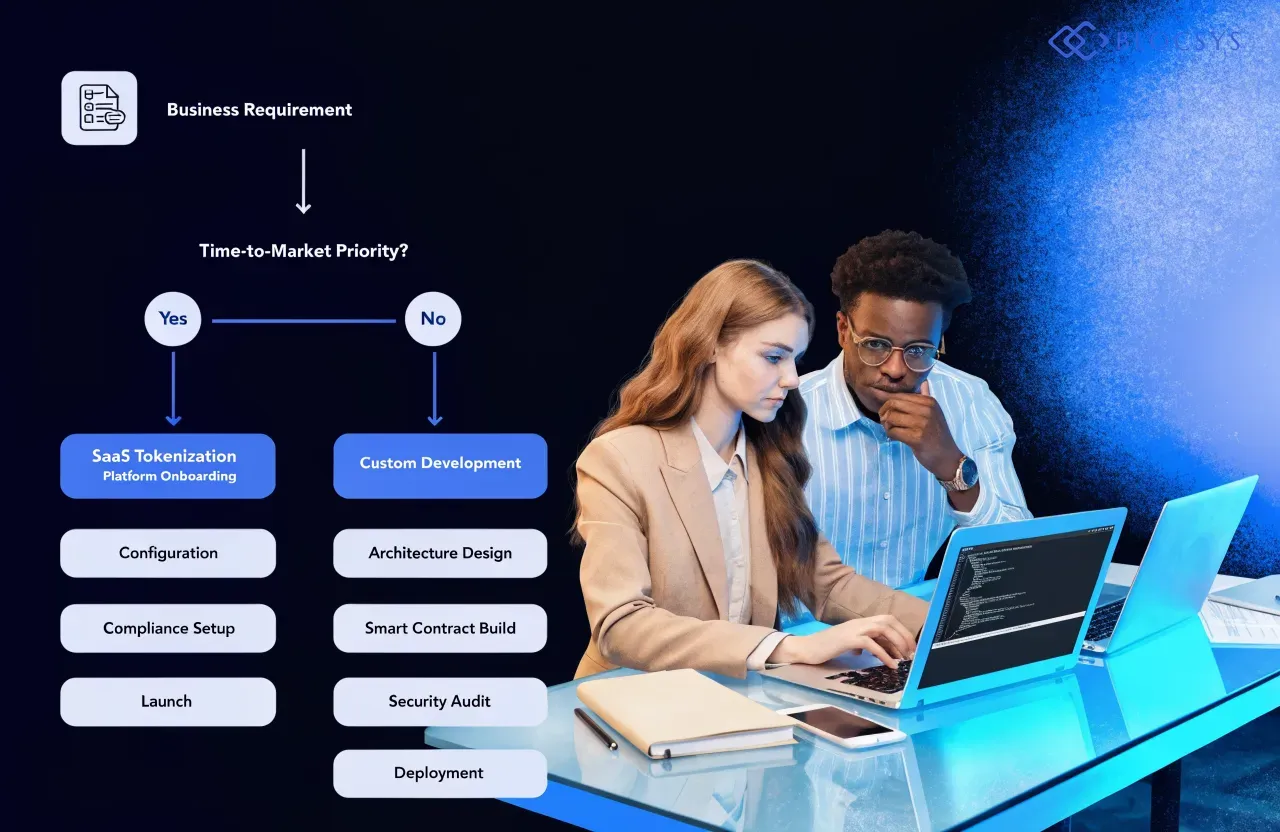
SaaS vs Custom Blockchain Development: A Direct Comparison
Numbers tell the story better than opinions do. Here’s how the two approaches typically compare across the factors that matter most to decision-makers.
| Factor | Custom Blockchain Development | SaaS Tokenization Platform |
|---|---|---|
| Implementation Timeline | 6–18 months | 2–8 weeks |
| Upfront Development Cost | $150,000–$1M+ | Subscription-based, low upfront cost |
| Infrastructure Management | In-house team required | Fully managed by provider |
| Compliance Updates | Manual, ongoing engineering work | Built-in, continuously updated |
| Scalability | Requires re-architecture | Native multi-tenant scaling |
| Security Audits | Separate, recurring expense | Included in platform maintenance |
| Long-Term ROI | Slower, higher risk | Faster payback, lower risk |
What stands out immediately is the timeline gap. Speed to market isn’t just convenience — for fintechs and asset managers, it’s often the difference between capturing a market window and missing it entirely.
Why a SaaS Tokenization Platform Development Company Changes the Cost Equation
When you work with a SaaS Tokenization Platform Development Company, you’re not paying for infrastructure you’ll use once. You’re paying for infrastructure that’s already been built, tested, and hardened across multiple clients. That shared cost model is exactly why subscription pricing beats custom development on total cost of ownership almost every time.
Think about it this way: would you build your own cloud data centers to run a CRM, or would you subscribe to Salesforce? Tokenization infrastructure is heading the same direction, and the economics are nearly identical.
Multi-Tenant Architecture: The Engine Behind Scalable Tokenization
Here’s a concept that doesn’t get discussed enough: multi-tenancy. A Multi-Tenant Tokenization Platform allows one underlying infrastructure to serve multiple issuers, each with isolated data, custom branding, and independent compliance rules.
For a SaaS provider or blockchain consulting firm serving multiple clients, this is the difference between deploying a new environment for every customer and simply onboarding a new tenant in hours. That’s a massive operational advantage.
Multi-tenancy also improves security posture. Rather than maintaining dozens of separate deployments, each with its own patching cycle, you maintain one hardened core system. Updates roll out once and apply everywhere, consistently and predictably.
How Multi-Tenancy Supports Different Asset Classes
A well-designed Blockchain SaaS Platform doesn’t lock you into one asset type. Enterprises are tokenizing equity, corporate bonds, real estate, carbon credits, and commodities, often on the same underlying platform.
For instance, Blocsys supports dedicated workflows for Equity Tokenization Platform Development, Corporate Bond Tokenization Platform Development, and Carbon Tokenization Platform Development, all built on shared multi-tenant infrastructure. That flexibility matters enormously for enterprises exploring multiple asset classes without rebuilding their tech stack each time.
Cloud-Native Deployment and AI-Powered Automation
Cloud deployment isn’t just about hosting anymore. Modern platforms use containerized microservices, auto-scaling infrastructure, and API-first design so integrations happen in days, not months.
AI is playing a growing role too. Automated KYC/AML screening, anomaly detection in transaction patterns, and predictive compliance alerts are becoming standard features rather than premium add-ons. A SaaS Digital Asset Platform with AI baked in can flag suspicious activity before a human compliance officer even sees the report.
This matters for regulated industries especially. Financial institutions in Switzerland, Germany, and the Netherlands operate under strict oversight, and AI-driven compliance monitoring helps them stay ahead of audits rather than scrambling after the fact.
DevOps and Platform Upgrades Without the Operational Burden
One quiet advantage of SaaS models: you never have to plan a migration. When your provider ships a new feature or patches a vulnerability, it deploys across the platform automatically. You don’t schedule downtime. You don’t coordinate a release calendar with your internal team.
Custom-built platforms don’t get this luxury. Every upgrade is a project, and every project has a cost.
Enterprise Security and Regulatory Compliance
Security concerns are usually the first objection enterprises raise about SaaS models. Fair question. Isn’t shared infrastructure inherently riskier than something you control completely?
In practice, it’s often the opposite. Established providers invest heavily in penetration testing, smart contract audits, and encryption standards because their entire business depends on it. A single security failure would affect every client on the platform, so the incentive to harden defenses is enormous.
An Enterprise Tokenization Platform built for institutional use typically includes multi-signature wallet support, role-based access controls, real-time transaction monitoring, and jurisdiction-specific compliance modules covering frameworks like MiCA in Europe, SEC guidelines in the US, and VARA regulations in Dubai.
Choosing a SaaS Tokenization Platform Development Company You Can Trust
Not every provider offers the same depth of security and compliance coverage. When evaluating a SaaS Tokenization Platform Development Company, ask about audit history, regulatory partnerships, and uptime guarantees. These details separate serious enterprise vendors from platforms that only look production-ready on the surface.
Blocsys works directly with enterprise clients on Asset Tokenization Platform deployments that meet institutional security standards from day one, rather than retrofitting compliance after launch.
Real-World Enterprise Use Cases
Theory is one thing. Here’s where SaaS tokenization platforms are actually delivering value right now.
Real estate funds are tokenizing property portfolios to unlock fractional ownership for a broader investor base, reducing minimum investment thresholds without sacrificing regulatory compliance.
Fixed income desks are digitizing corporate bond issuance, cutting settlement times from days to minutes while maintaining full audit trails for regulators.
Trading desks are building OTC Trading Platform Development solutions on top of tokenized assets, enabling faster institutional settlement outside traditional exchange rails.
Prediction markets operators are using tokenization infrastructure to launch compliant, transparent forecasting platforms, an area where Prediction Markets Platform Development expertise is increasingly in demand.
Supply chain and agriculture companies are combining tokenization with traceability, similar to how a Blockchain-Powered Organic Certification & Food Traceability Platform verifies product authenticity from farm to shelf.
Capital markets infrastructure providers are streamlining post-trade operations through systems like Permissioned Blockchain Infrastructure for Capital Market Post-Trade Operations, cutting reconciliation time significantly.
Industries Adopting SaaS Tokenization Platforms Fastest
Financial services lead adoption, unsurprisingly. However, real estate, commodities trading, carbon markets, gaming, and even document verification through platforms like Tamper-Proof Document Verification Platform Built on Blockchain are close behind. What connects all of them? Each needs trustworthy digital infrastructure without the multi-year build cycle custom development demands.
Implementation Roadmap: From Evaluation to Launch
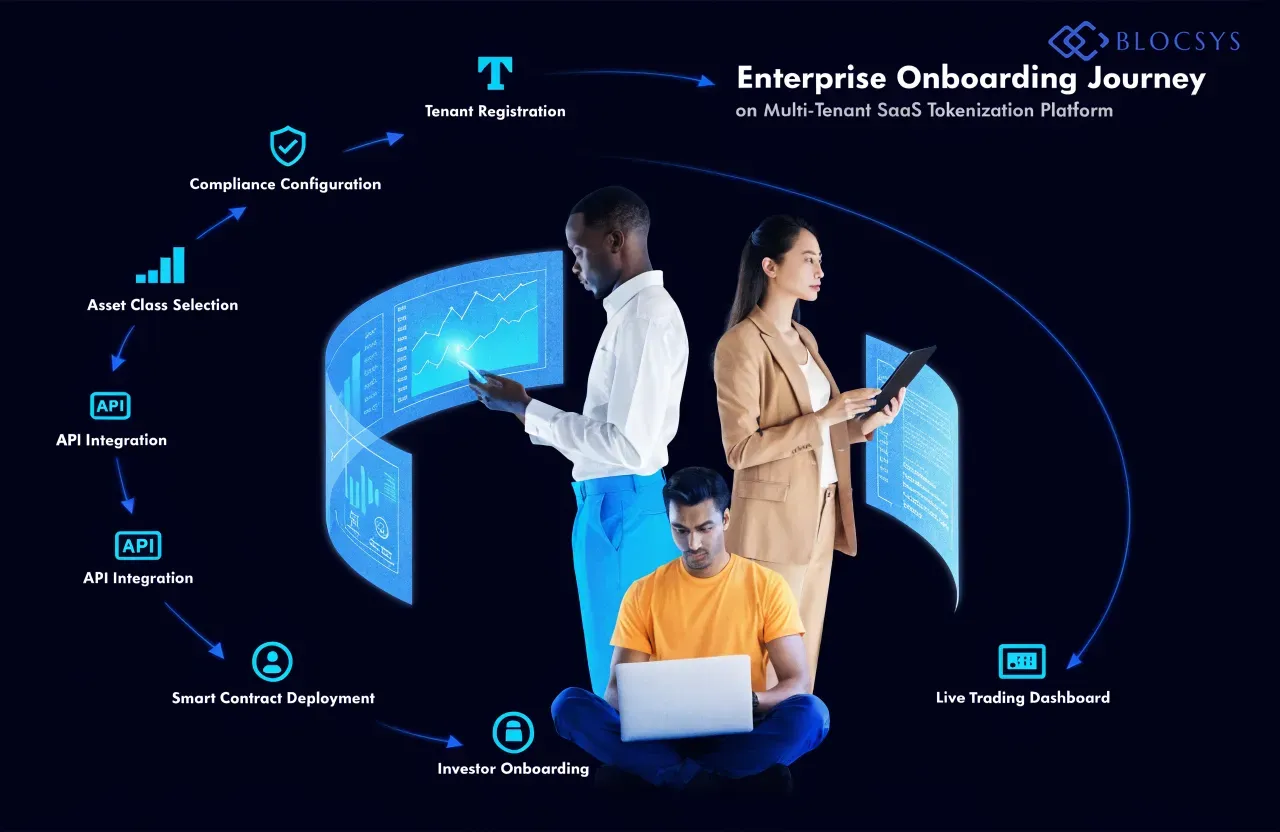
Enterprises typically move through a predictable path when adopting a SaaS tokenization platform:
- Discovery and requirements mapping, including asset class and jurisdiction
- Compliance framework alignment with legal and regulatory advisors
- Platform configuration and API integration with existing systems
- Smart contract deployment and third-party security review
- Pilot launch with a limited investor group
- Full production rollout and ongoing platform monitoring
Most enterprises complete this entire sequence in weeks rather than the year-plus timeline custom development typically demands. That speed advantage compounds too, since faster launches mean faster revenue and faster investor feedback loops.
Why Blocsys Is the Right SaaS Tokenization Platform Development Partner
Choosing a partner for something this foundational deserves scrutiny. Blocsys has built its reputation as a trusted SaaS Tokenization Platform Development Company by combining deep blockchain engineering with enterprise-grade compliance knowledge.
Our team supports the full spectrum of tokenization needs, from Tokenization Platform Development to Real World Asset Tokenization, backed by Smart Contract Development expertise that’s been audited across multiple production deployments.
Need dedicated engineering talent instead? You can Hire Blockchain Developers or Hire Web3 Developers directly through Blocsys, giving you flexibility whether you need a full platform or targeted development support.
As a recognized Blockchain Development Company, Blocsys understands that every enterprise has different requirements. That’s why our SaaS Platform is built to configure around your business, not the other way around.
What Sets Our SaaS Tokenization Platform Development Services Apart
Enterprises choose Blocsys because we don’t just deliver technology, we deliver outcomes. Our SaaS Tokenization Platform Development Company approach centers on rapid deployment, institutional-grade security, and compliance frameworks mapped to your target markets, whether that’s the UAE, Singapore, the UK, or the US.
Ready to move faster than custom development allows? Visit Blocsys to start the conversation about your tokenization roadmap.
How SaaS Platforms Help Businesses Tokenise Assets
For businesses operating in the UK, SaaS-based tokenization platforms can simplify the process of tokenising real-world assets and financial instruments without requiring a fully custom blockchain infrastructure. These platforms provide pre-built capabilities for asset issuance, compliance, smart contracts, and transaction management, allowing businesses to tokenise assets more efficiently while reducing development time and infrastructure costs.
GIFT City and the Shift Toward SaaS-Based Tokenization Platforms
GIFT City is emerging as an important financial hub for businesses exploring digital assets and tokenization, creating demand for scalable infrastructure that can support institutional use cases. SaaS-based tokenization platforms can help businesses enter this market faster by providing ready-to-use infrastructure for asset issuance, management, compliance, and transaction workflows without the time and cost involved in building a custom blockchain stack from scratch.
Frequently Asked Questions
Here are direct answers to the questions we hear most often about SaaS-based tokenization platforms.
What is a SaaS-based tokenization platform?
A SaaS-based tokenization platform is cloud-hosted infrastructure that lets businesses issue, manage, and trade digital assets without building blockchain systems from scratch. It bundles smart contract templates, compliance tools, and multi-tenant architecture into a subscription service.
Instead of hiring an in-house blockchain team, you configure an existing platform to match your asset class, whether that’s equity, bonds, real estate, or commodities, and launch in weeks.
Why are enterprises replacing custom blockchain development with SaaS platforms?
Custom blockchain development typically takes 6 to 18 months and requires specialized engineering, ongoing security audits, and continuous compliance updates. SaaS platforms cut that timeline to weeks while shifting infrastructure maintenance to the provider.
Enterprises also avoid the hidden costs of custom builds, including recurring audits, node maintenance, and regulatory re-engineering, which makes SaaS the more predictable financial choice.
What are the main benefits of a SaaS tokenization platform?
The core benefits include faster deployment, lower upfront costs, built-in compliance updates, multi-tenant scalability, and continuous security patching without downtime. You also get access to pre-audited smart contract templates instead of building and testing your own.
For growing businesses, the ability to scale to new clients or asset classes without re-architecting the platform is often the deciding factor.
How does a SaaS tokenization platform reduce development costs?
SaaS platforms spread infrastructure and security costs across many clients through a subscription model, rather than each business bearing the full cost of building, auditing, and maintaining its own blockchain system. This eliminates large upfront capital expenditure.
You also avoid ongoing engineering salaries for infrastructure maintenance, since the provider handles upgrades, patches, and compliance changes as part of the subscription.
Is a SaaS tokenization platform secure enough for enterprise use?
Yes, when built by an established provider. Enterprise-grade SaaS tokenization platforms undergo regular third-party security audits, use multi-signature wallet controls, and apply role-based access permissions across every tenant.
Because providers serve multiple enterprise clients on shared infrastructure, they typically invest more heavily in security than a single company building a one-off custom system would.
What’s the difference between SaaS and custom blockchain development?
Custom blockchain development means building every layer, from smart contracts to compliance tools, from scratch for a single organization. A SaaS tokenization platform provides that infrastructure pre-built, tested, and maintained, which you configure rather than construct.
The trade-off is flexibility versus speed. Custom builds offer maximum customization but slower timelines. SaaS platforms offer rapid deployment with configuration-level flexibility instead.
Can SaaS tokenization platforms support multiple asset classes?
Yes. Modern platforms support equity, corporate bonds, real estate, carbon credits, and commodities on shared multi-tenant infrastructure. This means you can expand into new asset classes without rebuilding your technology stack.
Blocsys, for example, offers dedicated workflows for equity, bond, and carbon tokenization, all running on the same underlying enterprise platform.
How long does it take to launch a SaaS tokenization platform?
Most enterprises launch within 2 to 8 weeks, depending on compliance complexity and integration requirements. This compares to 6 to 18 months for custom blockchain development from the ground up.
The timeline includes discovery, compliance configuration, API integration, smart contract deployment, and a pilot phase before full production rollout.
What industries benefit most from SaaS tokenization platforms?
Financial services lead adoption, particularly for equity, bonds, and fund tokenization. Real estate, commodities trading, carbon markets, and supply chain traceability follow closely behind.
Any industry needing verifiable, transparent digital asset infrastructure without a multi-year engineering commitment benefits from this model, including gaming, document verification, and capital markets operations.
Why should businesses choose Blocsys for SaaS tokenization platform development?
Blocsys combines enterprise-grade security, regulatory compliance knowledge, and rapid deployment capabilities as a trusted SaaS Tokenization Platform Development Company. Our platform supports multiple asset classes on shared, audited infrastructure.
We also offer dedicated development services, from smart contracts to full platform builds, giving enterprises flexibility whether they need a complete SaaS solution or targeted engineering support.
The shift toward SaaS-based tokenization isn’t a temporary trend, it’s a structural change in how enterprises approach digital asset infrastructure. Businesses that adapt now will launch faster, spend less, and scale more easily than those still weighing custom blockchain development. If you’re ready to explore what a modern, compliant tokenization platform looks like for your organization, Blocsys is ready to help you build it right.
Ready to move beyond theory and build an intelligent platform that delivers real-world value? Blocsys Technologies specialises in engineering enterprise-grade AI and blockchain solutions for the fintech, Web3, and digital asset sectors. Connect with our experts today to discuss your vision and chart a clear path from concept to a secure, scalable reality.
