How Gold Businesses Can Expand Their Reach Through a Shared Digital Gold Platform
Most independent jewellers and bullion dealers hit the same wall sooner or later. You’ve built a loyal customer base in your town or city, your relationships with suppliers are solid, and your margins are respectable. But growth beyond your existing footprint usually means opening a new store, hiring more staff, or chasing wholesale buyers you don’t yet know. That’s expensive and slow. A shared digital gold platform offers a different route — one where independent businesses collaborate through common technology instead of each one building distribution from scratch. Let’s look at how that actually works, and where the real decisions lie.
Why Gold Businesses Should Look Beyond Their Existing Business Networks
India’s jewellery retail market is largely made up of independent, regionally rooted businesses. Many jewellers and bullion dealers have built decades of trust within a specific city or district. However, that trust rarely travels automatically to new markets.
Your existing customer base has a ceiling. Once you’ve served the families, local investors, and repeat buyers within your reach, growth slows unless you open new outlets. Traditional distribution — wholesalers supplying a fixed set of retailers — also has limits, since each relationship has to be built and maintained manually.
Consequently, many gold businesses stay regional even when demand exists elsewhere. Digital collaboration changes this equation by letting independent businesses plug into shared infrastructure rather than duplicating it.
What Is a Shared Digital Gold Platform?
A shared digital gold platform is a digital system where multiple independent gold businesses operate alongside each other, using common technology for transactions, pricing, and customer access. Think of it as a digital gold platform for multiple businesses rather than a single-brand app.
Here’s the important distinction: participation doesn’t mean merger. Each business usually retains its own identity, pricing arrangement, and legal responsibilities. What’s shared is the underlying technology layer — not necessarily inventory, physical custody, or customer ownership.
The businesses that get the most from a shared digital gold platform are the ones that treat it as a distribution channel, not a replacement for their existing operations. Partnership structure matters more than the app itself.
This model works well for a gold business network expansion strategy because it lets a jeweller in Coimbatore reach a buyer in Pune without opening a branch there — provided the right partnership exists behind the scenes.
Two Ways Gold Businesses Can Build Digital Partnerships
There are two distinct paths here, and conflating them leads to confusion later.
Joining an Existing Shared Platform
In this model, an independent jeweller or bullion dealer joins a platform that’s already operated by another company or a consortium. You become one of several participating businesses, typically under agreed commercial terms — commission on referrals, revenue sharing on transactions, or a flat participation fee. You don’t control the platform’s technology or roadmap, but you gain faster access to a wider digital gold business partnerships network.
Building a Proprietary Platform With Your Own Partner Network
Alternatively, a business — often a larger jeweller, wholesaler, or bullion house — can build its own platform and onboard other independent businesses as partners. Here, you own the technology, set the commercial terms, and manage partner relationships directly. This suits businesses that already have supplier relationships, brand strength, or distribution reach and want to formalise it digitally instead of through manual coordination.
Neither path is inherently better. Joining is faster and cheaper upfront; owning gives you control but requires investment in digital gold and silver app development and ongoing platform management.
How Jewellers, Bullion Dealers and Gold Merchants Can Collaborate
Practical partnerships tend to follow a few recognisable patterns across India’s gold trade.
- A bullion dealer with strong sourcing relationships partners with several regional jewellers, supplying digital gold inventory while the jewellers handle customer-facing retail.
- A wholesaler connects with multiple independent retailers across different cities, letting each retailer offer digital gold under its own brand while the wholesaler manages backend settlement.
- Two jewellers in different states agree to cross-refer customers — one handles southern India, the other handles the north — through a shared digital gold platform that tracks referrals and commissions.
These arrangements support partnerships between jewellers and bullion dealers without requiring either party to give up their existing operations. Each business still sources, prices, and services its own customers; the platform simply connects the dots.
How a Shared Digital Gold Platform Can Expand Customer Reach
Reach expansion through partnerships works differently from opening new branches. Here’s what actually drives it.
Referral partnerships let one business introduce customers to another’s offering, earning a commission without carrying inventory risk. Regional partnerships let a business enter a new geography through a local partner who already understands that market, rather than starting cold.
Additionally, a digital gold platform for bullion dealers can route distribution to multiple retail partners simultaneously, instead of negotiating each relationship separately. Cross-business engagement — where a jeweller’s existing customers discover a partner’s gold savings scheme, for instance — adds another layer of gold business customer reach that’s hard to achieve through advertising alone.
None of this is automatic, though. Reach only expands when the partnership agreement, technology, and incentives are actually aligned.
Business Opportunities Created by Digital Gold Partnerships
Commercial arrangements vary widely, and that’s actually a strength of the model — businesses can structure deals around what makes sense for them.
Common structures include a flat referral fee per new customer, a percentage-based commission on transaction value, or a recurring revenue-sharing model where partners split margins on every trade processed through the platform. Distribution partnerships — where a bullion dealer pays retailers to stock and promote digital gold products — are another common arrangement.
A digital gold revenue-sharing model works best when it’s clearly defined upfront: who earns what, at what transaction stage, and how disputes get resolved. Vague terms cause friction later, even between businesses that trust each other.
Essential Features for Managing Multiple Business Partners
Running a multi-vendor digital gold platform development project — or joining one — requires specific technical capabilities that a single-business app doesn’t need.
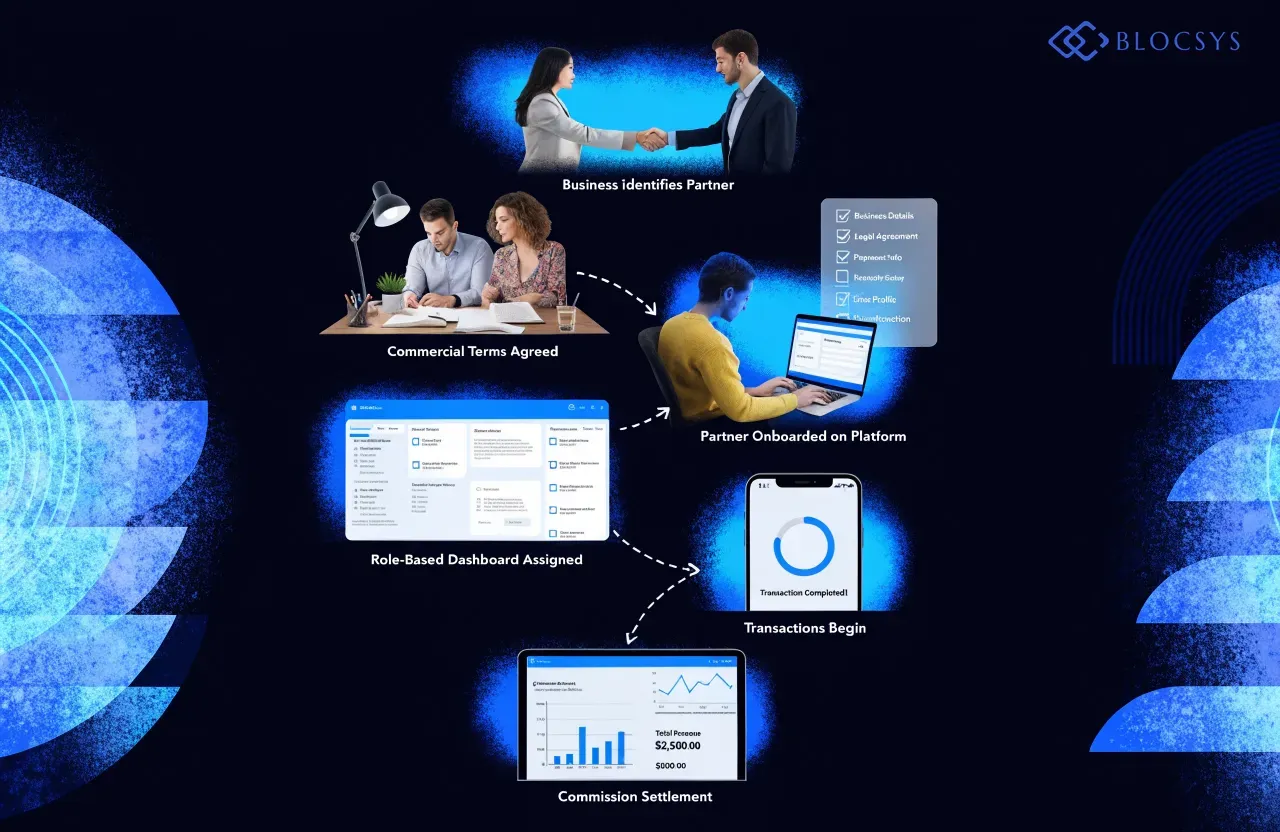
- Partner onboarding workflows — structured steps for verifying a new business, agreeing terms, and activating access.
- Individual dashboards — each partner needs visibility into their own transactions, customers, and earnings, without seeing another partner’s data.
- Role-based access control — administrators, partners, and sub-users each get permissions suited to their responsibilities.
- Pricing and commission management — tools to set partner-specific rates, margins, and payout schedules.
- Transaction tracking and reporting — real-time visibility into volumes, settlements, and reconciliation across partners.
- Centralized administration — a single control layer for the platform owner to monitor the entire network.
- Integrations — payment gateways, gold rate feeds, KYC verification, and vault or custodian systems where applicable.
A digital gold partner management platform that handles these functions well reduces the manual coordination that otherwise eats into the benefits of partnering at all.
What Gold Businesses Must Agree on Before Forming Partnerships
This is where many partnerships succeed or fail — not in the technology, but in what’s agreed beforehand.
Platform ownership needs to be unambiguous: who controls the technology, who can add or remove partners, and who makes final decisions on commercial terms. Sourcing and physical gold backing matter too — does each partner source and hold their own gold, or does one party act as custodian for the network? This should never be assumed.
Pricing and settlement timing need clear rules, especially since gold rates move throughout the trading day. Customer relationships and data access are equally sensitive — does the referring business retain its customer relationship, or does the platform owner take over that contact? Redemption processes (how a customer converts digital gold into physical delivery) must be defined per partner, since fulfilment capability differs across businesses.
Finally, compliance obligations — including KYC norms, anti-money laundering requirements, and relevant guidance from bodies like the Blocsys partner network’s own due diligence processes — need to be assigned clearly so no party assumes another is handling them.
Challenges of Operating a Shared Digital Gold Platform
Collaboration brings real friction, not just opportunity.
Partner trust takes time to build, especially when money and gold are involved. Operational coordination gets harder as the network grows — more partners means more edge cases in pricing, settlement, and customer disputes. Commercial disagreements over commission splits or referral attribution are common if terms weren’t precise from the start.
Security and data management carry extra weight too, since a multi-partner system handles sensitive financial and customer information across several businesses. Integration challenges arise when partners use different internal systems that need to connect to the shared platform. And compliance becomes more complex, since each partner may operate under slightly different regulatory expectations depending on their business structure.
None of these challenges rule out the model. They just mean it needs planning, not improvisation.
How to Build a Digital Gold Partner Network
If you’re considering building rather than joining, here’s a practical sequence.
Start by defining your business objective clearly — are you trying to expand geographically, add distribution volume, or diversify revenue? Next, choose your partnership model: referral-based, revenue-sharing, or full distribution. Then evaluate potential partners on reputation, financial stability, and operational capacity, not just willingness to join.
Define commercial agreements in writing before any technical integration begins. Plan your platform requirements — partner dashboards, commission logic, compliance checks — based on how many partners you expect and how they’ll operate. Test workflows with one or two partners before expanding the network further. Independent gold business collaboration works best when it scales gradually, with lessons from early partners shaping how later ones are onboarded.

How Blocsys Helps Businesses Build Shared Digital Gold Platforms
Blocsys Technologies Pvt. Ltd. works with businesses planning either a shared digital gold platform or a proprietary platform with multiple participating partners. As a company focused on blockchain development, tokenization, and digital asset platforms, Blocsys supports the technical side of partner-based gold business models — including role-based dashboards, partner onboarding flows, commission management, and transaction reporting.
For a jeweller exploring a custom digital gold platform for gold dealers, or a wholesaler planning a digital gold platform for jewellery retailers under its own brand, the technology decisions matter as much as the commercial ones. Features like centralized partner administration and gold rate integration need to be built with multi-business use in mind from day one, not retrofitted later.
If you’re evaluating digital gold application development company options for a partner-based model, it’s worth reviewing Blocsys’s digital gold and silver app development services directly to understand what’s technically feasible for your specific partnership structure.
Conclusion
Expanding a gold business doesn’t have to mean opening branch after branch. A shared digital gold platform gives independent jewellers, bullion dealers, and wholesalers a way to connect with partners, reach new customers, and create additional revenue streams — provided the commercial terms, custody arrangements, and technology are planned properly. Whether you join an existing network or build your own, the opportunity lies in collaboration done right. If you’re ready to explore what a partner-based model could look like for your business, Blocsys’s digital gold and silver app development team can walk through the options with you.
Frequently Asked Questions
Here are direct answers to the questions we hear most often about shared digital gold platforms and partnership-based expansion.
What is a shared digital gold platform?
It’s a digital system where multiple independent gold businesses operate side by side, using common technology for transactions and customer access. Each business usually keeps its own pricing, sourcing, and customer relationships.
Can multiple independent jewellers join the same digital gold platform?
Yes. Independent jewellers can join an existing platform under agreed commercial terms, such as referral fees or revenue sharing, without merging their businesses.
How can bullion dealers partner with jewellery retailers?
A bullion dealer can supply sourcing and backend settlement while retailers handle customer-facing sales, with commission or margin-sharing terms defined between them.
What is the difference between joining an existing platform and building your own?
Joining gives faster access to a network but less control over technology and terms. Building your own means owning the platform and managing partners directly, which requires more investment and effort upfront.
How can a shared digital gold platform help businesses reach new customers?
Through referrals, regional partnerships, and cross-business customer engagement, a business can access buyers in markets it doesn’t operate in directly.
What revenue-sharing models can gold business partners use?
Common models include flat referral fees, percentage-based commissions on transactions, and ongoing margin splits between the platform owner and partners.
What features are needed to manage multiple businesses on a digital gold platform?
Partner onboarding, individual dashboards, role-based access, commission management, transaction tracking, and centralized administration are essential.
How should partners manage gold sourcing and custody responsibilities?
This must be explicitly agreed per partnership — some partners source and hold their own gold, while others rely on a central custodian. It’s never assumed automatically.
What challenges should businesses consider before joining a shared digital gold platform?
Partner trust, unclear commission terms, data access boundaries, and compliance responsibilities are the most common sources of friction.
Can Blocsys develop a digital gold platform for multiple business partners?
Yes. Blocsys supports development of digital gold and silver platforms designed for multi-business and partner-based models, including partner management features.
Ready to move beyond theory and build an intelligent platform that delivers real-world value? Blocsys Technologies specialises in engineering enterprise-grade AI and blockchain solutions for the fintech, Web3, and digital asset sectors. Connect with our experts today to discuss your vision and chart a clear path from concept to a secure, scalable reality.