
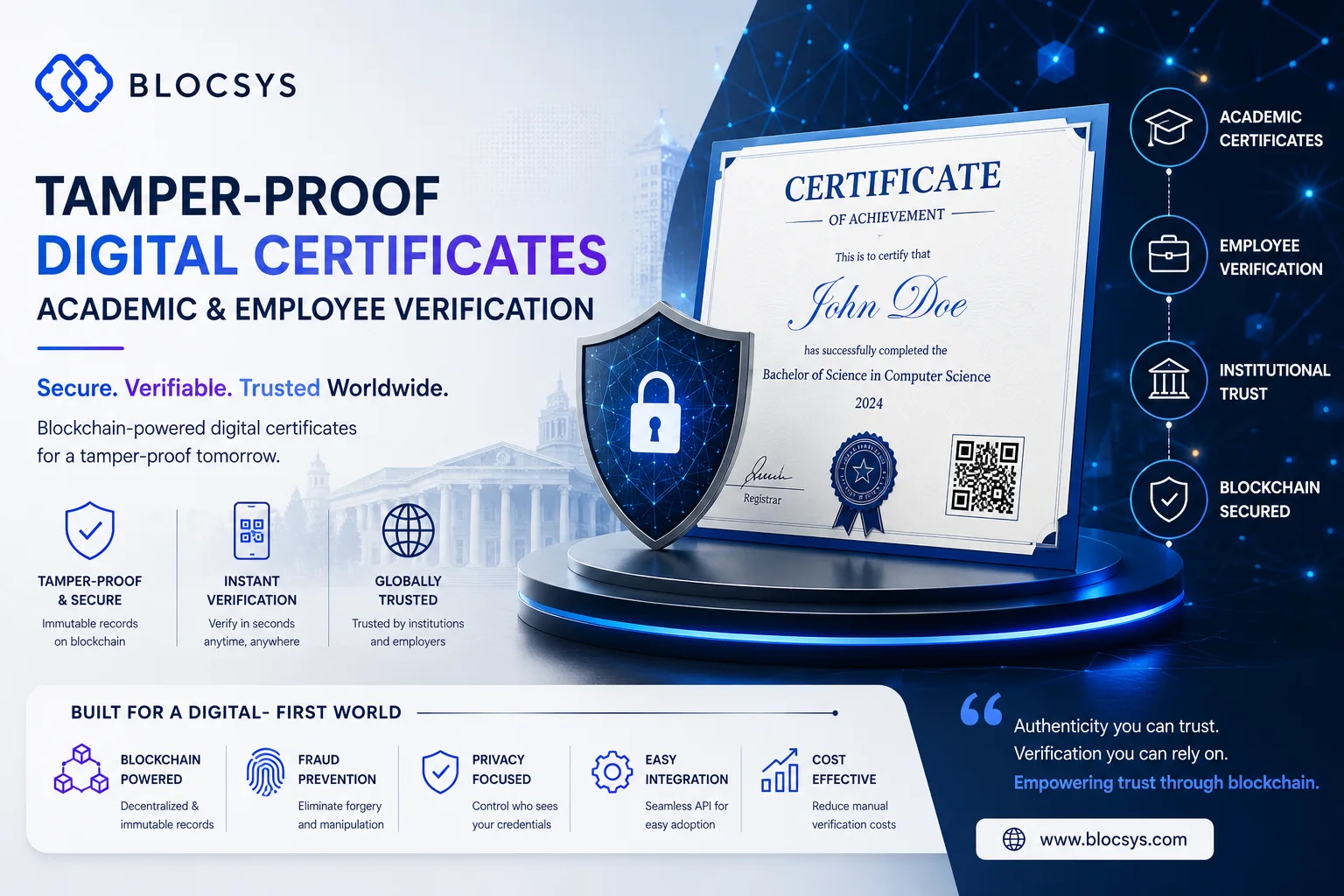
Tamper-Proof Digital Certificates: The Future of Academic & Employee Verification
Fraud is expensive, and it’s getting bolder. Every year, thousands of employers hire candidates based on falsified academic credentials — degrees that were never earned, certifications that don’t exist, and transcripts edited in a basic PDF tool. Universities and institutions, meanwhile, spend enormous resources trying to verify documents that anyone could fake in under an hour. Blockchain-backed digital certificates are changing all of that. They make credential fraud structurally impossible, cut verification time from days to seconds, and give both institutions and employers a system they can actually trust.
Why Paper-Based Academic Credentials Don’t Cut It Anymore
Paper certificates have one fundamental problem — they’re easy to fake. Anyone with a scanner and an image editor can produce a convincing forgery. Consequently, the burden always falls on employers and institutions to manually verify every document, call universities directly, and wait days or even weeks for a response.
Think about the scale of this problem. Resume fraud affects a staggering number of hiring decisions globally. Furthermore, international hiring makes verification even harder — checking academic credentials from foreign institutions is slow, inconsistent, and genuinely expensive.
Physical documents also degrade, get lost, or become inaccessible when institutions shut down. Additionally, the person who earned a degree has no digital, portable proof they can instantly share with anyone who needs it. The whole system is stuck in the past, and it’s costing everyone involved.
Here’s what makes things worse: even official verification services can be manipulated. Diploma mills issue real-looking certificates for programs that don’t genuinely assess competency. Therefore, what looks like a verified credential might still be completely worthless to any serious employer doing proper due diligence.
The cracks in the old system are too wide to patch.
How Blockchain Technology Transforms Certificate Verification
Blockchain doesn’t just digitize documents — it fundamentally changes how trust works. Instead of relying on a central authority to vouch for a certificate’s authenticity, blockchain distributes that trust across a network of nodes. No single party controls the record, so no single party can alter it without detection.
When a university issues a digital certificate on a blockchain, it creates a cryptographic hash — a unique digital fingerprint — of that document. That hash gets written permanently to the chain. Furthermore, any attempt to alter even a single character in the document changes its hash entirely, instantly exposing the tampering.
You can think of it this way: every certificate gets its own DNA. Change anything about it, and the DNA no longer matches. Consequently, verification becomes a simple comparison between the document you’re holding and the record on-chain.
This is the core of how a Blockchain Document Verification System for Secure Digital Proof works — cryptographic proof that doesn’t require anyone to simply “trust” the issuer’s word.
What Makes a Certificate Truly Tamper-Proof?
True tamper-proofing combines three layers of security. First, immutability — once written to a blockchain, the record can’t be changed or deleted. Second, cryptographic hashing — any document modification breaks the hash comparison immediately. Third, decentralization — there’s no single server to hack, bribe, or take offline.
Additionally, smart contracts automate the issuance process, ensuring that only authorized institutions can write credential records to the chain. This removes human error and insider manipulation from the equation entirely.
Fraud doesn’t stand a chance.
“The problem with traditional credential verification isn’t just speed — it’s systemic opacity. When every stakeholder can independently verify a record without asking anyone’s permission, fraud becomes structurally impossible rather than just difficult to pull off.” — Dr. Ananya Krishnan, Digital Trust Infrastructure Researcher
Verifying Employee Records Has Never Been This Fast
Recruitment teams traditionally spend hours on background checks. They call universities, email HR departments from previous employers, and wait for responses that sometimes never arrive. This slows down hiring, introduces risk at every stage, and frustrates good candidates who deserve better treatment.
With blockchain-verified certificates, your HR team doesn’t need to call anyone. A candidate shares their digital academic credentials — as a QR code, a shareable link, or a verifiable credential file. You scan it, the system checks the on-chain hash, and you get an instant confirmed result. The whole process takes seconds.
That speed matters enormously in competitive hiring markets. Moreover, it levels the playing field — small companies get the same verification power as large multinationals with dedicated compliance departments. You don’t need a global team to hire with confidence.
Our Tamper-Proof Document Verification Platform Built on Blockchain enables exactly this kind of real-time, institution-independent verification without costly third-party services standing between you and the truth.
The Real Cost of Credential Fraud for Employers
When a bad hire slips through, the consequences go far beyond a wasted salary. You’re looking at potential legal liability if a fraudulent professional caused harm — think a fake engineer signing off on structural calculations, or a fabricated medical qualification. Additionally, there’s significant reputational damage when a high-profile hire’s fake degree becomes public.
Studies consistently put the cost of a bad hire at 30% or more of that employee’s annual salary. For senior roles, that number climbs dramatically. Therefore, investing in solid verification infrastructure isn’t a luxury — it’s fundamental risk management that protects your business.
Prevention always costs less than recovery.
Universities Issuing Blockchain-Backed Academic Credentials
Forward-thinking universities are already moving beyond paper. Institutions across Europe, Asia, and the Americas now issue blockchain-verified academic credentials that graduates carry in digital wallets — permanently accessible, instantly shareable, and impossible to falsify without immediate detection.
The graduate experience improves dramatically too. You no longer need to contact your old university every time an employer requests verification. Furthermore, you don’t risk losing your proof of education to a house fire or a hard drive crash. Your credentials exist securely on a distributed network, accessible from anywhere on the planet at any time.
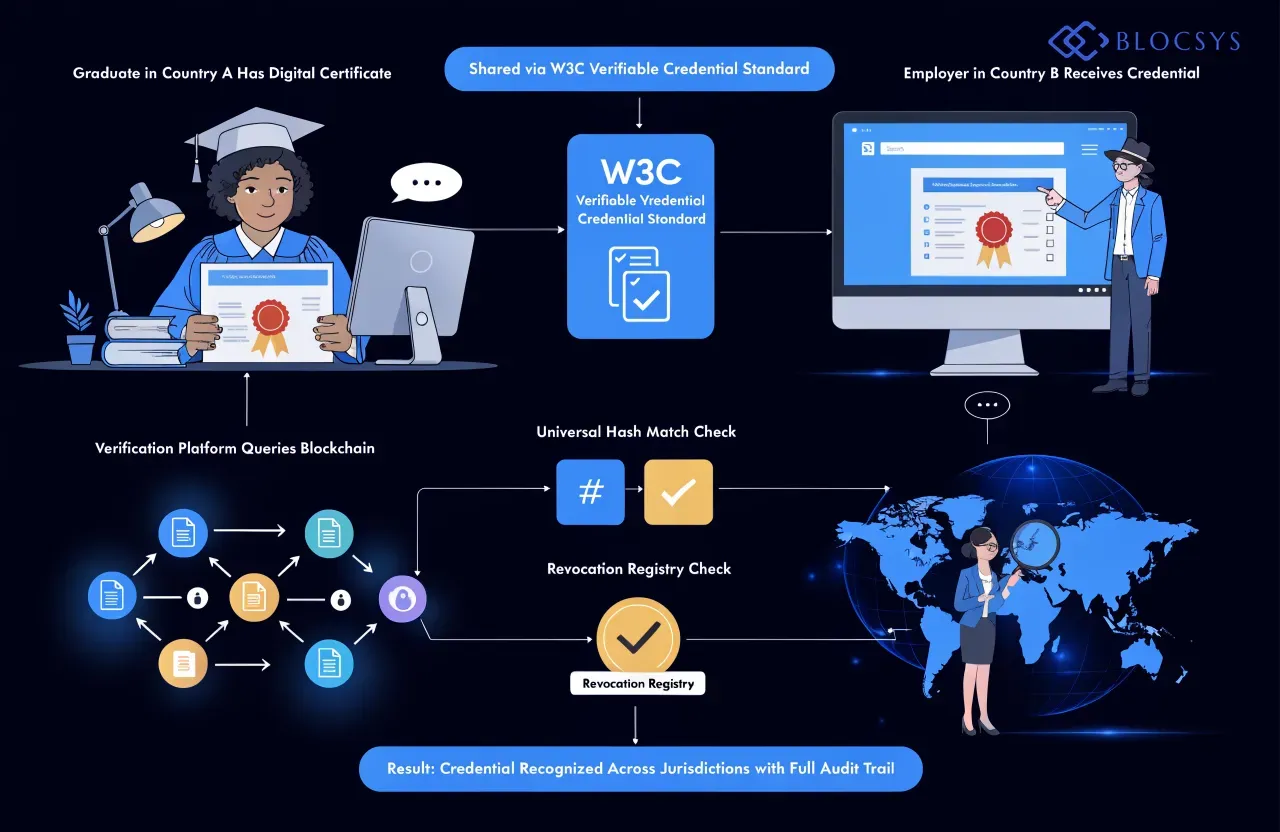
Some institutions use open standards like W3C Verifiable Credentials or IMS Global Open Badges — frameworks designed to make credentials interoperable across different platforms and countries. Consequently, your digital degree from a university in India is just as verifiable by an employer in Germany as it is locally, with no extra steps required.
Behind this shift is serious infrastructure work. Building a scalable, standards-compliant credential issuance system requires experienced blockchain engineers. If your institution is exploring this path, Dedicated Blockchain Engineering Teams can accelerate your rollout significantly and help you avoid common implementation pitfalls that slow down lesser-prepared projects.
What Standards Govern Digital Academic Credentials?
Several open frameworks are shaping how digital academic credentials get issued and recognized globally. The W3C Verifiable Credentials standard defines a machine-readable format that works across blockchain platforms without proprietary lock-in. IMS Global Open Badges focuses on micro-credentials and skill-specific certifications that go beyond traditional degrees.
Additionally, Europass in the EU and initiatives from the American Council on Education are pushing toward genuine cross-border recognition of digital certificates. This means your credential won’t just be verifiable — it’ll be understood and accepted in standardized ways across jurisdictions without additional bureaucratic steps slowing you down.
Standards aren’t glamorous, but they’re what make real interoperability possible.
The Step-by-Step Verification Process
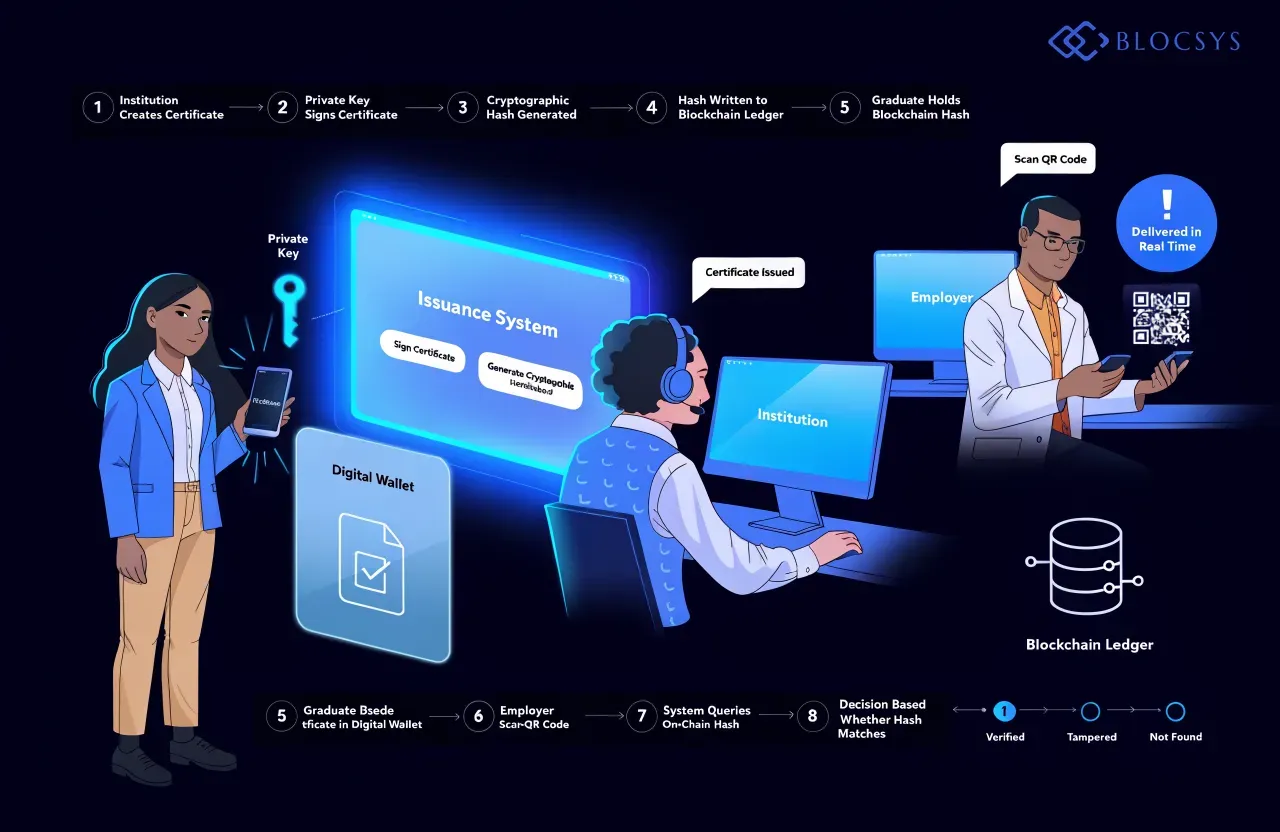
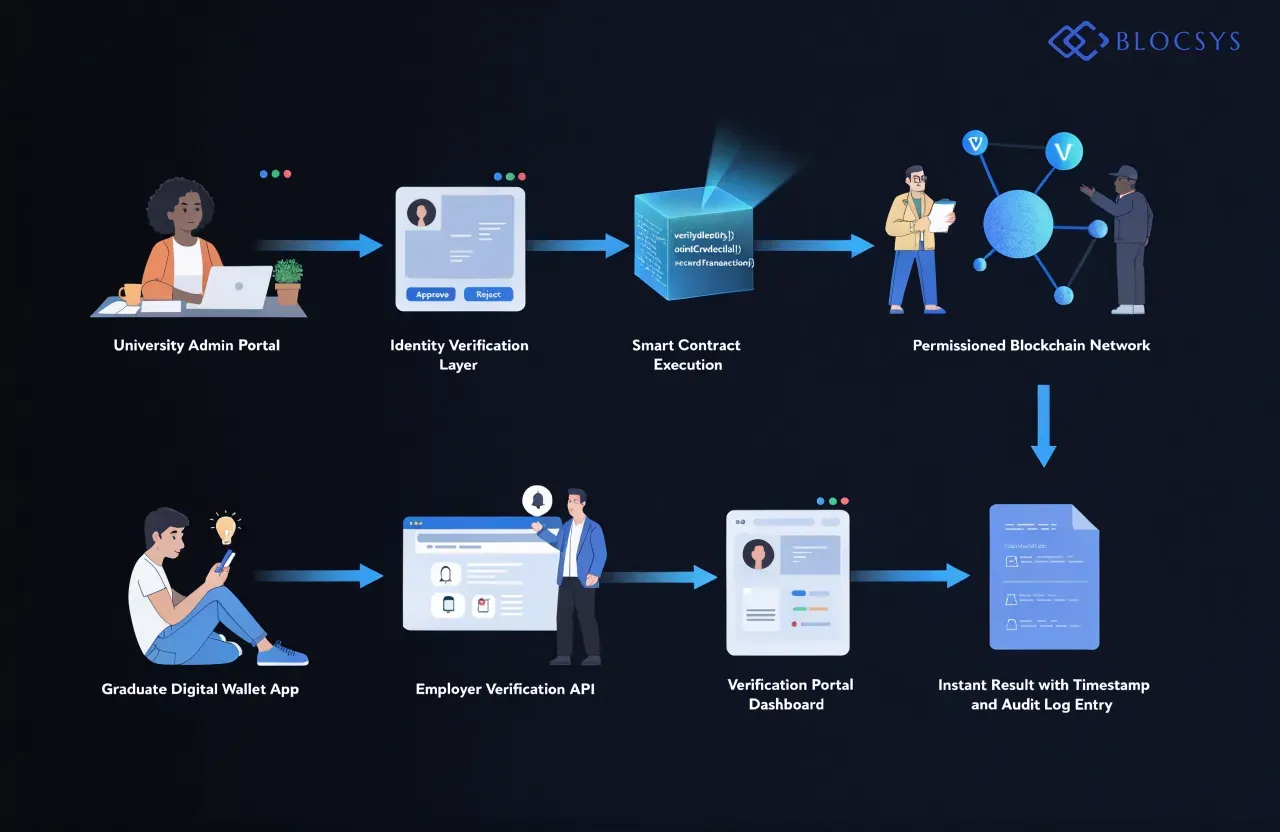
Here’s how the full cycle works in a modern blockchain credential system. The institution creates the certificate and signs it with their private cryptographic key. A hash of the document — along with the institution’s digital signature and issue date — gets written to the blockchain as a permanent, immutable record that anyone can query.
The graduate receives their digital certificate, typically in a wallet app or as a downloadable file with an embedded QR code. When they apply for a role, they share the certificate directly with the employer. The employer’s verification platform then scans the QR code or accepts the credential file for analysis.
The system retrieves the on-chain hash and compares it against the submitted document in real time. If they match, the certificate is genuine. If they don’t, the document was altered after issuance. No phone calls. No waiting. No ambiguity whatsoever.
This is the architecture that a robust Blockchain Document Verification System is built around — a clean, auditable chain from issuance to verification that both parties can trust completely and independently.
From Issuance to Instant Verification
What’s especially powerful here is the audit trail. Every verification attempt is logged on-chain with a timestamp. Therefore, institutions can see who’s checking their certificates and exactly when they did it. Employers can prove they performed proper due diligence. Graduates can track when and where their credentials were accessed by third parties — full transparency all around.
This transparency creates genuine accountability at every step of the process. Moreover, it gives regulators and auditors a clear digital trail when they need to investigate disputes or review compliance questions. Verification becomes a living, timestamped record — not a one-time event with no paper trail to show for it.
That’s a completely different level of institutional confidence.
“We’ve moved past the question of whether blockchain can secure credentials — that’s settled technology. The real frontier now is building the institutional trust and user experience layers that make organizations actually want to adopt these systems at scale.” — Marcus Oyelaran, Blockchain Solutions Architect
Beyond Fraud Prevention — The Broader Benefits
Tamper-proof digital certificates offer benefits that go well beyond stopping fraudsters. Think about administrative efficiency alone. Universities receive tens of thousands of verification requests each year. Each one currently requires staff time, email chains, and manual record-checking. Blockchain verification automates most of that workload away — freeing your team for genuinely valuable work.
Additionally, digital credentials open up new possibilities for micro-credentialing. Verifiable digital certificates for short courses, professional workshops, and skill-specific training are increasingly valuable. Employers value these granular proofs of competency alongside traditional degrees, especially in fast-moving technical fields where skills evolve faster than curricula do.
Furthermore, graduates from institutions in developing countries gain something especially meaningful: internationally credible, independently verifiable proof of their qualifications. This directly reduces the bias in hiring that stems from simple unfamiliarity with foreign institutions that HR teams haven’t encountered before.
The efficiency gains also stack up financially. If you’re wondering what it costs to build or integrate such a system, our Software Development Cost Estimator gives you a quick, project-specific starting point without any commitment required.
Your Academic Credentials Work Across Borders
One of the biggest practical wins is global portability. Traditional academic credentials create real friction when you move across borders — different countries have different recognition processes, different transcript formats, and different requirements for officially authenticated documents.
Digital credentials built on open standards cut through that friction completely. Your blockchain-verified degree is readable and verifiable by any employer or institution using a compatible verification platform, regardless of where they’re based. Consequently, you carry your entire educational record with you — always current, always accessible, always trustworthy on any device.
That’s a tangible, real-world quality-of-life improvement for millions of globally mobile professionals right now.
Academic Credentials on Blockchain: Challenges Worth Knowing
We’d be giving you an incomplete picture if we skipped the challenges. Blockchain credential systems aren’t magic — they come with real implementation hurdles that institutions and employers need to plan for carefully before committing to a platform.
First, adoption is still uneven. A verified digital certificate only helps if the receiving party has the tools and knowledge to verify it. Many HR departments and smaller employers aren’t yet equipped for blockchain verification. Therefore, education and accessible tooling need to roll out alongside the credentials themselves — not as an afterthought added months later.
Second, private key management is genuinely tricky. If an institution loses or compromises its signing key, every credential it issued becomes suspect. Consequently, robust key management infrastructure is non-negotiable for any serious deployment. This often requires dedicated security protocols that go well beyond standard IT practices your team might already have.
Third, blockchain permanence cuts both ways. Revocation — for instance, revoking a degree due to academic misconduct — requires careful technical design from the start. You can’t simply delete a blockchain record, so revocation systems must be built explicitly into the credential architecture before you issue a single certificate, not retrofitted afterward.
Additionally, there’s the question of scalability. Some public networks experience congestion during peak periods, which could slow issuance for large universities graduating thousands of students simultaneously. Choosing the right chain — or a purpose-built permissioned ledger — matters enormously and should inform your architecture decisions early in the planning process.
These aren’t insurmountable obstacles. They’re engineering and policy challenges that experienced teams solve regularly, and planning for them upfront makes the difference between a smooth launch and a painful one.
What’s Coming Next in Digital Certificate Technology
The field is moving fast, and we’re genuinely excited about where it’s heading. We’re seeing AI and blockchain converge to create smarter verification systems — ones that detect anomalies in credential patterns, flag suspicious issuance spikes, and cross-reference credentials against institutional records in real time without human intervention.
Additionally, self-sovereign identity (SSI) models are gaining serious traction across the industry. These give graduates direct ownership of their credential data, letting them share only specific attributes — “I hold a degree in engineering” — without exposing full personal details unnecessarily. This privacy-preserving approach aligns well with global data protection regulations like GDPR and similar frameworks worldwide.
The connection between credential systems and broader on-chain infrastructure is also deepening rapidly. Platforms that already handle complex on-chain automation, like our AI Agent Skills for On-Chain Operations, demonstrate how intelligent automation and blockchain verification can work together in genuinely powerful, production-ready ways.
Furthermore, if you’re a founder exploring this space seriously, our Founder Checklist 2026: Blockchain Startup Guide covers the key architectural and regulatory considerations you’ll want to address before building any credential infrastructure at scale.
The era of instantly verifiable, globally portable, fraud-proof academic credentials isn’t a distant future — it’s being built right now, institution by institution, platform by platform. Don’t wait for everyone else to figure it out first.
blockchain explorer
blockchain explorer is an increasingly important topic for readers of “Tamper-Proof Digital Certificates: The Future of Academic & Employee Verification”. This section covers what it means, why it matters, and the key points to keep in mind.
blockchain applications
blockchain applications is an increasingly important topic for readers of “Tamper-Proof Digital Certificates: The Future of Academic & Employee Verification”. This section covers what it means, why it matters, and the key points to keep in mind.
Frequently Asked Questions
Here are direct answers to the questions we hear most often about tamper-proof digital certificates and blockchain credential verification.
Can a blockchain-verified certificate really never be faked?
The certificate itself can’t be altered without breaking its cryptographic hash — any change to even a single character invalidates it instantly. However, the system’s security depends on the issuing institution properly controlling their private signing keys. If a bad actor somehow gained access to those keys, they could issue fraudulent certificates that appear legitimate.
Therefore, robust key management is just as critical as the blockchain technology itself. Well-designed systems use multi-signature schemes and hardware security modules to protect signing keys, making unauthorized access exponentially harder to achieve.
Do employers actually accept digital certificates for verification?
Adoption is growing rapidly. Many large multinationals, tech companies, and government employers already accept and actively prefer blockchain-verified credentials because they’re faster and more reliable than manual verification calls. Smaller employers are catching up quickly as verification platforms become more accessible and user-friendly across different industries.
Additionally, regulatory bodies in several countries are beginning to mandate digital credential standards for licensed professions. This regulatory push is accelerating employer adoption in sectors like healthcare, engineering, and financial services where credential verification is a compliance requirement.
What happens to my academic credentials if the issuing institution closes?
This is one of blockchain’s strongest practical advantages over paper records. Once your credential is written to the blockchain, it exists permanently — regardless of what happens to the institution that issued it. The record is distributed across many nodes, so no single point of failure can erase it.
Your proof of education survives even if the university doesn’t. You’ll always be able to share a verifiable, timestamped credential that proves when and where you earned your qualification — without needing the original institution to be active or cooperative.
How does credential revocation work on a blockchain?
Well-designed systems maintain a separate revocation registry on-chain. When verifying a credential, the system checks both the certificate’s cryptographic hash AND the revocation registry simultaneously. If a credential appears in the revocation list, it shows as invalid — even though the original issuance record still exists on-chain permanently.
Consequently, revocation is transparent, auditable, and takes effect immediately across every verification point worldwide. There’s no lag between when an institution revokes a credential and when employers see the updated status during a verification check.
How much does it cost to implement a blockchain credential system for a university or organization?
Costs vary significantly depending on scale, the blockchain network chosen, integration complexity, and whether you’re building custom infrastructure or integrating with an existing platform. A basic integration with an established platform can start in the tens of thousands of dollars, while a fully custom enterprise-grade system runs considerably higher depending on your requirements.
Use our Software Development Cost Estimator to get a realistic project-specific baseline for your scale and requirements. It takes just a few minutes and gives you a grounded starting point for internal budget conversations before you engage any development team.
Ready to move beyond theory and build an intelligent platform that delivers real-world value? Blocsys Technologies specialises in engineering enterprise-grade AI and blockchain solutions for the fintech, Web3, and digital asset sectors. Connect with our experts today to discuss your vision and chart a clear path from concept to a secure, scalable reality.
