
For any enterprise founder, compliance team, or government agency, the friction of traditional document verification is a constant headache. The entire process is a drain on operational resources, a never-ending fight against sophisticated fraud, and a source of frustration for the very customers and citizens you serve. This deep-seated reliance on outdated, centralized identity systems simply isn’t working anymore, paving the way for a much-needed new approach: Decentralized Digital Identity (DID).
This guide is for enterprise leaders, blockchain startups, and decision-makers in finance, healthcare, and government across Europe, the UK, USA, UAE, and Singapore. We will break down how Decentralized Digital Identity is transforming document verification, reducing fraud, and enabling a future of secure, user-controlled digital trust, and how your organization can build it.
Table of Contents
- Why Is Traditional Document Verification Failing Enterprises?
- What Is Decentralized Digital Identity (DID)?
- How Do Verifiable Credentials Revolutionize Document Proof?
- A Head-to-Head Look: Traditional vs. DID-Based Verification
- How Are Enterprises and Governments Using DID for a Competitive Edge?
- How Blocsys Can Help You Build Your Decentralized Identity Solution
- Frequently Asked Questions (FAQs)
- What is Decentralized Digital Identity (DID)?
- How does DID improve document verification?
- What are verifiable credentials?
- How does blockchain support decentralized identity?
- Why is self-sovereign identity important?
- Can DID prevent identity fraud?
- How do enterprises use DID systems?
- How can Blocsys help build decentralized identity solutions?
Why Is Traditional Document Verification Failing Enterprises?
Let’s be blunt: today’s verification methods are broken. Whether you’re a financial institution in Germany, a government agency in the USA, or a tech platform in Dubai, the story is depressingly similar. We’re all leaning on legacy systems built on manual reviews, isolated databases, and endless copies of physical documents. These methods are slow, expensive, and alarmingly insecure.
This isn’t just an operational snag; it’s a direct threat to your business.
These old-fashioned processes create massive bottlenecks, especially during customer onboarding. Think about the repetitive cycle of collecting, checking, and storing sensitive documents like passports and driver’s licenses for every single new service. It’s wildly inefficient and costly. Worse yet, it forces businesses to create massive, centralized “honeypots” of personal data—prime targets for cybercriminals. Every breach means not only immense financial penalties but also a catastrophic erosion of customer trust.
The challenges only get bigger in high-growth markets. While centralized systems have attempted to solve friction, they also concentrate risk. Decentralized identity flips the script by empowering users to control their own cryptographic credentials, sharing only the data necessary for a given transaction. This move away from repeated, full-document checks toward portable, privacy-preserving verification is essential for any business that needs to onboard users faster and more securely.

The core problems with the traditional model are impossible to ignore:
- Skyrocketing Operational Costs: Manual reviews and redundant data entry are driving compliance overhead through the roof, demanding significant and expensive human intervention.
- Escalating Fraud Risks: Sophisticated deepfakes and expertly forged documents can now sail past simple visual checks, exposing businesses to huge financial and reputational damage.
- Poor User Experience: Long, clunky onboarding processes are a direct cause of high drop-off rates, killing customer acquisition and torpedoing revenue goals.
- Data Security Vulnerabilities: Storing copies of sensitive documents in centralized databases is like putting a giant target on your back, creating a constant risk of a catastrophic data breach.
These failures aren’t just minor flaws; they are systemic, highlighting an urgent need for a completely new paradigm. Decentralized Digital Identity isn’t just another tech upgrade—it’s a strategic answer to these deep-seated business challenges. You can learn more about the security differences by reading our guide on centralized vs. blockchain-based document verification.
What Is Decentralized Digital Identity (DID)?
Decentralized Digital Identity (DID) is a trust framework where individuals, organizations, and devices own and control their identity data through secure digital wallets, completely cutting out the need for a central authority. This user-centric model is built on open standards, enabling verifiable, trustworthy interactions online.
Think about traditional identity systems. They’re like an apartment building where a single security guard holds all the keys. To enter any apartment (use any online service), you must go through the guard. They hold all the keys, verify everyone, and log every move. It’s clumsy, creates a single point of failure, and puts too much power in one entity’s hands.
DID gives every person their own unique set of keys. You are the only one who controls your keys, you decide who gets access, and you can grant that access without ever handing the actual keys over.
This model is built from the ground up to be more secure, private, and put the user back in control of their identity.
The Three Pillars of DID Architecture
The DID framework isn’t just one piece of technology. It’s built on three core components that work together to create a secure, universal system for blockchain-based identity.
Decentralized Identifiers (DIDs): These are globally unique, persistent digital addresses that you own and control. A DID is like a phone number for your identity that isn’t tied to any single company or government. It’s the permanent anchor for all your digital credentials.
DID Documents: Every DID comes with a corresponding DID Document. You can think of this as the public-facing “business card” for your identifier. It holds cryptographic material like public keys and service endpoints, telling other systems how they can securely interact with you and verify your credentials without ever seeing your private data.
Verifiable Data Registries: This is the trust layer, most often a blockchain or another type of distributed ledger technology (DLT). It functions like a public notary, allowing anyone to look up a DID document and confirm it’s authentic and hasn’t been altered. The registry never stores your personal data—only the cryptographic proof needed to verify it.
Together, these pillars create a powerful decentralized identity management system where you are the true controller of your digital self. This architecture is the foundation for secure and private DID document verification. For a deeper look into the mechanics, check out our full guide on blockchain digital identity and securing decentralized data.
How Do Verifiable Credentials Revolutionize Document Proof?
If Decentralized Identifiers (DIDs) are the permanent addresses for our digital selves, then Verifiable Credentials (VCs) are the actual proof we carry. A VC is a cryptographically secure, tamper-proof digital version of a physical document—like a driver’s license, university degree, or professional certification.
VCs are the workhorses of any decentralized identity solution. They turn static information into trustworthy, reusable assets. The magic behind this is a simple but powerful framework known as the “issuer-holder-verifier” model, which makes secure identity verification a reality in a decentralized world.
The Issuer-Holder-Verifier Model in Action
Let’s walk through a practical scenario with a recent graduate, a university, and a potential employer to see how blockchain identity verification works.
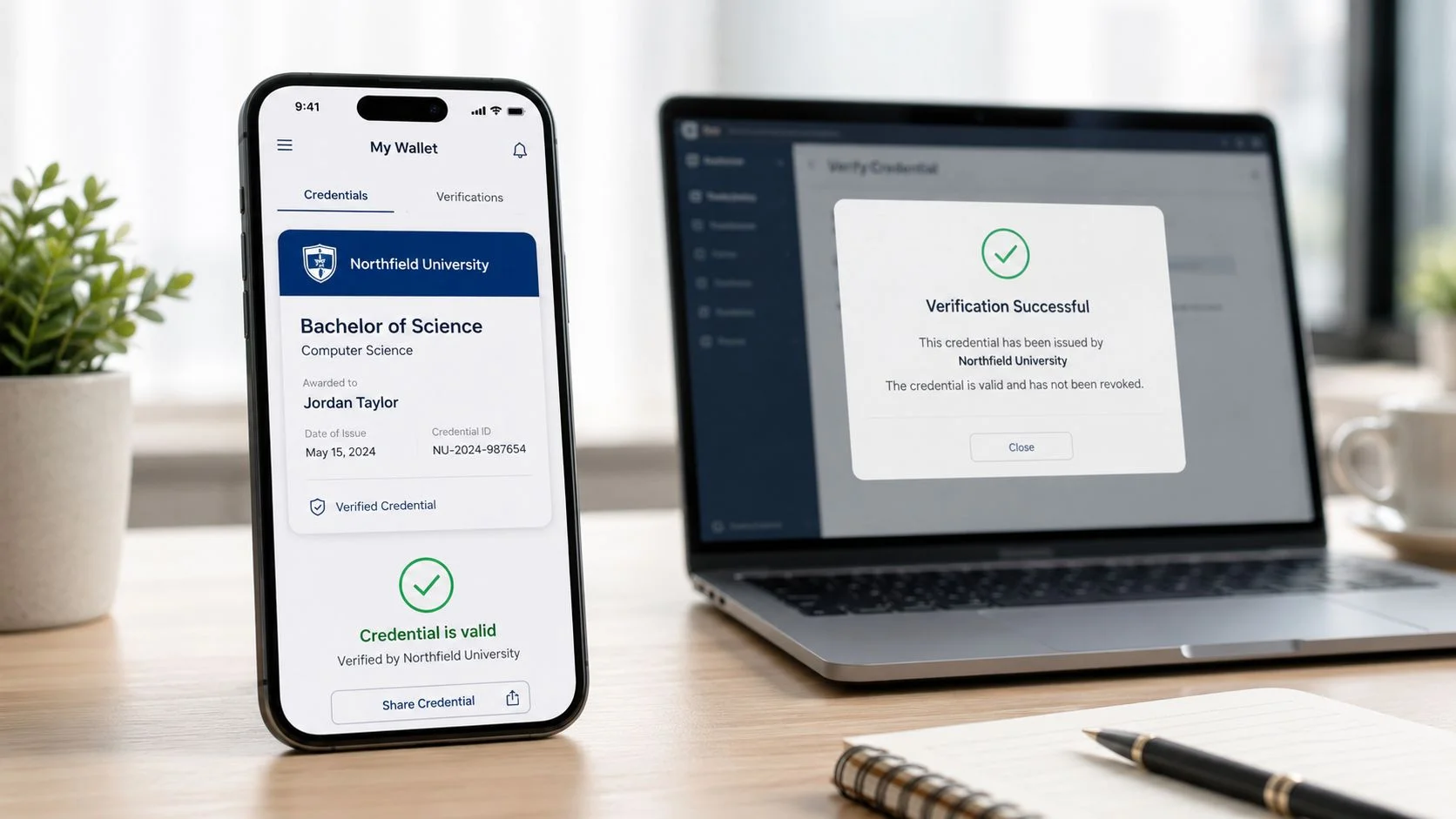
The Issuer (University): Northfield University issues a digital diploma to a graduating student, Maria. Instead of paper, the university creates a Verifiable Credential containing her name, degree, and graduation date. This VC is then cryptographically signed by the university, guaranteeing its authenticity.
The Holder (Student): Maria receives this VC and stores it safely in her secure digital wallet on her smartphone. She now completely owns and controls this digital diploma.
The Verifier (Employer): A few months later, Maria applies for a job at a tech firm in Switzerland. Instead of emailing a scanned copy of her diploma, she presents the VC directly from her digital wallet. The employer’s system can instantly check the cryptographic signature on the VC against the university’s public key on the blockchain.
This simple exchange confirms two critical facts: that the diploma was genuinely issued by Northfield University and that it hasn’t been altered. The employer gets instant, fraud-proof verification without ever needing to call the university’s registrar’s office.
Unlocking Privacy with Selective Disclosure
The benefits go far beyond just efficiency. VCs introduce a concept called selective disclosure. Imagine Maria needs to prove she is over 21 to enter a venue. Instead of showing her entire driver’s license—revealing her name, address, and exact date of birth—she can use a VC to present just a single, verified fact: “age is over 21.”
This is a monumental shift for privacy. Users share only the absolute minimum information required for any given transaction, which drastically reduces their digital footprint and the risk of data misuse.
This capability is at the core of a modern document verification platform, balancing the need for robust verification with an individual’s fundamental right to privacy. For organizations, this means getting the proof they need without the liability of storing excessive personal data. You can learn more about how tamper-proof digital certificates are shaping the future of verification to see how this works in practice.
A Head-to-Head Look: Traditional vs. DID-Based Verification
For enterprise leaders and compliance officers to champion change, they need a clear comparison. When you put traditional verification methods next to a decentralized digital identity framework, the strategic benefits of moving forward become impossible to ignore. The core architectural differences result in dramatically different outcomes for security, cost, and the user experience.
For decades, organizations have relied on siloed, repetitive processes. While familiar, these methods are built on a centralized trust model that is increasingly showing its cracks.
Why Is DID a Better Approach for Verification?
The move from centralized to decentralized isn’t just an incremental upgrade; it’s a fundamental rethinking of digital trust. In a DID model, trust is distributed and user-centric, which eliminates the single points of failure that plague legacy systems. This pivot in architecture directly solves the biggest headaches of modern document verification.
The monumental shift is from corporate data ownership to self-sovereign identity principles. This move empowers users and reduces an organization’s liability, a critical consideration in privacy-forward jurisdictions like Germany, Switzerland, the Netherlands, and Singapore.
The table below breaks down the practical differences between outdated, centralized verification and a modern, decentralized approach.
Comparison: Traditional vs. Decentralized Verification
| Parameter | Traditional Verification | Decentralized Digital Identity (DID) |
|---|---|---|
| Security | Centralized databases create “honeypot” risks, attracting large-scale breaches. | Distributed resilience eliminates single points of failure. Cryptographic proof makes data tamper-evident. |
| User Control & Privacy | Corporate ownership of user data creates significant privacy and compliance risks. | Users own and control their data, sharing only what’s necessary (selective disclosure). |
| Cost Efficiency | High operational costs due to repetitive, manual verification for each service. | “Verify once, use many times” model dramatically reduces redundant checks and operational overhead. |
| Verification Speed | Slow, often manual processes can take hours or days, leading to high user drop-off rates. | Instant, cryptographic verification enables frictionless and immediate onboarding. |
| Interoperability | Systems are siloed and proprietary, preventing seamless data sharing between platforms. | Built on open standards, DIDs are designed for seamless, global use across different ecosystems. |
| Fraud Resistance | Vulnerable to forged documents, deepfakes, and identity theft. | Tamper-proof verifiable credentials and cryptographic signatures significantly reduce fraud. |
Ultimately, a DID document verification system offers a more secure and efficient path forward. It transforms verification from a costly, high-risk operational burden into a streamlined, trusted interaction. By using a modern blockchain verification platform, organizations can reduce fraud, strengthen privacy, and build a far more resilient digital trust framework. Our insights on how we hash documents locally offer a deeper look into a privacy-first approach.
How Are Enterprises and Governments Using DID for a Competitive Edge?
It’s one thing to talk about the architecture of decentralized digital identity; it’s another to see how smart organizations are already using it to solve major business problems and pull ahead of the competition. This isn’t just a concept anymore; DID is live in major sectors, and it’s delivering a clear return on investment.
Across the board, innovative firms are replacing clunky, outdated verification processes with DID systems. The goal is simple: make identity verification faster, cheaper, and far more secure, and in doing so, build real trust with users.
Real-World Use Cases Across Industries
From global finance to national healthcare systems, DID document verification is already making a tangible impact on security and operational speed.
- Financial Services: For banks and fintech firms in the UK, US, and UAE, DID is completely changing the game for Know Your Customer (KYC) and Anti-Money Laundering (AML) compliance. Instead of forcing customers to upload identity documents for every new product, they can present a reusable verifiable credential. This single change is slashing onboarding times from days to minutes, with some UK banks reporting up to a 60% reduction in onboarding costs.
- Healthcare: In Canada and the United States, healthcare networks are adopting DID to give patients control over their medical histories and to instantly verify the credentials of doctors and nurses. A physician can hold their licenses in a secure digital wallet, cutting the hospital’s credentialing process from weeks down to minutes. The result is faster staffing and a direct improvement in patient care.
- Government Services: Governments in Europe (notably Germany, Netherlands) and Singapore are running pilot programs using DID for everything from digital voting trials to providing secure access to public benefits. This not only tightens security and protects citizen privacy but also dramatically cuts down the administrative workload.
- Education & HR: Universities can issue tamper-proof digital diplomas as VCs, and employers can verify them instantly. This prevents resume fraud and streamlines the hiring process, ensuring that credentials from institutions in Australia, the UK, or anywhere else are globally verifiable.
The chart below breaks down exactly how these decentralized methods stack up against the old way of doing things.
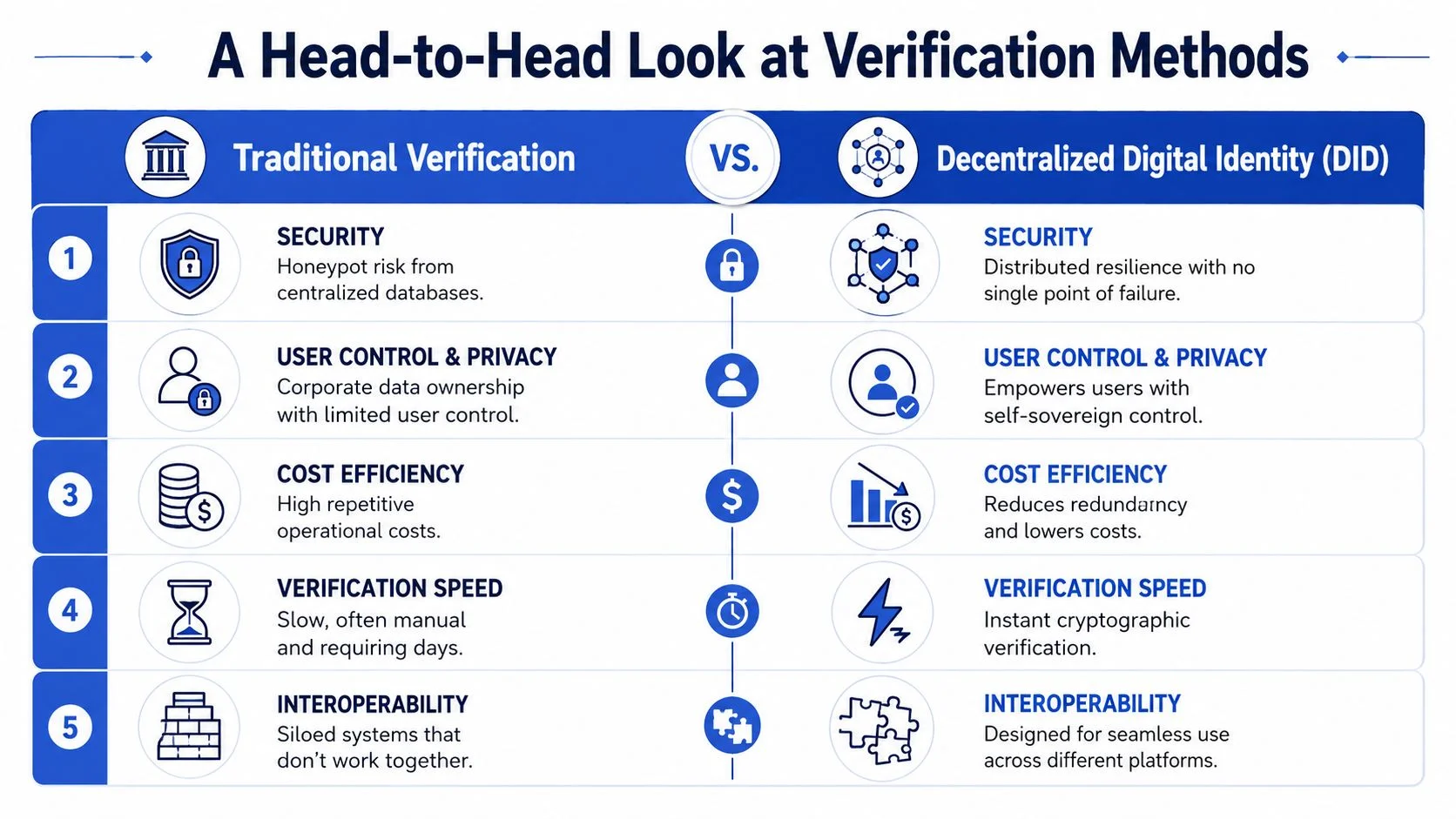
It’s immediately obvious that DID delivers superior security, gives users proper control over their data, and drives efficiency, making it a strategic necessity for any modern enterprise.
Global Trends and Market Readiness
The push for better digital identity is gaining serious momentum worldwide. The Digital Identity Solutions market is set to expand at a 17.2% CAGR, pushed forward by decentralization, biometrics, and the need for systems that actually work together.
In high-growth economies like the UAE, this technology is the perfect fit for a market that needs faster and more secure verification for everything from opening a bank account to accessing government services. A user with a decentralized wallet can prove their age or employment status without ever having to share the full document again. This transforms a clunky, repetitive workflow into a clean, privacy-first compliance process. You can find more data on these market trends at Scoop.Market.us.
These real-world applications prove that blockchain identity verification has already arrived. It’s a tool that organizations are using right now to become more efficient, secure, and trustworthy. The future outlook for the next 12-24 months points toward greater adoption in supply chain, carbon credit verification, and cross-border trade, where proving origin and authenticity is paramount.
How Blocsys Can Help You Build Your Decentralized Identity Solution
Understanding the strategic power of Decentralized Digital Identity is one thing. Building a robust, enterprise-grade solution is another. Migrating from legacy systems to a DID framework requires deep engineering expertise and a partner who lives and breathes security, scalability, and global compliance. This is where Blocsys steps in to turn your vision into a functional, secure reality.
The move to DID is no longer just an option—it’s a strategic imperative for enhanced security, better compliance, and serious operational efficiency. But constructing a decentralized identity solution from scratch is a massive undertaking. It demands a resilient blockchain identity infrastructure and a team that can master the technical complexities of DIDs, Verifiable Credentials, and distributed ledger technology.
Your Expert Engineering Partner for DID
As a trusted blockchain infrastructure and enterprise engineering company, Blocsys delivers the specialized talent and battle-tested frameworks you need to design, build, and deploy a powerful DID document verification platform that fits your organization perfectly. We don’t chase trends; we build the foundational systems that power them. Our entire focus is on architecting secure, scalable, and resilient identity systems that deliver real-world value.
We are focused on tangible outcomes, not just concepts. Here’s how we can help:
- Decentralized Identity Platforms: We design and implement the core blockchain verification systems that serve as the single, immutable source of truth for your entire identity ecosystem.
- Secure Authentication Infrastructure: We create multi-layered, privacy-preserving secure authentication solutions that are built on the cryptographic security inherent in DIDs.
- Verifiable Credential Platform Development: We architect systems that let your organization issue, manage, and verify VCs at scale—whether for millions of customers, thousands of employees, or a network of global partners.
- DID Implementation Services: From strategic consulting to full-scale deployment and ongoing support, we guide you through every stage. We have deep experience helping organizations hire blockchain developers with the right skills for these complex projects.
Choosing the right technology partner is one of the most critical decisions you’ll make in this transition. You can get more detailed insights from our complete guide on selecting a blockchain consulting partner to make sure your project is set up for success right from the start.
Blocsys has the experience and technical depth to help your enterprise, government agency, or startup build the future of digital trust. We provide the engineering power needed to take you from a high-level concept to a fully operational, secure, and compliant self-sovereign identity platform.
Frequently Asked Questions (FAQs)
As enterprises and governments start exploring a more modern framework for digital trust, a few key questions always come up. Here are straightforward answers to the most common queries about Decentralized Digital Identity (DID) and its real-world impact.
What is Decentralized Digital Identity (DID)?
Decentralized Digital Identity (DID) is a system that gives individuals and organizations full ownership and control over their identity data through a secure digital wallet. It allows you to share verified, cryptographically-proven facts about yourself (like a degree or age) without handing over control to a central authority like a tech company or government.
How does DID improve document verification?
DID improves document verification by replacing insecure, manual processes with instant, cryptographic proof. Instead of sending copies of documents, users present a tamper-proof Verifiable Credential. This drastically reduces fraud, cuts verification time from days to seconds, and lowers operational costs for organizations by eliminating repetitive checks.
What are verifiable credentials?
A Verifiable Credential (VC) is a secure, digital version of a physical document you’d normally keep in your wallet—like a passport, university degree, or driver’s license. It’s issued by a trusted organization (like a government), held by you in your digital wallet, and can be instantly and cryptographically checked by any party you authorize.
How does blockchain support decentralized identity?
Blockchain acts as the trust layer for decentralized identity. It serves as a public, tamper-proof registry where DIDs and the public keys of issuers (like universities or governments) are stored. This allows anyone to verify that a credential is authentic and was issued by the claimed authority, without the blockchain ever storing any personal data.
Why is self-sovereign identity important?
Self-Sovereign Identity (SSI) is important because it fundamentally shifts control over personal data back to the individual. You become the final authority on your own identity. This minimizes data misuse, enhances privacy through selective disclosure (e.g., proving you’re over 18 without revealing your birthdate), and reduces compliance risks for businesses.
Can DID prevent identity fraud?
Yes, DID can significantly prevent identity fraud. Because Verifiable Credentials are cryptographically signed and tamper-proof, they are extremely difficult to forge. This makes it much harder for criminals to use stolen or fake documents. By eliminating centralized databases of personal data, DID also removes the primary target for large-scale identity theft breaches.
How do enterprises use DID systems?
Enterprises use DID systems to streamline customer onboarding (KYC), verify employee credentials, secure supply chains, and enable passwordless logins. Financial institutions, healthcare providers, and technology companies are adopting DID to reduce fraud, cut operational costs, improve user experience, and comply with data privacy regulations like GDPR.
How can Blocsys help build decentralized identity solutions?
Blocsys is an expert blockchain engineering company that helps organizations design, build, and deploy secure decentralized identity solutions. We provide end-to-end services, from strategic consulting and architecture design to developing the blockchain infrastructure, verifiable credential platforms, and secure authentication systems tailored to your specific enterprise needs.
Ready to build the future of identity verification? Connect with our experts today to discuss your enterprise needs for a decentralized identity platform, blockchain verification system, or secure authentication infrastructure. Let’s build the future of digital trust together.
