
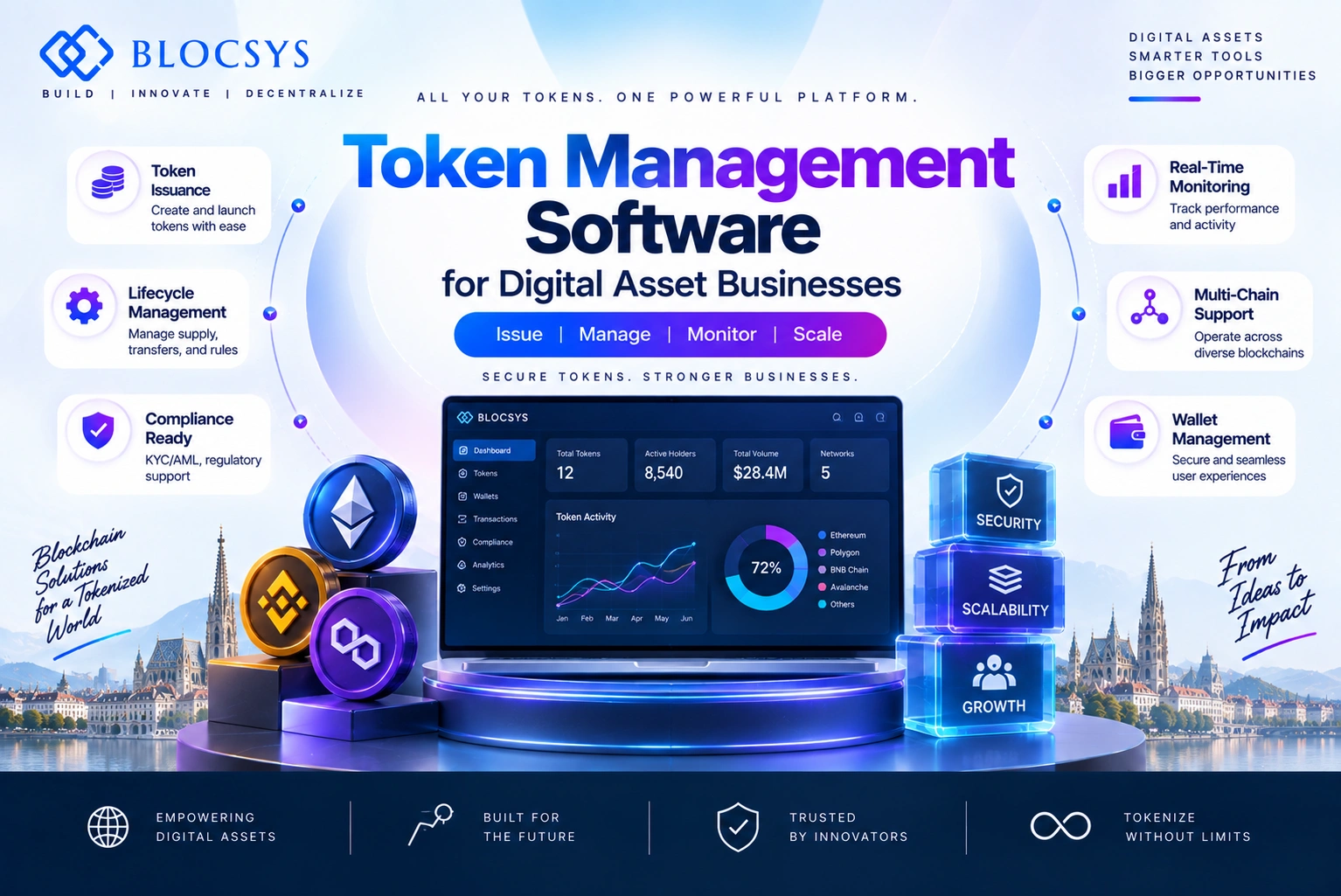
Token Management Software for Digital Asset Businesses
If you’re issuing tokens, managing token holders, or running any kind of digital asset operation, you already know spreadsheets and manual processes don’t scale. That’s where Token Management Software comes in. It’s the operational backbone that lets digital asset businesses issue, track, and administer tokens across their entire lifecycle, without rebuilding infrastructure from scratch every time. Companies like Blocsys build this kind of software for issuers, fintechs, and enterprises who need reliable, compliant, and scalable token operations.
This article looks at what Token Management Software actually does, how it differs from adjacent tools like wallets and exchanges, and what digital asset businesses should evaluate before building or buying one.
What Is Token Management Software?
Token Management Software is a dedicated application layer that lets businesses issue, configure, and administer digital tokens across their full lifecycle. It handles ownership records, transfers, permissions, compliance checks, and reporting from a single operational interface. Unlike generic blockchain tools, it’s purpose-built for the day-to-day work of running a token program.
Think of it as the operations console sitting on top of your blockchain infrastructure. Smart contracts handle the on-chain logic. Token Management Software handles everything around it: investor onboarding, holder records, transaction monitoring, permission enforcement, and the reports your compliance team needs at quarter-end.
For digital asset businesses, this distinction matters. A smart contract can enforce a transfer restriction, but it won’t tell you which investors are pending KYC review, generate a cap table, or reconcile holder balances across multiple chains. That operational layer is exactly what a Token Management Software Platform provides.
Here’s a short punchy fact: without this layer, most issuers end up duct-taping spreadsheets to blockchain explorers. That’s not sustainable at scale, especially once you’re managing thousands of token holders or multiple token classes simultaneously.
Why Digital Asset Businesses Need Token Management Software
Token issuance is the easy part. Managing what happens after issuance is where most businesses get stuck. Once tokens are live, you’re dealing with ownership changes, corporate actions, compliance obligations, and investor communications, often across multiple jurisdictions.
Consider a fintech platform issuing tokenized fund interests to investors in the US, UK, and Singapore. Each jurisdiction has different disclosure and transfer rules. Manually tracking eligibility per investor quickly becomes unmanageable. A dedicated Token Management Solution automates much of this coordination, applying jurisdiction-specific rules consistently across the holder base.
Similarly, an asset manager tokenizing a real estate fund needs to track fractional ownership, distribute income, and handle secondary transfers, all while maintaining an auditable record. This is an illustrative scenario common across the industry, not a claim about any specific deployment.
Additionally, regulators increasingly expect issuers to demonstrate control over who holds their tokens. According to the World Economic Forum, tokenized markets could reach trillions of dollars in value by the early 2030s, and institutional interest in digital securities has grown accordingly across the US, EU, and UAE. As that growth continues, businesses without proper Token Management Software risk falling behind on both compliance and operational efficiency.
The businesses that struggle with tokenization usually aren’t struggling with the blockchain part. They’re struggling with everything that happens after the token is minted, ownership changes, compliance reviews, and investor reporting. That’s operations, not cryptography.
Token Management Software vs Token Management Systems and Tokenization Platforms
People often use these terms interchangeably, but they’re not the same thing. A token management system is the broader concept, the overall framework, policies, and infrastructure an organization uses to govern tokens. Token Management Software is the actual application that implements that framework day to day. We’ve covered the systems-level concept in detail in our guide to token management systems; this article focuses specifically on the software layer businesses evaluate, build, and integrate.
A tokenization platform, meanwhile, is typically focused on the front-end process of converting an asset into a token, valuation, structuring, and initial issuance. Token Management Software picks up where tokenization platforms leave off, handling everything after the token exists.
How It Differs From Wallets, Custody, and Exchanges
Wallets store private keys and let holders interact with tokens directly. Custody solutions provide institutional-grade key security and asset safekeeping. Exchanges facilitate trading and price discovery. None of these are designed to manage the full administrative lifecycle of a token program.
Token Management Software typically integrates with wallets and custody providers rather than replacing them. It sits at the administrative layer, coordinating issuance, compliance, and reporting, while wallets and custodians handle the security and storage side of digital asset operations.
How It Differs From Digital Asset Management Platforms
Digital asset management platforms often focus on organizing digital files, media, or broader portfolio tracking. Token Management Software is narrower and more specialized, built specifically around the mechanics of token issuance, ownership, transfers, and lifecycle events. The distinction matters when evaluating vendors, since some platforms market themselves broadly without offering the depth issuers actually need.
![Token Management Software — [Comparison flow diagram showing Token Management Software positioned between Tokenization Platform (asset structuring, issuance) and downstream systems (Wallets, Custody, Exchanges), with arrows showing data flow: Tokenization Platform → Token Management Software → Wallet/Custody Integration → Reporting & Compliance Output]](https://s3.blocsys.com/blocsys/blog-images/1789474671230-2c55f4f60ef70016.webp)
Core Features of a Token Management Software Platform
Not every platform offers the same depth. However, a mature Token Management Software Platform generally covers a consistent set of capabilities across issuance, ownership, compliance, and reporting.
Token Issuance and Configuration
Issuance tools let businesses define token parameters, supply, standard, transfer rules, and metadata, without writing custom smart contract code for every deployment. This is where Token Issuance Software Development becomes relevant: many businesses need custom issuance workflows tailored to specific asset classes, like equity, bonds, or carbon credits.
Ownership and Transfer Management
The software maintains an authoritative record of who holds what, tracks transfer history, and enforces restrictions like lock-up periods or accredited investor requirements. Every transfer gets logged for audit purposes.
Compliance and Permission Controls
KYC/AML verification, whitelisting, and jurisdiction-based transfer restrictions typically get enforced through this layer. It’s worth being precise here: Token Management Software supports compliance workflows, it doesn’t itself guarantee regulatory approval or legal compliance. Businesses still need proper legal review for their specific jurisdiction and asset type.
Wallet and Custody Integrations
Rather than building wallet infrastructure from scratch, most platforms integrate with existing custody providers and wallet solutions through APIs, letting businesses focus on their core token operations instead of key management.
Smart Contract and Blockchain Integration
The software interacts with smart contracts to trigger issuance, transfers, and lifecycle events on-chain, while keeping an off-chain operational record synchronized with blockchain state.
APIs, Reporting, and Analytics
Enterprise integrations depend on solid APIs. Token Management Software typically exposes endpoints for holder data, transaction history, and compliance status, so businesses can connect it to their existing financial and CRM systems. Reporting dashboards then turn that data into investor statements, audit trails, and regulatory filings.
Multi-Chain Support
Many digital asset businesses operate across multiple blockchain networks. A capable platform manages tokens across chains from one interface, consolidating what would otherwise be fragmented operations into a single view.
Token Lifecycle Management Software: Managing the Full Journey
Token Lifecycle Management Software extends beyond issuance to cover the entire journey a token takes, from creation through redemption or retirement. This includes corporate actions like dividend distributions, buybacks, and token burns, alongside ordinary secondary market transfers.
Consider a table of typical lifecycle stages a Token Lifecycle Management Software Development effort needs to address:
| Lifecycle Stage | What the Software Handles |
|---|---|
| Issuance | Token creation, initial distribution, investor onboarding |
| Ownership Management | Holder records, cap table maintenance, balance tracking |
| Transfers | Secondary transfers, restriction enforcement, settlement |
| Corporate Actions | Dividends, redemptions, buybacks, token splits |
| Compliance Monitoring | Ongoing KYC refresh, transaction monitoring, reporting |
| Retirement | Burns, redemptions, final settlement |
What makes this challenging is that lifecycle events don’t happen in isolation. A dividend distribution, for instance, needs accurate holder records, compliance status checks, and tax reporting data, all pulled together at once. This is precisely why standalone spreadsheets break down as token programs mature.
Security and Access Control
Security spans both the software layer and the underlying blockchain infrastructure. Role-based access control, multi-signature approvals for sensitive actions, and detailed audit logging are common practices across serious Token Management Software Platforms.
Additionally, businesses should expect encryption for data at rest and in transit, alongside regular security reviews of both the application and any smart contracts it interacts with. However, no platform can promise absolute security. Any vendor claiming otherwise should raise questions rather than confidence.
Audit trails deserve particular attention. Regulators and auditors increasingly expect issuers to produce a complete, tamper-evident record of every ownership change and transfer. Consequently, this isn’t a nice-to-have feature, it’s foundational to how the software earns trust from compliance teams and investors alike.
![Token Management Software — [Security architecture flow diagram showing layered access control: User Authentication → Role-Based Permissions → Multi-Signature Approval for Sensitive Actions → Encrypted Data Storage → Audit Log Generation → Compliance Reporting Output]](https://s3.blocsys.com/blocsys/blog-images/1789474674156-2a4c4001092786f1.webp)
Enterprise Use Cases for Token Management Software
Digital securities issuers use this software to manage thousands of token holders, applying jurisdiction-specific transfer restrictions automatically rather than manually reviewing each transaction. This is a common industry pattern rather than a guarantee of outcome for every deployment.
Fintech platforms administering tokenized money market funds or credit instruments rely on Token Management Software to reconcile holder balances daily and generate investor statements without manual intervention. Asset managers running tokenized fund interests use it to track fractional ownership and automate distributions to hundreds of limited partners simultaneously.
Web3 businesses operating multiple token types, utility tokens, governance tokens, and wrapped assets, use a unified platform to avoid managing separate systems for each. Enterprises integrating tokenized assets into existing treasury or ERP systems connect through APIs rather than rebuilding their financial infrastructure around blockchain-native tools.
Businesses exploring these use cases in areas like equity tokenization or corporate bond tokenization generally find that lifecycle administration, not issuance itself, is where most operational effort goes long term.
Build vs Buy: Choosing a Token Management Solution
Should you build custom software or license an existing platform? It depends on your token complexity, compliance requirements, and long-term roadmap.
Off-the-shelf platforms work well for straightforward token programs with standard requirements. However, businesses with unique compliance rules, proprietary asset structures, or specific integration needs often find generic platforms too rigid. That’s where Custom Token Management Software becomes the more practical route.
A Token Management Software Company with real blockchain and enterprise integration experience can build a solution tailored to your exact workflows, rather than forcing your business to adapt to someone else’s assumptions. This matters especially for businesses tokenizing complex real-world assets, where generic templates rarely fit.
Working with an experienced real world asset tokenization partner also helps you avoid rebuilding infrastructure later when your token program outgrows an off-the-shelf tool.
Development Process and Cost Considerations for Custom Token Management Software
Token Management Solution Development typically follows a structured path: requirements discovery, architecture design, smart contract development, off-chain software build, integration testing, security review, and deployment. Each phase matters, and skipping security review to save time tends to cost more later.
Costs vary significantly based on token standards involved, compliance complexity, the number of blockchain networks supported, and how deeply the software needs to integrate with existing enterprise systems.
Rather than relying on generic ballpark figures that don’t reflect your actual requirements, businesses can get a more accurate picture through the Blocsys Software Development Cost Estimator, which accounts for the specific scope of your project.
Challenges in Token Management Software Platforms
Interoperability remains a genuine challenge. Different blockchain networks use different token standards, and keeping records synchronized across chains adds real engineering complexity. Regulatory fragmentation compounds this, since rules governing digital securities differ across the US, EU, UK, and Asia-Pacific markets.
Furthermore, integrating with legacy financial systems, especially at established institutions, often takes longer than the blockchain-native parts of the project. Data migration, API compatibility, and internal approval processes all add time. Businesses should plan for this rather than assume tokenization infrastructure alone solves operational complexity.
The Future of Token Management Software
Institutional adoption of tokenized assets continues to grow. Boston Consulting Group and other industry analysts have projected substantial growth in tokenized asset markets through the end of the decade, driven largely by interest in real-world asset tokenization from asset managers and financial institutions.
As that adoption grows, expect Token Management Software to take on more automated compliance workflows, deeper multi-chain interoperability, and tighter integration with traditional financial infrastructure. Emerging developments around programmable compliance and cross-chain settlement are worth watching, though these remain areas of active development rather than fully standardized industry practice today.
Why Work With an Experienced Token Management Software Company
Choosing a Token Management Software Provider isn’t just about picking a vendor with a product demo. You need a partner who understands blockchain infrastructure, smart contract security, regulatory context, and enterprise integration simultaneously.
Blocsys works with digital asset businesses, fintech companies, and enterprises to design and build token infrastructure suited to their specific asset class and compliance needs. Whether you’re building a token launchpad or need a dedicated blockchain engineering team to build custom lifecycle infrastructure, having an experienced technical partner reduces the risk of costly rework down the line.
![Token Management Software — [Development process flow diagram showing: Requirements Discovery → Architecture & Compliance Design → Smart Contract Development → Token Management Software Build → Integration Testing → Security Review → Deployment & Ongoing Support]](https://s3.blocsys.com/blocsys/blog-images/1789474673933-ed3e3bd1f7f45f2a.webp)
Frequently Asked Questions
Here are direct answers to the questions we hear most often about Token Management Software.
What is Token Management Software?
Token Management Software is an application that lets businesses issue, configure, and administer digital tokens throughout their lifecycle. It manages ownership records, transfers, compliance checks, permissions, and reporting from one operational platform. Unlike a smart contract alone, it provides the business-facing tools issuers and administrators need to run day-to-day token operations, including investor onboarding, holder communications, and audit-ready reporting across one or multiple blockchain networks.
What does Token Management Software do?
It automates the operational work behind running a token program: issuing tokens, tracking ownership changes, enforcing transfer restrictions, applying KYC/AML checks, and generating reports for compliance and investors. Rather than manually reconciling blockchain data with spreadsheets, businesses use the software to keep an authoritative, auditable record synchronized with on-chain activity, while connecting to wallets, custody providers, and existing enterprise systems through APIs.
Who needs Token Management Software?
Digital asset businesses, token issuers, fintech companies, asset managers, and enterprises running tokenized securities, funds, or utility tokens typically need it. So do Web3 businesses managing multiple token types and financial institutions integrating tokenized assets into existing operations. If you’re issuing more than a handful of tokens or managing ongoing compliance obligations, manual processes usually stop scaling fairly quickly.
What features should Token Management Software include?
Core features include token issuance and configuration tools, ownership and transfer management, compliance and permission controls, wallet and custody integrations, smart contract interaction, APIs for enterprise integration, and reporting and analytics dashboards. Multi-chain support matters if you operate across several blockchain networks. Security features like role-based access control and audit logging should be considered essential rather than optional add-ons.
How does Token Management Software manage the token lifecycle?
It tracks a token from issuance through ownership changes, corporate actions, and eventual redemption or retirement. This includes maintaining holder records, processing transfers, handling dividend distributions or buybacks, and monitoring compliance status continuously. Because lifecycle events depend on accurate, up-to-date data, the software keeps issuance records, compliance status, and blockchain state synchronized throughout the token’s entire operational life.
How does Token Management Software integrate with blockchain networks?
It connects to blockchain networks through APIs and smart contract interfaces, triggering on-chain actions like transfers or issuance while maintaining an off-chain operational record. Integration typically happens at the smart contract level, where the software reads and writes blockchain state, and through node infrastructure or third-party blockchain APIs that provide network connectivity without requiring businesses to run their own infrastructure.
Can Token Management Software support multiple token standards?
Many platforms support multiple token standards, such as those used for fungible and non-fungible tokens across different blockchain networks. Support varies by provider and depends on the underlying architecture. Businesses issuing tokens across several standards or chains should confirm specific standard support during vendor evaluation, since not every platform handles multi-standard or multi-chain operations with the same depth.
How does Token Management Software handle compliance and transfer restrictions?
It typically enforces transfer restrictions through whitelisting, KYC/AML verification, and jurisdiction-based rules applied automatically during transfer attempts. However, the software supports compliance workflows, it doesn’t independently guarantee regulatory approval. Businesses still need proper legal review for their jurisdiction and asset class, since regulations around digital securities continue evolving across different markets.
Should businesses build or buy Token Management Software?
It depends on token complexity and compliance requirements. Off-the-shelf platforms suit straightforward, standard token programs. Businesses with unique compliance rules, proprietary structures, or specific integration needs often benefit more from Custom Token Management Software built around their exact workflows, rather than adapting operations to fit a generic platform’s limitations.
How much does it cost to develop Token Management Software?
Cost depends on token standards, compliance complexity, number of supported blockchain networks, and integration depth with existing enterprise systems. Rather than relying on generic figures that may not reflect your specific scope, businesses can get a tailored estimate through the Blocsys Software Development Cost Estimator, which accounts for your project’s actual requirements.
Conclusion
Token Management Software has become essential infrastructure for any digital asset business managing more than a handful of token holders. It’s the layer that turns blockchain capability into operational reality, handling issuance, compliance, transfers, and reporting so your team isn’t stitching together spreadsheets and manual processes.
Whether you’re evaluating an existing Token Management Software Platform or considering a custom build, the right choice depends on your specific compliance needs, token complexity, and growth plans. If you’re ready to explore what a tailored Token Management Solution looks like for your business, Blocsys works with digital asset businesses, fintechs, and enterprises to design and build infrastructure suited to their exact requirements.
Ready to move beyond theory and build an intelligent platform that delivers real-world value? Blocsys Technologies specialises in engineering enterprise-grade AI and blockchain solutions for the fintech, Web3, and digital asset sectors. Connect with our experts today to discuss your vision and chart a clear path from concept to a secure, scalable reality.
