
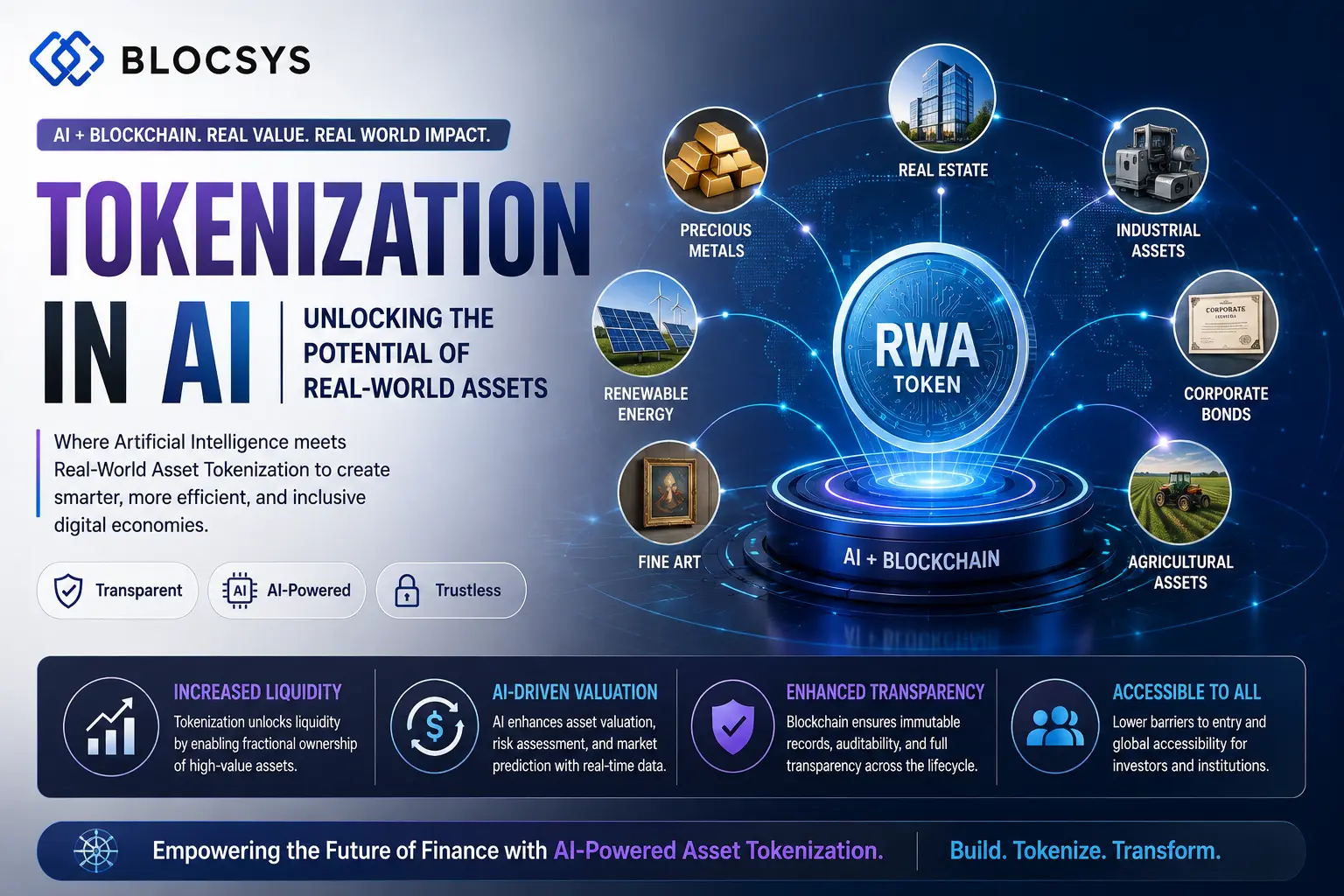
AI-Powered Tokenization: How Artificial Intelligence Is Transforming Real-World Assets
Tokenization in AI is changing how enterprises think about real-world assets. Real estate, bonds, equity, and commodities are moving onto blockchain rails, and artificial intelligence now supports much of the work behind the scenes. You’ll see AI helping teams evaluate assets faster, flag risk earlier, and monitor compliance continuously. However, AI doesn’t replace the legal structures, custody arrangements, or regulatory approvals that make a tokenized asset valid. Blockchain still handles ownership records and settlement, and smart contracts still enforce the rules. If you’re exploring how these technologies work together, Blocsys’s Real World Asset Tokenization services show what a production-grade approach looks like.
What Is Tokenization in AI? A Clear Definition
So what is Tokenization in AI, exactly? In simple terms, it’s the use of artificial intelligence tools, including machine learning models and AI agents, to support converting real-world assets into blockchain-based digital tokens. AI doesn’t create the token itself; smart contracts and blockchain infrastructure handle that part. Instead, AI assists with asset evaluation, valuation modeling, risk scoring, and ongoing compliance monitoring. Artificial intelligence in tokenization plays a supporting role, not a central one. Think of it as an intelligence layer sitting alongside the blockchain layer, and human oversight and legal review remain essential throughout.
How Tokenization in AI Connects With Blockchain Infrastructure
AI and blockchain solve different problems, which is exactly why they pair well. Blockchain provides the ownership ledger, the transfer mechanism, and the immutable audit trail. AI, meanwhile, processes unstructured data, such as appraisal reports and financial statements, that blockchain systems can’t interpret alone. Typically, AI models analyze an asset and generate structured data. That data then feeds a smart contract, which issues tokens under pre-set rules. Tokenization in AI workflows generally split the work this way: AI handles analysis, blockchain handles trust and enforcement. Neither layer replaces the other, and neither removes the need for licensed custodians.
The RWA Tokenization Lifecycle
Tokenizing a real-world asset follows a fairly consistent lifecycle. First comes asset selection and due diligence. Next, teams evaluate and value the asset, often with AI-assisted analysis. Compliance checks follow, then structuring documents get drafted, and a team deploys a smart contract to issue tokens. After issuance, the token needs ongoing management: reporting, secondary trading support, and continuous monitoring. The tokenization of real-world assets depends heavily on accurate data at every stage. Skipping a step, or assuming AI output alone satisfies legal requirements, creates real risk for issuers and investors.
| Lifecycle Stage | AI Contribution | Human / Blockchain Role |
|---|---|---|
| Asset Selection & Due Diligence | Data aggregation, document review | Legal verification, ownership confirmation |
| Valuation & Risk Assessment | Pattern recognition, comparable analysis | Licensed appraisers, final sign-off |
| Compliance & KYC/AML | Anomaly detection, continuous monitoring | Compliance officers, regulatory filings |
| Structuring & Contract Deployment | Workflow automation triggers | Smart contract audits, legal structuring |
| Token Issuance | Completeness checks, automated triggers | Custodians, blockchain network |
| Post-Issuance Management | Reporting, portfolio analytics | Governance, investor relations |
![Tokenization in AI — [Flow diagram showing the RWA tokenization lifecycle: Asset Selection & Due Diligence → AI-Assisted Valuation & Risk Assessment → Compliance & Legal Structuring → Smart Contract Deployment → Token Issuance → Ongoing AI-Powered Asset Management]](https://s3.blocsys.com/blocsys/blog-images/1787034688158-bb5d9c27f39bdcdc.webp)
AI-Powered Asset Evaluation
Before any asset gets tokenized, someone has to evaluate it. AI tools can speed up this early stage significantly. Machine learning models scan property records, financial statements, and ownership documents in minutes rather than days. Natural language processing tools extract key terms from lease agreements or bond covenants. This doesn’t replace human evaluators; it gives them a faster starting point. For asset managers handling large portfolios, AI in asset tokenization workflows means analysts spend less time on manual review. Enterprises exploring an Asset Tokenization Platform often start right here, at evaluation.
AI-Powered Valuation and Risk Assessment
Valuation is where AI-powered tokenization gets genuinely useful. AI models can pull comparable sales data, market trends, and historical pricing to support valuation estimates for real estate, bonds, or equity. Risk assessment works similarly: algorithms flag unusual ownership structures or inconsistent documentation. That said, AI-generated valuations are estimates, not certified appraisals. Regulated transactions still require licensed appraisers or credit rating processes depending on jurisdiction. Most enterprise projects treat AI valuation output as decision support, not a final number. It narrows the range; qualified professionals make the call.
AI can tell you an asset looks unusual before a human ever opens the file. That’s the real value, catching what a busy analyst would miss on page forty of a sixty-page appraisal.
AI for Compliance and Monitoring
Compliance doesn’t stop once a token gets issued. It’s ongoing. AI-driven compliance tools can track transaction patterns, flag potential AML concerns, and monitor investor eligibility continuously. For KYC processes, machine learning cross-checks identity documents against sanctions lists faster than manual review alone. However, tokenization doesn’t automatically make an asset compliant. Requirements depend on the asset class, jurisdiction, investor type, and platform structure. In the US, tokenized securities generally fall under existing SEC frameworks; in the EU, MiCA and national securities law both apply depending on the instrument. AI surfaces issues early; it doesn’t replace licensed compliance officers.
AI-Powered Token Issuance and Smart Contracts
Once valuation and compliance checks clear, issuance itself is largely a smart contract function. Smart contracts encode the rules: how many tokens get minted, transfer restrictions, and redemption terms. AI can assist by automating workflow triggers, flagging when documentation is complete so deployment can proceed. But contract logic, security audits, and network selection remain engineering and legal decisions. Enterprises building tokenized equity instruments often rely on Equity Tokenization Platform Development services to get this layer right, since a poorly audited contract creates more risk than a slow valuation ever could.
![Tokenization in AI — [Flow diagram showing AI-assisted smart contract issuance: Document Completeness Check (AI) → Compliance Trigger → Smart Contract Deployment → Token Minting → Investor Wallet Distribution → On-Chain Registry Update]](https://s3.blocsys.com/blocsys/blog-images/1787034685371-6b7ef92cf5f6446a.webp)
AI Agents and Tokenized Assets
AI agents are getting attention across fintech, and tokenization is no exception. In current implementations, AI agents mostly handle narrow, defined tasks: monitoring price feeds, checking document completeness, or generating compliance alerts. Fully autonomous agents that trade or rebalance tokenized portfolios without human sign-off remain more experimental than proven at enterprise scale. Some pilots explore agent-assisted monitoring for tokenized funds, alerting managers rather than executing trades outright. It’s a meaningful distinction. Treat autonomous agent capabilities as an emerging area, not yet a mature standard for high-value asset decisions.
AI-Powered Digital Asset Management
After issuance, digital asset management becomes an ongoing task. AI tokenization tools can support portfolio dashboards, flagging anomalies in trading volume or investor behavior. They can also generate reporting summaries, cutting manual aggregation work for compliance teams. For managers running tokenized real estate or bonds across jurisdictions, continuous monitoring matters more than a one-time valuation. AI-tokenized portfolios still need consistent governance, though. Governance sits with the issuer and custodian; AI surfaces information, while people and smart contract rules make the operational decisions.
Enterprise Use Cases for AI-Powered RWA Tokenization
Consider a mid-size asset manager exploring tokenized commercial real estate. Manual due diligence across a forty-property portfolio takes months. An AI-assisted evaluation layer could process title records and comparable sales data far faster, feeding structured output into an issuance workflow. This is an illustrative scenario, not a documented deployment. Similarly, a fintech exploring tokenized corporate bonds might use AI for ongoing covenant monitoring. In both cases, AI narrows the analysis window; legal structuring still determines whether the offering is compliant. Enterprises evaluating similar projects often work with a Corporate Bond Tokenization Platform Development partner instead of building both layers alone.
![Tokenization in AI — [Flow diagram showing an enterprise AI-assisted tokenization use case: Portfolio Data Ingestion → AI Document & Comparable Analysis → Risk Flagging → Compliance Review → Smart Contract Issuance → Investor Distribution & Reporting]](https://s3.blocsys.com/blocsys/blog-images/1787034687627-b281bea094fcdb1d.webp)
Tokenized Securities and Financial Assets
Tokenized securities, think tokenized equity, tokenized bonds, and fund shares, carry the highest regulatory bar of any RWA category. These are securities under most jurisdictions’ laws, so existing securities regulations apply regardless of the blockchain rails underneath. AI can assist with disclosure drafting support, investor eligibility screening, and ongoing surveillance for unusual trading patterns. Still, issuing a tokenized security legally requires the same registration or exemption pathway a traditional security needs. Firms in Singapore, the UAE, and Switzerland have each built regulatory sandboxes for digital securities, though requirements vary significantly by jurisdiction.
Benefits of Tokenization in AI Workflows
Combining AI with blockchain-based tokenization offers measurable advantages when applied correctly. Faster document review speeds up due diligence timelines. Continuous compliance monitoring catches issues earlier than periodic manual audits. Data-driven valuation support gives investors more transparency into how a price was reached. None of this guarantees lower costs or better investment outcomes, though. That’s the practical promise of Tokenization in AI: efficiency and better-informed decisions, not automated certainty.
Challenges and Limitations
AI-powered tokenization isn’t without real challenges. Data quality is a persistent issue, since AI models are only as good as the records they’re trained on. Real-world asset data, especially for private credit, is often incomplete. Model bias is another concern; valuation models trained on limited history can misprice unusual assets. Regulatory uncertainty adds further complexity, since rules for tokenized securities keep evolving across the US, EU, UK, and Asia-Pacific. Over-reliance on AI output without human review creates operational and legal risk. Enterprises need governance frameworks that define where AI assists and where humans retain final authority.
Security and Governance
Security in tokenized systems spans two layers: blockchain and AI. Smart contracts need independent security audits before deployment, full stop. AI models used for valuation or compliance also need governance, version control, and periodic bias testing. Custody of the underlying asset typically involves licensed custodians, not the AI system itself. Access controls, multi-signature wallets, and permissioned networks remain standard for institutional deployments. Enterprises building this kind of infrastructure often work with a Hire Real World Asset Tokenization Developers team experienced in both smart contract security and AI governance.
Governance isn’t a document you write once. It’s a living process, especially when an AI model feeds data into a smart contract that moves real money.
Regulatory Considerations
Regulatory treatment of tokenized assets depends heavily on jurisdiction, asset type, and investor classification. In the US, the SEC generally treats most tokenized securities under existing federal securities law. The EU’s MiCA regulation, effective from 2024, addresses certain crypto-assets but doesn’t override existing securities law for tokenized instruments. The UK’s FCA, Switzerland’s FINMA, and Singapore’s MAS each maintain their own frameworks. In the UK, discussions around Tokenisation in AI often center on FCA sandbox participation. None of this means tokenization automatically satisfies compliance; legal counsel needs to confirm the applicable framework for each offering.
Implementation Considerations for Enterprises
Before building an AI-powered tokenization platform, enterprises need to answer a few core questions. What asset class are you tokenizing, and who’s the investor base? Which blockchain network fits your compliance needs? How will AI models be trained and audited over time? Technical requirements typically include secure API integrations, KYC/AML tooling, smart contract auditing, and data pipelines for AI models. Budget planning varies widely by scope, so rather than relying on generic figures, use a proper estimate. Blocsys’s cost estimator tool gives a project-specific starting point based on your actual requirements.
The Future of Tokenization in AI for Enterprise Assets
Where is this heading? More enterprises are piloting AI-assisted due diligence and monitoring, though full end-to-end automation remains rare. Expect continued growth in tokenized real estate, bonds, and funds, alongside gradual regulatory clarity in markets like the US, EU, and UAE. AI agents will likely take on more monitoring responsibilities before they take on independent decision-making. Tokenization in AI, as a category, is maturing steadily rather than exploding overnight. Enterprises that build proper governance today will be better positioned as frameworks and AI capabilities keep developing.
Why Businesses Need an Experienced Tokenization Development Partner
Building AI-powered RWA infrastructure touches blockchain engineering, AI model development, legal structuring, and compliance operations at once. Few in-house teams have all four skill sets ready to go. That’s where an experienced partner matters. Blocsys works with financial institutions, fintechs, and enterprises to design tokenization platforms that combine smart contract infrastructure with AI-assisted evaluation and compliance monitoring. We’ve seen how much smoother a project runs when blockchain architecture and AI tooling get planned together from day one. If you’re evaluating real world asset tokenization for your organization, that’s the right starting point for a scoping conversation.
Frequently Asked Questions
Here are direct answers to the questions we hear most often about AI-powered tokenization.
What is AI-powered tokenization?
AI-powered tokenization, sometimes called Tokenization in AI, is the use of artificial intelligence tools alongside blockchain infrastructure to support converting real-world assets into digital tokens. AI assists with evaluation, valuation modeling, risk scoring, and compliance monitoring, while blockchain and smart contracts handle issuance and settlement. AI doesn’t replace legal structuring or custody; it adds a data-driven analysis layer to the tokenization lifecycle.
How does AI improve real-world asset tokenization?
AI improves real-world asset tokenization by speeding up document review, flagging inconsistencies in records, and supporting valuation with market data analysis. It also enables continuous compliance monitoring instead of periodic manual checks. These improvements reduce manual workload for analysts, though final valuations and regulatory sign-off still require qualified professionals and licensed institutions.
How is AI used in RWA tokenization?
AI is used across several stages: analyzing documents during due diligence, supporting valuation and risk models, monitoring transactions for compliance, and generating reporting after issuance. Some platforms use AI agents for narrow tasks, like flagging document completeness. Blockchain and smart contracts still handle actual token issuance and ownership transfer throughout the process.
What are the benefits of AI-powered tokenization?
Benefits include faster due diligence, more consistent data extraction across large portfolios, earlier detection of compliance or valuation anomalies, and better-informed decision-making for asset managers. It doesn’t guarantee lower costs or improved investment returns. The realistic value lies in operational efficiency, not automated certainty or guaranteed financial outcomes.
Can AI automate asset tokenization?
AI can automate parts of the workflow, such as document analysis and compliance flagging, but not the entire process. Legal structuring, regulatory approval, custody, and contract deployment still require human decision-making and, in most cases, licensed professionals. Full end-to-end automation without human oversight remains uncommon in enterprise-grade tokenization today.
How does AI help with tokenized asset valuation?
AI supports valuation by analyzing comparable sales, market trends, and historical pricing faster than manual methods allow. For real estate, bonds, or equity, this creates a data-driven starting estimate. AI-generated valuations function as decision-support tools, not certified appraisals, and regulated transactions typically still require licensed appraisers depending on jurisdiction.
How can AI improve compliance for tokenized assets?
AI improves compliance by continuously monitoring transactions for unusual patterns and flagging investor eligibility issues in near real time. This catches problems faster than periodic manual reviews. Tokenization doesn’t automatically make an asset compliant, though; requirements depend on jurisdiction and investor classification, and licensed compliance officers must confirm final decisions.
What assets can be tokenized using AI and blockchain?
Common categories include real estate, corporate bonds, equity, private credit, and commodities. AI can assist evaluation and monitoring for each, though tokenization approach and regulatory requirements differ by asset class. Tokenized securities generally carry stricter requirements than assets like tokenized real estate, depending on how they’re structured and offered.
What is an AI-powered tokenization platform?
An AI-powered tokenization platform combines blockchain infrastructure, smart contracts, and AI tools in one system for issuing and managing tokenized assets. The AI layer supports document analysis, valuation modeling, and compliance monitoring, while the blockchain layer handles issuance and settlement. These platforms still require licensed custodians and legal structuring to operate compliantly.
How can businesses build an AI-powered tokenization platform?
Building one requires blockchain engineering for smart contracts, AI model development for evaluation and compliance tools, and legal expertise for regulatory structuring. Most enterprises partner with an experienced development team rather than building every layer independently. Working with a provider like Blocsys, which combines blockchain and AI expertise, helps enterprises scope requirements realistically.
Getting Started With AI-Powered RWA Tokenization
Tokenization in AI isn’t about replacing blockchain, smart contracts, or human expertise. It’s about making the analysis behind real-world asset tokenization faster and more consistent. AI supports evaluation, valuation, and compliance monitoring; blockchain still handles ownership, settlement, and enforcement. Together, they give enterprises a more efficient path toward tokenizing real estate, bonds, and equity, provided the legal groundwork stays solid. If your organization is exploring how AI and blockchain can work together for your next project, Blocsys’s Real World Asset Tokenization team can help you scope the right approach, from asset evaluation through compliant token issuance.
Ready to move beyond theory and build an intelligent platform that delivers real-world value? Blocsys Technologies specialises in engineering enterprise-grade AI and blockchain solutions for the fintech, Web3, and digital asset sectors. Connect with our experts today to discuss your vision and chart a clear path from concept to a secure, scalable reality.
