
A PancakeSwap clone script is a pre-built, customisable software blueprint that mimics the core functionality of the popular decentralized exchange (DEX), PancakeSwap. This guide is for entrepreneurs, startups, and enterprises in the Web3 space who need to launch a secure, market-ready DEX quickly. Using a clone script allows you to bypass months of foundational development, reduce costs, and focus on building a unique brand and user base.
What is a PancakeSwap Clone Script?
A PancakeSwap clone script is a comprehensive, production-ready source code package for launching a decentralized exchange. It provides the foundational smart contracts, user interface (UI), and backend infrastructure needed to operate a platform similar to PancakeSwap, the leading DEX on the BNB Chain. This isn’t about making a cheap copy; it’s about leveraging a proven, successful model to accelerate market entry.
The script contains all the essential mechanics that made PancakeSwap a dominant force, giving you a functional platform from day one. Your team can then focus its resources on strategic activities: branding, UI/UX customization, adding unique features, and building a community.
Why is this model so appealing for building a DEX?
The appeal of a PancakeSwap clone script stems from the staggering success of PancakeSwap itself. For any Web3 entrepreneur, its market dominance is a powerful proof of concept. For instance, PancakeSwap commands a significant 13.0% market share by trading volume among all DEXs, a testament to its robust architecture and user-friendly design. This established success makes a clone script a lower-risk, higher-ROI entry point into the competitive DeFi space.
This pre-built foundation provides several clear business advantages:
- Accelerated Time-to-Market: Launch a fully functional DEX in weeks, not the months or years required to build from scratch. This speed allows you to capitalize on market opportunities before they disappear.
- Significant Cost Reduction: Sidestep the massive upfront investment needed for R&D, prototyping, and testing from the ground up, which often runs into hundreds of thousands of dollars.
- Reduced Technical Risk: The core logic is based on a platform that has been battle-tested by millions of users and billions in transaction volume. This dramatically lowers the risk of critical bugs or architectural flaws.
A PancakeSwap clone script isn’t just about saving time; it’s a strategic decision to start the race from a competitive position. You inherit a working economic model, a proven user experience, and a secure transaction framework, allowing you to innovate on top of a stable foundation rather than building one from scratch.
To understand its value, let’s examine the core components you receive out-of-the-box.
Anatomy of a PancakeSwap Clone Script: Core Components
Here is a breakdown of the essential components and the strategic advantages they provide for your DEX business.
| Component | What It Does | Your Strategic Advantage |
|---|---|---|
| AMM Engine | Automates token swaps using liquidity pools instead of traditional order books, enabling instant trades. | Launch with a proven, efficient trading mechanism that users already trust, ensuring immediate usability. |
| Solidity Smart Contracts | The on-chain logic governing all platform activities, from swaps and staking to governance and fees. | Inherit secure, audited code that has already processed billions in transaction volume, minimizing risk. |
| Front-End UI/UX | A customizable user interface for connecting wallets, swapping tokens, and interacting with DeFi features. | Start with a familiar, user-friendly design, then apply your brand to create a unique identity. |
| Admin & Security Panel | A backend dashboard for managing platform settings, security protocols, and monitoring on-chain activity. | Gain operational control and oversight from day one, ensuring platform stability and security. |
These components form a powerful, ready-to-deploy package that lets you focus on business growth. Ultimately, using a PancakeSwap clone script is a strategic business decision that enables you to launch with a product that users already understand and trust. This empowers you to shift your focus from complex engineering problems to high-value activities like attracting liquidity, building a community, and creating a unique value proposition for your audience. It is, without a doubt, the fastest route from a business idea to a live, revenue-generating DeFi platform.
What are the essential features your DEX must have?
To compete in the crowded DeFi landscape, a top-tier PancakeSwap clone must be more than just a token-swapping tool; it must be a self-sustaining financial ecosystem. The features below are not just add-ons; they are the core engines that will drive user acquisition, liquidity, and long-term engagement on your platform.
The heart of any modern DEX is its Automated Market Maker (AMM). Unlike traditional exchanges that match buyers and sellers in an order book, an AMM uses smart contracts and liquidity pools to execute trades instantly and algorithmically. This permissionless model removes the need for intermediaries, making trading fast, efficient, and accessible to anyone with a crypto wallet.
How do you power trades with liquidity pools and incentives?
Underpinning the AMM are liquidity pools. These are smart contracts that hold reserves of two or more tokens, forming a trading pair. When a user swaps Token A for Token B, they are trading against the reserves in that pair’s pool. The price is determined by a mathematical formula (e.g., x * y = k). Without deep, well-funded pools, your DEX cannot function effectively, as it would lead to high slippage and poor user experience.
The key to attracting liquidity is offering compelling incentives. A robust clone script must include these mechanisms:
- Yield Farming: Allows liquidity providers (LPs) to earn your platform’s native token in addition to trading fees. They do this by staking their LP tokens (which represent their share of a pool) to “farm” these extra rewards.
- Staking Pools (SYRUP Pools): A feature popularized by PancakeSwap, these pools let users stake your native token to earn other tokens. This creates immediate utility and demand for your platform’s token, helping stabilize its price and reward loyal users.
These features are essential for bootstrapping liquidity. A DEX with deep liquidity offers lower slippage, better trade execution, and a superior user experience—the very factors that attract high-volume traders.
How can you drive engagement beyond basic swaps?
To build a “sticky” platform and foster a vibrant community, your DEX needs to offer more than just efficient swaps. The best PancakeSwap clone scripts come with modules designed to drive user engagement and create network effects.
One of the most powerful growth tools is an Initial Farm Offering (IFO) Launchpad. This module provides a platform for new crypto projects to raise capital by selling their tokens directly to your users. It creates a win-win dynamic: new projects gain instant access to liquidity and an engaged community, while your users get early access to promising new assets.
An IFO launchpad acts as a powerful growth engine. It’s not just about generating listing fees; it’s about continuously injecting new projects, new communities, and fresh trading volume into your exchange, creating a powerful network effect that benefits the entire ecosystem.
Beyond launchpads, integrating features like an NFT Marketplace allows users to mint, buy, and sell non-fungible tokens directly on your DEX, tapping into a massive and passionate market. Other popular additions include Lottery Systems and Prediction Markets, which add gamified layers that increase user retention and create more use cases for your native token. The more reasons you give users to engage with your platform, the more indispensable it becomes. For deeper insights on wallet security, our guide on custodial vs non-custodial wallet architecture is a key resource.
What is the architecture and tech stack of a DEX?
Building a platform that can compete with PancakeSwap requires a robust and scalable technology stack. A PancakeSwap clone script is not a single piece of software but a complex system of interconnected layers. Understanding how these layers work together is critical for launching a secure, high-performance Decentralized Exchange (DEX).
The core engine of your DEX resides in the Solidity smart contracts. These are self-executing contracts deployed on the blockchain that enforce the rules for every action on your platform—from executing token swaps via the Automated Market Maker (AMM) to managing staking rewards and liquidity pool deposits. The security and efficiency of these contracts are paramount; they are the foundation of your platform’s trustworthiness.
The diagram below illustrates how these core functions, all powered by smart contracts, create the engine of your DEX.
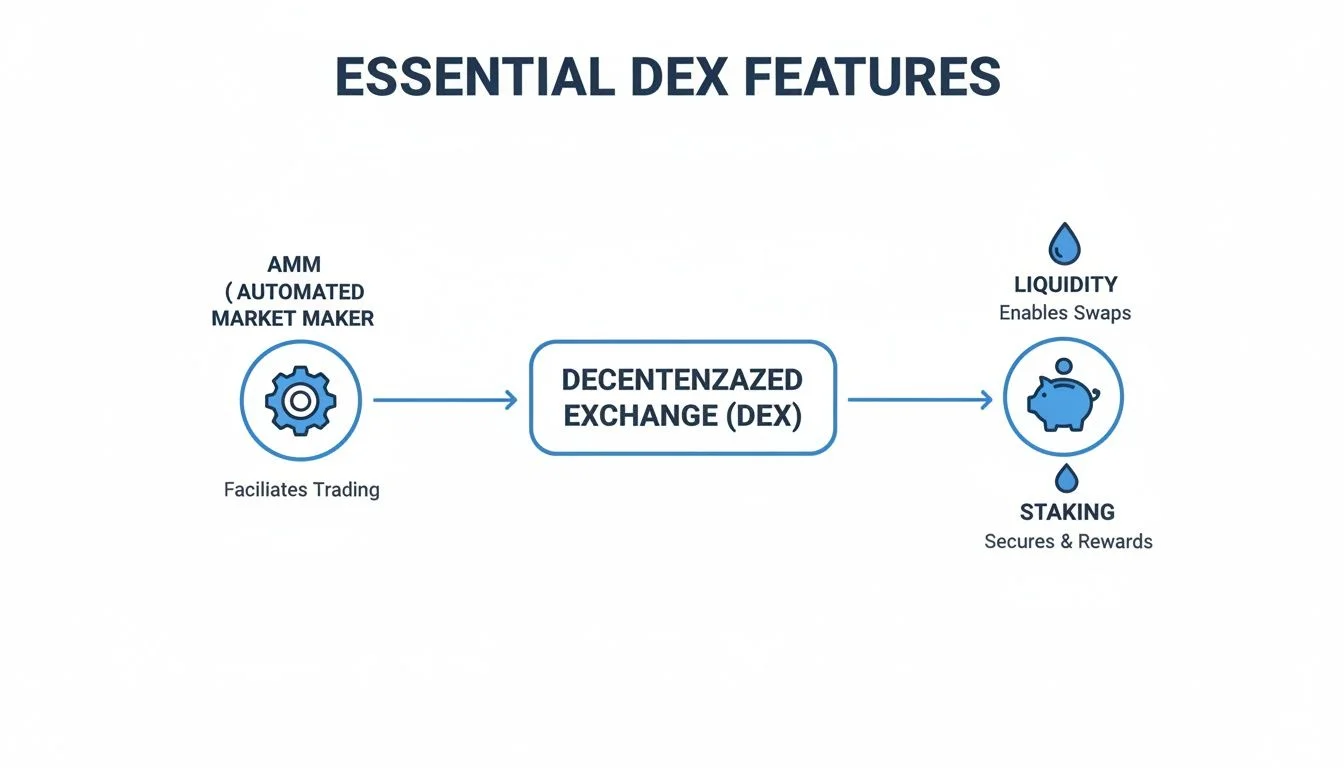
As shown, the AMM, liquidity, and staking features are deeply interconnected, forming the essential foundation for any modern DEX built from a PancakeSwap clone script.
What are the core infrastructure choices?
While smart contracts handle the on-chain logic, a powerful backend is needed to manage the user-facing side of the platform. This layer, often built with Node.js, serves as the bridge between your users and the smart contracts. It fetches data from the blockchain, handles API requests, and ensures your DEX feels fast and responsive, even during peak trading activity.
The front end is your platform’s public face. Here, modern JavaScript frameworks like React.js are the industry standard. React is ideal for building the dynamic, responsive, and stateful interface that DeFi traders expect, providing a seamless experience for swapping tokens, viewing charts, and managing liquidity positions.
Your choice of blockchain is one of the most critical strategic decisions. PancakeSwap operates on the BNB Chain, but a well-designed clone script should be chain-agnostic, allowing deployment on other EVM-compatible networks.
The decision to deploy on BNB Chain, Polygon, or Avalanche is not just technical—it’s a strategic business choice. You are selecting an ecosystem, a user base, and a fee structure. This choice directly impacts your user acquisition costs, transaction speed, and overall competitiveness.
What are the essential integrations for a DEX?
A DEX cannot operate in isolation. To be functional and competitive, it must integrate with the broader Web3 ecosystem. These integrations are non-negotiable for a successful launch.
- Web3 Wallets: Your platform must connect flawlessly with popular non-custodial wallets like MetaMask and Trust Wallet. This is how users sign transactions and interact with your DEX, so the experience must be seamless.
- Oracles: To ensure fair market prices and prevent manipulation, your DEX needs reliable price feeds, especially for assets with low on-chain liquidity. Integrating a decentralized oracle service like Chainlink is crucial for providing accurate, real-time price data.
Making the right technology choices from the start will define your platform’s performance, scalability, and security.
How to Choose Your Tech Stack: A Decision Framework
This table compares key technology choices and their impact on your DEX’s performance, cost, and security.
| Technology Layer | Popular Options | Key Considerations (Cost, Speed, Security) |
|---|---|---|
| Blockchain | BNB Chain, Polygon, Avalanche, Ethereum | BNB Chain offers low fees and high speed. Ethereum provides maximum security and decentralization but at a higher cost. |
| Smart Contracts | Solidity | The industry standard for EVM chains. Security is paramount and requires rigorous, professional auditing. |
| Backend | Node.js, Go | Node.js is flexible and has a large developer ecosystem. Go offers higher performance for computationally intensive tasks. |
| Front End | React.js, Vue.js | React.js is widely adopted with strong community support, ideal for building the complex, stateful UIs required for a DEX. |
| Wallet Connector | Web3.js, Ethers.js | Both are robust libraries for blockchain interaction; Ethers.js is often considered more modern and user-friendly. |
Ultimately, the architecture of your PancakeSwap clone script must be a deliberate combination of technologies that align with your business goals, target user base, and long-term vision.
How do you navigate security audits and compliance?
In DeFi, trust is not a marketing slogan; it’s a function of secure, battle-tested code. A PancakeSwap clone script provides a head start, but launching a successful DEX requires an unwavering commitment to security and a proactive approach to the evolving regulatory landscape. This is how you protect your users, build a reputable brand, and ensure long-term viability.
Without iron-clad security, your DEX is vulnerable to exploits that can drain liquidity pools in minutes, causing irreversible financial and reputational damage. A multi-layered security strategy, combining professional audits with continuous monitoring, is not optional—it’s essential for survival.

Why are smart contract audits critical for a DEX?
Before going live, a professional smart contract audit is your first and most critical security step. After customizing your PancakeSwap clone script, you must engage a reputable third-party firm to conduct an exhaustive analysis of your codebase. This process is designed to identify and remediate vulnerabilities, logical flaws, and potential attack vectors before they can be exploited.
Auditors search for critical vulnerabilities, including:
- Re-entrancy Attacks: An exploit where a malicious contract repeatedly calls a function to withdraw funds before the first transaction is finalized, draining the contract.
- Integer Overflows/Underflows: Mathematical errors in code that can lead to unintended consequences, like minting infinite tokens or enabling incorrect fund transfers.
- Price Oracle Manipulation: Attacks where a malicious actor manipulates external price data to execute trades at unfair values, profiting at the expense of liquidity providers.
A clean audit report from a respected firm is your signal to the market that you take security seriously. For a deeper understanding of this process, see our guide on professional smart contract auditing. After the initial audit, implementing ongoing security measures like penetration testing and a public bug bounty program helps create a robust, continuous defense.
A clean audit report is your DEX’s passport to the DeFi ecosystem. It is the baseline evidence that tells liquidity providers, traders, and project teams that your platform is a secure venue for transacting, making it one of the most critical investments you will make.
How to prepare for the regulatory landscape?
The “Wild West” era of DeFi is ending. As the market matures, regulatory compliance, particularly around Know Your Customer (KYC) and Anti-Money Laundering (AML) procedures, is becoming a strategic necessity. This is especially true for platforms aiming to attract institutional capital or integrate Real-World Assets (RWAs).
This shift is a global phenomenon. In high-growth crypto markets like India, for example, a recent Chainalysis report revealed that 93% of respondents believe the industry needs regulation. This indicates a clear market demand for DeFi platforms that can bridge the gap between decentralized innovation and regulated finance.
Integrating optional or mandatory KYC/AML checks into your PancakeSwap clone script can future-proof your business. While it may seem counter to DeFi’s permissionless ethos, it’s a pragmatic move that opens your platform to a larger, more risk-averse market segment. To build a platform that users and partners can rely on, exploring effective strategies for integrating security testing is essential for minimizing risk and maintaining trust. By designing with compliance in mind, you create a platform that is not only secure but also more attractive to institutional investors and enterprise partners.
Should you build from scratch or use a clone script?
For any founder entering the DeFi space, the first major decision is how to build the platform. Do you start from scratch, writing every line of code? Or do you accelerate your launch with a pre-built PancakeSwap clone script? This choice is critical, as it will define your budget, timeline, and competitive strategy. The decision involves a classic trade-off: building from scratch offers complete creative freedom but at a high cost in time, capital, and talent. A clone script provides a market-tested foundation for a fraction of the cost, allowing you to focus on customization and branding.
How to compare the two development paths?
The right choice depends on your specific business goals, resources, and risk tolerance. The optimal path for a lean startup differs significantly from that of an established enterprise aiming for proprietary protocol innovation.
A PancakeSwap clone script is the superior choice for teams prioritizing speed and cost-effectiveness. It enables the launch of a feature-rich DEX in weeks, a critical advantage in a market where timing is everything. For those exploring similar rapid development models, the broader ecosystem of white-label crypto exchange development offers valuable parallels.
Conversely, a custom build from scratch is necessary for organizations developing novel intellectual property or entirely new DeFi primitives. If your roadmap includes a unique AMM model, specialized financial products, or deep integrations with legacy systems, a blank slate is the only way to build without constraints. The rise of tools like No-Code API solutions further highlights the industry’s trend toward finding faster ways to deliver projects.
The choice isn’t about which path is “better,” but which one aligns with your strategic objectives. A clone script is a market-entry accelerator; a custom build is a vehicle for deep innovation. A mismatch between your strategy and development path can lead to burning through capital or missing your market window.
Let’s break down the comparison using a clear decision framework.
| Factor | PancakeSwap Clone Script | Build from Scratch |
|---|---|---|
| Speed to Market | Extremely Fast (Weeks to 2-3 months) | Slow (6–18+ months) |
| Upfront Cost | Lower (Typically $10,000 – $50,000 for a quality, audited script) | Very High (Often starting from $250,000 and can exceed $1,000,000) |
| Customisation | High but within a framework. You can reskin the UI, add features, and tune parameters. | Unlimited. Complete freedom to design the architecture, user experience, and protocol logic. |
| Technical Team Needed | A smaller team of skilled developers for customisation, deployment, and maintenance. | A large, senior team of blockchain architects, Solidity developers, and backend/frontend engineers. |
| Long-Term Maintenance | Simpler, as the core is based on a stable, widely understood architecture. | More complex, as your team is responsible for maintaining a completely unique and custom codebase. |
| Inherent Risk | Lower technical risk due to battle-tested core logic. The main risk is in poor customisation. | Higher technical and execution risk. Every component must be built, tested, and secured from zero. |
For most startups and enterprises, if the goal is to launch a reliable DEX quickly, capture market share, and build a community around a proven model, a PancakeSwap clone script is the most pragmatic and intelligent choice. It frees you to focus your resources on post-launch growth: marketing, liquidity acquisition, and user base expansion.
How Blocsys Delivers a Production-Ready DEX
You now have the blueprint for building a DEX with a PancakeSwap clone script. The next step is execution, and that’s where an engineering partner like Blocsys comes in. We don’t just hand over code; we build secure, scalable, and market-ready decentralised exchanges for startups and global enterprises.
A production-grade DEX is much more than a simple script. Our expertise is in taking the proven architecture of a platform like PancakeSwap and hardening it for real-world trading volume and security threats. This means engineering gas-optimised smart contracts, a resilient backend, and a front-end that delivers a flawless user experience.
From Blueprint to Live Platform
Our work begins by aligning your business vision with a solid technical strategy. We guide you through the critical decisions covered in this guide, from choosing the right blockchain ecosystem to defining a unique feature set that gives you a competitive edge.
Our specialisation in complex DeFi mechanisms allows us to integrate advanced capabilities that make your platform stand out.
This includes engineering for:
- Real-World Asset (RWA) Tokenisation: Unlocking new markets by bringing off-chain assets like commodities or real estate onto your DEX.
- Custom Liquidity Solutions: Designing novel liquidity pool structures or incentive models tailored to your specific goals.
- Institutional-Grade Security: Implementing multi-layered security protocols, including rigorous pre-launch audits and continuous on-chain monitoring.
Our experience spans multiple blockchains, giving us the insight to recommend the optimal network for your project based on transaction costs, speed, and ecosystem fit. We build with a long-term view, ensuring your platform is scalable and can adapt to future market trends.
Blocsys acts as your dedicated engineering partner, translating the potential of a PancakeSwap clone script into a robust, secure, and competitive financial platform. We focus on execution, security, and scalability, so you can focus on building your community and growing your business.
Choosing Blocsys means partnering with a firm committed to building serious, production-ready infrastructure. We handle the deep technical complexities, allowing you to launch with confidence and focus on what you do best.
Ready to move from concept to a live, revenue-generating DEX? Connect with our experts for a strategic consultation. Let’s discuss your vision and build a plan to make it a reality.
Frequently Asked Questions
This section provides concise answers to the most common questions from founders, project managers, and decision-makers evaluating a PancakeSwap clone script.
How much does a PancakeSwap clone script cost in 2024?
A high-quality, fully audited PancakeSwap clone script typically costs between $10,000 and $50,000. This price covers the core audited smart contracts and a customizable front-end UI. Be wary of offers significantly below this range, as they often involve unaudited, insecure code that exposes your platform and users to catastrophic risk. The final cost depends on customization depth, included features, and your development partner. For comparison, building a DEX from scratch starts at over $250,000.
Can I customize the script with unique features?
Yes, absolutely. A well-engineered PancakeSwap clone script is a foundation designed for customization. The goal is to leverage the proven core while building a unique competitive advantage. Common customizations include a complete UI/UX rebrand, integrating custom modules like an NFT marketplace or prediction markets, and adjusting the tokenomics, such as fee distribution and governance structures. The strategy is to build your own innovations on top of a secure, stable model.
What are the biggest risks of using a cheap clone script?
Using a cheap, unaudited script is the single greatest risk you can take. The primary danger is not just that the platform might fail; it’s that it might succeed enough to attract user funds before a hidden vulnerability is exploited, leading to a complete loss of assets and irreversible brand damage. Key risks include security holes like backdoors and re-entrancy bugs, hidden fees siphoning transactions to the original developer, and a lack of support for bugs or updates.
How long does it take to launch a DEX using a script?
Using a PancakeSwap clone script dramatically shortens your time-to-market. A typical launch timeline is between four to twelve weeks. This period includes initial setup, UI/UX customization, smart contract deployment on a testnet, a third-party security audit of the final code, and the final mainnet launch. This stands in stark contrast to building from scratch, which typically takes six to eighteen months or longer, allowing you to bypass the lengthy initial development phase.
Blocsys transforms the potential of a PancakeSwap clone script into a secure, scalable, and market-ready financial platform. We deliver the end-to-end engineering needed to move your vision from a blueprint to a production-grade system.
Ready to build a robust DEX? Connect with our experts for a strategic consultation.
