
Information security risk management is the proactive and systematic process of identifying, assessing, and neutralizing digital threats before they can cause harm to your organization. This guide is for decision-makers and technical teams in Web3, AI, and crypto who need to build a resilient and defensible security posture. By the end, you’ll have a clear framework for protecting your most valuable assets and turning security into a strategic advantage.
What is Information Security Risk Management?
Information security risk management is a core business function that identifies, evaluates, and treats potential threats to the confidentiality, integrity, and availability of information assets. It enables organizations to make data-driven decisions on where to invest their security budget for maximum impact, ensuring resources are not wasted on low-priority threats while critical vulnerabilities go unaddressed.
In high-stakes arenas like Web3, AI, and cryptocurrency, treating information security risk management as just another IT line item is a fundamental error. It should be treated as a core business function that builds trust, guarantees resilience, and creates a real competitive advantage. This isn’t about building thicker digital walls—it’s about developing an intelligent, forward-looking security posture to protect your most valuable assets.
Why is a Formal Risk Management Process Critical?
Adopting a formal risk management process is what separates a reactive, crisis-driven security model from a proactive, strategic one. It allows you to systematically answer crucial questions about your security exposure, transforming vague fears into a clear, manageable action plan.
For both startups and established enterprises, a formal approach delivers several key benefits:
- Improved Decision-Making: By quantifying risks, your leadership team can allocate budget and people more effectively, focusing on the threats that pose the greatest danger to the business.
- Enhanced Trust and Credibility: Showing a mature approach to security builds confidence with customers, partners, and investors—something that is absolutely vital in the Web3 space where trust is everything.
- Operational Resilience: A proactive programme helps you anticipate disruptions, whether from smart contract exploits or AI data poisoning, keeping your platform stable and online.
- Regulatory Compliance: It delivers a defensible framework for meeting the growing list of compliance demands across different jurisdictions, lowering the risk of fines and legal trouble.
In sectors where innovation moves at breakneck speed, a robust risk management framework isn’t a brake on progress—it’s the steering system that lets you navigate complex environments safely and with confidence.
This change in mindset is mission-critical for founders and engineering teams building the next generation of digital platforms. To dig deeper into the foundational concepts, this guide on Mastering IT Security Risk Management is an excellent resource.
Ultimately, committing to information security risk management is about future-proofing your organisation. It prepares you not just for today’s threats but also for the unknown challenges of tomorrow, securing your long-term survival in a competitive market.
How Do You Implement the Risk Management Lifecycle?
Effective information security risk management isn’t a one-off task you can check off a list. It’s a living, cyclical process. Think of it less like building a static fortress and more like operating a sophisticated surveillance network that constantly adapts to new realities. This lifecycle ensures your security posture evolves right alongside new technologies and emerging threats, keeping your organisation resilient.
The entire process breaks down into four distinct, repeating stages: Identify, Assess, Respond, and Monitor. Each stage flows directly into the next, creating a dynamic loop that drives proactive security. For teams building in Web3, moving beyond textbook definitions and applying this cycle to real-world code is what separates a secure protocol from a vulnerable one.
This process flow visualises the core cycle of identifying, evaluating, and treating risks.
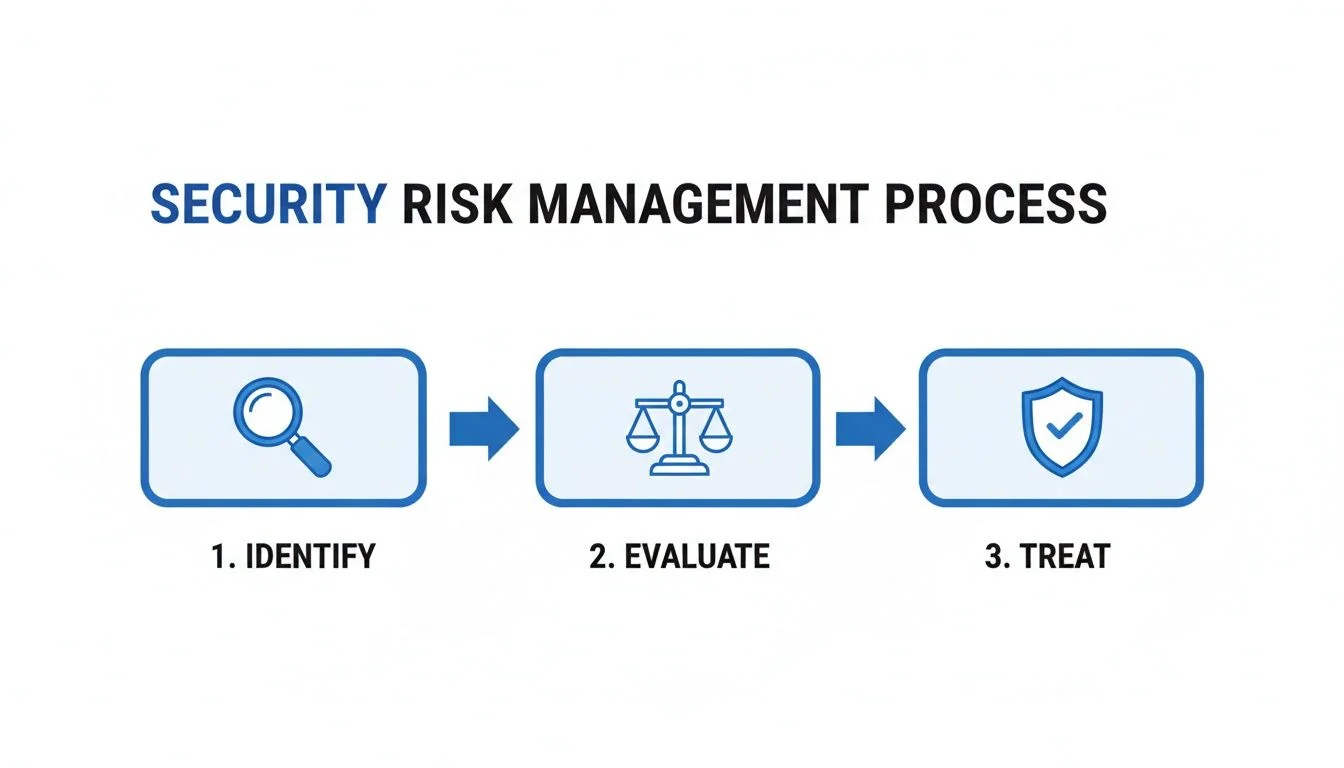
This visual reinforces a key idea: risk management is a disciplined, repeatable process, not just a series of chaotic reactions to incidents.
Stage 1: How Do You Identify Your Unique Risks?
You can’t defend against threats you don’t even know exist. The identification stage is all about systematically discovering and documenting every potential security risk your project faces. This goes far beyond generic threats like phishing; it demands a deep dive into your specific operational context, code, and architecture.
For a Web3 project, this means creating a risk register—a living document that catalogues potential threats. This register should include:
- Smart Contract Vulnerabilities: Document specific risks like re-entrancy attacks, integer overflows, or flawed access controls buried deep within your protocol’s code.
- Oracle Manipulation: Identify every dependency on external data feeds (oracles) and the risk of those feeds being compromised to trigger unwanted on-chain actions.
- Private Key Management: Acknowledge the immense risks tied to the custody and handling of admin keys, especially for upgradeable contracts or multi-signature wallets that control protocol funds.
The goal here is total clarity. Every potential vulnerability, from a minor frontend dApp glitch to a fundamental flaw in your tokenomics model, needs to be on the table and documented.
Stage 2: How Do You Assess and Prioritize Threats?
Once you have a comprehensive list of risks, you have to figure out which ones actually matter. The assessment stage is where you evaluate each identified risk based on its potential impact on your project and its likelihood of happening. This lets you focus your team’s limited time and resources on the threats that pose the greatest danger.
A practical tool for this is a simple risk matrix. This grid helps you visually categorise risks as low, medium, high, or critical. For instance, a minor display bug in a dApp might be a low-impact annoyance. On the other hand, a vulnerability in a DeFi lending protocol that could lead to the complete loss of user funds is undeniably critical.
The point of assessment isn’t to make perfect predictions. It’s to create a clear hierarchy of threats. This ensures your team is solving the most urgent problems first, instead of getting distracted by low-priority issues.
This prioritisation is absolutely vital. It prevents your engineering team from spending weeks fixing a trivial issue while a catastrophic vulnerability remains unaddressed.
Stage 3: How Do You Respond with Targeted Controls?
After assessing and prioritising your risks, you have to decide what to do about them. The response stage is where you develop and implement strategies to mitigate, transfer, accept, or avoid each threat. Critically, your response should be proportional to the risk’s severity.
Here are some real-world responses for Web3 projects:
- Mitigate: To reduce the risk of a smart contract exploit, you might implement controls like placing critical functions behind a multi-signature wallet or engaging a third-party for a deep security audit. For anyone building on-chain, getting a professional smart contract audit is a non-negotiable mitigation step.
- Transfer: For certain financial risks, you can transfer the burden. This often involves purchasing specialised cyber insurance that covers losses from smart contract exploits or private key compromises.
- Accept: Some low-impact, low-likelihood risks just aren’t worth the cost to fix. A startup might consciously accept the risk of a minor UI bug to keep its developers focused on core protocol security.
Stage 4: How Do You Monitor and Continuously Improve?
The threat landscape is never static—new attack vectors appear daily. The final stage, monitoring, is about continuously tracking your known risks, actively looking for new ones, and measuring how effective your controls are. This is what turns risk management into a living, breathing process.
Effective monitoring means using security dashboards to track key metrics, running regular vulnerability scans, and conducting periodic audits. This constant feedback loop ensures your risk register stays current and your security controls are performing as intended. For an AI-driven trading platform, this could mean continuously monitoring a model for signs of data poisoning or adversarial attacks, ensuring its integrity over time.
How to Choose the Right Risk Management Framework
You don’t have to build your information security risk management strategy from a blank slate. Established frameworks offer a battle-tested blueprint, giving you a structured way to find, evaluate, and handle threats. Think of them as the operating system for your entire security programme—you pick the one that fits your organisation and then customise it.
These frameworks are designed to turn complex security theory into real-world controls and processes. For builders in Web3 and AI, the goal isn’t just to adopt a framework off the shelf. It’s to adapt it for the specific risks that come with decentralised tech and intelligent systems.
What Are the Top Security Frameworks?
While dozens of frameworks are out there, three are widely seen as the industry standard: NIST, ISO 27001, and COBIT. Each one has a different emphasis and complexity, so your choice will depend on your company’s size, industry, and strategic goals. Getting this first step right is critical for building a mature security posture.
For any organisation dealing with complex data privacy regulations, learning from existing best practices is essential. For instance, a well-structured SharePoint GDPR compliance guide provides a practical model for creating a defensible and auditable system, a core principle found in both NIST and ISO standards.
- NIST Cybersecurity Framework (CSF): Created by the U.S. National Institute of Standards and Technology, the NIST CSF is known for being flexible and outcome-driven. It’s built around five core functions: Identify, Protect, Detect, Respond, and Recover. The latest version, CSF 2.0, introduced a sixth function—Govern—which cements cybersecurity as a key part of enterprise-wide risk.
- ISO/IEC 27001: This is the global standard for an Information Security Management System (ISMS). While the NIST CSF is a voluntary set of guidelines, ISO 27001 is a formal specification that organisations can get certified against. This certification is a powerful signal to customers and partners that your security measures meet an international benchmark.
- COBIT (Control Objectives for Information and Related Technologies): COBIT operates at a higher level, focusing mainly on governance. Its job is to align your IT strategy with your business objectives, making sure technology investments actually support your organisation’s mission. It’s less of a hands-on security guide and more of a framework for governing enterprise IT.
A framework is not a rigid set of rules; it’s a flexible structure. A Web3 startup can apply the NIST ‘Identify’ function to catalogue on-chain assets and smart contracts, while an AI firm can use ISO 27001’s control families to secure data pipelines against poisoning attacks.
How to Select the Right Framework for You
Picking the right framework means you need a solid grasp of your business needs, compliance duties, and what your stakeholders expect. There’s no single “best” option; the ideal choice is completely dependent on your context.
For example, a startup tokenising precious metals might lean towards the NIST CSF because it’s flexible and easier to get started with. In contrast, an enterprise building decentralised capital market infrastructure might go for ISO 27001 certification to prove compliance and build trust with institutional clients.
Here’s a quick rundown to help you decide.
Comparing Top Information Security Risk Management Frameworks
This table breaks down the three leading frameworks to help you find the best fit for your Web3 or AI organisation’s unique needs.
| Framework | Primary Focus | Best For | Implementation Complexity |
|---|---|---|---|
| NIST CSF | Practical risk reduction and communication | Organisations of all sizes, especially those in critical infrastructure, seeking a flexible, adaptable starting point. | Low to Medium |
| ISO/IEC 27001 | Comprehensive, process-based management system | Organisations needing formal certification to meet contractual or regulatory requirements and prove security maturity. | High |
| COBIT | IT governance and alignment with business goals | Large enterprises needing to align IT processes with overall business strategy and ensure governance over technology. | High |
Ultimately, your goal is to put a structured, scalable system for information security risk management in place from day one. By choosing and adapting one of these proven frameworks, you give your team the tools to build secure, resilient, and enterprise-grade platforms without having to reinvent the wheel.
How to Adapt Risk Management for Web3 and AI

Generic information security risk management advice is dangerously out of touch with the realities of Web3 and AI. While traditional frameworks offer a decent starting point, they were never built to handle the unique, high-stakes threats baked into decentralised technology and intelligent systems. Securing these platforms means adapting your entire approach for a completely new class of risk.
This isn’t about simply adding firewalls or running more phishing drills. It’s a fundamental mindset shift. Your risk register must account for sophisticated attack vectors that have no equivalent in traditional IT. For founders and engineering teams, this means obsessing over the specific logic and architecture that make your project tick.
The urgency is undeniable. A 2026 FICCI-EY Risk Survey found that 51% of India Inc ranks cybersecurity breaches as the top risk to their performance, even ahead of changing customer demands. For organizations in crypto gaming and prediction markets, this stat is old news—cyber threats are operational threats. You can see the complete breakdown in the full FICCI-EY survey summary.
What Are the Specific Risks in Web3?
In Web3, value isn’t just stored in a database; it is the code. Architecture isn’t just a blueprint; it’s the entire foundation. This creates a distinct set of vulnerabilities that demand specialised threat models and controls from day one.
Your risk management has to zero in on the on-chain components that define your project.
- Smart Contract Security: A single flaw in immutable code can be a company-ending event. Your threat modelling must go deep on vulnerabilities like re-entrancy, integer overflows, and broken access controls. A non-negotiable control is embedding static analysis (SAST) tools right into your DevSecOps pipeline to catch known bugs before they ever hit the mainnet.
- Oracle Dependencies: DeFi protocols, prediction markets, and tokenised assets often rely on oracles—external data feeds. A compromised oracle can feed malicious data to your smart contracts, triggering catastrophic losses. Your risk assessment has to map every single oracle dependency and model the impact of a data manipulation attack.
- Digital Asset Custody: How you manage private keys is a central point of failure. Whether you’re securing a decentralised equity fund or a crypto game’s treasury, custody risk is paramount. Multi-signature wallets and strict governance protocols for key access aren’t optional; they’re essential controls. For a full breakdown of the mechanics, our guide on private key cryptography covers the fundamentals.
In Web3, your risk boundary doesn’t end at your own servers. It extends to every smart contract you interact with, every oracle you depend on, and every wallet that holds administrative power. Your security posture must reflect this interconnected reality.
What Are the Emerging Threats in AI?
Like Web3, AI introduces novel risks that traditional security practices completely miss. Securing an AI-driven platform isn’t just about protecting infrastructure—it’s about protecting the integrity and reliability of the model itself. The focus shifts from preventing unauthorised access to ensuring the AI behaves exactly as intended.
Here are two emerging AI threats that must be on your radar:
- Data Poisoning: An attacker can intentionally inject malicious data into your model’s training set. This can create hidden backdoors or, worse, cause the model to make dangerously wrong decisions. Imagine an AI compliance engine being subtly trained to ignore a specific type of fraud.
- Adversarial Attacks: These attacks use carefully crafted inputs—imperceptible to a human—to trick a model into misclassifying them. For an AI-driven trading algorithm, an adversarial attack could bait it into executing a disastrous trade based on what it perceives as valid market signals.
The critical control here is establishing robust governance and continuous monitoring for your AI models. This means tracking model performance for any unexpected drift and implementing anomaly detection to spot the subtle signs of malicious influence. By adapting your risk management for these advanced threats, you build a system that is not only secure but truly resilient.
How Do You Create a Practical Implementation Plan?
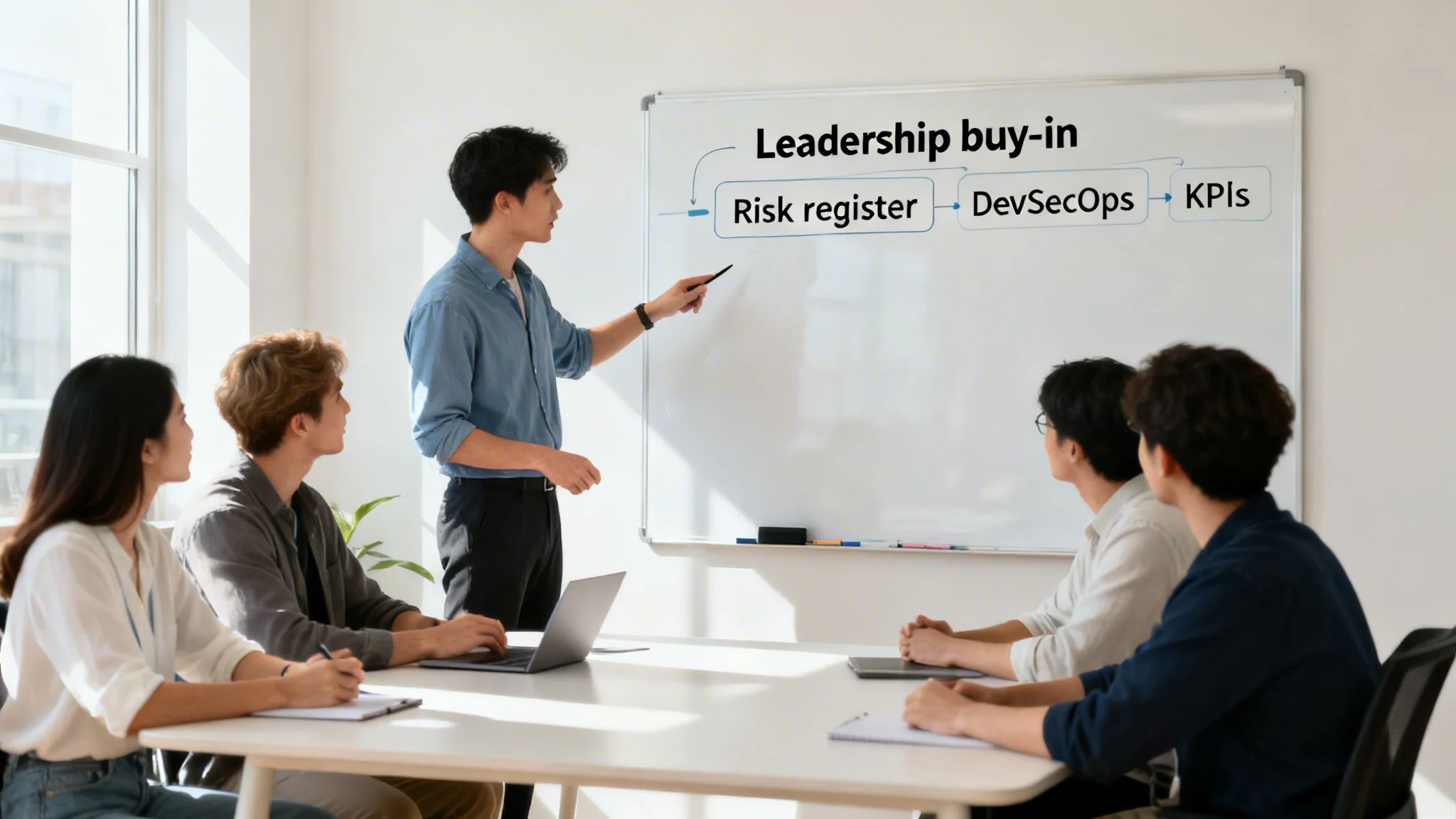
Knowing the theory is one thing, but turning it into a real-world, functioning system is where risk management proves its worth. For founders and engineering teams, the goal isn’t to build a perfect programme overnight. It’s to build a resilient one that gets stronger with every iteration.
The first step is always the hardest: getting leadership to buy in. Information security risk management isn’t just an IT expense; it’s a strategic business function. Frame the discussion around protecting revenue, building investor confidence, and creating a secure foundation for innovation, especially in high-stakes markets like Web3 and AI.
This mandate is becoming impossible to ignore. India’s security market, valued at USD 4.92 billion in 2024, is expected to hit USD 13.32 billion by 2033. This surge is fuelled by smart city projects and new regulations like the Personal Data Protection Bill, signalling a massive wave of investment in risk management for DeFi and tokenization. As detailed in market research on India’s security outlook, Web3 teams need to get their compliance workflows in order—fast.
Assemble Your Core Security Team
You don’t need a massive, dedicated security department from day one. At the startup stage, a lean but effective “security champions” team is more than enough to get started.
This group needs a 360-degree view of risk, so pull people from key areas of the business:
- Engineering: They are on the front lines, identifying technical vulnerabilities in your code, infrastructure, and architecture.
- Product: They know which features handle sensitive user data or create new attack surfaces that need protection.
- Operations/Legal: They bring the crucial context of compliance obligations and the potential business impact of a breach.
This cross-functional approach distributes accountability and ensures security is baked into the organization’s DNA, not siloed in one department.
Define Your Risk Appetite and Register
Before you can manage risk, you have to decide how much of it your organization is willing to stomach. This is your risk appetite. A DeFi protocol managing millions in user funds will—and should—have a much lower appetite for risk than a crypto gaming dApp still in beta.
Once you’ve established that threshold, your next move is to build a dynamic risk register. This becomes your single source of truth for every identified threat, its potential impact, and its current status.
A risk register isn’t a “set it and forget it” document. Think of it as a living backlog. Your security champions should be reviewing and updating it constantly, especially after a new feature launch, a system change, or an incident.
Embed Security into Your DevSecOps Lifecycle
The most effective way to manage technical risk is to stop treating security as a final checkbox. Instead, build it directly into your development process from the very beginning. That’s the entire philosophy behind DevSecOps.
Here are the key practices to implement in your CI/CD pipeline:
- Automated Scanning: Integrate static (SAST) and dynamic (DAST) analysis tools to hunt for vulnerabilities automatically with every code commit.
- Threat Modelling: Before a single line of code is written for a new feature, hold threat modelling sessions. This helps you spot potential security flaws in the design phase, where they are cheapest and easiest to fix.
- Regular Audits: For your most critical components—like smart contracts or custody solutions—schedule periodic third-party security audits to get an unbiased, expert assessment.
How Blocsys Builds Secure and Resilient Platforms
Turning security theory into a production-ready system is where the real work begins. At Blocsys, we don’t just talk about security; we build it into the DNA of every platform, bridging the gap between the chaotic realities of Web3 and the robust solutions our partners need to innovate safely.
Our entire approach revolves around embedding enterprise-grade information security risk management from day one. This isn’t about running a few checks before launch. It’s about architecting resilient, battle-tested systems for fintechs, exchanges, and digital asset businesses so they can operate with confidence. We design secure tokenisation frameworks, hardened trading infrastructure, and intelligent compliance workflows from the ground up.
The threat landscape makes this non-negotiable. In 2025, India became one of the world’s most targeted nations for cyberattacks. The average organisation faced 2,011 attacks per week—a staggering 96% higher than the global average. For fintechs and crypto exchanges, this is a code-red environment. A single breach in DeFi trading, for example, can evaporate user trust overnight.
Even more concerning? Only 24% of Indian organisations feel prepared for these assaults, leaving 76% dangerously exposed. You can get a deeper look at the data in the 2025 India Cyber Threat Report.
How We Address Client Needs
Mitigating the unique, complex risks in Web3 and AI isn’t about following a generic checklist. It demands first-hand knowledge of where things break. We apply our deep specialisation to protect our clients’ most critical operations, turning our experience into tangible security outcomes.
Here’s what that looks like in practice:
- Secure Trading Infrastructure: We build spot trading platforms, cross-chain swap protocols, and decentralised capital market systems with security as the core design principle. This means actively minimising attack surfaces and engineering defences against market manipulation right into the architecture.
- Intelligent Compliance: We develop automated compliance workflows that use AI responsibly. That includes building in safeguards against model poisoning and adversarial attacks to ensure you meet regulatory requirements without opening up new security holes.
- Tokenisation and Custody: Whether it’s tokenising precious metals or securing decentralised equity funds, we design custody solutions and smart contract architectures that are built to protect assets and prevent unauthorised access from the start.
Our philosophy is simple: enterprise-grade security isn’t a feature—it’s the foundation. We partner with organisations to build, scale, and execute, providing the deep technical and security expertise required to turn ambitious ideas into secure, market-leading platforms.
We bring together the disciplines of software engineering, cybersecurity, and financial technology to deliver solutions that work end-to-end. For a closer look at how we secure the underlying technology stack, check out our guide on cloud computing consulting.
Ultimately, our goal is to empower our clients to build the future of finance and technology on a foundation of unshakeable security and resilience.
Frequently Asked Questions (FAQ)
Let’s tackle the questions we hear most often from founders and engineering teams when they start putting an information security risk management programme into practice.
How Much Does a Risk Management Programme Cost for a Startup?
There’s no single price tag, and it’s certainly not an all-or-nothing expense. A startup can make significant progress with low-cost, high-impact actions. The key is to focus on what delivers the most value right now—like running internal threat modelling workshops, adopting a flexible framework like the NIST CSF, and using open-source security tools for scanning.
The initial investment in building solid processes and security awareness is a fraction of what it costs to recover from a breach, which hits your finances and your reputation. Think of it as a progressive implementation that matures with your company, not a massive upfront bill.
Can We Handle Risk Management Without a Dedicated Security Officer?
Yes, especially in the early stages. Instead of hiring a full-time Chief Information Security Officer (CISO), you can build a cross-functional ‘security champions’ team. This group should be composed of motivated individuals from engineering, product, and operations who have a genuine interest in security and are empowered by leadership to drive key initiatives.
This team can own the risk register, lead threat modelling sessions, and drive the first wave of security initiatives. The critical success factor is assigning clear responsibility and accountability for risk management, even if it’s not someone’s full-time job. This ensures security is a shared priority with the leadership backing it needs to be effective.
What Is the Single Most Important First Step?
The single most crucial first step is to create a risk register. This simple but powerful action forces you to think like an attacker and methodically identify your organisation’s unique threats and vulnerabilities. It is the foundational document for a proactive security program, providing a clear, prioritized roadmap for assessment, response, and monitoring.
Documenting every potential risk—from a smart contract flaw in your Web3 protocol to data poisoning threats against an AI model—builds the foundation for everything that follows. It’s the move that shifts your security posture from reactive to proactive, making sure your team’s limited resources are aimed at the threats that actually matter.
At Blocsys, we specialise in embedding enterprise-grade security into the core of every platform we build, transforming risk management from a theoretical exercise into a practical reality. Our team helps fintechs, exchanges, and digital asset businesses build, scale, and execute with the confidence that their platforms are secure and resilient by design.
Ready to build your platform on a foundation of unshakeable security? Connect with us for expert guidance on your next project.
