

Forecasting infrastructure got more valuable when the world got harder to read. In 2026, founders aren’t building prediction markets just to let users speculate on elections or token prices. They’re building decision engines for volatile crypto markets, regulatory uncertainty, geopolitical events, tokenised commodities, and AI-assisted trading.
That shift is especially visible in India’s Web3 ecosystem. One analysis notes a 150% surge in DeFi trading volume on Indian platforms like Polygon, averaging $2.5B monthly in Q1 2026, while AI-augmented markets outperformed pure crowd wisdom by 22% in accuracy for crypto price events in India (BettorEdge overview). That’s the counterintuitive part. Better forecasting in 2026 often comes from human judgement plus algorithmic structure, not crowd sentiment alone.
Founders searching for Types of Prediction Markets & Algorithms in Forecasting Platforms (2026 Guide) usually need one thing: a practical way to choose the right market design, pricing model, oracle stack, and chain architecture before they start building.
This guide is for teams designing prediction products in Web3, AI, crypto, fintech, carbon, gaming, and tokenised asset platforms. It focuses on what works, what breaks under real usage, and which design choices create operational pain later.
Why Prediction Markets Are Exploding in 2026
Volatility created demand. AI accelerated it. Blockchain made it buildable.
Prediction markets work because they turn disagreement into a tradable signal. Instead of asking a panel for an opinion, you let participants buy and sell contracts tied to an outcome. The price becomes a live estimate of collective belief.

Why founders care now
In calmer markets, forecasting can sit inside dashboards and research notes. In unstable markets, forecasting becomes product infrastructure.
Founders building in crypto, tokenised commodities, carbon markets, and event-driven trading now need systems that can:
- Price uncertainty live: Markets move before reports do.
- Aggregate fragmented information: Traders, researchers, bots, and community participants each contribute partial context.
- Support hedging behaviour: Users don’t always come to predict. They often come to offset risk.
- Create new trading surfaces: Governance, policy, compliance milestones, and cross-chain events can all become tradable contracts.
A founder who understands this shift can create a stronger product than one who treats a prediction market as just a betting interface.
What changed in practice
Two trends matter most.
First, decentralised infrastructure got mature enough to support real trading activity. Second, AI moved from external analytics into the market mechanism itself, especially in liquidity management and probability estimation.
Practical rule: If your platform still treats forecasting as a side feature, you’ll miss where value is forming. In 2026, forecasting is becoming core market infrastructure.
This demand spike also tracks with macro instability. For a broader view of that pressure, Blocsys has also examined why prediction markets are seeing stronger demand during wartime and global uncertainty.
What a prediction market really is
A prediction market isn’t best understood as a gambling product or an opinion poll. It’s a pricing system for future states.
That distinction matters because product design changes once you think this way. You stop asking, “How do users place bets?” and start asking:
- How will the market form a price?
- How will liquidity stay available?
- Who resolves the event?
- What happens when the crowd is wrong, thin, or manipulated?
Those four questions drive the rest of your architecture.
The Core Models Types of Prediction Markets Explained
Founders usually compare prediction markets by brand name. That’s a mistake. You should compare them by market structure.
A clean mental model starts with who controls custody, how prices form, and where liquidity comes from.

Centralised prediction markets
These platforms manage custody, compliance, user accounts, and matching infrastructure directly.
They usually offer the best onboarding flow. Fiat rails are simpler where regulation allows them. Customer support is also easier because the operator controls the stack.
The trade-off is obvious. Users trust the operator for custody, market integrity, and payouts. That’s manageable in regulated environments. It becomes a strategic limitation if your audience wants open access, self-custody, or composability with DeFi.
Centralised models fit best when you need:
- Tight operational control
- Faster consumer onboarding
- Traditional compliance workflows
- Curated market creation
They fit poorly when your thesis depends on permissionless participation.
Decentralised prediction markets
Decentralised platforms push settlement and often custody into smart contracts. They give users more transparency and reduce reliance on a single operator.
The value here isn’t ideological. It’s operational. Traders can inspect rules, verify payouts, and integrate positions into broader on-chain workflows.
In India’s Web3 ecosystem, Polymarket’s decentralised prediction markets on Polygon use blockchain-based binary contracts where price directly reflects probability, so a ₹67 contract implies a 67% likelihood of the event. The same source notes a USD 425 million single-day volume spike on February 28, 2026, driven by Indian crypto traders hedging regulatory shifts, with 99.8% settlement accuracy per on-chain audits (MetaMask prediction market overview).
That example matters because it shows what decentralisation does well. It supports transparent probability discovery around fast-moving policy and market events.
If you’re comparing structures directly, this breakdown of centralized vs decentralized prediction markets is useful when you’re deciding what to own off-chain versus on-chain.
AMM-based markets
AMM-based prediction markets replace the traditional matching engine with a pricing function. Users trade against a pool instead of waiting for a counterparty at the exact same moment.
That solves the cold-start problem better than pure order books in thin markets. Early-stage platforms often choose AMMs because they can launch many markets without needing immediate two-sided participation.
But there’s a cost. AMMs can become capital-inefficient when events are volatile or when informed traders hit stale prices faster than the pool adjusts.
AMMs are usually strongest for:
- Long-tail questions
- Community-created markets
- Early-stage liquidity bootstrapping
- Simpler yes/no contract formats
Order book-based markets
Order books work best when you expect concentrated liquidity and active traders who care about price precision.
Professional users prefer them because they can place limit orders, shape execution, and run market-making or arbitrage strategies. But order books break down in empty markets. A clean interface with no depth is still no market.
Here’s a useful reference point before going deeper into algorithms:
Hybrid markets
Most serious founders end up here.
A hybrid model combines structures. You might use an AMM to guarantee baseline liquidity, then shift active markets into an order book once participation crosses a threshold. You might keep resolution and custody on-chain while running faster matching off-chain.
The strongest platforms in 2026 rarely choose purity. They choose the minimum decentralisation needed for trust and the minimum centralisation needed for performance.
Hybrid design is often the right answer for founders who want both retail accessibility and pro-trader depth. That’s also why many teams explore hybrid trading prediction market platform development before locking architecture.
AI-integrated prediction markets
This is the newest category, and it’s where many generic guides stop too early.
AI-integrated markets don’t replace traders. They improve market operations around them. That can include dynamic spread adjustment, market seeding, probability priors, anomaly detection, moderation, and market creation support.
In crypto, finance, and geopolitics, this matters because information lands unevenly. AI can help normalise that flow, but only if it’s connected to effective incentive design. A weak market with an AI layer is still a weak market.
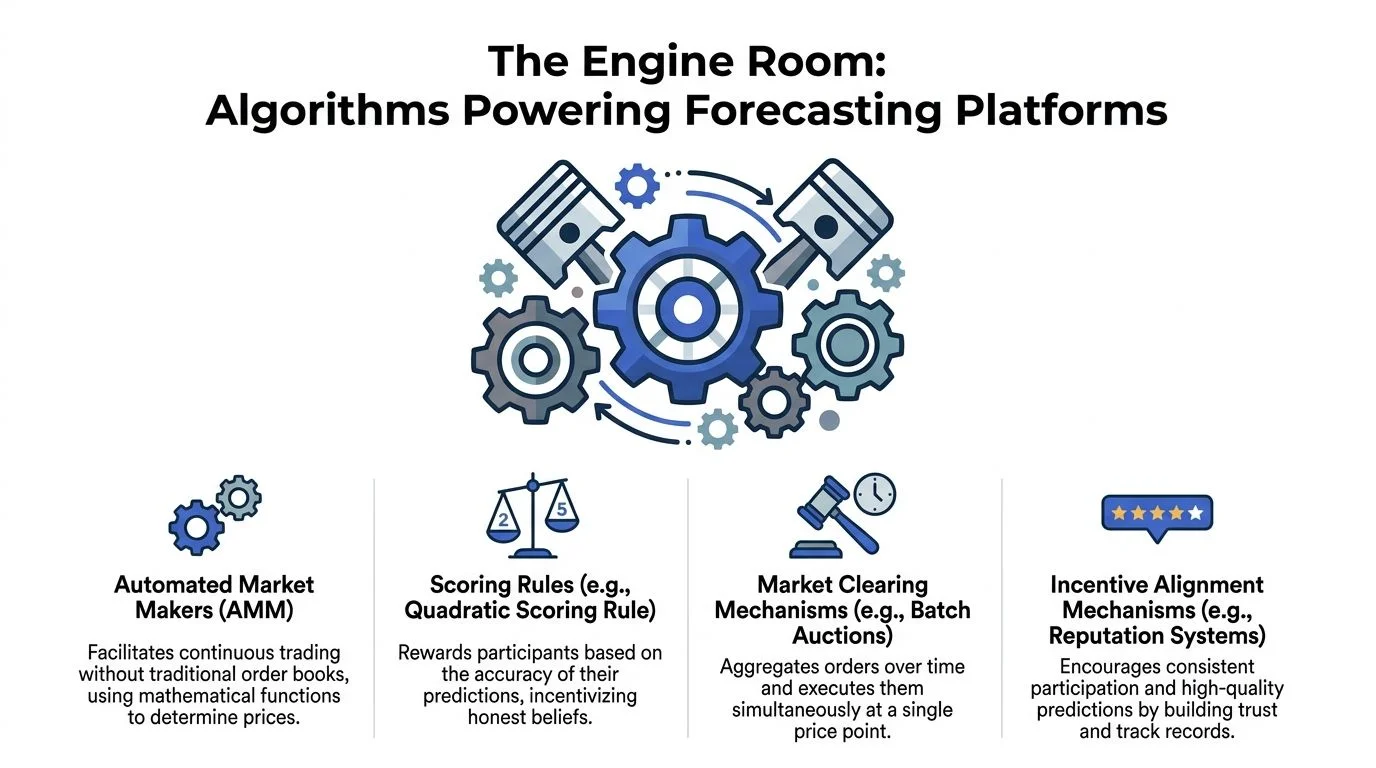
The Engine Room Algorithms Powering Forecasting Platforms
The market model tells you how your platform behaves. The algorithm tells you why.
A founder choosing between LMSR, a custom AMM, a central limit order book, or a conditional token framework isn’t picking academic theory. They’re choosing user experience, capital requirements, manipulation risk, and engineering complexity.
LMSR and scoring-rule pricing
LMSR, or Logarithmic Market Scoring Rule, is one of the classic ways to price prediction contracts when you want continuous liquidity.
The idea is simple. The system updates price as traders buy or sell positions, and a liquidity parameter controls how sharply price moves. If liquidity is low, each trade moves price more. If liquidity is high, price adjusts more smoothly.
Why founders choose LMSR:
- It guarantees a quote
- It works without a deep order book
- It’s useful for small or niche markets
Why they often move beyond it:
- It can be expensive to subsidise
- It’s less flexible for advanced execution
- Users may not understand why slippage feels steep
LMSR is good for bootstrapping information markets. It’s usually not the final answer for a platform that expects active trading across many correlated markets.
Automated market makers in prediction markets
AMMs generalise the same idea. They use a pricing function plus collateral pool to let users trade continuously.
For founders, the core design question isn’t “Should we use an AMM?” It’s “What kind of liquidity behaviour do we need under stress?”
Gnosis offers an important 2026 example. Gnosis protocol’s on-chain prediction modules use AI-driven market making algorithms that dynamically adjust liquidity spreads using RLHF-optimised LLMs analysing on-chain metrics and NSE data feeds. This produced 30% tighter spreads, in a 0.5% to 1% range, during 2026 gold token volatility spikes. The same analysis cites USD 21B monthly global volume, with IN traders capturing 8% share (TRM Labs analysis of prediction market scaling).
That matters because static AMMs often get picked apart in event-driven markets. Adaptive AMMs hold up better when volatility is uneven and news arrives in bursts.
Order book matching engines
If your users care about execution quality, they’ll eventually ask for limit orders.
An order book matching engine allows traders to post bids and asks at explicit prices. For liquid markets, this gives better price discovery than a pool-based AMM. It also supports more advanced roles such as market makers, statistical traders, and hedgers.
But order books create their own product demands:
- You need enough active traders.
- You need low-latency infrastructure.
- You need clear market-making incentives.
- You need reliable cancellation and update logic.
A thin order book is worse than a simple AMM because it advertises precision without delivering tradability.
Oracle-based resolution systems
This part decides whether your platform is trusted after the trade.
Prediction markets don’t end when traders stop trading. They end when someone or something resolves the event. If that process is weak, every other design choice collapses.
Good oracle design requires clear resolution criteria, dispute handling, fallback procedures, and rules for ambiguous outcomes. Founders often underinvest here because resolution looks like a backend task. It isn’t. It’s the settlement layer of your product promise.
If users doubt resolution, they won’t trust price. If they don’t trust price, liquidity leaves.
AI and ML forecasting models
AI in prediction markets works best when it supports the market instead of pretending to replace it.
Useful roles include:
- Pre-market probability seeding
- Spread and inventory management
- Event clustering and market suggestion
- Manipulation and anomaly detection
- Compliance flagging for risky market categories
What doesn’t work as well is treating an LLM as a direct oracle of truth. Language models can generate useful priors and summaries, but they still need market incentives and structured data around them.
If your team is exploring model-assisted trading infrastructure, practical work in pattern recognition and artificial intelligence becomes relevant because forecasting quality depends heavily on signal selection, not just model choice.
For teams evaluating supporting statistical approaches outside market-native pricing, this overview of time series forecasting methods is a useful complement. It helps clarify where classical forecasting ends and incentive-based market forecasting begins.
Conditional token frameworks
Conditional token systems let you split collateral into outcome-linked claims. That enables multi-outcome and combinatorial markets rather than just simple yes/no contracts.
This is powerful when you’re building:
- Governance markets with branching outcomes
- Macro policy markets with multiple decision paths
- Portfolio products tied to event trees
- Structured risk products in tokenised assets
The trade-off is complexity. Conditional tokens make composability richer, but they raise the burden on wallet UX, settlement logic, and user education.
Prediction Market Algorithm Comparison
| Algorithm | Core Principle | Best For | Key Trade-Off |
|---|---|---|---|
| LMSR | Prices move based on a scoring-rule cost function | Early-stage and niche markets | Requires subsidy and can produce sharp slippage |
| AMM | Users trade against a liquidity pool with formula-based pricing | Continuous access and broad market coverage | Capital efficiency can weaken in volatile markets |
| Order book matching | Buyers and sellers place explicit bids and asks | High-liquidity and pro-trader products | Fails visibly when market depth is thin |
| Oracle resolution | External data or adjudication settles outcomes | Any market with real-world resolution | Trust depends on clear rules and dispute design |
| AI and ML models | Models support pricing, liquidity, and monitoring | Adaptive market operations | Can amplify bad assumptions if poorly supervised |
| Conditional tokens | Collateral splits into outcome-linked claims | Complex multi-outcome products | UX and settlement logic get more complicated |
From Builder to Founder Key Design Decisions for Your Platform
Most failed prediction market products don’t fail because the idea was weak. They fail because the design assumptions were wrong.
A founder has to decide which trade-offs are acceptable before development starts. If you postpone those decisions, engineering will make them for you later, usually at higher cost.

Choose the market model from expected behaviour
Start with user behaviour, not ideology.
If you expect occasional participation across many niche markets, an AMM or LMSR-style setup is usually more practical. If you expect concentrated activity around finance, crypto, or geopolitics, an order book or hybrid design will age better.
Ask these questions early:
- Will users trade often or only around major events?
- Do they need limit orders or is instant execution enough?
- Will markets be curated or user-generated?
- Do you need one flagship market or hundreds of thin ones?
Founder check: Pick the model that works for your weakest important market, not your strongest demo market.
If your team is still shaping scope, use our Blockchain Project Checklist to validate the concept before development. It helps pressure-test market structure, token flow, and operational dependencies.
Select the chain for operational reality
Polygon, Avalanche, and other networks all look viable in a slide deck. What matters is how they behave under your actual product load.
Chain selection usually comes down to five practical factors:
- Transaction cost predictability
- Settlement speed
- Wallet and tooling ecosystem
- Oracle and bridge support
- Developer hiring and maintenance risk
For many founders, Polygon remains attractive because of ecosystem maturity and compatibility with existing DeFi patterns. But the right choice depends on where your liquidity, users, and compliance constraints sit.
Don’t optimise for theoretical throughput if your users mainly care about simple execution and low friction. Also don’t choose a chain just because your engineering team likes the tooling. Product realities should lead.
The hiring signal matters too. Reviewing roles such as Senior QA Engineer positions at Polymarket gives founders a grounded sense of how much testing, market integrity work, and infrastructure discipline serious platforms require.
Decide how much decentralisation users will value
Many founders become abstract at this point. Users don’t reward decentralisation as a philosophy. They reward it when it solves a visible trust problem.
A practical split looks like this:
- On-chain where trust matters most: custody, settlement, token accounting, market auditability
- Off-chain where speed matters most: indexing, analytics, notifications, some matching workflows
- Hybrid where regulation or UX requires control: account recovery, moderation, region gating, support processes
That balance is often the right answer. Full decentralisation sounds clean. It can also create poor onboarding, slow support, and governance overhead your users never asked for.
Build for operations, not only launch
Founders usually obsess over front-end flows and forget the repetitive work:
- Market creation review
- Resolution management
- Liquidity seeding
- Compliance filtering
- Fraud and abuse monitoring
A production platform needs these workflows designed from day one.
Planning to build a prediction market platform?
Use our Blockchain Project Checklist to validate your idea before development.
If you’re comparing implementation routes, useful references include how to build a prediction market platform like Polymarket, build decentralised exchange with prediction market, and prediction market software development.
The Blockchain Advantage and Its Hurdles
Blockchain gives prediction markets three things traditional systems struggle to match. Transparent settlement, programmable incentives, and composable ownership.
That makes it easier to verify positions, inspect payouts, and plug prediction contracts into wallets, DeFi rails, and treasury systems. For founders building tokenised trading products, that’s a serious advantage.
Why blockchain still wins
Smart contracts reduce dependence on platform trust for core settlement logic. Token incentives can help bootstrap participation. Public ledgers also make disputes more visible because market mechanics and transfers are inspectable.
For digital asset businesses, that transparency is often the product.
A practical build can include:
- Smart contracts for market creation and settlement
- Token rewards for market makers or curators
- On-chain audit trails for trades and payouts
- Composable collateral tied to other DeFi systems
This is especially useful when your product overlaps with governance, carbon instruments, precious metal tokenisation, or decentralised fund structures.
The four hurdles founders can’t ignore
Liquidity remains the hardest problem. A market without active participants is only a contract wrapper.
Manipulation is the second. Thin markets invite price distortion, coordinated trading, and incentive abuse. Some manipulation can even improve price discovery in deep markets if others fade it. In shallow markets, it usually destroys trust.
Oracle risk is third. Resolution disputes are where user confidence breaks fastest. Founders who need a deeper design approach should think carefully about decentralized prediction market oracle design.
Regulation is the fourth, and it doesn’t behave evenly across jurisdictions.
A frequently ignored angle is India’s DPG 2025 context. One analysis notes 200% growth in decentralised gaming bets, reaching $1.2B TVL in March 2026, while emphasising that India’s ban on fiat event contracts pushes platforms toward blockchain-only solutions and leaves compliance workflow gaps for crypto game and event-market builders (RotoWire prediction markets overview).
What works in practice
Founders usually reduce risk by narrowing scope first.
Start with fewer market types, tighter resolution rules, and stronger curation. Expansion is easier than regaining trust after ambiguous settlement or abuse.
That means:
- Seed fewer markets, but make them liquid
- Use narrow resolution criteria
- Add dispute processes before scale
- Align market categories with actual compliance capacity
Teams building for India, the UK, or multi-region deployment should also avoid copying U.S.-centric assumptions into local workflows. The compliance model often has to change with the market structure.
The Future of Forecasting 2026 Trends and Beyond
The next wave of prediction platforms won’t look like isolated event markets. They’ll look like forecasting layers inside broader financial and operational products.
AI moves from assistant to operator
The strongest change is AI shifting deeper into execution. Instead of only generating summaries or market ideas, AI systems are increasingly being used to adjust liquidity, score participant quality, surface anomalies, and support probability calibration.
That doesn’t remove the crowd. It changes the crowd’s environment.
A likely near-term pattern is this:
- AI proposes market structures
- Humans and institutions trade them
- Smart contracts settle them
- Monitoring systems keep them inside risk boundaries
This model is far more durable than the old “AI predicts everything” narrative.
Cross-chain markets become more normal
Liquidity is still fragmented. Users sit across wallets, ecosystems, and different compliance surfaces.
Over the next cycle, more platforms will treat chain choice as a routing layer rather than a product identity. That means cross-chain collateral movement, unified position views, and market access that doesn’t force users to think about bridge complexity on every trade.
Founders should design with this in mind early. Retrofitting multi-chain support later often creates brittle asset accounting and operational overhead.
Prediction markets move into RWAs and carbon
This is one of the more interesting product directions.
Forecasting markets can price uncertainty around real-world asset events, compliance milestones, commodity supply shifts, and verification outcomes. In carbon markets, the market isn’t only the credit. It’s the uncertainty around issuance, delivery, methodology approval, and policy timing.
That creates room for:
- Hedging tools around carbon project milestones
- Market-based signals for tokenised metal or commodity products
- Governance and compliance markets for decentralised funds
- Forecast layers embedded in treasury and risk dashboards
Founders who combine tokenisation with forecasting will likely build stronger products than those who keep them separate.
Build Your Forecasting Platform with Blocsys
Building a credible prediction market in 2026 means making the right decisions early. Market type, pricing model, oracle design, chain selection, liquidity strategy, and compliance logic all shape whether the platform feels reliable or fragile.
For teams evaluating delivery options, Blocsys Technologies works on production-ready blockchain and AI-powered platforms for fintechs, exchanges, and digital asset businesses. That includes tokenisation systems, trading infrastructure, and intelligent compliance workflows that fit prediction market products, hybrid trading models, and adjacent digital asset use cases.
If your roadmap includes decentralised event markets, tokenised commodities, cross-chain trading, or AI-supported liquidity systems, the build plan should be specific before code starts.
Planning to build a prediction market platform?
Use our Blockchain Project Checklist to validate your idea before development.
You can also review decentralized prediction market platform, prediction markets in the UK business model how to build your platform 2026, and prediction markets platform development company if you’re comparing delivery models and rollout approaches.
Frequently Asked Questions for Founders
Which prediction market type is best for a startup
Most startups should begin with an AMM-based or hybrid market, not a pure order book. That gives you tradability before you have dense liquidity.
Pure order books work best when you already expect active market makers and concentrated volume. Early-stage products usually need a structure that can survive thin participation while still producing a usable price.
When should I use an order book instead of an AMM
Use an order book when execution precision matters more than universal availability. That usually means finance, crypto, macro, or professional trading audiences.
If your users want limit orders, tighter entry control, and advanced strategies, an order book becomes more attractive. If your market set is broad and thin, an AMM is often more forgiving.
Are AI prediction markets better
AI can improve a platform, but only when it’s used in the right layer. It works well for liquidity adjustment, probability seeding, anomaly detection, and operational monitoring.
It doesn’t eliminate the need for incentives, good resolution, or trader participation. A badly structured market with an AI wrapper still produces weak signals.
What is the biggest technical risk in a prediction market platform
For most founders, the biggest technical risk isn’t matching logic. It’s resolution integrity.
If your oracle process is unclear, delayed, or open to dispute, users stop trusting the contract itself. That damages liquidity faster than a rough interface or limited market catalogue.
How should founders seed liquidity in a new market
Start narrow. Seed a small number of markets that are easy to understand, easy to resolve, and likely to attract repeat participation.
Teams often achieve better results with one liquid flagship category than dozens of empty markets. Pair initial liquidity support with strong curation, visible rules, and incentives that reward actual market quality rather than superficial activity.
How much decentralisation should a prediction platform have
Enough to make trust visible, not so much that usability collapses.
Settlement, custody, and auditability usually benefit from being on-chain. Support, moderation, analytics, and some execution layers often work better with selective centralisation. Most successful products land somewhere in the middle.
If you’re evaluating a prediction market, forecasting engine, or hybrid event-trading product, Blocsys Technologies can help you define the architecture before development begins. Our team works with founders and product teams building blockchain, AI, crypto, and tokenisation platforms that need secure trading logic, practical compliance design, and production-ready execution. Connect with Blocsys to review your concept, pressure-test the market model, and plan the right build path.
