
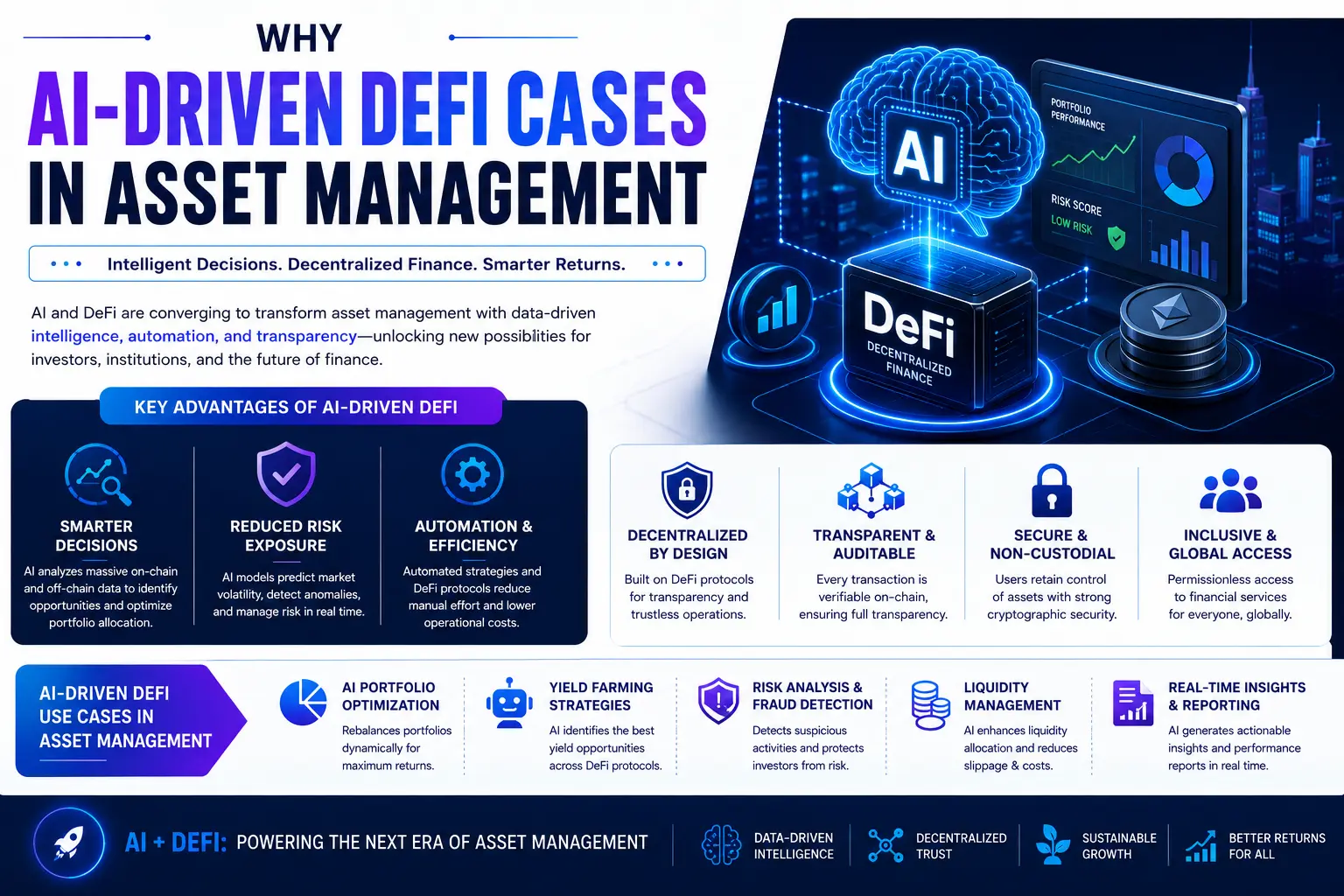
The market signal is hard to ignore. The AI in asset management market was valued at USD 3.8 billion in 2025 and is projected to grow at a CAGR of over 27.7% from 2026 to 2034, according to Global Market Insights. For enterprise teams in digital assets, that doesn’t read like a niche trend. It reads like infrastructure moving into production.
For fintech founders, DeFi startups, hedge funds, exchanges, tokenization platforms, and institutional investors, the practical question isn’t whether AI and decentralised finance belong together. It’s where AI-driven systems create real operational advantage in asset management, and where they still require tighter controls, staged deployment, and human oversight.
This guide examines AI- DRIVEN DEFI CASES IN ASSET MANAGEMENT through an enterprise lens. It focuses on implementation logic, not hype. It looks at how AI changes portfolio management, execution, risk controls, smart contract automation, tokenized asset workflows, and institutional operating models. For readers who want a concise primer before going deeper, Alpha Scala’s explainer on understanding decentralized finance is a useful starting point. For teams evaluating broader architecture choices around blockchain and machine intelligence, Blocsys has also outlined key integration patterns in its analysis of AI and blockchain integration.
Table of Contents
- The New Financial Frontier AI and DeFi in Asset Management
- The Evolution from DeFi Protocols to Intelligent Financial Systems
- Core AI Capabilities Transforming DeFi Asset Management
- The Technology Stack Demystified
- Traditional Finance vs AI-Driven DeFi Systems A Comparison
- Enterprise Use Cases and Institutional Adoption Strategy
- How Blocsys Engineers Enterprise-Grade AI-Driven DeFi Infrastructure
- Frequently Asked Questions
- What is AI-driven DeFi?
- How does AI improve asset management in DeFi?
- What are DeFi asset management platforms?
- How do smart contracts automate DeFi systems?
- What are tokenized assets?
- How secure are AI-powered DeFi platforms?
- Why are enterprises adopting decentralised finance?
- How can Blocsys develop AI-driven DeFi infrastructure?
The New Financial Frontier AI and DeFi in Asset Management
AI-driven DeFi in asset management means combining machine-led analysis and decision support with blockchain-native execution rails. In practice, that can include AI models that assess yield opportunities, detect anomalies, prioritise liquidity venues, support rebalancing, or trigger rule-based actions through smart contracts.
The strategic importance comes from the operating model, not the branding. DeFi already offers programmable settlement, transparent state changes, and continuous market access. AI adds the missing layer of adaptation. It can interpret changing market conditions, compare strategy paths, and reduce the reliance on manual parameter tuning that limited earlier onchain investment workflows.
That matters because enterprise asset management isn’t looking for novelty. It’s looking for faster decisions, lower operational friction, better controls, and auditable automation. The market projection cited above matters less as a headline than as a signal that institutional buyers are funding these capabilities as part of mainstream financial infrastructure.
Key point: AI-driven DeFi becomes relevant when it improves execution quality, control design, and operational resilience. It’s far less interesting when it’s framed only as a source of speculative alpha.
For enterprise teams, the true opportunity sits in the overlap between DeFi’s programmability and AI’s pattern recognition. That overlap is where portfolio operations, collateral movement, liquidity routing, surveillance, and tokenized asset workflows start to look less like fragmented tools and more like coordinated financial systems.
The Evolution from DeFi Protocols to Intelligent Financial Systems
First-generation DeFi protocols proved that financial services could run through code rather than central intermediaries. Lending, swaps, staking, collateralisation, and vault strategies became programmable. But most of those systems were still mechanically rigid. They executed rules well, yet they didn’t interpret changing conditions with much intelligence.
A large share of early DeFi strategy management depended on manual intervention. Teams adjusted parameters, responded to governance events, watched volatility, and reallocated assets when conditions changed. This created a paradox. DeFi was automated at the transaction layer, but often manual at the strategy layer.
That distinction matters for asset managers. Transaction automation alone doesn’t create an intelligent portfolio system. It only creates a faster one.
Static protocols created operational drag
The limits of early DeFi became clear in four recurring areas:
- Static allocation logic: Vaults and yield strategies often followed predefined rules that weren’t designed to adapt to changing liquidity, risk, or fee conditions.
- Manual governance dependence: Protocol changes, whitelist decisions, and risk responses often required human review cycles.
- Fragmented data handling: Onchain signals, offchain context, and internal compliance logic rarely sat in one decision framework.
- Reactive risk posture: Teams often recognised stress after markets moved, rather than building surveillance that flagged deteriorating conditions earlier.
These constraints made DeFi usable, but not yet institutional by default.
AI adds the missing adaptation layer
AI changes the design logic. Instead of hard-coding every response path, teams can create systems that rank options, identify anomalies, classify market states, and support or trigger bounded actions. That’s the shift from protocol usage to intelligent financial systems.
A useful way to think about it is this:
| Layer | Early DeFi model | AI-enhanced model |
|---|---|---|
| Decision input | Fixed rules and manual review | Dynamic analysis of changing conditions |
| Portfolio changes | Periodic human-led adjustments | Continuous recommendation or bounded automation |
| Risk detection | Threshold alerts after events | Pattern-based monitoring and anomaly flagging |
| Execution | Smart contracts as passive tools | Smart contracts as policy-bound execution rails |
The strategic implication is bigger than efficiency. AI lets firms redesign DeFi operations around orchestration rather than isolated protocol interactions.
DeFi matured when finance became programmable. It becomes institutionally credible when that programmability is paired with governed intelligence.
For teams thinking about decentralised fund operations, this is the difference between using protocols tactically and designing a true operating model for onchain asset management. Blocsys explores that shift in more depth in its guide to decentralized fund management.
Why this shift is accelerating now
The broader asset-management industry has already started to validate AI as an operating layer for real workflows. That matters because DeFi teams don’t need to invent the institutional logic from scratch. They can adapt tested architecture patterns from mainstream finance into onchain systems.
The result is a more mature model for digital asset management. AI doesn’t replace DeFi. It makes DeFi more usable for organisations that need disciplined execution, policy-aware controls, and systems that can respond to live conditions without becoming fully unconstrained.
Core AI Capabilities Transforming DeFi Asset Management
The strongest enterprise use cases don’t come from general claims about intelligence. They come from specific capabilities that improve how assets are allocated, monitored, and moved. A 2025 State Street survey found that AI adoption in asset management is now focused on productivity and operational integration, including data validation, workflow automation, and deeper integration for optimal order routing and portfolio decision support, marking a shift from pilot programmes to structured roadmaps, as noted in State Street’s asset management analysis.
That finding is highly relevant to DeFi asset management. It suggests that AI value is already moving from analytics into routing, execution support, and control workflows. Onchain finance provides a more programmable execution environment for the same shift.
AI-powered portfolio optimisation
Portfolio optimisation in DeFi is rarely about a single trade. It’s usually about balancing yield, liquidity access, smart contract exposure, collateral efficiency, execution cost, and concentration risk across multiple venues or protocols.
AI helps by evaluating more variables at once than a rules-only system can comfortably handle. An enterprise treasury or crypto asset manager can use models to rank possible allocations based on internal mandates, live market conditions, and policy constraints. That doesn’t require full autonomy. Even decision support can materially improve portfolio operations.
Examples of where this becomes useful include:
- Yield allocation: Selecting among lending pools, liquidity venues, or tokenized yield products based on changing risk and return conditions.
- Rebalancing logic: Adjusting exposures when portfolio drift, volatility, or utilisation thresholds move outside target range.
- Collateral efficiency: Recommending how assets should be distributed across products or venues to support margin or liquidity needs.
The key enterprise insight is that AI doesn’t just optimise returns. It also helps standardise how decisions are made.
Predictive risk management
Risk management is where AI has immediate practical value in DeFi. Onchain markets generate constant streams of pricing, wallet, collateral, and protocol activity data. Human teams can monitor dashboards, but they can’t consistently interpret every weak signal across every venue in real time.
AI is better suited to tasks such as:
- Anomaly flagging: Detecting wallet behaviours, transaction clusters, or liquidity movements that differ from normal patterns.
- Exposure monitoring: Highlighting concentration risks across protocols, counterparties, bridges, or collateral types.
- Stress recognition: Identifying conditions that may warrant tighter thresholds, slower execution, or human review.
Practical rule: Start with surveillance, scoring, and alerts before granting autonomous capital movement. Governance usually improves faster than performance when teams sequence adoption that way.
This is also where pattern recognition and artificial intelligence becomes useful as an enterprise capability, particularly for trading systems and compliance workflows that need explainable signals rather than opaque automation.
A short explainer on market-facing automation helps ground the discussion:
Automated strategy execution
Execution is where AI-driven DeFi starts to move from recommendation to action. Once models produce bounded decisions, smart contracts and trading infrastructure can handle the operational legwork.
This can include:
- Routing trades to venues based on liquidity, slippage tolerance, and policy filters.
- Triggering rebalances when predefined conditions are met.
- Enforcing compliance rules before execution.
- Logging actions into auditable systems for review and post-trade analysis.
The enterprise advantage is consistency. Human teams are good at handling exceptions. Machines are better at repeating approved logic under pressure.
That’s why automated DeFi investment platforms need to be designed as governed systems, not black boxes. The strongest architecture usually separates decision models, policy constraints, and execution services so that each layer can be tested independently. Firms building trading-grade infrastructure often take that path when designing crypto trading platform development stacks that must support both speed and control.
What this means for decision-makers
The three capabilities above work best when deployed together, but they don’t have to go live at once. Enterprise teams usually get the cleanest results by implementing them in sequence:
| Capability | Best first use | Governance intensity |
|---|---|---|
| Portfolio optimisation | Recommendations and allocation support | Moderate |
| Risk management | Surveillance, anomaly alerts, exposure scoring | High |
| Strategy execution | Policy-bound automation on approved actions | Very high |
That staged model is more durable than launching fully autonomous agents too early. In DeFi asset management, intelligence creates value only when governance keeps pace.
The Technology Stack Demystified
AI-driven DeFi systems are only as strong as the architecture beneath them. Most implementation failures don’t come from a weak model. They come from poor data discipline, unclear execution permissions, or a mismatch between financial logic and technical controls.
For CTOs and product leaders, three building blocks matter most: smart contract automation, blockchain-based asset verification, and tokenized asset platforms. These aren’t isolated features. They form the operating backbone that lets AI-driven decisions become trusted financial actions.
Smart contract automation
Smart contracts turn approved logic into executable workflows. In an AI-enabled asset management system, they don’t need to “think”. They need to enforce.
That distinction is important. The model can score opportunities or identify risks, but the contract should remain policy-bound. It should define what actions are allowed, under what conditions, with what approvals, and with what logging.
Typical contract-level responsibilities include:
- Execution gating: Only allowing actions that fall within approved strategy limits.
- Rule enforcement: Applying allocation caps, whitelist restrictions, time locks, or review requirements.
- Settlement logic: Handling subscriptions, redemptions, swaps, or collateral movements in a deterministic way.
For engineering teams building this layer, the technical quality of smart contract automation often matters more than the sophistication of the AI model. A weak contract can invalidate a strong strategy.
Blockchain-based asset verification
AI models need trusted inputs. If the underlying asset, reserve, transaction, or ownership data is inconsistent, the outputs become less reliable no matter how advanced the analytics are.
That’s why blockchain verification matters. It creates a tamper-resistant record of state changes, ownership, transfer history, and in many cases the relationship between offchain data and onchain execution. In asset management, this supports stronger auditability and cleaner reconciliation.
A practical architecture often combines:
| Component | Role in the stack |
|---|---|
| Onchain state data | Provides transparent records of holdings, transfers, and contract interactions |
| Offchain enrichment | Adds compliance, pricing, or operational context |
| Verification layer | Confirms provenance and aligns data before execution |
| Model layer | Consumes verified data for scoring, routing, or surveillance |
For firms evaluating tamper-proof verification systems, the broader requirement is reliable systems engineering, not just protocol integration. That’s why many teams treat enterprise blockchain solutions as part of the control plane rather than a standalone ledger choice.
Tokenized asset platforms
Tokenized asset platforms matter because they expand what AI-driven DeFi can manage. Once funds, treasury instruments, real-world assets, or structured products are represented as programmable digital assets, portfolio systems can evaluate and interact with them more consistently.
This shifts DeFi asset management away from a narrow crypto-only model. It opens the door to workflows where AI evaluates tokenized funds, collateral pools, stable-value instruments, or other onchain representations with the same operating discipline used in broader asset management.
The implementation challenge is orchestration. Product teams need data pipelines that unify market signals, token state, compliance context, and internal policy logic. That’s as much a data engineering problem as a DeFi problem. Teams planning for scale usually need a disciplined data pipeline architecture before they need more models.
Strong AI-DeFi systems usually fail or succeed at the data and permission layers, not at the interface layer.
A useful parallel comes from another domain where prediction, data quality, and execution logic need to work together. Polytreasury’s walkthrough of an AI betting prediction workflow is helpful because it shows how model outputs only become operationally useful when connected to structured pipelines, risk boundaries, and controlled execution.
Traditional Finance vs AI-Driven DeFi Systems A Comparison
The useful comparison isn’t “banks versus blockchains”. It’s workflow versus workflow. Enterprise teams need to understand how operating models differ when asset management moves from intermediary-led infrastructure to programmable and analytics-driven systems.
| Dimension | Traditional finance systems | AI-driven DeFi systems |
|---|---|---|
| Execution model | Intermediated, process-heavy, often batch-oriented | Programmable, API-connected, smart contract enabled |
| Availability | Constrained by business hours, counterparties, and operational windows | Continuous market access with machine-readable execution paths |
| Transparency | Reporting is typically periodic and role-based | State changes can be recorded and observed onchain |
| Portfolio operations | Human-led review and rebalancing cycles | Model-assisted or policy-bound continuous adjustment |
| Compliance handling | Often document-driven and post-event | Can be embedded into execution logic and monitoring |
| Infrastructure change | Slow integration with legacy dependencies | Faster modular design, but higher smart contract and model risk |
The strongest advantage of AI-driven DeFi is not speed alone. It’s the ability to combine decisioning, execution, and auditability inside a more unified operating flow.
Where traditional finance still holds an edge
Traditional finance still has structural strengths in areas such as established legal wrappers, mature custody arrangements, and well-defined institutional process controls. For many firms, that remains decisive. AI-driven DeFi doesn’t erase those advantages overnight.
It does, however, challenge the assumption that operational complexity must remain manual.
Where AI-driven DeFi is structurally different
AI-driven DeFi performs best in environments where firms need:
- Continuous surveillance across live markets and positions
- Programmable execution with clear rules and approvals
- Transparent state transitions for audit and post-trade review
- Composable products built from tokenized or onchain financial primitives
The key comparison isn’t whether DeFi is more innovative. It’s whether a given workflow becomes more controllable, visible, and efficient when rebuilt on programmable infrastructure.
That’s why many enterprise adoption paths are hybrid. Firms often retain familiar control structures from traditional finance while moving selected workflows, such as rebalancing, collateral checks, or treasury deployment, into AI-supported onchain systems.
The decision framework is practical. If a process depends on real-time visibility, machine-readable assets, and repeated policy checks, AI-driven DeFi may be structurally better suited than legacy workflow design. If it depends mainly on legal discretion, bespoke negotiation, or fragmented offchain approvals, traditional processes may still dominate for now.
Enterprise Use Cases and Institutional Adoption Strategy
The most credible use cases aren’t abstract. They sit inside treasury operations, exchange infrastructure, and compliance-intensive digital asset products. Adoption is already broad enough to justify serious planning, but outcomes remain uneven. Mercer found that 91% of managers are using or plan to use AI, while Grant Thornton found 77% of firms already have an AI roadmap. At the same time, two-thirds report only modest ROI and under 10% use agentic AI, according to Mercer’s survey on AI in investment management.
That combination tells enterprise buyers something important. Adoption is real, but careless autonomy is still a weak operating model.
Treasury and idle capital management
A corporate treasury or stablecoin-heavy operating business can use AI-driven DeFi to manage idle balances across lower-risk onchain strategies, tokenized instruments, or liquidity venues. The immediate value is not aggressive yield seeking. It’s better capital placement under controlled policy rules.
A sensible design would let the model recommend placement changes while execution remains bounded by approved limits, asset eligibility, and review triggers. This reduces manual monitoring without handing over unrestricted control.
Liquidity provisioning and execution oversight
Exchanges and trading venues face a different problem. Their concern isn’t just portfolio return. It’s market quality, liquidity depth, inventory balance, and surveillance.
AI can help score venue conditions, identify abnormal flows, and support dynamic provisioning or routing decisions. In DeFi-connected environments, it can also help determine when to move inventory, rebalance pools, or tighten constraints. For institutions entering this space, the onboarding path matters as much as the model. Governance, permissions, and operating playbooks need to be designed before automation expands. That’s why firms increasingly focus on institutional DeFi onboarding rather than protocol access alone.
Compliance-first rollout design
The strongest institutional pattern is staged deployment. Based on the survey signals above, a practical rollout often follows this sequence:
- Start with constrained tasks such as anomaly detection, trade surveillance, liquidity alerts, and regulatory triage.
- Benchmark each module independently so teams can see where value is real and where it’s still uncertain.
- Add execution support next through recommendations, not immediate full autonomy.
- Grant limited authority only after controls are proven across audit, rollback, and exception handling.
This approach is more conservative than the common market narrative. It’s also more likely to survive contact with risk committees, compliance teams, and institutional clients.
Implementation bias: Teams usually overestimate the value of autonomy and underestimate the value of orchestration, data hygiene, and permission design.
An enterprise programme in this area should therefore judge success on three questions:
- Can the system explain why it acted?
- Can the firm prove the action was policy-compliant?
- Can operations intervene quickly when conditions change?
If the answer to any of those remains weak, the model is not ready for wider authority.
How Blocsys Engineers Enterprise-Grade AI-Driven DeFi Infrastructure
Enterprise adoption usually fails at the seams. One team builds the model, another team manages wallet and contract permissions, and a third owns compliance. The result is fragmented accountability. AI-driven DeFi only works in production when these layers are engineered as one operating system.
That’s where infrastructure-focused delivery matters. Buyers typically need secure execution logic, data pipelines that support trustworthy model inputs, and workflow controls that can fit regulated or institution-facing environments. The build problem is broader than smart contracts alone. It includes orchestration, monitoring, policy enforcement, and integration with existing trading or treasury systems.
A useful reference point from outside Web3 is this Applied case study on Claude Enterprise, which shows how institutional investment work benefits when AI is embedded into governed operating workflows rather than treated as a standalone assistant. The same principle holds in DeFi infrastructure.
In that context, Blocsys Technologies can be evaluated as one implementation option for firms building AI-driven DeFi platform development, smart contract automation, tokenization systems, and intelligent compliance workflows. Its published focus is on production-ready blockchain and AI-powered platforms for fintechs, exchanges, and digital asset businesses.
The practical decision standard is straightforward. Choose a delivery partner that can connect model logic, blockchain infrastructure, execution rules, and enterprise controls without treating them as separate projects. In AI-driven asset management, architecture quality usually determines whether innovation becomes a product or a risk event.
AI Is Enhancing DeFi Strategies for Tokenized Fixed-Income Assets
Artificial intelligence is transforming DeFi asset management by enabling data-driven investment strategies for tokenized financial assets. Advanced AI models can continuously analyze corporate bond yields, corporate bond spreads, market volatility, and on-chain transaction data to optimize portfolio performance and identify emerging investment opportunities. Combined with enterprise blockchain applications, these intelligent systems provide greater transparency, automated risk assessment, and real-time decision-making for decentralized investment platforms. As real-world asset (RWA) tokenization continues to expand, asset managers are increasingly using AI to automate portfolio rebalancing, improve liquidity management, and strengthen compliance monitoring across digital investment ecosystems. This combination of AI, blockchain, and tokenized fixed-income assets enables more efficient, secure, and scalable asset management while helping institutional and enterprise investors make informed decisions in rapidly evolving financial markets. Businesses looking to build next-generation DeFi investment platforms can leverage Corporate Bond Tokenization Platform solutions to tokenize fixed-income assets and create intelligent, blockchain-powered investment ecosystems.
Frequently Asked Questions
What is AI-driven DeFi?
AI-driven DeFi is the use of artificial intelligence inside decentralised finance workflows to support or automate tasks such as portfolio allocation, liquidity routing, risk detection, compliance checks, and execution. The value comes from combining AI decision support with blockchain-based settlement and programmable smart contract logic.
How does AI improve asset management in DeFi?
AI improves DeFi asset management by helping firms assess changing market conditions, monitor portfolio exposures, identify anomalies, and support rebalancing decisions. In enterprise settings, it’s most useful when paired with strict governance so models can improve speed and consistency without bypassing approved controls.
What are DeFi asset management platforms?
DeFi asset management platforms are systems that help users or institutions manage digital assets through onchain strategies, smart contracts, and connected analytics. More advanced platforms add AI for decision support, risk scoring, and workflow orchestration rather than relying only on static rules or manual adjustments.
How do smart contracts automate DeFi systems?
Smart contracts automate DeFi systems by enforcing predefined rules for transfers, swaps, subscriptions, redemptions, collateral actions, and other financial events. In AI-enabled environments, they typically act as the execution layer. They don’t replace governance. They apply approved logic consistently and record actions transparently.
What are tokenized assets?
Tokenized assets are digital representations of assets issued on a blockchain. They can represent financial instruments, funds, treasury positions, or other ownership and value claims. In asset management, tokenization matters because it makes assets programmable, easier to track, and more compatible with automated workflows.
How secure are AI-powered DeFi platforms?
Security depends on architecture quality, not on the AI label. Strong platforms need secure smart contracts, trusted data inputs, clear permissions, monitoring, and human override paths. The biggest risk usually comes from weak control design, especially when firms give too much autonomy to models before governance is mature.
Why are enterprises adopting decentralised finance?
Enterprises adopt DeFi when they need programmable execution, faster settlement logic, more transparent workflows, or better access to tokenized asset models. Adoption is strongest where firms can improve treasury operations, portfolio automation, liquidity management, or auditability without compromising internal control standards.
How can Blocsys develop AI-driven DeFi infrastructure?
Blocsys can support organisations that need blockchain and AI engineering across DeFi platforms, tokenization systems, smart contract workflows, and intelligent compliance layers. For enterprise buyers, the relevant question is whether the delivery model can join execution logic, data pipelines, and governance controls into one production-ready system.
If your team is evaluating AI-driven DeFi for trading, treasury, tokenized assets, or institutional workflow automation, Blocsys Technologies can help you assess architecture options, define a phased implementation path, and build secure production systems that align AI models with smart contract controls and enterprise operating requirements.
