
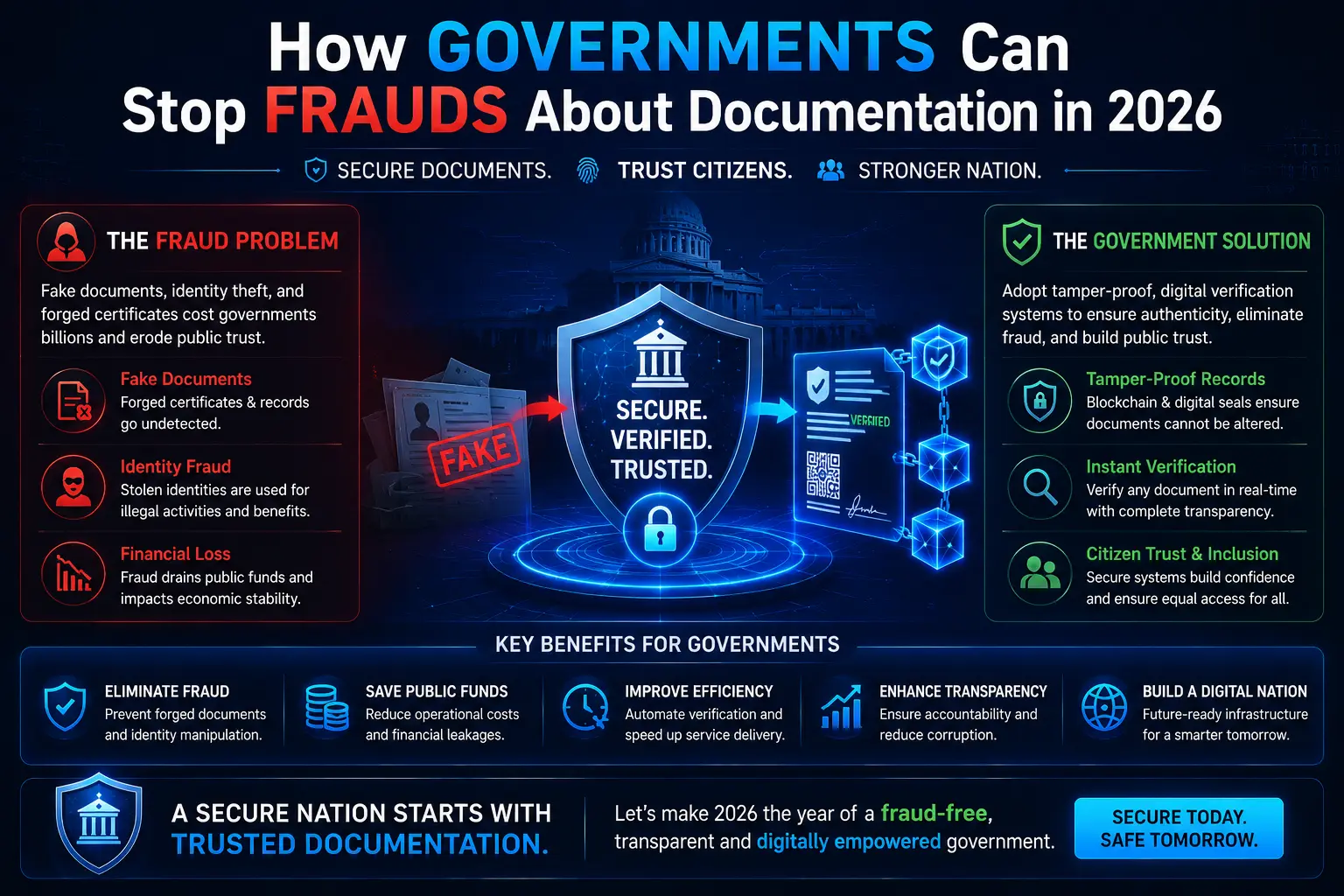
Government documentation fraud is no longer just a records-management problem. It is an infrastructure problem. In India, more than 1.3 billion Aadhaar numbers had been issued by 2024, making Aadhaar the world’s largest biometric ID system and a foundational layer for document verification at scale in public workflows, according to the verified reference provided by the White House page on eliminating information silos (Aadhaar verification context). That single fact changes the policy conversation. Fraud prevention works best when identity, records, and auditability are engineered together.
For policymakers, public administration leaders, regulated enterprises, and digital service operators across the UK, Europe, the USA, the UAE, Singapore, and other highly regulated jurisdictions, the practical question isn’t whether document fraud exists. It’s how governments can stop frauds about documentation without making public services slower, less accessible, or more fragmented.
This briefing takes a governance-first view. It focuses on the end-to-end architecture required for government-grade deployment: identity assurance, tamper-evident record-keeping, verifiable credentials, secure communication channels, compliance controls, and operational governance. It also reflects lessons from blockchain in government services and transparency models, where the strongest systems don’t merely digitise paper processes. They redesign trust.
Table of Contents
- Introduction The Imperative for Secure Government Documentation
- The Escalating Challenge of Government Document Fraud
- The Core Solution Blockchain AI and Smart Contracts
- Centralised vs Blockchain Verification A Comparative Analysis
- Government Use Cases for Secure Verification Infrastructure
- Implementing Enterprise-Grade Security and Compliance
- How Blocsys Builds Government-Grade Verification Platforms
- Frequently Asked Questions
- How do governments prevent document fraud
- What is tamper-proof document verification
- How does blockchain stop document fraud
- What is the difference between centralised and blockchain verification
- How do smart contracts improve document security
- How can governments secure public records
- How can Blocsys help with government verification infrastructure
Introduction The Imperative for Secure Government Documentation
A forged certificate, an altered permit, a duplicate beneficiary record, or a fake notice delivered through an imposter email can all produce the same outcome. Public money moves incorrectly, legal rights become disputed, and trust in institutions weakens.
That is why secure government documentation now sits at the intersection of cybersecurity, identity infrastructure, and administrative law. Paper-era controls assumed that fraud would be visible at the document surface. Modern fraud often targets the workflow behind the document instead. It exploits weak issuance controls, editable records, disconnected systems, and unverifiable delivery channels.
Secure documentation is now a governance function
Governments that still rely on scanned PDFs, siloed databases, and manual reconciliation are defending high-value processes with low-assurance tools. A document may look authentic while the underlying record has been changed, superseded, or issued by an unauthorised actor.
The stronger model is different. It treats each document as the output of a controlled chain of events:
- Identity-bound issuance that ties records to verified people and authorised officers
- Tamper-evident storage that makes silent edits detectable
- Machine-readable validation at the point of use
- Auditable delivery so agencies can prove what was sent, by whom, and in what state
Governments don’t stop documentation fraud by checking more paper. They stop it by making authenticity verifiable across the full lifecycle.
For decision-makers, the policy implication is straightforward. Fraud control must move from after-the-fact inspection to system design. That means replacing document-centric thinking with infrastructure-centric thinking.
The Escalating Challenge of Government Document Fraud
Government document fraud appears in many forms, but most incidents cluster around the same operational weaknesses: false identity, altered records, duplicate claims, forged supporting evidence, and impersonation through digital channels.
Where fraud actually enters the system
Fraud rarely starts with a dramatic database breach. It often enters through ordinary administrative steps.
Some of the most exposed points include:
- Application intake where forged identity proofs or edited attachments are accepted into workflow systems
- Record maintenance where authorised users can alter fields without immutable history
- Document re-issuance where superseded versions remain in circulation
- Inter-agency exchange where one department trusts another department’s document copy without validating source integrity
- Citizen communication where residents receive fake notices that appear to come from government domains
This last category is often underestimated. Verified guidance notes that existing guidance often underplays the fraud threat from imposter communications and document tampering in digital-first service delivery, and that agencies should invest in email authentication and digital governance to detect altered PDFs or web content, while efforts remain fragmented and lack a unified framework (government imposter communication risks).
A useful parallel exists outside government. In vehicle ownership workflows, trusted document provenance is central to helping participants reduce dealer risk when they assess whether a logbook or transfer document can be relied upon. The same logic applies to permits, certificates, and entitlement notices in public systems.
Why legacy controls fail in digital-first services
Most legacy verification models were built on a hidden assumption: if a document sits in an official system, it can be trusted. That assumption breaks down when systems are fragmented and records are editable.
Common failure modes include:
Siloed records
Different agencies maintain their own versions of the truth. Fraudsters exploit timing gaps, mismatched data, and inconsistent revocation practices.Mutable audit histories
If an officer can edit a record without a strong chain of custody, investigators may know that something is wrong but not who changed what and when.Visual inspection bias
Staff are still asked to judge authenticity from layout, stamps, signatures, or PDF appearance. That is weak control in a world of copied templates and altered digital files.Delivery-channel blindness
Agencies may secure the document itself but leave the message channel weak. A forged notice delivered through a convincing email can redirect citizens before any formal verification occurs.
Operational warning: If a government can’t independently verify issuer identity, record history, and revocation status at the point of use, it is still trusting appearances.
Many administrations respond by adding more manual checks. That usually increases friction without fixing root causes. A better response is to redesign the underlying trust architecture, as explored in enterprise adoption of tamper-proof verification platforms.
The Core Solution Blockchain AI and Smart Contracts
The most effective anti-fraud control is not a better document viewer. It is a verification infrastructure that makes unauthorised changes detectable and valid records easy to authenticate.
Why append-only records change the fraud equation
For government documentation fraud, the most impactful control is to replace siloed, editable records with a permissioned, append-only registry that creates a cryptographic audit trail. The verified source notes that the World Bank highlights blockchain-based audit trails as a way to address fragmented record-keeping and create a single real-time data record, making after-the-fact tampering detectable rather than silent (blockchain audit trail design).
In practical terms, that means:
- each issuance event is time-stamped
- each modification is linked to an authorised signer
- each version can be hashed and checked
- each access or state change leaves evidence
That is the key shift. Fraud becomes visible as a divergence from recorded history, not merely a suspicion based on visual irregularities.
A defensible design usually follows this pattern:
| Component | Function |
|---|---|
| Permissioned ledger | Stores hashes, transaction references, signer events, and audit metadata |
| Off-chain encrypted repository | Stores the underlying document content and sensitive data |
| Digital signatures | Bind actions to issuing officers or authorised systems |
| Verification APIs | Let downstream agencies validate authenticity and status at intake |
| Revocation registry | Marks cancelled, expired, or superseded documents |
This architecture matters because governments cannot place all sensitive records on-chain. They need privacy, selective disclosure, and legal control over access. The blockchain layer should anchor integrity and event history, not become a dumping ground for raw personal data.
Where AI and smart contracts fit
Blockchain secures history. AI and smart contracts improve operational response.
AI is most useful where agencies handle large document volumes and need to detect anomalies early. It can support triage by flagging suspicious submission patterns, mismatched metadata, unusual issuance behaviour, or inconsistencies between related records. It should be treated as an investigative support layer, not a final authority.
Smart contracts serve a different role. They encode the verification logic and workflow rules that officers would otherwise apply manually. For example, a contract can check whether:
- an issuing authority is on an approved list
- a credential has been revoked
- a submitted version matches the registered hash
- the document is within its valid period
- required approvals exist before release or payment
That kind of automation is especially relevant for agencies building smart contract automation for secure document authentication, where consistency matters more than individual judgement.
A useful way to think about the stack is this:
- Blockchain answers, “Has this record been altered?”
- Digital signatures answer, “Who authorised it?”
- Verifiable credentials answer, “Can a third party validate it independently?”
- Smart contracts answer, “Does it meet policy conditions right now?”
- AI answers, “Does anything about this pattern look abnormal?”
Later in the implementation cycle, teams often need a visual explanation for non-technical stakeholders. This short explainer helps frame the mechanics.
A mature anti-fraud system does not ask staff to infer trust from a document. It lets systems prove trust through cryptography, policy logic, and traceable events.
One market example in this category is the tamper-proof document verification platform, which reflects the kind of architecture governments and regulated institutions increasingly evaluate when moving beyond document scanning and manual review.
Centralised vs Blockchain Verification A Comparative Analysis
The strategic choice is not merely old technology versus new technology. It is trust by administrator versus trust by evidence.
Comparison of Document Verification Systems
| Feature | Centralised System | Blockchain-Based System |
|---|---|---|
| Data integrity | Records can be edited by privileged users | Changes are recorded through append-only events |
| Auditability | Logs may be incomplete or difficult to reconcile | History is time-stamped and traceable |
| Failure model | Higher dependence on a central database and administrator controls | Integrity is distributed across governed nodes and signatures |
| Verification method | Often relies on visual review or issuer callbacks | Uses cryptographic checks and machine-readable validation |
| Revocation handling | Can be inconsistent across departments | Can be standardised through registries and API checks |
| Inter-agency trust | Requires bilateral trust and repeated reconciliation | Shared proof model reduces dependence on manual confirmation |
| Privacy design | Data often concentrated in one system | Sensitive data can remain off-chain with controlled disclosure |
| Dispute resolution | May depend on staff testimony and system logs | Stronger chain of custody supports forensics |
The case for blockchain-based verification is not that it eliminates governance problems. It doesn’t. Poor access control, weak key management, and unclear legal authority can still undermine outcomes.
The difference is that a well-designed blockchain-based model gives governments better forensic posture and cleaner operational controls. Investigators can trace sequence, signer, state change, and revocation history without depending on scattered logs from separate systems.
What decision-makers should weigh
A centralised system can still be appropriate for low-risk workflows or tightly bounded internal use. But once records move across agencies, vendors, banks, courts, or citizen-facing portals, the limits become more obvious.
Key decision criteria include:
- Cross-organisational verification needs
- Need for tamper evidence
- Frequency of disputes or appeals
- Volume of re-issued or revocable documents
- Sensitivity of the underlying personal data
For leaders comparing models in procurement or architecture reviews, this broader security framing is explored further in centralized vs blockchain-based document verification.
Government Use Cases for Secure Verification Infrastructure
Government records sit at the point where administrative process becomes legal fact. That is why document fraud in the public sector is rarely a formatting problem. It is a control failure across issuance, amendment, verification, and revocation. The strongest use cases for secure verification infrastructure are the ones where a forged or altered record can change ownership, confer an entitlement, or create regulatory exposure.
Land and civil records
Land registries show the architecture challenge clearly. Ownership disputes often arise from fragmented record history, unauthorised updates, duplicate entries, and weak audit trails across local offices, courts, and cadastral systems. A defensible verification model needs more than a digitised title database. It needs signed transactions by authorised officers, a complete history of state changes, and a way to show whether a record has been superseded, corrected, or challenged.
The same logic applies to civil registration. Birth and death certificates sit upstream of inheritance, pensions, healthcare enrolment, taxation, and identity issuance. If the source record cannot be verified with confidence, downstream systems inherit both fraud risk and administrative delay.
A government-grade design usually includes:
- cryptographic signing by authorised registrars
- immutable event history for issuance and amendment
- revocation and supersession controls
- verification access for courts, hospitals, banks, and welfare agencies
- policy rules for exception handling, appeals, and disputed entries
This architecture changes the operational posture of the state. Officials no longer rely only on whether a document looks legitimate. They can test whether it was issued by the right authority, whether it is still valid, and whether any later event has altered its legal status.
Identity and credential-based verification
Identity infrastructure matters most when it is connected to service delivery and constrained by law. India’s Aadhaar programme is a useful example for that reason. Aadhaar became embedded in public verification workflows, while court scrutiny also clarified limits on its use. The policy lesson is not to replicate a national identity model wholesale. It is to recognise that anti-fraud gains depend on governance choices as much as on technical scale.
What improved in practice was the shift from manual inspection to machine-verifiable checks across multiple services. That reduces reliance on photocopies, human pattern-matching, and isolated departmental databases.
A related design pattern is becoming more relevant across government. Verifiable credentials signed with public-key infrastructure allow an agency or relying party to confirm authenticity without calling the original issuer each time. That model is especially useful for KYC records, academic certificates, permits, and professional credentials that must be checked across institutional boundaries. The cryptographic proof carries more evidentiary weight than a visual document alone.
Credentials should be verifiable at the point of use, not merely inspectable at the point of submission.
That distinction matters for public administration. A copied PDF may look identical to an original. A forged credential will fail signature validation, status checks, or issuer trust rules if the governance architecture is designed properly.
For agencies assessing this model across sensitive public records, blockchain document verification for healthcare, legal, and government records offers a useful implementation perspective.
Healthcare, legal, and administrative records
Healthcare and legal workflows create a harder test case because they combine frequent verification with strict confidentiality obligations. Governments and public institutions need to confirm licences, case filings, patient-linked records, permits, procurement certifications, and chain-of-custody events without exposing full underlying files to every verifier.
That requirement pushes system design toward selective disclosure. The verifier should be able to confirm integrity, issuer, timestamp, and current status while access to sensitive content remains restricted to authorised parties. In policy terms, this is a better fit for public administration than broad document sharing because it narrows data exposure while preserving evidentiary value.
Common use cases include:
- practitioner licence and credential verification
- benefit eligibility documentation
- legal filing authenticity checks
- permit and compliance validation
- procurement and vendor certification records
The benefit is not limited to detecting forged paperwork. Agencies also get faster adjudication, fewer manual escalations, cleaner audit preparation, and stronger evidentiary records when decisions are contested. That is the true public-sector value of secure verification infrastructure. It improves how government proves, not just how government stores.
Implementing Enterprise-Grade Security and Compliance
A government-grade verification platform succeeds or fails on governance. The technology stack matters, but policy controls determine whether the system remains lawful, scalable, and trusted.
A practical control model for public systems
Public-sector leaders should require five control layers from the outset.
Privacy-by-design architecture
Sensitive personal data should remain off-chain in encrypted repositories. The ledger should carry hashes, references, signer events, and revocation status. This is especially important in jurisdictions shaped by GDPR and similar data protection regimes.Permissioned access governance
Not every agency, contractor, or department needs the same rights. Governments need role-based permissions for issuance, review, revocation, audit, and emergency investigation.Key management and signing discipline
A cryptographic system is only as strong as its signing controls. Officers, departments, and service accounts need formal processes for key issuance, rotation, suspension, and recovery.Interoperability with legacy estates
Most agencies cannot replace existing systems in one step. The target design should support APIs, middleware, and phased migration paths from current registries and document management tools.Legal and operational governance
Agencies must define who can issue, who can revoke, what constitutes legal validity, how disputes are handled, and what evidence is admissible in investigations or court proceedings.
Procurement rule: Buy a control model, not just a platform. If the vendor can’t explain governance, revocation, key custody, and audit evidence, the deployment risk is high.
What policymakers should require from vendors
A sound procurement or programme brief should ask vendors to show:
- How the platform separates on-chain integrity data from off-chain personal data
- How revocation and supersession are handled
- How the system supports selective disclosure
- How audit logs can be exported for regulators and investigators
- How it integrates with existing identity and case-management systems
- How resilience, backup, and continuity are governed
Many public projects become weaker than they need to be because teams focus on product demonstration and neglect operational authority, compliance mapping, and transition planning.
For agencies evaluating delivery partners, an experienced blockchain development company should be able to discuss not only distributed ledgers and APIs, but also administrative law, security controls, and public-sector operating realities.
How Blocsys Builds Government-Grade Verification Platforms
Governments and regulated institutions usually need more than a standalone verification tool. They need a full stack that supports issuance, validation, revocation, auditability, and integration with existing services.
Blocsys approaches this as infrastructure engineering. Its work is relevant where agencies, healthcare institutions, legal technology providers, and enterprise software teams need tamper-proof verification workflows, smart contract automation, and AI-assisted fraud controls in regulated environments.
A practical delivery model typically includes:
- Architecture design for permissioned ledgers, encrypted document storage, API-based verification, and role-based access
- Workflow automation that converts policy rules into smart-contract or service-layer logic
- Credential verification layers for machine-readable validation and revocation handling
- Integration engineering for public-sector systems that can’t be rebuilt from scratch
- Security and compliance alignment for auditability, governance, and evidentiary traceability
For organisations comparing providers or internal build paths, enterprise blockchain solutions and fraud prevention infrastructure are most useful when they support phased deployment. That usually means starting with one document class, one agency boundary, or one regulated process, then expanding after governance and operational controls are proven.
The strategic advantage of this approach is not novelty. It is control. Governments can reduce dependence on manual verification, tighten chain-of-custody evidence, and make document authenticity easier to validate across agencies and counterparties.
Frequently Asked Questions
How do governments prevent document fraud
Governments prevent document fraud by combining identity assurance, tamper-evident records, digital signatures, revocation controls, and secure communication channels. The strongest model verifies both the document and the workflow behind it, so agencies can check authenticity, issuer authority, and record status in real time.
What is tamper-proof document verification
Tamper-proof document verification is a method of proving that a document’s contents, issuer, and version history have not been altered without detection. It usually relies on cryptographic hashes, digital signatures, immutable audit trails, and machine-readable validation rather than visual inspection alone.
How does blockchain stop document fraud
Blockchain helps stop document fraud by creating an append-only record of issuance, updates, and access events. That makes silent tampering much harder because any unauthorised change breaks the expected chain of custody and can be detected during verification or audit.
What is the difference between centralised and blockchain verification
Centralised verification depends on one authority and often on editable records, internal logs, and manual confirmation. Blockchain verification relies more on cryptographic proof, traceable event history, and shared validation rules, which improves auditability and cross-organisational trust.
How do smart contracts improve document security
Smart contracts automate verification rules. They can check whether an issuer is authorised, whether a credential has been revoked, whether approvals are complete, and whether a document is still valid before it is accepted into a workflow.
How can governments secure public records
Governments secure public records by separating integrity data from sensitive content, using permissioned access controls, enforcing signed issuance, maintaining revocation registries, and hardening delivery channels such as official domains, authenticated communications, and controlled portals.
How can Blocsys help with government verification infrastructure
Blocsys Technologies can support agencies and regulated organisations that need blockchain-based verification architecture, smart contract automation, AI-enabled fraud controls, and secure integration patterns for document-intensive public workflows.
If your organisation is evaluating tamper-proof document verification, blockchain authentication infrastructure, or AI-powered fraud controls for public records and regulated documentation, Blocsys Technologies can help you assess architecture options, define governance requirements, and map a secure implementation path for government-grade deployment.
