
Global identity-fraud losses exceeded $50 billion in 2025, while AI-enabled attack methods intensified across onboarding and recovery flows, according to RegTech Analyst’s 2026 fraud overview. That single fact changes the verification discussion for enterprise leaders. Verification is no longer a back-office control. It’s now a revenue protection layer, a compliance evidence layer, and a board-level trust issue.
For CTOs, CFOs, compliance heads, and product owners in regulated industries, the question isn’t whether verification needs to improve. It’s whether the current stack can still produce defensible proof when disputes, fraud claims, and audits arrive. Tamper-proof verification platforms then enter the enterprise roadmap.
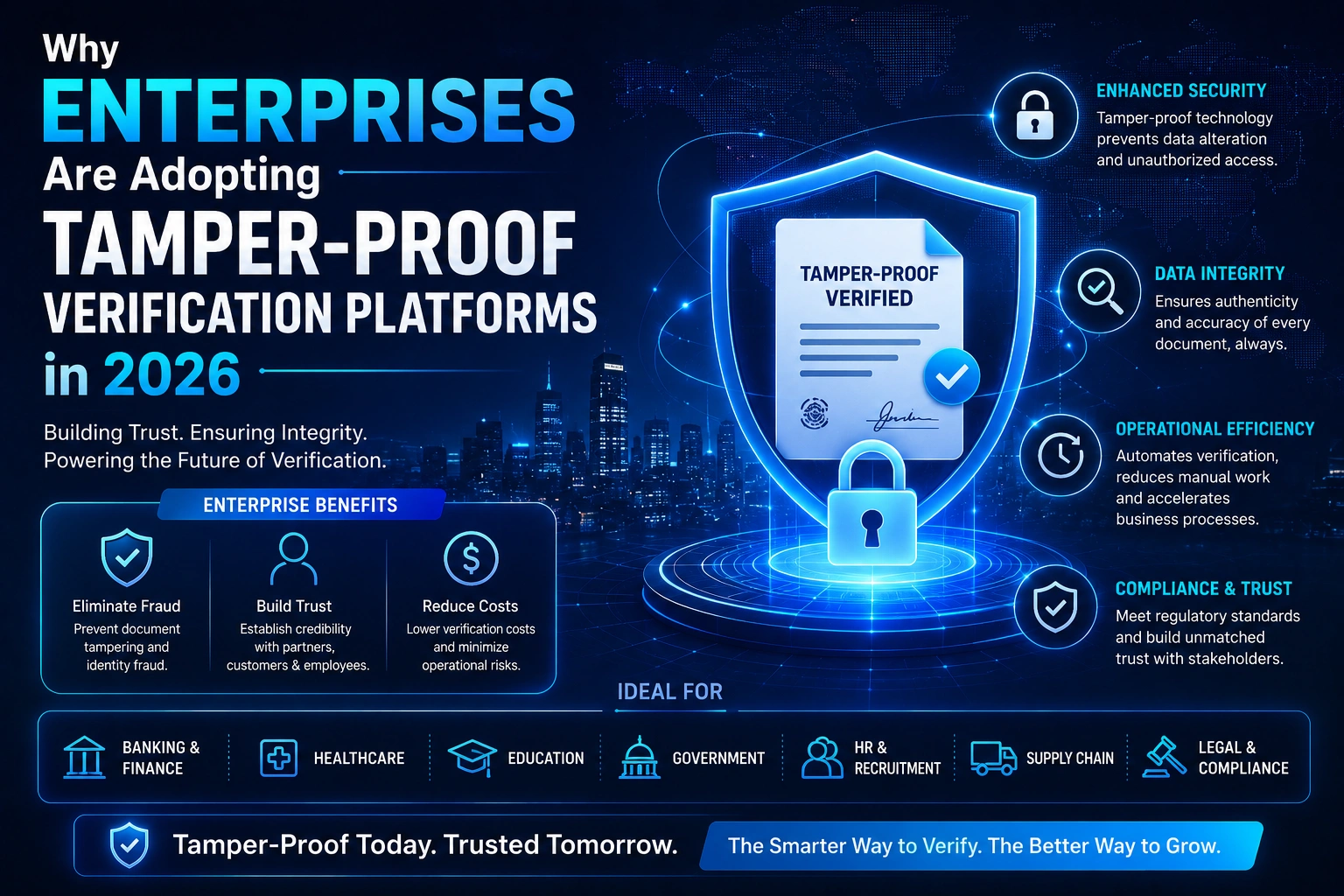
A tamper-proof verification platform is a system that records identity and document verification events in a way that preserves authenticity, integrity, issuer information, and time of issuance through immutable logs, signed attestations, and auditable verification records. It gives enterprises proof they can verify later, not just a pass or fail result in the moment.
Why Enterprises Are Adopting Tamper-Proof Verification Platforms in 2026 comes down to one shift. Security teams no longer just need to detect fraud. They need to prove what happened, who submitted it, when it was submitted, and whether that evidence remained unchanged. That requirement is pushing enterprises away from fragmented tools and towards cryptographic, provenance-first verification architectures such as tamper-proof digital certificates for academic and employee verification.
Table of Contents
- The Inevitable Shift to Verifiable Digital Trust
- Why Traditional Verification Systems Are Failing Enterprises
- How Tamper-Proof Platforms Create Cryptographic Truth
- Centralized vs Blockchain Verification A Framework for Decision
- Real-World Impact in Healthcare and Government
- How Blocsys Engineers Your Enterprise-Grade Verification Infrastructure
- Frequently Asked Questions about Tamper-Proof Verification
- What are tamper-proof verification platforms
- How do smart contracts automate verification
- How does blockchain prevent document fraud
- What is centralized vs blockchain verification
- How secure are blockchain authentication systems
- How can healthcare and government sectors use verification systems
- Why are enterprises adopting tamper-proof solutions
- How can Blocsys build verification infrastructure
The Inevitable Shift to Verifiable Digital Trust
The old enterprise model treated trust as a workflow checkpoint. A user uploaded a document, an analyst reviewed it, a system stored the result, and the business moved on. That model breaks when fraud becomes synthetic, scaled, and difficult to reverse.
Why trust moved from policy to infrastructure
The pressure is strongest where onboarding and account recovery carry both revenue value and regulatory exposure. Financial institutions, digital asset businesses, healthcare organisations, public sector teams, and enterprise SaaS providers all face the same structural problem. Their systems can often tell whether a document appears valid today, but they can’t always produce durable proof that stands up later.
That distinction matters more in 2026 because attack methods have changed. Deepfakes, synthetic identities, and spoofed credentials don’t just exploit weak checks. They exploit weak evidence chains.
Practical rule: If your team can approve a user but can’t later prove the full chain of custody behind that approval, your verification stack is incomplete.
Tamper-proof verification platforms answer that gap by turning each critical identity event into evidence. Instead of storing only an approval status, they preserve signed records, timestamps, issuer identity, capture context, and integrity proofs that can be checked independently.
What enterprises are buying now
This is why buying behaviour has shifted from point solutions to verification infrastructure. Enterprise leaders aren’t only looking for faster document checks. They’re looking for systems that support:
- Audit-ready evidence: Proof that survives disputes, internal reviews, and regulator questions.
- Lower operational drag: Fewer repetitive checks against the same users and documents.
- Better exception handling: Clear evidence when a transaction, credential, or onboarding event is challenged.
- Scalable trust: A way to maintain confidence as transaction volumes and digital channels expand.
A useful way to frame the business case is simple. Legacy verification confirms an event. Tamper-proof verification preserves the event.
That difference creates strategic value. It reduces dependence on manual review, strengthens defensibility in regulated environments, and allows enterprises to scale trust without scaling a matching volume of operational friction.
Why Traditional Verification Systems Are Failing Enterprises
Traditional verification stacks were built for a world where most fraud was document tampering, credential theft, or basic impersonation. They weren’t built for a world where AI can generate convincing artefacts at speed and where multiple disconnected tools each hold part of the truth.
Centralised systems answer the wrong question
Most centralised systems are designed to answer one immediate question. “Does this appear acceptable right now?” For low-risk use cases, that may be enough. For regulated onboarding, lending, healthcare credentials, public records, or exchange account recovery, it isn’t.
The weakness isn’t only fraud detection accuracy. It’s the absence of durable provenance. A document may pass a check, but can the organisation later prove the origin of capture, the integrity of the file, the decision path applied, and the exact evidence used? In many enterprises, the answer is fragmented across logs, vendors, analyst notes, and internal systems.
That’s why 2026 fraud patterns are exposing architectural limits, not just process gaps. Regula’s identity verification trends analysis argues that deepfakes, synthetic identities, and spoofed credentials are making traditional IDV stacks insufficient, and it points to hardware attestation, origin intelligence, and cryptographic proof-of-origin as the next line of defence.
Fragmented tools create accountability gaps
A second failure point is tool sprawl. One vendor handles document capture. Another runs liveness. A third performs sanctions checks. Internal teams log exceptions in separate systems. When an audit or customer dispute appears, reconstructing the chain becomes difficult and expensive.
That creates three enterprise-level problems:
- Security risk: Attackers exploit gaps between systems, especially during hand-offs.
- Compliance risk: Teams struggle to show a clean, standardised audit trail.
- Financial risk: Manual investigations consume specialist time and slow decisions.
This is also why legacy modernisation now overlaps with identity assurance. For technology leaders assessing inherited verification stacks, Modernization Intel’s guide for CTOs is a useful reference on the operational and security liabilities that build up around older authentication architectures.
Traditional verification often produces a result without producing a reliable record of how that result was reached.
The most important failure is economic. Centralised verification tends to force repeated checks because previous trust decisions aren’t portable and aren’t preserved in a verifiable form. The business pays again to review what it has effectively already reviewed.
This is one reason interest has grown in how blockchain-based document verification prevents fraud in 2026. The value isn’t just stronger security controls. It’s replacing revocable, opaque trust with evidence that remains testable over time.
How Tamper-Proof Platforms Create Cryptographic Truth
Tamper-proof verification systems work because they convert business events into cryptographic evidence. That sounds technical, but the business meaning is straightforward. They let an enterprise prove that a record is authentic, unchanged, time-bound, and linked to a known issuer or workflow.
The verification stack has three working layers
The first layer is cryptographic provenance. At issuance or capture, the system creates a hash of the record. That hash acts like a fingerprint. If the underlying file changes, the fingerprint changes too. Enterprises then batch these proofs efficiently and anchor them in an immutable ledger using Merkle structures and signed attestations.
The second layer is workflow automation. Smart contracts or equivalent policy engines apply business rules consistently. If a record meets defined issuance criteria, the system signs and anchors it. If an exception appears, the event is logged and routed for review. For teams that want a neutral primer, Blockchain Jobs’ explanation of what is a smart contract is a useful starting point before mapping contract logic to enterprise verification workflows.
The third layer is verification at the point of need. A relying party can check whether the document or credential is valid, whether it has changed, who issued it, and when the proof was recorded. That removes dependence on constant calls back to a central database.
Architect’s view: The strongest platform doesn’t just store records securely. It stores the proof that the records were created and handled correctly.
A concise explainer helps here.
- Blockchain in verification: an immutable evidence layer.
- Smart contracts in verification: an automated enforcement layer.
- AI in verification: a detection and triage layer that spots anomalies before trust is granted.
A short visual walkthrough is useful before going deeper.
Why provenance beats repeated re-checking
The operational advantage comes from anchoring trust once and verifying it many times. According to Blocsys’ tamper-proof document verification platform overview, enterprises are shifting from manual checks to a cryptographic provenance workflow using hash generation, Merkle batching, signed attestations, and a public verification step that can confirm authenticity in under 2 seconds. In that example, the architecture reportedly scaled to 2.4M+ documents and reduced verification time from 3 to 7 business days to under 2 seconds.
Those figures matter because they show where ROI usually appears first. Not in abstract blockchain adoption, but in a change to the operating model.
| Verification activity | Legacy approach | Cryptographic provenance approach |
|---|---|---|
| Issuance proof | Stored in internal systems | Signed and anchored as immutable evidence |
| Repeat validation | Re-check source systems | Verify integrity against anchored proof |
| Dispute handling | Manual reconstruction | Audit from preserved attestations and logs |
| Speed at scale | Slows with volume | Designed for automated verification |
This is also where AI fits productively. AI should not be the final source of truth in a regulated verification workflow. It should help identify anomalies, classify risk, and route exceptions. The immutable record remains the defensible evidence layer.
For teams evaluating architecture at the control-design level, digital proof of document integrity is the concept to understand first. Once integrity proof exists, automation, auditability, and reusable trust become much easier to design into the platform.
Centralized vs Blockchain Verification A Framework for Decision
The choice between centralised verification and blockchain-based tamper-proof verification isn’t ideological. It’s an operating model decision. The right question for executives is this. Which model gives the organisation the lowest long-term trust cost for the required level of auditability, speed, and fraud resilience?
Comparison of operating models
The table below is the practical comparison most leadership teams need.
| Criterion | Centralized Verification Systems | Tamper-Proof Blockchain Platforms |
|---|---|---|
| Primary trust model | Trust is placed in a single operator and its internal records | Trust is supported by cryptographic evidence and immutable anchoring |
| Data integrity | Records can be altered by privileged users or system failures unless separately controlled | Integrity is tested against anchored proofs and signed attestations |
| Audit readiness | Evidence is often spread across systems and vendors | Evidence chain is preserved in a unified, verifiable trail |
| Fraud response | Investigations rely on log gathering and manual reconstruction | Investigations rely on preserved provenance and verification history |
| Scalability of verification | Repeat checks increase operational load | Trust can be verified repeatedly from the same anchored proof |
| Dependency on manual review | Usually higher in exception-heavy environments | Lower when policy logic and proofs are standardised |
| Dispute handling | Can become slow and expensive | Faster when submission, issuance, and validation are all logged immutably |
| Architecture risk | Concentrated around central databases and tool sprawl | Concentrated around implementation quality, governance, and integration design |
No model is free. Blockchain-based verification introduces design decisions around governance, privacy boundaries, issuer control, and enterprise integration. But it can reduce recurring trust friction if verification events are frequent, regulated, and costly to dispute.
How CTOs and CFOs should evaluate ROI
The market still has a measurement problem. Dock’s reusable identity analysis notes that mid-market enterprises often lack clear ROI calculations, even though organisations that verify the same users repeatedly are “spending more than they need to” and facing “applicant abandonment”. That gap is especially acute in regulated sectors such as digital asset exchanges.
That missing ROI data doesn’t mean the business case is weak. It means leadership teams need a better framework.
A useful enterprise evaluation model includes five lenses:
Verification frequency
If the same users, documents, or credentials are checked repeatedly, reusable proof creates a stronger economic case.Cost of dispute resolution
Where trust failures trigger manual reviews, legal follow-up, or regulator responses, immutable evidence has direct value.Compliance defensibility
If the business must show not just approval outcomes but decision trails, provenance-first systems gain weight.Onboarding sensitivity
If friction causes drop-off, reducing repeated checks can protect conversion without relaxing control standards.Integration complexity
A platform only creates value if it fits the existing enterprise stack. Identity systems, case management, workflows, and policy engines must connect cleanly.
CFOs should avoid asking only, “What does the platform cost?” The more useful question is, “What does our current verification model cost us each time trust has to be re-established or defended?”
This is where centralized vs blockchain-based document verification becomes a business architecture question rather than a pure technology comparison. If your enterprise mostly performs one-time low-risk checks, centralised systems may remain sufficient. If your organisation operates in high-volume, high-trust, regulated flows, a tamper-proof model usually aligns better with long-term risk and operating efficiency.
Real-World Impact in Healthcare and Government
Healthcare and government are useful sectors to study because both operate under a simple constraint. They can’t afford trust failures, and they also can’t afford slow evidence handling.
Healthcare needs evidence, not only access control
In healthcare, access control is necessary but incomplete. Hospitals, clinics, insurers, and digital health platforms must often prove more than who accessed a record. They need to prove whether a credential was valid, whether a document was altered, whether a consent artefact remained intact, and how a decision was approved.
That makes tamper-proof verification useful across several workflows:
- Credential verification: Medical licences, staff certifications, and institutional approvals can be issued with persistent integrity proof.
- Patient document handling: Consent forms and supporting records can carry a verifiable history of issuance and change.
- Claims and exceptions: When information is challenged, teams can review a preserved evidence chain rather than chase fragmented logs.
For smaller healthcare organisations building a broader compliance baseline around protected data, CloudOrbis Inc.’s checklist for securing patient data for SMBs is a practical complement to verification-specific planning.
Government systems need scale with auditability
Public sector systems face the same issue at a larger scale. Identity programmes, land and certificate registries, licensing, and benefits administration all depend on records that must be trusted across departments, vendors, and citizens.
A strong signal comes from India’s digital infrastructure. HYPR’s 2026 identity security analysis notes that Aadhaar had reached roughly 1.3 billion enrolled residents by early 2025, while UPI was processing billions of monthly transactions in 2025. In that environment, enterprises are adopting tamper-proof platforms that bind identity events to immutable logs to reduce disputes and strengthen compliance.
The strategic lesson extends well beyond India. Once a country or sector reaches high digital participation, verification moves from a simple gatekeeping function to a system-of-record problem. At that point, immutable logs and auditable evidence trails become infrastructure, not enhancements.
Public trust improves when institutions can verify records quickly and defend those records when they’re challenged.
For agencies and regulated record custodians exploring this model, blockchain document verification for healthcare, legal, and government records is directly relevant because these sectors share the same requirement. They need records that can be verified across time, not just approved once.
How Blocsys Engineers Your Enterprise-Grade Verification Infrastructure
Enterprise adoption usually fails when leaders buy verification as a feature instead of designing it as infrastructure. The target architecture has to sit across issuance, capture, verification, audit, exception handling, and integration with existing systems.
What an enterprise implementation should include
A credible deployment should cover at least four design areas:
- Proof architecture: Hashing, signing, anchoring, and verification flows must be designed for legal and operational defensibility.
- Workflow logic: Approval policies, exception paths, and issuer controls need deterministic automation.
- Evidence retention: Logs, attestations, and verification outputs must be easy to retrieve during audits or disputes.
- System integration: Identity providers, KYC tools, case systems, and document workflows need to exchange evidence cleanly.
Enterprises also need to decide where not to use blockchain. Sensitive data generally shouldn’t be placed on-chain in raw form. What belongs in the immutable layer is the proof, not unrestricted exposure of the underlying content.
Where Blocsys fits
Blocsys operates in this category as an engineering partner for production-grade verification systems. Its work aligns with organisations that need tamper-proof document verification, blockchain authentication infrastructure, smart contract automation, and AI-supported compliance workflows rather than a standalone widget. In practice, that means designing verification systems that anchor proof at issuance, preserve auditable records, and fit regulated digital products.
That matters for fintechs, exchanges, healthcare platforms, public-sector workflows, and enterprise software teams where trust has to survive scale. It also matters for CTOs and CFOs who need a roadmap that connects technical controls to operating outcomes such as lower manual review dependency, stronger audit posture, and more defensible digital transactions.
Frequently Asked Questions about Tamper-Proof Verification
What are tamper-proof verification platforms
Tamper-proof verification platforms are systems that preserve identity or document verification events as immutable, auditable evidence rather than temporary checks. They typically combine cryptographic hashing, signed attestations, and verifiable logs so an enterprise can later confirm authenticity, integrity, issuance context, and decision history. Their value is highest where records are reused, challenged, or regulated.
How do smart contracts automate verification
Smart contracts automate verification by applying predefined business rules consistently when a document, identity event, or credential enters the workflow. Instead of relying on manual interpretation every time, the system can trigger issuance, rejection, escalation, or proof anchoring based on policy logic. In enterprise settings, this reduces inconsistency and creates a clearer decision trail for audits and exception reviews.
How does blockchain prevent document fraud
Blockchain doesn’t prevent every fraudulent attempt at the capture stage. What it does well is make unauthorised alteration and false provenance much harder to hide after issuance. When a document’s hash, attestation, and issuance details are anchored immutably, any later change breaks the integrity check. That gives relying parties a way to test whether the presented record still matches the original verified state.
What is centralized vs blockchain verification
Centralized verification relies on a single authority or operator to store records and confirm validity. Blockchain verification relies on cryptographic proof and immutable anchoring to support authenticity checks over time. The practical difference is that centralised systems usually require trust in the operator’s current database, while tamper-proof systems allow parties to verify integrity against preserved evidence with less dependence on that single source.
How secure are blockchain authentication systems
They can be highly secure when designed properly, but blockchain alone isn’t enough. Security depends on how identities are captured, how keys are managed, how issuers are controlled, and how private data is handled off-chain. A strong system uses blockchain for proof preservation, not as a substitute for access control, governance, hardware protections, or policy enforcement. Security comes from the full architecture.
How can healthcare and government sectors use verification systems
Healthcare providers can use tamper-proof verification for staff credentials, consent artefacts, patient-related documents, and auditable records in claims or exception workflows. Government agencies can use similar systems for identity-linked records, licences, certificates, and registries that need to remain verifiable across departments and time. In both sectors, the main benefit is defensible trust with less manual reconstruction during disputes.
Why are enterprises adopting tamper-proof solutions
Enterprises are adopting them because fraud patterns have become harder to detect with traditional tools alone, while compliance expectations increasingly require defensible evidence. A tamper-proof model helps organisations verify faster, preserve better audit trails, and reduce repeated trust checks. For many teams, the shift isn’t about experimenting with blockchain. It’s about making verification operationally scalable and legally supportable.
How can Blocsys build verification infrastructure
Blocsys can help by designing verification architecture around issuance proof, immutable audit trails, policy automation, and integration with enterprise workflows. That includes document verification systems, smart contract logic, blockchain-based evidence layers, and AI-assisted fraud review processes. The right implementation approach starts with workflow mapping and risk design, then moves into infrastructure, governance, and integration planning for production use.
If your team is evaluating tamper-proof verification platforms for fintech, healthcare, government, legal, or enterprise software workflows, Blocsys Technologies can help you assess the architecture, design the evidence model, and map a practical implementation path. Connect with Blocsys to discuss secure document authentication, blockchain verification systems, smart contract automation, and AI-supported fraud prevention infrastructure for enterprise-scale operations.
