
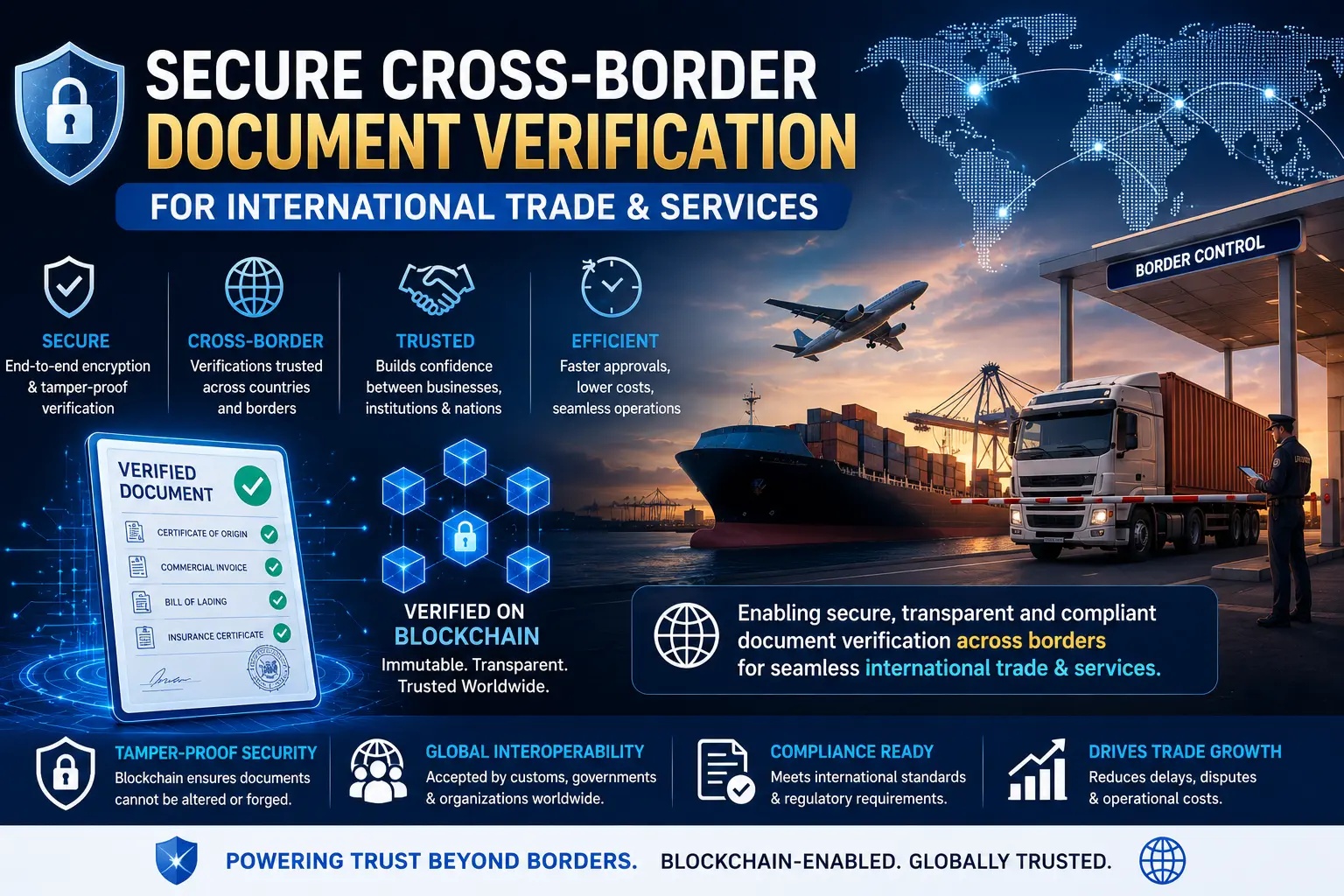
A shipment is ready to move. The goods are packed, the carrier is booked, financing is in place, and the buyer is waiting. Then customs, a bank, or a downstream partner flags one document that can’t be verified quickly enough. It may be a certificate of origin with an unclear attestation trail, a bill of lading with mismatched metadata, or a compliance file that exists in three different versions across email threads, portals, and PDFs.
That’s the moment most trade and platform teams realise the problem isn’t only document fraud. It’s document trust at system level. International trade still runs on documents that need to be accepted by parties operating under different legal, technical, and operational rules. If your product or internal platform can’t prove authenticity, provenance, and handling history across borders, delays become routine.
For product leaders, engineering teams, compliance owners, and founders building trade, logistics, fintech, carbon, or digital asset infrastructure, the practical question is simple. How do you design secure cross-border document verification for international trade and services without creating another silo?
Table of Contents
- The High Stakes of Document Verification in Global Trade
- The Crisis in Traditional Trade Document Verification
- How Blockchain Creates a Single Source of Truth for Trade
- System Architectures and Modern Integration Patterns
- Real-World Use Cases in Trade, Carbon, and Agri-Tech
- Your Implementation Roadmap and Global Compliance Strategy
- How Blocsys Engineers Future-Proof Trade Verification Systems
- Frequently Asked Questions
- How does blockchain improve cross-border document verification
- What is blockchain verification for international trade
- How do smart contracts automate trade documentation
- How does blockchain prevent trade document fraud
- What are tamper-proof customs verification systems
- Why are logistics companies adopting blockchain verification
- How can Blocsys help build blockchain trade verification systems
The High Stakes of Document Verification in Global Trade
A delayed shipment rarely starts as a logistics problem. It usually starts as a trust problem.
A supplier uploads a commercial invoice. A broker forwards a transport document. A bank checks trade-finance paperwork. Customs asks for one supporting certificate that was approved in one system, edited in another, and emailed as an attachment by a third party. Nobody is fully certain which version is authoritative, who handled it last, or whether the supporting evidence is still intact.
In live trade operations, that single break in verifiability can affect multiple teams at once. Operations can’t release goods. Compliance won’t sign off. Finance holds settlement. Customer-facing teams start managing the fallout.
The larger the deal and the more jurisdictions involved, the less tolerance there is for ambiguity. This is why teams have moved from simple “document upload” thinking toward tamper-evident proof, provenance tracking, and controlled sharing. If you need a practical framing of that shift, digital proof of document integrity is the core idea that turns a file from a static artefact into something that can be independently verified.
What leadership teams are really buying
Product and engineering leaders are not buying blockchain for its own sake. They’re trying to solve four operational failures:
- Version confusion that creates disputes between counterparties
- Manual verification loops across brokers, carriers, customs, and banks
- Weak auditability when a regulator or partner asks who changed what
- Exposure to fraud when altered files still look visually legitimate
Practical rule: If two counterparties can view the same document but can’t verify the same history, you don’t have a shared process. You have duplicated risk.
The useful end state is narrower than many vendors suggest. You need a system that can prove document authenticity, preserve an evidence trail, enforce access policy, and connect into the tools your trade teams already use. Anything less stays pilot-grade.
The Crisis in Traditional Trade Document Verification
Traditional verification breaks down because trade data moves through too many disconnected channels. Portals, email chains, ERP exports, scanned PDFs, broker systems, customs interfaces, and bank workflows all hold part of the truth. None of them guarantees that the receiving party is working from the same approved state.
That problem gets sharper when data has to cross borders. Cross-border data flows are critical to international business operations, logistics, and trade coordination. At the same time, restrictive policies around data movement can damage trade performance. Research from the Information Technology and Innovation Foundation states that restrictive cross-border data policies can cut gross trade output by 7%, lower productivity by 2.9%, and raise downstream prices by 1.5% over five years for each 1-point increase in data restrictiveness (ITIF research on barriers to cross-border data flows).
Why fragmented workflows fail under pressure
The weak point isn’t always paper. It’s often fragmented digitisation.
India’s trade facilitation model is a useful example of why integrated digital submission matters. Government materials describe the National Single Window System as a one-stop platform for approvals and compliances, while customs already processes the overwhelming majority of trade digitally through the ICEGATE and Indian Customs EDI framework. In the broader evidence base on trading across borders, electronic submission and processing of customs-related documents are identified as the most effective border-process reforms because they reduce delays and document-preparation burdens (good practices in trading across borders).
That doesn’t mean the problem is solved. It means the baseline has changed. Once documents are digital, the next bottleneck becomes verification across agencies and counterparties, especially when those parties sit in different jurisdictions and operate under different retention and privacy rules.
Traditional vs blockchain-based document verification
| Attribute | Traditional Systems | Blockchain-Based Systems |
|---|---|---|
| Source of truth | Multiple records across email, portals, and databases | Shared ledger reference for agreed document state |
| Tamper evidence | Often dependent on platform logs or manual comparison | Cryptographic hashing makes changes detectable |
| Audit trail | Incomplete across organisations | Persistent, cross-party event history |
| Trust model | Bilateral trust and manual reconciliation | Multi-party verification with shared evidence |
| Interoperability | Point integrations and file exchange | API-driven verification with common proof layer |
| Automation | Workflow rules inside single systems | Smart-contract driven checks across participants |
| Data handling | Full document copies spread widely | Selective sharing with proofs, hashes, and outcomes |
| Dispute resolution | Slow, document-by-document review | Faster comparison against immutable records |
What doesn’t work is pushing all parties into one monolithic platform and expecting adoption to follow. What works better is a verification layer that respects existing systems while standardising proof, policy, and event logging across them.
How Blockchain Creates a Single Source of Truth for Trade
The most useful way to explain blockchain in trade is not as a public chain full of anonymous transactions. For enterprise document verification, think of it as a shared notary book that multiple authorised parties can rely on, where entries are time-stamped, tamper-evident, and very difficult to rewrite without detection.
That matters because the document itself is rarely the only thing under review. Teams also need to verify issuance, approvals, signatures, revisions, and handoffs.
What the ledger actually does
A strong architecture usually separates document storage from document proof.
The raw file may stay in a controlled repository, regional data store, enterprise content system, or regulated archive. The blockchain layer records the hash, timestamp, issuer identity, workflow state, and verification events. If someone alters the file later, the hash no longer matches the recorded proof.
Three building blocks matter most:
- Cryptographic hashing creates a unique fingerprint for each document state.
- Distributed ledger records give multiple parties access to the same verification evidence.
- Smart contracts enforce rules such as who can attest, which fields must exist, or what approvals are required before a document can move to the next trade step.
A useful reference point for teams comparing design choices is this breakdown of centralised vs blockchain-based document verification.
A short walkthrough helps:
- A supplier submits a commercial invoice.
- The system validates the structure and captures issuer identity.
- The file is hashed.
- The hash and metadata are written to the ledger.
- A bank, customs broker, or buyer verifies the proof against the ledger entry.
- Every approval or rejection becomes another recorded event.
Later in the workflow, video often helps non-technical stakeholders align on the mechanics.
Where verifiable credentials change the model
Basic hashing proves integrity. It doesn’t, by itself, solve issuer trust or machine-readable portability. That’s where decentralised identifiers and verifiable credentials become useful.
The 2022 UNECE white paper argues that verifiable credentials and decentralised identifiers can automate the verification of every trade document, improve identity confidence, and enable new low-value trade-finance applications through algorithmic due diligence (UNECE white paper on verifiable credentials in cross-border trade).
That changes the operating model in a practical way:
- An exporter can present a signed credential rather than emailing a raw certificate repeatedly.
- A financer can verify issuer authenticity without calling back to the originator every time.
- A platform can automate acceptance rules based on trusted claims rather than image review alone.
The strongest trade systems don’t just store documents securely. They make trust portable.
What doesn’t work is putting full sensitive files on-chain. That creates privacy, retention, and localisation problems fast. What works is recording proofs on-chain and keeping sensitive payloads off-chain under jurisdiction-aware controls.
System Architectures and Modern Integration Patterns
Most engineering teams don’t need a generic blockchain stack. They need a system that can sit between trade documents, enterprise systems, counterparties, and compliance controls without forcing a full rip-and-replace.
The architecture that usually survives production has five layers:
- Capture layer for portal uploads, API submissions, scanned intake, and partner feeds
- Intelligence layer for classification, extraction, validation, and risk scoring
- Proof layer for hashing, ledger writes, credential issuance, and event attestations
- Policy layer for access control, jurisdiction rules, retention, and approval logic
- Integration layer for ERP, TMS, customs, trade finance, CRM, and partner systems
Pattern one with AI document intelligence at ingress
Trade documents arrive messy. Some are structured. Many are not. Templates differ by supplier, lane, and issuing authority.
AI provides assistance in this process, yet only if it’s placed correctly. Use it before ledger anchoring, not as a substitute for proof. AI should classify documents, extract key fields, detect mismatches, and flag anomalies for human review. Once the record is accepted, the approved payload is hashed and anchored.
A practical flow looks like this:
- Ingest PDF, image, XML, or API payload.
- Run document classification.
- Extract fields such as invoice number, consignee, HS code references, dates, and issuer metadata.
- Validate against business rules and external master data.
- Route exceptions to review.
- Write approved proof and event state to the ledger.
Teams evaluating this pattern usually care about one thing. Can AI reduce review effort without becoming a black box in a regulated process? The answer is yes, if you preserve explainability and keep the final trust anchor cryptographic. This approach aligns with the kind of architecture discussed in how AI and blockchain together detect fake documents in real time.
Design note: AI should suggest confidence. It should not replace evidentiary records.
Pattern two with oracle-driven policy and event flows
Some trade decisions depend on facts that originate outside your platform. A customs status update, sanctions screening result, inspection outcome, or trade-finance approval may need to trigger the next workflow state.
That’s where oracles fit. In enterprise terms, an oracle is a trusted connector that brings external events or verified data into your smart-contract logic.
Use this pattern when you need:
- State changes from external systems such as release, hold, inspection, or financing approval
- Reference data checks against approved code lists, issuer registries, or policy engines
- Conditional automation where a verified event enables settlement, release, or next-party access
What doesn’t work is letting any API response directly mutate ledger state. The safer model is to pass external data through a signed adapter, validate source identity, record the event provenance, and only then trigger the contract path.
Pattern three with IoT-linked chain of custody
For high-value goods, cold chain products, carbon-linked commodities, and regulated materials, document proof alone isn’t enough. You also need to connect the paperwork to the actual asset condition and movement history.
IoT-enabled verification does that by linking sensor evidence to the trade record. A shipment can carry environmental or location signals that are signed, normalised, and attached to the same evidence chain as the transport and compliance documents.
This pattern is useful for:
- Temperature-sensitive cargo where handling conditions affect acceptance
- High-value asset transfer where custody disputes matter
- Carbon and sustainability-linked products where provenance claims depend on physical chain-of-custody evidence
The trade-off is operational complexity. Sensor data is noisy, edge devices vary in reliability, and not every event belongs on-chain. The practical approach is to aggregate off-chain, apply threshold logic, and anchor only the events that matter for audit, disputes, or automated decisions.
The build-vs-buy choice often comes down to connector maturity and security ownership. A specialised verification platform can provide the proof and policy core, while your product team keeps control of workflow, user experience, and lane-specific business logic.
Real-World Use Cases in Trade, Carbon, and Agri-Tech
The best way to test architecture is to run it against actual operating scenarios. Generic supply-chain demos rarely survive contact with customs, finance, or sustainability audits.
Trade and logistics workflows
A bill of lading is created, amended, and checked by several parties before final release. In a traditional model, each participant keeps its own copy and disputes are handled by comparing versions after the fact.
In a verification-first model, the shipping document is anchored at creation, every endorsement or amendment is logged as a new state, and authorised parties verify against the recorded chain instead of trusting the latest email attachment. Customs brokers, banks, and buyers don’t need the full internal workflow. They need proof that the presented version is authentic and current.
A useful shipping-specific framing appears in how blockchain-based document verification prevents fraud in shipping and logistic.
Carbon market verification
Carbon markets expose a slightly different problem. The risk isn’t just forged paperwork. It’s weak provenance across issuance, transfer, claim, and retirement.
A credible system needs to prove that a carbon-related document set belongs to a specific asset lifecycle, that the attestations came from trusted issuers, and that downstream claims don’t drift from the source evidence. For tokenised environmental assets, this becomes even more important because financial representation can move faster than the underlying compliance paperwork.
The architecture usually combines:
- project-level identity,
- signed verification artefacts,
- controlled registry integration,
- and an immutable retirement event.
Without that, teams end up with digital certificates that are easy to share but hard to trust.
Agri-tech and regulated food movement
Consider organic produce moving from a farm in the Netherlands to a retailer in the UAE. The commercial value depends on more than transit. Buyers and regulators may need to verify origin, quality attestations, handling records, and import documentation before they accept the shipment.
In sustainability-focused markets, that evidence chain increasingly shapes supplier selection and market access. Teams exploring this space may find it useful to discover UAE sustainable business because it shows why verified sustainability claims are becoming part of mainstream commercial strategy, not a side programme.
If a sustainability claim can’t be tied back to a verifiable document trail, it will eventually fail commercial or regulatory scrutiny.
The same pattern also applies to tokenised real-world assets. Ownership records, inspection reports, legal attestations, and transfer approvals need a common evidence chain. The asset may be digital. The trust problem is still documentary.
Your Implementation Roadmap and Global Compliance Strategy
The mistake most organisations make is trying to digitise every document type, every partner workflow, and every jurisdictional rule in one programme. Secure cross-border document verification works better when it starts with one high-friction corridor and one document family.
Phase one with one corridor and one document family
Pick the workflow where verification failure hurts most. That may be certificates of origin, trade-finance packages, transport documents, KYC-linked onboarding files, or regulatory permits.
The pilot should answer a narrow set of questions:
- Who issues the document
- Who must verify it
- What event changes its legal or operational state
- Which data must remain off-chain
- What system currently owns the operational workflow
A strong pilot isn’t a design sprint with slideware. It’s a production-like path with real users, signed events, and measurable exception handling.
Phase two with partner expansion and policy controls
Once the initial lane works, the next challenge is policy, not plumbing. As more jurisdictions and counterparties join, privacy and transfer restrictions start shaping architecture choices.
The official launch of the Global Cross-Border Privacy Rules system formalises a standardised way for companies to certify compliance with internationally recognised data privacy protections, which is highly relevant for systems that move personal information or sensitive documents across jurisdictions (Global CBPR launch announcement).
In practice, cross-border verification systems should use:
- Data minimisation so shared systems hold hashes, attestations, and outcomes rather than full sensitive files
- Jurisdiction-aware storage so raw KYC or regulated personal data can remain in-region when required
- Tamper-evident audit trails so counterparties can trust the verification result without broad data exposure
- Policy-based access control so each party sees only the fields and evidence they need
For regulated sectors, governance teams often need a stronger operating model around review, controls, and policy ownership. That’s why adjacent resources such as strategic GRC for banks are useful context when designing enterprise-grade oversight for verification platforms.
Phase three with enterprise integration and operating governance
At scale, the technical challenge stops being document proof and starts being orchestration. ERP, CRM, TMS, customs connectors, customer portals, and trade-finance systems all need consistent event handling.
This is also the point where standards matter more than enthusiasm. Teams need a compliance framework for identity, smart contracts, operational logging, access control, and incident response. A practical starting point is this Web3 regulatory compliance framework, especially for teams combining document verification with tokenised assets, carbon instruments, or digital trade-finance workflows.
The architecture that tends to hold up globally uses on-chain proofs, off-chain controlled data stores, cryptographic audit logs, and explicit jurisdiction rules. That keeps the system auditable without making it legally brittle.
How Blocsys Engineers Future-Proof Trade Verification Systems
A product team usually sees the failure point only after the first live corridor goes into production. A customs broker cannot validate a credential issued in another jurisdiction, an ERP posts the wrong document state after a carrier update, or a tokenized carbon asset is transferred before the underlying registry evidence is confirmed. The verification model may be sound on paper, but the operating architecture fails under real partner, data, and compliance conditions.
That is the engineering problem Blocsys Technologies is built to solve.
Future-proof trade verification starts with system boundaries. Sensitive documents stay in controlled storage. Blockchain records proofs, workflow state, issuer attestations, and decision logs. AI services classify incoming files, extract fields, detect mismatches, and route exceptions for review. Oracles bring in external facts such as customs status, registry events, inspection outcomes, and market data. IoT feeds can add signed condition data for cargo, agricultural exports, or environmental assets where the physical state affects settlement or compliance.
The design trade-off is straightforward. Putting too much on-chain creates privacy, cost, and jurisdiction problems. Keeping everything off-chain weakens shared trust and makes cross-party audit harder. The architecture that holds up in production anchors the minimum shared proof set on-chain and keeps regulated content, large files, and revocable data off-chain behind policy controls.
Integration patterns matter just as much as ledger design. Enterprise teams need event-driven connectors for ERP, TMS, CRM, customs systems, registry APIs, and partner portals. They also need a canonical verification model so each external system does not invent its own status logic. Without that layer, AI extraction, smart-contract rules, and oracle inputs produce inconsistent outcomes across corridors and asset classes.
This becomes more important in emerging sectors. In carbon markets, the platform needs to verify project documents, methodology records, issuance events, and retirement status before a credit is financed or tokenized. In tokenized asset workflows, legal agreements, custody records, valuation inputs, and transfer restrictions have to be tied back to verifiable source evidence. In agri-tech, sensor data, lab certificates, and shipment records often need to be checked together, not as separate proofs.
Blocsys’s role in these programs is practical. Define the trust boundary. Set up the credential and policy model. Build the connector layer. Configure smart-contract controls around state changes that matter commercially or legally. Then harden the operating model so exceptions, revocations, partner onboarding, and jurisdiction-specific rules are handled as first-class system behavior, not manual patchwork.
The business result is clearer than the technology stack. Product teams keep control of user journeys and commercial logic. Engineering teams get a verification layer that can be reused across trade documents, carbon instruments, and digital asset flows. Compliance and operations teams get evidence they can review without stitching together emails, PDFs, and system logs after the fact.
The durable strategy is to add a verifiable coordination layer that existing systems can trust, then extend it corridor by corridor and asset by asset. That is how these platforms stay useful after the pilot phase.
Frequently Asked Questions
How does blockchain improve cross-border document verification
Blockchain gives counterparties a shared, tamper-evident proof layer. Instead of trusting whichever PDF arrived last, each party can verify the document hash, issuer record, workflow state, and audit trail against an immutable ledger entry.
What is blockchain verification for international trade
It’s the use of distributed ledger infrastructure, cryptographic proofs, and workflow automation to verify trade documents such as invoices, certificates, transport records, and compliance files across multiple organisations and jurisdictions.
How do smart contracts automate trade documentation
Smart contracts enforce predefined business rules. They can check whether required approvals exist, whether a trusted issuer signed a credential, or whether a document can move to the next state after an external event is verified.
How does blockchain prevent trade document fraud
It makes silent alteration much harder. Once a document state is hashed and anchored, any later change breaks the proof match. Combined with issuer identity and access policy, that reduces forgery, version substitution, and post-approval tampering.
What are tamper-proof customs verification systems
They are systems that preserve cryptographic evidence of document integrity, origin, and handling history so customs and related stakeholders can verify authenticity without relying on manual comparison alone.
Why are logistics companies adopting blockchain verification
Because logistics workflows involve many parties, frequent handoffs, and time-sensitive approvals. A shared verification layer reduces disputes over document version, custody, and approval status, especially when goods are moving across borders.
How can Blocsys help build blockchain trade verification systems
Blocsys can support architecture design, blockchain integration, AI document processing, verification workflows, and compliance-oriented infrastructure for platforms that need secure cross-border document verification in trade and adjacent sectors.
If you’re evaluating secure cross-border document verification for trade, logistics, carbon, or tokenised asset workflows, connect with Blocsys Technologies. The team can help assess your current document flows, define a production-ready architecture, and map the right build path for secure, compliant verification at enterprise scale.
