
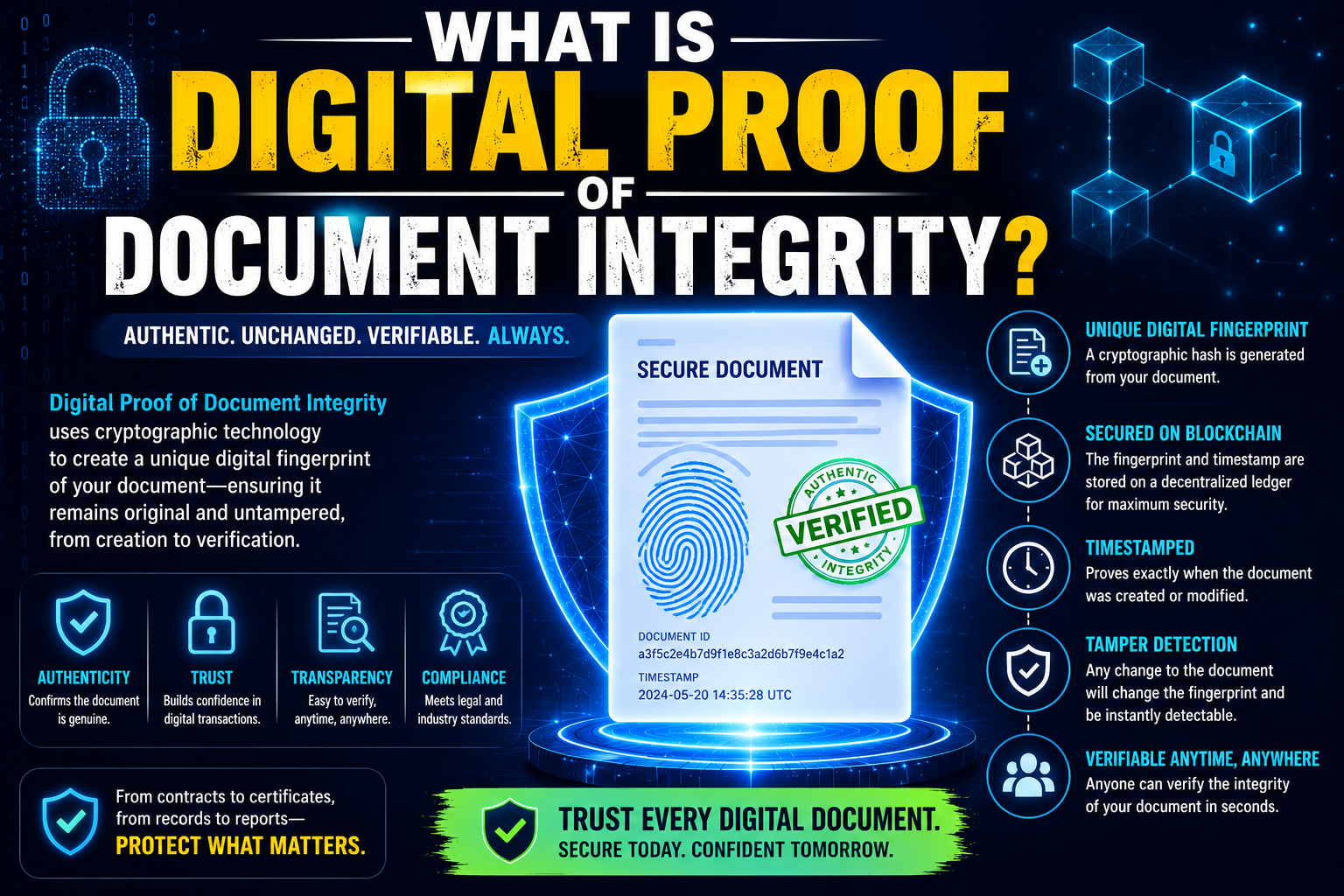
Digital proof of document integrity is a cryptographic way to prove that a file hasn’t been altered after verification. In practice, it relies on hashing, digital signatures, timestamps, and immutable records, and in India its importance is visible in systems where verified digital proofs helped support a 45% increase in successful cyber fraud convictions by 2022.
For fintechs, prediction markets, crypto exchanges, and gaming operators, this isn’t a niche security feature. It’s the difference between a document workflow you can defend in an audit, a dispute, or a regulator review, and one that breaks the moment someone questions authenticity. In high-value digital transactions, trust has to be provable.
If you’re building in the UK, EU, USA, UAE, Singapore, Malta, Gibraltar, Switzerland, the Netherlands, Canada, or Australia, the operational question is the same. How do you prove that KYC files, trade confirmations, source documents, payout inputs, and signed PDFs remained intact across systems, vendors, and jurisdictions?
That’s where digital proof of document integrity matters. It gives teams a verifiable record of what was signed, when it was sealed, and whether anything changed afterwards. For founders and CTOs, that means fewer integrity gaps across compliance, settlement, onboarding, and dispute resolution. It also creates a cleaner path to automation through smart contracts, AI-based document checks, and blockchain-backed audit trails.
Document authenticity also intersects with a broader content-verification problem. Teams assessing manipulated files, synthetic submissions, or AI-generated artefacts can use resources like AI Video Detector’s guide to AI detection to strengthen their review process before a document even reaches the signing or hashing stage.
Table of Contents
- Introduction What Is Digital Proof of Document Integrity
- Why Document Integrity Is Mission-Critical for Web3 Platforms
- How Blockchain Creates an Immutable Proof of Integrity
- Automating Verification with Smart Contracts and AI
- Comparing Traditional vs Blockchain Document Verification
- Enterprise Use Cases in Prediction Markets and Gaming
- How Blocsys Engineers Enterprise-Grade Document Integrity
- Frequently Asked Questions
Introduction What Is Digital Proof of Document Integrity
Digital proof of document integrity is verifiable evidence that a digital file remains unchanged from a known point in time. That proof usually combines a cryptographic hash, a timestamp, identity-linked signing, and a record that can be independently checked later.
That definition sounds simple, but the implementation isn’t. In a startup environment, documents move between onboarding tools, payment systems, compliance dashboards, cloud storage, internal reviewers, and third-party vendors. Each handoff creates a new place where integrity can fail.
For a prediction market, the document might be an official result file used to settle a market. For a crypto exchange, it might be a KYC pack, sanctions review output, or source-of-funds evidence. For a gaming operator, it could be age verification, responsible gaming disclosures, or a signed policy acknowledgement. If any of those records can’t be proven intact, the problem is no longer technical. It becomes legal, financial, and operational.
What the proof must answer
A sound integrity system should answer four questions clearly:
- What was the exact document state: The system should preserve a cryptographic fingerprint of the file at verification time.
- Who approved or signed it: Identity binding matters, especially for regulated onboarding and high-risk reviews.
- When it was fixed in time: Timestamps turn a file into evidence rather than just a stored artefact.
- Whether anything changed later: Re-hashing or signature validation should expose tampering immediately.
Practical rule: If your team can only say “it was in our database,” you don’t yet have defensible proof of integrity.
In regulated digital businesses, that proof is becoming part of core infrastructure. It supports fraud prevention, cleaner audits, lower dispute risk, and more reliable automation across borders.
Why Document Integrity Is Mission-Critical for Web3 Platforms
Web3 teams often focus on wallet security, key management, and smart contract risk first. Those matter, but document integrity is where many compliance and settlement failures surface. A platform can have strong on-chain logic and still break operationally if off-chain evidence is weak.
The legal side is already clear in at least one major jurisdiction. In India, the Supreme Court’s 2014 ruling in Anvar P.V. vs. P.K. Basheer mandated strict verification protocols for electronic evidence under Section 65B, and verified digital proofs later became associated with better cyber fraud outcomes. By 2022, the NCRB’s Crime in India reporting noted a 45% increase in successful convictions in cyber fraud cases, attributed to verified digital proofs such as cryptographic hashing and digital signatures, as discussed in this analysis of why digital evidence must be verified.
For a CTO, the message is direct. If authenticity can’t be demonstrated, records become vulnerable in disputes. That affects more than court evidence. It affects chargebacks, investigations, market settlements, internal misconduct reviews, licensing checks, and regulator questions.
Where Web3 platforms usually fail
The weak points are rarely exotic. They’re ordinary workflow decisions that don’t hold up under pressure.
- Unsigned PDF dependency: Teams store PDFs in cloud folders and assume access control equals integrity.
- Mutable admin processes: Staff can replace files, overwrite prior versions, or re-upload corrected documents without a defensible trail.
- Disconnected systems: KYC, CRM, storage, payments, and settlement engines each keep partial records with no common proof layer.
- Manual exception handling: Analysts approve edge cases in chats or email, leaving no durable verification path.
Trust falls apart when a platform can’t prove whether a disputed file is the original, a later revision, or a forged substitute.
Why this matters for global operators
Founders in crypto-friendly markets often think integrity standards are only a banking issue. They’re not. Betting operators, tokenization platforms, prediction markets, and digital asset venues all depend on documents that carry legal or financial consequences.
A few examples make this concrete:
- Outcome documents: A wrong or altered source file can trigger incorrect smart contract settlement.
- KYC evidence: If the verified version of an identity file can’t be proven, the entire onboarding decision becomes questionable.
- Policy acceptance: User disputes become harder to resolve when terms, acknowledgements, or disclosures lack a sealed record.
- Partner operations: B2B integrations fail audits when one side cannot independently verify what the other stored.
In practice, document integrity isn’t a feature users notice on day one. It’s the control that protects the business on the day something goes wrong.
How Blockchain Creates an Immutable Proof of Integrity
Blockchain changes document verification by moving the proof layer away from editable internal records and into an immutable ledger. The document itself usually stays off-chain. What goes on-chain is the evidence needed to prove that the document existed in a specific state at a specific time.
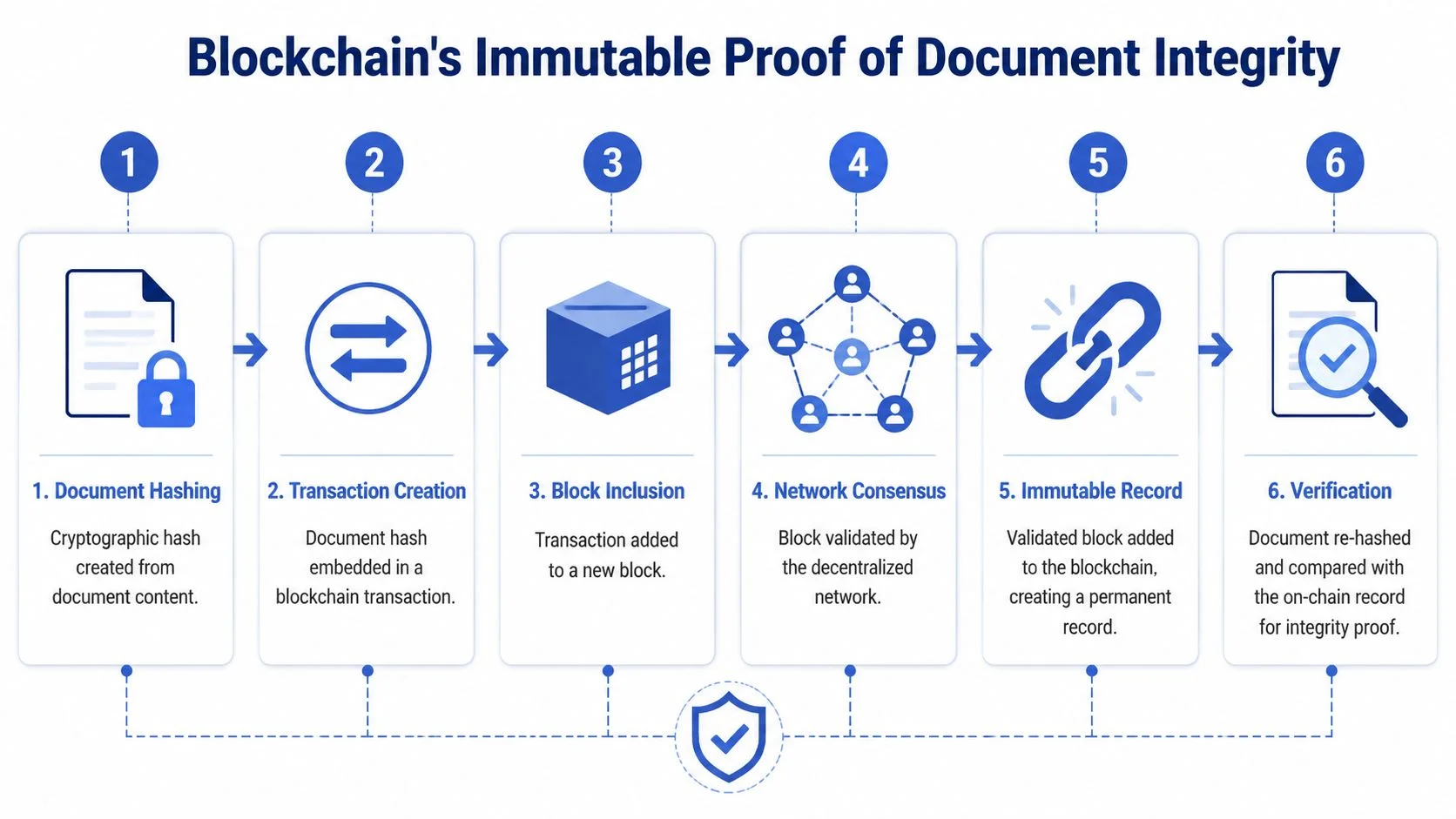
The core mechanism is the cryptographic hash. A hashing algorithm such as SHA-256 produces a unique digital fingerprint for a file. If one byte changes, the hash changes completely. The underlying security assumption is strong: the probability of two different documents producing the same SHA-256 hash is approximately 1 in 2^256, making collision attacks computationally infeasible, as described in the DPC fixity and checksums handbook.
How the proof is created
A production workflow usually follows a sequence like this:
Hash the source document
The platform computes a SHA-256 hash from the exact file bytes.Attach business context
The system links the hash to metadata such as document type, signer identity, approval state, or transaction reference.Anchor the proof on-chain
The hash, or a structured commitment containing it, is written to a blockchain transaction.Timestamp the event
The chain itself provides ordering, and many systems add an explicit trusted timestamp as well.Verify later by re-hashing
When needed, the file is hashed again and compared against the recorded on-chain value.
If the values match, the file remains intact relative to the original verified state. If they differ, the file changed.
A good primer for non-specialists is Blocsys’s overview of what blockchain technology is, especially for teams translating compliance requirements into engineering choices.
What works in production
The blockchain part is only one layer. Strong systems also make practical design choices around storage, privacy, and retrieval.
| Layer | Good practice | What fails |
|---|---|---|
| Proof anchor | Store the hash or commitment on-chain | Store the whole document publicly without need |
| Document storage | Keep documents off-chain in controlled storage | Treat blockchain as a document repository |
| Verification | Re-hash exact file bytes at every check | Compare filenames, IDs, or screenshots |
| Auditability | Preserve timestamps and approval events | Rely on mutable admin logs alone |
The winning pattern is simple. Keep sensitive files off-chain, keep proofs immutable, and make verification repeatable by any authorised party.
This model is especially useful for regulated sectors because it separates confidentiality from verifiability. The startup retains control over private files, but auditors, partners, courts, or internal teams can still validate integrity without trusting a single editable database entry.
Automating Verification with Smart Contracts and AI
Once the proof layer exists, the next step is automation. Manual checking doesn’t scale across onboarding queues, market settlement events, or multi-region compliance operations. Smart contracts and AI solve different parts of that problem.

Where smart contracts fit
Smart contracts are useful when a document’s verified state should trigger a rule. That might mean releasing a payout, approving a workflow step, enabling a tokenization action, or confirming settlement readiness.
A common enterprise pattern uses PAdES for signed PDFs. Under this model, a PDF contains an embedded digital signature backed by PKI, where the document is hashed and the hash is encrypted with the signer’s private key. That architecture supports independent verification and can be extended into Web3 workflows where a smart contract checks oracle-validated hash attestations, as outlined in Scrive’s explanation of document integrity and PAdES.
That matters for fintechs and gaming operators because signed documents can become machine-verifiable assets in a workflow, rather than files a human has to inspect every time.
Some teams exploring this path also review broader automation patterns in AI in smart contracts and blockchain automation.
Where AI improves the workflow
AI shouldn’t be the final source of truth for integrity. It should act as a screening and orchestration layer before the cryptographic proof is fixed.
Good uses of AI include:
- Document classification: Route passports, licences, source-of-funds letters, and policy acknowledgements correctly.
- Anomaly detection: Flag mismatched layouts, suspicious edits, incomplete fields, or inconsistent metadata.
- Workflow prioritisation: Push high-risk files into manual review while allowing low-risk, standards-compliant files to move faster.
- Contract review support: Teams assessing legal and operational exposure may also use tools and practices discussed in AI for contract risk assessment before sealing critical agreements.
AI is helpful because most operational fraud doesn’t begin at the blockchain layer. It begins upstream, when the wrong file enters the system and nobody spots it until later.
Here’s a useful reference point for teams evaluating workflow design:
The hybrid pattern that actually scales
The strongest architecture usually looks like this:
- AI checks the input
- PKI signs or validates identity-linked documents
- Hashing creates the immutable fingerprint
- Blockchain anchors the proof
- Smart contracts enforce downstream rules
This hybrid model avoids a common mistake. Teams either over-trust AI to “decide” authenticity, or they over-trust blockchain to fix poor document intake. Neither is enough alone. AI improves detection. Cryptography proves integrity. Smart contracts enforce policy.
Comparing Traditional vs Blockchain Document Verification
Most early-stage platforms start with familiar tools. Cloud storage, admin approvals, central databases, and basic e-sign workflows. Those tools are fine for internal coordination, but they’re weak when a regulator, banking partner, or dispute process asks for independent proof.
The true comparison isn’t old versus new technology. It’s editable trust versus verifiable trust.
Document Verification Methods A Comparison
| Criterion | Traditional Verification (e.g., Centralized Database) | Blockchain & AI Verification (e.g., Decentralized Ledger) |
|---|---|---|
| Security | Access control protects files, but privileged users can still overwrite records or replace documents | Hash-based proofs expose any post-verification change, and anomaly screening helps catch suspicious inputs earlier |
| Auditability | Logs are queryable, but they remain dependent on the operator’s own system integrity | Immutable records create a stronger chain of evidence for external review |
| Speed and efficiency | Manual review slows down exceptions and high-volume onboarding | Automated checks can route, verify, and trigger actions without repeated human handling |
| Cost profile | Lower entry cost, but rising operational friction during audits, disputes, and partner reviews | Higher design complexity upfront, but cleaner controls at scale |
| Scalability | Works for small teams until document volume and regulatory burden increase | Better suited to multi-entity, multi-region operations where evidence must stay consistent |
A more detailed strategic contrast between architectural models appears in Blocsys’s guide to blockchain vs traditional systems.
Centralised systems can store records. They struggle to prove, independently and repeatedly, that those records were never altered.
For CTOs, the trade-off is practical. Traditional systems are easier to start with. Blockchain-backed verification is harder to design properly, but it gives compliance, legal, and operations teams a much stronger position when verification has to survive external scrutiny.
Enterprise Use Cases in Prediction Markets and Gaming
The value of document integrity becomes obvious when money movement depends on a trusted record. That’s why prediction markets, online gaming, and digital asset platforms are strong candidates for blockchain-backed verification.

Prediction market settlement integrity
A prediction market often relies on an external source document to determine the winning outcome. That source might be an official PDF, exchange filing, regulator publication, or certified results statement. If the platform can’t prove which version of that record drove settlement, disputes become messy fast.
A stronger approach looks like this:
- Register the source document hash before settlement
- Store the source file in controlled off-chain storage
- Use a signed or attested feed to submit the verified hash
- Allow the smart contract to settle only against the approved proof
This creates a narrow and auditable settlement path. It also reduces the room for internal operator intervention after market close.
Founders building at the overlap of wagering and digital assets should also understand broader operational patterns in crypto casinos, prediction markets, and the future of gambling infrastructure.
Gaming and betting compliance records
Gaming operators have a different but equally serious problem. They must preserve trustworthy records around onboarding, account restrictions, policy acceptance, and customer reviews.
That’s where digitally signed identity workflows matter. India’s eSign framework, introduced under the IT Act, 2000, enabled Aadhaar-based electronic signatures with cryptographic proofs and had processed 12.47 crore transactions by March 2023, with an estimated INR 5,000 crore in prevented fraud, according to the source discussing secure digital copies and integrity controls in this eSign and document integrity paper.
For enterprise operators, the lesson isn’t to copy that exact framework. It’s to recognise that high-volume, legally meaningful digital signing can work at national scale when identity, cryptographic proof, and auditability are built into the process.
Typical use cases include:
- KYC and source-of-funds packs: Preserve the verified version used for approval.
- Age and jurisdiction checks: Prove what evidence was reviewed at onboarding time.
- Responsible gaming acknowledgements: Seal disclosures and user acceptance in a way that remains reviewable later.
- B2B compliance exchanges: Share document proofs with payment providers, affiliates, or licensing partners without exposing unnecessary raw data.
In multi-region operations, these controls support a cleaner compliance posture across Europe, the UK, North America, the Gulf, and Asia-Pacific markets where trust in digital records matters as much as the records themselves.
How Blocsys Engineers Enterprise-Grade Document Integrity
Enterprise-grade document integrity is an architecture problem, not a plugin choice. The hard part isn’t generating a hash. It’s designing the full system around document intake, identity binding, privacy boundaries, exception handling, chain anchoring, and verification APIs that downstream products can effectively use.
That’s where teams usually need engineering discipline. Pure blockchain proofs are useful, but they can hit scalability limits. The hybrid pattern is becoming more practical. One cited source describes India’s crypto exchanges using AI anomaly detection with Merkle proofs to reduce fraud by 42%, and notes that AI-optimised zero-knowledge proofs can cut verification to under 1 second in pilots handling 500+ TPS, while also stating that Blocsys specialises in engineering these hybrid systems for enterprise performance in this discussion of digital document verification techniques.
In practical terms, a production system should support:
- Secure ingestion pipelines for KYC files, signed PDFs, and regulated workflow documents
- Hash anchoring strategies that fit cost, privacy, and throughput needs
- Smart contract hooks for settlement, release conditions, or approval gating
- AI review layers for anomaly detection and document triage
- Audit-friendly retrieval so legal and compliance teams can verify proofs without engineering support
For teams evaluating implementation patterns, Blocsys maintains a tamper-proof document verification platform relevant to this exact problem space.
If you’re building a prediction market, exchange, tokenization product, or regulated gaming platform, the right integrity design should fit your throughput, compliance model, and product flow from the start. Retrofitting it later is far more painful.
Frequently Asked Questions
| Question | Answer |
|---|---|
| What is digital proof of document integrity in simple terms? | It’s a way to prove that a digital file hasn’t changed since a known point in time. The proof usually combines hashing, timestamps, digital signatures, and an auditable record that can be checked later. |
| Is blockchain required for document integrity? | No. Hashing and PKI-based signatures already provide strong integrity controls. Blockchain becomes valuable when you need an immutable, independently verifiable audit trail that doesn’t rely only on your own database. |
| Should the full document be stored on-chain? | Usually not. Most production systems store the document off-chain and only anchor the hash or proof commitment on-chain. That protects confidentiality, lowers cost, and keeps verification practical. |
| How do smart contracts use document integrity proofs? | A smart contract can check whether a submitted hash, attestation, or oracle-fed proof matches the approved document state before executing a business action such as settlement, release, or approval. |
| Where does AI help most? | AI is strongest before the proof is fixed. It can classify files, detect suspicious patterns, route exceptions, and reduce manual review volume. It shouldn’t replace cryptographic verification as the final integrity control. |
| Are these systems relevant outside crypto? | Yes. Any regulated digital business that depends on signed records, customer evidence, transaction documents, or auditable approvals can benefit from document integrity architecture, including fintech, gaming, insurance, and enterprise SaaS. |
| What’s the biggest implementation mistake? | Treating integrity as a storage problem instead of a workflow problem. The proof has to survive ingestion, review, signing, retrieval, and dispute handling. If those steps are disconnected, the control weakens. |
If your team is designing verification flows for a fintech, exchange, prediction market, or gaming platform, Blocsys Technologies can help you evaluate the right architecture for hashing, PKI signing, smart contract enforcement, AI-assisted review, and multi-region deployment. Connect with Blocsys to discuss secure document infrastructure, compliance-ready platform engineering, and scalable Web3 systems built for production.
Frequently Asked Questions
What is digital proof of document integrity?
It is verifiable evidence that a digital file remains unchanged from a known point in time. This proof typically combines a cryptographic hash, a timestamp, identity-linked signing, and a record that can be independently checked later, rather than relying on a file simply being stored in a database.
What four questions must a document integrity system answer?
A sound system must show the exact document state through a cryptographic fingerprint, who approved or signed it via identity binding, when it was fixed in time through a timestamp, and whether anything changed afterward through re-hashing or signature validation. Without these, a team cannot claim defensible proof of integrity.
Why does document integrity matter for fintechs, crypto exchanges, and gaming operators?
These businesses depend on KYC files, trade confirmations, payout inputs, and signed PDFs staying intact across systems, vendors, and jurisdictions. If integrity can’t be proven, the issue stops being technical and becomes legal, financial, and operational, affecting audits, disputes, and regulator reviews.
Why is document integrity considered mission-critical for Web3 platforms?
Web3 teams often prioritize wallet security, key management, and smart contract risk, but many compliance and settlement failures actually surface through weak off-chain evidence. A platform can have strong on-chain logic and still fail operationally, and one common weak point is relying on unsigned PDFs stored in cloud systems.
Is there legal precedent showing why verified digital proof matters?
Yes. In India, the Supreme Court’s 2014 ruling in Anvar P.V. vs. P.K. Basheer mandated strict verification protocols for electronic evidence under Section 65B. Verified digital proofs, such as cryptographic hashing and digital signatures, were later linked to a 45% increase in successful cyber fraud convictions by 2022, according to NCRB’s Crime in India reporting.
How does automation fit into proving document integrity?
Smart contracts, AI-based document checks, and blockchain-backed audit trails create a cleaner path to automating integrity verification. This reduces integrity gaps across compliance, settlement, onboarding, and dispute resolution for founders and CTOs managing high-value digital transactions.
