
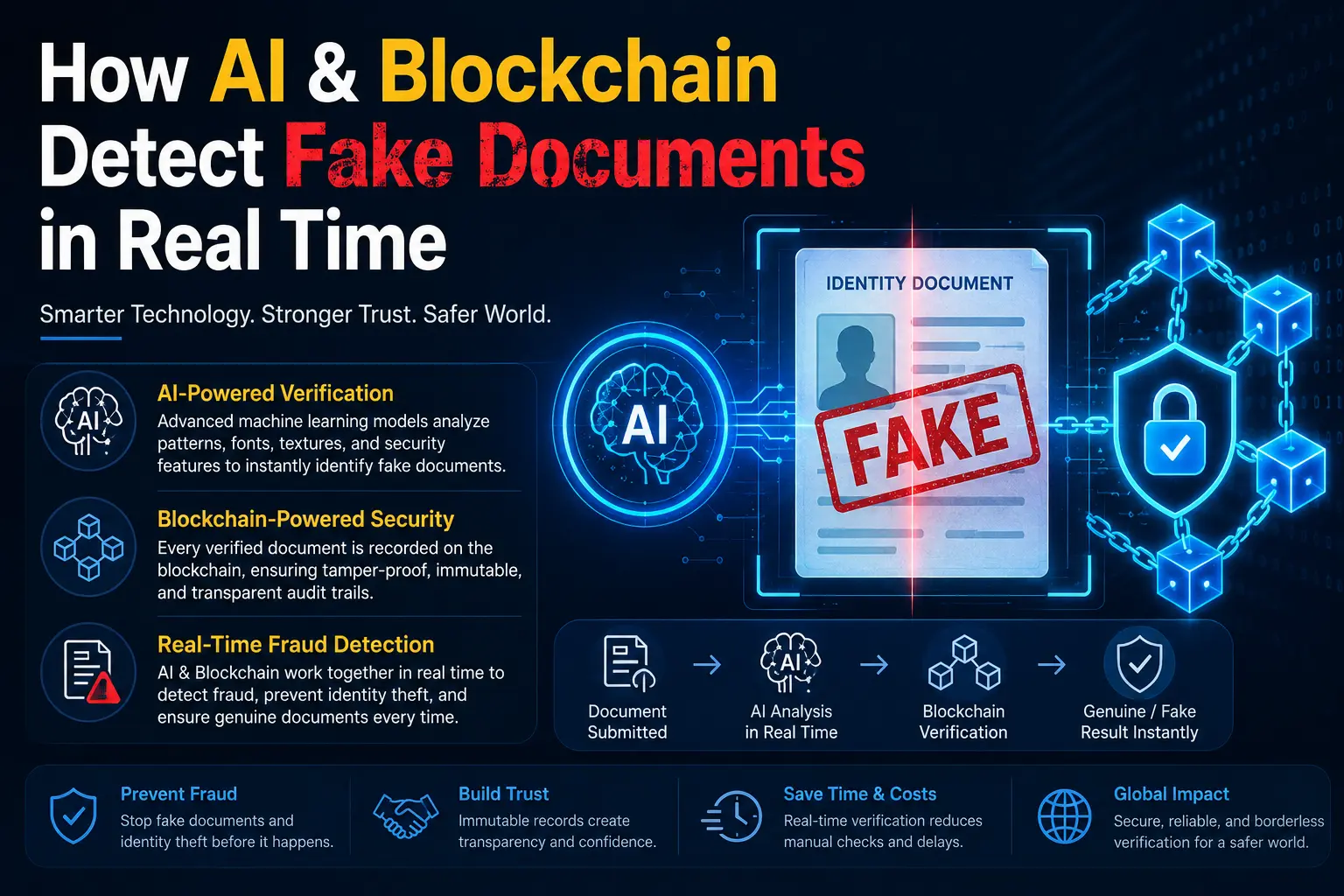
Real-time document verification stopped being a niche workflow once national digital identity and document rails reached production scale. In India, that threshold is already visible. Aadhaar had more than 1.33 billion enrolments by early 2024, and UIDAI reported more than 100 billion cumulative authentication transactions since launch, which shows that machine-queryable identity verification can operate at very high volume (Dialzara). That matters because fake document detection is no longer just a visual inspection problem. It’s now a systems design problem.
This article is for government teams, banks, fintech operators, healthcare providers, logistics platforms, compliance leaders, and blockchain builders who need a serious answer to one question. How AI & Blockchain Together Detect Fake Documents in Real Time without creating new audit, privacy, or operational gaps.
The short answer is that AI and blockchain solve different parts of the trust problem. AI inspects the submitted file for signs of manipulation. Blockchain preserves an immutable proof of what was checked, by whom, and against which state. The hard part, which many high-level guides skip, is handling issuance quality, identity binding, and revocation so the system doesn’t become a fast way to verify bad inputs.
Table of Contents
- The Rising Threat of Sophisticated Document Fraud
- Why Traditional Verification Systems Fail
- How AI Performs Real-Time Document Authentication
- How Blockchain Delivers Tamper-Proof Verification
- The Synergy A Unified AI and Blockchain Workflow
- Enterprise Use Cases in Global Industries
- Build Your Fraud Prevention Infrastructure with Blocsys
- Frequently Asked Questions
The Rising Threat of Sophisticated Document Fraud
Document fraud has changed in character. Older fraud models assumed a forged file would usually contain obvious errors, poor formatting, or visible edits. That assumption doesn’t hold anymore. Fraudsters can now generate cleaner layouts, mimic issuer templates, alter metadata, and submit files at a pace that overwhelms manual review.
The operational risk isn’t limited to fake passports or identity cards. Enterprises see fraud attempts in invoices, bank statements, proof-of-address files, shipping documents, insurance records, permits, and academic certificates. Each document type creates a slightly different attack surface, but the failure mode is similar. Teams accept a file that looks plausible, cannot prove its provenance, and only discover the issue later during dispute, compliance review, or incident response.
A second shift is architectural. Centralised verification models assume the organisation receiving the document can be the sole judge of authenticity. That’s often unrealistic when the file originated elsewhere and may need to be checked across multiple parties, issuers, or registries.
Practical rule: If your verification process depends on a human noticing a subtle edit under time pressure, you don’t have a fraud control. You have a hope-based workflow.
That’s why more organisations are moving from static review to instrumented verification. AI handles the forensic inspection at ingestion. Blockchain records the proof trail so later reviewers can confirm what was checked and whether the file state changed after approval.
Public-sector teams exploring anti-fraud controls can also review how governments can stop frauds about documentation for a policy and infrastructure view of the same challenge.
Why Traditional Verification Systems Fail
Traditional verification breaks in three places. It breaks when a document enters the system, when teams try to validate it against incomplete reference data, and when another party later asks for proof of what was checked. The core weakness is architectural. Many workflows were built to approve documents, not to establish provenance, preserve evidence, and support cross-party verification.
The result is a classic garbage-in, garbage-out problem. If the intake layer accepts a manipulated file, every downstream control inherits that error. Case management, compliance review, payout approval, and audit reporting all operate on a corrupted input set.
Manual review cannot keep pace with digital forgery
A trained reviewer can still catch crude edits. The failure point is consistency under volume. Modern forgeries preserve the visual cues that human operators rely on, while altering the fields that drive risk, eligibility, or payment decisions.
Common failure patterns are predictable:
- Reviewers inspect appearance more than provenance: a document can look correct while its issuer, issuance date, or file history remain unverified.
- Operational queues reward throughput: onboarding, claims, and KYC teams are usually measured on turnaround time, which reduces the depth of inspection per file.
- Controls vary by analyst and region: the same document may be accepted in one queue and rejected in another because the review standard lives in training materials rather than system logic.
- Reference data is often incomplete or stale: template libraries, issuer records, and approved document formats drift over time, which weakens rule-based validation.
This is why enterprises are shifting toward advanced fraud detection methods that instrument the submission workflow instead of relying on visual review alone.
Centralised records do not create shared trust
A verification status inside one company database is not the same as a verifiable fact. It only proves that an internal process wrote a status flag at a point in time. It does not automatically prove which version of the document was checked, which source was consulted, whether the file changed after approval, or whether another organisation can independently confirm the result.
That limitation matters in multi-party processes such as trade documentation, supplier onboarding, education credential checks, and regulated customer verification. The receiving organisation is rarely the document issuer. It is a relying party trying to assess authenticity from the outside. A centralised repository can store evidence, but it cannot by itself establish durable trust across separate entities with different systems, incentives, and audit requirements.
Security and compliance teams should treat this as a systems design issue, not a reviewer performance issue. If verification depends on mutable records, fragmented logs, and manual exception handling, the control will degrade as document volume rises. Teams comparing architecture choices can review the trade-offs in this guide to centralized vs blockchain-based document verification.
Enterprise verification is not a question of whether a file looks plausible. It is a question of whether the organisation can prove document origin, validation method, decision context, and post-approval integrity.
How AI Performs Real-Time Document Authentication
AI acts like a digital forensic layer at the point of submission. It doesn’t just read the document. It decomposes it into signals, compares those signals for internal consistency, and assigns risk before a human ever touches the case.
What AI actually inspects
Most enterprise-grade AI document fraud detection stacks run several checks in parallel rather than depending on a single classifier.
OCR and field extraction
The system extracts names, dates, numbers, addresses, issuer details, and structured zones from the file. This creates machine-usable data for downstream comparison.Layout and template consistency
AI checks whether the document structure matches known genuine formats. That includes spacing, field order, font behaviour, barcode zones, and the relationship between text blocks.Tamper localisation
Computer vision models inspect for signs of edits such as overwritten text, inconsistent edges, recompression artefacts, or image regions that don’t align with the rest of the file.Metadata analysis
The system reviews file properties, generation patterns, and conversion traces that may indicate a document was altered or reassembled.Semantic mismatch detection
AI compares extracted values against each other. If one section implies a different identity, timeline, or issuer context than another, the document gets flagged for review.
A useful external overview of these advanced fraud detection methods shows why modern anti-fraud systems combine pattern recognition, anomaly analysis, and workflow intelligence rather than relying on a single check.
Why AI works well in live verification queues
AI is strongest where humans are weakest. It can run the same inspection logic every time, at submission speed, without fatigue. That matters in fintech onboarding, healthcare credential intake, logistics documentation, and cross-border compliance operations where volume spikes are normal.
Its practical value comes from orchestration, not just model accuracy. A good system routes low-risk documents through automated approval paths, escalates ambiguous files with evidence attached, and preserves feature-level reasons for investigation. That reduces analyst time spent on obvious cases and increases attention on the documents most likely to be fraudulent.
For teams exploring the model layer in more depth, Blocsys has a technical overview of pattern recognition and artificial intelligence in verification workflows.
How Blockchain Delivers Tamper-Proof Verification
Blockchain doesn’t decide whether a document is genuine by visual inspection. It solves a different problem. It creates a durable, cryptographic record of document state, verification events, issuer actions, and revocations so trust can be checked later without relying on one mutable database.
What blockchain proves
In a document verification architecture, the common pattern is to generate a cryptographic hash of the document or approved data package. That hash functions as a fingerprint. If the underlying file changes, the hash changes. A smart contract or ledger entry can then anchor:
- the hash of the verified document
- the issuer or verifier identity
- the verification outcome
- the event time
- later updates such as renewal or revocation
This gives compliance teams and counterparties a non-repudiable record. They don’t need to trust someone’s screenshot or exported log file. They can verify whether the presented document still matches the anchored state.
Where most blockchain designs break
The hard problem isn’t hashing. It’s trust at issuance and verification. Existing articles often claim blockchain makes fake-document detection binary or tamper-proof, but they often miss the biggest real-world failure mode: garbage-in at issuance and identity-linking risk at verification. A stronger design needs live revocation and event-driven trust so systems can detect replayed credentials, duplicate submissions, and stale certificates (TrueAI).
That point changes the architecture. A serious blockchain authentication system needs:
- Verified issuer binding: the party creating or approving the record must itself be authenticated.
- Revocation support: a once-valid credential might later become invalid.
- Version awareness: the newest valid state must be distinguishable from prior versions.
- Replay resistance: the same credential shouldn’t be reusable outside its allowed context.
A hash proves integrity of the recorded state. It doesn’t prove the recorded state was trustworthy when written.
That’s why document integrity systems should be designed around lifecycle management, not one-time anchoring. This explainer on digital proof of document integrity is useful if you’re evaluating implementation patterns.
The Synergy A Unified AI and Blockchain Workflow
The hybrid model matters because the two technologies fail in different places. AI is strong at detecting anomalies in pixels, text, layout, and cross-field consistency. Blockchain is strong at preserving evidence, enforcing state transitions, and supporting later verification across organizational boundaries. Put together, they form a verification pipeline that can both score a document in real time and preserve what was checked, by whom, and under which policy.
Comparison of document verification methods
| Criterion | Traditional (Manual) | AI-Only | Blockchain-Only | AI + Blockchain Hybrid |
|---|---|---|---|---|
| Initial document inspection | Human visual review | Automated forensic analysis | Limited without external inspection layer | Automated inspection with recorded proof |
| Speed in large queues | Slow and variable | Fast | Fast for state checks | Fast end-to-end |
| Adaptation to new fraud patterns | Analyst-dependent | Strong, but needs retraining | Weak by itself | Strong with auditable state control |
| Tamper evidence after approval | Weak | Weak unless separately logged | Strong | Strong |
| Cross-organisation trust | Low | Moderate | High for recorded state | High for state plus analysis |
| Revocation handling | Often manual | Possible but operationally complex | Well suited if designed into the ledger events | Strong when AI and revocation events are linked |
| Audit readiness | Inconsistent | Better than manual, but model decisions need evidencing | Strong for event history | Strongest overall |
The architectural advantage is not “AI plus blockchain” in the abstract. It is the separation of responsibilities. The AI tier handles probabilistic judgment. The ledger tier handles deterministic evidence and state control. That distinction matters for compliance reviews, because auditors do not evaluate a model score the same way they evaluate an immutable event record.
The less obvious issue is Garbage-In, Garbage-Out. If the ingestion layer accepts low-quality scans, forged source records, or weak issuer bindings, the ledger will preserve bad decisions perfectly. Enterprises get better results when they treat blockchain as the control plane, not the truth generator. The truth still depends on document quality thresholds, issuer authentication, registry checks, and policy-based exception handling.
A practical reference architecture is described in this analysis of enterprise AI and blockchain integration patterns. The useful pattern is a staged pipeline, where confidence increases only after each control passes.
A practical hybrid workflow
The workflow that works in production usually looks like this:
Submission and quality gating
A user uploads a PDF, image, credential package, or machine-readable document. Before any fraud model runs, the system checks resolution, compression artifacts, missing zones, metadata consistency, and file structure. This is the first defense against Garbage-In, Garbage-Out.Parallel AI analysis
OCR, barcode validation, tamper detection, template matching, semantic consistency checks, and fraud classification run in parallel. The output should be more than a score. It should include an evidence bundle with feature-level explanations, model version, and policy result.
A short visual summary helps here:
Authoritative data validation
Extracted fields are checked against issuer systems, enterprise master data, sanctions tools, or sector registries where available. This step determines whether the document is merely well-formed or actually trustworthy.Decision orchestration
A rules engine combines model output, registry responses, document class, jurisdiction, and risk policy. Low-risk cases can be auto-approved. Edge cases go to manual review with the AI evidence attached.Hashing and state anchoring
The system hashes the verified representation, not the raw upload alone, and writes an event to the ledger with issuer identity, verifier identity, timestamp, policy version, and decision outcome. That design supports later proof without exposing sensitive document contents on-chain.Lifecycle and replay controls
Revocations, renewals, corrections, duplicate submissions, and expired approvals are recorded as later events. Verification then becomes a state query across time, not a one-time integrity check.
Design principle: Anchor the verified state, the responsible identities, and the policy context. A file hash without verification context has limited evidentiary value.
This pattern also changes business outcomes. Operations teams get faster triage. Risk teams get traceable decisions. Legal and compliance teams get a defensible audit trail tied to policy versions and reviewer actions. In sectors with paper-heavy exception flows, firms also use adjacent automation tools to streamline real estate workflows with AI before documents ever reach the verification queue. The strongest implementations treat verification as a governed system of record, not a standalone fraud model.
Enterprise Use Cases in Global Industries
Enterprise buyers should evaluate this architecture by failure mode, operating model, and audit burden, not by demo accuracy. The same AI and blockchain stack serves different industries, but the implementation pattern changes with document volatility, issuer diversity, and the cost of a bad acceptance decision. The overlooked constraint is usually data quality. If the source record is incomplete, stale, or mis-bound to the wrong subject, automation only accelerates the error.
Banking and fintech
Banking workflows are dense with high-impact documents: identity records, proof of address, bank statements, income documents, business registrations, and beneficial ownership filings. The business requirement is not just faster onboarding. It is consistent decisioning under AML, KYC, lending, and fraud controls.
India provides a useful signal for what large-scale digital verification infrastructure looks like. Aadhaar and DigiLocker have shown that machine-readable identity and document retrieval systems can support high-volume verification workflows, as noted earlier. For banks and fintech platforms, that matters because real-time checks become more reliable when the submitted file can be compared against an authoritative issuer record instead of only being scored for visual anomalies. Blockchain adds value after that comparison by preserving who verified the document, under which policy, and whether the decision was later superseded by a correction or revocation.
This changes credit and compliance operations in practical ways. Retail lending teams can distinguish manipulated statements from legitimate statements with formatting differences across issuers. Merchant onboarding teams can detect recycled business documents submitted across multiple entities. Compliance teams can explain why an approval was valid at the time it was made, which is often the central question in an audit or dispute.
Healthcare, logistics, and government
Healthcare systems deal with clinician licences, insurance documents, referrals, consent forms, and patient-submitted records. Here, the dominant risk is often temporal, not purely forensic. A credential may be genuine but expired. An insurance authorization may be valid but already consumed. An AI model can classify and extract the document, but trust still depends on whether the system checks the current status against the issuing authority and records that status for later review.
Logistics has a different failure pattern. Bills of lading, customs declarations, certificates of origin, inspection reports, and warehouse releases pass through multiple organizations that do not share a single database or security perimeter. In that setting, a shared ledger helps establish a common event history across carriers, brokers, warehouses, and importers. The benefit is less about cryptography in isolation and more about reducing disputes over version history, submission timing, and document substitution across handoffs.
Government programmes use the same architecture for permits, licences, land records, academic certificates, and registry extracts. The implementation challenge is usually not model accuracy. It is policy heterogeneity across agencies and jurisdictions. A production system needs document-specific rules for issuance authority, acceptable freshness windows, revocation semantics, and evidentiary retention. Without that layer, enterprises end up with a polished classifier attached to a weak control framework.
Adjacent sectors are already applying parts of this operating model to document-heavy workflows. In property operations, for example, teams use AI to streamline real estate workflows with AI where approvals, records, and exception handling intersect. Regulated verification environments require tighter identity controls and stronger audit design, but the architectural lesson is the same. Clean inputs, authoritative lookups, and recorded state transitions matter more than model confidence alone.
Build Your Fraud Prevention Infrastructure with Blocsys
Most verification programmes fail because teams buy isolated tools instead of designing a complete trust system. The missing pieces are usually issuer identity, event handling, revocation logic, and integration with compliance operations.
What enterprise teams need to design upfront
A production-grade platform should answer these questions before rollout:
- What is the source of truth? Decide which registries, issuers, or enterprise systems can authoritatively confirm document data.
- What gets anchored? Store hashes and verification outcomes, not uncontrolled data sprawl.
- How are revocations handled? If status changes, downstream relying parties need to see that change immediately.
- Who can write trust events? Issuer and verifier permissions need strong identity controls.
- How does the review queue work? Analysts need evidence, not just a red or green label.
Blocsys can fit into this stack as an engineering partner for AI-powered document verification, enterprise blockchain solutions, decentralized identity verification, smart contract development services, and specialised protocol engineering with Rust developers. For teams building adjacent regulated infrastructure, Blocsys also works across platforms such as OTC trading systems and prediction markets platforms. The relevant point here is practical. The fraud stack has to be integrated into the business workflow, not bolted on after launch.
The Growing Role of Blockchain Applications in Enterprise Digital Transformation
As digital transformation accelerates across industries, blockchain applications are becoming essential for building secure, transparent, and efficient business ecosystems. Organizations are increasingly adopting blockchain to strengthen data integrity, automate workflows, and create tamper-proof records that improve trust among customers, partners, and regulators. Beyond cryptocurrency, modern blockchain applications support secure document verification, digital identity management, supply chain traceability, asset tokenization, smart contract automation, and real-time audit trails. When integrated with emerging technologies such as artificial intelligence (AI), cloud computing, and the Internet of Things (IoT), blockchain enables organizations to reduce operational costs, improve regulatory compliance, and streamline complex business processes. Enterprises across finance, healthcare, logistics, government, and manufacturing continue to invest in blockchain-powered solutions to enhance security, increase operational efficiency, and accelerate digital innovation. As enterprise adoption continues to grow, blockchain applications are expected to play a central role in creating scalable, trusted, and future-ready digital infrastructure for businesses worldwide.
Frequently Asked Questions
How does AI detect fake documents?
AI detects fake documents by combining OCR, layout analysis, metadata inspection, anomaly detection, and cross-field consistency checks. It evaluates whether the file’s text, structure, and hidden properties align with known genuine patterns and whether the extracted data conflicts internally or with trusted records.
How does blockchain prevent document fraud?
Blockchain doesn’t inspect the document visually. It preserves a cryptographic proof of the verified state, along with issuer, verifier, and lifecycle events such as renewal or revocation. That makes later tampering easier to detect and improves auditability across organisations.
What is real-time document verification?
Real-time document verification is the ability to inspect a submitted file, compare it with trusted records, and return a decision during the live transaction or onboarding flow rather than through delayed manual review.
Why are enterprises adopting hybrid AI and blockchain verification?
Enterprises need both adaptive fraud detection and durable proof. AI identifies suspicious submissions quickly. Blockchain preserves what was checked and whether the approved state later changed. That combination supports security, compliance, and dispute resolution better than either layer alone.
How can Blocsys help build fraud prevention infrastructure?
Blocsys helps organisations design verification systems that combine AI analysis, blockchain anchoring, smart contract workflows, and enterprise integrations for regulated operations.
If you’re building verification infrastructure for banking, healthcare, logistics, government, or digital-asset workflows, Blocsys Technologies can help you map the architecture, define the trust lifecycle, and implement the AI and blockchain controls required for production deployment. Connect with Blocsys to evaluate document ingestion, issuer binding, revocation handling, smart contract automation, and enterprise integration requirements for your next fraud prevention system.
