
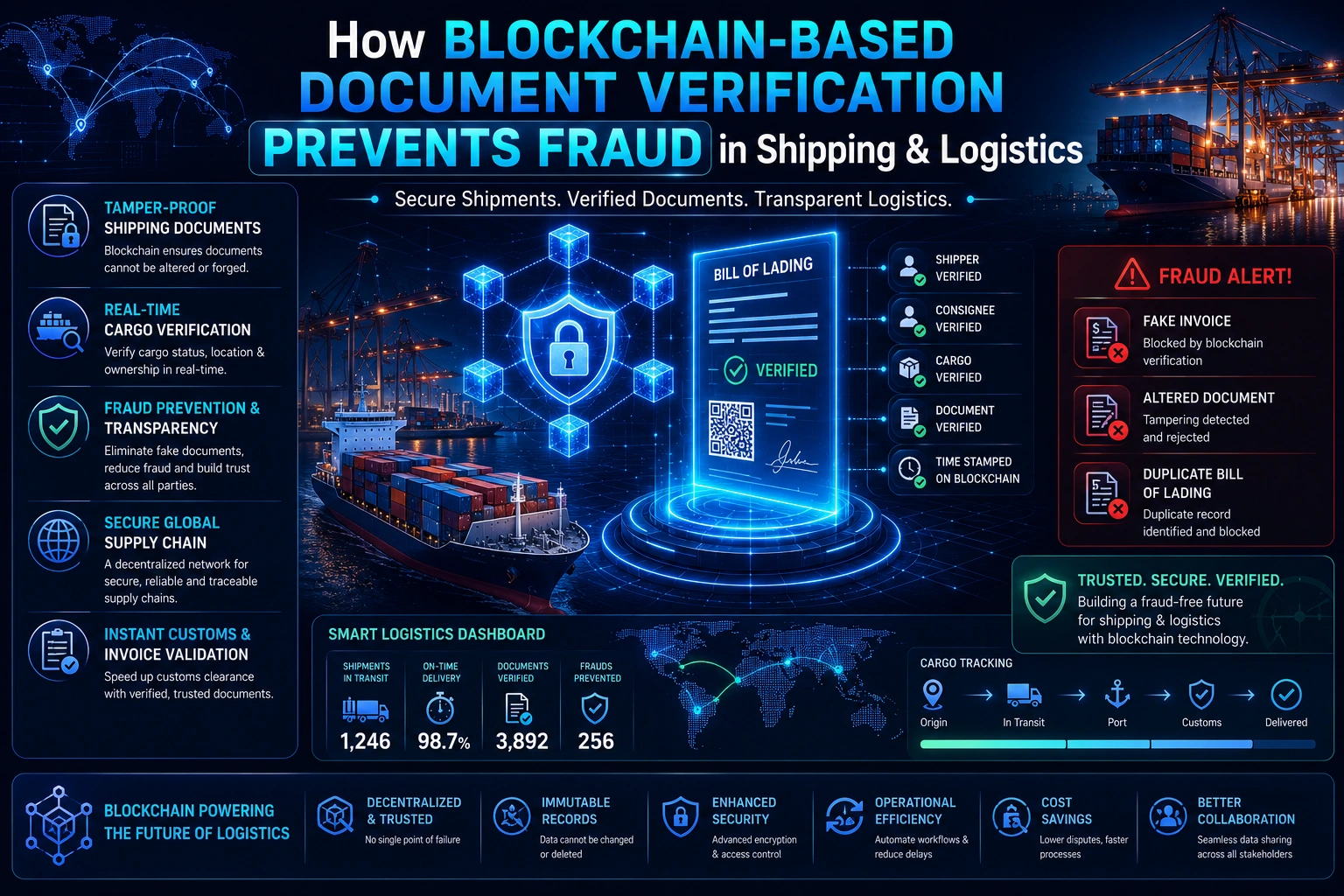
Fraud in shipping rarely starts with a spectacular cyberattack. It usually starts with a document that looks normal. That is why the strategic case for blockchain in logistics is less about cryptocurrency-style novelty and more about document control, handoff accountability, and shared evidence.
The strongest signal is market direction. The global Blockchain for Fraud Prevention market is projected to reach USD 77.6 billion by 2034 with a 26.5% CAGR, while the document verification market is projected to reach USD 25.0 billion by 2034. In blockchain verification pilots cited by Blocsys, systems using off-chain IPFS storage with on-chain hashes reduced unauthorised edit attempts by 96% and improved tamper-detection latency by 40% to 60% versus centralised systems, according to Blocsys’s analysis of blockchain-based document verification. For shipping and logistics leaders, that changes the conversation from “Should we digitise?” to “Which records must become tamper-evident first?”
This matters to carriers, freight forwarders, customs teams, warehouse operators, import-export businesses, and enterprise software teams building trade infrastructure. If your operation still depends on paper, PDF attachments, WhatsApp images, manual re-entry, and version-by-version reconciliation across multiple parties, blockchain-based document verification can reduce dispute windows, strengthen compliance evidence, and improve operational speed.
Table of Contents
- The Urgent Need for Secure Logistics Documentation
- Common Document Fraud Plaguing Shipping and Logistics
- How Blockchain Creates Tamper-Proof Logistics Documents
- Automating Shipping Workflows with Smart Contracts and AI
- Comparing Centralised vs Blockchain Logistics Verification
- Enterprise Benefits and Overcoming Adoption Hurdles
- How Blocsys Delivers Enterprise-Grade Logistics Verification Platforms
- Frequently Asked Questions
- How does blockchain prevent fraud in shipping and logistics
- What is blockchain-based logistics verification
- What are tamper-proof logistics documents
- How do smart contracts automate shipping operations
- Why are logistics companies adopting blockchain verification systems
- Can blockchain verification work with existing logistics systems
- What is blockchain bill of lading verification
- What is the biggest adoption challenge
The Urgent Need for Secure Logistics Documentation
Customs delays, payment holds, disputed deliveries, and compliance escalations often start with one failure. The document presented at a handoff cannot be trusted with enough confidence to release cargo, approve payment, or close an audit trail. In logistics, that failure rarely sits inside a single file. It sits between systems, counterparties, and physical checkpoints.
Why the business case has hardened
Enterprise spending on verification infrastructure is rising because the cost of weak documentation now reaches far beyond back-office rework. A mismatched bill of lading can delay customs clearance. An unclear proof-of-delivery record can slow invoicing and trigger disputes. An altered certificate can create tariff exposure or regulatory scrutiny months after shipment closeout.
The underlying problem is structural. Carriers, freight forwarders, customs brokers, warehouses, banks, and consignees each operate different systems, different approval rules, and different identity controls. Even where one company has modernised its own stack, risk persists at the edges where documents are uploaded, re-keyed, emailed, printed, stamped, or confirmed by a third party.
That is why secure documentation has become an operating model issue, not just an IT control issue.
For logistics operators, three pressure points matter most:
- Risk concentrates at handoffs. Fraud and error often enter before a record reaches the system of record, or after it leaves one.
- Identity is often weaker than data integrity. A timestamped file has limited value if the party uploading, approving, or receiving it was not authenticated with enough assurance.
- Physical events still govern commercial release. Cargo pickup, warehouse receipt, container release, and final delivery require evidence that links a digital record to a real-world action.
A useful adjacent lens is broader transport and logistics IT support, because many verification failures begin as integration failures between field operations, back-office tools, and partner systems.
What blockchain verification changes
Blockchain-based document verification creates a tamper-evident record of a document’s state at a specific time. In practice, the file itself can remain off-chain while its cryptographic hash, timestamp, approval events, and access history are recorded on-chain. That model gives authorised participants a shared evidence layer without forcing every stakeholder onto the same internal platform.
The strategic value is not immutability alone. The primary gain comes from reducing the time and cost of proving what happened, who approved it, and whether the document shown at a warehouse gate or customs desk matches the version accepted earlier in the workflow. That shortens dispute cycles, improves release confidence, and lowers the amount of manual reconciliation needed across trading partners.
The harder issue is the digital-physical divide. A blockchain record can prove that a document was not altered after approval. It cannot, by itself, prove that the truck driver, warehouse supervisor, surveyor, or consignee representative at the point of handoff is the right person. Strong implementations address that gap with identity controls, device-level capture, signed approval steps, and integration into existing operational systems rather than full platform replacement.
That is why many firms start through phased supply chain digitalisation programmes instead of rebuilding transport, warehouse, and trade systems from scratch. The practical objective is narrower and more valuable. Create one verifiable chain of custody for documents across fragmented systems and real-world handoffs.
Common Document Fraud Plaguing Shipping and Logistics
A forged logistics document doesn’t need to be technically complex. It only needs to pass one handoff unchecked. That is why some of the most damaging incidents look ordinary at first glance.
Where fraud appears in daily operations
The classic examples are familiar to anyone in freight or trade compliance.
- Forged bills of lading: a party alters consignee details, shipment terms, or release status to support an unauthorised cargo claim. Teams that need a refresher on the document’s legal and operational role can master your bill of lading before designing a digital control framework.
- Duplicated invoices: the same commercial event is represented more than once across disconnected systems or counterparties.
- Altered certificates and declarations: edits to origin, inspection, or shipment details can trigger tariff, customs, and compliance exposure.
- Disputed proof of delivery: the record may be real, but the timing, recipient identity, or conditions of receipt remain contested.
These aren’t edge cases. They happen because logistics documentation crosses organisational boundaries faster than controls do.
Why paper and shared drives fail under pressure
A government-linked maritime analysis published in 2020 identified reliance on paper-based documents such as bunker delivery notes as a core shipping bottleneck, making fuel origin and quality harder to trace while increasing the risk of errors, tampering, and verification delays in maritime workflows, according to the 2020 maritime blockchain use-case report. That finding is bigger than bunker documentation. It points to the structural weakness of paper-heavy trade processes.
Paper fails for three reasons that centralised portals don’t fully solve.
| Failure point | What happens in practice |
|---|---|
| Version sprawl | Different stakeholders hold different “final” copies |
| Weak provenance | Teams can see a file, but not always who approved which version and when |
| Late discovery | Errors or tampering are often found only when customs, finance, or delivery teams raise an exception |
A document can be authentic in format and still unreliable in workflow. Most shipping fraud hides in the gap between file validity and process validity.
That is the overlooked point. Fraud in logistics often isn’t about breaking a cryptographic system. It is about exploiting the delay between document creation, document review, and physical handoff.
How Blockchain Creates Tamper-Proof Logistics Documents
The practical question isn’t whether blockchain is immutable in theory. It’s whether that immutability helps operations teams verify a shipping document quickly, confidently, and across company boundaries. When designed well, it does.
The lifecycle of a verified shipping document
A logistics document usually moves through five control moments.
Document creation
A bill of lading, invoice, packing list, or proof-of-delivery file is generated in an operational system.Hashing and registration
The platform creates a cryptographic hash of the file. That hash acts like a fingerprint. The original file can remain in enterprise storage, while the hash and timestamp are written to the blockchain.Role-based approval
Authorised users sign or approve the document at key workflow points such as dispatch, gate release, receipt, or customs submission.Shared verification
Any authorised party can compare the current file to the on-chain record. If even a small change has been made, the hash no longer matches.Exception handling
Mismatches, out-of-sequence approvals, or missing signatures are flagged before they become disputes.
This model works because it changes the burden of proof. In a paper workflow, teams must prove a document was altered. In a blockchain workflow, the system proves whether the current document matches the registered record.
A useful technical explainer on this control pattern is digital proof of document integrity, which maps the relationship between file storage, cryptographic hashes, and verification evidence.
Later in the workflow, visual verification helps non-technical stakeholders understand the concept as well:
Why handoff accountability matters as much as immutability
The strongest operational results come when blockchain is tied to events, not only files. In delivery and inbound-logistics pilots, digital pre-registration and mobile verification cut vehicle gate processing from 20 minutes to under 2 minutes, and each event was written as a permanent, attributable record tied to the responsible user, according to iFactory’s blockchain delivery transparency overview. That point is critical.
A tamper-proof document is useful. A tamper-proof document linked to a time-stamped custody event is much more powerful.
- Seal checks become attributable: if a discrepancy appears, teams can identify who validated what and when.
- Quantity disputes shrink: receiving events and approval records are harder to backfill after the fact.
- Audit trails become external-facing: counterparties can verify evidence without relying on one party’s internal log.
Operational insight: Immutability matters most at moments of transfer. Fraud usually enters where responsibility changes hands.
That’s why mature architectures combine document hashing, user identity, event logs, and mobile capture into a single verification chain.
Automating Shipping Workflows with Smart Contracts and AI
Verification is the foundation. Automation is where the business case compounds. Once shipping documents and handoff events become trustworthy, firms can attach rules to them.
Where smart contracts fit in real operations
A smart contract is code that executes when predefined conditions are met. In logistics, that can mean release instructions, approval routing, status changes, or payment triggers tied to verified events.
Examples that fit real shipping workflows include:
- Delivery-linked settlement: payment can be triggered only after a verified proof-of-delivery event and the required signatures are present.
- Smart bill of lading transfer logic: document control can move only when authorised parties complete the required approvals.
- Compliance gating: a shipment can be blocked from the next workflow stage if the required supporting documents are missing or unverifiable.
- Exception-first routing: mismatched metadata, duplicate submissions, or missing role-based approvals can be sent directly to review queues.
A good implementation doesn’t automate everything. It automates the narrow points where disputes are common and rules are stable. That is often enough to reduce operational drag without increasing process risk.
For teams evaluating this architecture, how smart contracts automate secure document authentication is the useful design question. The right answer usually starts with one document family, one approval chain, and one exception model.
How AI strengthens fraud review
AI isn’t a replacement for blockchain verification. It is a detection layer built on top of trusted records. Once document events, approvals, timestamps, and handoff data are structured consistently, AI models can flag behaviour that deserves scrutiny.
That may include unusual submission timing, repeated exception patterns, conflicts between field evidence and document metadata, or inconsistent approval behaviour by role. The value is operational prioritisation. AI helps compliance and operations teams focus on the exceptions most likely to become losses or disputes.
The strategic insight is that blockchain and AI solve different parts of the same problem. Blockchain improves evidence quality. AI improves review efficiency. Together, they support a system that is both more trustworthy and more scalable.
Comparing Centralised vs Blockchain Logistics Verification
Many logistics firms don’t need a philosophical answer. They need a decision framework. Centralised systems still have a role, especially inside a single enterprise with stable counterparties. Blockchain becomes more compelling when trust is distributed and document disputes cross company lines.
Which model fits which risk profile
The comparison below focuses on control design rather than hype.
| Feature | Centralised System | Blockchain-Based System |
|---|---|---|
| System ownership | One organisation controls the database and access model | Multiple authorised participants rely on a shared verification layer |
| Document integrity | Strong inside one system, weaker when files move outside it | Tamper-evidence persists across participating organisations |
| Audit trail | Internal logs may be detailed but are controlled by one party | Time-stamped records are shared, attributable, and harder to dispute |
| Fraud resistance | Better than paper, but vulnerable to privileged edits and off-system versioning | Stronger against document substitution and post-event alteration |
| Partner trust | Counterparties may still request manual confirmation | Verification can be performed against a common record |
| Handoff accountability | Often split across apps, email, and spreadsheets | Events can be bound to identity, time, and approval state |
| Operational change required | Usually easier to start within one company | Requires governance, onboarding, and shared process design |
| Failure model | A single platform outage or integrity dispute can affect all users | Shared architecture reduces dependence on one party’s database |
| Best fit | Internal document management and controlled supplier networks | Multi-party trade, shipping, customs, warehousing, and settlement workflows |
This is why the right question isn’t “centralised or blockchain?” It’s “Which parts of the workflow need one company’s truth, and which parts need a shared truth?”
Choose centralised control for internal efficiency. Choose blockchain verification for inter-company evidence.
Firms making that decision should also review the security trade-offs in centralized vs blockchain-based document verification. In logistics, the decisive factor is usually not database architecture alone. It is whether multiple parties must trust the same evidence without a dominant intermediary.
A practical pattern is hybrid design. Keep operational systems centralised. Add blockchain only where documents, approvals, and custody events cross organisational boundaries. That approach limits disruption while preserving the benefits of a shared audit layer.
Enterprise Benefits and Overcoming Adoption Hurdles
Executives don’t buy verification systems because the underlying cryptography is elegant. They buy them because disputes cost money, delays damage service levels, and weak evidence slows decisions.
The benefits executives actually care about
When logistics documents become tamper-evident and handoff records become attributable, several enterprise outcomes improve qualitatively.
- Faster exception resolution: teams spend less time determining which version is valid.
- Stronger compliance evidence: customs, audit, and internal control reviews rely on clearer document lineage.
- Better counterpart alignment: carriers, warehouses, brokers, and cargo owners work from a common verification trail.
- Cleaner automation: payments, release instructions, and escalation logic can rely on verified events instead of manual interpretation.
These benefits are easy to underestimate because they are distributed. The value doesn’t sit in one line item. It appears across operations, compliance, finance, and customer service at the same time.
The last-mile identity gap
The hardest implementation problem is not document hashing. It is identity at the point of presentation. As noted in WTDC’s discussion of blockchain in logistics and shipping, a blockchain can prove a document is authentic, but it cannot by itself prove that the person presenting it is authorised. The biggest fraud losses often come from forged handoffs and disputed delivery events, not attacks on the ledger itself.
That changes the implementation agenda. A serious logistics verification platform needs more than immutable records.
- Role-based signing: the system must record whether the right person approved the right action.
- Device binding: field actions should be linked to known devices where feasible.
- Offline-to-online reconciliation: warehouses, yards, and transport corridors often operate with patchy connectivity.
- Minimal-friction workflows: small carriers and contract staff won’t adopt tools that add too many steps.
The digital-physical divide is where many blockchain projects fail. The ledger may be perfect while the handoff process remains weak.
The winning design pattern is incremental. Start with one document class, one handoff event, and one identity model. Prove reliability there. Then expand to adjacent workflows such as delivery confirmation, gate entry, invoice validation, or customs document checks.
How Blocsys Delivers Enterprise-Grade Logistics Verification Platforms
Most logistics organisations don’t need a generic blockchain build. They need a verification system that fits existing trade operations, partner workflows, and compliance controls. That means integrating document hashing, approval logic, identity controls, storage, and audit visibility into one operational model.
What an enterprise platform should include
A workable platform for shipping and logistics usually needs these capabilities:
- Document integrity controls that register hashes for bills of lading, invoices, certificates, proof-of-delivery records, and related trade documents.
- Workflow-aware approvals so every sign-off is tied to a role, timestamp, and business event.
- Exception handling logic that flags mismatches, incomplete submissions, and sequence problems before they create downstream disputes.
- Integration connectors for ERP, TMS, warehouse, and customs-facing systems.
- Governance design covering participant permissions, retention, and verification rights.
One option in this category is the tamper-proof document verification platform, which describes a model based on document hashes and transaction markers for integrity verification. In enterprise settings, the strategic value of a platform like this is that it can support secure shipping document authentication without requiring every operational file to live directly on-chain.
For buyers, vendor selection should be disciplined. Ask whether the platform supports hybrid storage, role-based approvals, mobile event capture, partner access, and phased rollout. Ask how it handles disputed handoffs, not just altered files. Ask what evidence a customs officer, auditor, finance approver, and warehouse supervisor would each see when something goes wrong.
That is the difference between a proof of concept and a production-grade logistics verification system.
The Growing Role of Blockchain Applications in Enterprise Digital Transformation
As digital transformation accelerates across industries, blockchain applications are becoming essential for building secure, transparent, and efficient business ecosystems. Organizations are increasingly adopting blockchain to strengthen data integrity, automate workflows, and create tamper-proof records that improve trust among customers, partners, and regulators. Beyond cryptocurrency, modern blockchain applications support secure document verification, digital identity management, supply chain traceability, asset tokenization, smart contract automation, and real-time audit trails. When integrated with emerging technologies such as artificial intelligence (AI), cloud computing, and the Internet of Things (IoT), blockchain enables organizations to reduce operational costs, improve regulatory compliance, and streamline complex business processes. Enterprises across finance, healthcare, logistics, government, and manufacturing continue to invest in blockchain-powered solutions to enhance security, increase operational efficiency, and accelerate digital innovation. As enterprise adoption continues to grow, blockchain applications are expected to play a central role in creating scalable, trusted, and future-ready digital infrastructure for businesses worldwide.
Frequently Asked Questions
How does blockchain prevent fraud in shipping and logistics
Blockchain prevents fraud by creating a tamper-evident record of documents and workflow events. When a document hash, timestamp, and approval history are registered on-chain, any later alteration becomes detectable. The strongest control comes when document verification is combined with identity, approvals, and event-level handoff records.
What is blockchain-based logistics verification
It is a system that uses blockchain to verify the integrity and history of shipping and logistics documents. The original file may remain off-chain, while its cryptographic fingerprint and related approval events are recorded on-chain so authorised parties can verify authenticity and sequence.
What are tamper-proof logistics documents
They are documents whose integrity can be independently checked against a trusted verification record. In practice, a bill of lading, invoice, certificate, or proof-of-delivery record becomes tamper-evident when its registered hash no longer matches after any unauthorised change.
How do smart contracts automate shipping operations
Smart contracts automate predefined actions when verified conditions are met. In shipping, that can include routing approvals, updating workflow state, gating release instructions, or linking settlement steps to verified delivery and document status.
Why are logistics companies adopting blockchain verification systems
They adopt them because multi-party logistics creates constant reconciliation problems. Shipping documents move across carriers, brokers, warehouses, customs processes, and consignees. A shared verification layer reduces disputes, strengthens evidence, and makes automation safer.
Can blockchain verification work with existing logistics systems
Yes. In most enterprise deployments, blockchain works as an additional trust layer rather than a full replacement. Organisations typically keep their ERP, TMS, warehouse, and storage systems, then add blockchain-based verification for selected documents and handoff events.
What is blockchain bill of lading verification
It is the use of blockchain to register and verify the integrity, approval status, and transfer history of a bill of lading. The goal is to reduce disputes over authenticity, ownership-related workflow steps, and unauthorised alteration across counterparties.
What is the biggest adoption challenge
The biggest challenge is often the last-mile identity problem. A system may prove that a document is authentic while still failing to prove that the person presenting or approving it was authorised. That is why strong identity controls and offline-capable field workflows matter.
If you’re evaluating blockchain logistics verification, shipping document authentication, or smart contract-based fraud controls, Blocsys Technologies can help you assess the workflow, identity, and integration requirements before you build. For shipping enterprises, logistics operators, customs-focused teams, and software providers, the most valuable next step is usually a scoped architecture discussion around which documents, handoff points, and counterparties should enter a tamper-evident verification layer first.
