
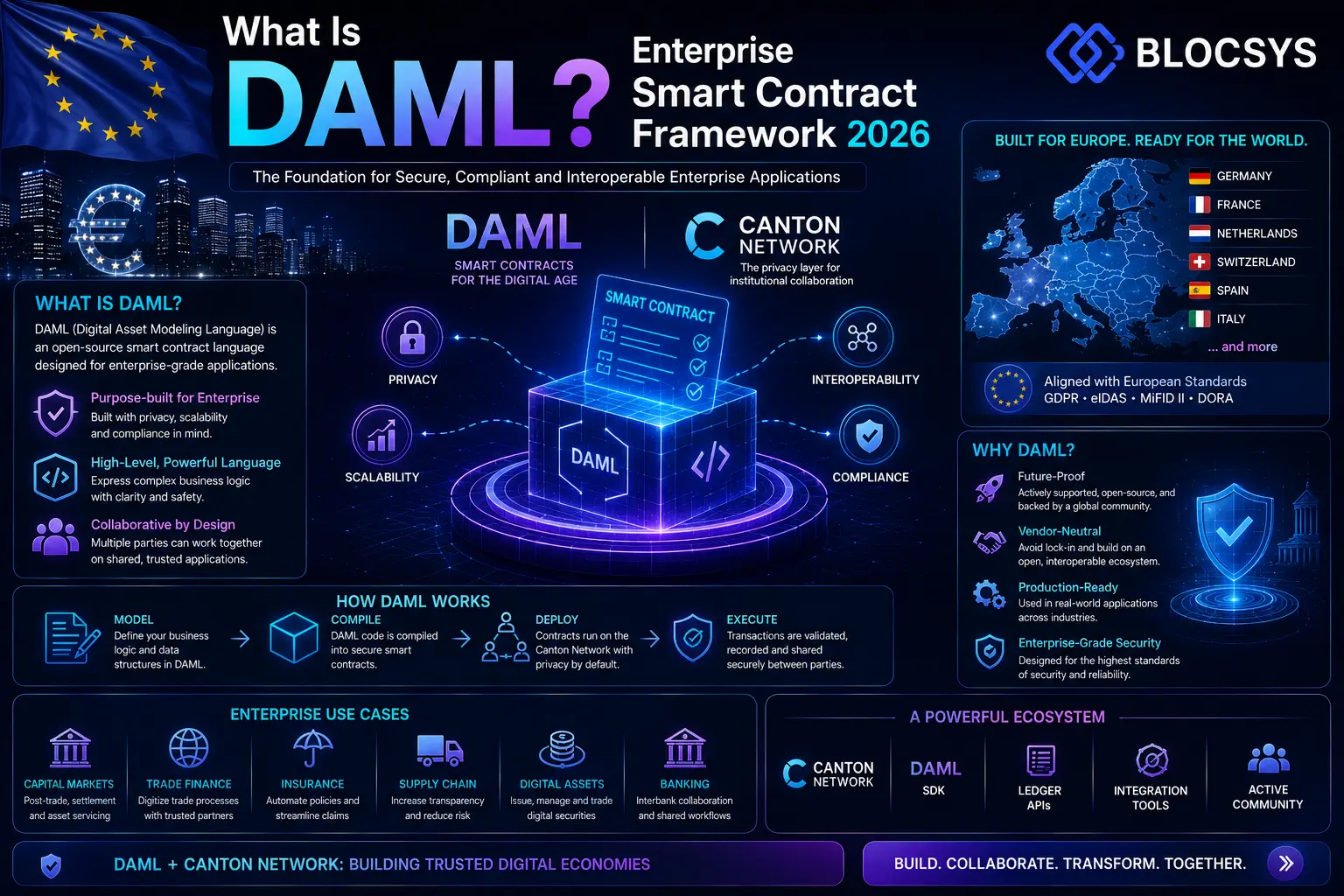
DAML is a specialised smart contract language built for multi-party business workflows. It models rights, obligations, privacy, and authorisation directly in the contract, which makes it fundamentally different from general-purpose blockchain languages that leave those concerns to application code.
Most “what is DAML” explainers stop at the definition. That’s not enough for a bank, exchange, tokenisation platform, or regulated fintech deciding whether DAML and Canton belong in a real production stack. The hard questions start later. How do you migrate from Solidity without breaking workflow semantics? What does privacy-by-default mean for audit, operations, and compliance? Where does DAML end and Canton begin?
This guide answers those questions from an enterprise architecture perspective. It’s written for technical leaders, founders, and product owners who need to evaluate DAML language, DAML smart contracts, and Canton Network as serious infrastructure for digital asset workflows, financial systems, and institutional blockchain platforms.
Table of Contents
- What Is DAML The Smart Contract Language for Business
- How DAML and Canton Network Deliver Enterprise-Grade Infrastructure
- DAML vs Solidity A Comparison for Enterprise Developers
- Enterprise Use Cases Tokenization and Digital Assets on DAML
- The Future of DAML and Canton Network in 2026
- Build Your Enterprise Blockchain with Blocsys and DAML
- Frequently Asked Questions about DAML and Canton
What Is DAML The Smart Contract Language for Business
DAML is a domain-specific smart contract language built for multi-party workflows. It lets developers encode parties, rights, obligations, privacy rules, and authorisation directly into the contract model, so the runtime enforces business logic without every team rebuilding ledger controls in application code, as outlined in this DAML overview.
That distinction matters. In enterprise systems, the primary difficulty usually isn’t computing a token balance or executing a function. It’s deciding who is allowed to act, who can see what, what approvals are required, and how obligations change as a workflow moves from issuance to transfer to settlement.

Why enterprises need a different contract model
Traditional legal agreements carry rich business meaning, but they’re hard to automate. First-generation public-chain contracts automate execution, but they often push privacy, permissions, and workflow semantics into surrounding infrastructure. That works for open networks. It doesn’t map cleanly to regulated coordination between banks, brokers, custodians, issuers, and counterparties.
DAML takes a different route. It starts from the agreement itself. Parties, signatories, observers, and choices become first-class concepts in the language.
Practical rule: If your system depends on explicit contractual roles and restricted data visibility, a business-oriented contract language is usually a better fit than a general-purpose one.
This is also why DAML belongs in the broader conversation about enterprise-grade blockchain architecture and implementation patterns, not just smart contract syntax.
What DAML actually encodes
In practical terms, a DAML model can describe:
- Who participates: the parties to an agreement, not just anonymous addresses.
- Who must authorise actions: signatories and role-based permissions are part of the model.
- Who may observe state: visibility can be defined as part of contract behaviour.
- How workflows progress: choices capture valid transitions, approvals, and business events.
The result is lower conceptual overhead for enterprise agreements and fewer reconciliation steps when multiple institutions need to share one workflow without sharing everything. That’s a big reason DAML often comes up in conversations about tokenised securities, syndicated operations, and private financial infrastructure.
For developers who want broader context on how contract design changes as systems become more complex, this guide to smart contracts advanced coding is a useful companion read. It helps frame why modelling decisions matter long before deployment.
How DAML and Canton Network Deliver Enterprise-Grade Infrastructure
DAML on its own is not the whole platform. The clearer way to understand the stack is this: DAML expresses the business logic, while Canton executes that logic in a distributed environment designed for authorised data sharing and interoperability, as described in Digital Asset’s Daml and Canton 2.0 framing.
That separation is one of the most important architectural ideas in the ecosystem.
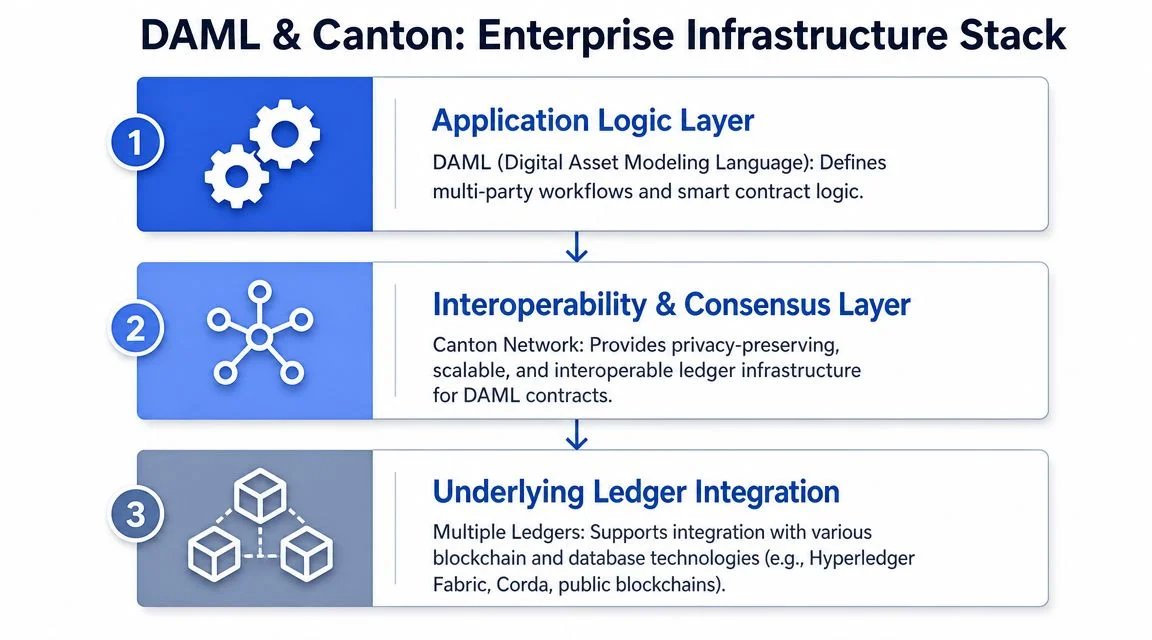
Think of DAML as logic and Canton as execution
A useful analogy for non-specialists is application and operating system. DAML defines the agreement model. Canton provides the ledger and protocol behaviour that faithfully implements that model.
Enterprise buyers often evaluate “blockchain platforms” as if language, execution model, privacy controls, and infrastructure are a single thing. In the DAML and Canton approach, they’re deliberately separated. That gives architects more control over portability and deployment choices.
Three practical consequences stand out:
- Business logic stays closer to the domain model: rights, obligations, privacy, and authorisation are defined where business teams can reason about them.
- Infrastructure choices stay more flexible: the same logic isn’t necessarily trapped inside one chain-specific execution environment.
- Multi-party coordination becomes the design centre: the stack is built for workflows across institutions, not for a globally visible shared state by default.
Why the stack matters in regulated environments
Canton’s design is especially relevant where firms need coordinated processing without broadcasting transaction data across the entire network. The protocol description says sub-transaction privacy means parties see only the part of a transaction that applies to them, and that the design supports data minimisation and right-to-be-forgotten alignment in enterprise settings, as detailed in the Canton protocol description.
That sounds ideal on paper, but there’s a real trade-off. Privacy reduces unnecessary disclosure, yet it also raises operational questions. How do support teams debug incidents? How do compliance teams reconstruct history across domains? How do institutions expose the right information to regulators without widening internal visibility beyond what the workflow requires?
Private-by-default is not operationally free. Teams need observability, audit design, and integration patterns that respect the same privacy boundaries the platform is enforcing.
That’s why discussions around how Canton Network is modernising capital markets infrastructure are more useful when they include operating model design, not just ledger features.
DAML vs Solidity A Comparison for Enterprise Developers
DAML and Solidity both support smart contract development, but they solve different categories of problem. Treating them as direct substitutes usually leads to weak platform decisions.
Solidity grew around public blockchain computation. DAML was designed for structured business agreements between known parties. That single difference shapes almost every downstream design choice, from privacy to workflow state to developer ergonomics.
The core architectural difference
With Solidity, teams often begin by asking, “What functions should this contract expose?” With DAML, the better starting point is, “What agreement exists between parties, who can exercise which choices, and who is allowed to observe state transitions?”
That means DAML tends to feel natural when the application is a regulated workflow. Solidity tends to feel natural when the application is a public or chain-native protocol with open execution assumptions.
A lot of confusion in migration projects comes from trying to port one mental model into the other. If a team built on Ethereum, it may assume globally visible state, address-centric permissions, and contract-level patterns that don’t map neatly to party-centric, privacy-scoped enterprise workflows. That’s why this primer on proxy contracts in Solidity can be useful background. It highlights how much Solidity architecture is shaped by different runtime assumptions.
DAML vs Solidity key differences for enterprise applications
| Criterion | DAML | Solidity |
|---|---|---|
| Primary design goal | Domain-specific language for multi-party agreements and business workflows | General-purpose smart contract language for Ethereum-style execution |
| Privacy model | Built around authorised visibility and workflow-specific disclosure | Public-chain deployments are typically transparent by default |
| Core abstraction | Parties, rights, obligations, observers, and choices | Contracts, functions, storage, and address-based interactions |
| State sharing | Better suited to selective data sharing between participants | Better suited to globally replicated state on-chain |
| Enterprise fit | Strong for regulated, privacy-sensitive coordination | Strong for open ecosystem protocols and public-chain applications |
| Migration effort | Requires workflow redesign around party and visibility models | Native fit for existing Ethereum assumptions |
| Operational focus | Contract semantics and agreement integrity | Low-level control over on-chain logic and EVM behaviour |
If your design requires every participant to see the same state, Solidity may be the simpler fit. If your design requires only specific participants to see specific facts, DAML usually maps better to the business reality.
This is why the better enterprise question isn’t “Is DAML better than Solidity?” It’s “Which execution and disclosure model matches the workflow we need to run?”
Enterprise Use Cases Tokenization and Digital Assets on DAML
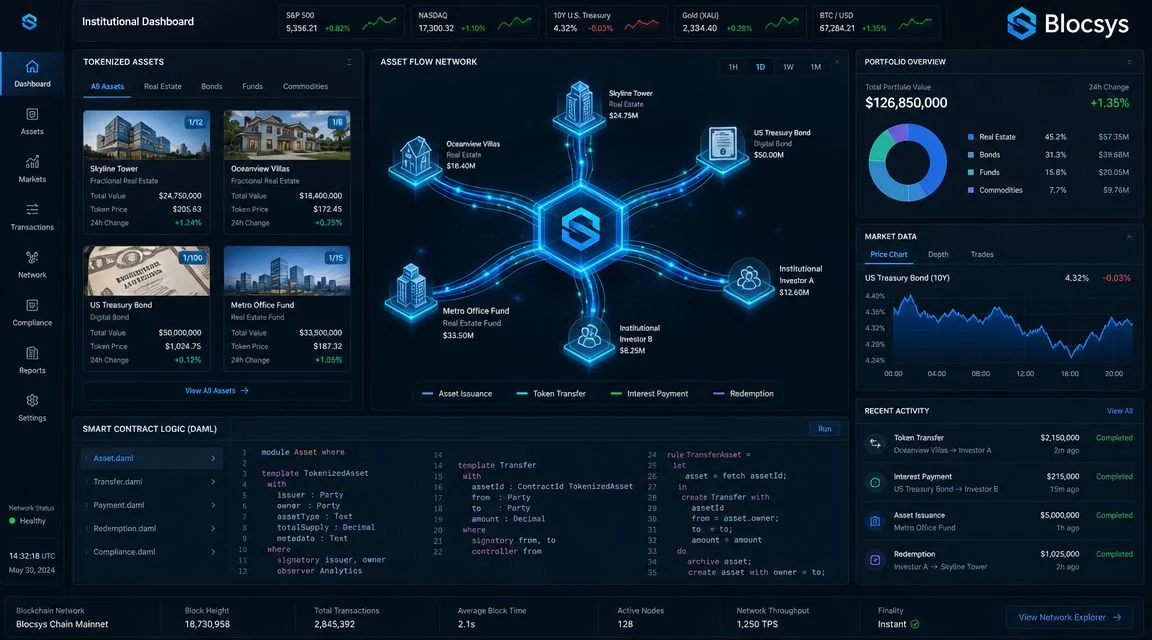
DAML becomes easier to evaluate when viewed through workflows rather than language features. In enterprise settings, the strongest use cases usually involve shared processes that cross legal entities, require role-based permissions, and need selective disclosure.
Where DAML fits best
A few patterns come up repeatedly in institutional design work:
- Tokenised assets with embedded rules: securities, funds, or private-market instruments often need transfer restrictions, role-based approvals, and lifecycle events tied to legal ownership.
- Post-trade coordination: allocation, affirmation, settlement preparation, and exception handling are multi-party by nature.
- Shared operating workflows: issuers, agents, custodians, distributors, and investors often need one process with segmented visibility, not a single public state.
In these cases, the attraction of DAML isn’t abstraction for its own sake. It’s that the contract model can express who has rights, who carries obligations, and who should see each part of the workflow.
That’s also why DAML often enters the conversation around real-world tokenisation use cases in US financial institutions, especially where privacy and auditability have to coexist.
Why capital markets paid attention early
One important historical marker was DAML’s use in capital-markets infrastructure connected to the Australian Securities Exchange trade-processing workflow. A University of Lausanne summary described that effort as targeting a 2021 deployment and noted that DAML’s built-in privacy and authorisation models were a core reason for selection, while Canton’s partitioned-state design addressed privacy and scaling bottlenecks seen in platforms such as Ethereum, according to the University of Lausanne summary on Daml and Canton.
That milestone matters for two reasons. First, it showed DAML moving beyond pilots into national-market infrastructure thinking. Second, it validated a core enterprise thesis: in regulated markets, workflow privacy and controlled coordination often matter more than universal transparency.
A short product walkthrough helps make that more concrete:
For tokenisation teams, the practical lesson is simple. The hard part is rarely minting a digital asset. The hard part is modelling issuance, permissions, transfers, servicing, reporting, and settlement in a way institutions can operate.
The Future of DAML and Canton Network in 2026
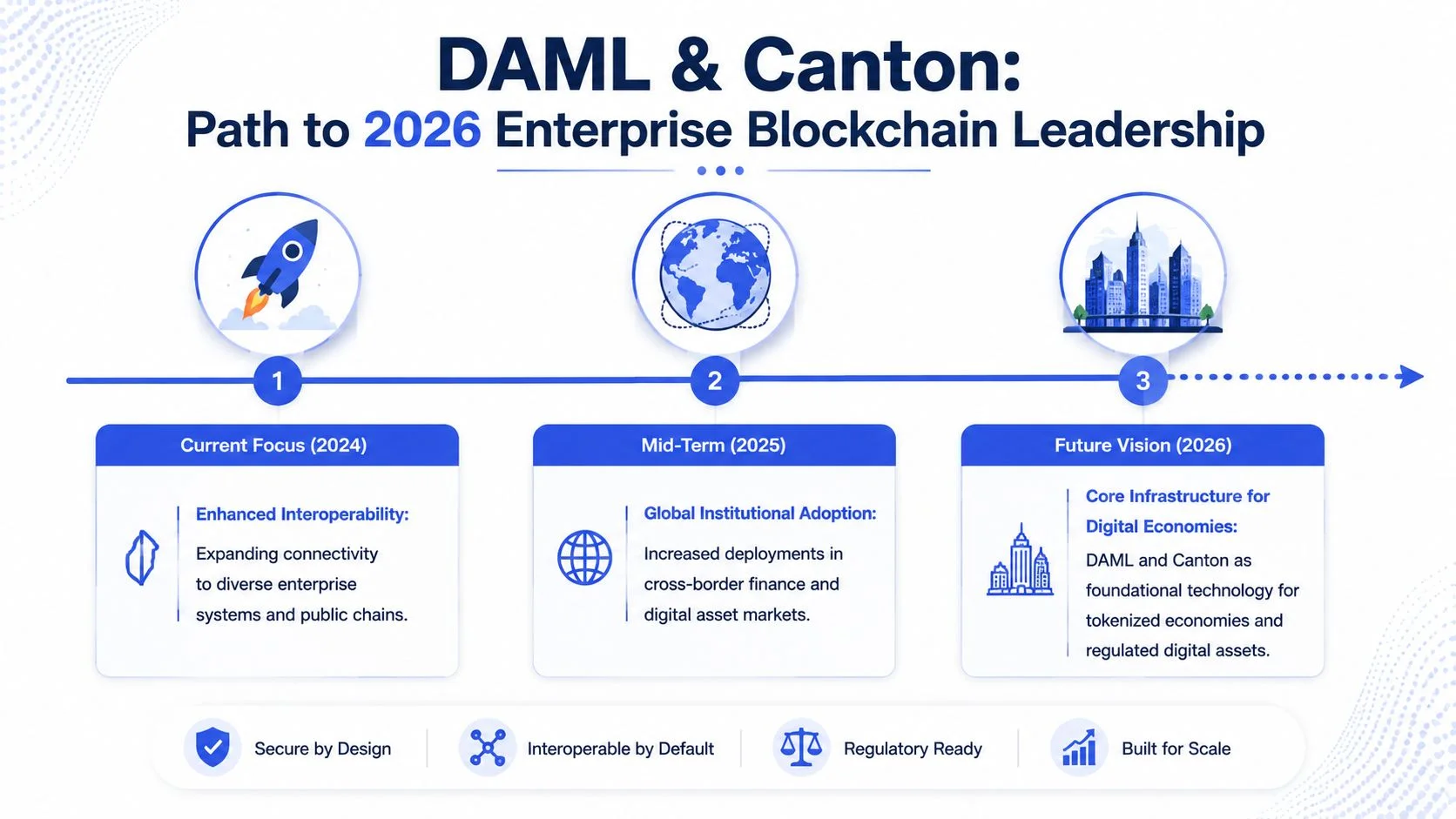
The most important 2026 question isn’t whether DAML is technically capable. It is. The core question is whether enterprise digital asset infrastructure will continue moving toward portable application logic, privacy-aware coordination, and cross-platform deployment. On that test, DAML and Canton are well aligned.
The strongest strategic argument is portability. DAML is architected as a portable smart-contract layer, and applications can be deployed across multiple ledgers and databases, including platforms such as Corda, Hyperledger Fabric, Besu, Sawtooth, VMware Blockchain, PostgreSQL, AWS Aurora, and AWS QLDB, as outlined in Digital Asset’s look into Daml with Kotlin and Java.
Portability becomes a strategic lever
That architecture has direct business implications.
- Infrastructure risk drops: teams aren’t forced to bind all business logic to one runtime from day one.
- Integration gets easier: heterogeneous enterprise estates can support a shared application model without full platform standardisation.
- Migration becomes less disruptive: organisations can modernise workflows while preserving optionality around ledger and database choices.
This is especially relevant in institutions where digital asset strategy is still evolving. Many firms don’t yet know which ledger topology, partner model, or interoperability route will dominate their operating environment. Portable application logic gives them room to move.
What enterprise leaders should watch
By 2026, the winning enterprise stacks will likely be those that handle three pressures well:
Systems need to be private enough for regulated markets, interoperable enough for ecosystem coordination, and operationally transparent enough for internal control.
The first pressure supports DAML and Canton. The second makes portable logic increasingly valuable. The third is where many deployments still need better engineering discipline.
That’s why forward-looking teams should pay attention to platform maturity around developer tooling, integration, migration, and operational governance, not only language design. Broader blockchain trends shaping enterprise adoption in 2026 point in the same direction. Enterprise buyers want systems that can plug into real business operations, not isolated proofs of concept.
Build Your Enterprise Blockchain with Blocsys and DAML
For organisations that want to turn DAML and Canton from architecture diagrams into production systems, the implementation gap is where most risk sits. That gap usually appears in workflow modelling, privacy boundaries, system integration, and migration from existing contract stacks.
Blocsys Technologies works in that gap. The team helps fintechs, exchanges, and digital asset businesses design production-ready blockchain and AI-powered platforms, with a focus on secure, scalable, enterprise-grade delivery.
What strong implementation support looks like
A capable delivery partner should be able to help with:
- Workflow modelling: translating legal and operational processes into executable contract logic.
- Privacy-aware architecture: deciding what each party must see, what they must not see, and how those boundaries affect APIs, reporting, and support tooling.
- Tokenisation platform design: structuring issuance, transfer, servicing, and settlement workflows for institutional products.
- Legacy and chain migration: rethinking public-chain assumptions before they become enterprise design flaws.
Teams evaluating enterprise delivery models often benefit from broader thinking on custom application projects, especially where integration complexity matters as much as core product logic.
Where specialist engineering matters most
Blocsys is positioned as an enterprise blockchain development company for organisations that need DAML development services, Canton Network solutions, institutional tokenisation systems, and privacy-preserving smart contract workflows. The value isn’t just writing code. It’s designing systems that work under real governance, operational, and regulatory constraints.
That matters most when the project involves:
- Institutional blockchain platforms
- Digital asset infrastructure
- Enterprise tokenisation platforms
- Smart contract migration from Solidity or legacy workflow engines
- Multi-party business processes with strict confidentiality requirements
Frequently Asked Questions about DAML and Canton
Can Solidity contracts be moved directly into DAML
Usually, no. The harder problem isn’t syntax translation. It’s redesigning the workflow around parties, visibility, and authorisation.
A 2026 Canton-related job posting explicitly framed the work as translating Ethereum smart contracts into DAML and Canton equivalents while preserving functional parity, privacy scoping, and platform compatibility, which is a strong signal that migration is a real implementation challenge, not a theoretical exercise, as described in this Canton DAML smart contract developer role.
What typically needs redesign:
- Contract keys and identity assumptions: Ethereum address logic doesn’t map cleanly to party-based workflow roles.
- Visibility boundaries: public-chain data exposure often has to be re-scoped for regulated access control.
- Workflow state transitions: DAML choices reflect business actions differently than Solidity function flows.
- Cross-domain orchestration: enterprise settlement and approval paths often need explicit modelling.
Does privacy-by-default make operations harder
Yes, it can. Privacy reduces unnecessary disclosure, but it also means teams must design support, monitoring, and audit workflows with more care.
Common operational friction points include incident debugging, cross-team investigations, and reconciling what one department needs to know against what the platform should reveal. In practice, successful teams define observability requirements early. They don’t bolt them on after the contract model is finished.
The operational mistake is assuming privacy architecture ends at the ledger. It extends into APIs, dashboards, reporting, support access, and escalation procedures.
How do regulated firms balance confidentiality with compliance reporting
They separate commercial visibility from supervisory visibility. That sounds obvious, but it requires deliberate system design.
A strong pattern is to model reporting outputs as authorised views rather than broadening underlying transaction access. Compliance teams usually need complete and reliable records for their remit. They don’t necessarily need the same default visibility as every operator, developer, or business user in the environment.
That means firms should define:
- Which roles need real-time access
- Which roles need after-the-fact reporting
- Which events require immutable audit evidence
- Which integrations must preserve minimised disclosure
Is DAML only for finance
No, but finance is where the fit is especially strong. DAML works best where workflows involve multiple parties, explicit rights and obligations, and non-trivial privacy rules.
Outside finance, the same model can make sense in any domain where several organisations must coordinate on one shared process without exposing all data to all participants. The common thread is governed collaboration, not a specific industry label.
When should a team choose DAML and Canton
Choose DAML and Canton when the workflow has most of these characteristics:
- Multiple institutions or business units must coordinate
- Not every participant should see the full transaction
- Authorisation rules are central to the application
- Auditability matters
- You need portability across infrastructure choices
- Public-chain transparency is a poor fit for the business model
Avoid forcing DAML into use cases that are fundamentally public, highly composable, and built around globally shared on-chain state. In those cases, a public-chain stack may be the cleaner answer.
If your team is evaluating DAML language, DAML smart contracts, or Canton Network for tokenisation, capital markets workflows, or enterprise blockchain infrastructure, Blocsys Technologies can help you assess fit, design the right architecture, and build a production-ready solution. Connect with Blocsys to plan migration paths, privacy-preserving workflows, and institutional-grade digital asset platforms with experienced engineering support.
