
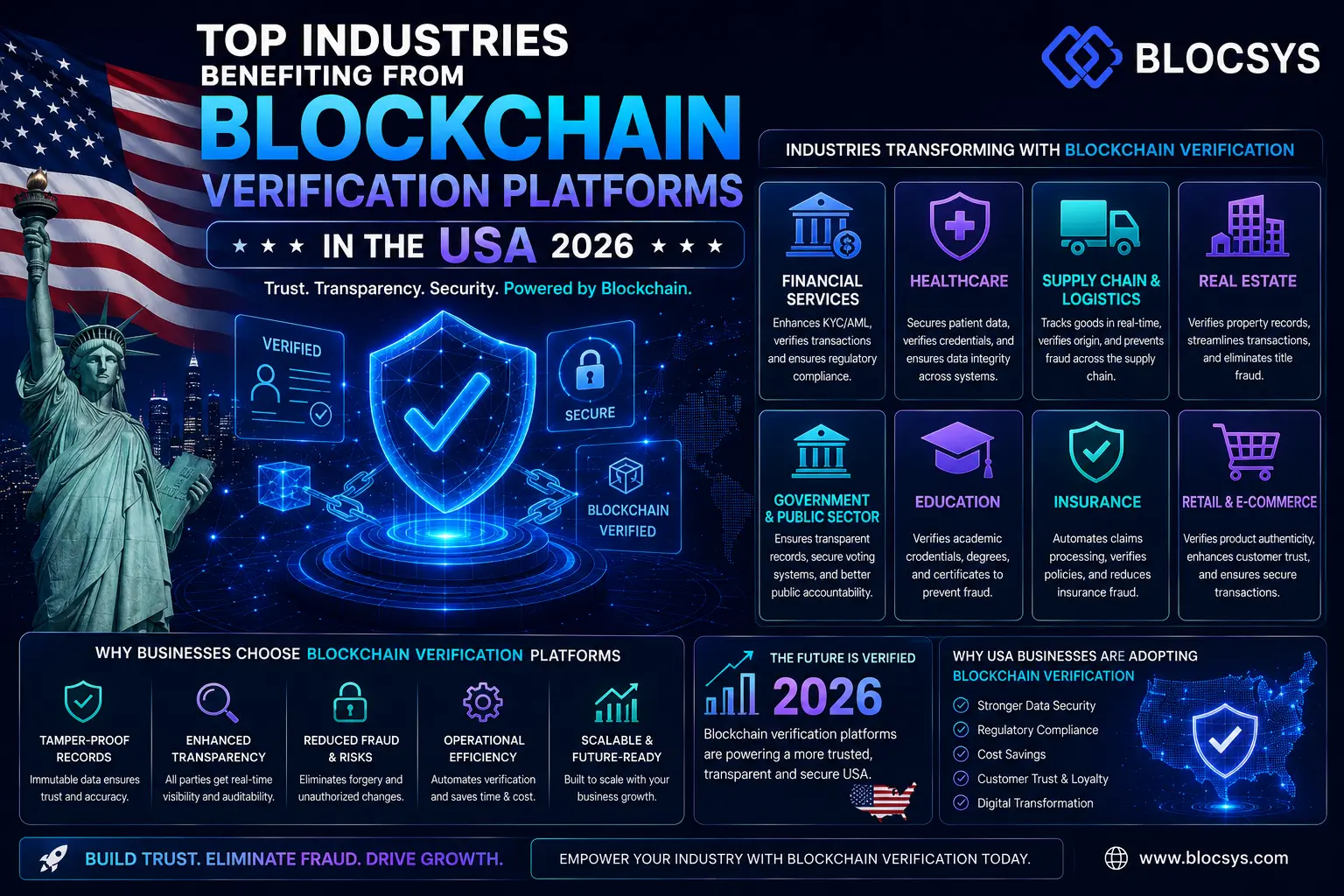
North American demand is pushing blockchain verification out of innovation labs and into production systems, especially in sectors where records move across legal entities, vendors, regulators, and audit teams. In the US, that shift is no longer about interest in blockchain as a category. It is about fixing verification workflows that break under fraud pressure, compliance deadlines, and fragmented data ownership.
Verification now sits inside core operations. Teams need to prove that a document, identity, consent record, asset event, or compliance action is authentic, time-bound, and unchanged after approval. Traditional tools struggle once that proof has to survive across multiple parties, multiple systems, and external review. A shared verification layer starts to make sense when email trails, scanned PDFs, manual reconciliations, and point-to-point integrations create delay, dispute risk, or audit cost.
2026 is a practical decision point. Zero trust programs are maturing. AI-assisted fraud is improving faster than many controls. Regulators expect better evidence trails, not just policy statements. Enterprise leaders are also under pressure to automate compliance work without adding more human review steps. That combination makes blockchain verification relevant now, but only for the right problem set. A broader view of why enterprises are adopting tamper-proof verification platforms in 2026 helps frame where the model fits and where it does not.
The key question is operational, not theoretical. Does the business have a multi-party trust problem that current systems cannot handle efficiently? If the answer is yes, a blockchain verification platform can reduce dispute resolution time, strengthen auditability, and prevent specific classes of record tampering and process fraud. If the answer is no, a conventional database with strong access controls is often the better choice.
Security leaders coming from established assurance frameworks already understand this trade-off. The same discipline behind comprehensive CISSP study materials applies here. Start with asset integrity, chain of custody, access control, and evidentiary requirements. Then choose the architecture that fits the risk.
This guide is written for enterprise leaders making that call in 2026 across regulated industries in the USA.
Table of Contents
- The Rise of Blockchain Verification in a Zero Trust World
- The Trust Deficit in Traditional Verification Systems
- The Architecture of a Blockchain Verification Platform
- Top US Industries Capitalizing on Blockchain Verification
- From Pilot to Production A Realistic Implementation Roadmap
- How Blocsys Engineers Enterprise-Grade Verification Platforms
- Frequently Asked Questions About Blockchain Verification
- What is a blockchain verification platform
- Which industries benefit most from blockchain verification
- How does blockchain prevent document fraud
- Why are healthcare organizations adopting blockchain verification
- How can governments use blockchain verification systems
- What are the benefits of tamper-proof document authentication
- How can Blocsys build enterprise blockchain verification platforms
The Rise of Blockchain Verification in a Zero Trust World
A blockchain verification platform is a system that records proofs of authenticity, approvals, or transaction events on a distributed ledger so authorised participants can verify that a record is genuine and hasn’t been altered. It is not mainly about cryptocurrency. It is about creating a tamper-evident, shared source of truth for documents, identities, workflows, and cross-party transactions.
Most enterprise buyers arrive here after trying to solve the same problem with portals, email approvals, API integrations, shared drives, and audit logs from half a dozen systems. Those tools can work inside one company. They start to break down when records move between counterparties, regulators, vendors, carriers, providers, or public agencies.
Why 2026 is different
The timing matters because organisations are under pressure to verify more things, across more systems, with stronger auditability. The sectors moving first are the ones where trust failures are expensive. For security teams that want a stronger grounding in how trust boundaries, access control, and risk architecture intersect, these comprehensive CISSP study materials are a useful reference.
The practical shift in 2026 is that verification platforms are being assessed as compliance and operations infrastructure. That is especially true in the USA, where payments, regulated reporting, identity proofing, and document authenticity have direct business consequences.
Practical rule: Blockchain verification works best when several parties need to trust the same record, but none of them should be able to rewrite history unilaterally.
Teams evaluating this category usually compare classic document authentication platforms, digital identity verification tools, and workflow automation systems against ledger-based approaches. The difference is that blockchain makes the proof portable across organisations. For a broader enterprise view, this analysis of why enterprises are adopting tamper-proof verification platforms in 2026 frames the shift well.
The Trust Deficit in Traditional Verification Systems
Traditional verification systems fail less because the software is broken and more because the operating model is fragmented. One party stores the master file. Another stores a copy. A third stores a signed version. A fourth keeps a compliance log. When a dispute happens, everyone argues over which system is authoritative.
That problem shows up everywhere. A bank tries to validate customer documents across onboarding, transaction monitoring, and periodic review. A hospital tries to prove who accessed patient records and whether consent was current at that moment. A manufacturer tries to confirm whether a sourcing certificate travelled with the goods or was added later.
Where legacy verification breaks
Three weaknesses appear repeatedly.
- Data silos: Each party keeps its own database, so reconciliation becomes routine work rather than an exception.
- Mutable records: Audit logs can exist, but many systems still allow privileged users to change underlying records or metadata.
- Manual validation layers: Operations teams end up checking files, timestamps, approvals, and source systems by hand.
The result isn’t just inefficiency. It creates uncertainty about provenance, timing, and accountability.
A finance example
In a multi-party finance workflow, one institution may verify identity documents, another may review transaction history, and another may need evidence that checks were completed before funds moved. If each party relies on separate logs and scanned evidence packs, the process becomes slow and fragile.
When something doesn’t match, teams don’t just fix one field. They retrace the workflow, confirm sign-offs, and rebuild an audit trail after the fact. That is expensive operationally and risky from a compliance standpoint.
Legacy verification often creates “proof by paperwork”. Modern verification needs proof by system design.
A healthcare example
Healthcare has the same issue with higher sensitivity. Access logs, consent states, and data handoffs often span providers, labs, insurers, and administrators. If one participant updates a record and others don’t see the same event trail, disputes arise around timing, authorisation, and patient rights.
The challenge isn’t that hospitals lack systems. They usually have too many. The problem is that those systems weren’t designed to provide a single tamper-evident chain of custody across organisational boundaries.
| Traditional approach | What usually happens | Business consequence |
|---|---|---|
| Central database with role controls | One owner becomes the de facto trust authority | Counterparties still demand secondary proof |
| Email or PDF document exchange | Version confusion and missing approvals | Delays, rework, audit friction |
| Point-to-point API integrations | Data moves, but proof context is inconsistent | Harder incident review and compliance response |
| Manual document checks | Human review catches some issues late | Costly exceptions and slow turnaround |
A lot of teams discover that “secure” and “verifiable” are not the same thing. A system can be secure in isolation and still be poor at cross-party trust. This comparison of centralized vs blockchain-based document verification which is more secure is useful because it separates internal system control from shared proof.
The Architecture of a Blockchain Verification Platform
The cleanest way to understand a blockchain verification platform is to think of it as a shared digital notary with automation built in. It doesn’t usually store every document directly on-chain. Instead, it stores cryptographic proof that a document, transaction, or event existed in a specific state at a specific time, and that approved participants validated it under agreed rules.
What the platform actually does
A typical workflow looks like this. A user uploads a document, certificate, claim file, identity credential, or transaction payload. The platform generates a cryptographic hash, which acts like a unique fingerprint of that content. That fingerprint is anchored to the ledger, along with metadata, workflow state, and permissions logic.
If anyone changes the underlying content later, the fingerprint no longer matches. Verification fails immediately.
The core components that matter
Not every component matters equally to business leaders. These ones do.
- Distributed ledger layer: This gives multiple authorised parties a consistent event history without requiring one central owner to maintain trust for everyone else.
- Hashing and proof generation: This is what makes tampering visible. The system doesn’t rely on someone noticing a changed file manually.
- Smart contract logic: This encodes business rules such as approval sequencing, access conditions, expiry states, or release triggers.
- Identity and permissions layer: Enterprise systems still need role-based access, consent management, and policy enforcement. Blockchain doesn’t remove that requirement.
- Audit and verification interfaces: Users need to verify records without needing to understand wallets, nodes, or low-level chain data.
Where teams get the design wrong
The biggest design mistake is putting too much raw data on-chain. For enterprise verification, that usually creates privacy, storage, and governance issues. In healthcare and regulated document flows, the better design is often to keep sensitive files off-chain and anchor proofs, permissions, and event logs on-chain.
Another common mistake is ignoring throughput and cost patterns. If every tiny event becomes its own chain transaction, the platform can become unnecessarily expensive and operationally awkward. Techniques such as proof aggregation matter, with Merkle batching one chain transaction for thousands of proofs becoming relevant for enterprise architecture.
Strong verification platforms are hybrid systems. Off-chain storage handles scale and privacy. On-chain proofing handles trust and integrity.
A sound architecture usually includes:
- Enterprise data sources such as EHRs, CRMs, ERPs, claim systems, student information systems, or government registries.
- A verification middleware layer that handles hashing, policy checks, APIs, and orchestration.
- A permissioned or public-chain anchoring model depending on governance, privacy, and interoperability needs.
- User-facing verification services for auditors, counterparties, administrators, and end users.
That stack matters because a blockchain verification platform isn’t a chain alone. It is an integration product, a policy engine, and an audit system working together.
Top US Industries Capitalizing on Blockchain Verification
Nearly every serious blockchain verification programme I see in 2026 starts the same way. A regulated process has too many parties, too many exceptions, and too much fraud or audit exposure for ordinary system logs to hold up.
The strongest US adopters are not buying blockchain to modernize their brand. They are buying verifiable process evidence. The timing matters. By 2026, more firms are dealing with tighter audit demands, AI-driven fraud, partner ecosystem risk, and higher expectations for machine-readable compliance. That combination makes blockchain verification attractive in a narrow set of environments. Shared workflows, disputed records, and costly verification failures.
Finance and payments
Financial services remains the clearest fit because the verification burden is constant and the cost of error is high. Banks, lenders, payment firms, custodians, and market infrastructure providers all run workflows where one disputed document or one unverifiable approval can trigger manual review, delayed settlement, or a regulator question.
The operational triggers are straightforward:
- Customer onboarding files that must be provably authentic
- Counterparty records that change across entities
- Payment and settlement events that need a tamper-evident audit trail
- Compliance checks that must be shown in sequence, not just reported after the fact
- Tokenized asset workflows where transfer integrity matters as much as ownership data
The practical value is not the chain by itself. The value is a shared proof layer across compliance, operations, risk, and external counterparties. In production, that usually means anchoring evidence that a document was validated, a policy ran, and an approval happened under a defined rule set.
Banks often start with one narrow workflow, such as KYC refreshes or corporate document handling. A useful example is how banks use blockchain for secure customer document verification.
Finance also has the strongest funding interest because the business case is easier to model. Lower fraud losses, fewer reconciliation breaks, and faster audit response times are all measurable. For founders building regulated infrastructure in this segment, investor readiness matters. If you’re mapping the capital market around this space, this list of firms helping teams discover blockchain VCs is a practical starting point.
Supply chain and logistics
Supply chain teams adopt verification platforms when provenance turns into a commercial, legal, or safety requirement. That is common in food, pharma, advanced manufacturing, defense supply chains, cross-border logistics, and authenticity-sensitive goods.
IBM notes that blockchain can improve traceability, transparency, and security by creating an auditable record across an asset’s journey and reducing document handling errors and third-party verification overhead in its overview of blockchain benefits.
That maps well to supply chain verification, but only under the right conditions. The process needs multiple independent participants. The handoffs need evidence. The records need to survive disputes.
The strongest patterns include:
- Product-origin tracking: proving source claims and preventing retroactive edits to origin records
- Shipment and customs documentation: preserving a verifiable event sequence across brokers, carriers, warehouses, and buyers
- Counterfeit reduction: tying the product record to custody history and inspection events
- Certification integrity: anchoring sourcing, quality, or ESG documents so tampering is easier to detect
There is a hard trade-off here. A ledger can preserve a clean chain of custody, but it cannot fix weak data capture at the edge. If barcode scans are skipped, sensors fail, or suppliers enter bad data, the platform records bad evidence faithfully. Teams need stronger participant identity, better scanning discipline, and exception workflows before they expand chain usage.
If the dispute is about provenance across companies, blockchain verification fits. If the issue sits inside one plant’s broken data-entry process, fix that first.
Healthcare
Healthcare adoption is being driven by integrity and auditability, not by a push to move clinical records onto a chain. Hospitals, payers, health information exchanges, labs, and credentialing bodies need reliable proof of who accessed data, who approved disclosure, and whether a sensitive workflow followed policy.
That makes blockchain verification useful in several high-risk areas:
- Patient consent records
- Access logs for protected health information
- Provider credential verification
- Inter-organizational record exchange evidence
- Audit trails for sensitive updates and disclosures
The implementation pattern is usually conservative, for good reason. EHRs and clinical repositories remain the operational systems of record. The verification platform sits alongside them and anchors proofs of access, consent, issuance, or change events. That separation helps with privacy, scale, and retention requirements while still giving compliance and audit teams something stronger than ordinary application logs.
The why now is clear. Healthcare organizations are under pressure to prove governance across distributed vendors, affiliated providers, and external partners. Manual audit reconstruction is too slow, and trust assumptions between parties are weaker than they were a few years ago.
Government services
Government agencies have a persistent verification problem. Records pass through departments, contractors, courts, residents, and auditors, often over long time horizons. Internal logs are useful, but they do not always create enough trust when a record is challenged outside the originating agency.
That makes blockchain verification a serious option for:
- Public records and registries
- Permits and licenses
- Benefits eligibility documentation
- Procurement and grant approvals
- Digital identity and attestation workflows
Adoption is slower here than in finance. Procurement cycles are longer, governance is heavier, and interoperability requirements are harder to settle. Still, the fit is strong where agencies need durable proof of custody, issuance, approval history, or document integrity that can be checked by multiple external parties without relying on one department’s database snapshot.
The best public-sector programmes stay narrow at first. A permit trail. A contractor credentialing process. A document authenticity service for one agency cluster. That is how teams get legal, security, and operational alignment before expanding.
Education, legal, insurance, and HR
These sectors are smaller buyers today, but they contain some of the cleanest verification use cases in the market. The pattern is consistent. A credential, document, or approval must be trusted by another party that does not control the source system.
| Industry | Good verification use case | Common adoption trigger |
|---|---|---|
| Education | Diplomas, certificates, transcripts, research credentials | Credential fraud and third-party verification delays |
| Legal | Document authenticity, filing histories, evidence provenance | Chain of custody and dispute defensibility |
| Insurance | Claims documents, policy event trails, identity-linked approvals | Fraud review, litigation exposure, and audit pressure |
| HR | Employment records, training certificates, onboarding credentials | Faster trust checks across employers, staffing firms, and partners |
These industries should use blockchain verification surgically. Universities do not need student records on-chain to make credentials portable. Legal teams do not need every document on a ledger to prove evidence integrity. Insurers do not need a chain for every claim note.
They need proof at the points where disputes, fraud, or partner mistrust create real cost. That is the decision test for 2026. If a process crosses organizational boundaries, carries regulatory or legal exposure, and still depends on weak verification methods, blockchain deserves a serious review.
From Pilot to Production A Realistic Implementation Roadmap
A large share of blockchain verification pilots fail for a simple reason. The team started with interest in the technology, not with a process failure that carries measurable cost, regulatory exposure, or fraud risk.
In 2026, the strongest production cases are being driven by operational pressure. Audit teams want faster evidence collection. Compliance leaders want policy enforcement that can be proven after the fact. Business units want fewer disputes with counterparties, fewer manual checks, and less time spent reconciling records across systems that were never designed to trust each other.
That changes how the roadmap should be built.
Start with the operational trigger
Pick the event that keeps breaking the process. A forged document. A disputed approval. A partner record that cannot be verified quickly enough for a regulated workflow. A chain of custody gap that creates legal exposure.
The right starting point is usually one of four triggers:
- Fraud reduction: forged credentials, altered records, duplicate submissions, or impersonated approvals
- Compliance evidence: proof that controls, reviews, and sign-offs occurred in the required order
- Cross-organization verification: a shared truth needed by suppliers, providers, auditors, customers, or regulators
- Asset or document provenance: proof of origin, transfer, status, or version history
If the business owner cannot define the trigger in one sentence, the pilot scope is still too vague.
Scope the first production candidate tightly
Early success comes from a narrow workflow with high friction and clear evidence requirements. One document type is enough. One approval path is enough. One department is enough, if the failure mode is expensive and the result can be tested in a real audit, dispute, or partner review.
A practical sequence looks like this:
- Choose a workflow with repeatable verification pain.
- Define the proof required. Authenticity, timestamp, signer identity, consent, approval state, origin, or transfer history.
- Map the operating stack. System of record, identity provider, API layer, storage, notification logic, and audit consumers.
- Set business success criteria. Fewer disputes, shorter verification time, lower review effort, cleaner audits, or better partner acceptance.
- Set governance early. Who submits records, who attests, who verifies, who can revoke, and who handles exceptions.
This is also the point to decide what does not belong on-chain. In regulated environments, sensitive payloads usually stay off-chain, while hashes, timestamps, status changes, and verification proofs are anchored on-chain. That design avoids privacy mistakes and keeps storage costs under control.
Production readiness is mostly an operating model question
Chain selection matters, but it is rarely the reason a program succeeds or fails. Production readiness depends more on identity controls, exception handling, legal acceptance of the evidence model, and the quality of integrations with existing systems.
Teams should test five areas before expanding scope:
- Integration reliability with source systems and downstream audit tools
- Permissioning and privacy controls across internal and external users
- Exception handling for bad inputs, rejected records, and disputed attestations
- Evidence retrieval for auditors, investigators, and counterparties
- Record lifecycle rules for revoked, expired, corrected, or superseded records
Security review should happen before rollout, not after procurement and architecture are locked. For teams exposing admin consoles, APIs, or verifier portals, this guide on SaaS application security is a useful reference for scoping testing requirements.
Build the platform around real users, not blockchain abstractions
Operations teams need simple intake and review flows. Compliance teams need visible control points and exportable evidence. External verifiers need a fast way to confirm authenticity without getting access to internal systems. Engineering needs observability, key management, and clear failure recovery procedures.
That is why enterprise teams usually deploy a hybrid pattern instead of a pure on-chain application. A purpose-built tamper-proof document verification platform typically combines off-chain document storage, cryptographic hashing, role-based access, workflow logic, and an immutable proof layer. The ledger supports trust. It does not replace every system around it.
The pilot is ready for production when compliance, operations, and engineering all agree on one point. The verification output can stand up in a real audit, partner review, or business dispute.
How Blocsys Engineers Enterprise-Grade Verification Platforms
Enterprise verification platforms are hybrid systems. They need document workflows, identity controls, cryptographic proofing, audit visibility, and secure integrations with the systems companies already run. That is where teams usually need an engineering partner rather than a generic low-code tool.
What enterprise teams usually need
In regulated environments, the implementation brief is rarely “put this on-chain”. It is usually closer to:
- connect verification to existing systems of record
- make tampering evident without exposing sensitive data
- automate policy checks and approval states
- give auditors and counterparties a simple way to verify proof
- keep the platform operable by internal teams
One option in this space is Blocsys Technologies, which builds blockchain and AI infrastructure for fintechs, exchanges, tokenization projects, and compliance-oriented digital platforms. For verification-specific requirements, its work on a tamper-proof document verification platform is directly aligned with enterprise document authentication and secure record workflows.
Where execution tends to fail
Most failures happen in three places: weak requirements, poor integration planning, or underestimating security hardening. Verification platforms live close to sensitive data and high-value workflows, so architecture review and testing cannot be treated as a final step. This guide on SaaS application security is a useful reminder of how quickly platform risk grows when security assumptions aren’t validated early.
The better pattern is to design verification as part of a broader trust stack. Identity, access, auditability, smart contract review, off-chain data handling, and monitoring all need to line up. That is what separates a pilot that demos well from a platform that survives legal, regulatory, and operational scrutiny.
Emerging Blockchain Applications Driving Enterprise Verification in the USA
Blockchain verification platforms are becoming one of the most valuable blockchain applications across U.S. industries as organizations prioritize data integrity, compliance, and digital trust. Beyond cryptocurrency, enterprises are implementing blockchain-based verification to authenticate documents, verify digital identities, secure healthcare records, track supply chain transactions, and protect intellectual property. Financial institutions are also leveraging blockchain to validate digital asset ownership and maintain immutable audit trails for regulatory reporting. These enterprise blockchain applications help eliminate manual verification processes, reduce fraud risks, and improve operational efficiency through transparent, tamper-proof records. As blockchain adoption continues to accelerate across the United States, businesses investing in secure verification infrastructure are better positioned to meet evolving compliance requirements while building greater trust with customers, partners, and regulators. Organizations seeking enterprise-grade blockchain solutions can leverage Blockchain Development Services to build scalable verification platforms tailored to industry-specific compliance and security needs.
Frequently Asked Questions About Blockchain Verification
What is a blockchain verification platform
A blockchain verification platform records proofs of authenticity, workflow events, or approvals on a distributed ledger so authorised parties can verify that a document, identity record, or transaction history hasn’t been altered. In practice, it acts as a tamper-evident trust layer across organisations, not just a database inside one company.
Which industries benefit most from blockchain verification
In the USA for 2026, the strongest beneficiaries are financial services, supply chain and logistics, healthcare, and government-related record workflows. These sectors share the same need: trusted records across multiple parties, strong auditability, and lower tolerance for fraud, data disputes, or unverifiable process history.
How does blockchain prevent document fraud
Blockchain doesn’t stop someone from creating a false document in the first place. It makes unauthorised changes and disputed versions much easier to detect by anchoring cryptographic proof, timestamps, and workflow history. If the content changes after verification, the proof no longer matches and the record fails validation.
Why are healthcare organizations adopting blockchain verification
Healthcare organisations use blockchain verification where access logs, consent history, and record provenance matter across multiple systems and parties. The value is strongest when hospitals, providers, labs, or administrators need a consistent tamper-evident event trail that supports compliance and makes disputes easier to resolve.
How can governments use blockchain verification systems
Governments can use blockchain verification for records that require strong authenticity and durable audit trails, such as licences, permits, identity-related workflows, procurement records, and public document verification. The main value is trustworthy proof across departments and external stakeholders without relying on one mutable administrative copy.
What are the benefits of tamper-proof document authentication
Tamper-proof document authentication helps organisations detect alteration early, reduce reliance on manual cross-checking, improve audit readiness, and establish shared trust across counterparties. It is especially useful when documents pass through several systems or institutions and each participant needs confidence in the same version and event history.
How can Blocsys build enterprise blockchain verification platforms
Blocsys can support enterprise verification by designing the full stack around it: blockchain proofing, smart contract workflows, integration layers, admin systems, audit interfaces, and security controls. That matters when the platform must fit existing operations, meet compliance requirements, and work reliably beyond a proof of concept.
If your organisation is evaluating a blockchain verification platform, blockchain document verification, digital identity verification, or a tamper-proof verification system for regulated workflows, connect with Blocsys Technologies. The team works on secure blockchain and AI infrastructure for enterprise-grade products, including document authentication, compliance workflows, tokenization systems, and verification platforms built for production environments.
Blockchain Adoption Across Key US Business Sectors
The growing adoption of fintech blockchain is helping financial institutions strengthen transaction verification, recordkeeping, and compliance, making financial services one of the important areas for blockchain verification platforms in the USA. At the same time, tokenization data security is becoming increasingly relevant as businesses manage digital representations of assets and ownership records that require secure and verifiable data. Similar benefits are emerging across healthcare, supply chain, insurance, and real estate, where organizations need reliable records for credentials, product histories, claims, and ownership. These developments reflect the broader expansion of blockchain technology into practical business processes where transparency, data integrity, and trusted verification are essential.
