
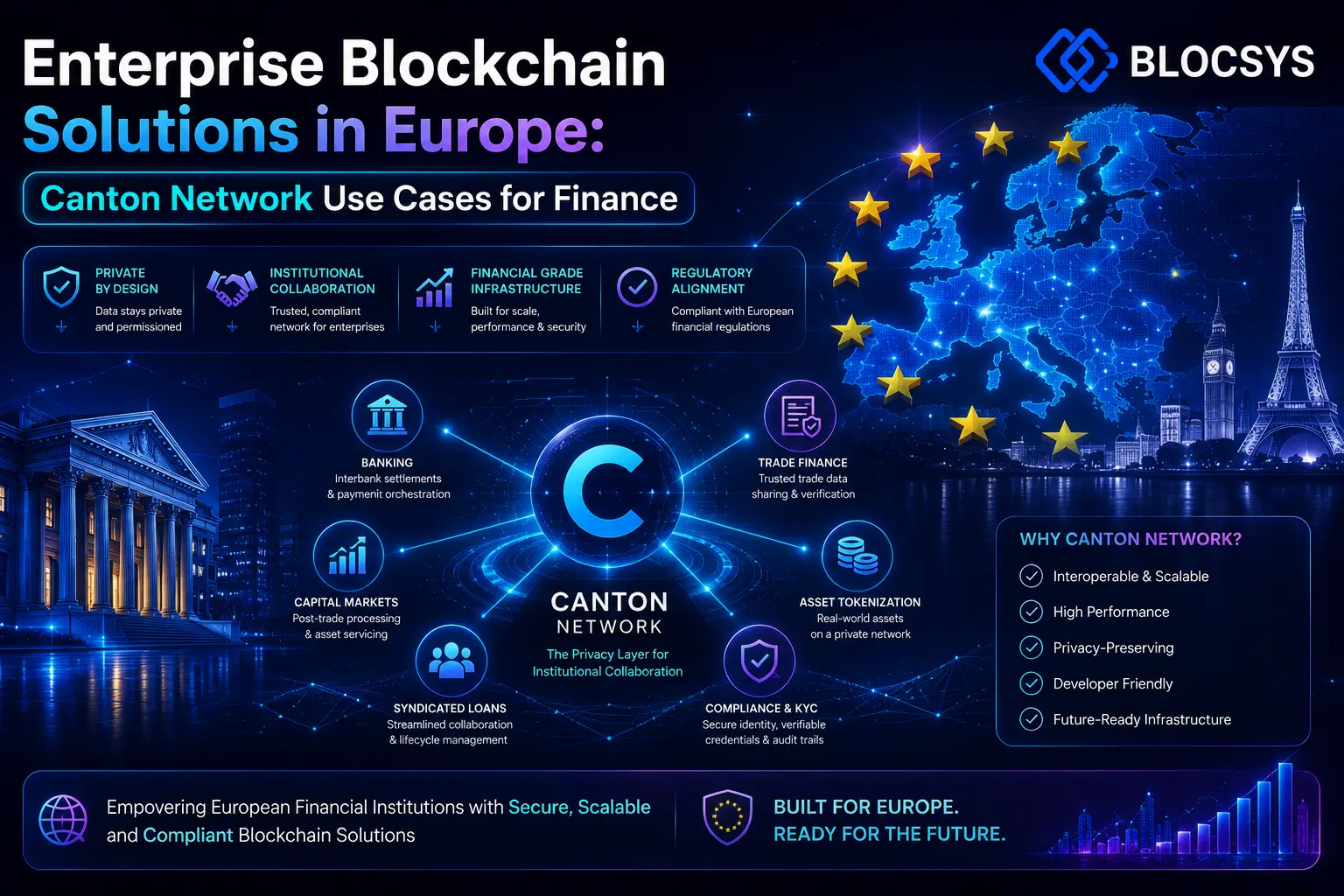
Institutional finance doesn’t need another generic blockchain pitch. It needs infrastructure that can handle regulated workflows at real scale. That’s why Canton matters. It’s already positioned for tokenized real-world assets at approximately $4T in TVL, including over $1.5T per month in tokenized UST repo, with ecosystem participation that includes BNP Paribas, Deutsche Börse Group, and Deloitte according to Kiln’s Canton overview.
For European banks, market infrastructures, custodians, and fintech teams, the issue isn’t whether distributed systems can create value. The issue is whether they can do it without exposing confidential transaction data, creating fresh operational silos, or colliding with governance and control requirements. Canton’s design addresses that problem directly.
The discussion around enterprise blockchain solutions in Europe then takes a more practical turn. The value of Canton isn’t “blockchain for blockchain’s sake”. It’s the way a network of networks can let separate institutions keep control of their own environments while still coordinating transactions atomically across organisational boundaries.
Table of Contents
- The Next Evolution of European Financial Infrastructure
- What Is the Canton Network? A New Blueprint for Finance
- Solving Core Challenges in Traditional Capital Markets
- Enterprise Use Cases for Canton Network in European Finance
- Navigating Privacy Compliance and Interoperability
- How Blocsys Engineers Enterprise-Grade Canton Network Solutions
- Frequently Asked Questions About Canton Network for Finance
The Next Evolution of European Financial Infrastructure
European finance already runs on highly structured systems, but those systems remain fragmented by institution, product, and operating model. That fragmentation shows up in slow coordination, repeated reconciliation, duplicated controls, and expensive handoffs between parties that all maintain their own version of the same process.
The pressure is rising from multiple directions at once. Digital assets are moving from pilot activity into regulated market design. Treasury and collateral teams want tighter capital efficiency. Operations leaders want fewer breaks across issuance, servicing, trading, and settlement. Technology leaders want modern infrastructure without giving up control over privacy and governance.
A lot of enterprise blockchain projects failed because they treated openness and confidentiality as mutually exclusive. Public chains offered broad interoperability but exposed too much data for institutional workflows. Private ledgers protected data but often created one more silo. Canton is relevant because it targets the problem more precisely.
Practical rule: In regulated finance, interoperability only matters if firms can use it without surrendering confidentiality, control, or operating discipline.
That’s why the “network of networks” model deserves executive attention. It aligns more closely with how financial institutions operate. Different firms, platforms, and market utilities keep their own systems, permissions, and governance models, yet can still transact across shared workflows when needed.
For leaders evaluating enterprise blockchain architecture and implementation models, Canton is one of the more credible blueprints because it starts with the constraints of finance rather than asking finance to adapt to consumer-style blockchain assumptions.
What Is the Canton Network? A New Blueprint for Finance
The Canton Network was launched on 9 May 2023 as the financial industry’s first privacy-enabled interoperable blockchain network for institutional assets, according to Digital Asset’s launch announcement. That matters because it framed Canton from day one as infrastructure for regulated financial-market workflows, not as a generic public chain looking for enterprise use cases later.
Why Canton is structurally different
Canton’s core idea is simple, but its implications are significant. It is a network of networks. Each participant or application can operate in its own controlled environment, yet still coordinate with others through a shared layer that supports interoperability.
That’s different from the two models most firms already know:
- Public blockchain model: Broad shared state, high transparency, limited confidentiality for institutional workflows.
- Traditional private ledger model: Strong control inside one environment, weak interoperability across institutions.
- Canton model: Independent domains with shared coordination, so privacy and cross-network execution can coexist.
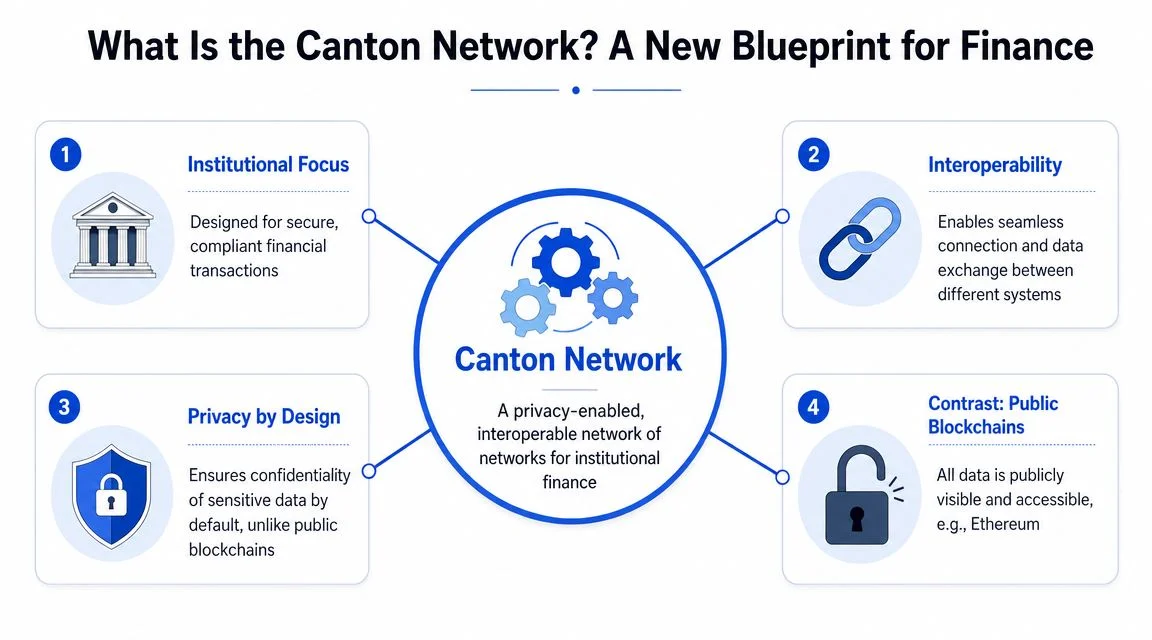
In practical terms, that means transaction details are not broadcast to every participant. Instead, the relevant parties see the relevant data. At the same time, the network can coordinate multi-party actions so transactions settle consistently across connected applications.
A useful way to think about it is this. Most financial institutions don’t want one giant shared database for the whole market. They want controlled local systems that can still “speak” to other trusted systems without manual stitching, duplicated records, or opaque bridge logic. Canton is designed around that operating reality.
One technical advantage is that it supports atomic interoperability. In plain language, that means linked actions across separate applications can complete together or fail together. For finance, that is much closer to the risk logic required for delivery-versus-payment, collateral movement, and coordinated settlement.
Why executives should care
This architecture changes the buying conversation. The question shifts from “Should we put this workflow on a blockchain?” to “Which workflows benefit when private applications can interoperate without losing control?”
That’s why Canton is increasingly discussed in the context of institutional-scale finance rather than retail crypto. If you want a quick market-facing reference point alongside the architecture discussion, CoinStats maintains comprehensive Canton Network data that can help teams track the broader ecosystem context.
From an implementation perspective, the design also aligns well with contract-centric business logic. Teams exploring how workflow rules are expressed in this environment often look at Daml as the smart contract framework associated with Canton because it maps legal and operational obligations more naturally than generic token scripting.
The real innovation isn’t that Canton uses blockchain. It’s that it treats privacy and interoperability as co-equal design requirements.
Solving Core Challenges in Traditional Capital Markets
Capital markets still suffer from an old systems problem. Each institution has its own books, controls, and workflow engines. That’s sensible internally, but across a transaction chain it creates friction. Firms spend time confirming state, validating instructions, matching records, and managing timing gaps between legal agreement and operational completion.
Where traditional workflows break down
The problem isn’t only speed. It’s coordination risk.
When issuers, custodians, brokers, counterparties, and servicing agents all depend on separate systems, several issues appear repeatedly:
- Data fragmentation: Each party records the transaction in its own way.
- Operational reconciliation: Teams spend effort confirming what should already be known.
- Settlement exposure: Asset movement and cash movement may depend on separate timing paths.
- Liquidity drag: Assets that could be mobilised more dynamically remain operationally trapped.
This is also where many “blockchain for finance” pitches become unhelpful. If a platform can’t preserve confidentiality, it won’t pass institutional scrutiny. If it can’t coordinate multiple ledgers atomically, it won’t remove the hard parts of settlement.
For adjacent workflow improvement, it’s worth looking at tools outside the ledger itself. For example, many firms are using financial document automation workflows from Matil to reduce manual processing around onboarding, approvals, and reporting packages that still sit around the transaction core.
Traditional Finance vs. Canton Network
| Challenge Area | Traditional System (Pain Point) | Canton Network (Solution) |
|---|---|---|
| Data visibility | Multiple parties maintain separate records and share data selectively through messages and files | Relevant parties share coordinated transaction state while preserving confidentiality |
| Reconciliation | Operations teams repeatedly confirm status across systems | Shared coordination reduces the need for duplicated post-trade checking |
| Settlement logic | Linked obligations may complete on different timelines | Atomic interoperability supports all-or-nothing execution across connected applications |
| Privacy | Data is often over-shared operationally or constrained into bilateral silos | Transaction details are visible only to the involved parties |
| Interoperability | Private systems usually require bespoke integration and middleware | Independent applications can interoperate through a common coordination model |
| Collateral mobility | Operational friction slows movement and reuse of assets | Coordinated workflows support faster, more controlled asset mobilisation |
| Governance | Cross-firm processes depend on contractual alignment plus manual controls | Network design incorporates governance, privacy, permissioning, and controls |
Decision lens: If your target workflow crosses multiple regulated entities, the winning architecture is the one that reduces reconciliation without forcing universal data exposure.
From an architect’s point of view, that trade-off is the heart of the matter. What works is selective transparency, atomic coordination, and system-level control. What doesn’t work is assuming that a single shared ledger or another isolated private stack will satisfy both market connectivity and institutional confidentiality.
Enterprise Use Cases for Canton Network in European Finance
European capital markets still spend large amounts of time and budget reconciling the same transaction across firms, systems, and legal entities. Canton matters because it addresses the constraint that has blocked wider adoption in finance: institutions need interoperability across workflows without exposing positions, counterparties, and commercial terms to the whole network.

That is why the most credible Canton use cases in Europe sit in core financial operations. Bond issuance, collateral management, fund servicing, and cross-border settlement all involve multiple regulated parties that must coordinate shared facts while keeping sensitive data restricted. A network of networks architecture fits these workflows better than a single replicated ledger and better than isolated private platforms connected by custom middleware.
Digital bond issuance and lifecycle management
Digital bonds are a practical starting point because the workflow is already structured, document-heavy, and dependent on several service providers. Issuers, paying agents, custodians, central securities depositories, distributors, and investors each need part of the process state, but not all of it.
On Canton, issuance terms, allocation, coupon calculations, corporate actions, and redemption events can be expressed in application logic shared across the relevant participants. That changes the operating model. Teams spend less time passing status messages between institutions and more time supervising exception handling, legal controls, and investor servicing.
The business case is straightforward. Reduce manual coordination in a high-value process, keep entitlement boundaries intact, and create an audit trail tied to the transaction lifecycle rather than to separate internal copies.
Tokenised securities and real-world assets
Tokenisation programs in Europe often stall after the asset is created because the surrounding workflow stays fragmented. Transfer restrictions, investor eligibility, custody instructions, servicing events, and reporting still sit in separate systems owned by different firms.
Canton is useful here because each participant can run its own application or domain while still participating in a coordinated transaction flow. That is the practical value of the network of networks model. It supports interoperability at the workflow level without forcing a common data pool across the market.
Institutions assessing product design choices can review examples of how financial institutions are using Canton for real-world tokenisation to compare how issuance, transfer, and servicing logic are handled across asset classes.
A tokenised asset creates enterprise value only when issuance, transfer, servicing, and settlement operate as one controlled process across firms.
Supporting processes matter as well. Many firms are also testing automating financial reporting with AI to reduce manual extraction, review, and disclosure work around asset operations.
A short explainer is helpful here before the next use cases:
Collateral mobility, repo, and asset servicing
Collateral workflows expose the limits of traditional integration models quickly. Repo, securities lending, margining, substitutions, and triparty servicing depend on tightly linked obligations across institutions that do not share one operating stack or one control framework.
Canton allows those parties to coordinate a single business process while keeping collateral schedules, approval rules, and position detail within the right control boundary. That is a material improvement for treasury and operations teams. The benefit is not abstract innovation. It is fewer breaks between systems, cleaner event handling for pledge and release, and less dependence on end-of-day reconciliation to confirm what should already be known.
In practice, this matters most where asset mobility drives funding efficiency. If collateral can move under clear rules and with synchronized state changes across participants, firms can improve intraday liquidity management and reduce operational drag in secured funding workflows.
Cross-border coordination and programmable payments
European financial institutions rarely operate inside one jurisdiction, one currency, or one regulatory perimeter. Payment instructions, settlement obligations, and asset transfers often cut across bank systems, custodians, market infrastructures, and internal treasury platforms.
Canton supports these workflows by letting separate applications coordinate conditional actions across entities. A payment can depend on an asset delivery event. A transfer can depend on eligibility checks and approval logic in another participant’s system. A servicing event can trigger downstream actions without publishing the full transaction to unrelated parties.
For executives, the strategic point is clear. The value is not blockchain adoption for its own sake. The value is replacing fragmented inter-firm process management with a model that preserves privacy, supports coordinated execution, and scales across regulated institutions without forcing everyone onto one monolithic platform.
Navigating Privacy Compliance and Interoperability
Privacy isn’t a feature request in European finance. It’s a deployment condition. If a platform can’t keep commercially sensitive and regulated transaction data restricted to authorised parties, it won’t get beyond limited experimentation.
Canton’s architecture is built for finance use cases requiring atomic interoperability, where only transaction parties see details. The ecosystem also includes a UK and EU regulated digital asset exchange, broker, and custodian, alongside partners such as Blockdaemon, which says it secures over $110B in digital assets for 400+ institutions, according to Canton Network’s institutional privacy overview. That gives a clearer picture of the operating environment Canton is designed to serve.
Privacy without isolation
The core architectural move is important. Canton avoids the familiar trade-off where privacy comes at the cost of composability.
On many systems, privacy is achieved by keeping workflows separate. That protects data, but it also fragments the market. Canton uses a shared coordination layer instead of a single globally replicated ledger, which lets separate applications interact without exposing transaction details beyond the relevant participants.
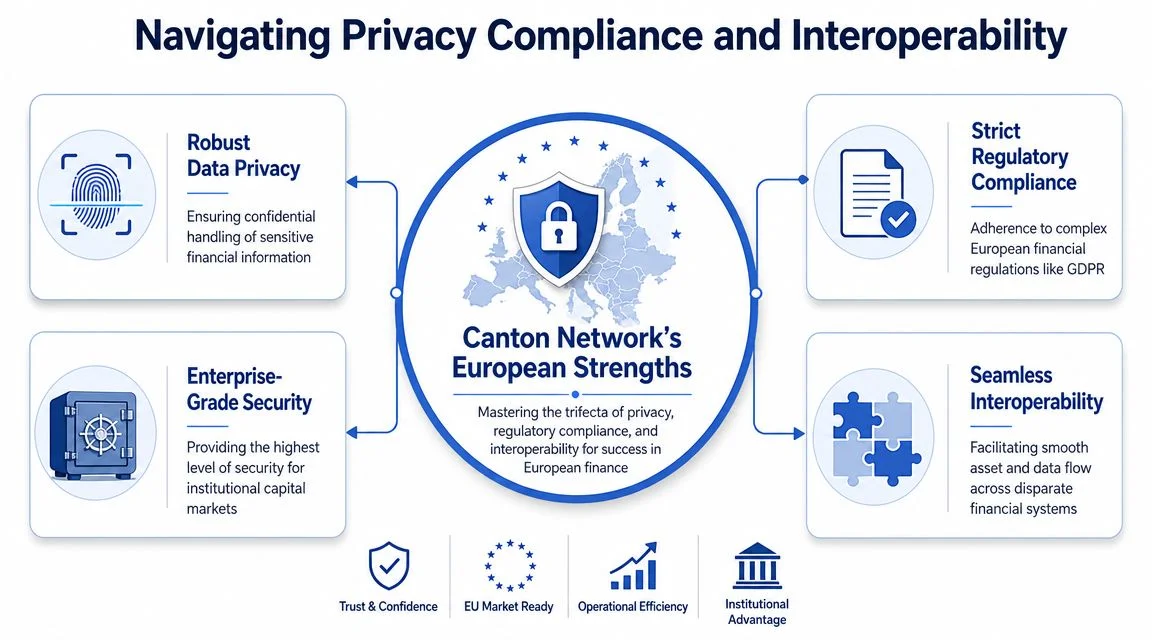
For GDPR-sensitive environments, that architectural choice matters more than broad claims about “secure blockchain”. Firms need clear data visibility boundaries, role-based participation, and controlled information sharing. Privacy by design is far more useful than privacy added later through procedural workarounds.
A closely related design topic is programmable privacy in blockchain systems, especially when institutions need to align technical permissions with internal policies, client confidentiality rules, and regulatory expectations.
What compliance teams actually need
Compliance teams rarely ask for radical reinvention. They ask for auditability, enforceable permissions, governance clarity, and evidence that operational controls hold across multi-party workflows.
Canton is relevant because its model fits those needs more naturally than public-by-default architectures. It supports permissioning and controls in a way that can be aligned with regulated financial processes.
What tends to work in real programmes is a layered approach:
- Business rule control: Eligibility, transfer restrictions, approval logic, and servicing rules should sit in the application layer.
- Data minimisation: Only the parties that need transaction details should receive them.
- Governance alignment: Network participation and workflow permissions must reflect legal and supervisory responsibilities.
- Interoperability discipline: Connected systems should coordinate deterministically, not through loosely managed batch integration.
Compliance doesn’t object to innovation. It objects to ambiguity about data exposure, control ownership, and operational accountability.
That’s why Canton is better understood as market infrastructure design, not as a blockchain experiment. In Europe especially, the winning platforms will be those that let institutions modernise workflows while preserving the control model that regulation expects.
How Blocsys Engineers Enterprise-Grade Canton Network Solutions
Most Canton projects don’t fail on strategy. They fail when architecture, workflow design, and delivery discipline drift apart. A promising use case becomes a vague innovation programme, then stalls at integration, permissions, or operational model design.
What effective delivery looks like
Implementation usually starts with workflow boundaries. Which parties need shared coordination? Which data must remain local? Where should atomic execution apply, and where is asynchronous integration still acceptable? Those decisions shape the platform far more than generic chain selection.
For organisations building institutional-grade products, custom blockchain development services are typically most valuable when they cover four practical tracks:
- Architecture design: Domain boundaries, participant roles, privacy model, and system integration patterns.
- Smart contract modelling: Encoding issuance, servicing, entitlement, settlement, and control logic into reliable workflow components.
- Operational readiness: Observability, permission management, failover assumptions, and environment governance.
- Product integration: Connecting ledger workflows to portals, reporting, compliance operations, and enterprise systems.
One delivery option in this space is Blocsys Technologies, which builds blockchain and AI-powered infrastructure for tokenisation, trading systems, and compliance-focused digital asset platforms. In Canton terms, that kind of engineering support is most useful when a firm needs to turn a financial workflow into a production-ready operating model rather than a proof of concept.
Frequently Asked Questions About Canton Network for Finance
| Question | Answer |
|---|---|
| What is the Canton Network? | Canton is a privacy-enabled interoperable blockchain network built for institutional finance. Its network-of-networks design allows separate applications and participants to coordinate transactions without exposing all data to all parties. |
| Why are European financial institutions interested in Canton? | Because they need digital asset infrastructure that supports privacy, governance, permissioning, and interoperability at the same time. Canton is designed around regulated financial workflows rather than retail-first blockchain assumptions. |
| How does Canton support tokenisation? | It provides a controlled environment where issuance, transfer, servicing, and settlement workflows can be coordinated across multiple parties while preserving confidentiality and permissions. |
| What makes Canton different from a public blockchain? | Public blockchains generally rely on broad visibility of shared state. Canton is designed so that only the parties involved in a transaction see its details, while still allowing coordinated execution across applications. |
| Is Canton only for banks? | No. It is also relevant for exchanges, custodians, fintech infrastructure providers, asset managers, and market utilities involved in regulated financial workflows. |
| Where does Canton fit best in practice? | It fits best where multiple regulated entities need shared execution across separate systems, especially in tokenised assets, collateral workflows, asset servicing, and settlement coordination. |
| Does Canton remove compliance obligations? | No. It provides an architecture that can better support compliance-oriented operating models. Firms still need to implement governance, permissions, legal controls, and supervisory alignment around the workflow. |
| What should a firm assess before starting? | Start with the business process. Identify participants, visibility rules, control points, settlement dependencies, and integration requirements. If the workflow depends on both confidentiality and cross-party coordination, Canton is a strong candidate. |
If your team is evaluating Canton for tokenisation, capital markets modernisation, or institutional digital asset infrastructure, Blocsys Technologies can help assess the workflow, define the architecture, and turn the design into an implementation roadmap. The right starting point is usually a focused scoping discussion around one high-value workflow, one control model, and one production path.
Frequently Asked Questions
What is the Canton Network?
The Canton Network is a privacy-enabled, interoperable blockchain network built for institutional assets, launched on 9 May 2023 by Digital Asset. It was designed from the outset as infrastructure for regulated financial-market workflows rather than as a generic public chain later adapted for enterprise use.
How big is Canton’s role in tokenized real-world assets?
Canton is already positioned at approximately $4T in TVL for tokenized real-world assets, including over $1.5T per month in tokenized UST repo activity. Its ecosystem participants include institutions such as BNP Paribas, Deutsche Börse Group, and Deloitte.
What makes Canton different from public and private blockchains?
Public blockchains offer broad interoperability but expose too much data for institutional workflows, while traditional private ledgers protect data but often create new silos. Canton is structured as a “network of networks,” where independent domains keep their own controlled environments while still coordinating transactions through a shared layer, so privacy and cross-network execution can coexist.
What does “atomic interoperability” mean in Canton?
Atomic interoperability means linked actions across separate applications on the network complete together or fail together. This is important for finance because it aligns with the risk logic required for delivery-versus-payment, collateral movement, and other coordinated multi-party transactions.
Who is Canton designed for?
Canton is built for European banks, market infrastructures, custodians, and fintech teams that need distributed systems without exposing confidential transaction data, creating operational silos, or conflicting with governance and control requirements. It targets institutions evaluating enterprise blockchain architecture that must work within the constraints of regulated finance rather than consumer-style blockchain assumptions.
