
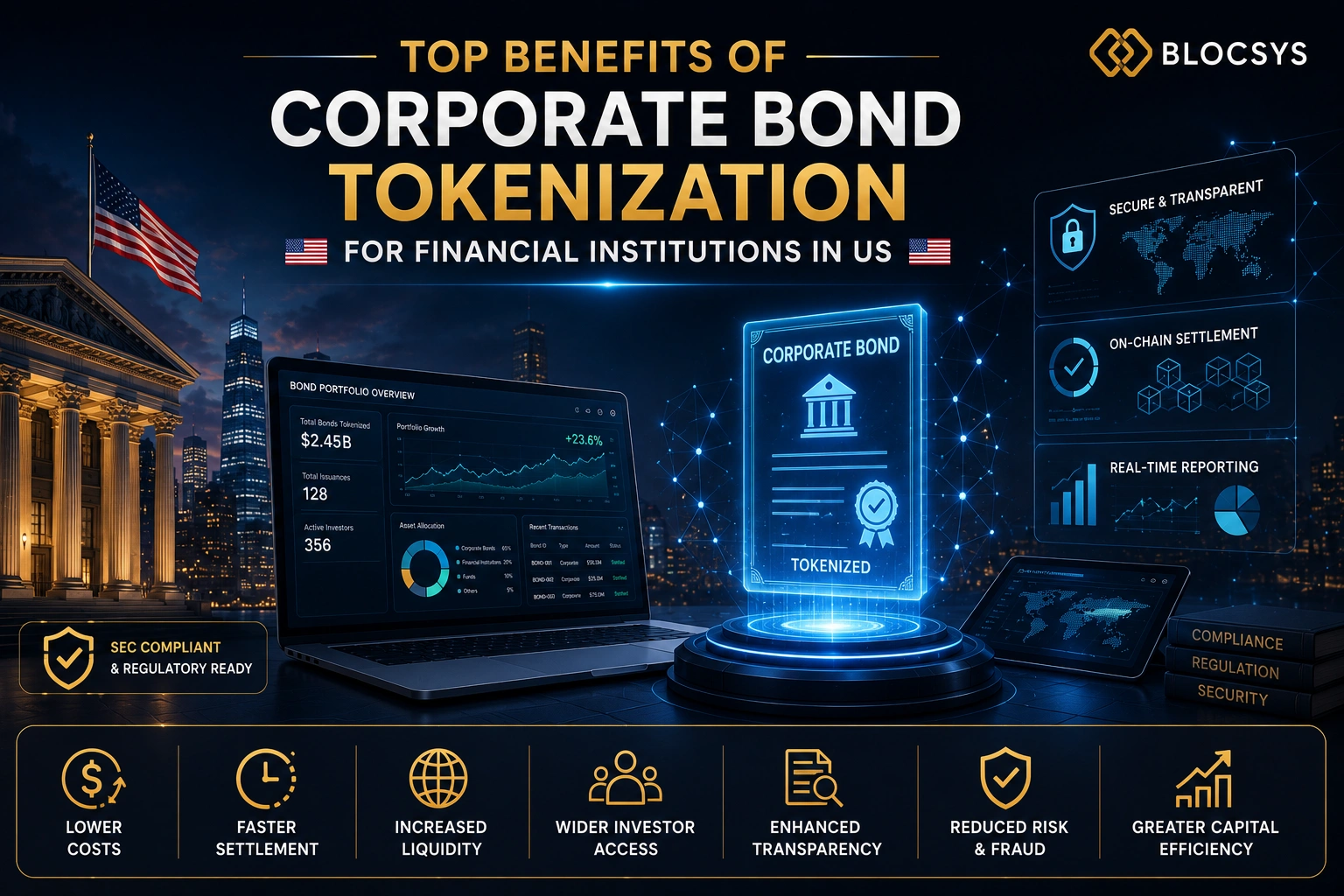
If your treasury, capital markets, or trading team is still living with T+2 settlement, chained reconciliations, and coupon processing that depends on too many handoffs, you’re already feeling the pressure that corporate bond tokenization is meant to relieve. The primary question isn’t whether blockchain can make a bond look digital, it’s whether your institution can redesign custody, transfer, compliance, and post-trade control without breaking the operating model that keeps regulators, auditors, and counterparties comfortable.
This is written for commercial banks, investment banks, broker-dealers, asset managers, fintech issuers, and digital securities teams trying to separate useful infrastructure from vendor theatre. For a useful contrast on where tokenization is heading across adjacent bank products, the discussion around the future of bank deposits helps frame why institutions are now rethinking ledger design, not just product packaging.
If you’re mapping a real implementation path, the practical lens matters more than the hype. The goal is a working view of what corporate bond tokenization changes, what it doesn’t, and where the trade-offs sit for U.S. institutions operating under real compliance and operational constraints. For a deeper view of the U.S. market context, see digital bond issuance in the U.S. with Canton Network.
Table of Contents
- Why US Financial Institutions Are Re-examining Corporate Bonds
- What Corporate Bond Tokenization Actually Means
- Key Frictions in the Current US Corporate Bond Workflow
- Core Benefits US Financial Institutions Should Care About
- Traditional Bonds Compared with Tokenized Bonds
- How Canton Network and DAML Enable Enterprise-Grade Tokenization
- Implementation Roadmap and the GIFT City Opportunity
- How Blocsys Helps Build Enterprise Tokenization Platforms
- FAQs
- What is corporate bond tokenization in simple terms?
- Why are U.S. financial institutions interested in tokenized corporate bonds?
- How does tokenization affect settlement time?
- Does tokenization improve liquidity?
- What are the biggest operational benefits for banks?
- Is corporate bond tokenization the same as crypto trading?
- How do Canton Network and DAML fit in?
- What should a U.S. institution test before going live?
- Is tokenization only useful for large issuers?
- What is the role of GIFT City and IFSCA in this market?
- How does Blocsys help with corporate bond tokenization?
- How should a bank start a tokenization project?
Why US Financial Institutions Are Re-examining Corporate Bonds
A U.S. treasury team usually does not start with ideology. It starts with a spreadsheet, a settlement queue, and a question from the trading desk about why cash is still trapped while operations is waiting on three different confirmations. At that point, corporate bond tokenization stops sounding experimental and starts looking like a possible operating-model change.
The institutions asking the right questions now are not just issuers. They include commercial banks, investment banks, broker-dealers, asset managers, fintech issuers, and digital securities platforms that need cleaner post-trade control and lower servicing drag. They also care about whether the ledger can become the system of record without forcing them into a public-chain model that compliance teams will immediately reject.
Practical rule: if tokenization does not change custody, reconciliation, or exception handling, it is probably just a prettier front end on the same old workflow.
The strategic context is broader than fixed income alone. Institutions are watching how tokenized products are being treated across the market, because once a ledger carries money movement, transfer restrictions, and compliance logic, the operating implications spill into deposits, treasury, and securities administration. That is why the market conversation around tokenized assets is increasingly about infrastructure, not just a single product line, and the future of bank deposits is part of that same operational debate.
The outcome readers should expect here is not a sales pitch. It is a candid view of where tokenized corporate bonds can help, where they cannot, and what architecture choices matter if the institution wants something production-grade rather than a proof of concept. For a practical comparison of the platform approach in the U.S., Blocsys’s corporate bond issuance and Canton Network guide is useful context.
You will also see why some teams get stuck. They focus on issuance speed and ignore the harder question, which is whether the institution can redesign transfer agent, custody, reconciliation, and control design around a token that behaves like a live instrument, not a document. That is the decision point for U.S. financial institutions.
Key Frictions in the Current US Corporate Bond Workflow
The workflow itself is the problem. A bond trade can move through trading, confirmation, custodian handoffs, and internal controls without giving operations a single place to see the full state of the instrument. Every handoff creates room for delay, and every delay adds another reconciliation task.
That is why tokenization gets attention from control teams, not just product teams. If the token becomes the system of record, the institution can redesign who holds what, when records change, and which approvals are required before a transfer finalizes. The benefit is operational clarity, but the trade-off is that the institution has to be precise about permissions, recordkeeping, and exception handling from the start.
What Corporate Bond Tokenization Actually Means
Corporate bond tokenization means putting the legal and economic rights of a bond onto a programmable ledger. In plain English, the token isn’t just a receipt. It’s a digital certificate that can also carry the rules for ownership, coupon payments, redemption, and transfer permissions.
A useful analogy is a bond token as a self-describing instrument. A conventional bond needs a stack of systems and intermediaries to explain what it is, who owns it, and what happens on each date. A tokenized bond carries that logic closer to the asset itself, so the ledger can record ownership and enforce lifecycle events with less manual coordination.
What changes in practice
Three differences matter most for U.S. institutions.
Continuous ownership records. Traditional securities rely on fragmented operational records across custodians, transfer agents, and market plumbing. A permissioned ledger gives the institution a more unified, current view of ownership.
Programmable lifecycle logic. Coupon dates, redemption events, and transfer rules can be embedded into the asset workflow instead of being managed only through documents and manual reminders.
Atomic cash-for-bond settlement. Cash and bond can move together on-chain, which reduces the settlement-failure risk that comes from separate workflows.
The important compliance point is what tokenization is not. It is not public-chain speculation with open-ended transfer rights. In institutional settings, whitelisting, identity checks, and rule-based permissions keep control inside the operating perimeter. That distinction is what makes the model relevant to broker-dealers, custodian banks, and issuers that need controlled distribution.
For a related asset-model explanation, the Blocsys real-world asset tokenization overview is useful because corporate bonds are one of the cleanest examples of a regulated real-world asset moving onto programmable infrastructure.
The practical takeaway is simple. A tokenized bond is not a cryptocurrency version of a bond. It’s a regulated bond whose record-keeping, transfer logic, and servicing events have been moved into programmable infrastructure.
Key Frictions in the Current US Corporate Bond Workflow
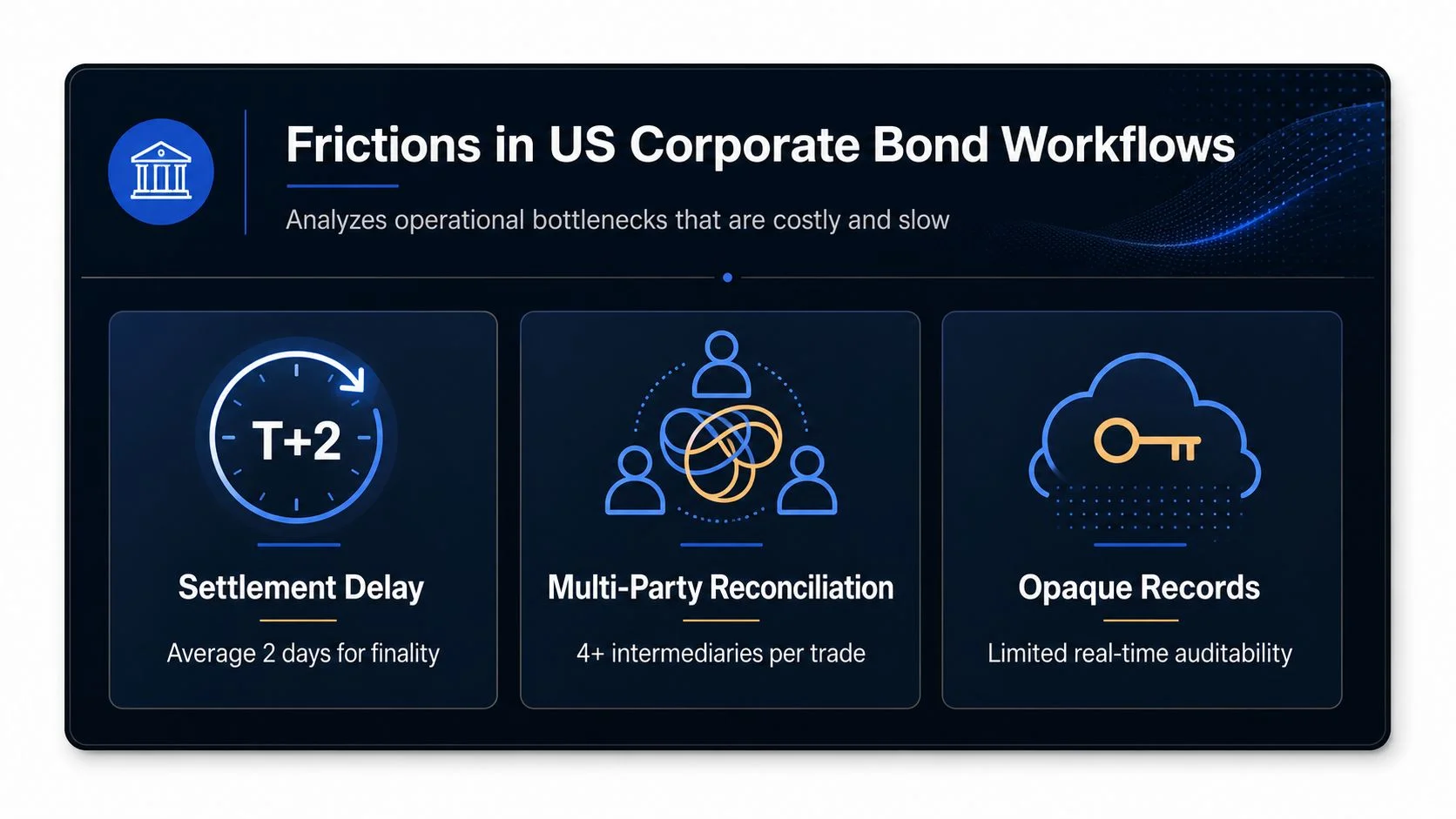
Most of the cost in corporate bonds doesn’t sit in the headline trade. It sits after the trade is agreed, where information still has to move across desks, vendors, custodians, and clearing infrastructure. That is the point where tokenization starts to look less like a market novelty and more like an operating-model redesign.
The early market evidence matters because it shows tokenization is not only a theoretical efficiency play. The Bank for International Settlements reported that the mean bid-ask spread of tokenised bonds was about 19 basis points, compared with 30 basis points for conventional bonds issued by the same issuers, while the minimum investment amount fell to about $110,000 versus $185,000 for conventional bonds (BIS bulletin). The same analysis noted that issuance costs did not differ systematically in the sampled cases, which is a useful reminder that the first gains may show up in secondary-market accessibility and liquidity characteristics, not just issuance friction.
Where the workflow gets bogged down
In a standard U.S. bond process, the issuer, dealer, custodian, transfer agent, paying agent, and settlement infrastructure all touch the same instrument in different ways. Each handoff adds reconciliation work, and each manual check introduces delay or exception handling. That is also where control failures show up, because every system keeps its own version of the record until someone reconciles the differences.
The Treasury Borrowing Advisory Committee has pointed to atomic settlement mechanics in tokenized environments, and that matters because simultaneous cash-and-bond movement cuts exposure that otherwise sits between steps. Industry analysis also describes traditional issuance as running through T+2 settlement, while tokenized structures can move to T+0 or near-instant settlement, with lower documentation and processing costs for straightforward structures (Treasury Borrowing Advisory Committee paper). For U.S. institutions, the key question is whether those mechanics still hold once legal, compliance, and cybersecurity controls are embedded into the workflow.
The hardest part of tokenization isn’t writing the token. It’s deciding which post-trade tasks disappear, which become programmable, and which still need human override.
For a job-market signal that the industry is still staffing for this change, the role profile Head Of Tokenization Digital Asset Strategy shows how seriously institutions are treating the operating and strategy layer, not just the technology stack.
A good way to think about the current U.S. market is this. The settlement problem is real, but so is the reconciliation problem. Tokenization only becomes useful when it reduces both.
The right lens for this section is not whether blockchain makes bonds faster. It is which parts of the bond operating chain become simpler, and which parts become more governable.
Core Benefits US Financial Institutions Should Care About
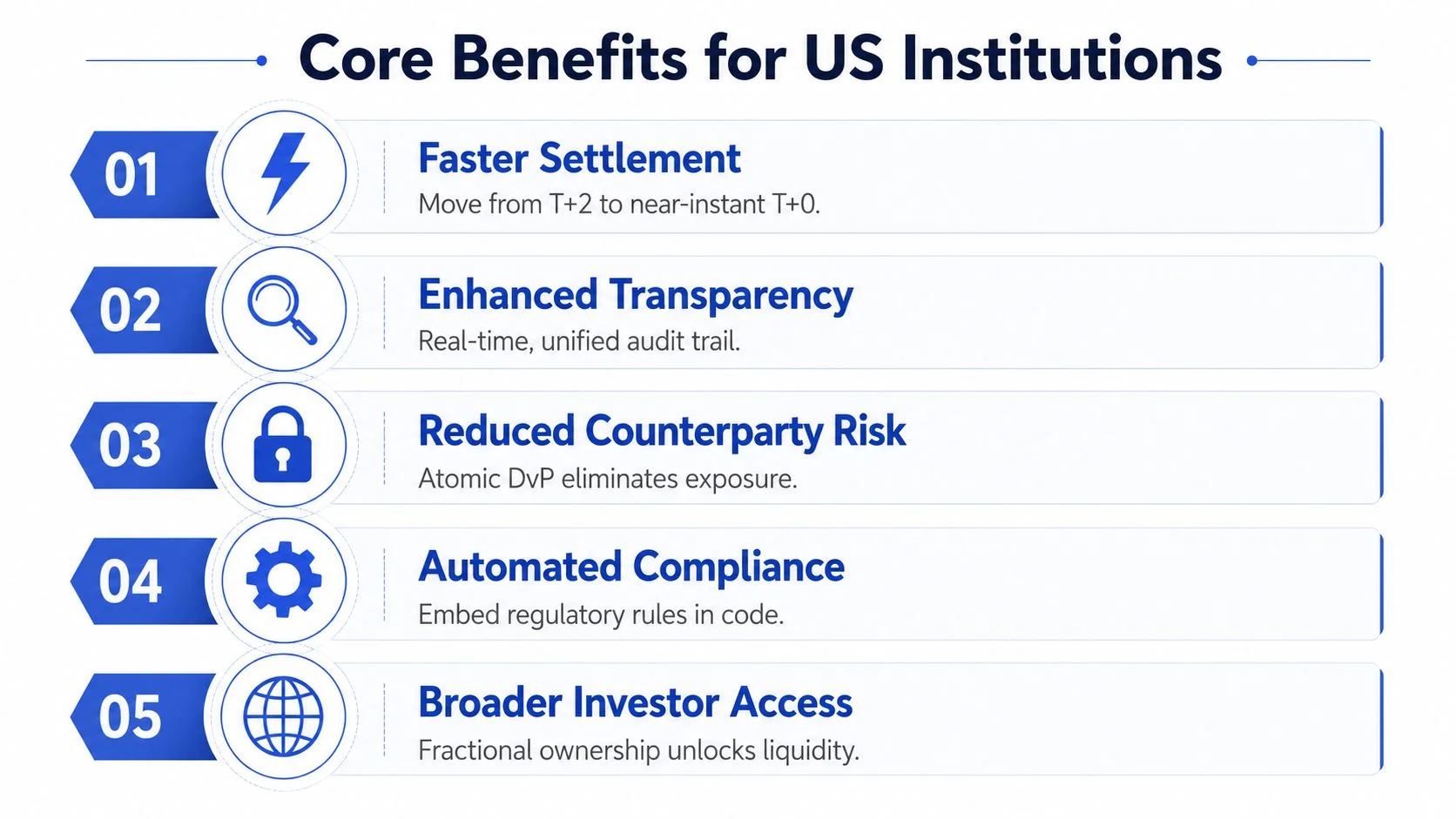
A tokenized bond matters when it changes how post-trade work gets controlled. That means the benefit has to show up in settlement, funding, servicing, compliance, and investor access, not in abstract claims about distributed systems. The strongest cases survive because they improve process quality, shrink exception handling, and give operations teams a cleaner control point.
The operating-model shift starts the moment the token becomes the system of record for the asset. At that point, custody, reconciliation, and transfer control stop depending on a chain of back-office handoffs. The institution still has to manage legal, cybersecurity, and audit requirements, but the work is more explicit and easier to govern.
Faster settlement and lower funding drag
Settlement efficiency is usually the first visible gain, but the core value is narrower and more practical. When the bond and cash legs move together, there is less exposure to failed settlement and less time when capital sits idle. For broker-dealers, treasury teams, and corporate issuers that need to recycle cash quickly, that means lower counterparty exposure and less funding drag.
Broader investor access through lower denominations
Lower denominations change who can participate. A smaller minimum investment can open a bond to a wider eligible investor base, especially in private placements and structured debt where denomination size often keeps otherwise suitable investors out. That does not make every bond liquid, and it does not change the credit profile. It does make the structure more reachable without rewriting the economics of the deal.
For a fuller side-by-side view of how those differences show up in practice, see Blocsys’s traditional versus tokenized corporate bond comparison.
Transparency and auditability
Tokenized ownership records give internal control teams a cleaner audit trail. When the token carries lifecycle data and transfer permissions, operations staff spend less time reconciling records across separate systems. That matters for institutions that need to show who held the bond, when they held it, and which rule set governed the transfer.
The primary improvement is control clarity. A single ledger view does not remove oversight, but it does reduce the number of places where the answer can drift.
Compliance embedded into the asset workflow
Whitelisting, identity checks, and rule-based transfer permissions are the mechanism that keeps tokenized bonds inside an institutional perimeter. When compliance logic sits close to the asset, reporting and transfer control rely less on manual intervention and fewer side channels. That makes the control model easier to defend during review, because the policy is attached to the workflow instead of being checked after the fact.
Cost reduction across issuance and servicing
The cost case is strongest where manual work has the most room to disappear. In tokenized structures, issuance and servicing can be simplified because corporate actions, record maintenance, and transfer checks are handled inside the workflow instead of across multiple systems. That is where the savings come from, not from a headline about blockchain.
The practical question is whether those savings hold once legal review, audit expectations, and cybersecurity controls are built in. If the operating model still depends on manual reconciliation at the end of each process, the token only shifts where the work happens. If the controls are designed into the ledger flow, the case becomes materially stronger.
Traditional Bonds Compared with Tokenized Bonds
A trade rarely breaks on the bond itself. It breaks in the handoffs around it. Traditional corporate bonds still fit many institutional workflows, but they depend on custody, transfer, reconciliation, and servicing steps that tokenized bonds can collapse into a single ledger-based control model.
For a broader side-by-side analysis, see Blocsys’s traditional versus tokenized corporate bond comparison.
| Dimension | Traditional Corporate Bonds | Tokenized Corporate Bonds |
|---|---|---|
| Issuance cost | Higher, with manual processing and multiple intermediaries | Lower in straightforward structures, with automation embedded in the workflow |
| Settlement time | Commonly T+2 | T+0 or near-instant settlement in tokenized structures |
| Minimum investment | Higher denominations often limit access | Lower minimums can broaden the investor base |
| Bid-ask spread | Wider in the sampled comparison, about 30 basis points | Tighter in the sampled comparison, about 19 basis points |
| Ongoing servicing | Manual corporate actions and record maintenance | Automated corporate actions and simpler record-keeping can reduce ongoing cost |
| Control model | Distributed across systems and intermediaries | Programmatic, with permissions and lifecycle logic closer to the asset |
The operating difference is where control sits. In a traditional setup, the institution depends on several systems and parties to agree on who owns what, what changed, and which record is current. In a tokenized setup, the token can become the system of record for transfer, permissions, and lifecycle events, so the operational burden shifts from reconciling multiple versions of the same event to enforcing one coordinated workflow.
The savings do not come from blockchain by itself. They come from legal structure, compliance design, and cybersecurity controls being built into the asset workflow from the start.
That is also why the comparison is not just about cost. If the institution leaves exceptions, approvals, and audit logging outside the ledger, the token only moves work from one queue to another. If custody, transfer permissions, and servicing logic are designed around the ledger from day one, the post-trade model becomes simpler to run and easier to defend in review.
The trade-off is straightforward. Traditional bonds preserve familiar roles and controls, which many US institutions still need for complex books of business. Tokenized bonds can reduce operational friction, but only when legal finality, access control, and reconciliation are redesigned together. The core question is whether the institution wants a faster wrapper around the old model, or a cleaner operating model where the token carries the record and the controls with it.
How Canton Network and DAML Enable Enterprise-Grade Tokenization
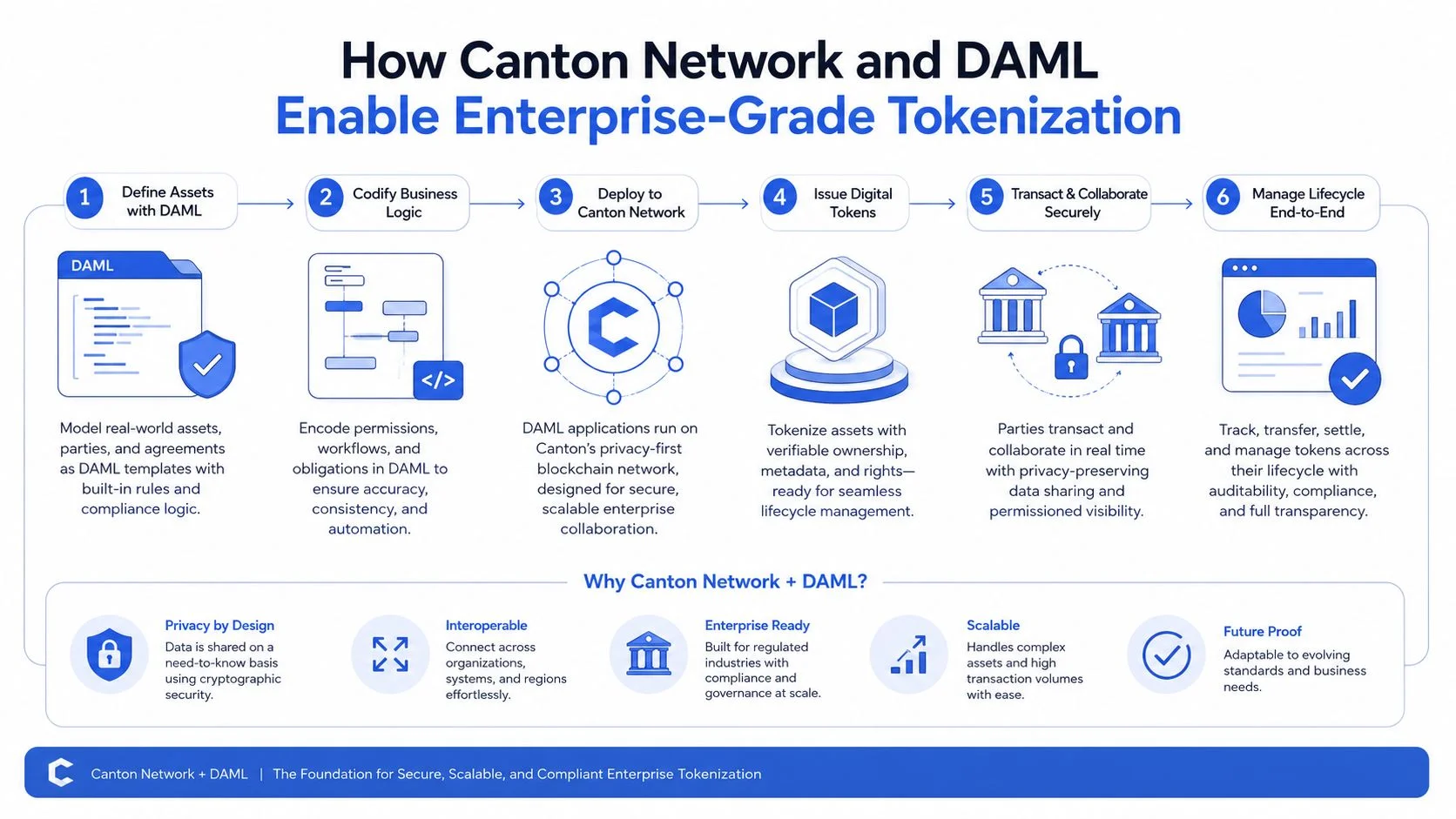
A U.S. institution doesn’t need a noisy public chain to tokenise a bond. It needs privacy, controlled participation, and a rule system that can survive broker-dealer, custodian, and audit review. That’s why the Canton Network and DAML come up so often in enterprise conversations.
Why the architecture matters
Canton gives institutions a permissioned, interoperable ledger fabric. That matters because counterparties can transact without exposing positions or business terms broadly across the network. DAML then encodes the bond lifecycle, issuance, allocation, coupon, redemption, and corporate actions, as enforceable logic rather than a stack of disconnected documents.
The practical advantage is not abstract decentralisation. It’s that the institution can reduce reconciliation drift by making the ledger and the servicing rules line up. When settlement is atomic, the bond and cash legs can move together, which cuts the number of breaks operations needs to fix after the fact.
What CIOs should check
A tokenization architecture for U.S. markets should answer a few direct questions.
- Who sees what: Privacy controls must limit exposure of sensitive positions and trade details.
- Who can move the asset: Whitelisting and identity checks need to be built into transfer permissions.
- What is automated: Coupons, redemptions, and actions should be handled by coded rules, not just by reminders in a workflow tool.
- How exceptions work: The system needs a controlled process for overrides, errors, and compliance review.
That is why interoperability matters. Multiple issuers, dealers, and investors may need to share one ledger while preserving the confidentiality each side expects. If the architecture can’t support that, the tokenization project will struggle once it leaves the pilot stage.
For a more detailed technical angle, Blocsys’s DAML and Canton Network guide is relevant because it maps the platform layer to institutional workflows rather than treating tokenization like a generic blockchain demo.
A good architecture gives you control without forcing every participant to see everything. That’s the balance U.S. institutions need.
Implementation Roadmap and the GIFT City Opportunity
The cleanest tokenization programmes usually start with one bond family, one distribution model, and one set of servicing rules. If the first step tries to redesign the whole capital markets stack, the project becomes harder to govern and easier to kill.
A practical rollout sequence
Pick a bounded use case. Start with a structure where the legal terms, investor universe, and servicing events are clear. Straightforward issuance is easier to automate and easier to review.
Design the post-trade operating model. This is the part many competitors skip. Decide how custody, transfer agent functions, reconciliation, and exception handling change once the token becomes the system of record.
Build the control perimeter. Legal, compliance, and cybersecurity need to define the permission model before the workflow goes live. If that comes later, the architecture becomes harder to defend.
Run pilot settlement and servicing tests. Validate coupon events, transfer restrictions, and audit logs under realistic operating conditions, not just in a demo environment.
Scale to multi-issuer production. Only after controls, reporting, and exception handling are stable should the platform support broader issuance.
Governance rule: if you can’t explain who owns each exception path, you’re not ready for production.
The global optionality piece is also worth attention. GIFT City and the IFSCA are emerging as regulated corridors where global issuers can explore digital securities structures with clearer frameworks than many teams expect in early-stage markets. For U.S. firms thinking cross-border, that can matter when issuance strategy includes regional flexibility, investor segmentation, or experimentation under a more defined regime.
The wider lesson is simple. U.S. institutions should not only ask how fast a bond can settle. They should ask how the institution will operate when the token is the record, the workflow is programmable, and the exception path has to satisfy auditors as well as traders.
For platform design reference, the Blocsys corporate bond tokenization platform feature and cost guide is a useful way to think about scope, architecture, and operating commitments before production work starts.
How Blocsys Helps Build Enterprise Tokenization Platforms
Blocsys works on corporate bond tokenization platform development, Canton Network application builds, DAML smart contract development, digital securities infrastructure, RWA tokenization, and enterprise blockchain integration. For institutions, the important point is that tokenization only works when legal structure, lifecycle logic, settlement design, and compliance controls are built together rather than bolted on later.
That’s the same reason a general-purpose software partner matters. If you need an enterprise baseline, Technioz’s enterprise solutions are a good benchmark for how broad delivery capabilities are usually framed, but tokenized bonds add a much narrower set of financial controls, custody assumptions, and post-trade rules.
Blocsys positions the engineering work around the operational outcomes discussed above, faster settlement, stronger auditability, lower servicing overhead, and more controlled investor access. For banks, asset managers, and issuers that need a scoped engagement, the right next step is usually a structured architecture review before platform build-out.
If your team is evaluating corporate bond tokenization in the U.S., Blocsys can help scope the operating model, map the technical stack, and build the production workflow around real institutional constraints.
FAQs
What is corporate bond tokenization in simple terms?
It’s the process of representing a bond’s legal and economic rights on a programmable ledger. The token carries ownership, transfer rules, and lifecycle logic, so the bond can be issued and serviced with fewer manual handoffs.
Why are U.S. financial institutions interested in tokenized corporate bonds?
They’re interested because tokenization can improve settlement efficiency, reduce servicing friction, and make ownership records more transparent. The business case is strongest when the institution also wants to redesign post-trade operations.
How does tokenization affect settlement time?
Verified evidence shows tokenized structures can move from the traditional T+2 cycle to T+0 or near-instant settlement in some workflows (Treasury Borrowing Advisory Committee). That reduces settlement risk and shortens the time cash stays tied up.
Does tokenization improve liquidity?
It can, especially when lower minimum denominations broaden access and tighter spreads improve secondary-market conditions. In early BIS evidence, tokenised bonds showed a mean bid-ask spread of about 19 basis points versus 30 basis points for conventional bonds from the same issuers (BIS bulletin).
What are the biggest operational benefits for banks?
The biggest gains usually come from less reconciliation, fewer manual servicing steps, better audit trails, and programmable transfer controls. Those changes matter more than the marketing language around blockchain.
Is corporate bond tokenization the same as crypto trading?
No. Institutional tokenization uses permissioned access, whitelisting, identity checks, and rule-based transfers. That keeps the instrument inside a controlled securities workflow instead of an open crypto market.
How do Canton Network and DAML fit in?
Canton provides the interoperable permissioned ledger environment, while DAML encodes the bond’s lifecycle logic. Together, they support privacy, controlled settlement, and programmable servicing.
What should a U.S. institution test before going live?
It should test transfer permissions, coupon processing, redemption events, exception handling, audit logs, and the way custody and reconciliation change when the token becomes the system of record.
Is tokenization only useful for large issuers?
No. The model can also help structured debt and private placements where lower denominations and cleaner servicing make distribution more practical. The right use case depends more on operating complexity than on issuer size alone.
What is the role of GIFT City and IFSCA in this market?
They provide a regulated corridor that some global issuers may use for digital securities structures. For cross-border strategy, that can add optionality when the U.S. institution wants a clearer launch environment for certain tokenized offerings.
How does Blocsys help with corporate bond tokenization?
Blocsys builds the tokenization platform, the Canton and DAML components, and the enterprise workflow around issuance, servicing, and control design. That makes it a fit for institutions that need an end-to-end engineering partner rather than a point tool.
How should a bank start a tokenization project?
Start with one bounded bond use case, define the post-trade operating model, lock the compliance rules, and validate servicing before scaling. If those steps are skipped, the project usually becomes harder to defend and more expensive to run.
If your institution is ready to evaluate corporate bond tokenization platform development, Canton Network development, DAML smart contract development, or digital securities infrastructure, Blocsys Technologies can help scope the operating model and build the production path. Visit Blocsys Technologies to start a focused conversation on tokenized corporate bonds, post-trade redesign, and enterprise-grade implementation.
