
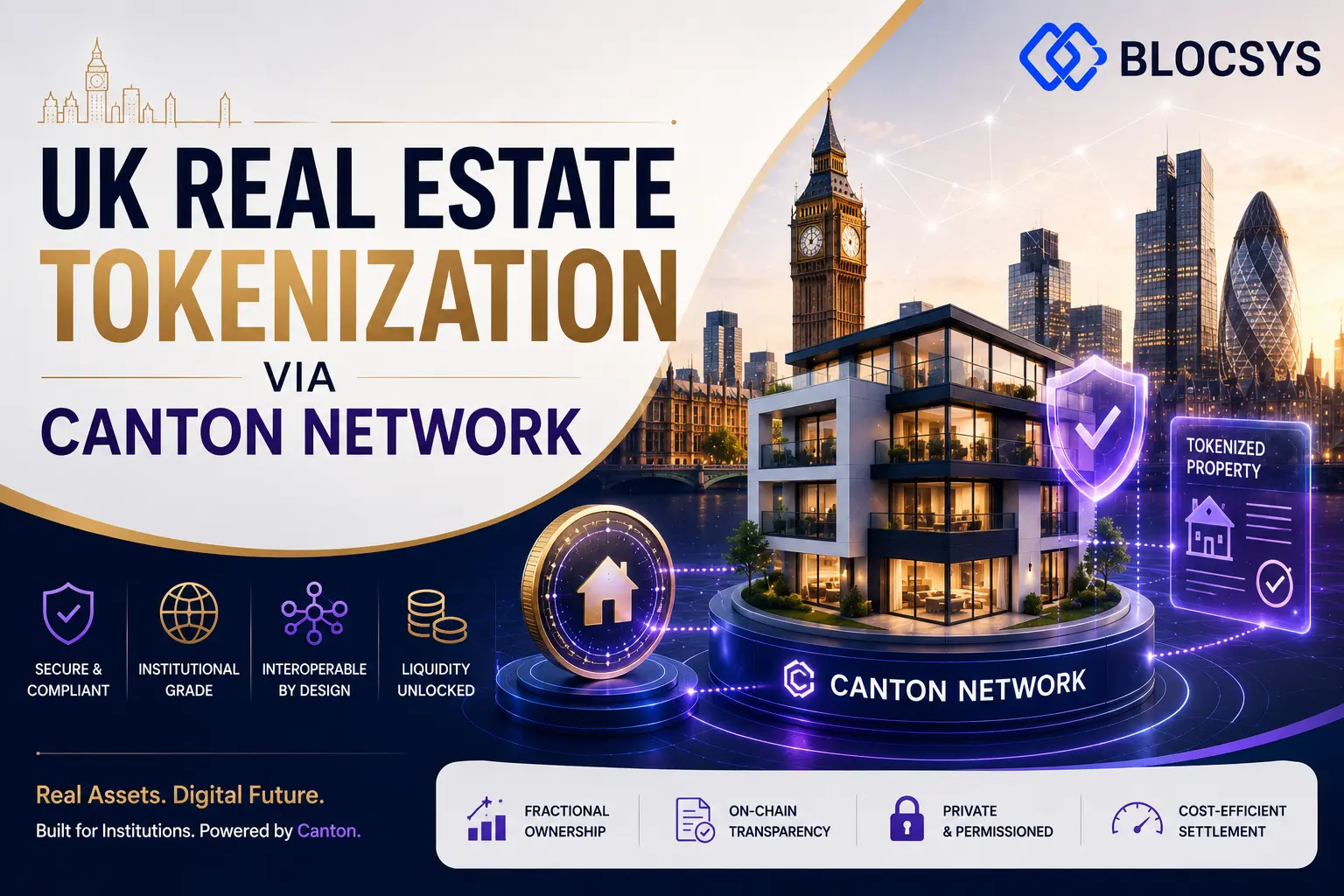
The UK property market is already large enough to make tokenization an institutional infrastructure question, not a speculative side project. Independent market estimates cited in industry coverage indicate that tokenized real estate reached $0.3 trillion in 2024 and could rise to $4 trillion by 2035, implying roughly a 13-fold expansion over that period, which is especially relevant in a market like the UK with a large asset base and strong legal infrastructure (industry coverage citing independent estimates).
For real estate funds, asset managers, property platforms, and financial institutions, the practical question isn’t whether digital ownership models are conceptually possible. It’s whether they can be structured in a way that satisfies legal enforceability, investor controls, settlement discipline, and institutional operating standards. That’s where the conversation shifts from generic tokenization to UK real estate tokenization platforms on Canton Network.
The useful lens is enterprise design, not retail novelty. Teams evaluating this space need to decide how fractional interests are issued, what legal wrapper sits behind the token, how transfers are restricted, how distributions are automated, and whether the platform is built for domestic investors, international syndication, or secondary trading among approved participants. For readers looking for a broader market primer before the institutional deep dive, this guide to real estate tokens is a helpful starting point.
Table of Contents
- The Dawn of Digital Property in the UK
- Why Traditional Real Estate Investment is Ripe for Disruption
- How Fractional Ownership on Blockchain Unlocks Value
- Why Canton Network is the Institutional Choice for UK Real Estate
- Navigating the UK Regulatory and Compliance Landscape
- Institutional Use Cases and the Market in 2026
- Build Your Institutional Tokenization Platform with Blocsys
- Frequently Asked Questions
- What is real estate tokenization
- How does fractional ownership work on blockchain
- Why is Canton Network suitable for institutional real estate tokenization
- Is tokenized property ownership legal in the UK
- Can international investors participate in tokenized UK real estate
- How can an organisation start building
The Dawn of Digital Property in the UK
The UK sits in a rare position. It has the kind of deep real estate market, established property rights framework, and institutional transaction culture that makes tokenization commercially meaningful rather than experimental. That matters because enterprise adoption only happens when the underlying market is large enough, governed clearly enough, and fragmented enough for digitisation to solve real coordination problems.
What’s changing now is the architecture available to support ownership, transfer, and reporting. In earlier cycles, tokenization discussions were dominated by consumer crowdfunding language. That framing missed the harder opportunity. The stronger use case is institutional. A fund manager wants cleaner cap table control. A property platform wants programmable investor permissions. A lender wants transfer restrictions and auditability built into the process instead of layered on manually.
A market problem that fits a digital infrastructure answer
UK real estate has never lacked demand. It has lacked fluidity. Buyers, managers, counsel, administrators, and settlement parties still operate through disconnected workflows that weren’t built for fractional secondary ownership.
UK real estate tokenization platforms become interesting when they stop imitating crypto exchanges and start behaving like financial market infrastructure.
That distinction matters when evaluating Canton-based designs. The right platform isn’t just a token issuance portal. It’s an operational stack for investor onboarding, rights management, distributions, transfer controls, and evidence trails that stand up to fund governance and regulatory review.
Who should care now
The strongest fit is for organisations already managing regulated relationships or complex assets:
- Real estate funds: looking to widen access without breaking governance discipline.
- Property investment firms: trying to package assets into more flexible structures.
- Financial institutions: exploring digital asset rails that can support permissioned transactions.
- Tokenization startups: seeking a more credible route than public-chain-first retail models.
- Cross-border platforms: structuring UK property exposure for approved international capital.
The near-term winners won’t be the loudest issuers. They’ll be the firms that design legal structure, smart contract logic, and operating controls as one system.
Why Traditional Real Estate Investment is Ripe for Disruption
Traditional property investing still works, but it works with friction that institutions have learned to tolerate rather than solve. That tolerance is expensive. It slows capital formation, narrows the investor base, and turns transfer events into process-heavy projects.
The friction is operational, not just financial
The obvious problem is high capital concentration. Prime assets and quality income-producing properties often require investors to commit far more capital than they’d like to allocate to a single exposure. But the deeper issue is operational indivisibility. Ownership structures, approvals, documentation, and transfer mechanics are usually built around whole-asset or large-block participation.
That creates several familiar constraints:
- Illiquidity: Investors can’t easily adjust exposure in smaller units.
- Administrative drag: Distributions, reporting, approvals, and ledger updates pass through multiple parties.
- Slow transfer cycles: Ownership changes depend on legal review, manual reconciliation, and fragmented records.
- Limited access design: Platforms often default to a narrow investor profile because onboarding more participants raises complexity.
Why incumbents still struggle to fix it
Most traditional systems weren’t designed to let ownership be sliced, governed, and transferred in a controlled digital format. Registry processes, fund administration routines, and investor servicing models all evolved around paper-heavy or database-centric assumptions. Firms can digitise forms and portals, but that alone doesn’t create programmable ownership.
The result is a strange middle ground. Many firms have modern client interfaces, but the back office still runs on reconciliations, email trails, and legal review loops. That’s why seemingly simple tasks, such as restricting transfers to approved investors or automating distributions tied to economic rights, become costly workflow exercises.
Practical rule: If a platform can’t encode who may hold, buy, receive, or transfer an interest, it hasn’t solved tokenization. It has only digitised administration.
This is also why market disruption in real estate won’t come from a cosmetic “property on blockchain” label. The useful shift is architectural. Ownership data, investor permissions, payout logic, and transfer conditions need to live in a system that can coordinate them consistently.
A platform that does that well changes more than access. It changes operating rhythm. Asset issuers gain better control over investor rights. Administrators gain cleaner records. Investors gain a more legible structure for holding and transferring exposure. Legal teams gain a stronger basis for governance because the transaction logic is defined upfront rather than reconstructed after the fact.
How Fractional Ownership on Blockchain Unlocks Value
Fractional ownership on blockchain works when the legal and technical layers are tied together cleanly. The property itself doesn’t become a token. The ownership interests around it do.
The legal wrapper matters more than the token graphic
A common model is to place the underlying property into a dedicated legal entity such as an SPV or trust, then issue tokens representing economic rights in that entity. Smart contracts govern issuance, balances, and payouts, while the off-chain legal ownership remains inside the SPV. That’s what allows on-chain programmability to coexist with jurisdiction-specific property rules (Chainalysis explanation of asset tokenization structures).
A simple analogy helps. Think of a commercial building like a single valuable painting. You don’t cut the canvas into pieces. You place it inside a legal structure and issue clearly defined shares in that structure. The token is the digital mechanism for tracking and transferring those shares under controlled rules.
For teams evaluating architecture in more depth, this RWA tokenization explainer covers the underlying operating model.
What fractional ownership actually changes
A key benefit isn’t novelty. It’s precision. A fractional ownership platform can define investor rights, transfer permissions, and payment logic in a way that reduces ambiguity and manual handling.
Key changes typically include:
- Smaller units of participation: An issuer can divide economic exposure into transferable portions instead of selling only large positions.
- Structured distributions: Rental income or other entitled payouts can follow coded rules tied to recorded balances.
- Clearer cap table visibility: Balance tracking becomes more consistent across approved participants.
- Transfer discipline: Secondary movement can be limited to whitelisted investors or other predefined conditions.
Later in the workflow, video can help non-technical stakeholders align on the mechanics:
Where platforms usually go wrong
The biggest design mistake is treating token issuance as the product. It isn’t. Token issuance is one function inside a larger operating model.
Teams often underestimate these implementation points:
- Legal enforceability: The token must map cleanly to rights defined in the underlying entity documents.
- Investor servicing: Onboarding, notifications, distributions, and reporting need institutional workflows.
- Transfer logic: Restrictions shouldn’t rely on manual exceptions after the fact.
- Data governance: Sensitive ownership information can’t be exposed casually if the target market includes institutions.
When those elements are aligned, fractional ownership becomes a practical mechanism for making value accessible from assets that were previously too large, too static, or too cumbersome to distribute widely.
Why Canton Network is the Institutional Choice for UK Real Estate
Canton becomes relevant when the project moves from concept to market structure. Real estate tokenization in the UK doesn’t need a chain that is merely available. It needs one that can support permissioned participation, enforceable workflows, and interoperability with institutional processes.
Canton Network’s 2026 RWA tokenization report describes fractional ownership as the mechanism that makes high-value assets such as commercial real estate investable with lower capital requirements. The same report also makes the harder point that matters for implementation: the token layer has to integrate with legal ownership structures and smart-contract-based transfer logic if fractional secondary trading is going to remain enforceable (Canton Network 2026 RWA tokenization report).
Why fractional ownership needs institutional rails
A real estate token isn’t useful if it can move without controls, expose sensitive holdings, or sit in a silo disconnected from administrator, custodian, and compliance workflows. Institutional buyers care less about token issuance speed and more about governed transferability.
Canton-based design offers a stronger fit than generic blockchain deployments. It aligns well with environments where participants need controlled access, synchronised records, and the ability to automate actions without turning every data point into a public artefact.
A useful way to assess fit is to ask three operational questions:
- Who should see the data? Not every participant should see every position or transaction detail.
- Who can transact? Transfers often need predefined eligibility checks.
- Who must coordinate? Issuers, administrators, counsel, and investors need a shared system of record without sacrificing control.
What matters in a UK institutional deployment
For UK real estate tokenization platforms, three capabilities usually separate a viable institutional stack from a demo.
Privacy that supports real transactions
Real estate deals contain commercially sensitive information. Investor allocations, pricing arrangements, side-letter implications, and transfer events often need controlled visibility. A platform used by funds or financial institutions can’t assume broad transparency is acceptable.
Interoperability that avoids a dead-end platform
Property tokenization becomes more useful when it doesn’t trap the asset inside one isolated application. The long-term value sits in how issuance, custody, investor management, reporting, and settlement workflows can coordinate across systems.
Permissioned governance that regulators and operators can live with
The UK market expects accountable operators, not anonymous access. That means the network design has to support participant control, approvals, policy enforcement, and auditability.
Most failed tokenization pilots don’t fail because the token model is impossible. They fail because the operating model never matched the institution using it.
A more detailed view of where Canton fits into financial market infrastructure in Europe is covered in this enterprise blockchain perspective on Canton use cases.
Traditional vs Canton-based real estate investment
| Attribute | Traditional Real Estate | Tokenized on Canton Network |
|---|---|---|
| Ownership structure | Managed through conventional legal documentation and administrator records | Legal structure remains off-chain, with token layer coordinating rights and transfers under governed logic |
| Investor access | Often limited by large ticket sizes and operational complexity | Fractional participation can be structured with controlled eligibility |
| Transfer process | Manual, document-heavy, and slow to coordinate | Programmable transfer workflows can reduce operational handoffs |
| Privacy model | Information shared through bilateral processes and administrator channels | Data access can be permissioned according to participant role |
| Compliance controls | Frequently applied through manual review and post-trade checks | Rules can be embedded into onboarding and transfer logic |
| Reporting and auditability | Reconciliation across multiple internal and external systems | Shared records improve traceability for approved participants |
| Secondary activity | Often limited and operationally burdensome | Secondary transfer can be structured within whitelisted market rules |
For a UK real estate fund, that difference isn’t cosmetic. It changes whether tokenization is treated as a marketing layer or as investable infrastructure.
Navigating the UK Regulatory and Compliance Landscape
In the UK, regulation isn’t the obstacle to tokenization. Poor structuring is. Real estate tokenization projects usually run into trouble when teams treat legal qualification, investor controls, and transfer permissions as matters to tidy up after launch.
The UK is already testing the underlying model
The UK has one of the richest property data foundations available for digitisation. HM Land Registry records about 25 million ownership titles for land and property, and those assets are valued at over £7 trillion. A blockchain proof-of-concept run with Consensys Codefi was designed to test whether distributed ledgers and smart contracts could improve speed, simplicity, transparency, and cost efficiency in property transactions (HM Land Registry blockchain proof of concept).
That doesn’t mean every tokenized structure is automatically straightforward. It does mean there is clear institutional interest in improving the rails around property ownership and transfer.
Compliance by design beats compliance as an afterthought
For a UK platform, compliance has to sit in the workflow itself. A good system does more than store a token balance. It determines whether the recipient is eligible, whether a transfer fits the instrument rules, and whether the resulting ownership state remains compliant.
The strongest builds usually include:
- Investor onboarding controls: KYC and AML checks before allocation or transfer rights are activated.
- Whitelisting logic: Only approved wallets or accounts can hold or receive the instrument.
- Transfer restrictions: Rules can reflect holding eligibility, lockups, or jurisdiction-specific conditions.
- Audit-ready reporting: Teams need evidence trails that administrators, counsel, and regulators can review.
Operationally, specialised compliance tooling and workflow discipline are important. For teams reviewing broader software considerations in property operations, RealEstateCRM’s compliance guide is a useful resource.
The operating model to get right
The legal character of the token matters. Depending on structure, a token may be treated as a security, an interest in a collective investment arrangement, or another regulated instrument. That affects onboarding, disclosures, custody, marketing restrictions, and reporting.
This is also why cross-functional design matters more than chain selection alone. Product, legal, compliance, fund operations, and engineering need to define the instrument together. If one group designs in isolation, the platform usually ends up with avoidable friction.
Compliance view: The cleanest tokenization programmes start by defining what may happen, who may do it, and what evidence must exist if challenged later.
For teams planning that process, this regulatory challenges and compliance roadmap is a practical reference point for early-stage architecture decisions.
Institutional Use Cases and the Market in 2026
The interesting part of UK real estate tokenization isn’t a single building sold in digital slices. It’s what happens when institutions use tokenization to package, govern, and move property exposure more flexibly across approved participants.
Use case one portfolio-level fractionalisation
A fund with multiple commercial properties can structure exposure at portfolio level rather than tokenizing each asset in isolation. That makes the product more familiar to institutional allocators who prefer diversified holdings to single-asset concentration.
In practice, this approach works best when the platform can coordinate:
- Entity-level rights mapping: So investors know what claim they hold.
- Distribution logic: So income allocation follows documented entitlement rules.
- Controlled transfers: So the investor base stays within permitted bounds.
The result looks less like retail crowdfunding and more like a digitally administered private market instrument.
Use case two cross-border capital into UK property
Cross-border demand is one of the most commercially important use cases, but it’s also where weak platforms get exposed. A key challenge is handling international investor demand while remaining aligned with UK compliance expectations. That affects onboarding, custody, tax reporting, and even whether the token is treated as a security, which is central to attracting institutional capital from outside the UK (Brickken discussion of cross-border tokenization challenges).
That means a platform has to make a strategic choice. Is it designed for UK domestic distribution, international syndication, or controlled secondary transfer among whitelisted non-UK investors? Each path implies different onboarding and servicing requirements.
For firms modelling demand assumptions around London assets specifically, broader context from London property market predictions for 2026 can help shape product positioning, even though tokenization strategy still depends on structure and compliance choices.
Use case three programmable private market transfers
Another strong use case is secondary movement in private real estate holdings where transferability exists, but only inside carefully controlled boundaries. Traditional private market transfers are possible, but they’re often cumbersome. A tokenized format can make those transfers more legible and operationally manageable.
By 2026, the more mature market won’t be defined by “everything on-chain”. It will be defined by platforms that handle these questions well:
- Can approved investors enter efficiently without reducing diligence standards?
- Can administrators and issuers monitor ownership changes in near real time?
- Can rights, restrictions, and payouts stay aligned as holdings move?
The funds that benefit most will be those that treat tokenization as a product and infrastructure programme at the same time.
Build Your Institutional Tokenization Platform with Blocsys
Once a fund or platform operator decides to move, the project quickly stops being theoretical. It becomes a build programme spanning legal structure, product design, smart contracts, permissions, data flows, investor operations, and security controls.
What a serious build programme includes
Institutional tokenization platforms usually need more than issuance logic. They need an integrated operating layer that supports onboarding, eligibility rules, transfer workflows, reporting, and administrator controls.
A practical delivery scope often includes:
- Legal-technical mapping: Defining how rights in the SPV or trust are represented digitally.
- Smart contract design: Encoding issuance, restrictions, balances, and payout logic.
- Investor operations: Building approvals, onboarding flows, and servicing tools.
- Permissioning and auditability: Ensuring the platform can enforce and evidence rules.
- Integration work: Connecting custody, payments, reporting, and internal systems.
Where Blocsys fits
One option in this market is Blocsys Technologies, which builds blockchain and tokenization infrastructure for fintech and digital asset products. For real estate tokenization specifically, the relevant capability is its real world asset tokenization offering, which aligns with the kind of compliant fractional ownership, secondary transfer logic, and enterprise workflow design that institutional property platforms need.
The build discipline matters as much as the technology choice. Teams should expect to prototype instrument rules, model transfer scenarios, define the permissioning framework, and pressure-test edge cases before launch. This RWA tokenization checklist for 2026 projects is a useful planning aid for that process.
The organisations that execute well usually start narrow. One asset class. One jurisdictional path. One investor onboarding model. Then they expand once legal, operational, and settlement assumptions have been proven in production conditions.
How Tokenization Is Reshaping UK Corporate Bond Funds
While real estate remains one of the most popular use cases for asset tokenization, the UK is also witnessing growing interest in corporate bond funds powered by blockchain technology. By tokenizing corporate bonds, financial institutions can enable fractional ownership, improve liquidity, reduce settlement times, and increase transparency throughout the investment lifecycle. This evolution allows investors to access fixed-income opportunities with greater efficiency while maintaining regulatory compliance. As enterprise blockchain networks such as the Canton Network continue to support secure and interoperable digital asset ecosystems, businesses are increasingly exploring tokenization beyond property into bonds, private credit, and other real-world assets. Organizations planning to launch regulated digital securities can leverage Corporate Bond Tokenization Platform solutions to simplify issuance, management, and trading while unlocking new investment opportunities in the UK’s rapidly evolving digital finance ecosystem
Tokenise UK Real Estate for Fractional Ownership
The ability to tokenise real estate is creating new ways for businesses and investors to access fractional property ownership through blockchain platforms. In the UK, tokenise-based real estate platforms can represent property interests digitally, manage ownership records, and support easier transfers between eligible participants. With Canton Network providing an enterprise-focused blockchain environment, real estate tokenization can connect traditional property markets with digital asset infrastructure while improving transparency, efficiency, and accessibility.
Frequently Asked Questions
What is real estate tokenization
Real estate tokenization is the process of structuring a property or property-holding entity so that economic rights can be represented digitally. In most serious implementations, the property sits in an SPV or similar vehicle, and the token represents rights linked to that vehicle rather than replacing the legal title itself.
How does fractional ownership work on blockchain
Fractional ownership works by dividing economic exposure into smaller digital units that can be allocated and, where permitted, transferred. Smart contract logic can track balances, enforce restrictions, and support payouts, while the legal documents define what rights each token holder has.
Why is Canton Network suitable for institutional real estate tokenization
Canton is a strong fit when the project requires permissioned participation, controlled data visibility, and rules-based coordination across multiple institutional parties. That matters in UK property settings where privacy, compliance, and enforceable transfer logic are operational requirements rather than optional features.
Is tokenized property ownership legal in the UK
A tokenized structure can be lawful in the UK, but legality depends on how the instrument is structured, marketed, transferred, and serviced. The key issue isn’t the existence of a token. It’s whether the legal wrapper, investor rights, and compliance model have been designed correctly.
Can international investors participate in tokenized UK real estate
They can, in principle, but cross-border participation raises practical issues around onboarding, custody, tax handling, investor classification, and instrument treatment. Platforms need a clear target model for international distribution instead of assuming that global access and regulatory alignment will happen automatically.
How can an organisation start building
Start with instrument design and operating assumptions, not interface design. Define the legal wrapper, target investor group, transfer restrictions, servicing model, and reporting requirements first. After that, choose the network, token architecture, and integration approach that support those rules in production.
If your firm is evaluating UK property tokenization, cross-border investor onboarding, or a Canton-based fractional ownership platform, Blocsys Technologies can help you scope the legal-technical model, define the product architecture, and build the supporting infrastructure for compliant digital asset operations. Connect with the team to discuss real world asset tokenization, smart contract implementation, and enterprise platform delivery aligned to institutional market requirements.
