

The hardest part of a stablecoin programme usually isn’t the token. It’s the control plane around the token.
That’s clearer in markets where digital payments already run at national scale. In India, UPI processed 131 billion transactions in 2023–24 with total value crossing ₹200 trillion, and later reached about 12 billion transactions in August 2024 with roughly ₹20 trillion in monthly value, according to Digital Asset’s Canton analysis. Any serious stablecoin stack meant for institutional use has to fit into that reality. It can’t behave like an isolated crypto wallet product.
For banks, fintechs, exchanges, and regulated payment firms, the primary build problem is more exacting: who can mint, who can redeem, who can freeze, who can see what, how evidence is preserved, how reserves reconcile, and how workflows keep operating when external rails fail. That’s where DAML becomes interesting. Not as another smart contract language, but as a way to model regulated, multi-party financial workflows directly in the system.
This article is for teams evaluating enterprise stablecoin infrastructure development, DAML smart contracts, and compliance-ready payment architecture. The focus is practical. What works, what breaks under institutional scrutiny, and how to design a stablecoin system that security teams, operations teams, and supervisors can live with.
Table of Contents
- The Real Challenge in Stablecoin Infrastructure
- What is DAML and Why Is It Built for Enterprise Finance
- Architecture of a DAML-Powered Stablecoin System
- Ensuring Security and Compliance by Design
- DAML versus Traditional Blockchains for Stablecoins
- Enterprise Use Cases for DAML Stablecoin Infrastructure
- How Blocsys Builds Your Secure Stablecoin Platform
- Frequently Asked Questions
- What is DAML language in enterprise blockchain
- How does DAML help build stablecoin infrastructure
- Why is DAML secure for enterprise financial systems
- How are stablecoins built using smart contracts
- What compliance requirements exist for stablecoin infrastructure
- Why are enterprises using DAML instead of Solidity
- How can Blocsys build enterprise stablecoin infrastructure solutions
The Real Challenge in Stablecoin Infrastructure
A stablecoin becomes enterprise infrastructure only when the operating model is stronger than the token model.
Most failed designs share the same flaw. Teams treat issuance as the product and treat compliance, reconciliation, reserve controls, and exception handling as integrations to add later. That approach works for demos. It doesn’t work when treasury, legal, compliance, custody, and settlement teams all need different authority boundaries and a common audit trail.
Three pressures usually collide at once:
- Regulatory pressure. Someone must prove who approved minting, why a transfer was blocked, and what policy was in force at that moment.
- Operational pressure. Finance teams need a ledger view that matches on-chain events to internal postings and external funding evidence.
- Security pressure. Key compromise, bad approval design, and weak segregation of duties can turn one wallet incident into a platform incident.
Practical rule: If your freeze, burn, or redemption process depends on manual coordination across email, spreadsheets, and separate dashboards, you don’t have stablecoin infrastructure. You have an operational risk stack.
That’s why DAML stands out in regulated environments. It gives architects a way to encode rights, obligations, visibility, and workflow state as first-class system behaviour. Instead of adding policy after the transaction, you define policy as part of the transaction path itself.
This changes the build conversation. The question stops being “How do we issue a token?” and becomes “How do we run programmable money with institutional controls across multiple parties?” That’s the right question for enterprise blockchain payments, secure stablecoin development, and blockchain compliance infrastructure.
What is DAML and Why Is It Built for Enterprise Finance
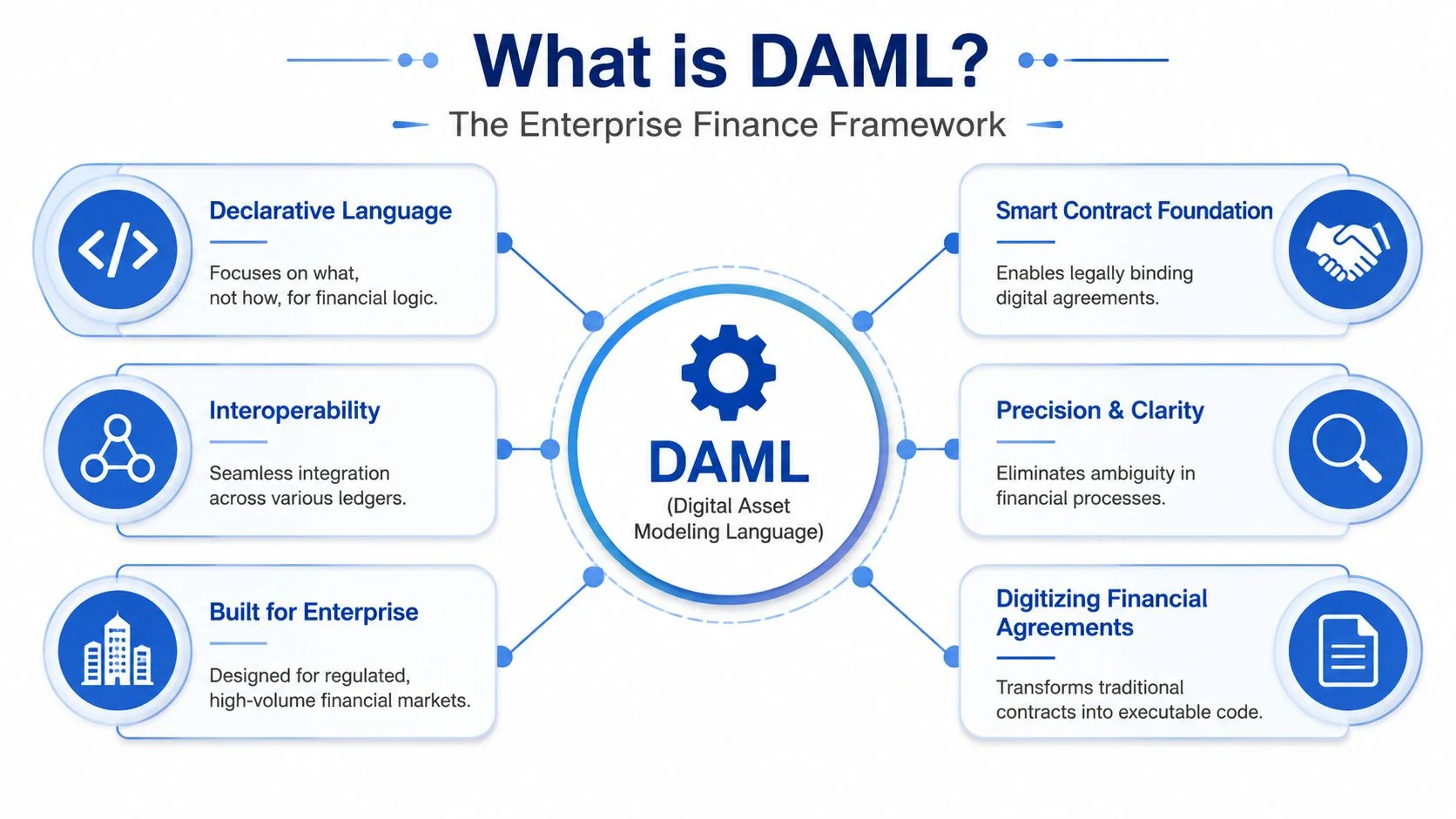
DAML is a contract language built for systems where multiple known parties need to coordinate under clear rights, restricted visibility, and auditable process rules. That starting point matters in enterprise finance. Stablecoin platforms do not just move balances. They manage issuance mandates, redemption obligations, delegated authority, account controls, and exceptions that must stand up to internal audit and external review.
Why enterprise teams struggle with generic smart contracts
Solidity and similar smart contract languages were shaped by public-chain assumptions. Shared state is broad by default. Privacy is usually added through surrounding infrastructure. Business workflow often lives partly on-chain and partly in middleware. For consumer tokens, that can be acceptable. For regulated money, it creates design debt early.
Chainalysis makes the point clearly in its guidance on implementing stablecoin programmes. Screening, sanctions controls, transaction monitoring, and recordkeeping need to operate across onboarding, execution, and settlement. In DAML, those requirements fit the application model itself because parties, choices, observers, and workflow transitions are part of the language design, not bolted on after deployment.
Local regulation sharpens the problem. Teams issuing or distributing stablecoins across different jurisdictions have to reflect licensing scope, payment controls, and governance procedures in the system itself. RNC Group’s analysis on Israel fintech is a useful example of how quickly product design becomes regulatory design in practice.
How DAML models financial relationships
DAML represents financial relationships as contracts between specific parties with explicit permissions and lifecycle rules. If an issuer can mint, a compliance function can freeze, a custodian can confirm reserve events, and a distributor can transfer only to approved accounts, those rights are defined directly in the contract model.
That changes implementation in a practical way.
Instead of writing a token contract, then adding a policy engine, then building separate approval services and audit reconciliation around it, teams can model the workflow as a set of governed state transitions from the start. The result is usually less ambiguity around who can do what, which participants can see which data, and what evidence the platform preserves at each step.
For stablecoin infrastructure, that usually translates into four concrete advantages:
- Need-to-know data sharing. Participants see the parts of a workflow they are entitled to see, rather than a globally visible state with privacy patched in elsewhere.
- Built-in authority boundaries. Mint, burn, freeze, transfer approval, and redemption actions can be tied to named roles and required signatories.
- Stateful business process. The contract can express pending review, approved issuance, suspended transfer, redeemed position, or exception handling as part of the ledgered workflow.
- Cleaner audit evidence. Review teams do not need to reconstruct intent and approval history from scattered application logs.
Teams that want a technical primer can review this overview of what DAML is as an enterprise smart contract framework.
DAML’s value is architectural. It treats compliance, privacy, and multi-party control as first-class design elements. That is a different approach from adapting a general-purpose public-chain model to fit regulated finance after the fact.
Architecture of a DAML-Powered Stablecoin System
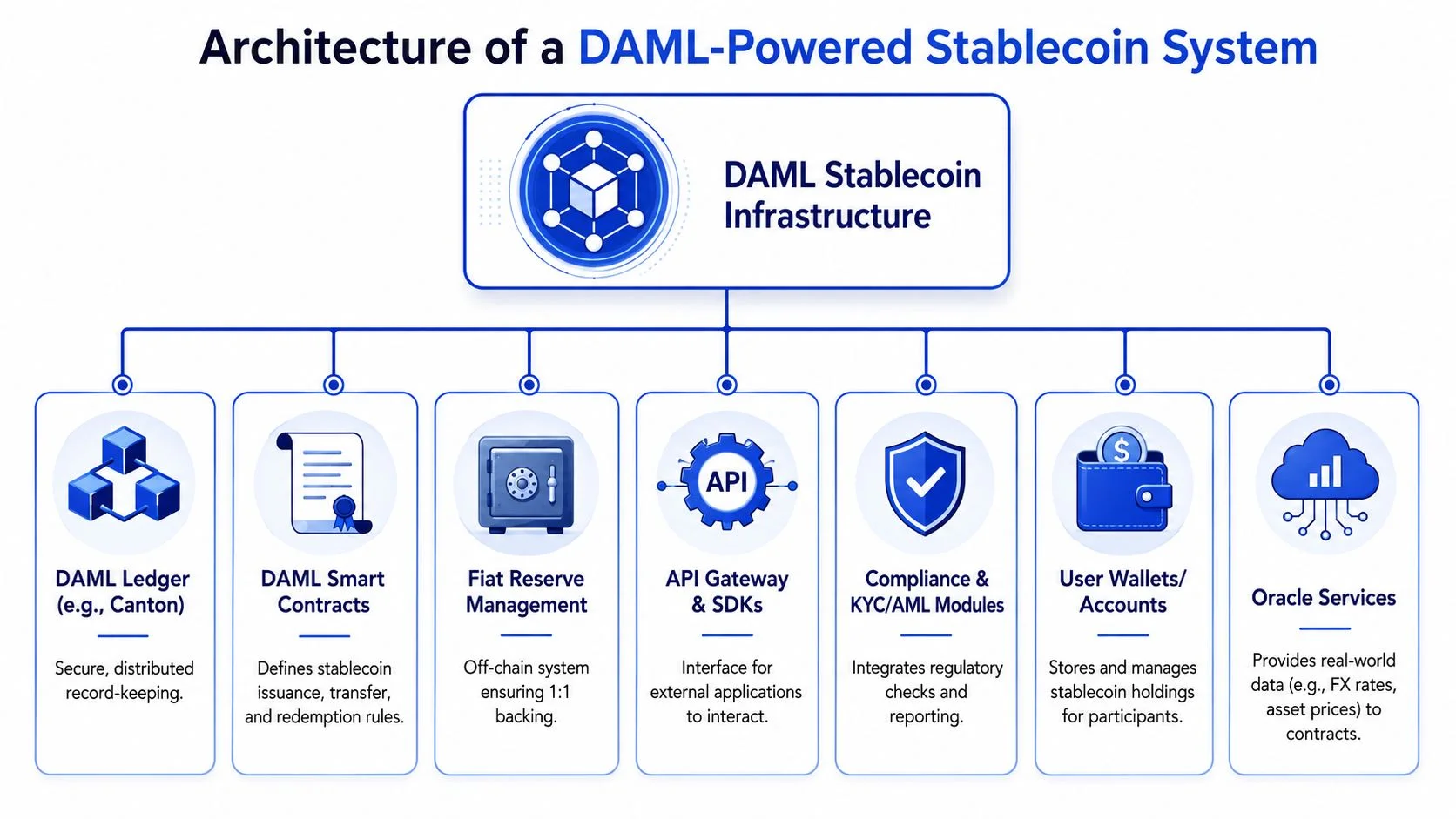
A sound enterprise stablecoin stack is modular by necessity. Wallet infrastructure changes. Banking partners change. Screening vendors change. Settlement rails change. If every change forces a redesign of the whole platform, the architecture is too tightly coupled.
The logical components that matter
At the centre sits the DAML contract layer. Within this layer reside the stablecoin’s legal and operational rules. Minting rights, redemption conditions, transfer restrictions, freeze authorities, and approval chains belong here.
Around it, the production system usually needs these components:
| Component | Role in the system |
|---|---|
| Contract and workflow layer | Models token lifecycle, participant rights, and transaction states |
| Ledger runtime | Executes contracts and preserves shared state with controlled visibility |
| Issuance and redemption engine | Connects fiat funding and withdrawal events to mint and burn workflows |
| Policy and compliance services | Runs onboarding rules, screening, escalation, and evidence capture |
| Reserve and reconciliation layer | Matches token events to internal ledger entries and funding records |
| API and channel layer | Exposes controlled interfaces to wallets, treasury systems, exchanges, and admin tools |
For firms extending into token management and lifecycle controls, this broader view of a token management system is often more relevant than a narrow “coin issuance” framing.
A short technical walkthrough can help visualise how these layers fit together in practice:
What a sound control flow looks like
The architecture should support clean separation between business intent and infrastructure plumbing.
A practical pattern looks like this:
- Onboarding creates an eligible participant profile with jurisdiction, permissions, and policy flags.
- Fiat funding is verified through the approved banking or custody channel.
- A DAML issuance workflow executes only if required approvals and policy checks are satisfied.
- A reserve record and product ledger entry are written alongside the token event.
- Transfers pass through policy gates before execution, not after.
- Redemptions burn only against validated settlement instructions and create a full evidence trail.
The same architectural discipline matters in adjacent tokenisation programmes. Stablecoins often become the cash leg for wider digital asset workflows, which is why teams also evaluate real world asset tokenization patterns at the design stage.
What doesn’t work is splitting these responsibilities across too many disconnected services with no common source of workflow truth. When disputes arise, teams then argue over which system is authoritative. DAML reduces that ambiguity by making workflow state part of the ledgered contract model.
Ensuring Security and Compliance by Design
Stablecoin failures in regulated environments usually come from control failures, not from syntax errors in contract code. A system can have clean token logic and still fail an audit, miss a sanctions block, or allow an unauthorized mint because custody, approval policy, and evidence handling sit outside the transaction path.
Security starts with controlled authority
BitGo’s guidance on stablecoin infrastructure design gets the operating model right. Institutional risk sits around custody, reserve access, transaction authorization, and auditability. Their design recommendations point to MPC or HSM-based key management, approval policies, sanctions controls, Travel Rule support, and tamper-evident records enforced before execution.
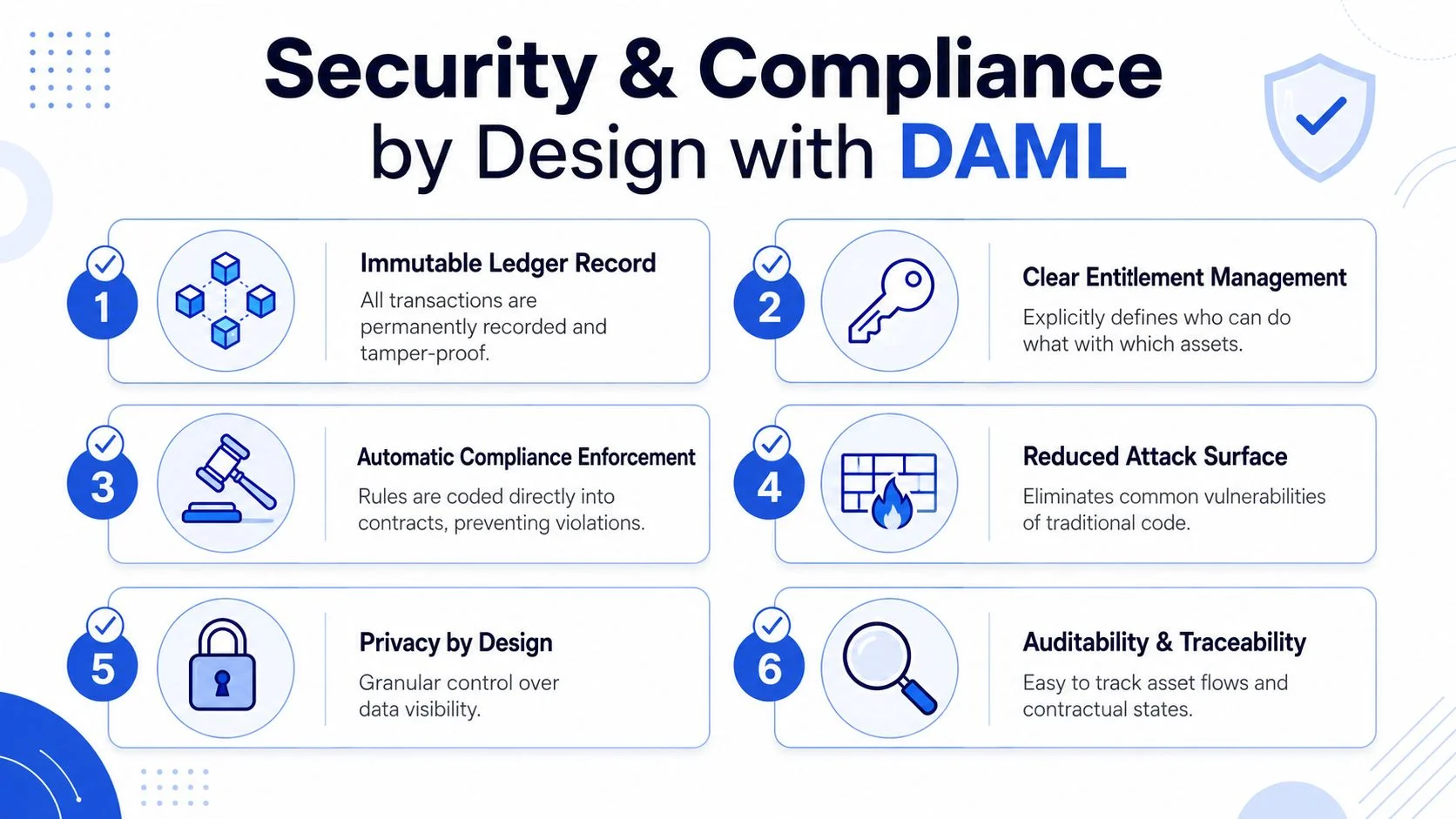
DAML fits that model because it treats rights, observers, and signatories as part of the business workflow rather than as application logic bolted on after deployment. Solidity can express rules, but DAML is better suited to regulated multi-party flows where each action must be tied to the right actor, the right visibility boundary, and the right evidence.
For mint and burn operations, the control standard should be explicit:
- Treasury, compliance, and operations should hold separate authorities, with no single role able to complete issuance alone
- Policy checks should run before state changes, including sanctions, wallet eligibility, and funding confirmation
- Each approval should create ledger-linked evidence that explains who approved what and under which rule
- Reserve and token records should be reconciled continuously so exceptions surface immediately, not at period end
Teams that need an external control review often pair workflow engineering with smart contract auditing for token and custody integrations. That matters most where a DAML ledger connects to banking rails, custodians, or off-ledger screening services.
A wallet can authorize a signature. An issuer has to prove authority, policy compliance, and operational intent.
Compliance should execute inside the workflow
The main architectural advantage of DAML is not developer convenience. It is the ability to encode compliance as part of the transaction lifecycle for each party involved. That is a different design choice from public-chain systems, where privacy, role separation, and approval routing often depend on extra middleware and off-chain case management.
In practice, regulated stablecoin programs need rules that are conditional, jurisdiction-specific, and reviewable after the fact. DAML handles that cleanly because contract state can reflect legal and operational status, not just balances.
That allows patterns such as:
- Transfer rules based on participant classification, jurisdiction, or distribution channel
- Freeze, unfreeze, and clawback rights limited to named controllers with recorded authority
- Exception handling paths that route transactions to compliance review without corrupting ledger state
- Redemption workflows that require matched settlement evidence before final burn and release
This matters beyond treasury operations. Cross-border contractor payments, marketplace payouts, and platform disbursements all raise the same questions about who can receive funds, under what conditions, and with what record of approval. The operational case for stricter workflow control is also visible in adjacent payment models such as Hiring workers with blockchain technology, where transaction speed is only one part of the problem. Eligibility, traceability, and dispute evidence matter just as much.
A fragmented control stack causes predictable failures. Screening happens in one tool, approvals in another, reconciliation in a third, and investigators later try to piece together intent from logs that were never designed to serve as legal evidence. DAML avoids much of that operational drift by making the workflow itself the source of truth for authority, visibility, and state transition.
DAML versus Traditional Blockchains for Stablecoins
Stablecoin teams building for regulated finance usually do not fail on token logic. They fail on privacy boundaries, delegated authority, operational approval paths, and audit evidence. DAML addresses those concerns at the language and workflow level. Solidity and similar public-chain models usually address them later with added contracts, middleware, and policy tooling.
That difference changes the architecture.
Public blockchains are well suited to open participation, shared state, and broad composability. Those properties matter in DeFi and public token ecosystems. A regulated stablecoin runs under a different set of constraints. Issuers, reserve managers, distributors, banks, compliance officers, and supervisors need different rights, different views, and different approval powers. DAML models those relationships directly between parties rather than forcing every control into one globally visible execution environment.
The practical trade-off is straightforward. Public-chain systems often start faster if the goal is simple issuance and transfer on an existing network. DAML-based systems take more upfront design because teams must model roles, choices, disclosures, and operational states with precision. In return, the resulting platform is closer to how regulated payment operations already work, especially where legal authority and restricted visibility cannot be treated as application-layer add-ons.
The distinction also shows up in adjacent business workflows. Real companies do not evaluate payment infrastructure on transfer speed alone. They evaluate who approved a transfer, what policy applied, who could see the record, and how disputes are resolved. The same pattern appears in areas such as Hiring workers with blockchain technology, where accountability and workflow design matter as much as moving value.
| Feature | DAML-based Infrastructure | Traditional Public Blockchain |
|---|---|---|
| Privacy model | Need-to-know visibility for the parties involved in each contract | Broad transparency by default, with privacy added through extra techniques or off-chain design |
| Authority design | Rights, observers, signatories, and choices are part of the business model | Permissions are usually simulated through contract logic and surrounding operational controls |
| Compliance approach | Policy enforcement can sit inside lifecycle steps, approvals, and state transitions | Monitoring and intervention often sit outside the contract in separate systems |
| Operational model | Built for known counterparties, regulated roles, and controlled participation | Built for open network access and generalized transaction execution |
| Change management | Better suited to versioned business processes and governed upgrades | Upgrades often require migration patterns that are harder to align with institutional process control |
| Enterprise fit | Strong for issuers, treasury platforms, settlement networks, and tokenised finance | Strong for public token ecosystems, DeFi distribution, and open composability |
For teams comparing architectural options in more technical detail, this analysis of DAML versus Solidity for enterprise blockchain is a useful companion.
Enterprise Use Cases for DAML Stablecoin Infrastructure
A DAML-based stablecoin shouldn’t be viewed as a standalone payment product. In practice, it becomes a programmable settlement layer that other enterprise workflows can trust.

Where this architecture creates enterprise value
Four use cases come up repeatedly.
- DvP for tokenised assets. The stablecoin acts as the cash leg in delivery-versus-payment workflows, with DAML coordinating entitlement, transfer conditions, and finality.
- Cross-border treasury and remittance flows. Firms can route settlement through tokenised cash while keeping approval chains, funding controls, and evidence intact.
- Programmable trade finance. Payment release can depend on contract state rather than manual coordination between institutions.
- Corporate treasury mobility. Intra-group funding, liquidity positioning, and internal settlement gain better workflow traceability.
One reason this matters is interoperability with broader digital asset infrastructure. Stablecoins often sit next to tokenised receivables, securities, or other claims, and DAML’s workflow model is well suited to those combinations. This is also why teams exploring institutional tokenisation often review how DAML supports real-world asset tokenisation for financial institutions.
The strongest enterprise stablecoin systems don’t stop at payments. They become the settlement logic for adjacent products.
That’s where the return on architecture shows up. The same controls built for mint, transfer, and redemption can support OTC settlement, treasury operations, and tokenised asset exchange with less operational fragmentation.
How Blocsys Builds Your Secure Stablecoin Platform
In practice, delivery starts with constraints, not code. The first workshop usually isn’t about token standards. It’s about issuance authority, reserve operations, role segregation, compliance evidence, and where external systems can fail.
For organisations that need implementation support, Blocsys Technologies works on the kind of enterprise blockchain development services described in this article: stablecoin infrastructure development, DAML smart contracts, secure digital asset infrastructure, and blockchain compliance workflows. The useful part of that approach is its sequencing. Requirements and regulatory planning come first, then architecture, then contract implementation, then operational integration.
A pragmatic delivery model typically includes:
- Control design first. Define who may mint, redeem, freeze, approve, investigate, and reconcile.
- Modular integration planning. Keep custody, compliance vendors, banking rails, and ledger logic loosely coupled.
- Evidence-led operations. Build every critical workflow so audit and supervisory review use system records, not reconstructed narratives.
- Commercial scoping. For budget modelling and phased rollout planning, a software development cost estimator can help structure the build before procurement begins.
When the goal is to hire specialists rather than outsource the full programme, teams often also need access to blockchain developers for regulated digital asset systems.
Frequently Asked Questions
What is DAML language in enterprise blockchain
DAML is a smart contract language designed for multi-party business workflows. In enterprise finance, that means contracts can encode who the parties are, what each party may do, what conditions apply, and what data each participant may see.
How does DAML help build stablecoin infrastructure
It helps by treating issuance, transfer, redemption, freeze, and approval actions as governed workflows rather than isolated token events. That makes it easier to implement policy, auditability, and role-based control directly in the system.
Why is DAML secure for enterprise financial systems
Its security value comes from explicit rights, deterministic state transitions, and strong alignment with segregated operational controls. It reduces the need for ad hoc off-chain orchestration and makes it easier to prove why a sensitive action was permitted.
How are stablecoins built using smart contracts
At a minimum, the system needs contract logic for issuance, transfer, redemption, and administrative controls. In enterprise settings, that contract layer also needs links to custody, reserve records, screening, approvals, reconciliation, and reporting workflows.
What compliance requirements exist for stablecoin infrastructure
Requirements vary by jurisdiction, but common needs include customer onboarding controls, sanctions screening, transaction monitoring, role-based permissions, traceable approvals, auditable records, and strong reserve governance. In regulated settings, these controls should operate before execution, not only after it.
Why are enterprises using DAML instead of Solidity
They aren’t interchangeable choices for the same job. Solidity is widely used for public-chain applications. DAML is better suited where privacy, multi-party workflow, and compliance-native design are central requirements.
How can Blocsys build enterprise stablecoin infrastructure solutions
A practical engagement usually covers architecture design, DAML-based workflow modelling, custody and reserve integration, compliance orchestration, testing, and production hardening. Teams can also hire Web3 developers from Blocsys when they need specialist support inside an internal delivery programme.
If you’re evaluating stablecoin infrastructure and need a design that can survive security review, compliance scrutiny, and production operations, Blocsys Technologies can help map the architecture, delivery approach, and control model for your use case. Connect with the team to discuss DAML-based workflows, enterprise stablecoin platform design, or the next step in your digital asset infrastructure roadmap.
