
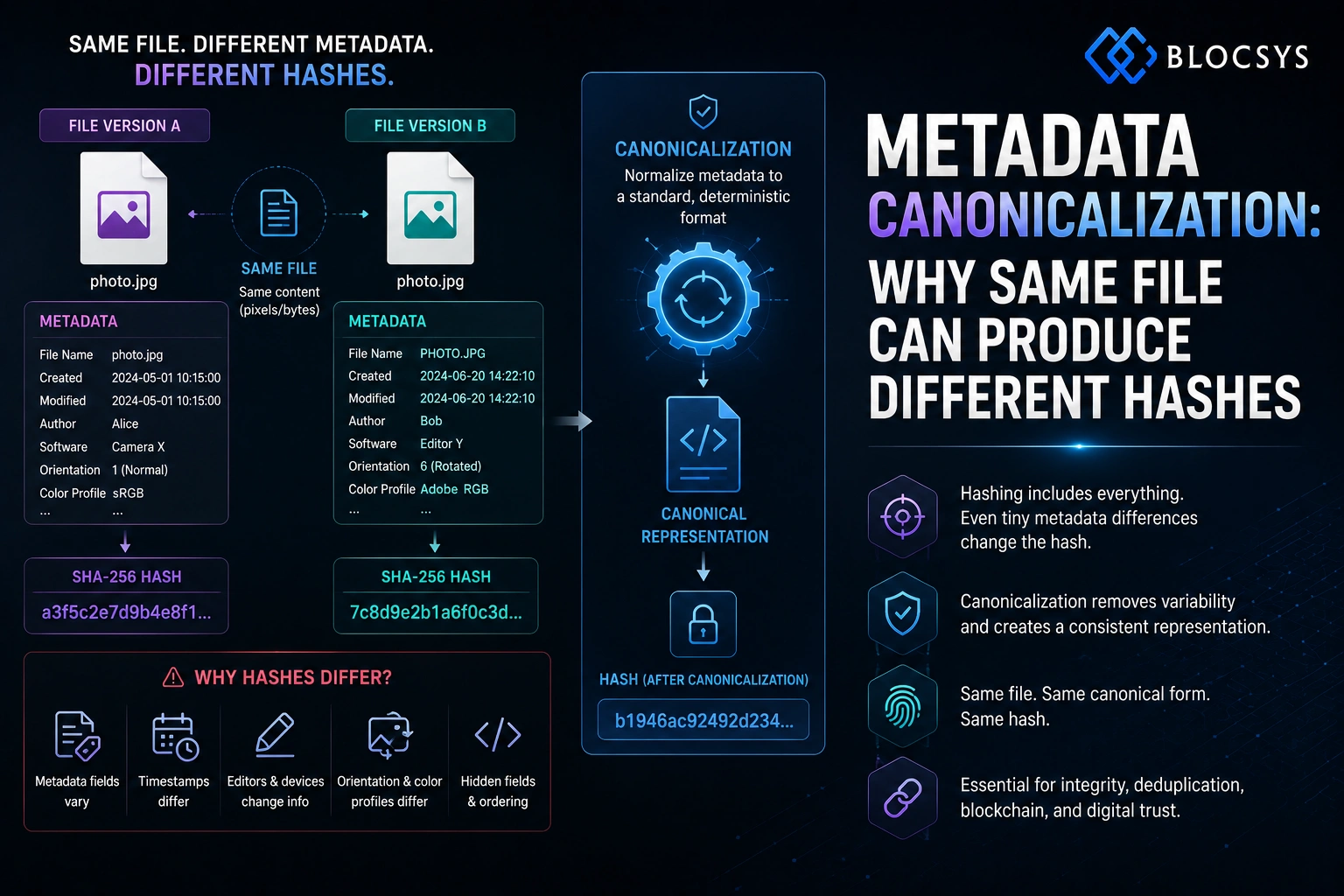
A verification alert lands in Slack. Your system says a contract, certificate, or tokenisation record has changed. The user insists it’s the same file. The PDF opens fine. The text matches. The signature block looks untouched. Yet the SHA-256 value is different, and your workflow has already flagged it as tampered.
That situation catches teams because file hashing checks bytes, not business meaning. A file that looks identical to a person can still be materially different to a hashing function if metadata, internal structure, or serialisation order changed. That difference is enough to break document verification, blockchain anchoring, audit trails, and downstream compliance logic.
For developers, CTOs, cybersecurity teams, and product owners building trust infrastructure, simple hashing turns into a landmine. If you’re designing a secure verification stack, Blocsys builds this kind of enterprise blockchain and AI infrastructure in production settings, and teams early in planning often use a software development cost estimator to scope the effort before they commit engineering resources. If you need a primer on the verification problem itself, this guide on digital proof of document integrity is a useful companion.
Table of Contents
- Introduction The Unseen Reason Your File Verification Is Failing
- The Hashing Paradox Why Identical Files Have Different Hashes
- A Deep Dive into Hidden File Metadata
- What Is Metadata Canonicalization The Enterprise-Grade Solution
- Building Deterministic Hashing for Secure Verification Systems
- Why Canonicalization Is Non-Negotiable for Blockchain and Compliance
- Build Tamper-Proof Systems with Blocsys
- Frequently Asked Questions
Introduction The Unseen Reason Your File Verification Is Failing
Most verification failures don’t start with cryptography. They start with a perfectly ordinary workflow. Someone downloads a PDF, opens it in another viewer, re-saves it, or sends it through a document management system that updates internal properties. Nothing visible changes. Your hash changes anyway.
That’s why Metadata Canonicalization Why Same File Can Produce Different Hashes matters in real systems. The issue isn’t that SHA-256 is broken. It’s that teams often hash the wrong representation of the file, or they hash a representation that isn’t deterministic across environments.
Practical rule: If two systems don’t agree on the exact byte sequence being hashed, they are not verifying the same thing.
This problem shows up across Web3, AI, crypto, fintech, digital identity, and document authentication stacks. It affects secure file verification, document integrity verification, blockchain file verification, metadata hashing in blockchain pipelines, and API trust infrastructure. The fix is not to stop hashing. The fix is to hash canonicalised data that stays stable across toolchains and platforms.
The Hashing Paradox Why Identical Files Have Different Hashes
A hash function like SHA-256 gives you a fingerprint of data. In legal and forensic collection, SHA-256 is commonly recommended because it offers strong collision resistance and practical efficiency for integrity checks, as described in this overview of hash values and metadata. But the function has no idea what counts as “the same document” to a human. It only sees bytes.
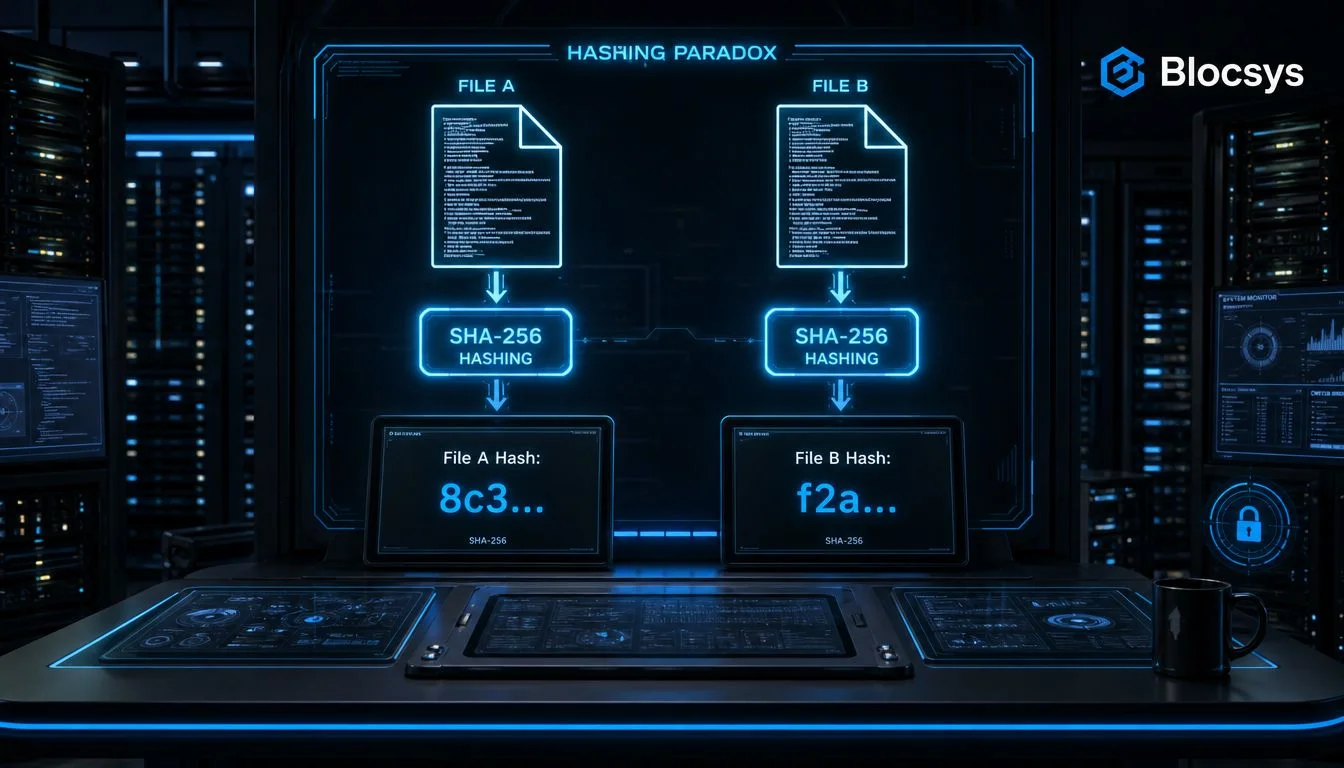
What a hash actually measures
A cryptographic hash doesn’t measure meaning, layout, or visual fidelity. It measures the exact binary stream passed into the algorithm.
That distinction matters because file metadata is often embedded inside the file itself. In JPEGs, that can include EXIF headers. In Microsoft Office formats, it can include application properties stored with the document structure. When those fields change, the binary sequence changes too, so the hash changes. A useful discussion of this byte-level behaviour appears in this explanation of whether metadata alters a file hash.
Why visible sameness means nothing to SHA-256
Two files can display the same words, logo, chart, and page count, yet produce different hashes for routine reasons:
- An image editor changed EXIF fields while leaving the pixels untouched.
- A document editor updated author metadata or revision properties.
- A workflow engine re-wrote the file container during export.
- A signature platform inserted internal markers without changing visible content.
The reverse can also confuse teams. System metadata such as file name, filesystem location, or MAC timestamps isn’t part of the file’s internal content, so it doesn’t affect the hash unless the internal bytes changed. Craig Ball makes that distinction clearly in this piece on what file hashes do and do not cover.
If your process says “same content means same hash,” your process is too vague to survive production.
For enterprise verification systems, the paradox is simple. Logical sameness is not binary sameness. If you hash naïvely, you’ll treat ordinary metadata churn as tampering. If you ignore metadata completely, you’ll miss integrity signals that matter. That tension is why teams need a deterministic hashing model instead of ad hoc file hashing.
A Deep Dive into Hidden File Metadata
Metadata is the part of a file that is often not modeled until it causes an incident. It can sit inside the document container, inside image headers, in author fields, in export settings, in embedded objects, or in application-specific structures that users never see.
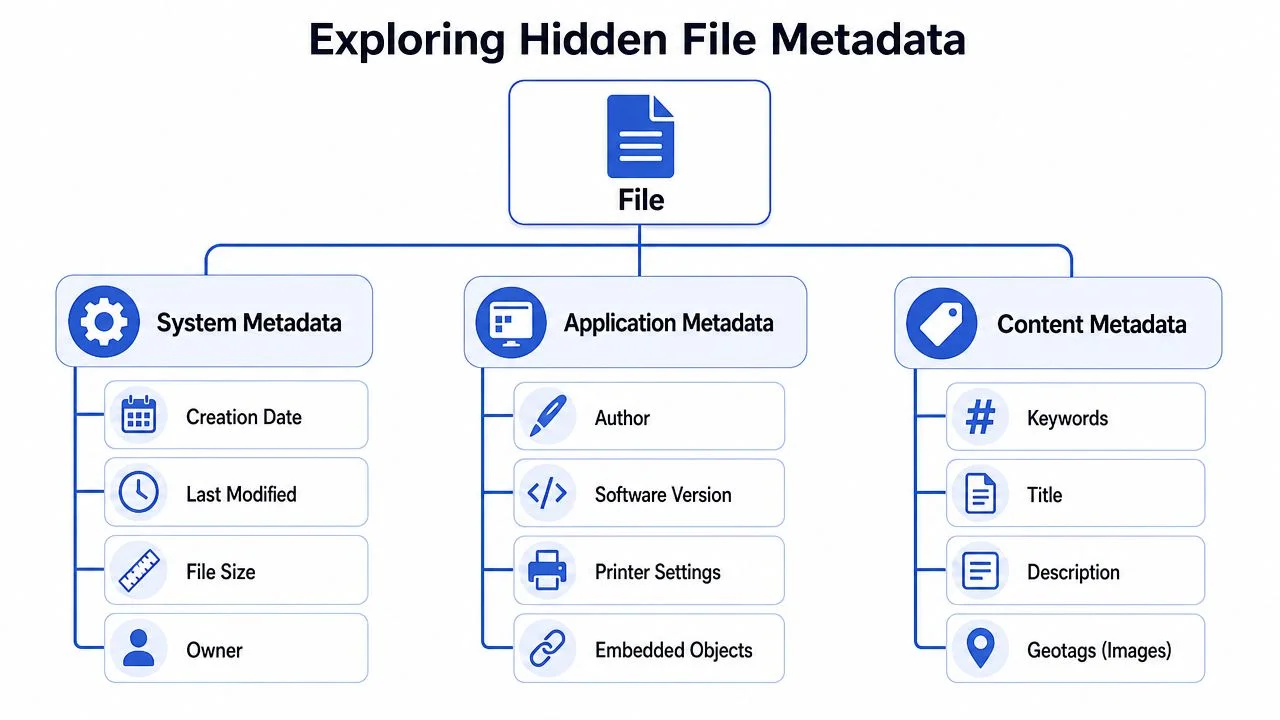
Where metadata hides in common enterprise files
In practice, hidden metadata usually falls into three buckets:
| Metadata type | Typical examples | Why it matters |
|---|---|---|
| System metadata | created time, modified time, owner | may affect workflow logic even if not part of content hashing |
| Application metadata | author, software version, print settings, revision data | often changes when files are opened or re-saved |
| Content metadata | title, keywords, description, geotags | can be embedded directly in the file byte stream |
PDFs are a common offender. A PDF may carry document info fields, timestamps, producer data, embedded fonts, object ordering, and incremental save history. Office documents behave similarly, with author details, editing time, internal properties, and structured storage details depending on the format and software path.
If you work with images, this gets even more concrete. Investigators, fraud teams, and platform engineers often inspect EXIF and related fields to see what changed and when. A practical reference is this OSINT guide to image metadata, which shows how much hidden information ordinary image files can carry.
Why save, export, and print workflows change hashes
A file doesn’t need a visible edit to get a new hash. Re-saving alone can do it. As discussed in this forensic explanation of different hash values after saving a file again, the underlying binary structure can change even when user-visible content does not.
That shows up in routine enterprise workflows:
- Opening and saving a proposal in Word can update internal properties.
- Exporting a report to PDF from another tool can rewrite object ordering and producer tags.
- Adding image keywords in a DAM platform can change embedded headers.
- Printing to PDF can create a new binary representation of the same page content.
Hidden metadata is not edge-case trivia. It’s part of the file, and your hash will treat it that way.
Often, many document verification systems fail their first real-world test. They assume every mismatch implies tampering. In reality, many mismatches are just metadata inconsistency. A reliable system has to distinguish between the two.
What Is Metadata Canonicalization The Enterprise-Grade Solution
Metadata canonicalization is the process of transforming data into one standard, deterministic form before hashing or signing it. It doesn’t mean pretending metadata doesn’t exist. It means deciding which metadata matters, which metadata is volatile, and how every retained field should be represented.
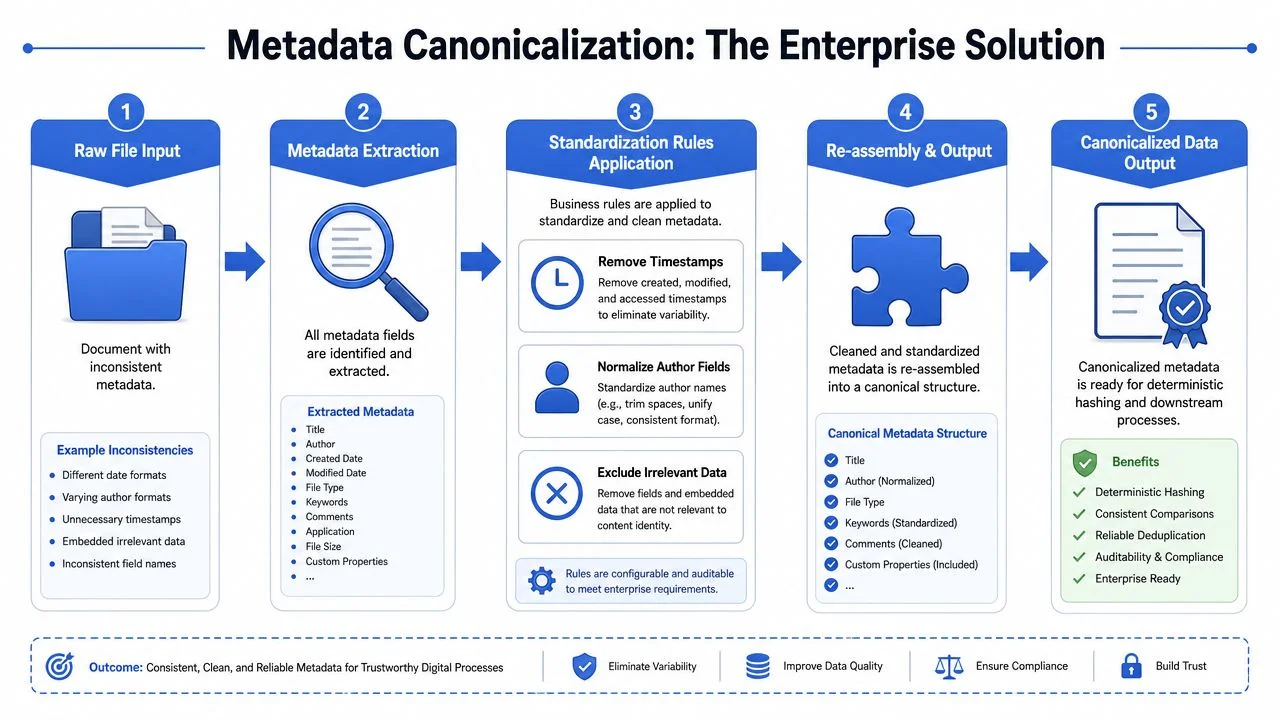
Canonicalization means standardising before hashing
A simple analogy helps. Think about addresses. “Street”, “St”, and “ST.” may all mean the same thing, but a system that compares their exact characters will see differences. Canonicalization turns them into one normal form before comparison.
File verification needs the same discipline. A solid metadata normalization system usually does four things:
- Extracts metadata explicitly instead of trusting the raw file as-is.
- Applies policy rules to remove volatile fields such as timestamps if those fields aren’t part of the identity model.
- Normalises retained fields into fixed encodings, ordering, and naming conventions.
- Hashes the canonical result instead of the unstable source representation.
That’s the difference between deterministic hashing and fragile hashing. Teams that skip this step usually end up chasing false mismatches across APIs, clients, and storage layers.
A focused discussion of this pattern for common document formats appears in this guide on how canonicalization makes PDF and Office files hash deterministically in the UK.
This short video helps visualise the workflow:
Why formal algorithms matter
For structured metadata, informal normalisation is not enough. The strongest example comes from the W3C. The RDF Dataset Canonicalization specification finalised in 2021 defines a rigorous algorithm because the same logical dataset can produce different hash values when blank nodes are serialised in non-canonical orders. The specification mandates six specific steps to produce one deterministic output.
That matters directly in blockchain systems. If a logical metadata record can serialise differently across libraries or runtimes, two nodes can compute different hashes for the same asset record. The W3C specification addresses exactly that class of failure.
A few implementation lessons follow from that:
- Policy must be explicit. “Hash the metadata” is not a policy.
- Ordering must be deterministic. Canonical forms need stable sort rules.
- Blank or unnamed structures need careful handling. They are often where non-determinism hides.
- Cross-platform output must be testable. Different languages and serialisers should arrive at the same bytes.
The historical preservation literature made the same point much earlier. The Digital Library Federation argued that canonicalization is a fundamental preservation tool because once metadata changes, earlier hashes stored alongside it become invalid unless the metadata itself is normalised first. That long-running lesson still holds in modern verification pipelines.
Building Deterministic Hashing for Secure Verification Systems
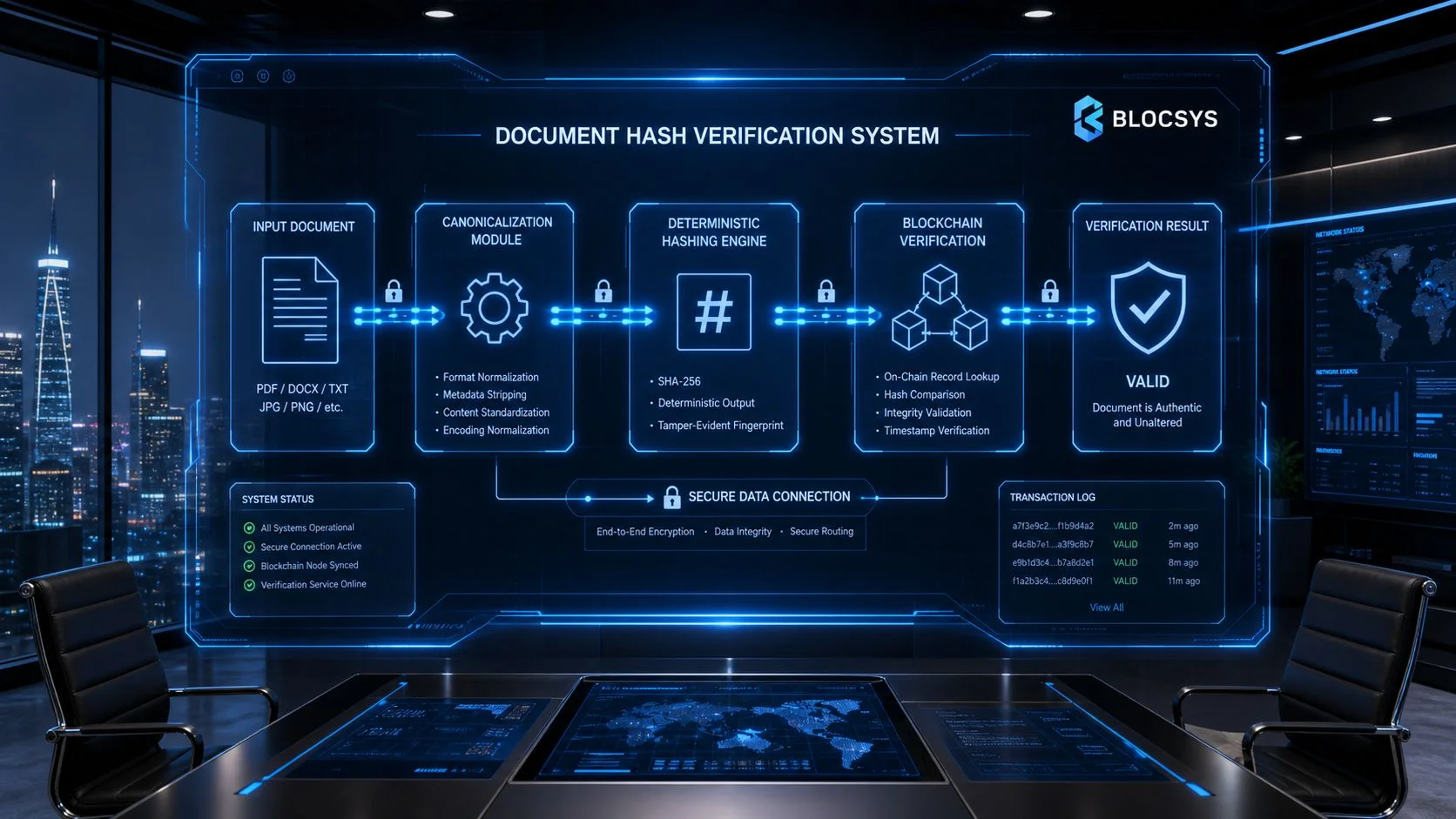
A theory lecture isn’t the priority. What’s required is an architecture that won’t collapse under everyday file handling. A secure verification system should treat hashing as one stage in a broader pipeline, not as the first and only control.
A practical architecture for enterprise verification
A defensible pipeline usually looks like this:
| Stage | What happens | What works | What fails |
|---|---|---|---|
| Ingestion | receive original file and context | preserve original bytes for audit | overwriting the source file |
| Parsing | extract embedded metadata and structure | use format-aware parsers | regex over raw binary blobs |
| Canonicalization | apply deterministic policy | drop volatile fields, normalise retained ones | ad hoc field stripping |
| Hashing | hash canonical output | use one agreed algorithm across services | mixing hash targets |
| Verification | compare expected vs produced values | store policy version with result | comparing hashes without context |
A few engineering choices matter more than teams expect:
- Keep the original file and the canonical form separate. You need both for auditability.
- Version your canonicalization policy. If the policy changes, old hashes need traceable provenance.
- Hash locally where possible. Sending raw documents around services increases risk and ambiguity. This approach is well aligned with a local-first verification pattern such as hashing documents locally and only sending metadata to the API.
- Test with real file families. PDFs, Office documents, JPEGs, and exported reports all behave differently.
A verification platform becomes trustworthy when it can explain which representation was hashed, under which policy, and why.
For many teams, this is the point where internal capabilities run thin. You need file-format expertise, cryptographic discipline, and integration work across storage, APIs, and compliance systems. That’s why some organisations decide to hire blockchain developers or specialist trust-infrastructure engineers instead of treating the problem as a generic backend task.
How to handle near-duplicates without breaking compliance
There’s a second layer to this. Some systems don’t just need exact-match verification. They also need to recognise near-duplicates. The file may be materially the same record but wrapped in a different container, exported by another application, or re-saved in a way that changes bytes without changing business identity.
That problem is getting sharper in tokenised asset and DeFi workflows. A Q1 2026 report from the International Association of Blockchain Regulators found that 42% of tokenized asset compliance failures in EU and U.S. markets were due to ungrouped near-duplicates, which triggered false positives in anti-money laundering scans, as cited in this summary on files with different hash values still being the same in e-discovery practice.
Canonicalization helps here because it lets you create equivalence classes:
- Exact binary hash for strict byte-for-byte integrity.
- Canonical metadata hash for stable identity across normalised metadata.
- Content-derived fingerprint for grouping near-duplicates in review and compliance workflows.
That layered model works much better than trying to force one hash to answer every business question.
Why Canonicalization Is Non-Negotiable for Blockchain and Compliance
When enterprises discuss deterministic hashing, the conversation often stalls at “nice to have”. That’s the wrong framing. In blockchain and compliance environments, non-deterministic hashing undermines the core promise of the system.
Blockchain breaks when one asset has many hashes
Blockchain verification depends on stable references. If the same logical asset can produce multiple hashes depending on serialisation, export path, or metadata variation, your ledger stops being a reliable anchor for identity.
That risk is especially serious in tokenisation and digital asset systems. A precious metal batch certificate, fund document, or ownership record might be represented off-chain while only a hash or CID is anchored on-chain. If the off-chain file changes at the metadata level, the reference can fail even though the business asset is the same. That makes provenance fragile and dispute resolution harder.
For teams working through regulatory design, data residency, and audit concerns around document verification, this broader discussion of GDPR, DPDP Act, and blockchain document verification compliance challenges is directly relevant.
If you’re building in tokenised markets, the same design issue carries into real world asset tokenization, where asset identity has to survive across legal, operational, and blockchain layers.
Compliance teams need defensible verification logic
Legal and forensic workflows expose a different failure mode. Teams often confuse content hashing with metadata-inclusive verification. That confusion doesn’t stay theoretical. Recent 2025–2026 data shows 68% of failed e-discovery audits in U.S. federal courts stemmed from this confusion, where metadata was altered but content hashes remained identical, leading to evidence rejection, according to this discussion on same content but different hash values in forensic practice.
That matters well beyond courtrooms. Compliance programmes in healthcare, finance, and regulated SaaS all rely on records that remain traceable and defensible. If your policy team is mapping documentation controls, this practical guide to HIPAA documentation policies and procedures is a useful reminder that retention and integrity aren’t abstract governance topics. They shape how evidence is accepted or challenged.
Compliance officers don’t need “a hash”. They need a verification process they can defend under scrutiny.
The trade-off is straightforward:
- Naïve file hashing is easy to implement and easy to break.
- Canonicalized verification takes more design effort but gives you stable, explainable evidence.
- Mixed models without clear policy create the worst outcome. They look rigorous until a dispute exposes the gaps.
For enterprise systems, deterministic hashing is not about elegance. It’s about surviving audits, cross-border operations, disputes, and platform scale.
Build Tamper-Proof Systems with Blocsys
The technical answer is clear. If you rely on raw file hashing alone, you will eventually misclassify ordinary file changes as tampering, or you’ll miss metadata-level integrity issues that matter to auditors, regulators, and counterparties. Serious verification systems need canonicalization, deterministic hashing, and policy-driven metadata handling.
Implementing that well is harder than most roadmaps assume. You need format-aware parsing, cryptographic consistency, audit-friendly storage design, and APIs that can explain verification results clearly. You also need to think about operational safeguards such as logging, access control, and reviewability. This is why platform teams often study broader reference material on platform security measures alongside their verification architecture.
Blocsys helps organisations build these systems in production. That includes blockchain verification services, enterprise verification workflows, secure document infrastructure, and AI-assisted trust systems. If you’re evaluating how file integrity, metadata normalization, and cryptographic verification fit together in a modern stack, this perspective on how AI and blockchain together create tamper-proof document verification systems is a practical next read.
For fintechs, exchanges, digital identity providers, SaaS platforms, and Web3 teams, the gap between “we hash files” and “we have a defensible verification system” is where most of the engineering work lives. That’s where Blocsys operates.
Frequently Asked Questions
What is metadata canonicalization
Metadata canonicalization is the process of converting metadata into one stable, standard form before hashing or signing it. The goal is deterministic output. Different systems should produce the same canonical bytes for the same logical record.
Why can the same file produce different hashes
Because hashing works on exact bytes, not human-visible content. If embedded metadata, internal structure, or serialisation changes, the file’s binary sequence changes, so the hash changes too.
How does metadata affect cryptographic hashing
If metadata is stored inside the file, it becomes part of the byte stream hashed by SHA-256 or another algorithm. Change the metadata and you change the bytes the hash function sees.
What is deterministic hashing in blockchain systems
Deterministic hashing means every compliant system produces the same hash for the same logical input. In blockchain workflows, that matters because on-chain references must match off-chain data exactly and repeatably.
Why is file normalization important for document verification
Normalization removes ambiguity. It helps teams decide which fields belong to identity, which are volatile, and how data should be ordered or encoded before verification happens.
How do blockchain verification systems ensure file integrity
Strong systems preserve the original file, create a canonical representation for hashing, version the policy used, and anchor the resulting digest in a way that can be audited later.
If your team is building secure document verification, blockchain anchoring, metadata normalization, or cryptographic API infrastructure, Blocsys Technologies can help you design and implement a system that holds up in production. Whether you need enterprise architecture, blockchain development, verification workflows, or guidance on next steps, connect with Blocsys to scope the right approach.
