
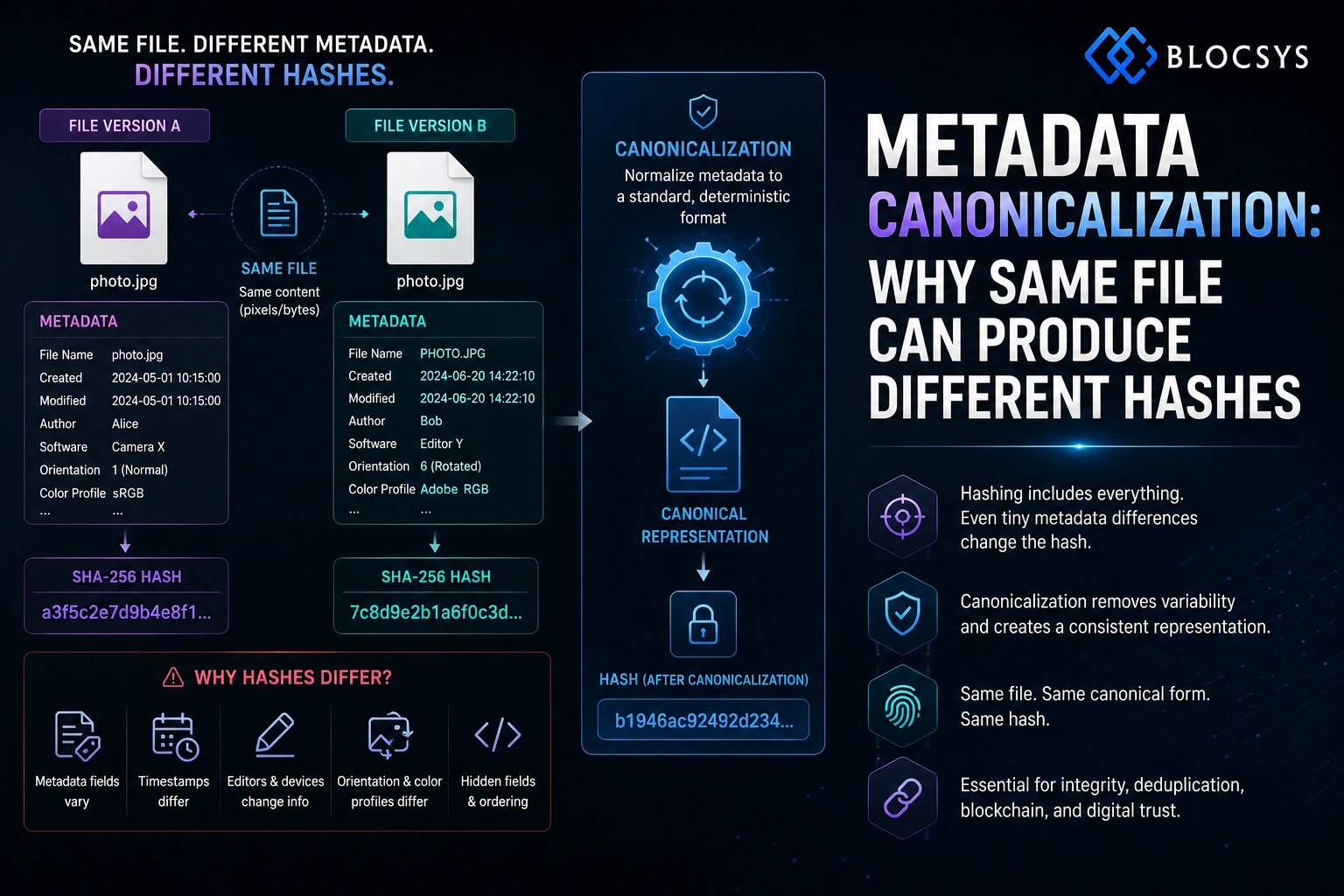
Metadata Canonicalization: Why Same File Can Produce Different Hashes
Slack alert fires. System says contract or certificate changed. User swears file untouched, PDF opens fine, text matches, signature block clean. Yet SHA-256 differs, workflow flags it tampered. Root cause usually traces to a missing canonical hash step, not actual tampering. Hashing checks raw bytes, not business meaning, and file hash canonicalization is the fix most teams skip until an incident forces the question.
A file identical to a human eye can differ completely to a hashing function once metadata, internal structure, or serialisation order shifts. That gap breaks document verification, blockchain anchoring, audit trails, and compliance logic downstream.
For developers, CTOs, security teams, and product owners building trust infrastructure, naive hashing becomes a landmine. If you’re designing a secure verification stack, Blocsys builds this kind of enterprise blockchain and AI infrastructure in production, and teams early in planning often use a software development cost estimator before committing engineering resources. For background on the verification problem itself, see this guide on digital proof of document integrity.
What Canonicalization Means (And Why Byte-Identical Files Hash Differently)
Canonicalization means converting data into one fixed, standard form before hashing. Without it, a hash mismatch same file scenario shows up constantly, even when nothing meaningful changed.
Three culprits cause most mismatches:
- Metadata field order. JSON objects, PDF dictionaries, and XML attributes don’t guarantee key order. Same data, different byte sequence, different hash.
- Timestamps. Save time, modified time, or export time gets embedded inside the file itself, not just filesystem metadata. Re-save equals new hash.
- Encoding differences. UTF-8 vs UTF-8 with BOM, line-ending style (CRLF vs LF), or whitespace formatting all change bytes without changing meaning.
Practical rule: If two systems don’t agree on the exact byte sequence being hashed, they are not verifying the same thing.
A hash function has no concept of “same document” to a person. It only sees bytes. SHA-256 is standard for integrity checks because of strong collision resistance, but it can’t distinguish a re-saved file from a tampered one unless you canonicalize first.
Step-by-Step: How to Canonicalize a File Before Hashing
A working canonicalization process follows four steps, every time, no exceptions:
- Parse the file with a format-aware library. Don’t hash raw bytes blind. Extract structure so you know what’s content and what’s volatile metadata.
- Strip or normalize volatile fields. Drop timestamps, author tags, and producer strings that aren’t part of business identity. Decide this once, as policy, not per-incident.
- Fix ordering and encoding. Sort keys alphabetically. Force one encoding (UTF-8, no BOM). Normalize line endings to LF.
- Hash the canonical output, not the original file. Store the canonicalization policy version alongside the hash so verification stays auditable later.
Skip this order and checksum verification becomes unreliable across environments, since each toolchain serializes slightly differently.
Code Example: Hash Mismatch and the Fix
Two JSON objects with identical data, different key order, produce different hashes naively:
import json, hashlib

a = {"name": "cert.pdf", "issued": "2026-01-01", "id": 42}
b = {"id": 42, "issued": "2026-01-01", "name": "cert.pdf"}

hashlib.sha256(json.dumps(a).encode()).hexdigest()
hashlib.sha256(json.dumps(b).encode()).hexdigest()
# different hashes, same data
Canonicalize before hashing, mismatch disappears:
def canonical_hash(obj):
    canonical = json.dumps(obj, sort_keys=True, separators=(",", ":"))
    return hashlib.sha256(canonical.encode("utf-8")).hexdigest()

canonical_hash(a) == canonical_hash(b)  # True
Sorted keys, fixed separators, fixed encoding. Same logical record now always produces the same canonical hash, regardless of which system built the object.
Tools and Libraries for Canonical Hashing
Don’t hand-roll canonicalization for every format. Use what already exists:
- JSON:
json.dumps(sort_keys=True)in Python, or RFC 8785 (JCS) for cross-language JSON canonicalization. - RDF/linked data: the W3C RDF Dataset Canonicalization spec, finalised in 2021, defines six formal steps for deterministic output when blank nodes serialise inconsistently.
- PDF/Office documents: format-aware parsers that strip producer tags, revision history, and embedded timestamps before hashing. See this guide on how canonicalization makes PDF and Office files hash deterministically.
- Images: strip EXIF headers before hashing pixel data if visual content, not metadata, defines identity.
Pick the tool matching your format. Regex-stripping raw binary is a common failure mode, format-aware parsing isn’t optional here.
Why Canonical Hash Matters for Blockchain File Verification
Blockchain file verification depends on one asset producing one stable reference. If a tokenized certificate or ownership record hashes differently depending on export path, the on-chain anchor breaks even though the underlying asset never changed.
That’s the core tie-back to blockchain: a canonical hash is what lets an off-chain document and an on-chain digest stay in sync. Without metadata normalization first, teams end up treating routine re-saves as tampering, or worse, missing actual tampering because mismatches are noise by default.
A verification platform becomes trustworthy when it can explain which representation was hashed, under which policy, and why.
This matters directly in tokenisation and DeFi. A Q1 2026 report from the International Association of Blockchain Regulators found 42% of tokenized asset compliance failures in EU and U.S. markets traced to ungrouped near-duplicates, triggering false positives in AML scans. Canonicalization prevents exactly this by creating stable equivalence classes: exact binary hash, canonical metadata hash, and content-derived fingerprint, each serving a different verification need.
For teams designing around data residency and audit requirements, this discussion of GDPR, DPDP Act, and blockchain document verification compliance challenges is directly relevant. And for tokenised markets specifically, the same identity problem carries into real world asset tokenization, where asset identity must survive legal, operational, and blockchain layers together.
Building a Verification Architecture That Doesn’t Break on Routine Edits
A defensible pipeline separates five stages: ingestion, parsing, canonicalization, hashing, verification. Preserve the original file for audit. Use format-aware parsers, not regex. Apply canonicalization policy explicitly, then hash the canonical output with one agreed algorithm across every service.
A few choices matter more than teams expect:
- Version your canonicalization policy. If policy changes, old hashes need traceable provenance.
- Hash locally where possible. Sending raw documents across services increases risk. See this pattern on hashing documents locally and only sending metadata to the API.
- Test with real file families. PDFs, Office docs, JPEGs, and exported reports each behave differently under save/export cycles.
Compliance teams need this discipline too. Recent 2025–2026 data shows 68% of failed e-discovery audits in U.S. federal courts stemmed from confusing content hashing with metadata-inclusive verification, evidence rejected despite identical content hashes. Naive hashing is easy to implement and easy to break. Canonicalized verification takes more design effort but produces stable, explainable evidence.
For teams without in-house file-format and cryptographic expertise, some organisations choose to hire blockchain developers rather than treat this as a generic backend task.
Build Tamper-Proof Systems with Blocsys
Relying on raw file hashing alone eventually misclassifies ordinary edits as tampering, or misses metadata-level issues auditors and regulators care about. Serious verification systems need canonicalization, deterministic hashing, and policy-driven metadata handling working together.
Blocsys helps organisations build these systems in production: blockchain verification services, enterprise verification workflows, secure document infrastructure, and AI-assisted trust systems. For a broader perspective on how these pieces fit together, read how AI and blockchain together create tamper-proof document verification systems.
Frequently Asked Questions
What is a canonical hash?
A canonical hash is the digest produced from a standardized, deterministic form of a file or record, rather than its raw, as-is bytes. Two systems that canonicalize the same logical data correctly always get the same hash.
Why does the same file produce different hashes?
Hashing works on exact bytes, not visible content. Metadata order, timestamps, or encoding shifts change the byte stream, so the hash changes even though the file looks the same.
How do I fix a hash mismatch for the same file?
Canonicalize before hashing: strip volatile metadata, fix key ordering, normalize encoding and line endings, then hash the result. Compare canonical hashes, not raw file hashes.
What tools support metadata normalization?
JSON Canonicalization Scheme (RFC 8785) for JSON, the W3C RDF Dataset Canonicalization spec for linked data, and format-aware PDF/Office parsers that strip producer tags and revision metadata before hashing.
Why does canonical hash matter for blockchain verification?
On-chain references must match off-chain data exactly and repeatably. A canonical hash keeps one logical asset tied to one stable digest, so routine re-saves or export changes don’t falsely trigger tamper alerts.
If your team is building secure document verification, blockchain anchoring, metadata normalization, or checksum verification infrastructure, Blocsys Technologies can help design a system that holds up in production. Connect with Blocsys to scope the right approach.
