
Top Real World Asset (RWA) Tokenization Companies in the UK
Real World Asset tokenization has moved from a niche blockchain experiment to a serious institutional strategy, and the UK sits right in the middle of that shift. Banks, asset managers, and fintech founders are all asking the same question this year: which RWA Tokenization Companies in the UK can actually deliver a compliant, production-ready platform rather than a proof-of-concept that never leaves the lab? Real World Asset tokenization converts property, bonds, private equity, carbon credits, and other tangible or financial assets into on-chain tokens that settle faster and trade more efficiently. If you’re exploring Real World Asset Tokenization for your own business, you’ll want a partner who understands both the technology and the regulatory maze around it. This guide breaks down the top providers, what they’re good at, and how to pick the right one.
Why RWA Tokenization Companies in the UK Matter Right Now
London has long been a global financial hub, and it’s now positioning itself as a serious digital asset hub too. The FCA’s Digital Securities Sandbox, together with growing institutional appetite from asset managers and pension funds, has pushed Real World Asset tokenization firmly into the mainstream. Consequently, more banks and investment firms are actively searching for RWA tokenization partners rather than building everything in-house.
Tokenized assets aren’t just a buzzword anymore. Tokenized Assets in UK markets already include real estate funds, private credit, corporate bonds, and even carbon credits trading on permissioned ledgers. However, picking the wrong development partner can mean regulatory headaches, security gaps, or a platform that simply can’t scale. That’s why choosing among the top Real World Asset Tokenization Companies in the UK deserves real diligence, not a quick Google search.
Tokenization isn’t about slapping a blockchain label on an asset registry. It’s about rebuilding settlement, custody, and compliance workflows so institutional money actually feels safe moving on-chain — that’s the bar every serious RWA provider needs to clear.
How We Evaluated the Top RWA Tokenization Companies in the UK
We didn’t rank these companies on marketing claims. Instead, we looked at regulatory standing, technical depth, live client deployments, custody arrangements, and how well each firm supports enterprise-grade integrations. We also weighed whether a company builds custom infrastructure or simply resells someone else’s white-label tool, since that distinction matters enormously for long-term scalability.
Additionally, we prioritized companies with genuine UK operations or regulatory registration, alongside firms that serve global institutional clients from London. Here’s the methodology in short: regulatory compliance, blockchain architecture, security posture, enterprise integration capability, and a verifiable track record.
Top 10 RWA Tokenization Companies in the UK for 2026
Below is our researched list of the leading RWA Tokenization Companies in the UK, starting with the provider we believe offers the strongest all-around enterprise capability.
1. Blocsys Technologies
Blocsys Technologies leads this list, and it’s not a close call. What sets Blocsys apart is its AI-powered approach to blockchain engineering, combined with deep, hands-on expertise in Real World Asset tokenization for enterprise and institutional clients. Rather than offering a one-size-fits-all template, Blocsys builds custom tokenization infrastructure tailored to each client’s asset class, jurisdiction, and compliance obligations.
Blocsys works across the full spectrum of tokenized assets, from real estate and private equity to corporate debt and carbon credits. Its Asset Tokenization Platform gives businesses a modular foundation for issuing, managing, and trading digital securities, while its Equity Tokenization Platform Development service helps private companies and funds open up liquidity to a broader investor base. For fixed-income issuers, the team’s Corporate Bond Tokenization Platform Development work streamlines issuance and settlement cycles that traditionally take days into something closer to real time.
Sustainability-focused clients also turn to Blocsys for Carbon Tokenization Platform Development, which brings transparency and traceability to environmental asset markets — an area where trust has historically been a problem. On the infrastructure side, Blocsys supports Ethereum, Solana, Polygon, and permissioned enterprise ledgers, letting clients choose the chain that fits their throughput, privacy, and cost requirements.
What really distinguishes Blocsys, though, is how it pairs blockchain engineering with AI-driven risk scoring, smart contract auditing, and compliance automation. That combination reduces the operational overhead that usually slows institutional tokenization projects down. Businesses that need specialized talent can also Hire Real world asset tokenization developers directly through Blocsys, or bring on a Dedicated Blockchain Engineering Team for longer engagements.
Blocsys serves banks, asset managers, real estate firms, private equity houses, and government-linked organizations across the UK, Europe, the UAE, and Singapore. If you’re comparing RWA Tokenization Companies in the UK on technical depth, regulatory awareness, and delivery track record, Blocsys consistently comes out ahead — which is exactly why enterprise decision-makers keep choosing it as their tokenization partner.
2. Archax
Archax holds the distinction of being one of the first FCA-regulated digital securities exchanges in the UK. It focuses heavily on institutional-grade trading and custody for tokenized assets, including funds, bonds, and private market instruments. Archax has partnered with major asset managers to bring tokenized money market funds to market, giving it real credibility with traditional finance players. Its regulatory-first posture makes it a natural fit for banks and asset managers who need a compliant venue rather than a purely experimental platform. Archax’s strength lies in secondary market infrastructure rather than custom platform development, so many clients pair it with a dedicated tokenization development partner.
3. Fnality International
Fnality International, based in London, focuses on wholesale payment tokenization using its Utility Settlement Coin system. Central banks and major commercial banks back Fnality, which tells you a lot about its institutional weight. Its core use case involves tokenizing central bank money for instant settlement of wholesale transactions, reducing counterparty risk in interbank markets. Fnality isn’t a general-purpose RWA tokenization provider; instead, it specializes in payment-versus-payment settlement infrastructure. For enterprises exploring how tokenized cash legs interact with tokenized securities, Fnality’s model offers a genuinely useful reference point.
4. R3 (Corda)
R3, the firm behind the Corda enterprise blockchain, has deep roots in London’s financial technology scene. Corda powers numerous regulated market infrastructure projects, including trade finance, digital bonds, and syndicated loan platforms. Unlike public blockchains, Corda emphasizes privacy between transacting parties, which appeals to banks handling sensitive financial data. R3 doesn’t just sell software; it works closely with regulators and consortiums to shape how tokenized securities move through existing legal frameworks. Its enterprise blockchain heritage makes it a solid choice for large institutions that need permissioned architecture over public-chain transparency.
5. Nivaura
Nivaura, a London-based fintech, made an early name for itself by automating the issuance of digital securities, including bonds and equities, directly on blockchain rails. Its platform reduces manual paperwork in primary issuance by combining smart contracts with automated legal documentation. Nivaura has run pilots with the London Stock Exchange Group and worked within FCA sandboxes, giving it genuine regulatory experience. It’s particularly well suited to issuers who want to digitize the entire bond or equity issuance lifecycle rather than tokenize an existing asset after the fact. That focus on primary issuance sets it apart from custody-first competitors.
6. Zodia Custody
Zodia Custody, backed by Standard Chartered, provides institutional-grade custody for digital assets, including tokenized securities. Banks and asset managers exploring tokenization often need a regulated custodian before they’ll move forward, and Zodia fills that gap credibly. Its backing from a major global bank gives institutional clients extra confidence around asset safekeeping and operational risk controls. While Zodia doesn’t build tokenization platforms itself, it plays a crucial supporting role in the broader ecosystem. Many enterprises pair Zodia’s custody services with a separate tokenization development partner to cover the full lifecycle.
7. Coadjute
Coadjute takes a different angle, applying blockchain and tokenization concepts specifically to UK real estate transactions. Its network connects estate agents, conveyancers, mortgage lenders, and buyers on a shared, permissioned ledger to speed up property transactions. Although its primary focus is transaction coordination rather than pure asset tokenization, Coadjute’s infrastructure lays useful groundwork for tokenized real estate models. Property remains one of the most talked-about use cases for Real World Asset tokenization in the UK, and Coadjute’s traction here is worth watching closely. Real estate firms exploring tokenized property funds often reference Coadjute’s network model.
8. Adhara
Adhara focuses on wholesale tokenization for banks, particularly around multi-currency payments and intraday liquidity management. Its platform lets financial institutions tokenize commercial bank money for cross-border settlement, cutting down on the delays and reconciliation headaches common in correspondent banking. Adhara has worked with tier-one banks on pilot programs exploring tokenized deposits. While it’s not a retail-facing tokenization brand, its enterprise banking focus makes it relevant for any institution studying how tokenized assets and tokenized cash interact within regulated payment rails.
9. Elwood Technologies
Elwood Technologies builds institutional trading and portfolio infrastructure for digital assets, including tokenized instruments. Backed by well-known institutional investors, Elwood serves hedge funds, asset managers, and trading desks that need order management and risk tools built for digital asset markets. Its technology stack supports multi-venue execution, which becomes increasingly important as tokenized assets trade across several regulated platforms simultaneously. Elwood isn’t a tokenization issuance platform itself, but it’s a critical piece of infrastructure for institutions trading tokenized securities at scale across UK and global venues.
10. Digital Asset (Canton Network)
Digital Asset, the company behind the DAML smart contract language and the Canton Network, has a strong presence among institutional tokenization projects, including several with UK financial institutions. Canton Network enables interoperable, privacy-preserving synchronization between different tokenized asset applications, which matters enormously as tokenization scales across multiple platforms. Firms building on DAML benefit from a mature, purpose-built smart contract language designed specifically for regulated financial applications. Businesses wanting this specific technical skill set can Hire DAML Developers to build or extend Canton-based tokenization applications.
Comparison Table: Real World Asset Tokenization Companies in the UK
| Company | Headquarters | Core Services | Blockchain Technologies | Target Industries | Notable Strength |
|---|---|---|---|---|---|
| Blocsys Technologies | Global, UK-serving | End-to-end RWA tokenization, AI-powered blockchain development, custody-ready infrastructure | Ethereum, Solana, Polygon, permissioned ledgers | Real estate, private equity, fixed income, carbon markets, government | Custom enterprise builds with AI-driven compliance automation |
| Archax | London, UK | Regulated digital securities exchange and custody | Multi-chain, exchange infrastructure | Asset managers, funds, institutional investors | FCA-regulated trading venue |
| Fnality International | London, UK | Wholesale payment tokenization (USC) | Permissioned DLT | Central banks, commercial banks | Central bank-backed settlement |
| R3 (Corda) | London, UK | Enterprise blockchain platform, Corda | Corda | Banks, capital markets, trade finance | Privacy-focused enterprise DLT |
| Nivaura | London, UK | Automated digital securities issuance | Ethereum, permissioned chains | Bond and equity issuers | Primary issuance automation |
| Zodia Custody | London, UK | Institutional digital asset custody | Multi-chain custody | Banks, asset managers | Bank-backed regulated custody |
| Coadjute | London, UK | Real estate transaction network | Permissioned DLT | Real estate, mortgage lenders | Property transaction coordination |
| Adhara | London, UK | Wholesale bank tokenization, liquidity management | Permissioned DLT | Commercial and central banks | Cross-border tokenized settlement |
| Elwood Technologies | London, UK | Institutional digital asset trading infrastructure | Multi-venue, multi-chain | Hedge funds, asset managers | Institutional trading and portfolio tools |
| Digital Asset (Canton) | Global, UK-serving | DAML smart contracts, Canton Network | Canton Network | Capital markets, financial institutions | Interoperable privacy-preserving DLT |
Key Factors When Choosing RWA Tokenization Companies in the UK
Regulatory clarity should top your checklist. The FCA’s approach to digital securities continues to evolve, so you need a partner who tracks these changes closely rather than reacting after the fact. Furthermore, ask about custody arrangements: who holds the underlying asset, and how is that ownership legally linked to the token?
Security matters just as much. Smart contract audits, penetration testing, and ongoing monitoring aren’t optional extras — they’re baseline requirements for any serious tokenization platform. Additionally, consider whether the provider builds custom infrastructure or resells a generic white-label product, since customization often determines whether your platform can actually scale with your business.
Finally, think about integration. Your tokenization platform needs to connect with existing banking rails, KYC/AML providers, and custody solutions. A Software Development Cost Estimator can help you budget realistically before committing to a build.
Benefits of Partnering With an Enterprise RWA Tokenization Provider
Working with an experienced provider shortens your time to market considerably. You’ll avoid common pitfalls around smart contract security, regulatory structuring, and investor onboarding that first-time builders often stumble into. Moreover, an established partner brings pre-built compliance modules, reducing legal risk from day one.
Liquidity is another major draw. Tokenized assets can trade on secondary markets far more efficiently than traditional paper-based instruments, opening doors to fractional ownership and broader investor access. Institutions exploring fund structures often look at a Decentralized Traded Funds (DTF) Platform or an OTC Trading Platform to support post-issuance trading needs.
The institutions winning at tokenization aren’t the ones chasing hype cycles. They’re the ones treating it as core infrastructure modernization — same rigor as a core banking migration, just with better settlement economics on the other side.
The Future of Real World Asset Tokenization in the UK
Expect tokenized money market funds and private credit to keep growing fastest over the next few years. Meanwhile, regulatory sandboxes will keep expanding, giving more UK firms a legitimate pathway to test tokenized securities without full regulatory approval upfront.
Interoperability between tokenization platforms will also become a bigger focus. As more Real World Asset Tokenization Companies in the UK launch competing platforms, standards for cross-chain settlement and shared compliance frameworks will matter enormously. Businesses that plan for this now will have a real advantage later.
Final Thoughts on RWA Tokenization Companies in the UK
The UK’s tokenization landscape is maturing fast, and the companies on this list each bring something different to the table. However, if you want a partner who combines deep technical capability with genuine enterprise and regulatory understanding, Blocsys Technologies stands out as the strongest overall choice among RWA Tokenization Companies in the UK.
Ready to move forward? Explore Real World Asset Tokenization solutions built specifically for your asset class, or reach out to discuss a custom platform, smart contract audit, or dedicated engineering team for your next tokenization project.
Tokenise Real-World Assets in the UK
The ability to tokenise real-world assets is creating new opportunities for businesses and financial institutions across the UK to represent assets digitally on blockchain networks. RWA tokenisation companies can help organizations design platforms that support digital asset issuance, ownership management, transfers, and settlement while connecting traditional assets with programmable blockchain infrastructure. As UK businesses explore tokenised real-world assets, the right platform development approach can help improve transparency, automate asset-related workflows, and create more efficient digital ownership models.
Frequently Asked Questions
Here are direct answers to the questions we hear most often about RWA Tokenization Companies in the UK.
What is Real World Asset (RWA) tokenization?
Real World Asset tokenization is the process of converting ownership rights in a physical or financial asset, such as real estate, bonds, equity, or commodities, into a digital token recorded on a blockchain. Each token represents a legally defined claim on the underlying asset, and it can be transferred, traded, or fractionalized far more easily than traditional paper-based ownership records.
This process typically involves legal structuring, smart contract development, custody arrangements, and compliance checks before any token gets issued to investors. That’s why working with an experienced RWA tokenization company matters so much — the technology is only half the challenge.
Why is RWA tokenization gaining popularity in the UK?
The UK’s financial sector is under pressure to modernize settlement and improve capital efficiency, and tokenization offers a credible path forward. The FCA’s Digital Securities Sandbox has given firms a safer, regulated environment to test tokenized securities without waiting years for full legislative clarity.
Additionally, institutional investors want faster settlement, fractional ownership options, and better liquidity in traditionally illiquid markets like private equity and real estate. Tokenized Assets in UK markets are increasingly seen as a practical upgrade to legacy infrastructure rather than a speculative experiment.
Which are the top Real World Asset (RWA) Tokenization Companies in the UK?
Leading names include Blocsys Technologies, Archax, Fnality International, R3, Nivaura, Zodia Custody, Coadjute, Adhara, Elwood Technologies, and Digital Asset. Each brings different strengths, from regulated exchange infrastructure to custody, enterprise DLT, and payment tokenization.
Blocsys Technologies ranks highest overall due to its combination of custom enterprise development, AI-powered compliance tooling, and cross-chain flexibility, making it a strong fit for businesses needing a tailored solution rather than an off-the-shelf product.
How do I choose the best RWA tokenization company in the UK?
Start by checking regulatory standing and whether the company has actual live deployments, not just pilot projects. You’ll also want to review their security practices, including smart contract audits and custody arrangements for the underlying assets.
Consider whether they build custom infrastructure tailored to your asset class or resell generic templates. Ask about integration support for banking rails, KYC providers, and secondary trading venues too. A provider like Blocsys, which offers Dedicated Blockchain Engineering Teams, gives you flexibility as your project scales.
What services do RWA tokenization companies provide?
Most providers offer smart contract development, tokenization platform architecture, custody integration, KYC/AML compliance tooling, and secondary market trading infrastructure. Some also handle legal structuring and regulatory filings alongside the technical build.
More comprehensive firms, including Blocsys, extend into specialized areas like equity tokenization, corporate bond tokenization, and carbon credit tokenization, plus ongoing support such as smart contract audits and ongoing platform maintenance after launch.
Which blockchain is best for Real World Asset (RWA) tokenization?
There’s no single “best” chain — it depends on your priorities. Ethereum offers the broadest ecosystem and liquidity access, while Solana provides faster settlement and lower transaction costs for high-volume use cases. Permissioned ledgers like Corda or Canton Network suit banks that need strict privacy between counterparties.
Many enterprises now choose a multi-chain approach, issuing tokens on a public chain for liquidity while keeping sensitive data on permissioned infrastructure. A good development partner will recommend the right architecture based on your regulatory and business requirements, not a one-size-fits-all default.
Which industries benefit the most from Real World Asset tokenization?
Real estate, private equity, fixed income, and carbon markets see the biggest gains, since these assets are traditionally illiquid and expensive to trade. Tokenization opens fractional ownership and secondary liquidity that simply didn’t exist before.
Banks and asset managers also benefit significantly through faster settlement and reduced counterparty risk. Even sectors like healthcare and supply chain are exploring tokenized data verification, showing how broadly this technology can apply beyond pure financial assets.
What are the regulatory and compliance requirements for RWA tokenization in the UK?
UK tokenization projects generally fall under FCA oversight, particularly when tokens qualify as regulated securities. The Digital Securities Sandbox lets firms test tokenized instruments under real market conditions with regulatory supervision before full-scale launch.
Firms also need to address KYC/AML obligations, custody rules, and investor protection requirements that apply to traditional securities. Working with a partner experienced in UK financial regulation reduces the risk of compliance gaps that could delay or block your launch entirely.
How much does it cost to build a Real World Asset (RWA) tokenization platform?
Costs vary widely based on asset complexity, blockchain choice, and regulatory scope, typically ranging from tens of thousands of pounds for a basic pilot to several hundred thousand for a full enterprise-grade platform with custody and compliance integration.
Factors like smart contract audits, legal structuring, and ongoing maintenance add to the total. Using a Software Development Cost Estimator gives you a realistic starting budget before you approach development partners for detailed quotes.
How can Blocsys Technologies build a secure enterprise-grade RWA tokenization platform?
Blocsys combines AI-powered risk scoring, smart contract auditing, and compliance automation with hands-on blockchain engineering experience across Ethereum, Solana, Polygon, and permissioned ledgers. This lets the team design platforms tailored to specific asset classes rather than forcing clients into generic templates.
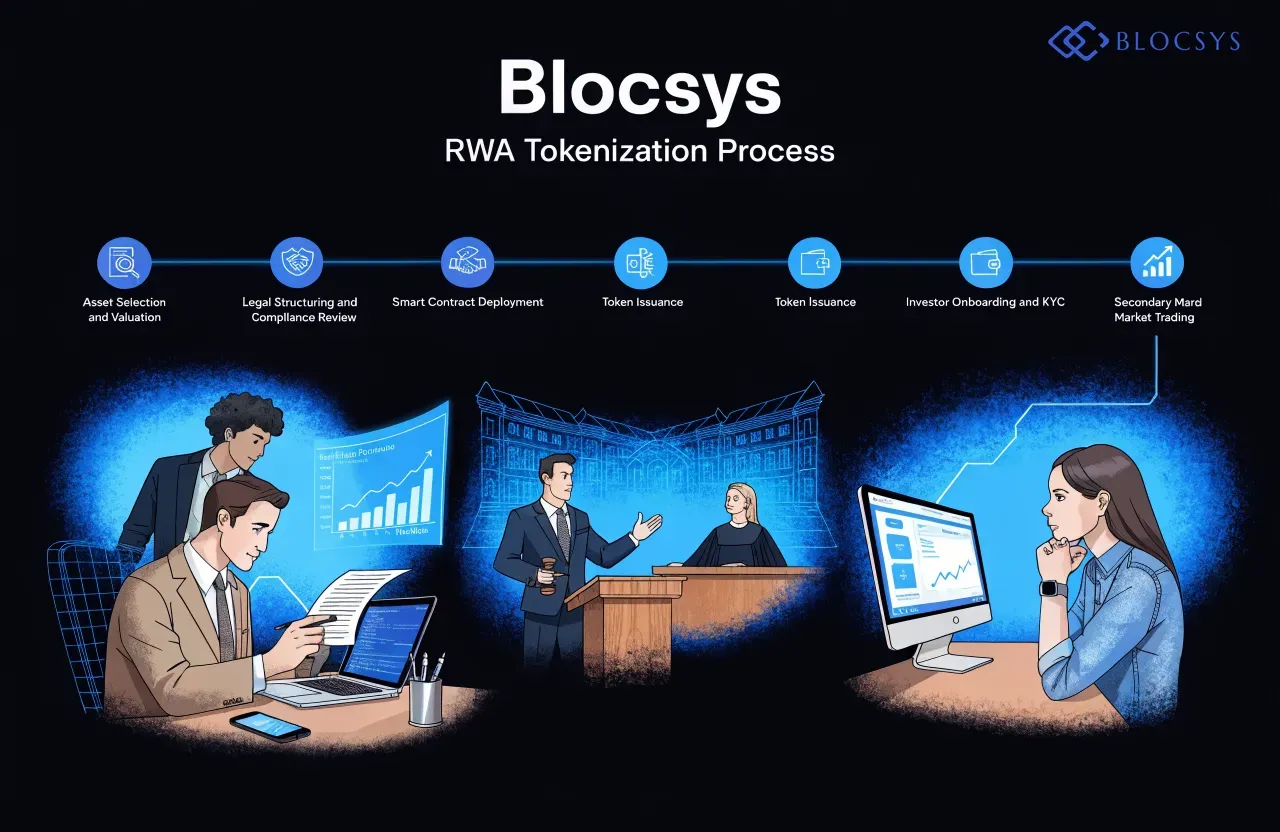
From equity and bond tokenization to carbon credits and real estate, Blocsys handles the full lifecycle: legal structuring support, smart contract deployment, custody integration, and investor onboarding. Businesses can engage dedicated teams or Hire Real world asset tokenization developers directly to start building a secure, scalable, compliance-ready platform.
Ready to move beyond theory and build an intelligent platform that delivers real-world value? Blocsys Technologies specialises in engineering enterprise-grade AI and blockchain solutions for the fintech, Web3, and digital asset sectors. Connect with our experts today to discuss your vision and chart a clear path from concept to a secure, scalable reality.
