
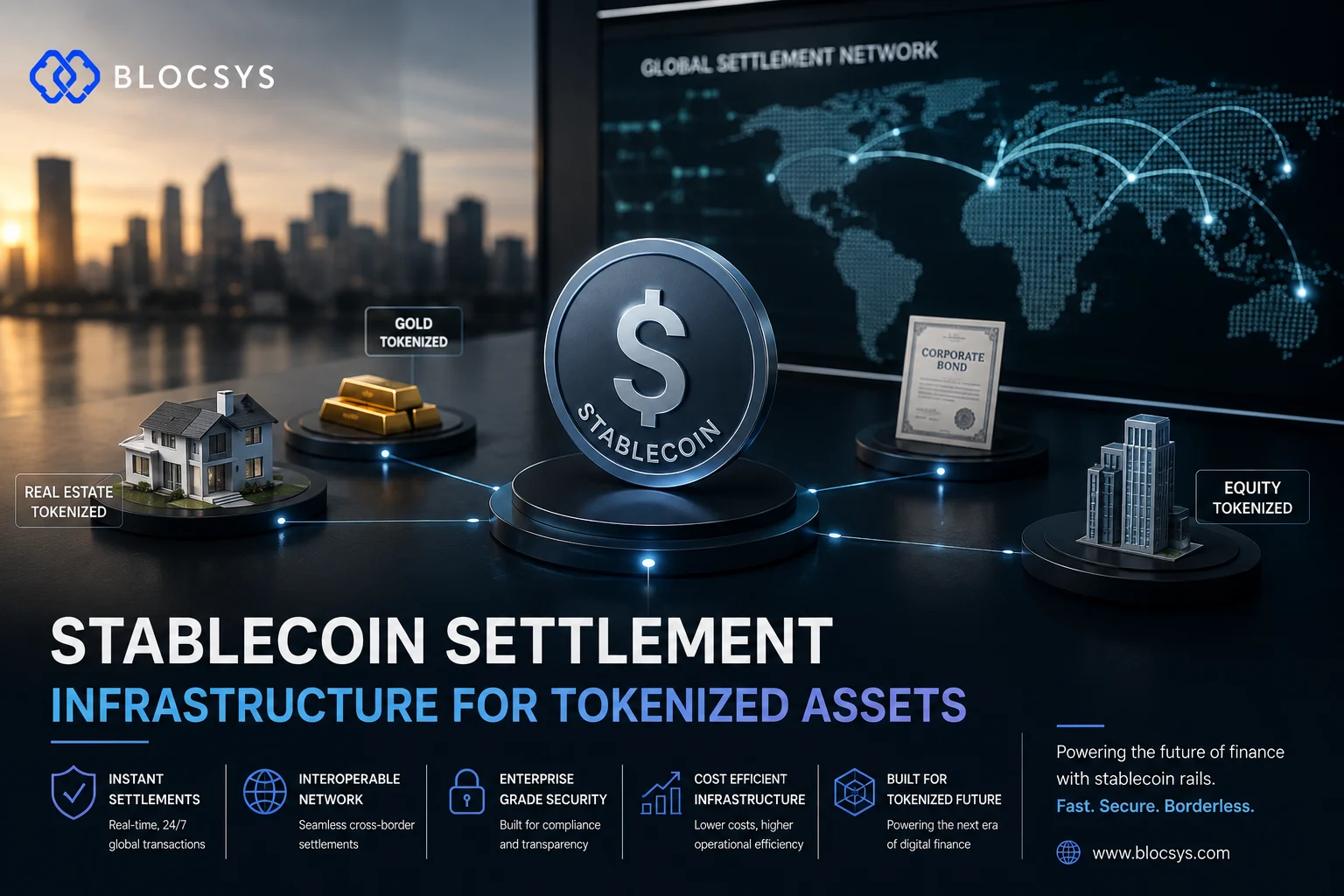
Stablecoin-Based Settlement Infrastructure for Tokenized Assets
Every bank, asset manager, and fintech founder we talk to eventually asks the same question: how do you actually settle a tokenized asset once it’s issued? Tokenization gets the headlines, but settlement is where real value moves — and that’s exactly where stablecoin settlement infrastructure comes in. Instead of waiting two or three days for a wire to clear, institutions can settle trades in seconds using programmable, on-chain cash. If you’re exploring Real World Asset Tokenization for your organization, understanding this settlement layer isn’t optional — it’s the backbone that makes the whole model work. At Blocsys, we’ve built this infrastructure for financial institutions across the US, UK, UAE, and Singapore, so we’ve seen firsthand what separates a working system from a whitepaper concept.
Why Stablecoin Settlement Infrastructure Matters for Enterprise Blockchain
Tokenizing a bond or an equity share is the easy part, honestly. The hard part is moving cash and assets simultaneously, with finality, across parties who don’t fully trust each other. That’s precisely the gap stablecoin settlement infrastructure closes. It gives institutions a digital cash instrument that settles atomically alongside the tokenized asset, eliminating the counterparty risk that plagues traditional T+2 settlement cycles.
Banks in Dubai’s ADGM and DIFC zones, along with fintechs across Switzerland and Germany, are moving quickly here. Why? Because regulators in these jurisdictions have started building frameworks specifically for stablecoin-based settlement, and institutions that wait risk falling behind faster-moving competitors. Consequently, we’re seeing capital markets firms treat this as core infrastructure, not an experiment.
Settlement isn’t a back-office afterthought anymore — it’s the layer where you either win institutional trust or lose it. If your stablecoin can’t settle a tokenized bond trade with legal finality in under a minute, you don’t have infrastructure, you have a demo.
What Is Stablecoin-Based Settlement Infrastructure?
Stablecoin-based settlement infrastructure refers to the technical and legal architecture that lets tokenized assets and stablecoins exchange hands atomically on a shared ledger. Think of it as the plumbing beneath every tokenized transaction — the part nobody sees but everyone depends on. Rather than settling cash through a correspondent bank network and assets through a separate custodian, both legs move on the same rail, at the same moment.
This matters because traditional finance splits settlement into fragmented steps: trade matching, clearing, custody confirmation, and cash transfer. A well-built tokenized asset settlement infrastructure collapses those steps into one programmable event. That’s a meaningful shift for anyone running capital markets operations.
Core Components of a Tokenized Asset Settlement Infrastructure
A production-grade setup typically includes four layers working together. First, there’s the tokenization layer, where real world asset tokenization happens — bonds, equities, funds, or real estate get represented as digital tokens. Second, a stablecoin or tokenized deposit layer provides the settlement currency. Third, smart contracts enforce delivery-versus-payment logic. Finally, a compliance layer handles KYC, AML, and jurisdictional restrictions in real time.
- Tokenization engine for digital securities and RWA tokenization
- Stablecoin or tokenized deposit rail for cash-leg settlement
- Smart contract logic enforcing atomic delivery-versus-payment
- Compliance and identity layer for regulated participants
- Interoperability bridges connecting multiple chains and ledgers
Miss any one of these, and you end up with a system that looks good in a pitch deck but fails under real trading volume. We’ve built these components for clients through our Asset Tokenization Platform work, and the compliance layer is almost always the piece teams underestimate.
How Stablecoin-Powered Transaction Workflows Work
Picture a straightforward corporate bond trade. A buyer’s wallet holds stablecoins; a seller’s wallet holds tokenized bond units. Instead of two separate settlement processes, a smart contract locks both assets simultaneously, verifies compliance conditions, then releases them to each party at the exact same block confirmation. There’s no window where one side has paid and the other hasn’t delivered.
That single change removes a huge chunk of operational risk from capital markets. Furthermore, it removes the need for reconciliation teams to manually match records across siloed systems days later.
![Stablecoin Settlement Infrastructure — [Flow diagram showing stablecoin settlement workflow: Trade Initiation → Compliance Check → Smart Contract Escrow → Atomic Asset-Cash Exchange → On-Chain Settlement Finality → Automated Reconciliation]](https://s3.blocsys.com/blocsys/blog-images/1784073713095-62a2ca0648a11427.webp)
Smart Contract-Based Settlement Automation
Automation is where the real efficiency gains show up. Smart contracts can trigger coupon payments, dividend distributions, or margin calls without a human ever touching a spreadsheet. You’d be surprised how much operational overhead disappears once settlement logic runs on autopilot.
For firms exploring corporate debt instruments, our Corporate Bond Tokenization Platform Development services build exactly this kind of automated coupon and redemption logic directly into the settlement layer.
Real World Asset Tokenization and Stablecoin Settlement
RWA tokenization has moved well past the experimental phase. Money market funds, private credit, real estate, and even carbon credits are now issued as tokens backed by verifiable off-chain assets. But none of that tokenization delivers value without a reliable cash settlement rail sitting beneath it.
That’s the connection institutions often miss early on: stablecoin for tokenized assets isn’t a nice-to-have feature — it’s the mechanism that makes RWA tokenization actually tradeable. Without it, you’ve just digitized a paper certificate.
RWA Tokenization Use Cases Across Banking and Capital Markets
Banks are using tokenized deposits to settle interbank transfers instantly. Asset managers are issuing tokenized fund shares that settle same-day instead of T+2. Capital markets desks are experimenting with tokenized repo transactions where stablecoins provide overnight liquidity.
- Cross-border payments settled in stablecoins instead of correspondent banking
- Tokenized money market funds with instant subscription and redemption
- Equity settlement through Equity Tokenization Platform Development paired with stablecoin cash legs
- On-chain repo and collateral swaps using tokenized deposits
- Fund distribution through Decentralized Traded Funds (DTF) Platform architecture
Interestingly, carbon markets are catching up too. Environmental asset issuers use similar mechanics through platforms like our Carbon Tokenization Platform Development solution, where stablecoin settlement supports transparent, verifiable trading.
Blockchain Interoperability and Digital Securities
No single chain will win the tokenization race. That’s just reality. Institutions issue assets on permissioned ledgers, public chains, or hybrid networks, depending on regulatory needs and counterparty preferences. Consequently, stablecoin settlement infrastructure has to bridge these environments rather than lock users into one ecosystem.
Cross-chain messaging protocols, wrapped stablecoin representations, and shared settlement layers all play a role here. Digital securities issued in London need to settle against liquidity pools that might sit on an entirely different network in Singapore. Without interoperability, you get fragmented liquidity — and fragmented liquidity kills institutional adoption.
Enterprise AI Integration in Stablecoin Settlement Infrastructure
AI is quietly becoming a core part of settlement operations. Anomaly detection models flag suspicious settlement patterns before they become compliance headaches. Predictive liquidity models help treasury teams forecast stablecoin reserve needs across time zones. Meanwhile, AI agents increasingly handle routine settlement instructions autonomously.
We’ve built this kind of intelligent automation through our AI Agent Skills for On-Chain Operations work, where AI agents monitor settlement queues, flag exceptions, and even initiate corrective transactions under predefined governance rules. It’s not about replacing compliance officers — it’s about giving them better tools.
![Stablecoin Settlement Infrastructure — [Flow diagram showing AI-integrated settlement monitoring: Transaction Stream → AI Anomaly Detection → Risk Scoring → Automated Flagging or Auto-Approval → Compliance Officer Review → Settlement Execution]](https://s3.blocsys.com/blocsys/blog-images/1784073707536-9f111c4fb03ba2f4.webp)
Institutional Blockchain Infrastructure: Security, Privacy, and Compliance
Financial institutions won’t touch infrastructure that can’t guarantee privacy alongside transparency. That’s a tricky balance. Regulators need visibility into transactions; competitors shouldn’t see your trading book. Permissioned architectures with selective disclosure solve this, letting auditors see everything while counterparties see only what’s relevant to their trade.
We’ve addressed this exact challenge through our Permissioned Blockchain Infrastructure for Capital Market Post-Trade Operations, which gives institutions granular access control without sacrificing audit trails. Additionally, tamper-proof record keeping matters enormously for regulatory reporting, something our Tamper-Proof Document Verification Platform was built specifically to address.
Regulatory Considerations Across Global Markets
Every jurisdiction handles stablecoin settlement infrastructure differently. The US has been refining its stablecoin oversight framework through federal legislation. The UK’s FCA has issued its own stablecoin regulatory perimeter. UAE’s ADGM and DIFC have built dedicated digital asset frameworks that many institutions view as more predictable than Western equivalents.
Singapore’s MAS continues to license stablecoin issuers under strict reserve requirements, while Switzerland’s FINMA treats compliant stablecoins as payment tokens under existing law. Therefore, any enterprise-grade settlement platform needs jurisdiction-aware compliance logic baked in from day one, not bolted on afterward.
Scalability and Performance of Stablecoin Settlement Systems
Capital markets don’t tolerate slow infrastructure. A settlement system handling thousands of tokenized bond trades per second needs sub-second finality, not “eventually consistent” promises. Layer 2 networks, purpose-built institutional chains, and optimized consensus mechanisms all factor into whether a stablecoin settlement infrastructure can handle real trading volume.
Throughput matters, but so does predictability. An institution settling billion-dollar trades needs fee structures and confirmation times that don’t fluctuate wildly during network congestion. That’s why we architect systems with dedicated throughput reserved for institutional settlement flows, separate from public network congestion.
Stablecoin Settlement Infrastructure vs Traditional Settlement Systems
Traditional settlement runs on a batch-based model — trades match, clear overnight, and settle days later through central securities depositories. It works, but it’s slow, expensive, and opaque. Stablecoin-based asset settlement flips that model entirely by settling continuously, transparently, and near-instantly.
Here’s the practical difference: a traditional cross-border securities trade might tie up capital for 48 hours across multiple intermediaries. A tokenized asset settlement infrastructure running on stablecoins can complete the same trade in under a minute, with full audit visibility. That capital efficiency alone changes how treasury desks manage liquidity.
The institutions winning this shift aren’t the ones with the flashiest token launch — they’re the ones who quietly rebuilt their settlement rails first. Everything else follows from that decision.
Implementation Roadmap for Stablecoin-Based Settlement Infrastructure
Where should you actually start? We recommend a phased approach rather than a big-bang deployment. Rushing this tends to create technical debt that’s painful to unwind later.
- Assess which asset classes and jurisdictions you’ll tokenize first
- Select a stablecoin or tokenized deposit model that fits your regulatory footprint
- Design smart contract settlement logic with compliance rules embedded
- Pilot with a limited counterparty group before scaling
- Integrate with existing core banking and treasury systems
- Expand interoperability across additional chains as liquidity grows
![Stablecoin Settlement Infrastructure — [Flow diagram showing implementation roadmap: Asset & Jurisdiction Assessment → Stablecoin Model Selection → Smart Contract Design → Pilot Program → Core System Integration → Multi-Chain Scaling]](https://s3.blocsys.com/blocsys/blog-images/1784073706551-cd2151a44e08946b.webp)
If you’re unsure what this will cost, our Software Development Cost Estimator gives founders and CTOs a realistic budgeting starting point before committing to a full build.
The Future of Stablecoin Settlement Infrastructure in 2026
Looking ahead, we expect tokenized deposits issued directly by banks to compete with third-party stablecoins for settlement dominance. Central banks in Europe and Asia are also piloting wholesale CBDC settlement rails that could interoperate with private stablecoin networks. That’s a meaningful development for anyone planning long-term infrastructure.
Moreover, expect AI-driven settlement agents to handle an increasing share of routine institutional transactions autonomously, under governance frameworks banks are still finalizing. Enterprises that build flexible, interoperable stablecoin settlement infrastructure now will adapt far more easily than those locked into rigid, single-chain designs.
Why Enterprises Choose Blocsys for Stablecoin Settlement Infrastructure
We’ve spent years building enterprise blockchain systems for banks, asset managers, and fintechs across the US, UK, UAE, Singapore, and Europe. Our team doesn’t just write smart contracts — we design the compliance logic, interoperability bridges, and stablecoin integration that make institutional adoption realistic.
Whether you need to Hire Blockchain Developers, bring on Hire Web3 Developers for a specific integration, or need a full Dedicated Blockchain Engineering Team, we build settlement infrastructure that survives real regulatory scrutiny. Teams working with permissioned DLT platforms also frequently work with us to Hire DAML Developers for multi-party workflow design. If real world asset tokenization is on your roadmap for 2026, our Real World Asset Tokenization services are built specifically to pair with stablecoin settlement infrastructure from day one.
Open USD Stablecoin for Tokenized Asset Settlement
The open USD stablecoin concept is relevant to tokenized asset settlement because stablecoin-based infrastructure can provide a digital settlement layer for transactions involving tokenized assets. Businesses and financial institutions can use stablecoin rails to support faster value transfer, programmable settlement, and more streamlined transaction workflows, while the underlying platform can incorporate features such as wallet management, transaction processing, compliance controls, and blockchain interoperability.
Stablecoin Settlement for Tokenized Assets in GIFT City
GIFT City can be a relevant environment for businesses exploring stablecoin-based settlement alongside tokenized assets and blockchain infrastructure. Stablecoins can support digital transaction flows between participants, while tokenized assets can provide a structured representation of underlying assets on blockchain networks. Combining these components can help businesses design more efficient settlement workflows for tokenized asset platforms operating in GIFT City.
Visa and the Future of Tokenized Asset Settlement
As financial assets move onto blockchain networks, the way payments are handled also needs to evolve. Visa’s work in blockchain shows how traditional payment infrastructure can start connecting with digital assets and blockchain-based money. This is important for tokenized assets because buying or selling a tokenized bond, fund, or other asset still requires a reliable payment process. By bringing digital money and blockchain-based assets closer together, financial institutions can explore settlement processes that are faster, more automated, and easier to manage across different markets. Visa’s involvement also shows that the development of tokenized finance is not limited to creating digital assets; it also requires payment and settlement infrastructure that can support those assets.
Frequently Asked Questions
Here are direct answers to the questions we hear most often about stablecoin settlement infrastructure.
What is stablecoin-based settlement infrastructure for tokenized assets?
It’s the combined technical and legal architecture that lets tokenized assets and stablecoins exchange simultaneously, with legal finality, on a shared ledger. It replaces separate cash and securities settlement processes with a single atomic transaction.
How do stablecoins work in tokenized asset settlement systems?
Stablecoins act as the digital cash leg in a trade. Smart contracts lock the stablecoin and the tokenized asset together, then release both simultaneously once compliance and matching conditions are met.
Why are stablecoins important for enterprise blockchain and financial institutions?
They give institutions a programmable, always-available settlement currency that doesn’t depend on banking hours or correspondent networks. That means faster settlement, lower counterparty risk, and better capital efficiency.
What is the difference between traditional settlement systems and blockchain-based stablecoin settlement?
Traditional settlement relies on batch processing through intermediaries and typically takes one to three days. Stablecoin-based settlement happens near-instantly, on-chain, with full transparency and no reliance on multiple clearing intermediaries.
How can Blocsys build secure enterprise-grade stablecoin settlement and tokenization solutions?
We design the full stack — tokenization logic, stablecoin integration, compliance controls, and interoperability bridges — tailored to your jurisdiction and asset class. Our team has delivered this across banking, capital markets, and RWA tokenization projects globally.
Stablecoin settlement infrastructure isn’t a future consideration anymore — it’s what separates institutions actively settling tokenized assets from those still stuck in pilot mode. If you’re ready to build a real world asset tokenization platform backed by production-grade settlement rails, talk to Blocsys about Real World Asset Tokenization and let’s design your infrastructure roadmap together. Reach out through blocsys.com to start the conversation.
Ready to move beyond theory and build an intelligent platform that delivers real-world value? Blocsys Technologies specialises in engineering enterprise-grade AI and blockchain solutions for the fintech, Web3, and digital asset sectors. Connect with our experts today to discuss your vision and chart a clear path from concept to a secure, scalable reality.
