

MiCA has shifted blockchain from a watchlist item to an execution priority for European enterprises.
For CTOs, CIOs, product leaders, founders, and transformation teams, the core decision is now architectural. The teams getting traction are not asking whether blockchain belongs on the roadmap. They are deciding which design choices can clear legal review, pass procurement, integrate with existing systems, and hold up in production.
That is the lens for this article. It examines the top blockchain development trends in Europe for 2026 through the decisions enterprises have to make: whether to use a public, permissioned, or hybrid model; where tools such as DAML fit versus EVM-based stacks; when zero-knowledge proofs justify their complexity; and how tokenization programs should be structured for regulated assets, including narrower but commercially serious segments such as precious metals.
The practical challenge is connecting regulation to implementation. MiCA affects product design, custody assumptions, governance, reporting, and partner selection. It also changes the privacy conversation. In many cases, zero-knowledge techniques are no longer an experimental add-on. They are becoming a realistic option for proving compliance without exposing sensitive transaction or customer data across counterparties.
Enterprises also need a better screening framework. A pilot may look convincing in a strategy deck and still fail under onboarding friction, fragmented data ownership, or weak operating-model design. Teams assessing deployment constraints, target-state governance, and regulatory fit should review institutional adoption of blockchain in 2026 trends challenges and opportunities.
Blocsys is referenced in this article as one example of enterprise blockchain and digital product delivery in the European market.
Table of Contents
- Introduction The New Era of European Blockchain Innovation
- Why Europe is the Global Hub for Blockchain in 2026
- The Top 5 Blockchain Development Trends for European Enterprises
- An Enterprise Adoption Roadmap for Blockchain Integration
- Future Outlook and Navigating the Next Wave of Innovation
- How Blocsys Can Accelerate Your European Blockchain Strategy
- Frequently Asked Questions about Blockchain in Europe
- What are the top blockchain development trends in Europe for 2026
- Why is Europe leading blockchain innovation
- How is AI transforming blockchain development
- What industries are adopting blockchain in Europe
- What is enterprise blockchain
- How do DAML and Canton Network support enterprise applications
- What role does tokenization play in Europe’s blockchain market
- What are zero-knowledge proofs used for in enterprise blockchain
- How much does enterprise blockchain development cost
- How can businesses adopt blockchain successfully
- Why choose Blocsys for enterprise blockchain development in Europe
- What does MiCA change for blockchain businesses in Europe
Introduction The New Era of European Blockchain Innovation
Europe in 2026 is where blockchain stops being a lab exercise and becomes operating infrastructure. That matters because enterprise buyers don’t fund novelty for long. They fund auditability, settlement efficiency, controllable access, policy enforcement, and systems that can survive legal review.
The strongest projects now start with a narrower brief. They don’t ask, “How do we put this process on-chain?” They ask, “Which parts benefit from shared state, programmable controls, and verifiable execution, and which parts should stay off-chain?” That distinction separates expensive pilots from systems people use.
Several themes now dominate board-level and architecture-level discussions across Europe, the UK, Switzerland, the Netherlands, France, Germany, and adjacent global markets. Financial institutions are moving from tokenization pilots to production thinking. Manufacturers and supply chain operators are looking harder at traceability and privacy. Product teams in Web3 and fintech are treating wallet UX, compliance logic, and interoperability as design constraints from day one.
Practical rule: If your blockchain strategy starts with protocol choice before governance, data ownership, and regulatory obligations are clear, you’re solving the wrong problem first.
The most useful way to read the current market is through the enterprise “how”. Which stack supports permissioning without killing liquidity? Where do DAML and Canton fit better than general-purpose smart contracts? When do ZKPs justify the complexity? And when is a hybrid public-permissioned model the only realistic answer?
Why Europe is the Global Hub for Blockchain in 2026
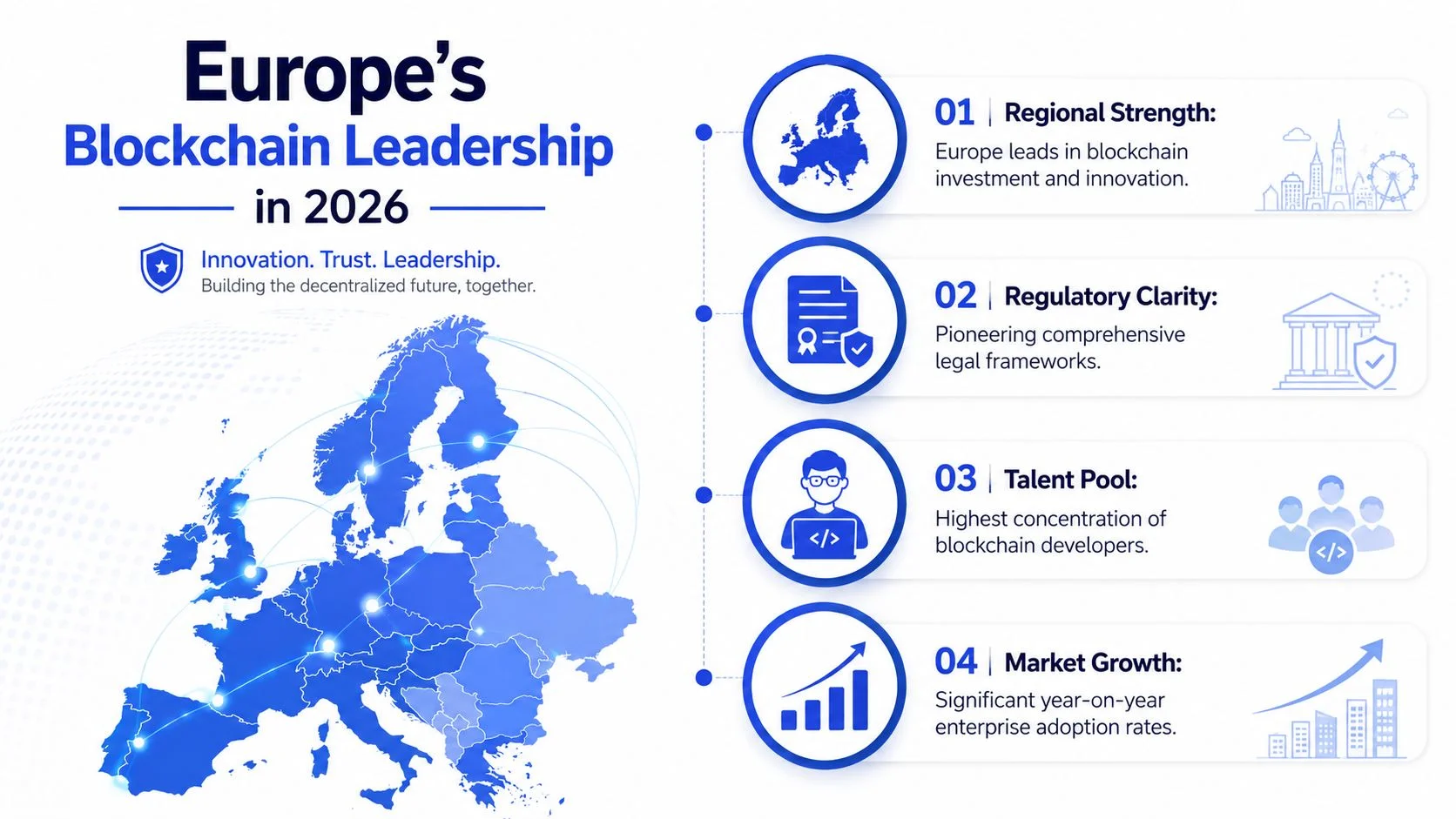
A market projected to expand at an exceptional rate gets attention. In Europe, that growth matters because it is being shaped by regulation, institutional demand, and production-focused architecture choices, not by speculative retail cycles.
Europe has become the reference market for enterprise blockchain because executive teams can now connect legal obligations to technical design with far less guesswork. MiCA is a large part of that shift, but the wider advantage is operational. Risk teams, product owners, compliance leads, and architects can evaluate the same programme against a clearer set of constraints, then decide where blockchain belongs and where it does not.
MiCA changed the enterprise decision model
Before MiCA, many projects stalled in design review. The technical case was often credible, but cross-border distribution, custody responsibilities, disclosures, and market abuse controls were handled differently across jurisdictions. That made boards cautious and slowed procurement.
By 2026, the conversation is different. MiCA gives firms a clearer baseline for issuing digital assets, operating related services, and defining control points early in delivery. For CTOs and product leaders, that changes the order of decisions. The first question is no longer whether regulation will tolerate the model. The question is which architecture meets regulatory duties without making the product commercially useless.
That trade-off shows up quickly in delivery:
- Funding decisions move faster because legal and control requirements can be scoped earlier.
- Architecture choices improve because identity, reporting, custody, and transfer restrictions can be designed into workflows rather than patched in later.
- Pan-European rollout gets more realistic because teams can target a shared regulatory baseline instead of rebuilding the model country by country.
Teams evaluating regulated financial workflows can see this more clearly in these enterprise blockchain solutions in Europe using Canton Network for finance.
Europe rewards architectures that fit the business model
The strongest European programmes are not the ones with the most on-chain activity. They are the ones that place shared state, privacy controls, and settlement logic exactly where they create measurable value.
That is why Europe has become attractive to both incumbents and specialist entrants. Banks, fintechs, commodity platforms, and infrastructure providers can design around a practical midpoint between public-chain liquidity and permissioned control. In my experience, many enterprise teams either save a programme or overcomplicate their efforts at this stage. If the asset class needs controlled participation, selective disclosure, and legally enforceable governance, a hybrid model usually deserves serious consideration before a pure public-chain build.
This matters even more in under-served categories such as precious metal tokenization. Gold, silver, and other vaulted assets can benefit from programmability and broader distribution, but they also carry custody, provenance, redemption, and jurisdiction issues that public smart contracts alone do not solve neatly. Europe is one of the few markets where firms can now structure these products with a clearer path from compliance design to technical execution.
Teams still need discipline. A regulated market does not remove the need to evaluate blockchain technology in development against conventional alternatives. It does, however, make those decisions far more concrete. Europe leads in 2026 because enterprises can move from abstract blockchain ambition to implementation choices that survive legal review, operational scrutiny, and commercial reality.
The Top 5 Blockchain Development Trends for European Enterprises
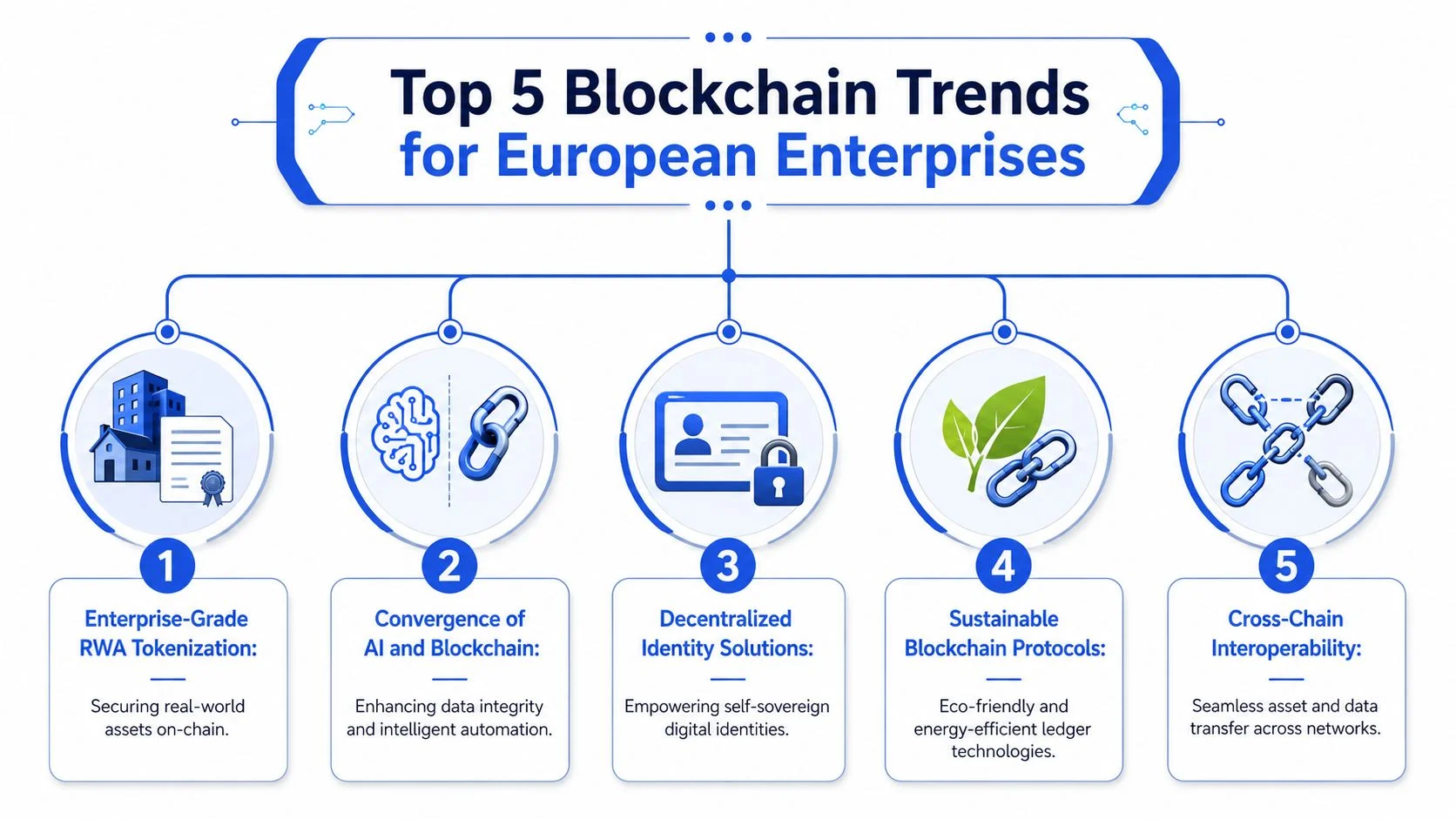
The most important trends for 2026 are connected. Tokenization needs compliance. Compliance increasingly needs privacy tooling. Privacy and interoperability push architecture choices. Those choices affect settlement, liquidity, and product design.
Enterprise-grade RWA tokenization moves into production
RWA tokenization is no longer a slide-deck category. By 2026, it’s a dominant European use case in financial services, and production infrastructure is replacing pilot logic, as noted by Chainlaunch on permissioned blockchain trends in 2026.
The part worth emphasising is where value concentrates. Most institutional activity is clustering around sovereign debt, private equity, funds, and regulated issuance structures. That’s sensible. These assets already sit inside formal legal and operational frameworks.
The harder and often more interesting opportunity sits in precision assets such as precious metals and carbon-linked instruments. These markets face fragmented liquidity and often need a design that connects restricted custody or compliance controls with broader market accessibility. That’s where a pure public-chain approach often fails and a pure permissioned approach often stays too closed to scale.
For CTOs, this creates three practical architecture patterns:
- Public-first tokenization suits open distribution but often struggles with institutional compliance expectations.
- Permissioned-first tokenization supports control, privacy, and access management, but can isolate liquidity.
- Hybrid tokenization usually works best when asset custody, investor controls, and reporting need stronger governance while settlement or market access benefits from public connectivity.
DAML and Canton deserve serious attention here. DAML is useful when contractual workflows, rights, obligations, and participant visibility need clear business semantics rather than just lower-level smart contract logic. Canton fits well when separate parties need synchronised workflows without exposing all data to everyone on the network.
A short global note matters too. Financial innovation hubs outside Europe are also watching this model closely. GIFT City in India is becoming relevant in digital finance and institutional fintech experimentation, which makes it useful for firms comparing cross-border tokenization strategies and future expansion paths.
To pressure-test vendor claims or internal assumptions, teams should also evaluate blockchain technology in development against business process fit, governance burden, and integration overhead rather than just feature lists.
A quick visual summary helps frame the design trade-offs.
| Architecture choice | What it does well | Where it breaks down |
|---|---|---|
| Public chain | Broad accessibility, composability, transparent state | Compliance controls, confidential workflows |
| Permissioned chain | Controlled access, privacy, governance | Limited external liquidity, ecosystem isolation |
| Hybrid model | Balances compliance and market reach | More integration complexity, heavier orchestration |
Later in the section, it’s worth watching how modular blockchain architecture supports scalable networks in 2026 because tokenization platforms increasingly depend on that design approach.
The industry discussion below is also useful context.
AI and blockchain start shipping together
AI plus blockchain has spent too long as a conference slogan. In 2026, it starts to matter because the integration is moving into shipping products rather than remaining conceptual, as highlighted in the earlier Chainlaunch reference.
The enterprise use cases are specific:
- Smart contract development support for drafting, reviewing, and test generation.
- Monitoring and anomaly detection for transaction flows, policy violations, and operational drift.
- Workflow orchestration where AI agents act within constrained, verifiable transaction boundaries.
- Document-linked execution where off-chain documents feed structured on-chain actions under approval controls.
What works is narrow AI with clear permissions and auditability. What doesn’t work is letting an unconstrained agent initiate economically meaningful actions without policy checks, signing controls, and human override paths.
AI is useful in blockchain operations when it reduces review effort or improves detection quality. It becomes dangerous when teams treat probabilistic output as if it were deterministic execution logic.
The design principle is simple. AI should propose, classify, monitor, and explain. Smart contracts should enforce.
Zero-knowledge privacy becomes a compliance tool
Privacy isn’t optional in Europe. It’s part of the architecture brief.
By 2026, ZK rollups are becoming the standard for new projects, and ZK-based approaches are gaining favour because they support cryptographic verifiability that aligns with compliance needs, according to Legereum on blockchain development trends in 2026. This matters far beyond scaling.
For enterprise teams, ZKPs solve a specific problem. They allow a participant to prove that a condition is true without disclosing the underlying sensitive data. In regulated environments, that opens better patterns for selective disclosure, privacy-preserving compliance checks, and auditable reporting.
Use cases worth prioritising include:
- Eligibility proofs without exposing full identity records
- Transaction policy checks without revealing full business context
- Supply chain attestations where counterparties need proof, not complete data access
- Fee-sharing or governance reporting that requires auditability without broad disclosure
The trade-off is engineering maturity. ZK systems improve privacy and assurance, but they add proving complexity, specialist tooling, and stricter testing requirements. Teams shouldn’t adopt them because they sound advanced. They should adopt them where the disclosure problem is expensive enough to justify the stack.
Modular and hybrid architectures win on interoperability
Monolithic chain design is increasingly a poor fit for enterprise reality. Different workloads need different trust, privacy, throughput, and data availability assumptions.
Modular architectures solve that by separating concerns. Execution, settlement, identity, messaging, and data availability can be composed rather than forced into one layer. In Europe, that approach is becoming more relevant as organisations need to connect internal systems, counterparties, regulators, and public-market rails without exposing every transaction detail.
A useful rule of thumb:
- Use permissioned environments for identity-bound workflows, internal approvals, and regulated asset servicing.
- Use public networks or public connectivity where distribution, external settlement visibility, or broader liquidity matters.
- Use middleware and standards carefully because most interoperability problems are really data model and governance problems in disguise.
This is also where digital identity decisions become strategic. Self-sovereign identity ideas remain important, but enterprises usually need a more constrained version: verifiable identity attributes, revocation handling, role-based access, and integration with existing IAM and KYC systems.
Institutional DeFi, stablecoins and CBDC-adjacent rails mature
The final trend isn’t “retail DeFi comes to the enterprise.” That framing is too loose. The story is that stablecoins have emerged as the most important real-world crypto use case and are becoming business payment infrastructure under proper EU regulation, while wallet and account abstraction are helping remove user complexity, according to SmartyPro on blockchain technology trends and MiCA in 2026.
In practice, enterprises care about three things here:
- Cross-border payments with less friction than traditional multi-hop flows.
- Controlled access to on-chain liquidity and settlement without exposing every user to raw crypto UX.
- Programmable treasury operations tied to business rules and reporting.
CBDC discussion also matters, even where production systems remain limited or indirect. Large institutions are designing with the assumption that future state-backed digital money, regulated stablecoins, and tokenized deposits may need to interoperate with the same operational stack.
What works:
- Treasury workflows with clear approval chains
- Business payments with policy controls
- Wallet abstraction that hides key-management complexity from end users
What doesn’t:
- Consumer-grade wallet UX in enterprise settings
- Unclear custody boundaries
- DeFi integrations that create legal uncertainty no one in risk will approve
An Enterprise Adoption Roadmap for Blockchain Integration
Most failed blockchain programmes don’t fail because the chain was slow or the smart contracts were buggy. They fail because the operating model was vague, the ownership model was political, or the use case never justified the integration burden.
Start with the operating model, not the chain
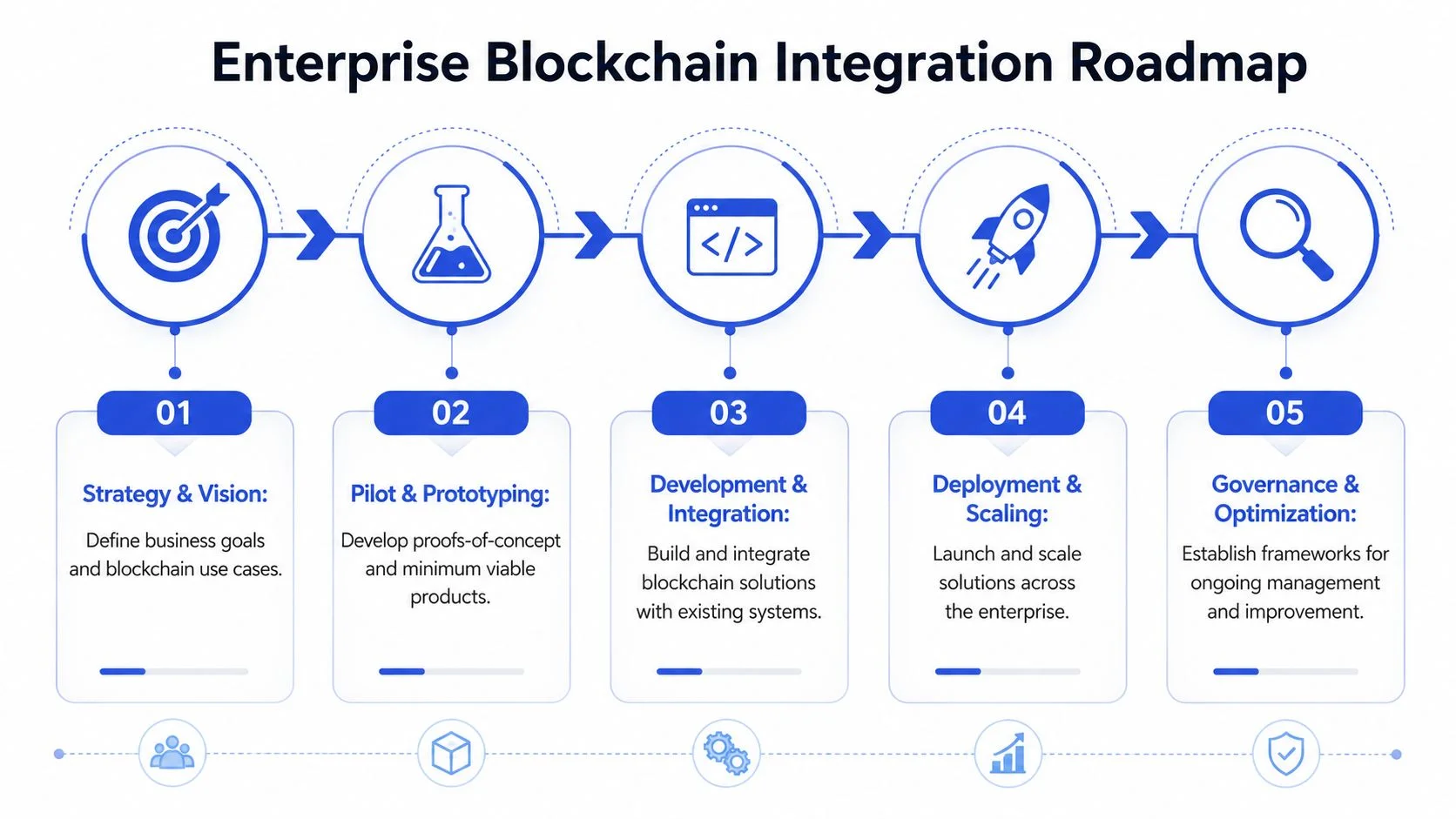
For European enterprises, the first design choice should be institutional. Who writes to the ledger, who validates, who can see what, who can reverse or remediate errors, and which legal agreements govern participation?
That question becomes even more important in underserved tokenization niches. As KuCoin’s discussion of blockchain trends from Paris 2026 notes, precision assets such as precious metals face fragmented liquidity and often require hybrid public-permissioned designs to align market access with MiCA-driven compliance needs.
A sensible roadmap usually follows this order:
- Define the business event that benefits from shared truth or programmable enforcement.
- Map the legal state to the digital state. Asset ownership, transfer restrictions, reporting duties, and remediation paths need explicit representation.
- Choose the network model only after participant rights and data boundaries are known.
- Integrate with existing systems such as KYC, ERP, treasury, custody, and reporting.
- Set governance early because production issues are usually governance issues wearing technical clothes.
A broader delivery perspective appears in enterprise blockchain solutions for 2026.
Enterprise and startup paths are different
Large enterprises and startups shouldn’t follow the same adoption playbook.
| Team type | Best starting move | Common mistake |
|---|---|---|
| Enterprise | Start with one regulated workflow and one accountable business owner | Launching a broad platform before internal controls are agreed |
| Startup | Start with a narrow distribution or settlement pain point | Building protocol complexity before proving user demand |
Enterprises usually benefit from a workflow-first pilot. Tokenized collateral movement, investor servicing, permissioned document exchange, or controlled secondary transfer flows are typical examples. The point is to prove operational fit, not to advertise innovation.
Startups need the opposite discipline. They should minimise chain novelty and prove that users, counterparties, or institutional partners want the product. Too many young companies overbuild interoperability before they’ve earned any meaningful transaction flow.
Choose the smallest blockchain system that can validate your commercial assumption. Most teams build two levels too much architecture too early.
A practical architecture decision table
Here’s a compact way to make stack decisions.
| Question | If yes | If no |
|---|---|---|
| Do you need regulated participant access? | Bias toward permissioned or hybrid | Public-first may work |
| Do you need broad liquidity or external composability? | Add public connectivity | Keep flows closed and simpler |
| Is confidentiality a core business requirement? | Prioritise ZK, privacy controls, selective disclosure | Standard transparency may be acceptable |
| Are contractual workflows complex and multi-party? | Consider DAML and Canton-style coordination | Simpler smart contract stacks may suffice |
Technology consulting proves its value. Most complexity sits between systems, parties, and obligations, not inside the contract code itself.
Future Outlook and Navigating the Next Wave of Innovation
The next planning cycle will reward teams that keep their architecture adaptable. The market is moving quickly, but the deeper pattern is stable. Enterprises want better throughput, better privacy, better tooling, and less operational fragility.

Ethereum improvements matter, but architecture discipline matters more
Ethereum still shapes the design assumptions of much of the market. One important projected development is the Glamsterdam hard fork, targeted for H1 2026, which introduces Enshrined Proposer-Builder Separation and Block-Level Access Lists to support parallel execution and push Layer-1 throughput toward a stated goal of 10,000 TPS while improving MEV fairness, as described by Antier’s overview of blockchain trends reshaping Web3 in 2026.
That matters, but it shouldn’t distract buyers from a more grounded truth. Better base-layer performance does not remove the need for strong identity models, selective disclosure, treasury controls, legal wrappers, or middleware discipline. Many enterprise bottlenecks are organisational and architectural long before they’re transactional.
What to watch over the next planning cycle
Three themes deserve close monitoring over the next twelve to twenty-four months:
- Wallet abstraction and account design. Enterprises want secure interaction models that don’t depend on fragile user behaviour.
- Compliance-aware automation. AI-assisted development and monitoring will improve, but only systems with explicit approval logic and audit trails will be trusted.
- RWA market structure. The next wave of value won’t come from repeating the same sovereign-debt narrative. It will come from solving access, custody, and liquidity design for harder assets and more fragmented markets.
The best future-proofing strategy is modularity with restraint. Keep legal logic explicit. Keep data boundaries deliberate. Avoid stack choices that lock the business into one liquidity venue, one custody model, or one disclosure pattern.
How Blocsys Can Accelerate Your European Blockchain Strategy
Execution is where many blockchain strategies drift off course. Teams understand the trend, but they still need delivery choices that fit regulated operations, product timelines, and integration realities.
Where execution support matters most
For organisations building in Europe, the highest-friction areas are usually the same:
- Tokenization platform design for regulated assets and controlled transfer models
- Smart contract architecture that embeds audit trails, access controls, and business rules
- Hybrid infrastructure that balances permissioned workflows with public-chain connectivity
- AI-assisted operational tooling for monitoring, compliance workflows, and support automation
- Staff augmentation when internal teams need protocol, smart contract, or Web3 engineering depth
One execution option in this market is Blocsys Technologies, which works on blockchain, AI, enterprise software, and tokenized platform delivery. For companies with near-term product requirements, relevant paths include real world asset tokenization services, hiring blockchain developers, crypto trading platform development, and OTC trading platform development.
The right partner should be able to do more than write contracts. They should translate regulatory constraints into technical controls, choose between public, permissioned, and hybrid models with clear rationale, and integrate blockchain systems into the rest of the enterprise stack without turning every release into an exception process.
Frequently Asked Questions about Blockchain in Europe
What are the top blockchain development trends in Europe for 2026
For enterprise teams, five trends matter most in practice: real-world asset tokenization, privacy-preserving compliance with zero-knowledge proofs, AI used in controlled operational workflows, hybrid public and permissioned architectures, and regulated payment or settlement platforms built around digital assets. The strategic question is not which trend sounds promising. It is which one removes friction in a regulated business model and can be integrated into existing controls, reporting, and partner processes.
Why is Europe leading blockchain innovation
Europe is ahead because regulation is becoming specific enough to build against. MiCA gives product leaders, legal teams, and architects a clearer basis for licensing, disclosures, custody models, and service boundaries. That reduces one of the biggest blockers in enterprise adoption: uncertainty about what the target operating model should look like.
How is AI transforming blockchain development
AI is proving useful in code review, transaction monitoring, document handling, support workflows, and compliance operations. The strongest enterprise designs keep AI in an advisory or triage role and leave enforcement to deterministic systems such as smart contracts, approval rules, and policy engines. That trade-off matters. It improves efficiency without creating governance problems around opaque decisions.
What industries are adopting blockchain in Europe
Financial services remain the clearest driver, especially in tokenization, post-trade workflows, collateral, and regulated payments. Beyond finance, traction is building in supply chain coordination, digital identity, energy markets, and other multi-party processes where several organisations need a shared record but do not want a single intermediary to control it.
What is enterprise blockchain
Enterprise blockchain applies distributed ledger infrastructure to business processes that require shared records, programmable rules, auditability, and governed participation. In practice, it usually means stronger identity controls, tighter privacy boundaries, formal integration with ERP or case management systems, and clearer legal accountability than consumer Web3 products.
How do DAML and Canton Network support enterprise applications
They fit best where workflows are multi-party, stateful, and legally sensitive. DAML helps teams model rights, obligations, and event-driven business logic in a way that business and legal stakeholders can review. Canton-style infrastructure supports synchronised workflows and selective data sharing across organisations, which is useful when one network must serve multiple regulated participants without exposing more data than necessary.
What role does tokenization play in Europe’s blockchain market
Tokenization is one of the few blockchain use cases that consistently maps to a business case enterprises can defend. It connects legal ownership, transfer controls, reporting, servicing, and settlement in one system design. That is especially relevant in Europe for regulated financial products and niche assets, including precious metals, where firms often need tighter control over eligibility, custody, and secondary transfers than open crypto rails provide by default.
What are zero-knowledge proofs used for in enterprise blockchain
Zero-knowledge proofs let one party prove a condition without disclosing all underlying data. For European enterprises, that makes them useful for compliance checks, investor or counterparty eligibility, sanctions screening attestations, and selective disclosure models. The practical value is clear. Firms can meet privacy expectations and still produce verifiable evidence that a rule was enforced.
How much does enterprise blockchain development cost
Cost depends less on chain selection alone and more on workflow complexity, integration depth, governance design, and compliance scope. A tokenization pilot with limited participants is very different from a production platform that must connect custody, payments, reporting, and onboarding systems across jurisdictions. The safest approach is to estimate by operating model, interfaces, and control requirements, not by smart contract count.
How can businesses adopt blockchain successfully
Start with a use case where shared state, controlled transfers, or auditability solve a real operating problem. Define participant roles, legal responsibilities, and data boundaries before selecting a protocol. Then choose the architecture that fits those constraints. In many European deployments, that leads to a hybrid model because public infrastructure helps with interoperability and settlement reach, while permissioned components handle confidentiality, approvals, and regulated workflow control.
Why choose Blocsys for enterprise blockchain development in Europe
The right partner should be able to turn regulatory obligations into system requirements and delivery decisions. That includes architecture selection, smart contract design, integration planning, data controls, and rollout sequencing across business and compliance teams. Blocsys Technologies is one execution option for firms that need support across blockchain, AI, enterprise software, and tokenized platform delivery.
What does MiCA change for blockchain businesses in Europe
By 2026, MiCA changes the discussion from exploratory innovation to operational readiness. Teams now need to decide how issuance, custody, disclosures, governance, and customer protections will be implemented in the product and operating model. For CTOs and product leaders, that often leads to specific technical choices: stronger identity layers, better auditability, clearer asset classification logic, and privacy-preserving controls such as ZKPs where compliance checks must be provable without exposing unnecessary data.
If you’re planning an enterprise blockchain platform, tokenization product, Web3 application, AI-powered compliance workflow, or smart contract rollout, Blocsys Technologies can help shape the strategy, architecture, and delivery plan. Teams that need execution support can connect with Blocsys for enterprise blockchain development, Web3 solutions, tokenization platforms, smart contract engineering, and digital transformation guidance aligned to European market realities.
