
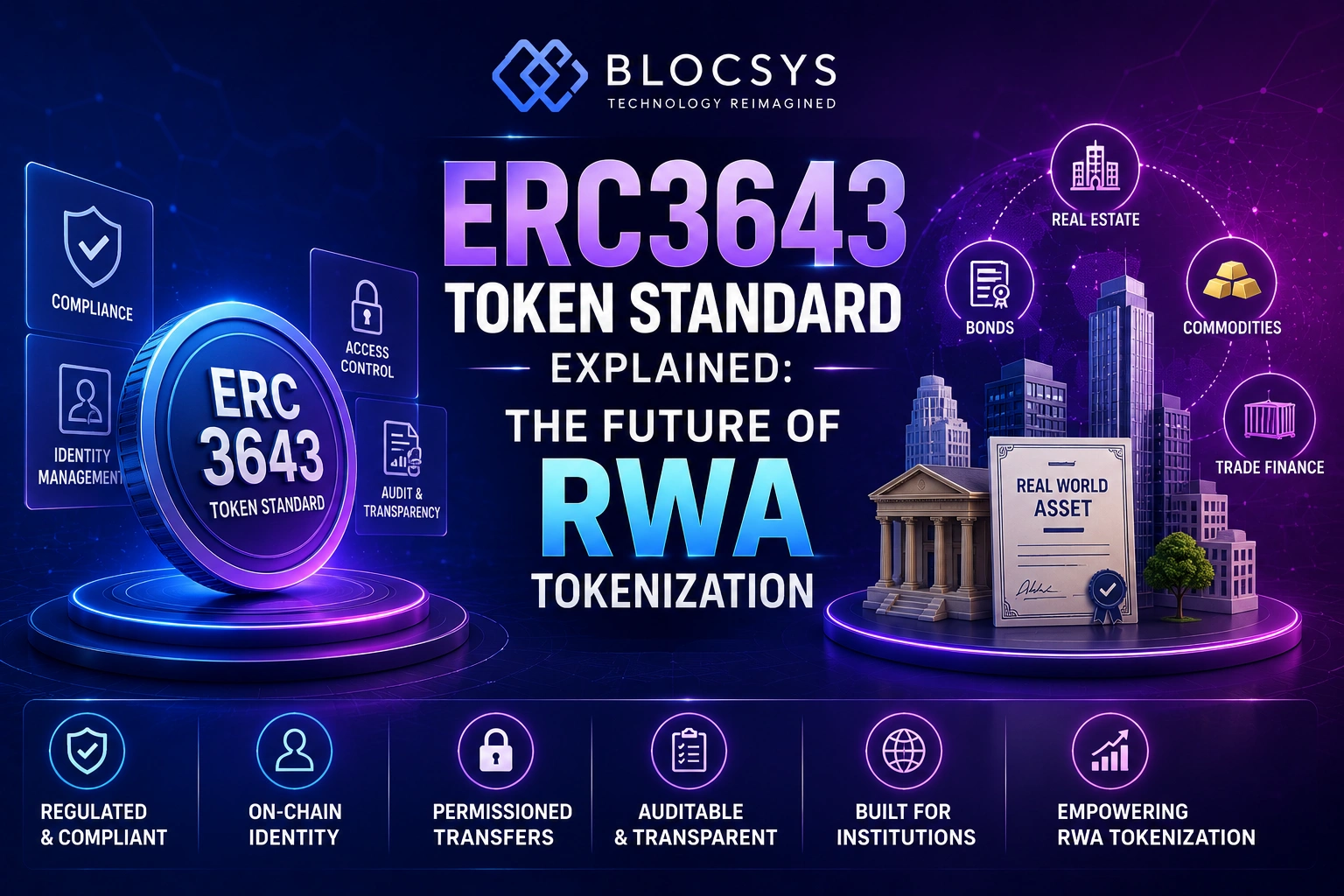
ERC3643 Token Standard Explained: The Future of RWA Tokenization
If you’re building anything in institutional finance right now, you’ve probably heard the term ERC3643 thrown around in board meetings and technology roadmaps. It’s not hype. ERC3643 is quickly becoming the backbone of compliant real world asset tokenization, giving banks, asset managers, and fintech founders a way to issue digital securities that actually respect regulatory requirements instead of fighting them. At Blocsys, we’ve watched this standard move from a niche Ethereum improvement proposal to the go-to framework for enterprise blockchain teams building real world asset tokenization platforms. This guide breaks down what ERC3643 actually is, how it works, and why it matters for anyone planning a serious tokenization strategy in 2026.
What Is the ERC3643 Token Standard?
ERC3643, originally known as the T-REX standard (Token for Regulated EXchanges), is an Ethereum token standard purpose-built for compliant security tokens. Unlike generic token formats, it bakes identity verification and regulatory logic directly into the smart contract layer. That’s a fundamental shift.
Think about it this way: a regular token doesn’t care who holds it. ERC3643 does. Every transfer gets checked against an on-chain identity and compliance framework before it’s allowed to happen. Consequently, issuers can enforce KYC, AML, jurisdictional restrictions, and investor eligibility rules automatically, without manual intervention on every trade.
Because of this, ERC3643 has become the preferred security token standard for banks, capital markets firms, and asset managers who need programmable compliance rather than compliance bolted on after the fact.
Why ERC3643 Matters for Real World Asset Tokenization
Real world asset tokenization only works at institutional scale if regulators, custodians, and investors trust the underlying infrastructure. Bonds, equities, real estate, and funds can’t just live on a permissionless chain with no controls. That’s where ERC3643 earns its reputation.
The standard gives issuers granular control over who can hold, transfer, or redeem a token. Furthermore, it supports forced transfers for legal recovery, freezing for investigations, and recovery mechanisms if a private key is lost. These aren’t nice-to-haves. They’re the exact features a compliance officer at a regulated bank will ask about before signing off on any asset tokenization project.
ERC3643 isn’t trying to reinvent finance from scratch. It’s trying to give existing financial infrastructure a programmable, auditable rail that regulators can actually get comfortable with.
How the ERC3643 Architecture Works
Under the hood, ERC3643 is built from several interlocking components rather than one monolithic contract. Understanding the pieces helps you see why the standard is so well suited to digital securities.
Identity-Based Smart Contract Framework
At the center of ERC3643 sits ONCHAINID, a decentralized identity framework. Each investor gets a digital identity contract that stores verified claims, such as KYC status or accreditation level, without exposing personal data on-chain. That’s an important distinction.
When a token transfer is initiated, the smart contract checks the sender’s and receiver’s identity claims against the issuer’s compliance rules. If the claims check out, the transfer executes. If not, it reverts automatically. No manual review queue, no back-and-forth emails with a transfer agent.
Permissioned Token Transfers and Compliance-by-Design
Here’s what makes ERC3643 genuinely different: compliance logic lives in a separate, modular contract rather than being hardcoded into the token itself. This modular compliance engine can enforce rules like maximum investor counts, geographic restrictions, holding periods, and accredited investor limits.
Because the compliance module is pluggable, issuers can update rules as regulations evolve without redeploying the entire token contract. That flexibility matters enormously for banks operating across multiple jurisdictions with different securities laws.
ERC3643 for Digital Securities and Asset Tokenization
Digital securities need more than a wrapper around a spreadsheet. They need enforceable rights, transparent ownership records, and audit trails regulators can actually inspect. ERC3643 delivers all three natively.
Asset tokenization platforms built on this standard can represent equities, corporate bonds, real estate funds, private credit, and even carbon credits. Each asset class benefits from the same core guarantee: only verified, eligible investors can hold the token at any point in its lifecycle.
Take equity tokenization as an example. A company issuing tokenized shares needs to track ownership caps, respect transfer restrictions, and sometimes claw back tokens during legal disputes. Our Equity Tokenization Platform Development work leans heavily on ERC3643’s forced-transfer and identity registry features to satisfy exactly these requirements.
Corporate bonds tell a similar story. Coupon payments, maturity schedules, and investor eligibility all need automated enforcement. Teams building on our Corporate Bond Tokenization Platform Development services use ERC3643’s compliance modules to encode these rules directly into the bond token, reducing settlement friction significantly.
Blockchain Interoperability and Enterprise Infrastructure
ERC3643 tokens aren’t locked to a single chain. The standard has been implemented across Ethereum, Polygon, and several enterprise-grade permissioned networks, which matters for institutions weighing throughput, cost, and privacy tradeoffs.
Additionally, interoperability protocols are emerging that let ERC3643 tokens move between chains while preserving their compliance rules. That’s a big deal for asset managers who want liquidity across multiple venues without duplicating compliance logic on every network.
Security, Privacy, and Compliance Considerations
Security in tokenized finance isn’t just about smart contract audits, though those matter too. It’s about making sure the compliance layer can’t be bypassed, that identity data stays private, and that the system can respond to legal or regulatory intervention when needed.
ERC3643 addresses privacy by storing only claim hashes and verification references on-chain rather than raw personal data. The actual KYC documents live off-chain with regulated identity providers. Consequently, issuers get auditability without turning the blockchain into a public database of investor identities.
Moreover, the standard’s recovery function lets an investor recover tokens if they lose access to their wallet, provided they can re-verify their identity. That single feature removes one of the biggest objections institutional custodians raise about blockchain-based securities: irreversible loss.
Why Compliance-First Design Reduces Enterprise Risk
Traditional tokenization attempts often treated compliance as an afterthought, layering KYC checks on top of a generic ERC20 token. That approach breaks down fast once regulators start asking hard questions.
ERC3643 flips the order. Compliance is enforced at the protocol level, so it’s nearly impossible for a non-compliant transfer to succeed. For banks and regulated financial institutions, that’s the difference between a pilot project and something that survives a real regulatory audit.
ERC3643 Use Cases Across Banking and Capital Markets
So where is this actually being used? Quite a lot of places, honestly.
Banks are exploring ERC3643 for tokenized deposits, structured products, and private placements. Capital markets firms use it for tokenized bonds and equity offerings that need to comply with securities law across multiple regions. Asset managers use it to fractionalize real estate and private equity funds, opening access to smaller investors while keeping full regulatory control.
- Tokenized corporate bonds with automated coupon distribution and investor eligibility checks
- Fractionalized real estate funds with jurisdiction-based transfer restrictions
- Private equity and venture fund interests with lock-up periods enforced on-chain
- Tokenized carbon credits with verified issuer and buyer identity requirements
- Structured products requiring accredited investor status verification
For carbon markets specifically, our Carbon Tokenization Platform Development practice applies ERC3643’s identity registry to make sure only verified project developers and eligible buyers can transact, which matters a lot given the scrutiny carbon markets face today.
Regulated Financial Hubs Embracing Tokenization Infrastructure
Regulated financial hubs are paying close attention to tokenization frameworks like ERC3643 as they build out digital asset regulatory sandboxes. ADGM and DIFC in the UAE have both published detailed digital asset frameworks that align well with identity-based compliance token standards. Singapore continues to run active tokenization pilots through its regulatory sandbox programs, while Switzerland’s DLT Act gives issuers a clear legal basis for tokenized securities.
India’s GIFT City is also emerging as a notable International Financial Services Centre for digital assets, with growing interest from fintech firms exploring real world asset tokenization frameworks within its regulatory sandbox. It’s worth watching, though it’s still early days there compared to more established hubs. None of these jurisdictions have mandated ERC3643 specifically, but the compliance-first architecture it offers fits naturally with how these regulators think about investor protection.
Scalability and Performance in ERC3643 Deployments
A common question we get from CTOs: does adding identity checks to every transfer slow things down? It’s a fair concern, but in practice, well-architected ERC3643 deployments handle it efficiently.
Compliance checks happen through lightweight on-chain calls to the identity registry and compliance contracts, which adds marginal gas overhead compared to a standard ERC20 transfer. For high-volume trading environments, many enterprises pair ERC3643 with layer-2 networks or permissioned sidechains to keep transaction costs low while preserving Ethereum-level security guarantees.
Scalability also depends heavily on how the compliance module is structured. A poorly designed rule set with dozens of nested checks will slow things down. A clean, modular implementation won’t. This is exactly why experienced blockchain developers matter so much for enterprise tokenization projects — the architecture decisions made early on determine performance for years.
ERC3643 vs ERC20, ERC721, ERC1155, and ERC1400
It helps to see ERC3643 next to the standards you already know.
ERC20 is the classic fungible token standard, great for utility tokens and cryptocurrencies, but it has zero built-in compliance logic. Anyone can hold or transfer it freely. ERC721 and ERC1155 handle unique and semi-fungible assets like NFTs, which isn’t the right fit for fungible securities representing shares of a fund or bond.
ERC1400 was an earlier attempt at a security token standard, introducing partitioned balances and transfer restrictions. However, it lacked a robust, standardized identity framework and never achieved the same level of industry consensus. ERC3643 builds on those lessons, combining transfer restrictions with a dedicated identity registry, modular compliance, and recovery mechanisms specifically designed for regulated securities.
In short: if you’re issuing a utility token, ERC20 is fine. If you’re issuing a compliant security representing real world value, ERC3643 is purpose-built for that job.
Implementation Roadmap for ERC3643-Based Platforms
Enterprises considering ERC3643 development typically move through a fairly consistent process, though the details vary by asset class and jurisdiction.
First comes regulatory scoping: identifying which securities laws apply and what investor eligibility rules need enforcement. Next is identity infrastructure setup, connecting ONCHAINID or an equivalent registry to verified KYC providers. From there, teams design the compliance module logic, deploy smart contracts, and integrate with custody and settlement systems.
Testing matters more here than in most Web3 projects, since a compliance failure isn’t just a bug, it’s a regulatory incident. Before launch, most institutional issuers run extensive simulations covering edge cases like forced transfers, investor exits, and cross-border restrictions.
If you’re mapping out budget and timeline for this kind of build, our Software Development Cost Estimator gives a useful starting point before scoping a full engagement.
Building a Complete ERC3643 Tokenization Platform
A production-grade ERC3643 platform needs more than just the token contract. You’ll need investor onboarding portals, secondary market trading infrastructure, custody integration, and reporting dashboards for compliance teams.
This is where full-service platform development matters. Our Asset Tokenization Platform offering combines ERC3643-based smart contracts with the surrounding infrastructure institutions actually need to go live, from KYC provider integrations to secondary market liquidity tools.
The Future of ERC3643 for RWA Tokenization in 2026
Looking ahead, we expect ERC3643 adoption to accelerate as more regulators publish clear digital asset frameworks and more institutions move past pilot programs into production. Cross-chain compliance, where identity claims and compliance rules travel with tokens across multiple networks, is likely to mature significantly this year.
We’re also seeing growing interest in tokenized funds, where ERC3643 governs investor eligibility while a separate protocol layer handles automated portfolio management. Our Decentralized Traded Funds (DTF) Platform work explores exactly this combination, pairing compliant token issuance with AI-driven on-chain asset management.
Institutional-grade token launches are also evolving quickly, with issuers demanding launchpad infrastructure that respects the same compliance guarantees ERC3643 provides. Our Institutional-Grade Crypto Token Launchpad supports exactly this kind of compliant issuance flow for enterprise clients.
The institutions winning in tokenized finance right now aren’t the ones chasing the flashiest chain. They’re the ones treating compliance architecture as a first-class design decision from day one.
Why Blocsys for ERC3643 Development
Building compliant security token infrastructure isn’t a weekend project. It requires deep expertise in smart contract security, identity frameworks, regulatory nuance, and enterprise system integration all at once.
Blocsys has spent years building enterprise blockchain infrastructure, and our team understands how to translate regulatory requirements into working ERC3643 smart contracts. Whether you need a full real world asset tokenization platform, dedicated engineering support, or specialized smart contract development, we structure our engagements around your compliance obligations, not around generic templates.
Our Dedicated Blockchain Engineering Teams work alongside your internal technology leadership, and if your project needs specialized talent quickly, you can hire Web3 developers from our team on flexible engagement models. For institutions exploring adjacent enterprise infrastructure needs, such as private ledger networks, our Hire DAML Developers service supports teams building on that ecosystem too.
Frequently Asked Questions
Here are direct answers to the questions we hear most often about ERC3643 and real world asset tokenization.
What is the ERC3643 token standard?
ERC3643 is an Ethereum token standard designed specifically for compliant security tokens. It combines a fungible token structure with an on-chain identity registry and a modular compliance engine, so every transfer gets checked against KYC, AML, and investor eligibility rules before it executes. Originally called T-REX, it’s now maintained by the ERC3643 Association and used widely across enterprise tokenization projects.
Unlike standard tokens, ERC3643 enforces regulatory logic directly at the protocol level rather than relying on off-chain processes, making it a strong fit for banks, asset managers, and fintech firms issuing digital securities.
Why is ERC3643 important for real world asset tokenization?
Real world asset tokenization needs enforceable compliance to satisfy regulators, custodians, and institutional investors. ERC3643 provides exactly that by embedding identity verification and jurisdictional rules into the smart contract layer itself.
This means issuers can tokenize bonds, equities, real estate, and funds while automatically restricting transfers to eligible, verified investors. Without this kind of built-in compliance, most regulated institutions simply wouldn’t consider blockchain-based securities issuance viable at scale.
How does ERC3643 work for compliant security tokens?
ERC3643 works through three connected components: the token contract, an identity registry built on ONCHAINID, and a modular compliance contract. When someone tries to transfer tokens, the system checks the sender’s and receiver’s verified identity claims against the issuer’s compliance rules.
If both parties meet the requirements, the transfer executes automatically. If not, it reverts. This removes manual review bottlenecks while keeping every transaction fully auditable and compliant with the issuer’s regulatory obligations.
What makes ERC3643 different from ERC20, ERC721, ERC1155, and ERC1400?
ERC20 handles simple fungible tokens with no compliance logic. ERC721 and ERC1155 are built for unique or semi-fungible assets like NFTs, not securities. ERC1400 introduced partition-based transfer restrictions but lacked a standardized, robust identity framework.
ERC3643 combines transfer restrictions with a dedicated on-chain identity registry, pluggable compliance modules, and recovery mechanisms purpose-built for regulated securities, which is why it’s become the preferred security token standard for institutional issuers.
How does ERC3643 support KYC, AML, and regulatory compliance?
ERC3643 stores verified identity claims, such as KYC and accreditation status, as hashed references on a dedicated identity registry contract rather than storing raw personal data on-chain. Regulated identity providers verify investors off-chain, then issue claims that the smart contract checks during every transfer.
This structure lets issuers enforce AML rules, geographic restrictions, and investor caps automatically while keeping sensitive personal information private and off the public blockchain.
Which industries can benefit from ERC3643-based tokenization?
Banking, capital markets, asset management, real estate, private equity, and carbon markets all benefit significantly from ERC3643-based tokenization. Any industry issuing regulated financial instruments that require investor eligibility checks is a strong candidate.
We’ve also seen growing interest from insurance and structured credit firms exploring tokenized products, since ERC3643’s compliance-by-design architecture adapts well to nearly any asset class requiring controlled ownership and transfer rules.
Which blockchain networks support ERC3643 tokens?
ERC3643 was originally built for Ethereum, and it remains widely deployed there. However, the standard has also been implemented on Polygon and several permissioned, enterprise-grade EVM-compatible networks that offer lower transaction costs and greater privacy controls.
Because ERC3643 is an open standard, any EVM-compatible chain can technically support it, giving institutions flexibility to choose infrastructure based on throughput, cost, and regulatory requirements in their specific market.
How can financial institutions use ERC3643 for digital securities and asset tokenization?
Financial institutions can use ERC3643 to issue tokenized bonds, equities, fund interests, and structured products with automated compliance enforcement built directly into the asset. This reduces reliance on manual transfer agents and speeds up settlement significantly.
Banks also use it for tokenized deposits and private placements, where investor eligibility and jurisdictional restrictions need constant enforcement. Working with an experienced real world asset tokenization partner helps institutions map these requirements accurately before development begins.
Is ERC3643 suitable for regulated financial hubs like GIFT City, ADGM, and DIFC?
ERC3643’s compliance-first architecture aligns well with the investor protection principles that regulated hubs like ADGM, DIFC, and GIFT City emphasize in their digital asset frameworks. None of these hubs have officially mandated ERC3643 specifically, but its identity-based transfer restrictions fit naturally with how these jurisdictions approach securities regulation.
Firms exploring tokenization in these hubs should still confirm specific licensing and framework requirements with local regulators before deployment.
How can Blocsys build secure enterprise-grade ERC3643 tokenization solutions?
Blocsys combines smart contract engineering expertise with a deep understanding of regulatory compliance requirements to build production-ready ERC3643 platforms. Our team handles everything from identity registry integration and compliance module design to secondary market infrastructure and custody connections.
We work directly with financial institutions, fintech founders, and enterprise technology teams to scope, build, and deploy compliant tokenization platforms. Visit our Real World Asset Tokenization page to see how we approach these engagements from start to finish.
ERC3643 isn’t a passing trend in enterprise blockchain circles. It’s becoming the standard vocabulary regulators, custodians, and institutional investors use when discussing compliant digital securities. If you’re a bank, asset manager, or fintech founder planning a tokenization strategy for 2026, getting the architecture right from the start will save you enormous rework later. Reach out to Blocsys to discuss custom ERC3643 token development, enterprise smart contract engineering, or a full-scale real world asset tokenization platform built around your specific compliance requirements.
Ready to move beyond theory and build an intelligent platform that delivers real-world value? Blocsys Technologies specialises in engineering enterprise-grade AI and blockchain solutions for the fintech, Web3, and digital asset sectors. Connect with our experts today to discuss your vision and chart a clear path from concept to a secure, scalable reality.
