
Most hospital software projects don’t fail because the idea was weak. They fail because the vendor treated a live hospital like a generic software client, then discovered too late that registration, lab, pharmacy, billing, insurance, and clinical documentation all have to move together. In Pune, Mumbai, Dubai, or Abu Dhabi, that usually shows up as duplicate entry, delayed discharges, messy audits, and staff who work around the system instead of using it.
That’s the buyer problem behind Healthcare Software Development Company | Blocsys. If you’re a hospital administrator, CTO, founder, or procurement lead, you’re probably trying to choose a partner who can handle HMS, EMR/EHR, telemedicine, AI, and cloud delivery without breaking compliance or adding operational friction. For a useful parallel in adjacent regulated software work, clinical software development shows how much more the domain demands than a standard app build.
Table of Contents
- The Reality Behind Modern Healthcare Software Decisions
- What a Healthcare Software Development Company Actually Does
- Core Healthcare Software Solutions Hospitals Actually Need
- Custom, Off-the-Shelf, or Hybrid Healthcare Software
- Compliance, Security, and Integration Architecture That Holds Up
- Development Process, Cost Factors, and Realistic ROI
- Why Blocsys Is the Right Healthcare Software Partner for 2026
The Reality Behind Modern Healthcare Software Decisions
A multi-specialty hospital can look smooth from the reception desk and still be highly fragmented behind the counter. Registration may run in one system, the lab in another, pharmacy stock in a spreadsheet, billing in a separate package, and insurance follow-up by email. When a discharge note is missing, or a lab result doesn’t reach the consultant on time, the patient feels delay and the finance team absorbs the fallout.
That’s why software selection in healthcare is rarely about features alone. It’s about whether the architecture can survive real hospital conditions, shared counters, rotating staff, urgent cases, incomplete data, and compliance checks that arrive after go-live, not before. Buyers who ignore that reality usually end up comparing glossy demos instead of asking how the workflow holds up at the point of care.
A proper evaluation also needs the right lens. A specialist hospital in Pune needs different discipline from a clinic chain in Dubai, but the core problem is similar, disconnected systems create avoidable friction. If you want a broader product-development perspective on regulated healthcare software, electronic medical record solutions are useful as a reference point for how structured clinical data should behave in production.
Practical rule: if a vendor can’t explain how a nurse, doctor, front-desk executive, and billing officer will use the same platform without re-entering the same data, the demo is too shallow.
Blocsys Technologies Private Limited, incorporated on 18 October 2021 in Pune, Maharashtra, with CIN U72900PN2021PTC205303, is a relatively young but formally registered software business with a legal and financial base in India. That matters because healthcare buyers in the region often weigh operational maturity and local delivery understanding as heavily as they weigh feature claims. For its healthcare positioning, this also fits Blocsys’s own India-facing hospital software focus, which is relevant to buyers who need software built for Indian compliance and accounting realities.
What a Healthcare Software Development Company Actually Does
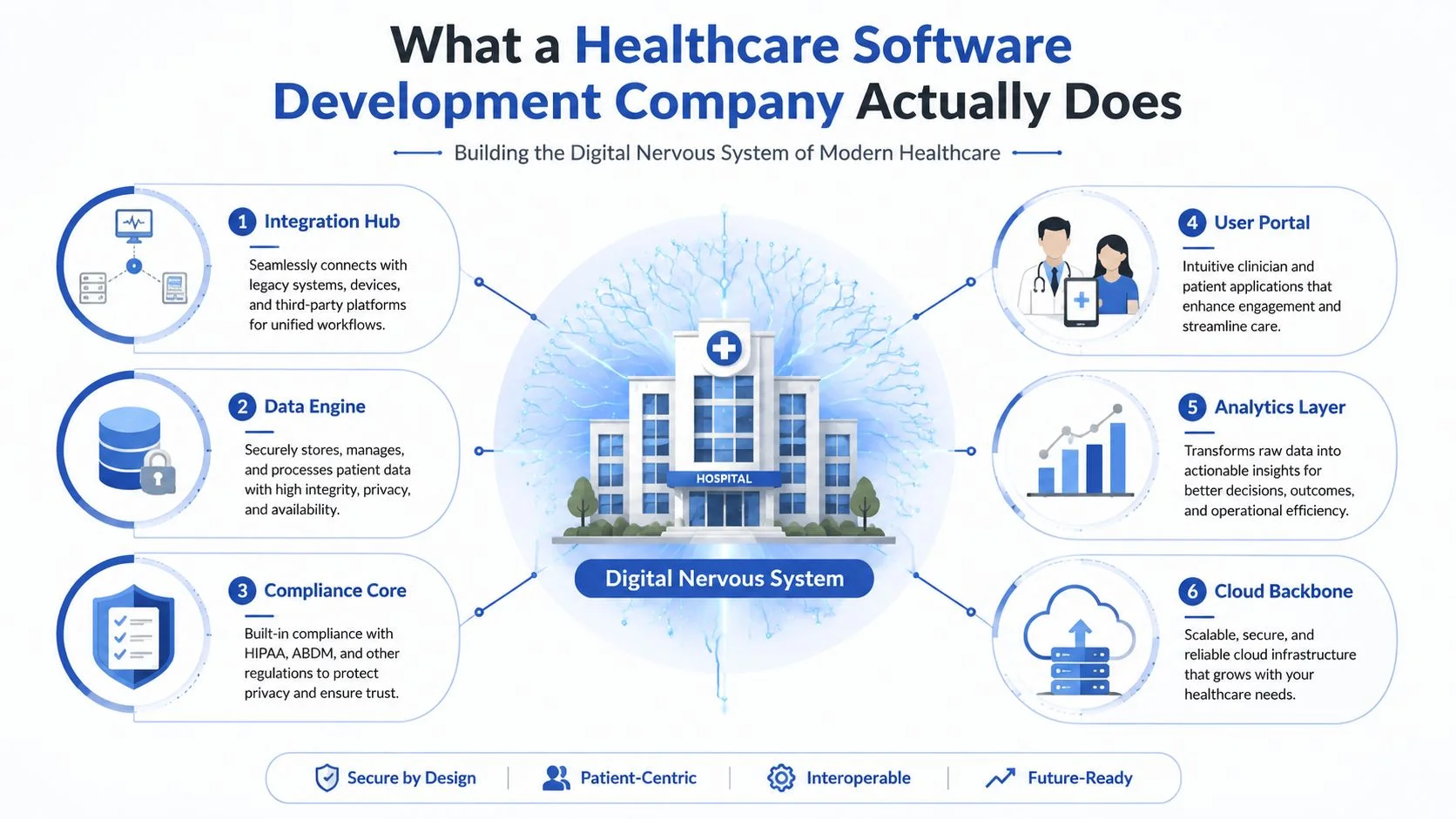
A real healthcare software development company doesn’t just build screens. It designs the digital nervous system of a hospital, the part that moves patient, clinical, financial, and operational information to the right place at the right time. That means understanding how a front desk, ward nurse, consultant, pharmacist, lab technician, insurer, and finance team all touch the same patient journey.
The work starts before code
Discovery should map actual hospital behaviour, not idealised workflows. The best teams document where duplicate entry happens, where approvals get stuck, and where records fall out of sync. They also ask which role owns each step, because healthcare software that ignores role-based accountability usually breaks under pressure.
Then comes integration, not isolation
A specialist team links the hospital system with lab tools, billing engines, insurance workflows, and, where relevant, public registries. It also defines data models, permissions, and audit behaviour before development gets too far. That’s the difference between a product that looks complete and a platform that can be operated every day.
Post-launch support is part of the job
Healthcare systems change after go-live. New departments join, regulators ask for better evidence, and clinicians request workflow changes that should have been in scope from the start. A serious vendor owns the lifecycle, not just the build phase.
Blocsys Technologies Private Limited is positioned in Pune, Maharashtra, and describes itself as building secure, scalable platforms for regulated industries. Its profile also places it in the 11 to 50 employee band, with a revenue estimate of about $2M in 2025 and roughly 18 employees in 2026, which signals a compact, specialised engineering organisation rather than a large generalist firm. That kind of profile usually suits focused hospital information system work better than broad, unfocused outsourcing.
Core Healthcare Software Solutions Hospitals Actually Need
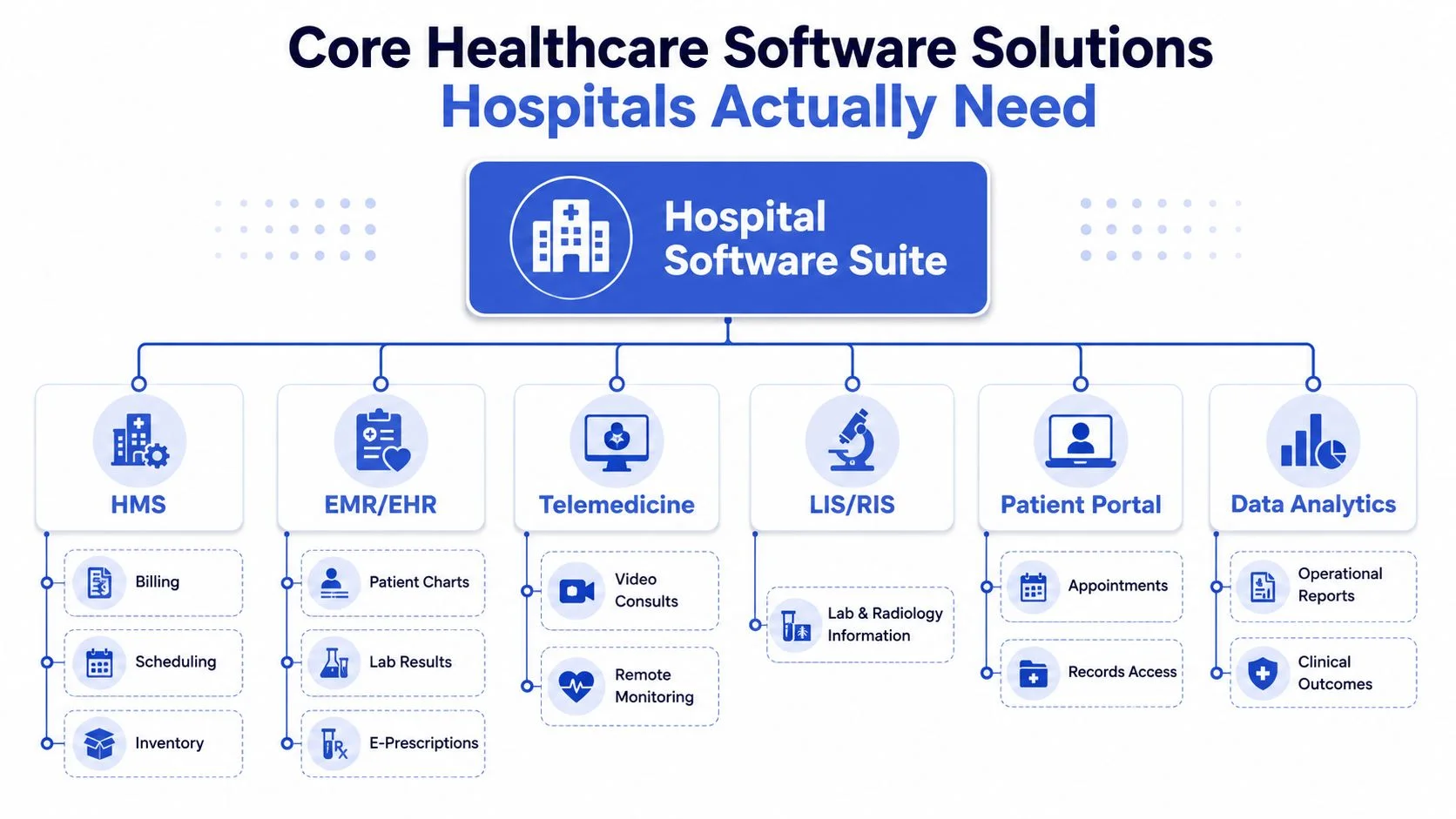
Hospitals do not need every module a vendor can demo. They need the stack that matches their current bottlenecks, audit needs, and integration burden. In most real deployments, that means a Hospital Management System, EMR/EHR, telemedicine, AI-assisted decision support, healthcare CRM, and ERP functions that keep clinical and back-office work aligned.
Hospital management systems
An HMS brings registration, appointments, admissions, discharge, pharmacy, lab, billing, reporting, and admin control into one operational flow. The value is not convenience alone. It reduces duplicate entry, keeps patient data aligned across departments, and gives operations teams a cleaner view of what is happening on the floor. Blocsys’s own hospital management system positioning follows this end-to-end approach.
EMR and EHR
EMR and EHR platforms replace scattered notes and paper files with structured clinical records. The point is not just digital storage. It is readable, searchable, reusable information that supports continuity of care and makes handoffs less fragile. If clinicians cannot trust the record, they stop using it.
Telemedicine
Telemedicine software extends care to patients who will not, or cannot, come in person. It works best when booking, consent, documentation, and follow-up sit inside the same workflow, instead of being split between the clinical system and a separate video tool. That separation is where adoption usually starts to slip.
AI, CRM, and ERP
AI is most useful where it helps clinicians and operations teams prioritise, triage, or remove repetitive work. CRM supports patient journey management, reminders, and engagement across the care cycle. ERP matters when finance, procurement, and inventory must reconcile against clinical activity rather than fight with it.
Indian hospital networks also need to plan for scale and uneven data readiness. The country has roughly 1.57 million allopathic doctors registered with the National Medical Commission and about 1.18 million ASHAs, while WHO notes India has historically faced doctor density below the recommended threshold. That operating load makes unified workflows more practical than disconnected tools, because fragmented software adds friction every time a patient moves from registration to care, billing, and follow-up.
A practical reference for hospitals that are comparing record systems is electronic medical record solutions, especially when the priority is structured records rather than simple digitisation.
Custom, Off-the-Shelf, or Hybrid Healthcare Software
Most buyers don’t need to choose between “custom” and “SaaS” in the abstract. They need to decide what will fit their workflow, integration burden, and compliance exposure over time. For a specialty clinic, off-the-shelf software with configuration may be enough. For a multi-site hospital, a hybrid model often makes more sense because some core workflows need tailoring while other functions can stay standard.
The decision is easier when you compare the models by criteria that matter in healthcare.
| Healthcare Software Engagement Models Compared | Custom Development | Off-the-Shelf SaaS | Hybrid Model |
|---|---|---|---|
| Workflow fit | Built around your real processes | Fits common workflows, not edge cases | Strong for core processes, configurable elsewhere |
| Integration depth | High, if designed well | Often limited by vendor APIs | Good balance of control and speed |
| Compliance agility | Strong when compliance is built in | Depends on vendor roadmap | Usually the safest compromise |
| Total cost of ownership | Higher upfront, can pay off over time | Lower entry cost, licensing accumulates | Middle path, often more predictable |
| Vendor lock-in risk | Lower if IP is owned properly | Higher, especially with proprietary data models | Moderate, depends on how architecture is split |
When custom wins
Custom development is the better fit when your workflows are unusual, your integrations are complex, or your organisation needs tighter control over data and user journeys. Digital health startups also land here because their product itself is the differentiator.
When SaaS is enough
Configured SaaS can work for smaller clinics that mainly need scheduling, basic records, and billing. The trade-off is that you often adapt your process to the software, not the other way around.
Why hybrid often fits hospitals
A 200-bed hospital in India or the Middle East often needs standard modules for routine functions and custom layers for local compliance, insurance, and departmental quirks. That’s why hybrid architecture is usually the most defensible option.
For hospitals that want a more detailed view of custom-build trade-offs, custom hospital management software in India is the right lens to apply before signing a vendor contract.
Compliance, Security, and Integration Architecture That Holds Up
Healthcare software only looks modern until an audit, an incident, or an interoperability request exposes the weak spots. The architecture has to do more than store records. It needs to prove who accessed what, when consent was given, and how the data moved between systems.
India-first design choices
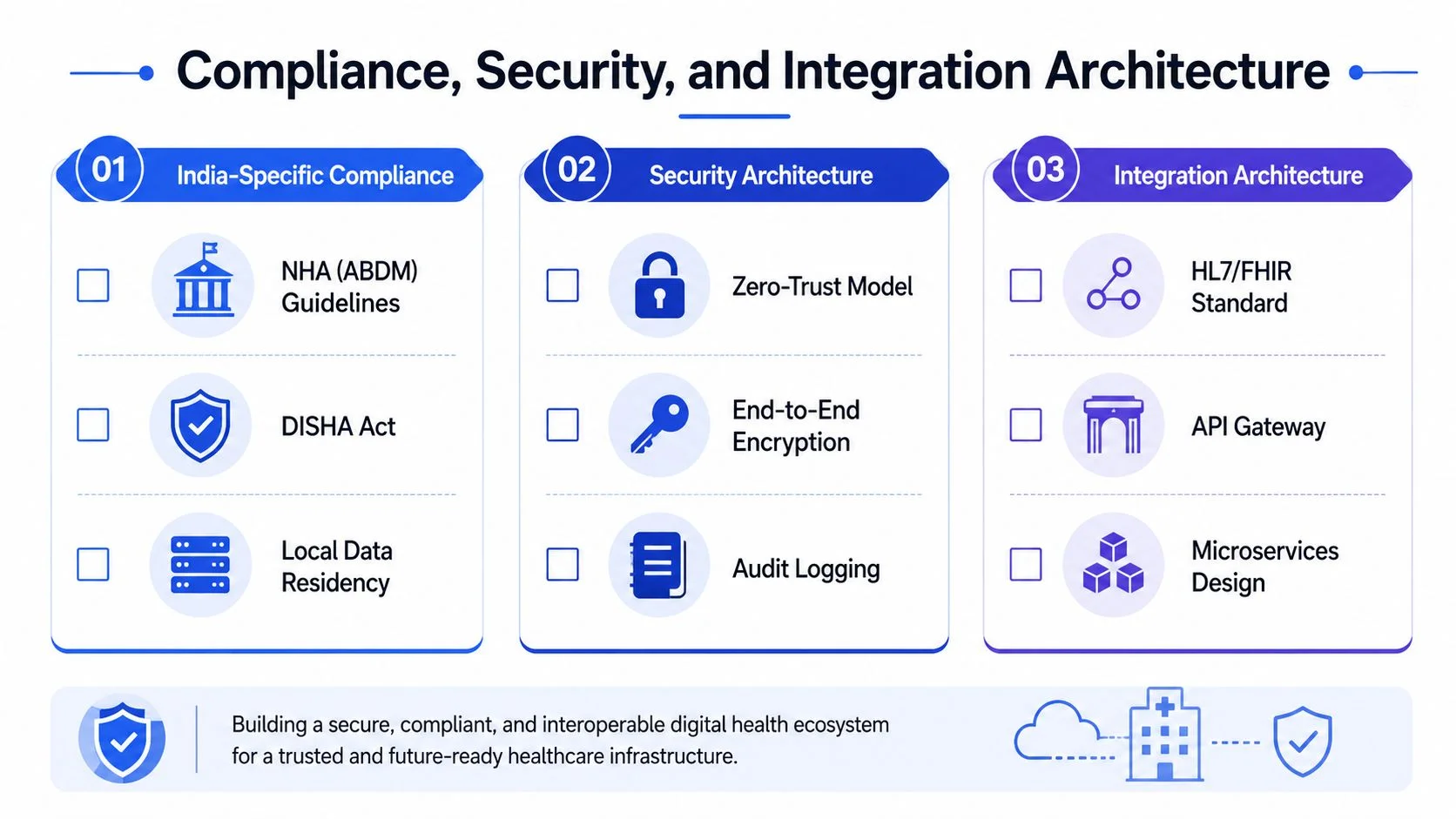
India’s Ayushman Bharat Digital Mission has issued more than 76 crore ABHA IDs, and the National Health Authority has built the ecosystem around standardised registries and consent-based exchange of health records. That makes ABHA-linked identity mapping and consent architecture a baseline requirement, not a nice-to-have. Systems that ignore that layer will struggle with portability and onboarding across providers.
Global security expectations still matter
For cross-border or export-facing platforms, HIPAA, GDPR, and ISO 27001 are common trust markers. True engineering work is not in the logo on the website; it’s in role-based access, encryption at rest and in transit, immutable audit trails, and predictable incident handling. If those controls are missing, compliance becomes theatre.
Integration should be API-first
Labs, insurers, pharmacies, and government systems should connect through a clean API layer, not fragile point-to-point hacks. That makes upgrades easier and reduces the odds that one workflow change breaks three others. It also gives you a cleaner path to HL7 and FHIR-based interoperability where needed.
Architecture rule: if consent, identity, and audit logging are bolted on after launch, the platform will always feel retrofitted, because it is.
If your team is exploring trust-sensitive record workflows, blockchain document verification for healthcare legal and government records is a relevant example of how tamper-evident design can support auditability, though it should be used where governance needs it, not as a novelty feature.
One more practical point. India’s healthcare digitisation is uneven across providers and regions, so workflow adoption matters as much as technical correctness. The strongest systems are the ones clinicians can use under load, with clean permissions, sensible defaults, and low-friction data exchange.
Development Process, Cost Factors, and Realistic ROI
A serious healthcare build usually follows a sequence that leadership can govern. It starts with workflow discovery, then architecture design, then phased module rollout. One should pilot one department first, cut over carefully, and keep optimising after launch. That’s a more realistic path than trying to switch an entire hospital in one shot.
Cost is driven by a few predictable factors. Integrations add effort, especially when lab, insurance, and legacy systems all need to talk. Compliance scope matters too, because auditability, access controls, and data governance take real engineering time. On-premise deployments, custom AI features, and cross-site rollouts also raise complexity.
What ROI looks like in hospitals
ROI in healthcare is usually operational, not flashy. It shows up as less duplicate entry, fewer billing errors, better claim handling, cleaner audit evidence, and a more usable clinician interface. Hospitals also tend to feel the people side of it, because better software reduces frustration for staff who are already working under pressure.
What to ask a vendor
- Which integrations are native and which need custom work? That question exposes hidden scope quickly.
- How will the pilot department be chosen? A sensible answer usually reflects real operational risk.
- What changes after go-live? If the answer is “nothing,” the vendor hasn’t worked in healthcare for long.
Budgeting discipline matters more than feature ambition. The right estimate usually starts with workflow and integration scope, not a generic platform package.
Blocsys’s external profile reports about $2 million in revenue in 2025 and an 18-person team, which is a useful signal of a compact engineering setup that can stay focused on complex workflows such as hospital information systems and system integration. If you’re comparing proposal structures, the software development cost breakdown page is a practical starting point for thinking about scope, rather than guessing from a sales deck.
Why Blocsys Is the Right Healthcare Software Partner for 2026
Blocsys is based in Pune, Maharashtra, and publicly positions itself around secure, scalable software for regulated businesses. In healthcare, that matters because hospitals and digital health companies need more than coding capacity. They need a partner that understands workflow design, data exchange, auditability, and the operational reality of Indian and global care environments.
Blocsys’s own healthcare pages align with the kinds of problems buyers are trying to solve, HMS, EMR/EHR, telemedicine, workflow automation, and local deployment needs. For a closer look at the company’s healthcare framing, this hospital software development company overview is the most relevant internal reference.
The point isn’t to buy more software. It’s to build a system that holds up when patients, clinicians, and finance teams all touch it at once. That’s where architecture, implementation discipline, and local healthcare context decide whether the project succeeds.
Here’s a concise view of Blocsys’s healthcare relevance for decision-makers:
- Hospitals and clinics can use it to scope HMS and workflow automation.
- Digital health teams can use it for custom platform builds and integrations.
- Operational leaders can use it to think about compliance, data exchange, and scale before code starts.
If you’re evaluating a healthcare software development company for a new HMS, EMR/EHR platform, telemedicine workflow, or cloud-based hospital rollout, Blocsys is a sensible partner to speak with. Use the software development cost estimator on the site to shape the brief, then judge the proposal on workflow fit, integration depth, and compliance readiness.
Blocsys Technologies builds custom healthcare software, hospital management systems, and digital health platforms designed for real-world clinical workflows. If you’re planning an HMS, EMR/EHR rollout, or telemedicine platform, visit Blocsys Technologies to start a discovery conversation and see how your next build can be scoped with more clarity and less guesswork.
Frequently Asked Questions
What does a healthcare software development company do?
A healthcare software development company designs and builds digital systems that support clinical, administrative, financial, and operational healthcare workflows. Its work can include hospital management systems, EMR/EHR platforms, telemedicine applications, healthcare ERP, AI-powered automation, patient engagement systems, integrations, data security, and ongoing post-launch support.
What healthcare software solutions can a development company build?
A healthcare software development company can build hospital management systems, EMR and EHR platforms, telemedicine software, healthcare ERP, patient portals, healthcare CRM, pharmacy and laboratory systems, AI-powered healthcare applications, and custom digital health platforms. The appropriate solution depends on the organisation’s workflows, users, integrations, compliance requirements, and operational goals.
Should hospitals choose custom healthcare software or off-the-shelf software?
Hospitals should choose custom healthcare software when they have specialised workflows, complex integrations, unique compliance requirements, or a need for greater control over the product roadmap. Off-the-shelf software can be sufficient for smaller clinics with standard workflows, while a hybrid approach can combine configurable standard modules with custom functionality for hospital-specific requirements.
What features should a hospital management system include?
A hospital management system should typically include patient registration, appointment scheduling, OPD and IPD management, admissions and discharge, pharmacy, laboratory, billing, insurance, inventory, reporting, and administrative workflows. Larger hospitals may also require EMR/EHR integration, radiology and PACS connectivity, operation theatre management, multi-branch support, analytics, and AI-powered automation.
How can healthcare software integrate with EMR and EHR systems?
Healthcare software can integrate with EMR and EHR systems through APIs and healthcare interoperability standards such as HL7 and FHIR. An API-first architecture allows patient, clinical, billing, laboratory, and administrative information to move between authorised systems while maintaining access controls, audit trails, data validation, and appropriate consent and privacy mechanisms.
How does AI improve healthcare software?
AI improves healthcare software by automating repetitive administrative tasks, supporting clinical prioritisation, analysing operational data, forecasting demand, improving scheduling, assisting claims and billing workflows, and identifying patterns that may require attention. AI is most effective when it operates on reliable, structured healthcare data and remains subject to appropriate governance and human oversight.
What healthcare compliance and security features should software include?
Healthcare software should include role-based access control, encryption in transit and at rest, strong authentication, audit trails, consent management, secure APIs, backup and recovery, data governance, and controlled access to sensitive health information. Depending on the market and use case, organisations may also need to consider frameworks and standards such as ABDM, HIPAA, GDPR, ISO 27001, HL7, and FHIR.
How does ABDM and ABHA integration work in healthcare software?
ABDM and ABHA integration connects healthcare software with India’s digital health ecosystem through standardised identity, consent, and health-information exchange workflows. A healthcare platform can use ABHA-linked identity and ABDM-compatible interfaces to support authorised exchange of health information, provided the system implements appropriate consent, security, interoperability, and data-governance controls.
How long does it take to develop healthcare software?
Healthcare software development can take several months to more than a year depending on the number of modules, integrations, custom workflows, compliance requirements, data migration, AI functionality, and deployment model. A phased development approach is generally more practical because organisations can first implement high-priority workflows and then expand the platform based on real operational feedback.
How much does healthcare software development cost?
Healthcare software development cost depends on the platform type, number of modules, customisation, integrations, AI requirements, compliance scope, user roles, deployment model, data migration, security requirements, and ongoing support. A focused telemedicine or clinic application can require substantially less investment than a custom enterprise healthcare platform connecting HMS, EMR/EHR, laboratory, pharmacy, billing, insurance, ERP, and AI workflows.
How do you choose the right healthcare software development company?
The right healthcare software development company should be evaluated on its understanding of healthcare workflows, integration capabilities, security architecture, compliance experience, development methodology, scalability, post-launch support, and ability to demonstrate relevant projects. Hospitals should also ask which integrations are native, how the vendor handles workflow changes after go-live, how data is protected, and how the platform can scale as departments and facilities grow.
