
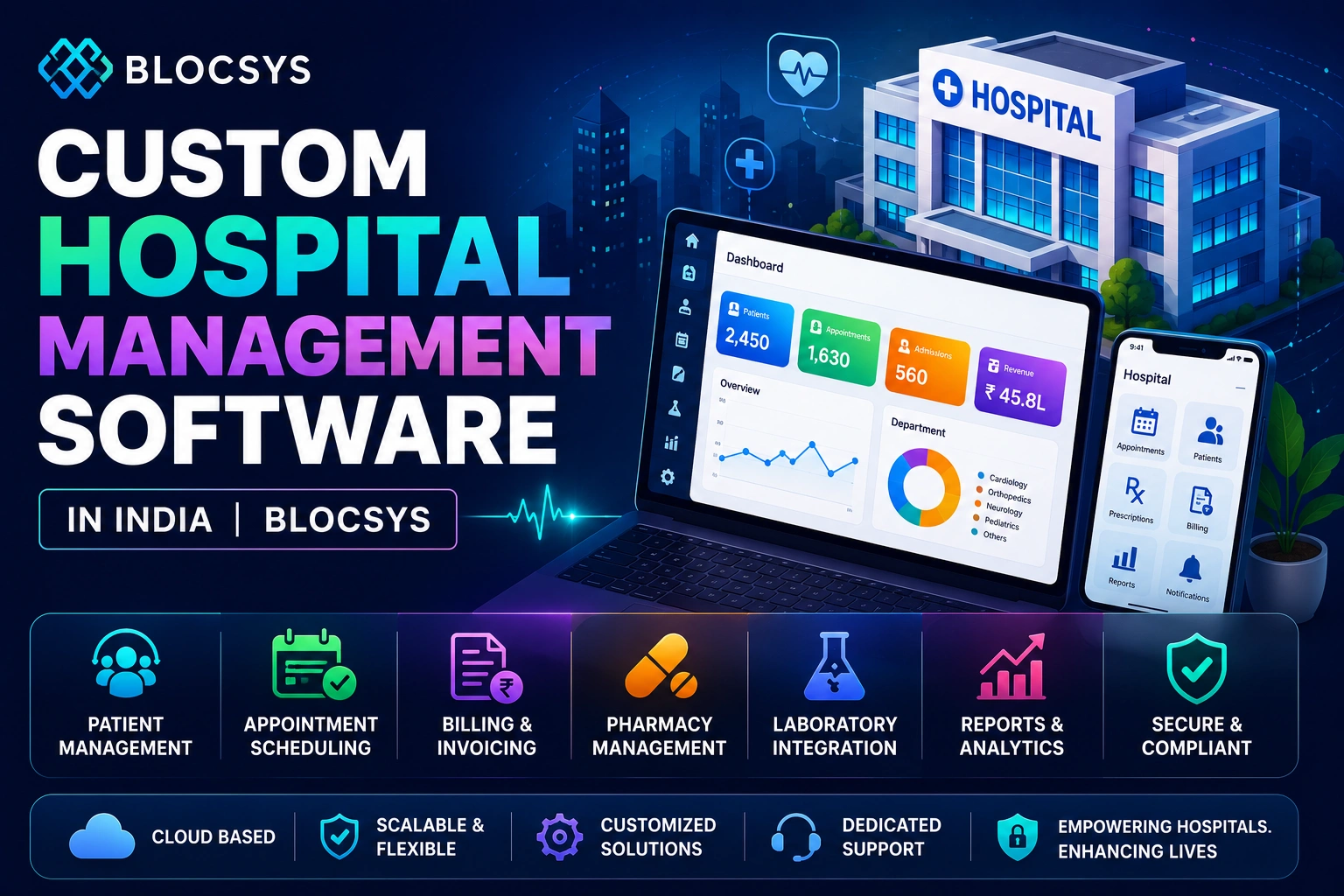
A hospital group reaches a familiar breaking point when growth exposes what day-to-day work had been hiding. Registration runs in one system, billing in another, pharmacy in spreadsheets, insurance claims in email threads, and clinical notes sit wherever each department has managed to keep them. Finance sees delayed collections. Clinicians don’t get a clean patient view. Administrators spend too much time reconciling records that should never have diverged in the first place.
That’s usually the moment when a standard clinic tool stops being enough and a focused search begins for custom hospital management software in India. The buyers aren’t just looking for screens and modules. They’re trying to remove revenue leakage, tighten compliance, reduce staff friction, and create a system that can support telemedicine, analytics, AI-assisted workflows, and future interoperability without rebuilding from scratch a year later.
For hospital administrators, CIOs, founders, and operators comparing options, the hard part isn’t recognising the need. It’s deciding what to build, what to configure, what to integrate, and how to choose a partner that understands both healthcare operations and software delivery risk. A generic ERP approach rarely survives real hospital complexity.
A practical place to start is with a unified hospital management system approach that treats clinical, operational, and financial workflows as one connected operating model rather than separate departmental purchases.
This guide is written from that operator’s viewpoint. It’s meant for teams that need a clearer buying framework, a stronger technical checklist, a more realistic view of pricing, and a safer path from vendor evaluation to go-live. It also closes with where Blocsys fits when you need a configurable HMS built for present operations and future change.
Table of Contents
- Introduction
- Understanding the Value and Core Features of Custom HMS
- Defining Your Requirements and Technical Checklist
- Selecting and Evaluating Development Partners
- Structuring Engagement Models Pricing Considerations and Red Flags
- Onboarding and Delivery Best Practices
- Future Outlook and Why Blocsys is Your Partner
- FAQs
- What is custom hospital management software in India
- Who should choose a custom HMS instead of an off-the-shelf product
- What core modules should a hospital prioritise first
- Can a custom HMS integrate with EMR and EHR systems
- How long does custom HMS development usually take in India
- How much does custom hospital management software cost in India
- How is cloud HMS commonly priced in India
- Is cloud better than on-premise for hospitals
- What compliance items should be in the requirements document
- How should hospitals evaluate an HMS vendor
- What are the biggest hidden cost factors in HMS projects
- Can AI and blockchain capabilities be added later
Introduction
The most expensive HMS problems usually don’t appear in procurement. They show up after launch, when doctors bypass the EMR because the workflow is clumsy, when pharmacy stock doesn’t align with billing, or when the finance team still exports data manually to close books. Hospitals feel those failures as operational drag, not just IT defects.
A custom build works when the hospital treats software selection as an operating model decision. That means mapping patient flow, approvals, exception handling, insurer rules, discharge bottlenecks, and reporting obligations before a single screen gets designed. It also means being honest about what needs to be configurable and what should stay standard.
For Indian providers, the decision now has a second layer. A modern HMS has to be useful today and adaptable tomorrow. That includes clean APIs, cloud readiness where appropriate, stronger auditability, support for digital prescriptions, and a realistic path toward AI and secure interoperability. Teams exploring blockchain-based record integrity or consent-heavy data exchange also need architecture that won’t force a rewrite later.
Practical rule: If billing, clinical documentation, and inventory don’t reconcile inside the same operating model, the hospital hasn’t digitised the workflow. It has only moved the friction.
The rest of the decision comes down to execution discipline. Requirements have to be specific. Vendors have to be evaluated against healthcare reality, not presentation quality. Commercial terms have to reflect how hospital projects change once departments get involved. And onboarding has to be staged so operations stay stable while adoption builds.
Understanding the Value and Core Features of Custom HMS
A useful HMS doesn’t win by having the longest module list. It wins when the patient journey, clinical tasks, and money flow all connect cleanly. That’s the core commercial value of custom hospital management software in India.
Why unified workflows matter more than feature count
Hospitals often buy software in fragments. One tool for appointments, another for pharmacy, another for claims, another for accounts. The result is predictable. Staff duplicate entries, managers can’t trust reports, and finance spends time tracing gaps rather than improving collections.
Blocsys’s hospital management system platform is described as a unified HMS in India that integrates clinical, operational, and financial workflows, including patient registration, OPD/IPD management, pharmacy, lab services, insurance claims processing, and a built-in accounting ledger that reconciles directly with Tally. That kind of design matters because hospitals don’t operate in departmental silos, even if their software often does.
When teams research the practicalities of developing hospital management software, the recurring lesson is that architecture choices shape operational outcomes. A fragmented design creates support tickets. A unified design reduces handoffs and makes accountability visible.
A future-proof version of that architecture also needs to think about secure data exchange and consent-heavy interoperability. That’s where healthcare leaders increasingly look at blockchain in healthcare for securing data interoperability as a design consideration, not as a novelty feature.
The modules that usually drive the most operational value
The highest-impact modules are usually the least glamorous. Hospitals get disproportionate value when a few core areas work together without manual workarounds.
- Patient registration and appointments keep identity, contact, visit history, and scheduling logic aligned from the first interaction.
- OPD and IPD management shape how doctors, nurses, beds, transfers, and discharge actions are coordinated.
- Pharmacy and laboratory modules reduce delays between ordering, fulfilment, charging, and reporting.
- Billing and insurance workflows matter because every exception, package rule, and insurer document path becomes a source of operational friction if it isn’t designed well.
- EMR and EHR integration determine whether clinicians document inside the system or revert to external notes and later back-entry.
A hospital should judge each module by one question. Does it remove a real handoff between teams, or does it simply digitise the same delay?
Over the next 12 to 24 months, the modules with the strongest effect are usually the ones that improve reconciliation, clinician usability, insurer processing, and reporting consistency. AI can help with triage support, documentation assistance, and operational alerts, but only after the base workflows are clean. Hospitals that try to layer AI onto poor core data usually end up automating confusion.
Defining Your Requirements and Technical Checklist
Most HMS projects go off course before development starts. The problem isn’t code quality yet. It’s that the hospital never translated operational needs into a requirements document detailed enough to guide design, scope, and vendor accountability.
Start with workflow truth not vendor demos
A serious requirements exercise begins inside the hospital, not in a sales meeting. Gather representatives from registration, nursing, clinicians, pharmacy, lab, billing, insurance, IT, finance, and management. Ask each function where work currently stalls, where duplicate entry happens, where approvals get stuck, and where compliance evidence is hardest to produce.
Then document the flows as they happen, not as policy says they should happen. Emergency admissions, bed transfers, part-payments, cashless approvals, package changes, consultant sharing, partial discharges, repeat prescriptions, and lab corrections all matter. If the edge cases are missing, the system will look good in a demo and fail in production.
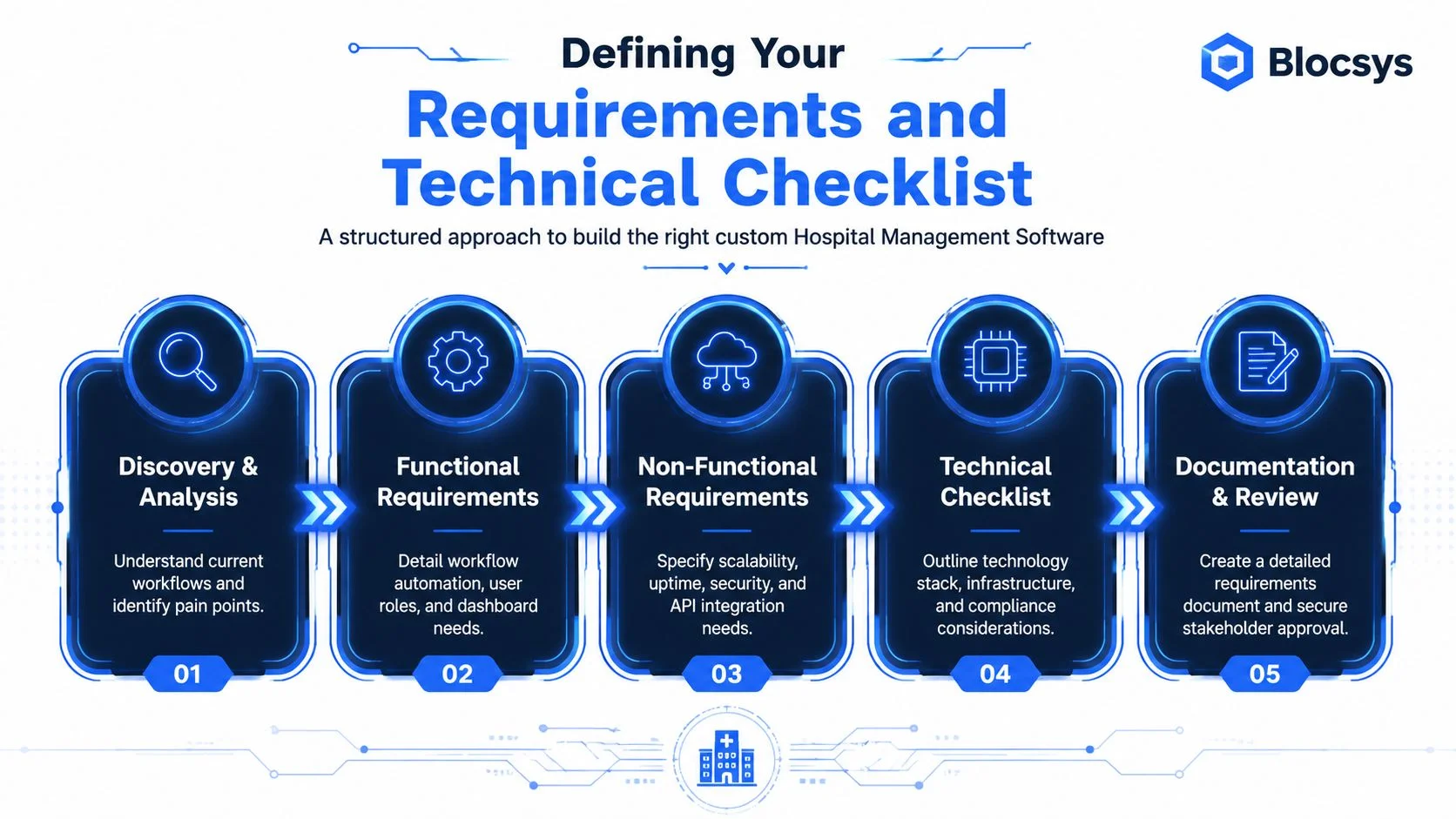
A practical technical checklist
A hospital-grade checklist should cover three layers at the same time.
Functional requirements
- User roles and permissions for doctors, nurses, front desk, pharmacists, lab technicians, finance, management, and external stakeholders where required.
- Workflow automation for admissions, discharge approvals, pharmacy requests, lab orders, claims handling, and escalations.
- Dashboards and reporting that match decision-makers. A CFO, a nursing superintendent, and a medical director won’t use the same dashboard.
- Clinical documentation needs including specialty templates, prescription workflows, progress notes, discharge summaries, and order entry behaviour.
- Integration points such as accounting systems, diagnostic devices, payment gateways, messaging tools, telemedicine tools, and existing EMR layers if they remain in place.
Non-functional requirements
- Scalability across more facilities, more users, and more specialties without redesigning the core platform.
- Security controls around encryption, audit logs, role-based access, backup discipline, and incident response.
- Uptime and performance expectations especially for registration, billing, and ward operations that can’t tolerate prolonged downtime.
- API strategy for interoperability, partner integrations, and future modules such as analytics, patient apps, or insurer connectivity.
- Deployment model covering cloud, managed SaaS, or on-premise, along with responsibilities for patching, monitoring, and disaster recovery.
Compliance and interoperability
- HIPAA-aligned thinking if international handling or enterprise governance models require it.
- NABH workflow considerations for operational discipline and audit readiness.
- HL7 and FHIR readiness where interoperability matters.
- ABDM alignment for Indian deployments where digital health ecosystem participation is part of the roadmap.
Field advice: Write acceptance criteria for workflows, not just features. “Insurance claims module” is vague. “Finance user can reconcile insurer settlement against billed package exceptions and export validated accounting entries” is testable.
The output should be a document a product owner, architect, implementation lead, and hospital administrator can all use. If only the vendor understands it, the hospital hasn’t defined requirements. It has outsourced thinking.
Selecting and Evaluating Development Partners
Hospitals often compare vendors too loosely. They ask for demos, collect proposals, and look at price bands. That overlooks the fundamental question. Which partner can handle the clinical, financial, operational, and regulatory complexity of hospital software without turning every change into a reset?
What separates a credible HMS partner from a generic software vendor
A credible partner understands that hospital software is not a normal enterprise app. It has to survive incomplete data, role conflicts, urgent exceptions, clinical sensitivity, and audit requirements. Teams that mainly build generic business systems usually underestimate this.
The cost and time ranges alone tell you why vendor discipline matters. In India, custom hospital management software for a 10 to 30 bed clinic costs ₹6–15 lakh and takes 3–6 months to build, while enterprise hospitals with 150+ beds require ₹35–70 lakh+ over 12–18 months, according to OneCity’s HMS cost analysis. Those are scope-driven bands, which means a weak partner can distort cost through poor discovery just as easily as through coding inefficiency.
In practice, the strongest evaluation criteria are usually these:
- Domain depth. Can the vendor discuss OPD, IPD, claims, pharmacy controls, discharge logic, and accounting handoffs without reverting to generic software language?
- Architecture quality. Are APIs, auditability, modularity, and interoperability designed early?
- AI and blockchain readiness. Not because every hospital needs both now, but because future record integrity, automation, and decision support shouldn’t require a platform replacement.
- Security posture. Hospitals should expect clear answers on access control, logging, backup, incident handling, and data segregation.
- Support model. Who owns implementation support, post-go-live fixes, and change requests? If support is vague before signature, it will be worse after launch.
For finance-heavy teams, it also helps to study adjacent healthcare systems such as best RCM software solutions. That kind of comparison sharpens what to ask about claims handling, denial workflows, and billing discipline inside an HMS proposal.
Hospitals that want partners with broader strategic readiness often also review whether the company can think beyond coding toward architecture and regulated digital transformation. That’s one reason some buyers look at a firm’s thinking on topics like a blockchain consulting partner guide for 2026, especially when long-term data trust and interoperability are part of the roadmap.
Sample RFP Questions for HMS Vendors
| Category | Sample Questions |
|---|---|
| Clinical workflows | How do you model OPD, IPD, discharge, and specialty-specific documentation without hardcoding every department? |
| Revenue and billing | How are package billing, insurance exceptions, partial settlements, and finance reconciliation handled? |
| Pharmacy and lab | How do stock movement, order fulfilment, result validation, and billing events stay synchronised? |
| EMR and interoperability | What is your approach to EMR usability, external EHR integration, and HL7/FHIR-compatible API design? |
| Security | How are permissions, audit logs, backups, and access reviews managed? |
| AI readiness | Which workflows can later support documentation assistance, predictive alerts, or operational automation without core redesign? |
| Blockchain readiness | If we later require stronger record traceability or secure interoperability patterns, what architectural provisions are already in place? |
| Project governance | Who owns discovery, backlog control, testing sign-off, and go-live support on both sides? |
| Pricing transparency | What is included in implementation, integrations, training, support, and change requests, and what is excluded? |
| Delivery risk | What assumptions in your proposal could change timeline or budget after discovery? |
Don’t score vendors only on how polished the demo is. Score them on how clearly they expose risk, assumptions, and operational constraints.
Structuring Engagement Models Pricing Considerations and Red Flags
Commercial structure shapes delivery quality more than many hospitals expect. A solid product team can still fail under the wrong contract model. A weaker team can look inexpensive until the first workflow change triggers a dispute over scope.
Which engagement model fits which hospital context
Hospitals usually see three models.
Fixed price works when scope is narrow and stable. It suits contained implementations, smaller facility rollouts, or module-specific work where workflows are already documented and sign-off discipline is strong. The trade-off is rigidity. Hospitals often discover important exceptions only after users see prototypes.
Time and materials works better when requirements are still maturing. It gives room to refine user journeys, insurer logic, clinical templates, and integrations without renegotiating every change. The trade-off is management overhead. The hospital needs an internal product owner who can prioritise actively.
Dedicated team fits organisations building a long-term digital platform rather than buying a one-off project. This model gives the hospital more continuity across roadmap phases, integrations, analytics, AI features, and post-launch optimisation. It also demands stronger internal governance and clearer decision ownership.
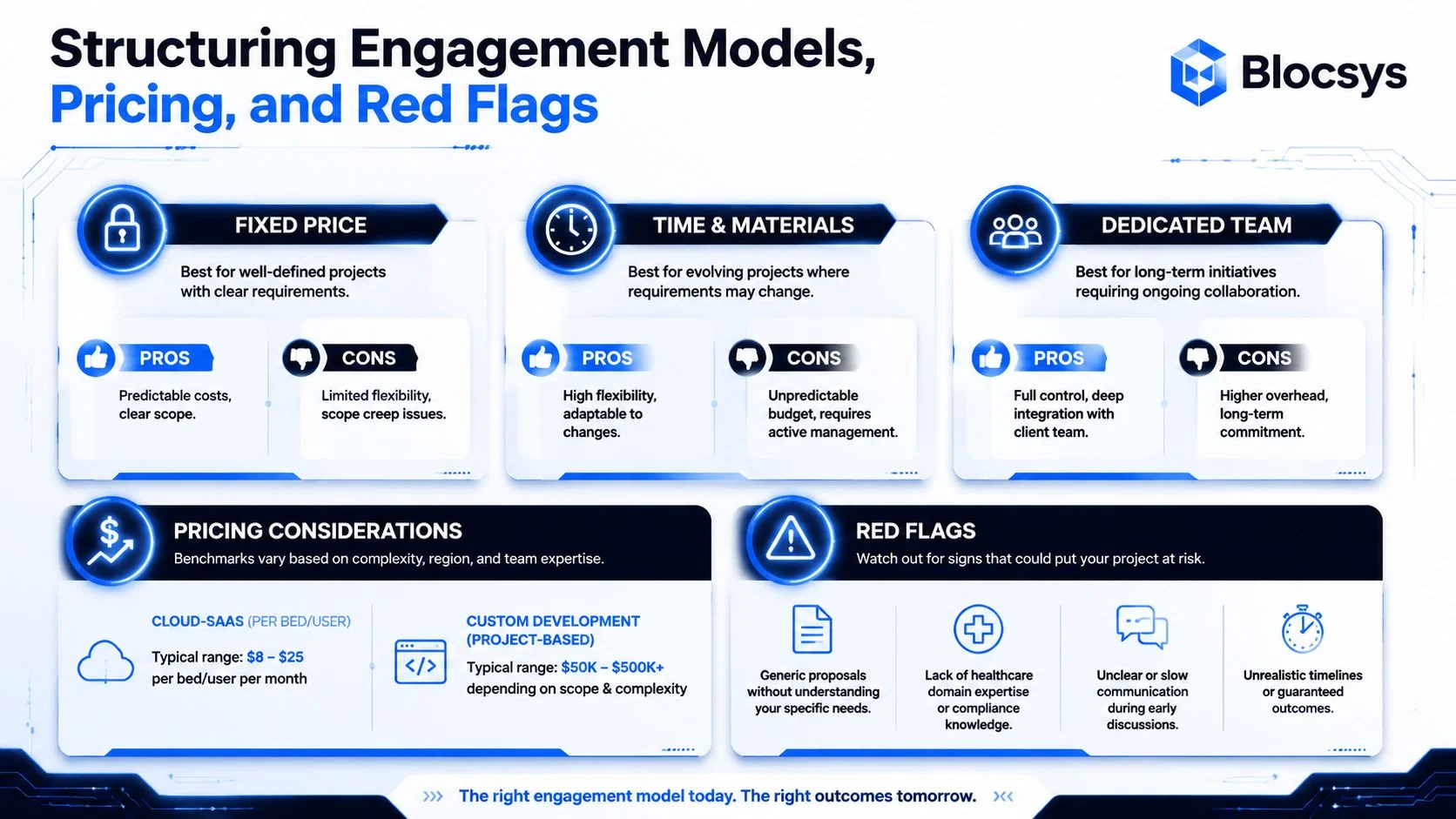
For cloud deployments, Indian pricing has moved toward usage-based structures. Cloud-based HMS in India now uses per-bed or per-user pricing models: ₹150–₹500 per bed per month for inpatient facilities and ₹500–₹2,000 per active user per month for outpatient clinics, according to Anzo’s HMS pricing guide. Those figures are useful for benchmarking, but they don’t remove the need to clarify what is and isn’t bundled into implementation, support, integrations, and customisation.
Before signing anything, hospitals should also estimate the likely total shape of the project, not just the sticker price. A practical starting point is a structured software development cost estimator that helps procurement and technology teams frame scope more realistically.
Where HMS contracts usually go wrong
The obvious red flags are easy to spot. The dangerous ones often sound reasonable at first.
- Vague SLAs let vendors claim compliance while leaving hospitals exposed during critical issues.
- Generic proposals usually mean the vendor hasn’t understood speciality workflows, reporting needs, or exception paths.
- Low upfront pricing with expensive change control shifts cost from proposal stage to implementation stage.
- Unclear integration ownership creates disputes over third-party systems, data migration, or accounting alignment.
- Training treated as an afterthought almost guarantees poor adoption, even if the software itself is capable.
A hospital should treat contract wording on data migration, integrations, training, hypercare, and change requests as operational clauses, not legal fine print.
There’s also a common strategic mistake. Some buyers optimise for lower first-year spend and ignore whether the platform can support telemedicine, analytics, AI-assisted workflows, or stronger data-trust models later. That usually becomes more expensive than choosing a flexible architecture from the start.
Onboarding and Delivery Best Practices
Go-live doesn’t rescue a weak implementation. It exposes it. The best onboarding plans reduce operational risk before users ever log in.
A practical rollout starts by isolating what must be migrated, what can be archived, and what has to remain temporarily connected through integration. Legacy data is rarely clean. Duplicate patients, inconsistent doctor names, outdated tariffs, and partial insurance records need to be resolved before migration rules are approved.
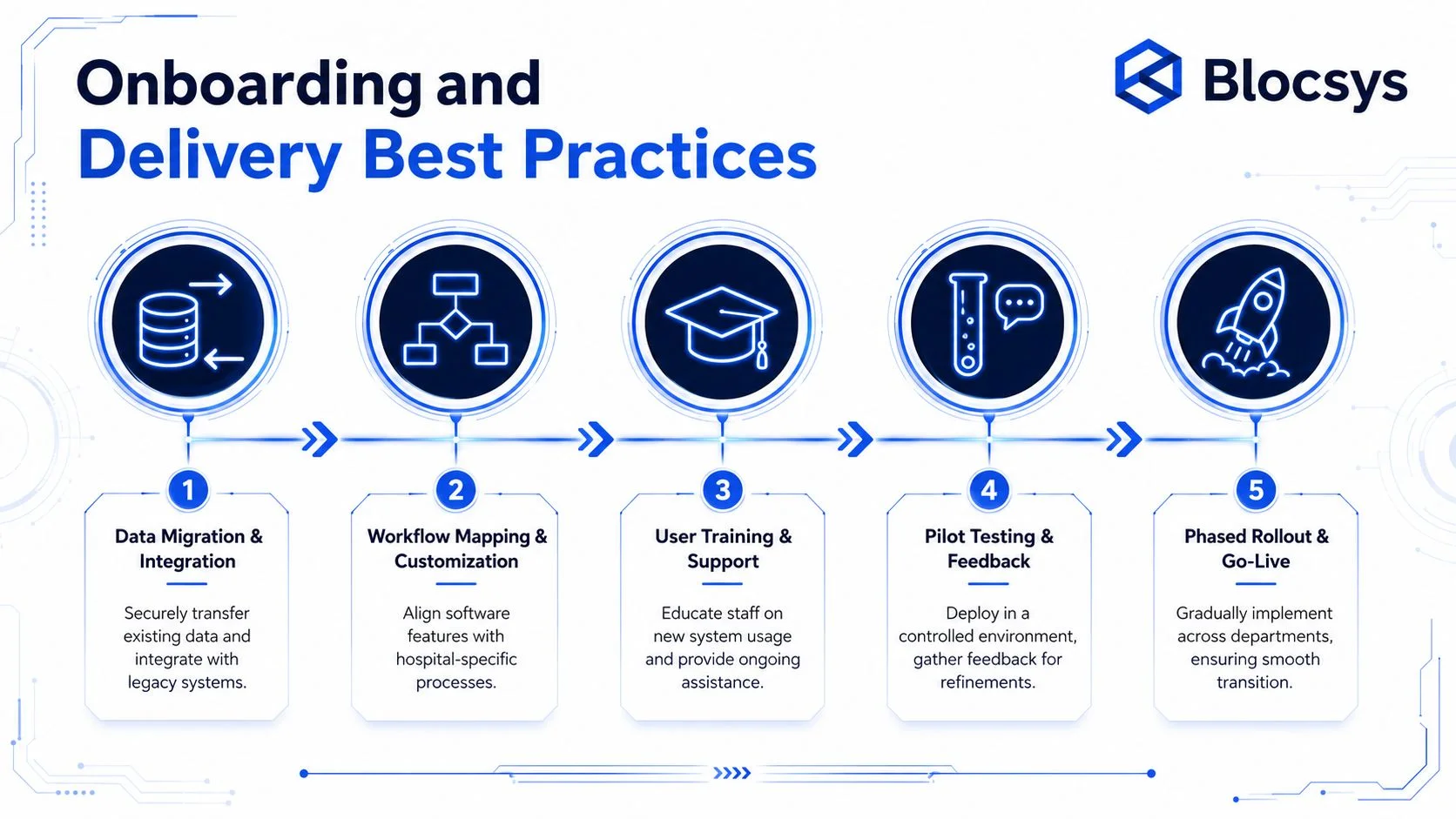
A rollout plan that protects operations
Hospitals that onboard well usually follow a phased discipline rather than a dramatic switch.
- Map current and future workflows. Confirm what changes on day one and what stays temporarily familiar so staff can adapt safely.
- Run controlled data migration cycles. Test imports in repeatable batches, validate critical records, and reconcile outputs with department owners.
- Train by role not by feature list. Front desk staff, consultants, nurses, finance teams, and pharmacists need scenario-based training anchored in their actual work.
- Pilot in a contained environment. One department, one facility, or one workflow path is enough to reveal missing permissions, print issues, discharge delays, or reporting gaps.
- Roll out in phases with visible escalation paths. Users adopt faster when they know who resolves issues, how quickly, and what workaround is approved in the meantime.
A useful implementation reference point is below. It’s worth reviewing as part of planning discussions with both hospital leadership and the delivery team.
What to watch in the first 90 days
The first 90 days are mostly about behavioural adoption and issue triage. If staff are still maintaining shadow spreadsheets, using side channels for approvals, or delaying entries until end of shift, the hospital has an adoption problem even if the vendor marks the project complete.
Focus review meetings on observable operational questions:
- Are registration, billing, and pharmacy entries reconciling daily?
- Are doctors completing documentation inside the system or outside it?
- Are claims and discharge workflows moving faster or just moving differently?
- Which reports are trusted by management, and which still need manual correction?
- What recurring support tickets indicate a design problem rather than a training gap?
The real sign of success isn’t that the system went live. It’s that departments stop asking for offline workarounds.
Future Outlook and Why Blocsys is Your Partner
Hospitals planning HMS decisions today shouldn’t buy only for current workflows. Over the next 12 to 24 months, the architecture choices made now will determine whether the organisation can add AI-assisted documentation, smarter operational alerts, telemedicine extensions, stronger consent management, and more secure data interoperability without major rework.
What forward-looking hospitals are preparing for
The practical future of HMS is not science fiction. It’s quieter and more useful than that. Clinicians want less typing. Administrators want cleaner reporting. Finance wants fewer reconciliation gaps. Patients expect more digital continuity across appointments, records, communication, and billing.
That pushes the market toward systems that are configurable, integration-friendly, and designed for trustworthy data flows. AI will be most effective where records are structured and workflows are explicit. Blockchain-related capabilities will matter where traceability, tamper awareness, or secure multi-party interoperability become material to the provider’s model. Telemedicine will keep converging with core HMS rather than sitting as a detached add-on.
Why Blocsys fits this operating model
For buyers who need a modern build path, Blocsys Technologies is a relevant option because the company was incorporated in 2021 in Pune, Maharashtra, with CIN U72900PN2021PTC205303, and has positioned itself as an agile entrant delivering modern, configurable, enterprise-grade HMS solutions in India, as outlined on its company page for hospital management software development in India.
That matters less as a branding point and more as an operating signal. Newer healthcare technology partners can sometimes move with more architectural flexibility than legacy vendors tied to old product assumptions. For hospitals evaluating future-proof custom HMS, the relevant question is whether the partner can connect present-day operations with AI readiness, compliance discipline, cloud or on-premise deployment choice, and long-term interoperability thinking.
A hospital should still evaluate Blocsys the same way it evaluates any serious vendor. Test requirements depth. Probe security and delivery governance. Review how clinical, financial, and operational modules connect. Ask how future integrations and data-trust needs are handled. Good decisions come from scrutiny, not claims.
FAQs
What is custom hospital management software in India
Custom hospital management software in India is an HMS designed around a hospital’s specific workflows, departments, reporting needs, user roles, and integrations rather than forcing the organisation into a generic template. It typically covers clinical, operational, and financial processes in one connected system.
Who should choose a custom HMS instead of an off-the-shelf product
Multi-specialty hospitals, growing clinics, diagnostic networks, healthcare enterprises, and providers with complex billing, insurance, pharmacy, lab, or compliance requirements usually benefit most. If your teams rely on workarounds, duplicate entry, or many disconnected tools, customisation often becomes necessary.
What core modules should a hospital prioritise first
Start with patient registration, appointments, OPD and IPD management, billing, insurance handling, pharmacy, laboratory workflows, and EMR-related documentation. Those modules usually affect day-to-day operations and revenue control most directly.
Can a custom HMS integrate with EMR and EHR systems
Yes, if interoperability is planned properly from the beginning. The important point is not just technical integration but workflow alignment, user permissions, auditability, and data consistency across departments.
How long does custom HMS development usually take in India
For reference, a 10 to 30 bed clinic typically falls in the 3 to 6 month range, while enterprise hospitals with 150+ beds can take 12 to 18 months, based on OneCity’s HMS development cost and timeline overview.
How much does custom hospital management software cost in India
Custom pricing depends on scope, modules, integrations, and complexity. For reference, 10 to 30 bed clinics are cited at ₹6–15 lakh, while enterprise hospitals with 150+ beds are cited at ₹35–70 lakh+, based on the same OneCity analysis.
How is cloud HMS commonly priced in India
Common cloud pricing models include per-bed and per-user structures. For reference, inpatient pricing is cited at ₹150–₹500 per bed per month and outpatient pricing at ₹500–₹2,000 per active user per month in Anzo’s HMS pricing guide.
Is cloud better than on-premise for hospitals
It depends on internal IT maturity, data governance preferences, connectivity confidence, and procurement strategy. Cloud can simplify maintenance and updates. On-premise can suit organisations with strict internal infrastructure preferences. The right answer is operational, not ideological.
What compliance items should be in the requirements document
Hospitals should address role-based access, audit logs, data retention, backup and recovery, interoperability expectations, NABH workflow implications, HL7/FHIR readiness, ABDM alignment where relevant, and broader governance needs such as HIPAA-aligned controls when required.
How should hospitals evaluate an HMS vendor
Use an RFP and score vendors on healthcare workflow depth, architecture quality, integration readiness, security posture, project governance, support clarity, pricing transparency, and how well they handle future requirements such as AI or secure interoperability.
What are the biggest hidden cost factors in HMS projects
The common ones are poor discovery, underestimated integrations, messy data migration, excessive change-request fees, weak training, vague support clauses, and delays caused by unresolved stakeholder decisions inside the hospital.
Can AI and blockchain capabilities be added later
They can, but only if the base architecture supports structured data, clear APIs, secure permissions, and auditability. Hospitals that ignore those foundations often find future AI or blockchain initiatives much harder to implement.
If you’re assessing custom hospital management software in India and want a grounded discussion on architecture, scope, pricing, onboarding, or future-ready capabilities such as AI workflows and secure interoperability, connect with Blocsys Technologies. A practical next step is to review your current workflow gaps, define the right deployment model, and turn that into a build plan your hospital can implement with confidence.
