
A hospital CTO in Mumbai has three vendor proposals open, a finance lead asking for a clearer implementation budget, and a clinical team that wants fewer clicks, not another IT project that slows the ward down. One proposal promises a full hospital ERP. Another focuses on EMR workflows. A third talks about AI, analytics, and automation, but says very little about how patient data will be handled under India’s privacy regime.
That buying situation is common now. Hospitals, clinics, diagnostic centres, and healthcare startups aren’t choosing software in a vacuum. They’re balancing patient registration, billing, doctor workflows, pharmacy, laboratory operations, insurance claims, and reporting, while also dealing with legacy systems, cloud decisions, interoperability, and compliance risk. Search intent around the best hospital software development company India is clearly commercial and decision-stage. Buyers want practical evaluation criteria, feature clarity, architecture guidance, migration advice, and a credible delivery partner that can build for today without blocking tomorrow.
The gap in many comparison pages is obvious. They list modules, but they don’t explain trade-offs. They mention AI, but skip governance. They mention security, but don’t connect it to actual hospital workflows. That’s where a more useful view helps. Hospitals looking at Blocsys usually also want to estimate implementation scope early, so a practical tool like the software development cost estimator is often more useful than a generic sales conversation.
Table of Contents
- Introduction to Hospital Software Selection
- Understanding Hospital Management Software
- Benefits and Key Features of Custom HMS Solutions
- Architecture and Integration Patterns
- Data Privacy and Compliance Workflow Design
- Vendor Evaluation Criteria
- Migration Checklist for Existing Systems
- Why Blocsys and Next Steps
Introduction to Hospital Software Selection
The wrong hospital system rarely fails on demo day. It fails three months after go-live, when reception starts maintaining side spreadsheets, the billing team disputes code mappings, and consultants complain that OPD documentation takes longer than before. That’s usually not a feature problem. It’s a fit problem.
In practice, hospital software selection sits at the intersection of clinical workflow, financial control, and regulatory design. A multi-specialty hospital may need appointment scheduling, IPD bed management, laboratory workflows, billing, discharge summaries, and insurer-specific claim logic to work as one operational system. If even one of those pieces is weak, staff create workarounds, and workarounds become risk.
Practical rule: If a vendor can describe features but can’t map your patient, billing, and audit flows end to end, the project is still at brochure level.
There’s another complication in the Indian market. Many software companies talk about generic healthcare digitisation, while others come from adjacent domains such as fintech, data engineering, or enterprise AI. That can be an advantage when the team understands systems architecture thoroughly. It becomes a problem when they don’t translate that expertise into hospital operations, consent handling, auditability, and user roles.
A useful selection process starts with business constraints, not screens:
- Clinical constraints include OPD speed, IPD coordination, discharge turnaround, and fewer duplicate entries.
- Financial constraints include billing rules, package handling, insurer workflows, and reconciliation discipline.
- Technical constraints include legacy EMR/EHR integrations, cloud readiness, API maturity, and uptime expectations.
- Compliance constraints include privacy controls, audit logging, access roles, and retention practices suited to healthcare data.
Hospitals that choose well usually ask harder questions earlier. How will this system handle partial digitisation during rollout? What happens when one department moves faster than another? Can the architecture absorb telemedicine, analytics, and AI-assisted workflows later without forcing a rebuild? Those questions separate a software purchase from a sustainable digital health programme.
Understanding Hospital Management Software
Hospital Management Software, or HMS, is the operational system that coordinates administrative, clinical, and financial activity across a healthcare organisation. At minimum, it should connect front desk operations, care delivery, diagnostics, pharmacy, billing, and reporting in a single workflow model rather than scattered tools.
A strong HMS isn’t just a digital register. It becomes the system of record for day-to-day execution. That means patient registration has to feed appointments. Appointments have to feed consultation queues. Clinical orders have to move to lab and pharmacy. Billing has to reflect what happened, not what someone re-entered later.
Core modules hospitals actually use
Most hospital teams evaluate the same module families, but the quality of implementation varies sharply:
- Patient administration covers registration, UHID generation, demographics, appointments, queues, admissions, transfers, and discharge.
- Clinical operations include OPD and IPD workflows, doctor notes, nursing records, treatment plans, vitals, and order management.
- Diagnostics and pharmacy connect prescriptions, lab orders, sample status, inventory, dispensing, and result reporting.
- Finance and CRM include billing, packages, credit handling, insurer coordination, receivables, follow-ups, and patient communication.
Hospitals exploring a customized platform often start by reviewing a purpose-built hospital management system offering and then validating whether it supports their actual process variation.
Why unification matters
When these modules don’t share data cleanly, teams compensate manually. Registration staff repeat data entry. Billing misses chargeable events. Doctors don’t trust records because updates lag. Administrators get reports that are technically complete but operationally useless.
A unified HMS works best when each department sees only what it needs, while leadership still gets a complete operational picture.
That’s also why hospitals should treat EMR, ERP, CRM, billing, inventory, and scheduling as connected design choices, not separate purchases. Once the foundation is stable, advanced services such as telemedicine, analytics dashboards, and AI-assisted task automation become much easier to introduce without disrupting core care delivery.
Benefits and Key Features of Custom HMS Solutions
At 8:15 a.m., OPD registration is full, one consultant has switched rooms, two beds marked available are still being cleaned, and billing has not picked up a package exception for an insured admission. In that setting, software quality shows up as operational control. Hospitals feel the difference immediately when the system fits their actual rules instead of forcing staff to work around them.
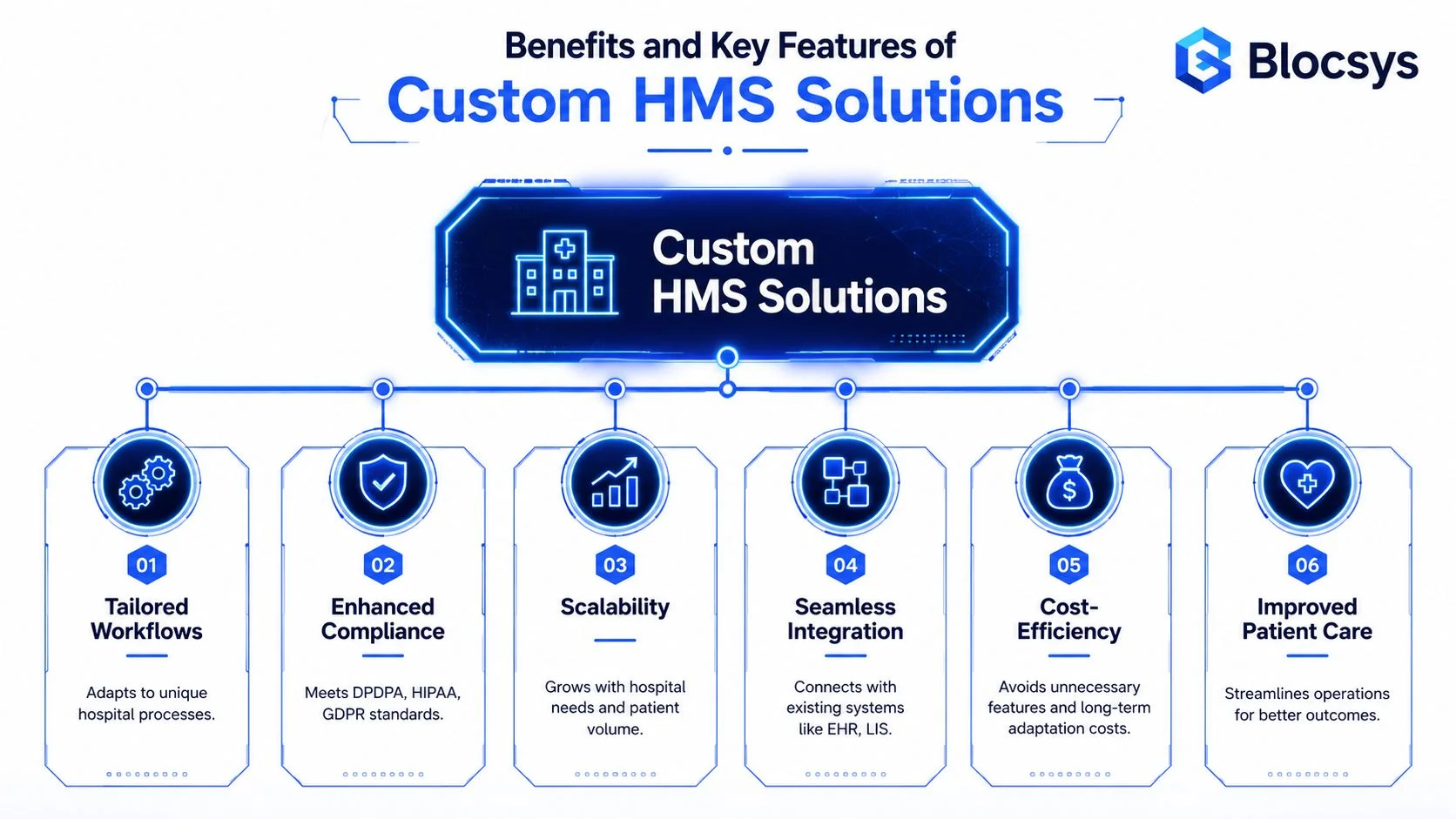
Teams evaluating custom hospital management software in India are usually deciding between two operating models. One model asks the hospital to change established workflows to fit a product template. The other builds software around department logic, approval paths, insurer requirements, and reporting needs that already exist on the ground.
Why custom development pays off
Custom HMS development works best for hospitals with multi-specialty operations, facility-specific billing rules, complex TPA or insurer coordination, and a phased digitisation plan. A packaged product can still be the right choice for a smaller hospital with standard processes and limited integration needs. The trade-off is clear. Lower initial setup effort often leads to higher process friction later.
The strongest benefit is workflow accuracy.
If admission, diagnostics, pharmacy, nursing, and discharge rules match how the hospital operates, staff spend less time on exception handling. Fewer events are missed. Charge capture improves because the software reflects real clinical and administrative transitions rather than generic module logic. Leadership also gets reports built around bed turnover, queue pressure, denial patterns, package leakage, and inventory movement that matter in daily decisions.
Custom systems also give hospitals more control over change. New service lines, locations, and payer rules can be added without replacing the core platform every time an operating model shifts.
Key features that improve day-to-day performance
Feature lists matter less than execution quality. A useful HMS includes functions that reduce coordination gaps between departments and make responsibility visible.
| Feature | What good implementation looks like |
|---|---|
| Real-time bed management | Admissions, transfers, housekeeping, and discharge status update through one shared status model |
| Rules-based billing | Packages, room rent changes, doctor fees, consumables, and insurer conditions resolve through configurable rules and approval controls |
| EMR-ready records | Clinical data is structured for retrieval, continuity of care, coding support, and downstream integration |
| Healthcare CRM | Reminders, follow-ups, feedback, and outreach are linked to actual visits, procedures, and care plans |
| Inventory and supply chain | Pharmacy and stores track issue, reorder, expiry, batch usage, and ward consumption against live demand |
| Audit and consent tracking | User actions, record changes, approvals, and consent events are traceable with clear timestamps and role context |
A practical custom build should also support role-specific views. Clinicians need fast documentation and order visibility. Finance teams need exception queues. Administrators need operational dashboards that show where the bottleneck sits right now, not after end-of-day reconciliation.
Where AI and blockchain fit, and where they do not
Hospitals should apply AI and blockchain to narrow problems with clear returns. AI is useful for triage support, document classification, coding assistance, discharge summary checks, queue forecasting, and anomaly detection in claims or billing activity. It becomes a burden when teams force predictive features into workflows that still suffer from poor master data, weak user adoption, or inconsistent documentation.
The same rule applies to blockchain.
Smart contracts and tokenisation can strengthen a custom HMS in situations where multiple parties need a shared, tamper-evident transaction record. In Indian healthcare, that can include consent provenance, verified document exchange, referral and claims workflows with defined triggers, and controlled access logs across hospital groups or partner networks. A tokenised permission layer can help define who can view, share, or attest to specific records without exposing the full clinical dataset to every participant.
That does not mean putting every patient event on-chain. Clinical systems still need fast transactional databases, strong access control, and usable screens for doctors, nurses, and front-desk teams. Blockchain works best as a trust and audit layer around selected events. It should support the HMS, not slow it down.
Field observation: Smart contract logic is useful when insurer approvals, consent checkpoints, or document attestations involve several parties with different incentives. It adds little value to routine bedside documentation or basic appointment scheduling.
That distinction matters in vendor evaluation. A team with blockchain and AI experience should be able to explain exactly which workflows benefit, what stays off-chain, how keys and permissions are managed, and how the design aligns with Indian privacy and hospital audit requirements. If they cannot answer those points clearly, the technology choice is still too abstract to deploy safely.
Architecture and Integration Patterns
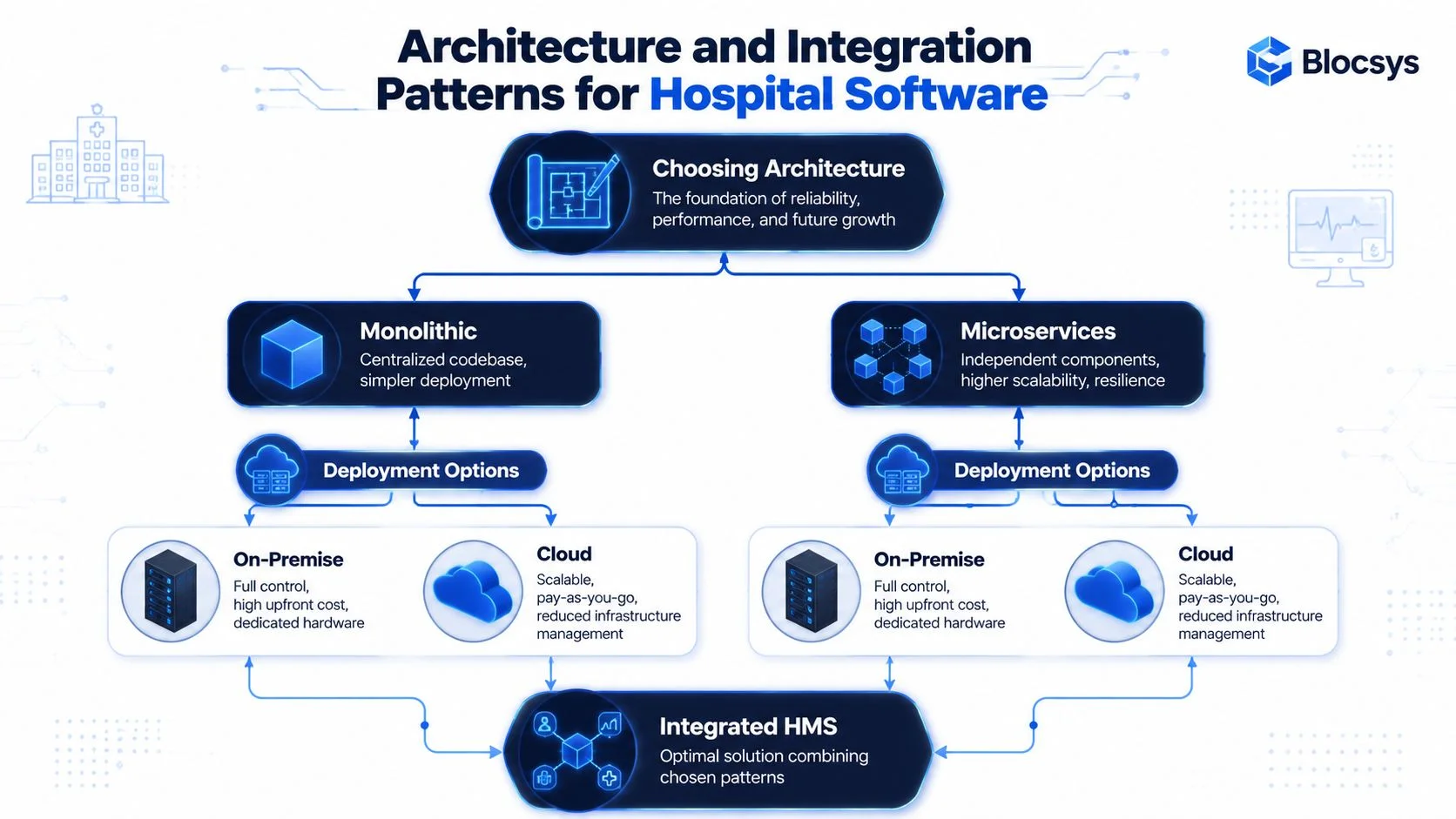
Architecture decisions lock in more than hosting. They affect release velocity, fault isolation, reporting accuracy, and how easily the HMS can absorb future services such as telemedicine, analytics, or patient-facing apps.
Hospitals planning integrations across departments usually benefit from a clear data pipeline architecture approach because the bottleneck is rarely just application code. It’s how data moves, validates, and becomes usable across systems.
Monolith or microservices
A monolithic HMS can be the right choice for a single-facility hospital with modest integration needs, one deployment pipeline, and a team that values operational simplicity. It reduces platform overhead and can speed up the first release.
Microservices become more attractive when the organisation has multiple facilities, separate product teams, heavy integration requirements, or different scaling profiles across modules. Pharmacy, appointments, billing, and analytics rarely experience load in the same way. Splitting them can improve resilience, but it also increases engineering discipline requirements.
Key trade-offs look like this:
- Monolith is simpler to deploy and govern, but module coupling can slow change.
- Microservices improve isolation and flexibility, but observability, security, and version management become harder.
- Modular monolith is often the practical middle ground for hospital software because it preserves cleaner boundaries without premature platform complexity.
This walkthrough helps clarify those choices in a healthcare context:
Hosting and integration choices
Deployment is rarely a pure cloud versus on-premise debate. Hospitals choose based on infrastructure maturity, regulatory posture, internal IT capability, and business continuity expectations.
| Model | Usually works best when | Main trade-off |
|---|---|---|
| On-premise | The hospital wants tighter infrastructure control and already runs strong internal IT operations | Higher hardware and maintenance responsibility |
| Cloud | The organisation wants faster scaling, managed services, and easier expansion | Requires disciplined vendor, access, and data governance |
| Hybrid | Sensitive workloads stay controlled while web, analytics, or patient-facing modules scale separately | Integration and monitoring become more complex |
Interoperability matters just as much as hosting. HL7 and FHIR are useful where ecosystem compatibility matters. REST APIs are often the practical default for internal module communication. Event-driven messaging helps with asynchronous actions such as lab updates, notifications, and audit propagation.
For blockchain-enabled workflows, the safest pattern is selective integration. Keep protected health data off-chain. Store references, hashes, consent states, or verification events where immutability adds value and operational overhead stays manageable.
Data Privacy and Compliance Workflow Design
A patient arrives in the emergency department after a road accident. Registration needs identity data immediately. The clinician needs allergies and prior history. Billing needs payer details. A referral lab may need a test order within minutes. If the software exposes all of that data to every user, or records consent as a vague checkbox, the hospital has already created compliance risk before treatment stabilises.
That is why privacy design has to be built into workflow logic, not added later as a policy document. In Indian hospital environments, the hard part is rarely encryption alone. The harder problem is controlling who can see what, under which purpose, with what audit trail, and how that changes when data moves to insurers, labs, pharmacies, telemedicine partners, or analytics systems.
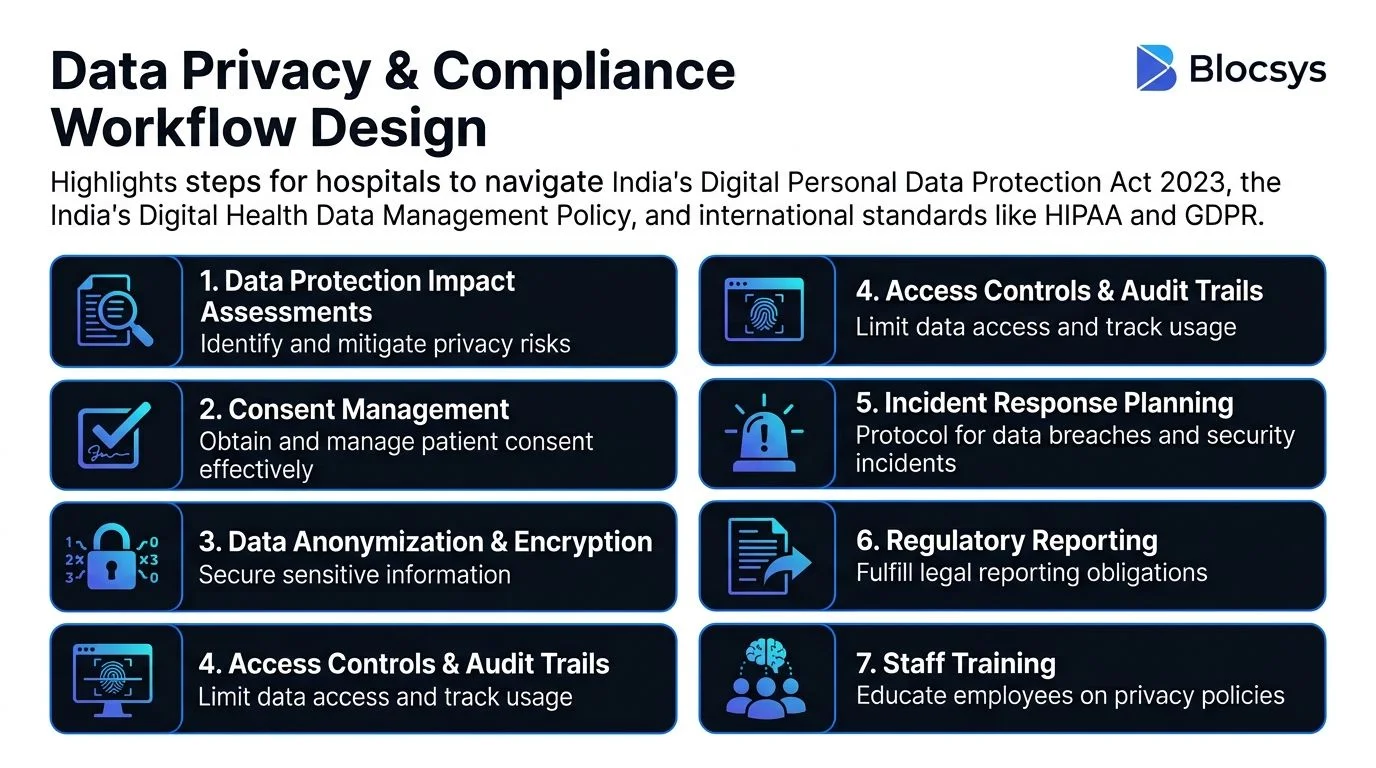
Teams working across Indian privacy requirements and cross-border data handling should review these GDPR, DPDP Act, and blockchain document verification compliance challenges before freezing workflow design.
A practical compliance workflow
A workable model shows up in screens, APIs, approval paths, and logs. These controls should be visible in both the product and the implementation plan:
- Classify data at intake. Separate identity, clinical, financial, and operational data from the first capture point. This avoids broad access defaults later.
- Record consent as an event. Store purpose, channel, timestamp, operator, and scope. A consent record should be queryable and revocable.
- Apply role and context-based access. A surgeon, billing executive, ward nurse, and external auditor need different views. In larger hospitals, department, shift, location, and treatment relationship also matter.
- Encrypt data in storage and transit. Include exports, backup sets, mobile app traffic, and system-to-system integrations. These gaps are common in rushed implementations.
- Maintain immutable audit evidence. Log view, create, edit, approve, reverse, print, and share actions. Audit quality matters most during disputes and breach reviews.
- Constrain third-party access. Labs, TPAs, insurers, payment gateways, and notification vendors should receive only the minimum data required for the transaction.
- Define retention and deletion rules. Hospitals need clear logic for active records, archived records, legal hold cases, and data that can be deleted or anonymised.
- Operationalise incident response. Assign owners, escalation paths, evidence capture steps, and reporting timelines before an incident occurs.
- Train by role. Front-desk staff, clinicians, finance teams, and administrators create different risks. Training should reflect that.
- Review controls in every release cycle. New modules, new APIs, and new reports often reopen old privacy gaps.
I have seen hospitals buy a technically sound HMS and still fail privacy reviews because exception handling was never designed. A user exports a spreadsheet to finish work faster. A consultant account stays active after a contract ends. A lab integration sends more fields than needed. Compliance breaks in these ordinary moments.
Where blockchain and AI fit, and where they do not
Blockchain adds value when multiple parties need shared proof, tamper evidence, or policy-driven state transitions. Consent receipts, referral document verification, insurer approval milestones, credential validation, and high-trust audit attestations are good candidates. Full medical records on-chain are usually a poor choice because privacy obligations, storage overhead, and correction workflows become harder to manage.
The practical pattern is selective tokenisation. Keep protected health information in the HMS or connected clinical repositories under standard access controls. Put hashes, document fingerprints, consent tokens, approval states, or smart-contract-triggered verification events on a permissioned blockchain where immutability improves trust without exposing clinical content.
AI also needs controls at the workflow level. If an AI model is used for triage support, coding assistance, fraud checks, or discharge summarisation, the system should log model version, input source, user review, and final action. In regulated hospital settings, an unlogged AI suggestion is a governance problem, not just a product feature gap.
The design goal is simple. Make every access, share, consent change, and cross-party verification event defensible during an audit, while keeping day-to-day operations fast enough for clinical teams to use correctly.
Vendor Evaluation Criteria
A hospital software vendor shouldn’t be shortlisted on price or presentation quality alone. The safer approach is to score vendors on their ability to build, integrate, govern, and support the system you’ll operate.
For teams comparing specialist healthcare vendors with broader enterprise engineering firms, it’s useful to look at a structured partner selection lens for complex blockchain strategy and delivery. The same discipline applies in hospital software procurement.
Vendor Criteria Comparison
| Criteria | What to Look for |
|---|---|
| Domain understanding | Can the vendor map OPD, IPD, billing, pharmacy, laboratory, and insurer workflows without hand-waving |
| Technical capability | Evidence of strong architecture choices, API design, cloud or hybrid delivery, and integration maturity |
| Compliance design | Clear approach to access control, consent, auditability, data handling, and release governance |
| Scalability and support | Named support model, escalation path, maintenance process, and product roadmap discipline |
| Total cost of ownership | Clarity on implementation scope, change handling, integrations, training, and long-term maintenance |
A few questions expose vendor quality quickly:
- Ask for workflow depth. Can they walk through admission to discharge, not just module screenshots?
- Ask for failure handling. What happens when lab interfaces fail, billing rules conflict, or user roles are misconfigured?
- Ask for governance. Who approves change requests, audits releases, and owns data migration validation?
- Ask for support realism. Hospitals need issue severity definitions and operational response, not vague assurances.
Selection filter: If the proposal treats implementation, integration, and training as minor add-ons, the vendor probably hasn’t lived through a difficult go-live.
Migration Checklist for Existing Systems
Migration projects fail when teams treat data transfer as a technical export instead of an operational cut-over. Hospitals need both. Every field, code, and status that crosses into the new HMS affects care continuity, billing integrity, and reporting confidence.
A practical migration sequence looks like this:
- Start with source mapping. Identify what sits in the legacy HMS, spreadsheets, billing tools, and standalone lab or pharmacy systems.
- Translate schemas carefully. Department names, code lists, doctor identifiers, and patient records rarely align cleanly without transformation rules.
- Test interfaces before volume loads. Validate imports, API exchanges, and downstream triggers in a controlled environment.
- Run parallel validation. Compare outputs for appointments, billing, pharmacy, and discharge summaries before cut-over.
- Train role-wise. Reception, nursing, consultants, billing, and administrators need scenario-based training, not generic sessions.
- Plan cut-over and rollback. Decide what happens if the migration weekend slips or a critical module behaves unexpectedly.
- Reconcile after go-live. Check missing encounters, duplicate records, orphan invoices, and incomplete audit trails.
Teams that need a grounded overview of how to navigate legacy data challenges should review migration patterns before finalising go-live dates. That work often reveals risks the vendor estimate missed.
Why Blocsys and Next Steps
A hospital CIO approves a new HMS after a polished demo. Six months later, the core modules work, but consent records are hard to verify across systems, insurer document flows still depend on email, and audit preparation turns into manual evidence gathering. That gap usually comes from choosing a vendor that can build screens and forms, but cannot design trust, traceability, and automation into the operating model.
Blocsys is relevant in this context because its profile extends beyond standard HMS engineering. The company was formally incorporated on October 18, 2021, in Pune, Maharashtra, India, with CIN U72900PN2021PTC205303, and its registered office is at Flat No-307, Bld-A, Lalit Nanded City, Sinhagad Road, Pune, Maharashtra 411041, according to Tofler’s company record. Its engineering profile includes smart contract development, decentralised system development, smart contract auditing, and dApp work, as described by Coinstori.
For Indian healthcare buyers, the practical question is not whether blockchain should sit inside every hospital workflow. It should not. The better question is where cryptographic proof, tokenization, or smart-contract logic solves a real operating problem. In practice, that can include consent provenance, inter-entity approvals, tamper-evident audit trails, controlled release of records, and rule-based settlement workflows. Core HMS functions such as registration, ADT, pharmacy, laboratory, billing, and clinician documentation still need conventional healthcare architecture, stable integrations, and disciplined product design.
AI adds another layer of value if it is used with restraint. Good teams apply it to summarisation, triage support, coding assistance, anomaly detection, document classification, and workflow routing. They also define where AI stops. Clinical judgment, statutory reporting, and high-risk automation paths need human review, versioned policies, and clear accountability.
That combination matters. A vendor with both healthcare product discipline and blockchain engineering depth can help hospitals build systems that meet current operational needs while preparing for future data-sharing and verification models.
The next step should be an assessment, not a generic feature discussion. Define the care, billing, and administrative workflows that drive revenue and patient risk. Identify where compliance evidence is created, where approvals break down, and where duplicate data entry still exists. Then decide whether the right answer is a standard HMS, a custom build, or a phased platform that starts with core operations and adds AI or blockchain controls only where they produce measurable value.
If you are planning custom hospital management software, healthcare ERP, EMR/EHR integration, AI-enabled healthcare workflows, telemedicine platforms, medical billing software, or a cloud-based hospital management system, connect with Blocsys Technologies for an assessment of architecture, compliance, migration, and implementation options.
Frequently Asked Questions
What is Hospital Management Software (HMS)?
Hospital Management Software is the operational system that coordinates administrative, clinical, and financial activity across a healthcare organisation. It connects front desk operations, care delivery, diagnostics, pharmacy, billing, and reporting into a single workflow model rather than scattered tools, acting as the system of record for day-to-day execution.
Why does hospital software selection fail even when a vendor demo looks good?
Most failures aren’t feature problems, they’re fit problems that show up after go-live, when reception starts maintaining side spreadsheets, billing disputes code mappings, or OPD documentation takes longer than before. This happens when a vendor can describe features but can’t map a hospital’s patient, billing, and audit flows end to end, keeping the project at “brochure level.”
What core modules should a hospital’s software cover?
Buyers typically evaluate patient administration (registration, UHID, appointments, admissions, discharge), clinical operations (OPD/IPD workflows, doctor notes, nursing records, order management), diagnostics and pharmacy (prescriptions, lab orders, inventory, dispensing), and finance and CRM (billing, packages, insurer coordination, receivables). The quality of implementation across these modules varies sharply between vendors.
What business constraints should guide the software selection process?
A useful selection process starts with clinical constraints like OPD speed and IPD coordination, financial constraints like billing rules and insurer workflows, technical constraints like legacy integrations and cloud readiness, and compliance constraints like privacy controls and audit logging. Hospitals that choose well ask harder questions early, such as how the system handles partial digitisation and whether the architecture can absorb telemedicine and AI later without a rebuild.
Why is data privacy and compliance important when choosing a hospital software vendor?
Some vendors talk about AI, analytics, and automation but say very little about how patient data will be handled under India’s privacy regime. Comparison pages often mention security without connecting it to actual hospital workflows, which is why compliance controls, consent handling, auditability, and user roles need to be evaluated directly rather than assumed.
How can hospitals estimate the implementation scope before committing to a vendor?
Rather than relying on a generic sales conversation, hospitals evaluating a partner like Blocsys can use a practical tool such as the software development cost estimator to gauge implementation scope early. This helps finance leads get a clearer budget picture before finalising vendor proposals.
