
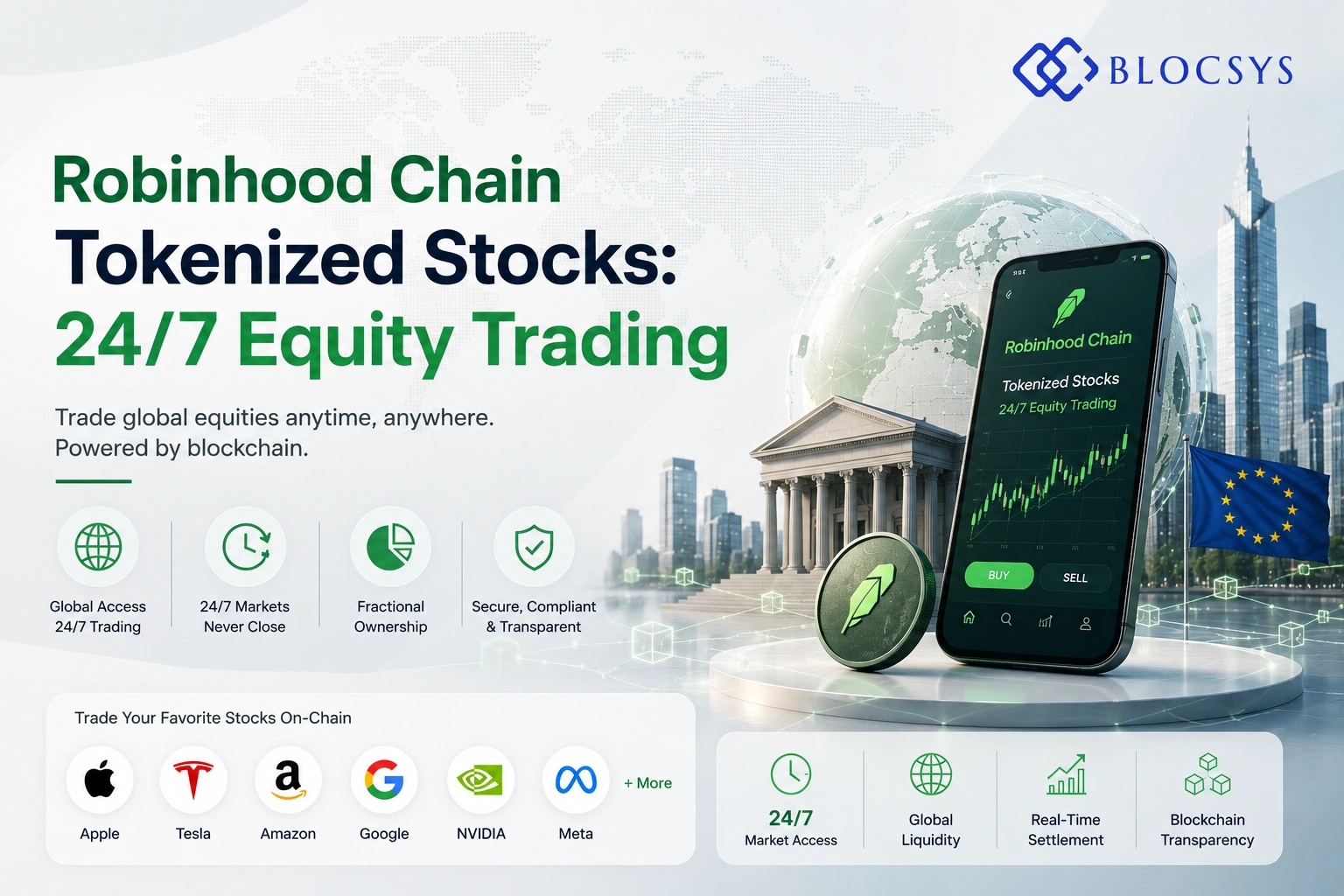
Robinhood Chain’s first week of observed stock-token transfers already showed that 144 of 313 transfers, or 46%, settled outside regular NYSE hours, including nights, pre-market periods, and weekends. That is the clearest early signal that 24/7 equity trading is no longer a conceptual argument, it’s a live market behaviour shaping how investors in Europe, and eventually other time zones, will access U.S. equities at scale. Robinhood Chain tokenized stock transfer data is worth watching because it captures the operating question institutions care about most, not whether tokenization sounds modern, but whether it changes when liquidity is available, how spreads behave, and who carries the execution risk.
For banks, brokerages, asset managers, fintechs, and infrastructure providers, the right frame is Robinhood Chain Tokenized Stocks as a market-structure shift, not a product gimmick. The system now sits at the intersection of blockchain capital markets, digital securities, regional compliance, and inventory management. If you’re evaluating tokenized stock platform development, tokenisation strategy in the UK, or SEC-compliant tokenization for U.S. markets, the question is how to build rails that can survive off-hours pricing, cross-border restrictions, and institutional controls.
Table of Contents
- The 24/7 Equity Trading Shift Is Already Measurable
- How Robinhood Chain Architecture Enables Tokenized Equities
- US and Europe Regulatory Divergence in Tokenized Stocks
- Trading Volume and Market Quality Reality Check
- Beyond Stocks, Tokenized ETFs, Treasury Bonds, and Capital Market Infrastructure
- Enterprise Decision Framework for Tokenized Equity Infrastructure
- Why Blocsys for Enterprise Blockchain and Tokenization Development
The 24/7 Equity Trading Shift Is Already Measurable
The measurable shift is not the headline promise of round-the-clock trading. It is the settlement pattern already showing up in tokenized stock activity. According to Robinhood Chain transfer analysis, 46% of all stock-token transfers settled outside regular NYSE hours in the first week of observed transfers. That includes nights, pre-market periods, and weekends, which suggests the product is already operating as an after-hours exposure layer for investors who cannot always trade during the U.S. session.
Why off-hours settlement changes the market map
European investors have long faced a structural timing disadvantage when they want U.S. equity exposure. Orders placed from Europe often have to wait for the next U.S. session, which weakens price responsiveness after major news events and compresses decision windows into local daytime hours. Tokenized stocks start to change that pattern by creating a continuous onchain wrapper around the economic value of the underlying share, even when the underlying exchange is closed.
That does not mean the underlying stock is trading on a true 24/7 basis yet. Robinhood’s EU support note says Classic Stock Tokens currently trade from Monday 02:00 CET/CEST until Saturday 02:00 CET/CEST, which is effectively 24/5 access, while true 24/7 trading is still a later-stage capability tied to Robinhood Chain’s routing stack. Robinhood EU stock token trading hours This distinction matters because institutions need to separate present operating hours from the target architecture, and from the execution work required to support it.
Practical rule: if your business case depends on weekend execution, treat it as a roadmap item, not a launch assumption.
What “continuous price discovery” really means
Continuous price discovery does not erase U.S. market structure. It means the token can absorb demand and repricing pressure when U.S. venues are shut, then carry that signal into the next regular session. For Europe-facing flows, that matters because the market is no longer forcing every reaction into the same narrow trading window.
The operational consequences are less visible than the trading-hours story. Wider access creates harder questions around spread control, inventory management, and regional compliance checks. Those frictions determine whether off-hours activity looks like a functional market extension or a thin wrapper with unstable quotes, and they are central to the Robinhood blockchain trends and tokenized asset analysis.
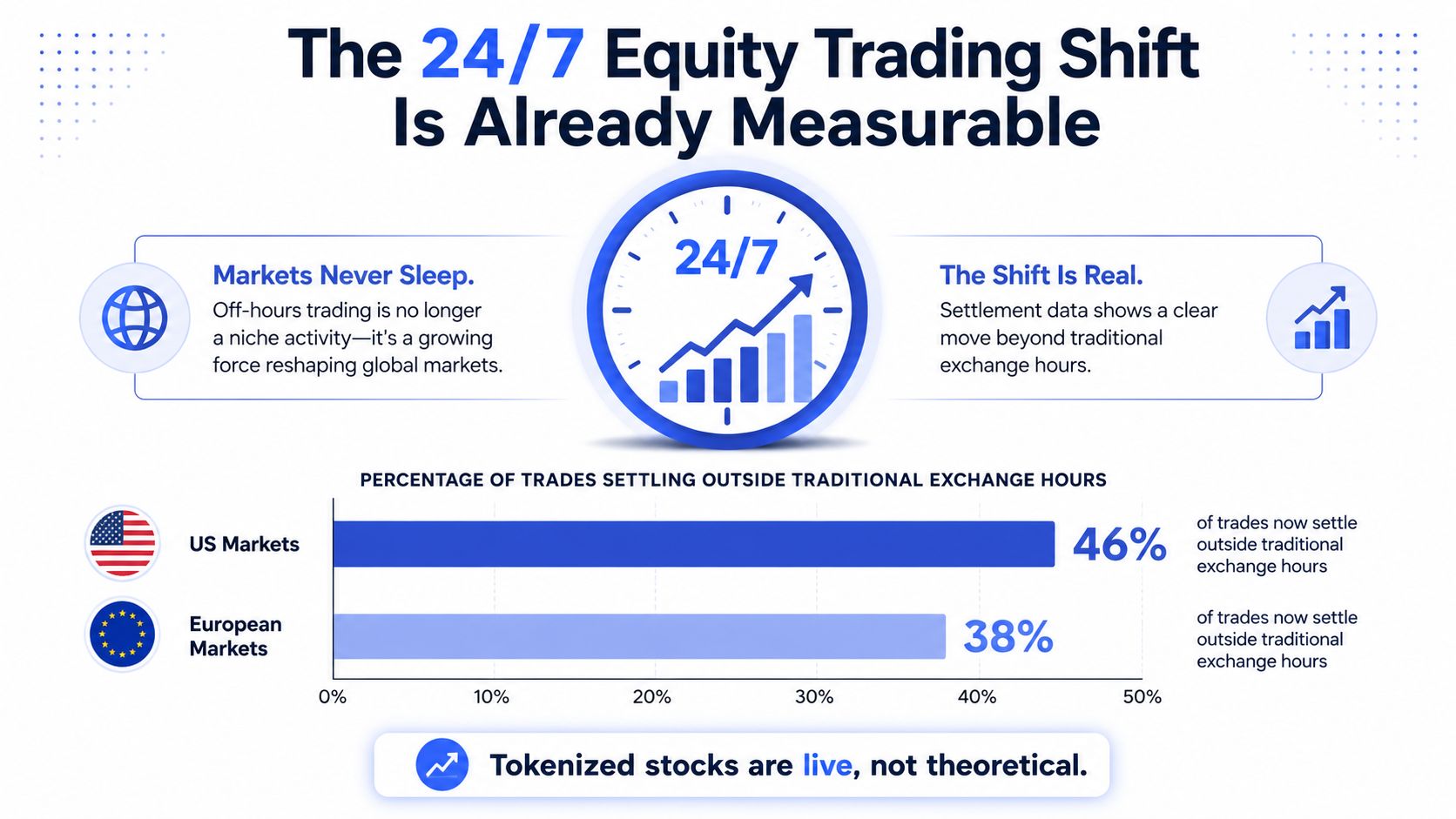
The first takeaway for institutional stakeholders is straightforward. Tokenized equities are already generating off-hours settlement behaviour, which makes them relevant to capital markets strategy now, not later. The second takeaway is more cautious. The market is still moving from 24/5 product access toward true 24/7 execution, and that gap is where operational risk, compliance policy, inventory management, and regional approval bottlenecks sit.
How Robinhood Chain Architecture Enables Tokenized Equities
Robinhood said its stock tokens were first issued on Arbitrum, while Robinhood Chain is being built as an Arbitrum Orbit Layer 2 for tokenized real-world assets, 24/7 trading, self-custody, compliance, and order routing. Robinhood newsroom on stock tokens and Robinhood Chain The architecture matters because it shapes how the product behaves when liquidity thins, settlement windows shift, and regulatory checks slow execution.
Why the launch starts on Arbitrum
Starting on an existing Ethereum Layer 2 gets Robinhood into market faster. It gives the product settlement rails immediately, without waiting for a proprietary chain to mature, which is a defensible trade-off for any institution testing demand before committing to a full migration. For teams evaluating architecture choices, the issue is similar to the framework in compare architecture design trade-offs, except the relevant variables here are market access, compliance orchestration, and execution risk, not just application latency.
The longer-term move to a dedicated chain is more strategic. A purpose-built Layer 2 can be tuned for tokenized securities lifecycle events, routing logic, and operational controls that a standard public-chain trading flow usually does not prioritise. The Robinhood Chain enterprise architecture lens is useful here, because it frames the build as infrastructure for issuance, transfer, and control, not as a generic blockchain deployment.
If you map that to enterprise delivery, the build pattern is close to Blockchain Development, which Blocsys describes as custom blockchain development services for enterprises, startups, and governments across public, private, and hybrid networks.
How the wrapper and the underlying share relate
The onchain token functions as a wrapper that tracks the economic performance of the underlying stock, while the underlying share still trades in the traditional market during regular U.S. hours. That separation is the core design choice, because it allows off-hours transfer and price discovery without implying that the U.S. exchange has altered its own operating calendar.
The execution challenge is not just moving a token. It is keeping the wrapper aligned with the reference price when the offchain market is closed.
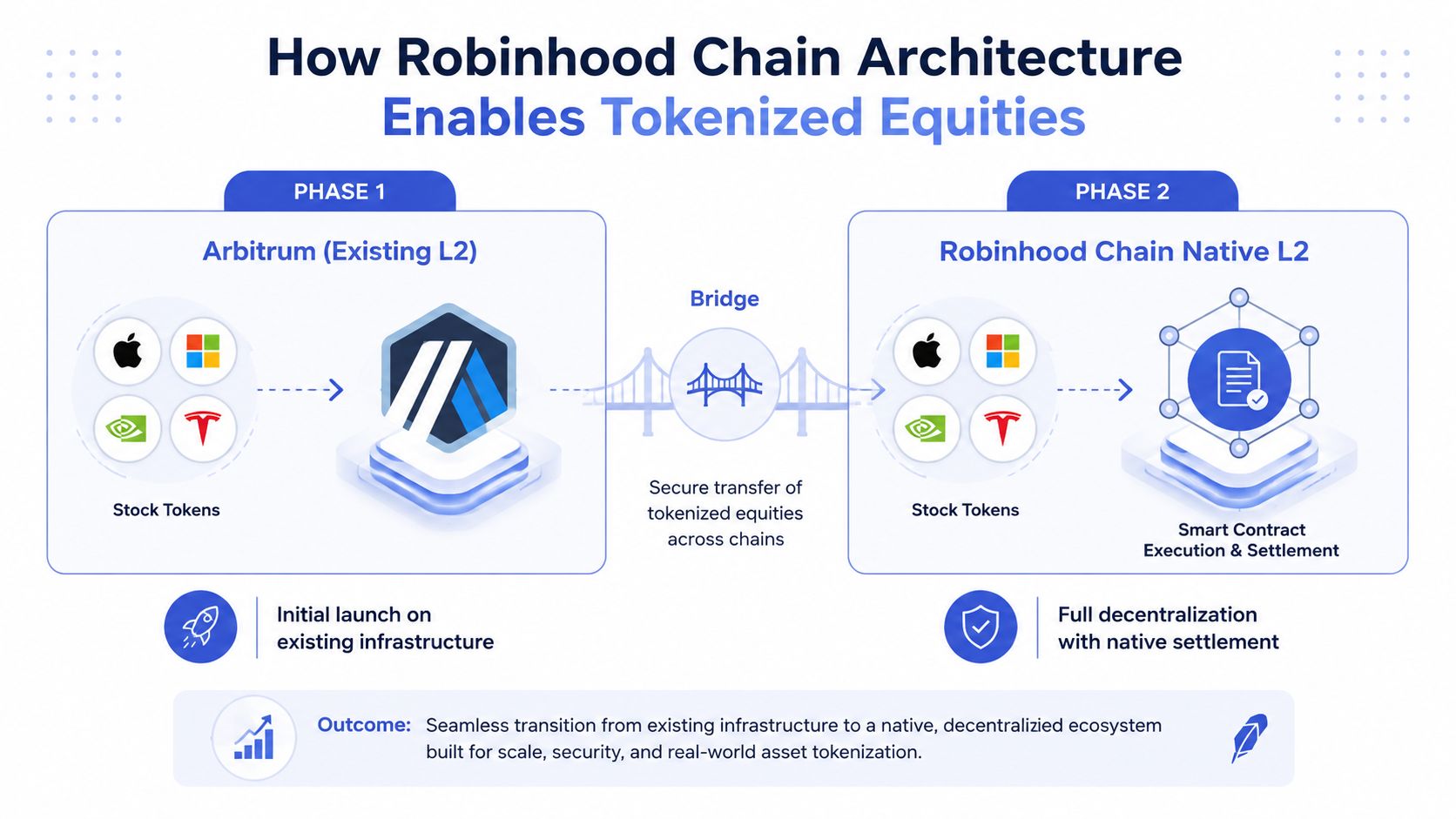
For enterprise teams, the technical lesson is clear. The infrastructure has value because it creates a controllable bridge between Ethereum Layer 2 for financial applications, compliance-aware routing, and market-making logic that can survive after-hours trading pressure. Robinhood’s plan to migrate settlement to a chain designed for tokenized real-world assets is a strong signal that architecture has become a revenue and risk question, not just an engineering choice.
US and Europe Regulatory Divergence in Tokenized Stocks
Robinhood launched stock tokens for verified users in the EU and EEA and blocked U.S. users at launch. That geographic split is a regulatory signal, not a marketing footnote. Tokenized stocks are reaching live markets first where distribution is more permissive, while U.S. access remains constrained by securities-law classification risk and product structure concerns. Robinhood Chain launch coverage
What the product is, legally speaking
TechTimes reports that a Robinhood Stock Token is a tokenized debt security, not equity ownership, and it does not confer voting rights, shareholder rights, or a direct legal claim on the underlying shares. TechTimes on ownership caveats The legal distinction matters more than the branding. Institutions need to know whether a token behaves like a security, a claim on a security, or a synthetic exposure wrapper. They also need to understand how settlement, custody, and transfer rules change when the product is offered across borders.
Europe is the initial live market because the commercial and regulatory posture is more open to experimentation with digital securities, while the U.S. remains more cautious about how tokenized exposure maps to securities law. The UK sits in a separate but related position, where tokenisation discussions are shaped by FCA Digital Assets expectations and broader digital securities policy. For teams studying how Robinhood Chain works for financial institutions, jurisdictional design is the starting point, not a later compliance layer.
Tokenized Equity Regulatory Comparison
| Regulatory Aspect | United States | European Union | United Kingdom |
|---|---|---|---|
| Product access | U.S. users are blocked at Robinhood launch | Verified users in the EU and EEA had launch access | Tokenisation discussion is shaped by FCA Digital Assets context |
| Legal framing | Securities treatment remains sensitive and classification-heavy | More room for digital securities experimentation | Tokenisation language is increasingly used in policy and market discussions |
| Ownership rights | Depends on structure, but Robinhood’s token does not convey equity ownership rights | Same product design caveat applies | Same product design caveat applies if tokenised exposure is used |
| Market positioning | Not the initial live market for Robinhood Stock Tokens | Initial live market for the product | Important regional market for tokenisation and digital securities planning |
| Geographic restrictions | U.S. persons excluded | Product available to eligible users | UK users may face jurisdiction-specific restrictions depending on the offering |
Robinhood also restricts access in Canada, Switzerland, the UAE, and sanctioned regions, which shows the product is being positioned as a tightly gated international exposure layer rather than a universal stock replacement. The Block on geographic restrictions
Why Europe matters more than the marketing suggests
Europe matters because it gives tokenized stocks a live operating market where product design, compliance controls, and user demand can be tested together. That setup is useful, but it also exposes execution risk quickly. Spread control has to hold when trading shifts across time zones, inventory management becomes harder when liquidity is fragmented, and regional compliance checks can slow or block distribution even when the token itself can move on-chain.
For banks and brokerages, the question is not whether tokenized stocks are allowed in the abstract. It is whether their own distribution, custody, and tax-reporting models can support cross-border tokenisation without creating a regulatory mismatch or a false promise of ownership.
Trading Volume and Market Quality Reality Check
Raw activity looks strong until you separate headline volume from tradable depth. Within roughly two weeks of launch, Robinhood Chain’s real-world-asset segment reached about $70 million in active market value, up from the low tens of millions, and tokenized equities began clearing more than $500,000 per day for a dozen listed stocks. The same dataset showed GameStop at $26.6 million, Nvidia at $14 million, and SpaceX at $6.4 million in daily trading volume. Coindesk’s trading volume report
Concentration tells you more than headline volume
The concentration of flow in a few names suggests early demand is still skewed toward recognisable, high-beta instruments. That pattern is familiar. New venues usually attract speculative attention before they attract diversified institutional flow, and tokenized equities on Robinhood Chain fit that profile.
Bitquery’s dataset adds a second corrective lens. It reported 63.5 million trades worth $12.2 billion over 13 complete July days, with tokenized equities accounting for 6.5% of trading, while the rest was overwhelmingly memecoins. Bitquery investigation That means broader chain activity does not automatically translate into mature equity-market demand.
A separate read on the market came from US market tokenization trends, which helps frame the issue as infrastructure readiness rather than trading excitement.
Execution benchmark: do not confuse bot activity with market quality. Sustainable tokenized stock rails need orderly spreads, real turnover, and disciplined inventory management.
Why spreads and inventory risk matter more than volume
The stock-token stack is designed to decouple price discovery from U.S. market hours, but the underlying equities still trade only during regular sessions. When the reference market is closed, the wrapper can drift away from the last oracle close, and spreads widen. Market analysts cited a practical benchmark of keeping spread below 50 bps most of the time, yet the execution burden shifts to the broker or affiliated market maker when the reference market is shut. Stalkchain analytics on spread control
That is the risk for institutional participation. If the market maker must hold inventory through the night, weekend, or holiday gap, tokenization stops being only a settlement upgrade. It becomes a balance-sheet and risk-transfer problem.
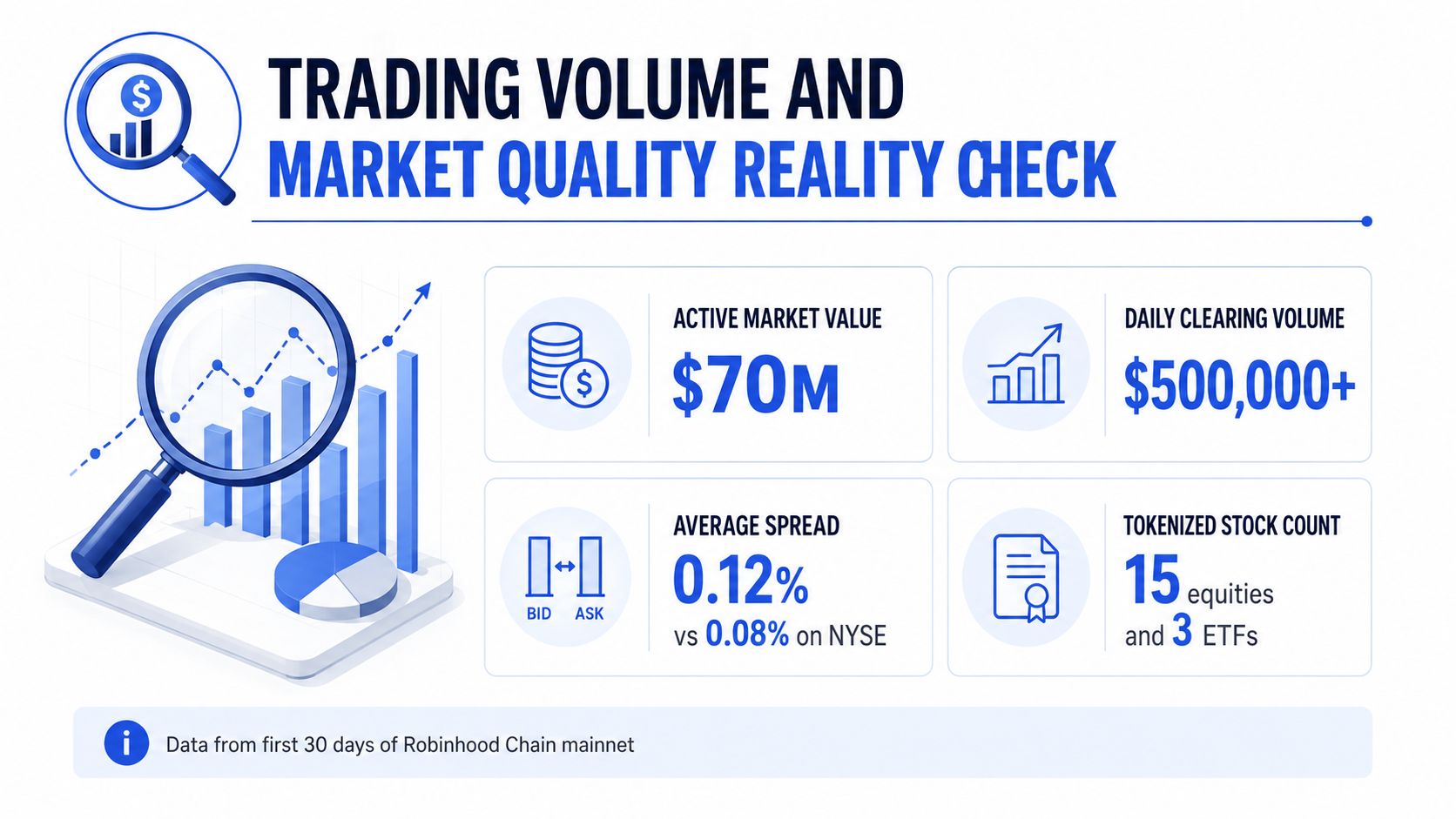
The same dataset also showed that even high-frequency bots struggled to turn a profit on equities, with only 33.3% profitable in the sample. Bitquery investigation That does not prove the product is weak, but it does show that raw transaction count is a poor proxy for healthy price formation. Institutions should assess spread control, inventory risk, and real turnover before they assess total volume.
Beyond Stocks, Tokenized ETFs, Treasury Bonds, and Capital Market Infrastructure
Tokenized stocks are only one entry point. The same rails can be extended to tokenized ETFs, tokenized Treasury bonds, tokenized money market funds, and eventually broader tokenized investment funds. For institutional buyers, that matters because adoption usually starts with products that already fit portfolio construction, collateral management, and treasury workflows.
Why interoperability becomes the core requirement
A token that trades off-hours, settles against a reference asset, and may serve as collateral cannot sit inside a closed stack. It needs blockchain interoperability solutions that connect wallets, custody systems, oracles, and lending venues without splitting the asset into incompatible versions. As noted earlier, Robinhood Stock Tokens can be used as collateral in DeFi lending protocols, which is a materially different function from brokerage-held shares. TechTimes on collateral utility
That collateral function changes the control surface. A token that can move around the clock and be rehypothecated into lending markets creates a wider on-chain financial ecosystem, but only if the platform can enforce transfer restrictions, identity checks, and compliance controls at the same time. Without those controls, the product may look liquid on the front end while creating back-end exceptions that are expensive to reconcile.
What broader capital markets need from the stack
For capital-markets teams, the question is whether the same digital securities platform can support products that institutions already underwrite, value, and report on with familiar rules. Fixed income instruments, cash-equivalent funds, and ETF wrappers all require clean lifecycle processing, predictable settlement semantics, and clear treatment of corporate actions and redemptions.
The operational test is whether tokenization can move beyond a single product wrapper and still preserve policy controls, reporting, and custody integrity. That is where DAML capital market infrastructure guide becomes relevant, because enterprise teams need a way to model issuance, transfer permissions, and downstream integration without breaking existing governance.
A practical development path usually starts with a narrow market use case, then expands into adjacent products once the compliance and custody stack has been proven. Blocsys has a relevant first-party offering in Tokenization Platform Development, which it describes as secure and compliant tokenization platforms for RWAs, securities, real estate, commodities, and digital assets using enterprise blockchain technology. For capital-markets leaders, that kind of build scope is what turns tokenized equities into part of a larger issuance and distribution strategy rather than a one-off experiment.
The hard constraint is that the rail only becomes institutionally useful when it can support more than speculative equity wrappers. If it cannot handle funds, bonds, and collateral logic, then it remains a narrow market structure. For teams assessing implementation tradeoffs, the question is also whether the architecture can empower business analysts to model controls and exceptions without relying on engineering for every policy change.
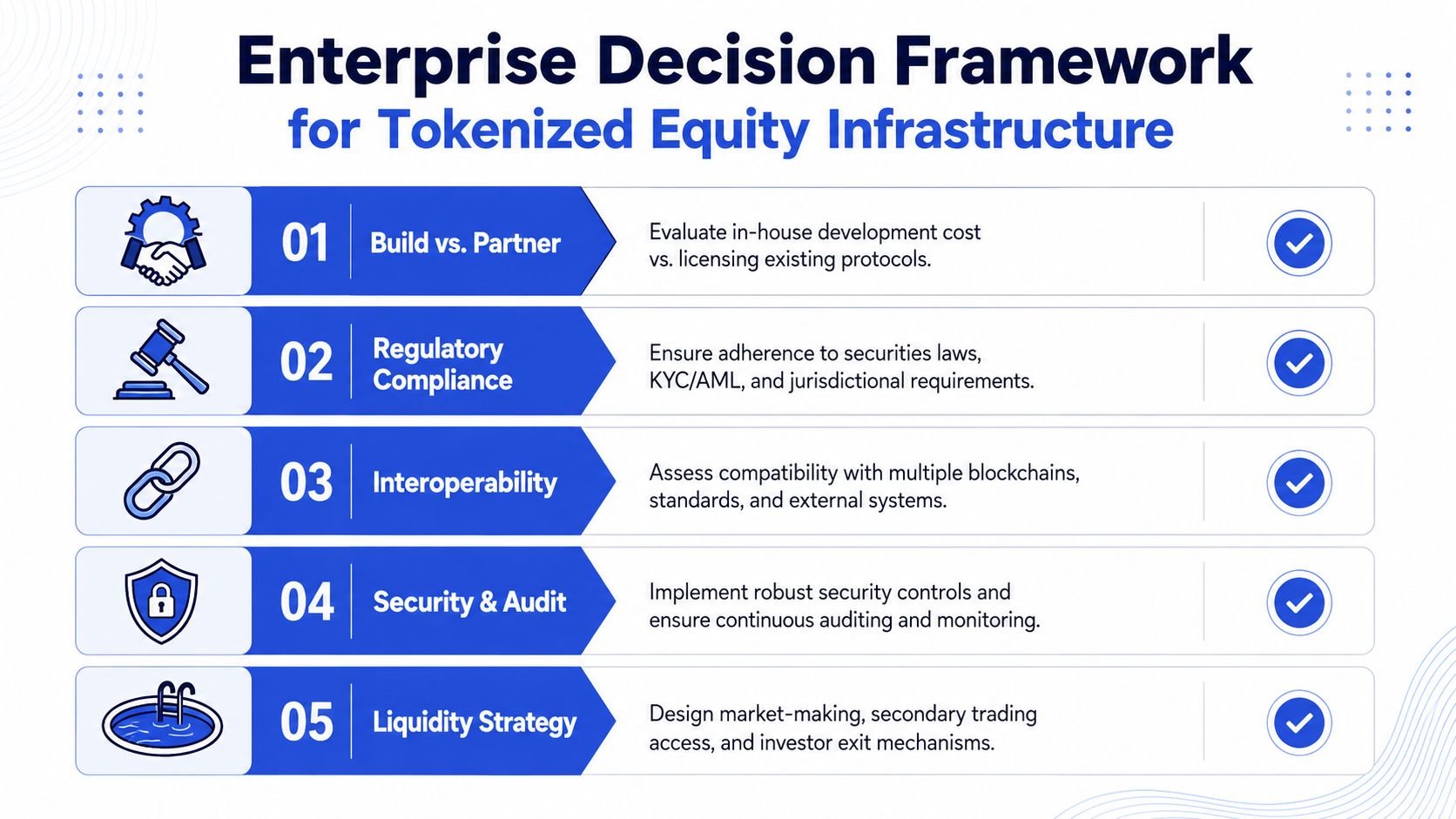
Enterprise Decision Framework for Tokenized Equity Infrastructure
In tokenized equities, execution quality can deteriorate long before a product reaches scale. Banks, brokerages, and asset managers should start with the operating model, because 24/7 trading only holds up when compliance, custody, market-making, and integration are aligned.
The questions that matter first
Can the product be distributed legally in each target region?
This determines whether the project is a viable commercial path or a jurisdictional dead end.Who provides inventory when the underlying market is closed?
If that answer is unclear, spreads widen and execution quality falls.How does the token connect to the existing OMS, risk, and reporting stack?
If it needs a parallel operating model, adoption becomes slower and more expensive.What custody and transfer restrictions are needed for the asset class?
Tokenized equities operate within securities-policy constraints, with different transfer and control requirements from standard wallet assets.Can the business absorb operational drift between onchain pricing and offchain reference markets?
If it cannot, the product may look fine during active hours and weaken when the market closes.
Teams that treat tokenization as a frontend project usually miss the core cost centre, market-making, controls, and regulatory reporting.
Build or partner
Institutional teams rarely build every layer internally. Tokenized equity infrastructure sits at the intersection of blockchain engineering, securities operations, custody design, market structure, and regional compliance, and each layer adds its own execution risk. The main constraint is not code volume, it is coordinating policy, liquidity, and reporting across markets that do not share the same rules.
A useful reference point is a reference point from Vision for CTOs, especially for teams that need to translate market data into product decisions and risk controls. The same logic applies to tokenized equities, where product managers need to understand distribution and compliance before they commit to a build roadmap.
For Europe-facing or cross-border projects, a 12 to 24 month planning horizon is realistic for serious preparation. That does not mean full public rollout takes that long everywhere. It means institutions need that window to align legal review, market-maker setup, custody architecture, and integration work before they can credibly offer tokenized stock access at scale.
Why Blocsys for Enterprise Blockchain and Tokenization Development
Blocsys fits this market because its work sits at the same intersection tokenized equities require, enterprise blockchain development, tokenization platform development, digital asset workflows, and institutional integration. It also helps teams that need adjacent capabilities such as crypto trading platforms, OTC trading systems, and real-world asset tokenization, which often share the same settlement, custody, and routing challenges.
For institutions evaluating tokenized stock platform development, the practical value is not a slogan. It’s the ability to map a regulated product into a production architecture, from smart contract logic to reporting flows and cross-border operating rules. That’s where digital securities platform development stops being a concept and becomes an implementation plan.
Blocsys Technologies helps fintechs, exchanges, and digital asset businesses build production-ready blockchain and AI-powered platforms. For banks, brokerages, asset managers, and fintech firms testing blockchain capital markets use cases, that means a partner that can support tokenization strategy, smart contract development, and blockchain infrastructure design without forcing the project into a generic Web3 template.
Frequently Asked Questions
What are Robinhood Chain tokenized stocks?
Robinhood Chain tokenized stocks are blockchain-based representations of stock exposure that allow eligible users to access and transfer certain U.S. equities outside traditional market hours. The token operates as a digital wrapper around the economic value of an underlying stock rather than automatically providing direct shareholder ownership or voting rights.
How do tokenized stocks enable 24/7 equity trading?
Tokenized stocks enable extended-hours equity access by moving the trading and transfer layer onto blockchain infrastructure that can operate beyond traditional exchange hours. However, extended access does not necessarily mean the underlying stock itself trades 24/7; the tokenized market can continue operating while the reference equity market remains closed, creating additional requirements for pricing, liquidity, inventory management, and risk controls.
Are Robinhood tokenized stocks available in the United States?
Robinhood’s initial tokenized stock offering was made available to eligible users in the European Union and European Economic Area rather than U.S. users. The geographic restriction reflects differences in securities regulation, product classification, distribution requirements, and compliance considerations between the U.S. and European markets.
Do tokenized stocks represent actual ownership of company shares?
Tokenized stocks do not necessarily provide direct legal ownership of the underlying company shares. The specific rights depend on the product structure, and Robinhood’s stock tokens are described as tokenized exposure rather than conventional equity ownership, meaning holders may not receive shareholder rights such as voting rights or a direct claim on the underlying shares.
How does Robinhood Chain use blockchain for tokenized equities?
Robinhood Chain uses blockchain infrastructure to support the issuance, transfer, settlement, and trading of tokenized real-world assets. Robinhood initially launched its stock tokens on Arbitrum and is developing Robinhood Chain as an Arbitrum Orbit Layer 2 designed for tokenized assets, 24/7 trading, self-custody, compliance, and order routing.
What is the difference between tokenized stocks and traditional stocks?
Traditional stocks represent legally recognised ownership interests recorded through established securities infrastructure, while tokenized stocks represent stock exposure through blockchain-based digital assets. Tokenized stocks can provide blockchain-based transferability and extended trading access, but their ownership rights, custody arrangements, settlement mechanisms, and regulatory treatment depend on how the specific product is structured.
What are the regulatory challenges of tokenized stocks in the US and Europe?
The main regulatory challenges include determining the legal classification of the token, establishing investor eligibility, complying with securities and financial-promotion requirements, managing cross-border distribution, applying transfer restrictions, and maintaining appropriate custody and reporting controls. The regulatory approach differs between the United States, European Union, and United Kingdom, so tokenized equity platforms require jurisdiction-specific compliance architecture.
Why are tokenized stocks important for European investors?
Tokenized stocks can give European investors greater access to U.S. equity exposure outside conventional U.S. trading hours. This can reduce the timing gap between European investors and U.S. markets, particularly when major market-moving events occur after the U.S. session closes, although liquidity, spreads, pricing, and regional eligibility still determine the quality of that access.
What are the main risks of 24/7 tokenized stock trading?
The main risks of 24/7 tokenized stock trading include limited off-hours liquidity, wider spreads, inventory risk, price divergence from the underlying stock, oracle or pricing issues, smart contract vulnerabilities, custody risks, and cross-border compliance restrictions. When the traditional stock market is closed, market makers may carry greater inventory and pricing risk because there is no continuously available reference-market liquidity.
Can tokenized stocks be used as collateral in DeFi?
Tokenized stocks can potentially be used as collateral in decentralised finance applications when the token’s design, transfer permissions, custody model, and underlying legal structure support that use. This expands the utility of tokenized equities beyond trading, but it also introduces additional requirements for identity controls, compliance, liquidation mechanisms, asset restrictions, and interoperability between traditional securities infrastructure and DeFi protocols.
How much does it cost to build a tokenized stock trading platform?
The cost of building a tokenized stock trading platform depends on factors such as blockchain architecture, tokenisation and smart contract functionality, custody, investor onboarding, KYC/AML controls, market-making infrastructure, pricing oracles, trading and order-routing systems, regulatory requirements, wallet functionality, interoperability, reporting, and security testing. A controlled tokenized equity pilot generally costs less than an institutional platform designed for multi-jurisdiction trading, custody, compliance, and 24/7 settlement.
If you’re evaluating Robinhood Chain, tokenized stocks, or a broader digital securities roadmap, Blocsys Technologies can help you turn the market structure into a production plan. Visit Blocsys Technologies to discuss tokenization platform development, enterprise blockchain architecture, and the next step for your 24/7 equity trading strategy.
