
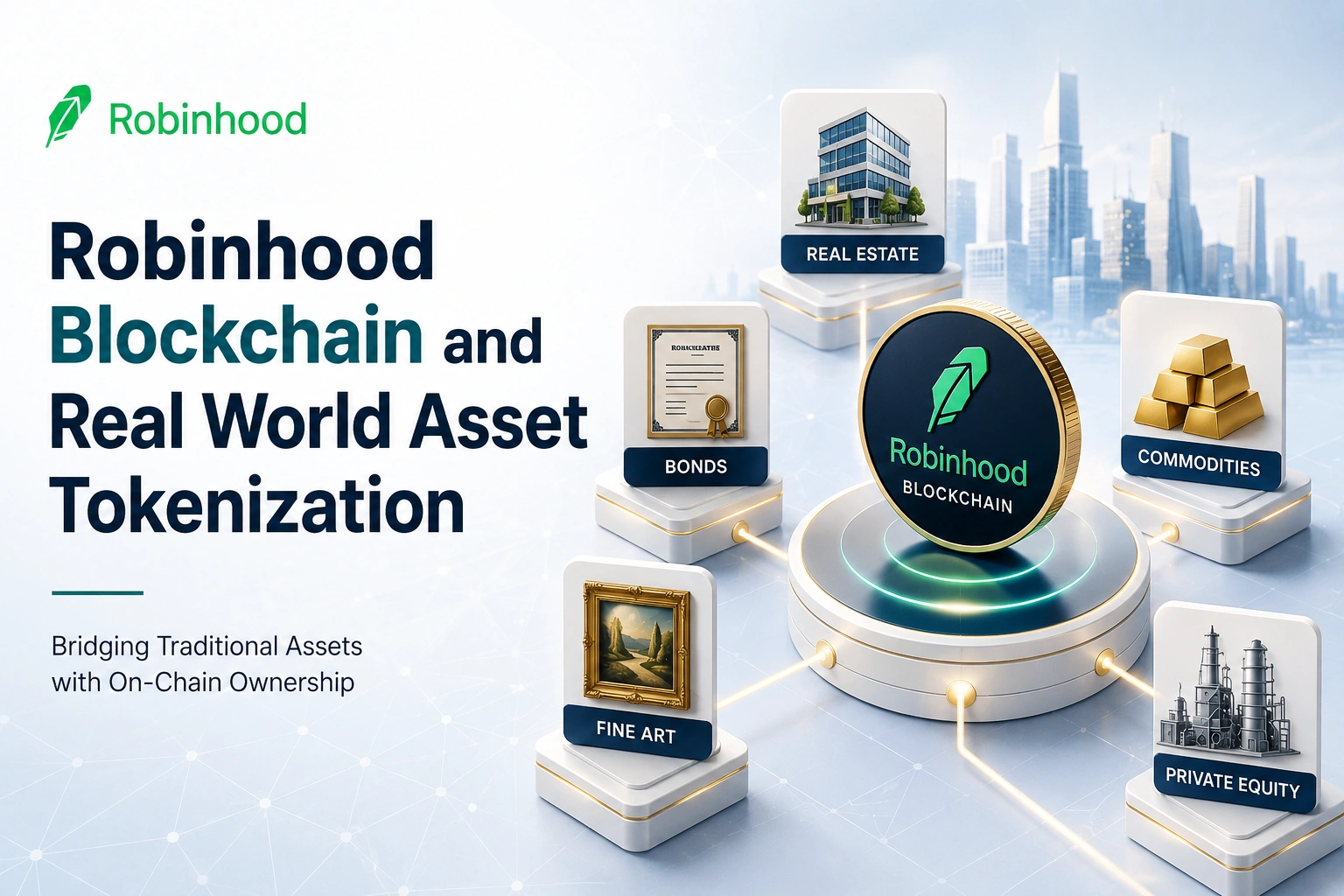
Robinhood Blockchain and Real World Asset Tokenization: How the US Market Is Moving In
Robinhood RWA tokenization has moved from pilot to measurable market reality. In late July 2026, Robinhood Chain’s real-world asset footprint reached roughly $70 million, five times its early post-launch figure. Twelve tokenized stocks cleared more than $500,000 per day, and five crossed $1 million daily, according to CoinDesk’s reporting on DefiLlama data. For banks, fintechs, exchanges, and treasury teams, the question is no longer whether real world asset tokenization crypto markets exist. The sharper question is how Robinhood blockchain infrastructure changes the rules for access, custody, settlement, and compliance across the US market.
Table of Contents
- Why Robinhood Chain Matters for US Markets Right Now
- What Is Robinhood Chain and How It Differs from Other L2s
- Robinhood Chain RWA Projects: What Is Live Now
- Robinhood RWA Tokenization: How the US Regulatory Landscape Is Shifting
- Step-by-Step: How Users Access Tokenized Assets via Robinhood
- Robinhood vs Other RWA Platforms: Coinbase, Ondo, and Backed Finance
- Tokenized Stocks and Smart Contracts in Practice
- Enterprise Adoption and the DeFi Infrastructure Layer
- The 12 to 24 Month Outlook for Tokenized US Markets
- How Blocsys Helps Enterprises Build on This Infrastructure
- Frequently Asked Questions
Why Robinhood Chain Matters for US Markets Right Now
Robinhood Chain launched its public mainnet on July 1, 2026. It generated $3.1 billion in DEX trading volume in its first week, ranking it among the top five chains by DEX activity, according to Bernstein as reported by TheStreet. That is not a soft launch metric. It is market-structure confirmation.
Moreover, the broader RWA market provides essential context. Tokenized RWAs surpassed $51 billion in the same cycle. Tokenized equities reached roughly $1.9 billion, growing toward a $5.5 billion market cap by June 2026, per The Block data via CoinMarketCap. Additionally, Robinhood’s crypto revenue rose 98% year-on-year to $160 million in Q2 2026, confirming that tokenization is a material business line, not a side project.
Who Should Care
Banks, brokerages, fintechs, exchanges, and treasury desks should treat these numbers as an early market-structure signal. Robinhood positions tokenization as financial infrastructure, not niche crypto. Therefore, how custody, liquidity, and compliance stacks get designed over the next 24 months will follow from decisions being made right now.
Market insight: If a tokenized asset clears at scale and maps back to regulated finance, it stops being a demo and starts becoming a distribution channel.
What Is Robinhood Chain and How It Differs from Other L2s
Robinhood Chain is an Ethereum-compatible Layer 2 built on the Arbitrum Orbit stack. However, calling it just another L2 misses the point. Most Layer 2 networks optimize for general-purpose throughput. Robinhood Chain optimizes specifically for tokenized real-world assets and 24/7 brokerage-grade trading.
Furthermore, it combines four elements that generic L2s typically lack together: a native retail wallet distribution channel via Robinhood Wallet, a dedicated cross-chain bridge, a compliance-aware architecture for regulated asset flows, and direct integration with Robinhood’s existing brokerage user base across more than 120 countries.
The practical difference matters for institutions. A general L2 requires additional layers for compliance and brokerage-grade identity checks. Robinhood Chain builds those requirements into the product design from the start. Therefore, competitors can copy throughput numbers, but they cannot easily replicate the integrated distribution and compliance model.
For a deeper look at the rollup design trade-offs that underpin this architecture, see this explainer on zkEVM versus optimistic rollups. Understanding those choices is essential for institutions evaluating which chain fits their tokenization strategy.
Robinhood Chain RWA Projects: What Is Live Now
Robinhood chain RWA projects span tokenized equities, ETFs, and on-chain financial primitives built for composability. Here is what is live or publicly announced as of mid-2026.
Tokenized US Stocks and ETFs
Robinhood launched tokenized US stocks and ETFs first in the EU on Arbitrum, then migrated settlement to Robinhood Chain. One Dune-based snapshot reported 493 tokenized assets with total value above $8.5 million on the EU deployment. However, post-mainnet figures show faster growth, with 12 stock tokens each clearing more than $500,000 per day.
These tokens provide economic exposure to the underlying share price. They confer no legal or beneficial ownership rights in the underlying shares. That distinction is critical for compliance and will determine how regulators classify them under US securities law.
DeFi Composability Layer
Additionally, Robinhood Chain reached roughly $450 million in total value locked and processed more than 95 million transactions within approximately three weeks of mainnet launch. This TVL reflects liquidity pools and DeFi integrations built directly on top of tokenized stock positions. Tokens can sit in lending protocols, pair into liquidity pools, or serve as collateral where regulations permit.
Real World Asset Exchange Proposal
Furthermore, Robinhood submitted a 42-page proposal to the SEC in May 2026 for a Real World Asset Exchange. This venue would use off-chain matching and on-chain settlement, targeting a reduction from T+2 to T+0 settlement and approximately 30% lower trading costs. If adopted, this would represent one of the most consequential robinhood chain RWA projects in terms of reshaping US market structure.
Robinhood RWA Tokenization: How the US Regulatory Landscape Is Shifting
Robinhood RWA tokenization faces a defining regulatory challenge in the United States. The company’s own SEC proposal states that the vast majority of tokenized RWAs qualify as securities under current US law. Therefore, the primary legal path today runs through Regulation D, which limits offerings to accredited investors.
Why Regulation Is the Real Bottleneck
Technical readiness is necessary, but it is not sufficient. A chain can process millions of transactions. However, if the legal wrapper is unclear, banks and exchanges cannot safely scale tokenized assets across the US market. The core obstacles are legal classification, custody rules, settlement finality, and whether tokenized shares carry the same legal standing as conventional securities.
Policy reality: The pace of adoption in tokenized US asset markets will be determined by rulemaking speed as much as by engineering quality.
However, the regulatory environment is shifting. The SEC actively engages with tokenization frameworks. Robinhood’s Real World Asset Exchange proposal directly challenges how US market structure has traditionally evolved, moving from the question of whether tokenized assets can exist to what rules should govern issuance, transfer, and finality.
For full context on compliance challenges, see this roadmap on blockchain startup regulatory compliance. Additionally, understanding token-layer standards matters deeply here. This explanation of ERC-3643 for RWA tokenization shows how transfer restrictions and identity checks embed directly at the token layer, rather than functioning as aftermarket controls.
Step-by-Step: How Users Access Tokenized Assets via Robinhood
Accessing tokenized assets through Robinhood blockchain infrastructure follows a clear sequence. Understanding each step helps institutions model what a retail-facing tokenization flow looks like in practice.
- Download and set up Robinhood Wallet. The wallet serves as the primary interface for on-chain tokenized assets. It supports cross-chain movement via a built-in bridge and works across more than 120 countries.
- Complete identity verification. Robinhood applies jurisdiction-specific eligibility checks at the wallet layer. Access to specific tokenized stocks and ETFs varies by country and regulatory status.
- Browse and select a tokenized asset. Users access tokenized US stocks and ETFs directly through the wallet interface. These tokens trade 24/7, unlike traditional market-hours constraints.
- Execute the trade on Robinhood Chain. Robinhood Chain’s L2 handles execution off Ethereum mainnet. Settlement then anchors back to Ethereum, creating an immutable on-chain settlement trail.
- Hold, transfer, or deploy in DeFi. Once held, tokens can move cross-chain via bridge, sit in lending protocols, or pair into liquidity pools where regulations permit.
Furthermore, the step from holding to deploying in DeFi is where RWA crypto investing becomes meaningfully different from traditional brokerage. Tokenized assets become programmable financial primitives rather than static positions locked inside a single account.
Robinhood vs Other RWA Platforms: Coinbase, Ondo, and Backed Finance
Robinhood is not the only player in real world asset tokenization crypto markets. However, its approach differs meaningfully from competitors. Therefore, institutions evaluating RWA crypto investing options should understand where each platform’s strengths begin and end.
| Platform | Primary Focus | Target User | Regulatory Approach | Key Differentiator |
|---|---|---|---|---|
| Robinhood Chain | Tokenized stocks, ETFs, RWA exchange | Retail and institutional | Active SEC proposal for federal RWA framework | Brokerage distribution combined with L2 settlement |
| Coinbase (Base) | General L2 with RWA integrations | Developers and institutional | Regulatory engagement via cbBTC and USDC | Developer ecosystem breadth and institutional tools |
| Ondo Finance | Tokenized US Treasuries and money markets | Institutional and DeFi protocols | Regulation D accredited-investor framework | Yield-bearing RWA products such as OUSG |
| Backed Finance | Tokenized ETFs and bonds for EU and non-US markets | Non-US institutional buyers | EU regulatory compliance focus | Full legal ownership embedded in tokenized wrapper |
The Key Distinction
Robinhood’s primary advantage is its existing retail distribution at scale. Coinbase Base offers broader developer reach but lacks native brokerage integration. Ondo Finance focuses specifically on yield-bearing institutional products, particularly tokenized Treasuries. Backed Finance targets EU and non-US markets where regulatory clarity is stronger and legal ownership can be embedded in the token itself.
Therefore, for US-focused institutions, Robinhood blockchain’s combination of retail reach, purpose-built L2 infrastructure, and active SEC engagement positions it differently from any single DeFi-native competitor. However, Ondo and Backed Finance fill meaningful gaps in yield products and non-US markets that Robinhood does not yet address directly.
Tokenized Stocks and Smart Contracts in Practice
Smart contracts for tokenized stocks automate transfer rules, collateral logic, and compliance checks. They also define where an asset can move, who can hold it, and what happens when it enters another protocol. That programmability is what separates tokenized equities from conventional brokerage positions.
Moreover, once a token sits on-chain, it can enter lending protocols, pair into liquidity pools, or route through automated trading systems that run continuously rather than waiting for market open. This is the shift from static brokerage exposure to an active financial primitive. For asset managers and fintechs, the design question therefore becomes: what can this asset actually do once it is composable?
Additionally, the token-layer approach to compliance deserves close attention from institutions. ERC-3643 embeds transfer restrictions and identity checks directly at the token layer, rather than treating compliance as an aftermarket addition. Robinhood’s architecture follows a similar philosophy, and institutions building their own tokenized products should understand this standard before designing issuance logic.
Why Regulation Remains the Critical Bottleneck
Programmable market access can move faster than the legal wrapper around it. Robinhood can redesign settlement logic and wallet flows. However, it still must keep each token’s legal status aligned with securities law, custody expectations, and jurisdiction limits. That gap is where most tokenized equity projects slow down and where institutional decision-makers should focus their due diligence.
Enterprise Adoption and the DeFi Infrastructure Layer
The institutional case for tokenized assets is not about replacing markets overnight. It is about building a stack that handles continuous trading, regulated settlement, and programmable distribution without forcing a full rewrite of custody and compliance systems.
What an Enterprise Stack Actually Needs
A financial institution launching tokenized assets needs four components working together:
- Scalable tokenization infrastructure: The chain and token logic must support issuance, transfer, and settlement under both retail and institutional load without degrading.
- Regulatory and compliance engine: Controls must map to securities rules, transfer restrictions, and jurisdiction-specific eligibility checks at the token layer.
- Interoperable liquidity access: Assets need routes into secondary markets, lending, or collateral workflows where regulations permit composability.
- Institutional client onboarding: Custody, wallets, and identity verification must meet existing operational and audit standards.
Where DeFi Infrastructure Fits
DeFi infrastructure becomes relevant once tokens move beyond a broker account. Liquidity pools, lending protocols, and cross-chain bridges extend the utility of tokenized assets considerably. However, these integrations only work if the legal wrapper is clear enough to support them without triggering securities violations. That is precisely why US adoption moves slower than EU product experimentation. The binding constraint is legal classification, not chain capacity.
Robinhood’s EU expansion demonstrates the pathway clearly. Build the infrastructure first, then let policy determine which client segments gain access and on what terms. For institutions planning their own build, the checklist is direct: can the token move cross-chain, get gated correctly, settle cleanly, and plug into treasury workflows without breaking compliance?
The 12 to 24 Month Outlook for Tokenized US Markets
The next 12 to 24 months will be shaped by policy iteration, controlled pilot programs, and selective scaling. Three signals anchor this forecast: the SEC actively engages with tokenization frameworks, Robinhood has demonstrated the ability to migrate product settlement across chain environments, and the broader tokenized equity market has already surpassed a multi-billion-dollar base.
The Likely Sequence
Phase 1 (0–12 months): Expect continued SEC scrutiny of tokenized asset structures, particularly around legal rights, custody design, and trading venue classification. The meaningful milestone is rule language that distinguishes tokenized securities from generic crypto instruments in a workable way.
Phase 2 (12–18 months): Institutions will test controlled pilots with tokenized equities, funds, or bond-like exposures. Additionally, banks, fintechs, and exchanges will need operational answers on identity, transfer restrictions, and settlement finality rather than just proofs of concept.
Phase 3 (18–24 months): Broader tokenized assets US market adoption becomes plausible if clearer rules and reliable settlement infrastructure arrive together. Moreover, the path is more likely to resemble a gradual regulatory opening than a single definitive breakthrough.
What Institutions Should Watch
The market has enough scale to attract serious capital, but not enough regulatory clarity to remove all operational risk. Therefore, planning should focus on three checkpoints: legal classification, liquidity depth, and infrastructure concentration. If any one remains weak, tokenized products will stay uneven across regions and asset classes.
For treasury teams and market makers, the practical move is to prepare pilot-ready infrastructure now, even if launch timing stays gated by policy. The 12 to 24 month window is sufficient time to design, test, and negotiate the compliance stack before the market standardizes around a competitor’s model.
How Blocsys Helps Enterprises Build on This Infrastructure
Blocsys Technologies works on real-world asset tokenization platforms, smart contract development, DeFi infrastructure, and crypto trading platform development for teams that need production-grade execution. For institutions mapping a Robinhood-style path, the right question is whether your stack handles token issuance, settlement logic, compliance workflows, and interoperability without rebuilding core systems from scratch.
This guide on choosing a blockchain consulting partner is a useful starting point for that evaluation. Blocsys helps financial teams turn tokenization strategy into working infrastructure, from RWA platforms and smart contracts to compliant trading workflows and DeFi integrations.
If you are evaluating how Robinhood Chain-style architecture could fit your product or market-structure roadmap, visit Blocsys Technologies to discuss enterprise blockchain development, RWA tokenization, and compliant digital asset execution.
Frequently Asked Questions
What is Robinhood RWA tokenization?
Robinhood RWA tokenization refers to Robinhood’s process of representing real-world assets, primarily US stocks and ETFs, as on-chain tokens on Robinhood Chain, its Ethereum-compatible Layer 2 blockchain. These tokens trade 24/7 and provide economic exposure to the underlying asset’s price. However, they do not confer legal or beneficial ownership rights in the underlying shares, which is a key distinction for regulatory classification in the United States.
Which RWA projects are live on Robinhood Chain?
As of mid-2026, Robinhood Chain hosts tokenized versions of US stocks and ETFs, with over 490 assets available in EU markets and 12 individual stock tokens clearing more than $500,000 daily on the main chain. Additionally, Robinhood has submitted a Real World Asset Exchange proposal to the SEC that would introduce off-chain matching with on-chain settlement for a broader range of tokenized securities, representing the most ambitious of the announced robinhood chain RWA projects in terms of market-structure scope.
How does Robinhood Chain compare to other RWA platforms like Ondo or Backed Finance?
Robinhood Chain’s primary differentiator is integrated retail brokerage distribution, connecting tokenized assets directly to an existing user base across more than 120 countries via Robinhood Wallet. Ondo Finance focuses on yield-bearing institutional products like tokenized US Treasuries. Backed Finance targets EU and non-US institutional markets with tokenized ETFs that carry full legal ownership. Robinhood therefore competes on distribution reach and settlement infrastructure rather than yield optimization or EU legal ownership structures.
Is RWA crypto investing legal in the United States?
Currently, most tokenized RWAs qualify as securities under US law. Therefore, the primary legal path for US investors runs through Regulation D, which limits access to accredited investors. Robinhood’s SEC proposal aims to create a federal framework that would expand access and establish clearer issuance and transfer rules for tokenized securities. However, regulatory approval remains pending as of 2026. Always consult a qualified legal advisor before investing in tokenized assets.
How do tokenized assets on Robinhood differ from traditional stocks?
Tokenized assets represent economic exposure to an underlying instrument via a blockchain token, rather than direct share ownership. Unlike traditional stocks, they trade 24/7, can move across chains via bridge, and can participate in DeFi workflows such as lending or liquidity provision. However, they typically do not carry the same legal ownership rights as directly held shares, and their regulatory treatment in the US remains actively under development by the SEC.
