
The UK’s first digital sovereign bond is now planned for early 2027 Reuters reported, and that alone changes the conversation for treasury teams. Digital bond issuance is no longer a side experiment for crypto natives, it’s becoming part of the mainstream capital-markets stack that UK issuers, banks, and institutional investors have to understand.
For companies evaluating digital bond issuance UK, the practical question isn’t whether blockchain can record a bond. It’s whether the legal structure, settlement model, investor onboarding, custody, and fallback procedures function inside UK regulation. If you’re a CFO, treasurer, legal counsel, or fintech leader comparing blockchain bond issuance, digital bonds UK, and corporate bond tokenisation, the sections below focus on the operational trade-offs, especially the cash leg and disruption mechanics that most explainers leave out.
Table of Contents
- Why UK Companies Are Moving Bond Issuance to Blockchain
- How Blockchain-Based Bond Issuance Actually Works
- The Cash-Leg Problem That Most Explainers Ignore
- UK Regulatory Framework for Digital Bond Issuance
- Choosing the Right Blockchain Infrastructure for UK Bonds
- What Happens When Digital Bond Systems Fail
- Building Production-Grade Digital Bond Infrastructure with Blocsys
Why UK Companies Are Moving Bond Issuance to Blockchain
The UK government’s DIGIT pilot has turned digital sovereign debt into a policy signal, not just a market experiment. Announced in 2024, the pilot is set up as a natively digital gilt issued and settled on a Distributed Ledger Technology platform inside the UK’s Digital Securities Sandbox, with HSBC’s Orion platform selected for the blockchain layer. That matters because corporate issuers usually follow the legal and operating models that public markets validate first.
The market is still small, but it is no longer theoretical. The European Central Bank said 2024 saw over 200 DLT-based transactions worth €1.6 billion in its trials and experiments. For UK companies, the signal is clear, digital issuance is shifting from proof of concept toward institutional deployment.
What this means for corporate treasuries
The important change is not just faster settlement. The UK is testing whether digitally native bonds can sit inside existing financial regulation, which is where institutional adoption starts to look credible. Once sovereign issuance is being trialled in a regulated sandbox, corporate treasury teams can assess tokenised debt against a clearer picture of what a compliant issuance path looks like.
The first wholly English-law-governed native DLT bond issued in 2024 also matters because it shows legal mapping is already possible, not just promised. The UK’s statutory route through the Uncertificated Securities Regulations 2001 gives companies a legal basis for dematerialised digital bonds through an electronic system operated by a designated operator, which is why the conversation has moved from “can we?” to “how do we do it well?”
Practical rule: treasury teams should treat blockchain bond issuance as a capital-markets operating model decision, not a branding exercise. The legal wrapper, post-trade plumbing, and cash settlement design matter more than the token itself.
If you are mapping use cases, the most relevant starting point is corporate bond tokenization use cases across banking and capital markets in the UK, because the primary decision is where digital issuance fits in funding strategy, investor access, and post-trade efficiency.
How Blockchain-Based Bond Issuance Actually Works
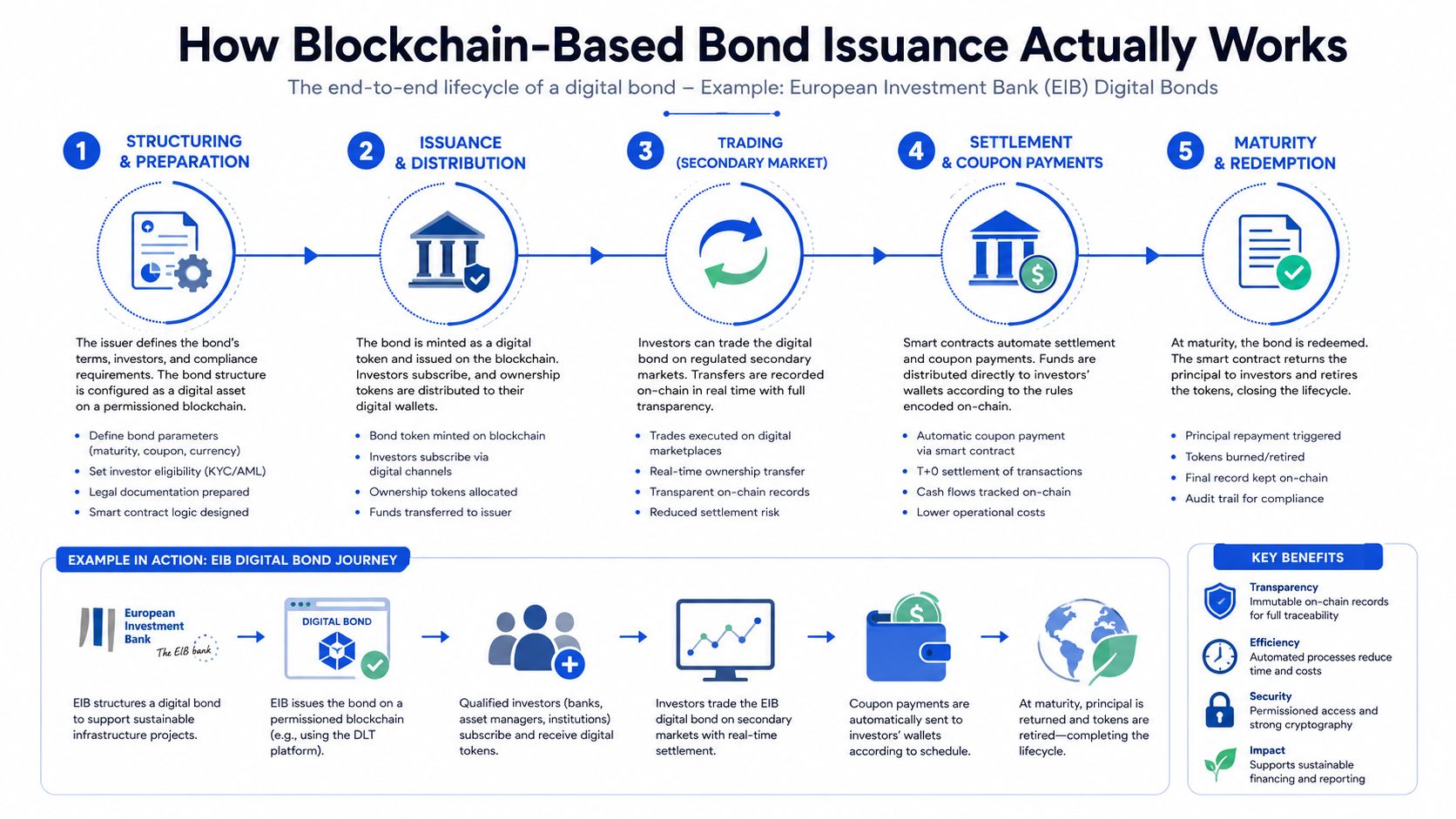
A digital bond does not change the economic promise of debt. Investors still fund the issuer, receive coupons, and get repaid at maturity. What changes is the operating stack, because the ownership record, transfer logic, and settlement path can all be mapped onto a blockchain-based workflow instead of being split across separate systems.
The cleanest reference point is the European Investment Bank. In 2021, it issued a EUR 100 million, 2-year, 0.000% coupon digital bond on Ethereum that settled the next day, with payment represented on-chain via a CBDC and Societe Generale–FORGE acting as platform manager EIB 2021 release. In 2023, it followed with a £50 million digital bond priced on 31 January 2023 and settled on 2 February 2023, using a floating-rate coupon of Compounded SONIA Index + 0.12%, payable quarterly in arrear, with custody handled through HSBC Orion EIB 2023 release.
The issuance lifecycle in practice
The workflow usually starts with structuring. Legal teams define the bond terms, investor eligibility, transfer restrictions, and the governing law, then technologists map those terms into smart contract logic and platform rules. That mapping is where many projects succeed or fail, because the code has to reflect the legal instrument rather than sit beside it.
Next comes investor onboarding. In institutional settings, whitelisting, KYC, AML, and eligibility checks happen before units are assigned on-chain. Then the issuance mints the bond token or native digital security to eligible wallets or accounts, with registrar functions tied to the ledger so ownership and entitlements stay synchronised.
A digital bond works best when issuance, registrar, and settlement are designed as one control surface, not three disconnected teams.
The how to tokenize corporate bonds on blockchain step by step guide is useful here because it shows how legal drafting, smart contract design, and operating controls have to line up before a live issuance can work. The corporate bond tokenization platform used in institutional deployments is usually built around that same operating model. Blocsys Technologies develops secure and compliant Corporate Bond Tokenization platforms that enable digital bond issuance, smart contract automation, faster settlements, and efficient investor management for banks, financial institutions, and capital markets worldwide.
Later lifecycle events are where the programmable part matters. Coupon schedules can be encoded into smart contracts, redemption logic can trigger at maturity, and transfer rules can stay consistent across primary and secondary markets. If the legal structure is tight and the settlement asset is available, the flow can be more coherent than the traditional mix of registrar files, custodian messages, and reconciliation processes.
The Cash-Leg Problem That Most Explainers Ignore
Most digital bond explainers stop after the security token is minted. That’s a mistake, because the bond leg is only half of the transaction. The primary bottleneck is the cash leg, and in the UK that usually means solving compliant on-chain settlement in sterling.
The UK’s planned digital gilt still depends on solving on-chain cash, with industry coverage pointing to gaps in compliant GBP stablecoins, tokenised deposits, and legal clarity around settlement finality. Without that, tokenised bonds may still have to settle through conventional banking rails, which weakens the efficiency case for blockchain-based issuance industry coverage on on-chain cash. In practical terms, that means the asset can be digital while the payment leg remains traditional.
Why atomic delivery versus payment matters
The DIGIT pilot is specifically expected to test on-chain settlement of the cash leg using tokenised commercial bank deposits, enabling atomic delivery-versus-payment on a permissioned ledger DIGIT operational detail. That model is important because it reduces principal settlement risk by moving the cash and security together, rather than leaving one side exposed while the other leg waits for banking rails to clear.
This is also where many pilots stall. If the settlement asset is not legally and operationally usable in the same environment as the bond, the transaction becomes a hybrid, part blockchain, part legacy infrastructure. The result is often more complexity, not less.
The right question for UK issuers isn’t “can we put the bond on chain?” It’s “what asset will pay for it, how will finality work, and what happens if the on-chain cash system is unavailable?” That’s the layer most board packs still skip.
Stablecoin settlement infrastructure for tokenized assets is the adjacent design problem for teams modelling this properly, because settlement architecture determines whether digital issuance stays native or falls back to old rails.
If on-chain cash can’t settle at the same speed and legal certainty as the bond, the blockchain only moves part of the workflow.
UK Regulatory Framework for Digital Bond Issuance
UK companies do not need a new securities statute before they can plan a digital bond issue. The Digital Securities Sandbox is the clearest live test environment for that work, because it lets firms explore DLT-based issuance inside controlled regulatory boundaries. For issuers, that closes part of the gap between a pilot and something a committee, a board, or external counsel can assess with confidence.
The legal route also sits outside the sandbox. The Uncertificated Securities Regulations 2001 already give UK companies a statutory path to issue digital bonds in dematerialised form through an electronic system operated by a designated operator. The legal point is straightforward, the law already recognises electronic securities records, so the harder task is fitting the operating model to rules that already exist.
FCA considerations that still matter
For corporate issuers, the FCA side cannot be treated as an afterthought. Financial promotions, disclosure quality, investor classification, and eligibility controls still apply even if the asset is tokenised. A digital bond remains a security, so the documentation has to stay readable, internally consistent, and enforceable across both the legal and technical layers.
Cross-border issuance adds another layer of friction. If you want investors in Europe or beyond, legal recognition, custody structures, and transfer mechanics can diverge quickly, even when the token itself looks identical on a screen. In practice, many issuers keep the UK as the legal centre of gravity first, then map international access after that.
For jurisdictional due diligence, a useful comparison point is crypto licensing challenges Israel, because it shows how fast digital asset rules fragment once you move outside a single domestic framework.
Digital bond issuers also need to think about infrastructure governance, not just a compliance checklist. The same legal terms can behave differently depending on whether the token sits on a permissioned ledger, a mirrored public chain, or a hybrid system with segregated records. That is why many firms use corporate bond tokenization platform development UK Spain 2026 as a benchmarking reference when they compare market structures and operating models.
Choosing the Right Blockchain Infrastructure for UK Bonds
Infrastructure choice is where strategy becomes real. UK issuers have to decide whether they want a permissioned ledger, a public blockchain, or a hybrid model with a public mirror record and private transaction controls. The EIB’s sterling digital bond gives the clearest institutional clue, it used a private blockchain for privacy and efficiency with a public blockchain mirror record for anonymised transparency EIB 2023 release.
That design is attractive because it separates confidentiality from verifiability. Treasury teams can keep sensitive issuance and holder information within controlled infrastructure, while still giving external observers or regulators a verifiable public trace of the instrument. The trade-off is that every extra layer introduces integration and governance work.
Permissioned versus public infrastructure
| Blockchain Infrastructure Options for UK Digital Bond Issuance | Permissioned Ledger | Public Blockchain with Mirror |
|---|---|---|
| Criteria | Controlled access, institutional privacy, easier governance | Broader transparency, open validation, harder confidentiality |
| Issuer fit | Banks, sovereign-like issuers, regulated capital markets | Smaller pilot structures, public transparency use cases |
| Operational control | High, with defined participant permissions | Lower, because network conditions are shared |
| Settlement design | Easier to align with regulated cash and custody flows | Needs stronger bridging and custody design |
| Audit and oversight | Simplified participant governance | Transparent activity, but more complex privacy handling |
| Integration | Better fit for existing post-trade systems | Better for experimentation, less ideal for legacy integration |
The UK market is still likely to favour controlled environments for institutional debt because treasury, registrar, and settlement teams need predictable permissions. That’s why a digital securities platform for bonds often looks more like capital-markets infrastructure than a generic crypto app.
If you’re evaluating the build-versus-buy path, best blockchain platforms for corporate bond tokenization in 2026 is a useful lens for narrowing the architecture shortlist. The broader Blockchain Development capability also matters, because secure, scalable, high-performance systems for public, private, and hybrid blockchain networks are usually what enterprise bond programs require.
A separate infrastructure issue is custody. Institutional investors won’t tolerate a design that treats private keys as an afterthought. They need wallet governance, controls, recovery procedures, and clear operational accountability, the same standards they expect from any core financial system.
For teams comparing adjacent enterprise architectures, secure cloud infrastructure for CPAs is a useful analogy, because regulated systems live or die on controlled environments, access logic, and resilience planning, not on abstract technology labels.
What Happens When Digital Bond Systems Fail
Resilience is the topic most glossy tokenisation decks avoid. If the ledger goes down, the custodian is disrupted, or a smart contract has a vulnerability, the core question is what counts as a valid transfer and who is allowed to act while systems are unstable.
The UK’s DIGIT work is expected to explore interoperability, OTC trading, collateral mobility, and secondary-market trading, but the practical rules for disruption events are still a key gap in market infrastructure. That gap matters because digital bonds create new failure modes, technology outages, smart contract defects, and custody issues can all affect coupon flows or transfers in ways traditional documentation never had to spell out as explicitly.
The failure scenarios to design for
If the ledger is unavailable, the issuer needs a fallback procedure for recording ownership and servicing obligations. If the custodian or registrar layer is disrupted, the legal record has to remain defensible. If the smart contract contains a bug, teams need a controlled remediation path that doesn’t accidentally break investor rights or create conflicting versions of the asset.
Secondary-market mechanics need just as much attention. Digital bonds may be traded OTC, used as collateral, or re-used in financing transactions, but those functions only work if transfer finality, eligibility rules, and redemption logic are consistent across counterparties. The operational lesson is simple, tokenisation doesn’t remove market risk, it changes where the risk sits.
A bond is only as resilient as its fallback procedure.
There’s also the insolvency question. If the ledger operator, platform provider, or service stack fails, legal advisers need to know how ownership, transfer recognition, and investor claims are treated when records are fragmented. That’s why practical market adoption depends on more than issuance mechanics, it depends on disruption planning that matches the legal architecture.
Building Production-Grade Digital Bond Infrastructure with Blocsys
UK issuers moving from pilot discussions to production need more than a token wrapper. They need a platform architecture that can handle legal mapping, compliance workflows, investor permissions, treasury connectivity, and post-trade control without turning every issuance into a one-off engineering project.
Blocsys works in that layer. A production tokenisation stack gives banks and issuers a structured path for digital bond issuance, smart contract automation, faster settlement handling, and investor management. For teams that need broader asset coverage, tokenisation platforms for securities and real-world assets can be designed to plug into the same institutional controls rather than spawning separate systems for each product line.
What production-grade implementation usually requires
The first requirement is clean legal and identity data. If the issuer, arranger, and investor entities are not verified consistently, the token layer inherits bad records from the start. That is why an upstream control such as the TaxID company verification API should be linked into onboarding and entity screening.
The second requirement is integration. A serious digital bond stack needs to connect with treasury systems, reporting workflows, and, where appropriate, secondary-market functionality. It also needs to support compliance events, not just initial issuance, because lifecycle servicing is where the operational value shows up and where the cash-leg bottleneck usually becomes visible.
The third requirement is design discipline. Smart contracts should automate only what is stable and legally clear. Anything ambiguous, especially around fallback servicing, should remain configurable at the operations layer until the market structure is mature enough for full automation.
For UK companies, Blocsys is a practical implementation option when the goal is to build a production-grade enterprise blockchain stack for digital securities UK, not just demo a token. Its value is in joining tokenisation, regulatory mapping, and settlement design into one architecture that can survive legal review and operational scrutiny. That matters in secondary markets as well, because transfer rules, redemption logic, and servicing controls have to behave consistently across counterparties if the bond is going to move beyond issuance day.
The weak point in many digital bond programmes is the cash leg. A token can move on ledger while money still relies on separate banking rails, custodian workflows, and reconciliation between institutions that do not share the same operating clock. Blocsys has to solve that coordination problem as much as the asset token itself, because production failure usually starts with settlement mismatch, not with the security token standard. In practice, the systems that hold up are the ones that make issuance, investor onboarding, servicing, and cash movement observable to operations teams instead of hiding them inside a polished front end.
Digital bond issuance is becoming a real option for UK companies because the legal route exists, the market is growing, and the public sector is testing the model in a regulated sandbox. The part that still needs the most attention is the cash leg, fallback procedures, and institutional controls that make the bond usable in production.
If you are evaluating digital bond issuance UK, blockchain bond issuance, or corporate bond tokenisation for a treasury, banking, or capital-markets programme, Blocsys Technologies can help you design the issuance, smart contract, settlement, and compliance layers around the realities of UK markets. Visit Blocsys Technologies to discuss how to move from concept to a production-ready digital securities platform.
Frequently Asked Questions
What is digital bond issuance?
Digital bond issuance is the process of creating, issuing, managing, and settling a bond using digital securities infrastructure, often supported by blockchain or distributed ledger technology. Instead of relying entirely on traditional securities records and post-trade systems, a digital bond can use programmable ownership records, smart contracts, digital investor onboarding, and blockchain-based settlement while preserving the legal and economic characteristics of a conventional bond.
How can UK companies issue bonds on blockchain?
UK companies can issue bonds on blockchain by defining the legal structure and bond terms, selecting appropriate digital securities infrastructure, completing investor eligibility and KYC/AML checks, issuing the digital security to approved investors, and establishing compliant settlement and servicing processes. The technology must be aligned with UK securities law, investor requirements, custody arrangements, and the operational controls needed throughout the bond’s lifecycle.
Are blockchain-based bonds legal in the UK?
Blockchain-based bonds can be structured within existing UK legal and regulatory frameworks, subject to the specific characteristics of the issuance. The Uncertificated Securities Regulations 2001 provide a statutory route for certain dematerialised securities through an electronic system operated by a designated operator, while the UK’s Digital Securities Sandbox provides a controlled environment for testing DLT-based securities infrastructure. Issuers still need appropriate legal, regulatory, disclosure, investor eligibility, and operational assessments.
What is the Digital Securities Sandbox for digital bonds?
The Digital Securities Sandbox is a UK regulatory framework that allows eligible firms to test and develop digital securities activities using distributed ledger technology within controlled regulatory conditions. For digital bond issuance, the sandbox can help market participants evaluate how blockchain-based issuance, trading, settlement, and related infrastructure can operate within a regulated securities environment before broader market deployment.
How does a blockchain-based bond issuance work?
A blockchain-based bond issuance typically begins with structuring the bond terms, governing law, investor eligibility, and transfer restrictions, followed by investor onboarding and compliance checks. The digital bond is then issued to eligible wallets or accounts, while smart contracts can automate functions such as ownership transfers, coupon payments, and redemption. The system must also connect the security leg with an appropriate cash settlement mechanism and maintain controls for custody, reporting, and lifecycle events.
What is the cash-leg problem in digital bond issuance?
The cash-leg problem occurs when the digital bond can move on a blockchain but the corresponding payment still depends on traditional banking infrastructure. This can create a hybrid settlement process in which the security is transferred digitally while the cash moves through separate systems. For fully efficient digital bond settlement, issuers and market participants need to determine what settlement asset will be used, how settlement finality will work, and what fallback process applies if on-chain cash infrastructure becomes unavailable.
Why is atomic delivery-versus-payment important for digital bonds?
Atomic delivery-versus-payment is important because it allows the digital security and corresponding cash payment to be exchanged together, reducing principal settlement risk. In a blockchain-based bond transaction, this approach can prevent one party from transferring the bond while waiting for the other party’s payment to settle, provided that the underlying cash asset, legal framework, and settlement infrastructure support atomic execution.
Should UK companies use a permissioned or public blockchain for digital bonds?
UK companies issuing digital bonds should choose between permissioned, public, or hybrid blockchain infrastructure based on their privacy, governance, settlement, interoperability, and investor requirements. Permissioned networks generally provide greater control over participants and confidential transaction data, while public blockchains offer broader transparency and network accessibility. Institutional issuers may also use hybrid architectures that combine controlled transaction infrastructure with public verification or mirror records.
What regulatory requirements apply to digital bond issuance in the UK?
UK digital bond issuance can involve requirements related to securities law, financial promotions, disclosure, investor classification, eligibility controls, custody, settlement, and market infrastructure. Tokenising a bond does not remove its underlying regulatory obligations because the digital representation remains connected to a financial security. Issuers should therefore establish the legal classification, applicable FCA requirements, investor restrictions, and operating responsibilities before implementing the technology.
What happens if a blockchain digital bond platform fails?
A digital bond platform needs predefined fallback procedures for events such as blockchain outages, custodian failures, smart contract vulnerabilities, registrar disruptions, and settlement interruptions. The fallback design should establish how ownership records are maintained, how coupon and redemption obligations continue, who can perform emergency actions, and how investor rights remain legally enforceable. Resilience planning is therefore a core part of production-grade digital bond infrastructure rather than an optional technical feature.
How much does it cost to build a digital bond issuance platform?
The cost of building a digital bond issuance platform depends on factors such as blockchain architecture, smart contract complexity, investor onboarding, KYC/AML integration, custody, digital securities management, settlement infrastructure, treasury connectivity, secondary-market functionality, compliance controls, security requirements, and regulatory jurisdiction. A pilot issuance platform generally requires less investment than a production-grade institutional system designed to support multiple issuances, investors, lifecycle events, and capital-markets integrations.
