
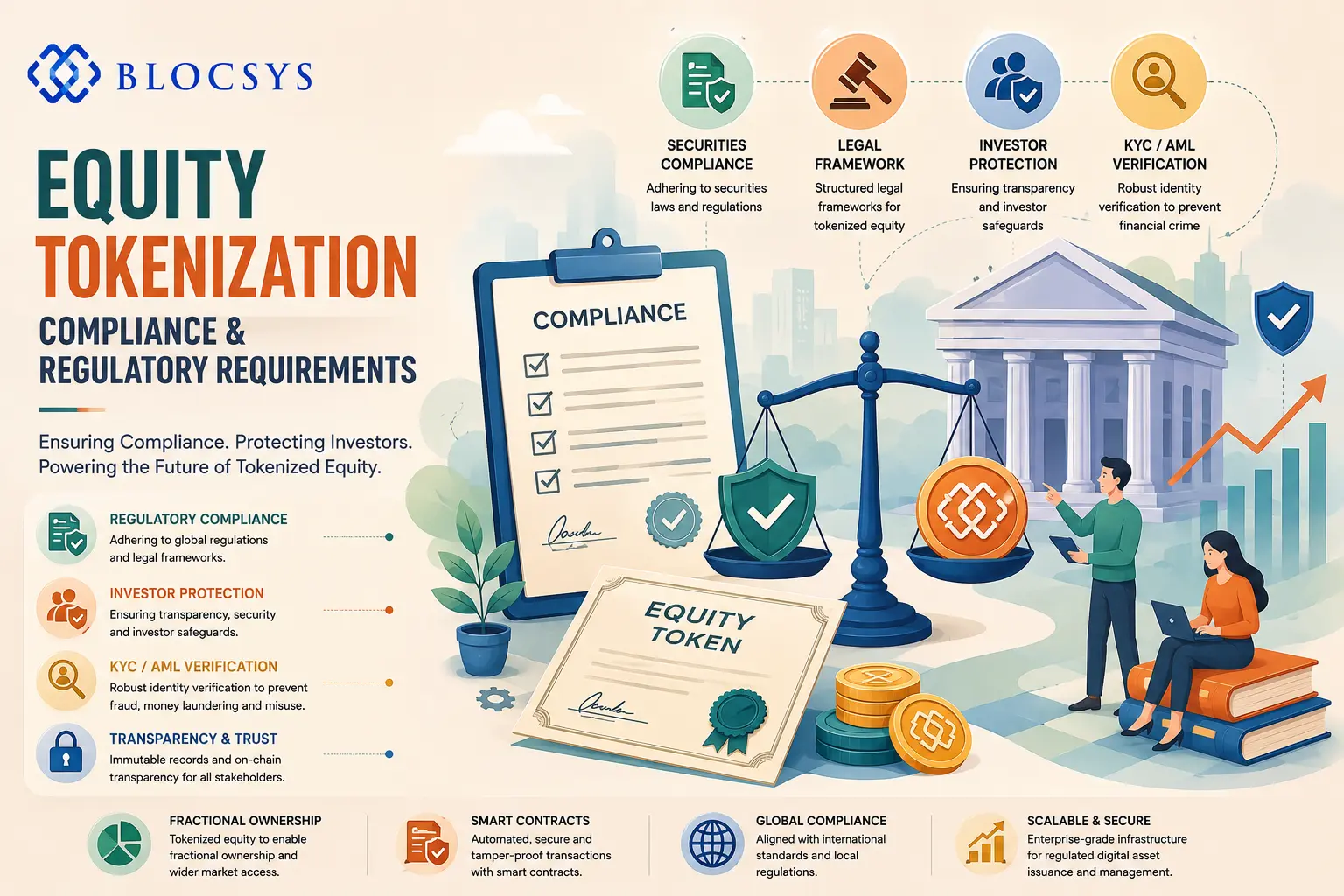
Equity Tokenization Compliance: Regulatory Requirements for Issuing Digital Shares
Equity tokenization compliance sits at the center of every serious digital shares project. Companies exploring tokenized equity often start with the technology, then discover that regulatory requirements shape almost every design decision that follows. Before you build anything, you need to understand how securities law, investor protection rules, and disclosure obligations apply to your specific offering. This guide walks through what equity tokenization compliance actually means, how requirements differ across major markets, and what issuers need to evaluate before launching a token-based share structure. If you’re weighing whether to build one, the Equity Tokenization Platform Development approach only works when compliance is designed in from day one, not bolted on afterward.
What Equity Tokenization Compliance Actually Means
Equity tokenization compliance refers to the process of structuring, issuing, and managing digital shares in accordance with the securities laws, investor protection rules, and disclosure obligations of the jurisdictions where they’re offered. It covers everything from registration and exemption eligibility to KYC/AML checks, transfer restrictions, and ongoing reporting. Put simply, wrapping equity in a token doesn’t change what regulators think it is — it’s still a security, and it still needs to follow securities rules.
That’s the part many founders miss. A blockchain record of ownership is a technical improvement, not a legal shortcut. Regulators in the US, UK, EU, UAE, and Singapore have each said, in one form or another, that a tokenized share is generally treated the same as its traditional counterpart for legal purposes. Therefore, your compliance obligations don’t shrink just because the cap table now lives on-chain.
Why Tokenized Equity Can Fall Under Securities Regulation
Most tokenized equity qualifies as a security because it represents an ownership stake, a profit expectation, or a claim on company assets. In the US, the SEC applies the Howey test to determine whether a digital asset is an investment contract, and equity tokens tied to company ownership almost always meet that bar. The UK’s FCA takes a similar functional view under the Financial Services and Markets Act, classifying tokens by what they represent rather than by their technical format. The European Union’s Markets in Crypto-Assets Regulation (MiCA), which came into force in 2024, deliberately excludes instruments that already qualify as financial instruments under MiFID II — meaning tokenized equity typically falls under existing EU securities law rather than MiCA itself.
This “substance over form” principle shows up everywhere. Singapore’s Monetary Authority of Singapore (MAS) regulates tokenized securities under the Securities and Futures Act, treating them as capital markets products regardless of the underlying ledger technology. The UAE’s Dubai Virtual Assets Regulatory Authority (VARA) and the Securities and Commodities Authority (SCA) apply overlapping frameworks depending on whether the token is issued from a mainland entity or a free zone like ADGM or DIFC. Consequently, issuers can’t rely on tokenization alone to sidestep securities registration — the underlying economic right is what regulators look at first.
The biggest misconception we hear from issuers is that a smart contract somehow replaces a securities filing. It doesn’t. The token is a wrapper around a legal right — the compliance work happens before a single line of Solidity gets written.
Key Regulatory Requirements for Equity Token Issuers
Equity tokenization regulatory requirements generally cluster around five areas: securities classification, registration or exemption, investor verification, disclosure, and ongoing reporting. Issuers also need custody arrangements, transfer agent functions, and a compliance monitoring process that can keep up with token movement in near real time. None of these requirements are unique to blockchain-based shares — they mirror what a traditional private placement or public offering already demands. What changes is how you implement them technically, since the smart contract layer needs to enforce rules that used to live in paperwork and manual review.
Here’s the practical part: your legal structure comes first, and your platform architecture follows it. A cap table on a blockchain still needs a transfer agent function somewhere, whether that’s a licensed third party or built into your smart contract logic with proper oversight. Skipping this step is the single most common mistake we see in early-stage equity token issuance compliance planning.

Securities Registration and Exemptions
In the United States, issuers typically rely on exemptions rather than full SEC registration, given the cost and disclosure burden of a registered offering. Regulation D (Rule 506(b) or 506(c)) allows sales to accredited investors without SEC registration, while Regulation A+ permits raises up to $75 million with lighter ongoing reporting, and Regulation CF supports smaller community raises through registered funding portals. Each exemption carries its own investor limits, marketing restrictions, and disclosure requirements, and choosing the wrong one can unwind an entire offering.
The UK generally uses the Financial Services and Markets Act 2000 (FSMA) framework, where a Prospectus is required above certain thresholds unless a private placement exemption applies. The EU relies on the Prospectus Regulation, and member states apply national private placement regimes alongside it — meaning an offering compliant in Germany isn’t automatically compliant in France. Singapore’s MAS allows private placement exemptions under the Securities and Futures Act for offers to no more than 50 persons within 12 months, or offers restricted to accredited and institutional investors. The UAE splits by zone: ADGM and DIFC operate common-law-based frameworks closer to UK/US models, while mainland UAE follows SCA rules that are still maturing around digital securities specifically.
KYC/AML and Investor Onboarding
KYC/AML checks aren’t optional extras for tokenized equity — they’re a baseline requirement almost everywhere digital securities are issued. Issuers need to verify investor identity, screen against sanctions and politically exposed persons lists, and document the source of funds before any token gets allocated. In the US, this ties into Bank Secrecy Act obligations and FinCEN guidance; in the EU, it flows from the Anti-Money Laundering Directives (AMLD5/6); in the UAE, VARA and the SCA both mandate AML programs modeled on FATF recommendations.
What makes this different from a traditional brokerage onboarding flow is timing. Because tokens can move instantly once minted, KYC verification has to happen before wallet whitelisting, not after. A well-designed equity token issuance compliance process pairs identity verification with wallet-level allowlisting, so a token literally can’t be transferred to an unverified address. That’s a meaningful upgrade over paper-based cap tables, where an unauthorized transfer might not surface for weeks.
Investor Eligibility and Transfer Restrictions
Who’s allowed to hold your tokenized shares depends entirely on which exemption or license your offering relies on. A Reg D 506(c) raise in the US restricts sales to verified accredited investors — meaning you’ll need documented proof of income, net worth, or professional certification, not just a self-attestation checkbox. Singapore’s accredited investor definition under the Securities and Futures Act sets its own income and asset thresholds, and they don’t map directly onto the US definition. Consequently, a single global eligibility check almost never works; you need jurisdiction-aware logic built into onboarding.
Transfer restrictions follow the same logic. Many exemptions carry mandatory holding periods — Rule 144 in the US, for example, generally requires a minimum holding period before restricted securities can be resold. Smart contracts can enforce these lockups programmatically, blocking a transfer attempt until the restriction period lapses. This is one area where Real World Asset Tokenization infrastructure genuinely outperforms manual processes, since the rule gets enforced at the protocol level instead of relying on someone remembering to check a spreadsheet.
Disclosure and Reporting Requirements
Disclosure obligations don’t disappear because shares are tokenized. Issuers under Reg A+ in the US file ongoing reports with the SEC, including annual and semiannual updates. UK and EU prospectus rules require detailed risk disclosures covering the issuer’s financial position, business model, and the specific risks of holding a digital instrument. Singapore’s MAS requires similar disclosure depth for offers that don’t qualify for a private placement exemption.
Here’s a short but important point: disclosure documents need to explicitly address blockchain-specific risks. That means covering custody arrangements, smart contract risk, network dependency, and what happens to ownership records if the underlying platform changes. Investors deserve to understand these risks in plain language, not buried in technical appendices.
Ownership Records and Custody
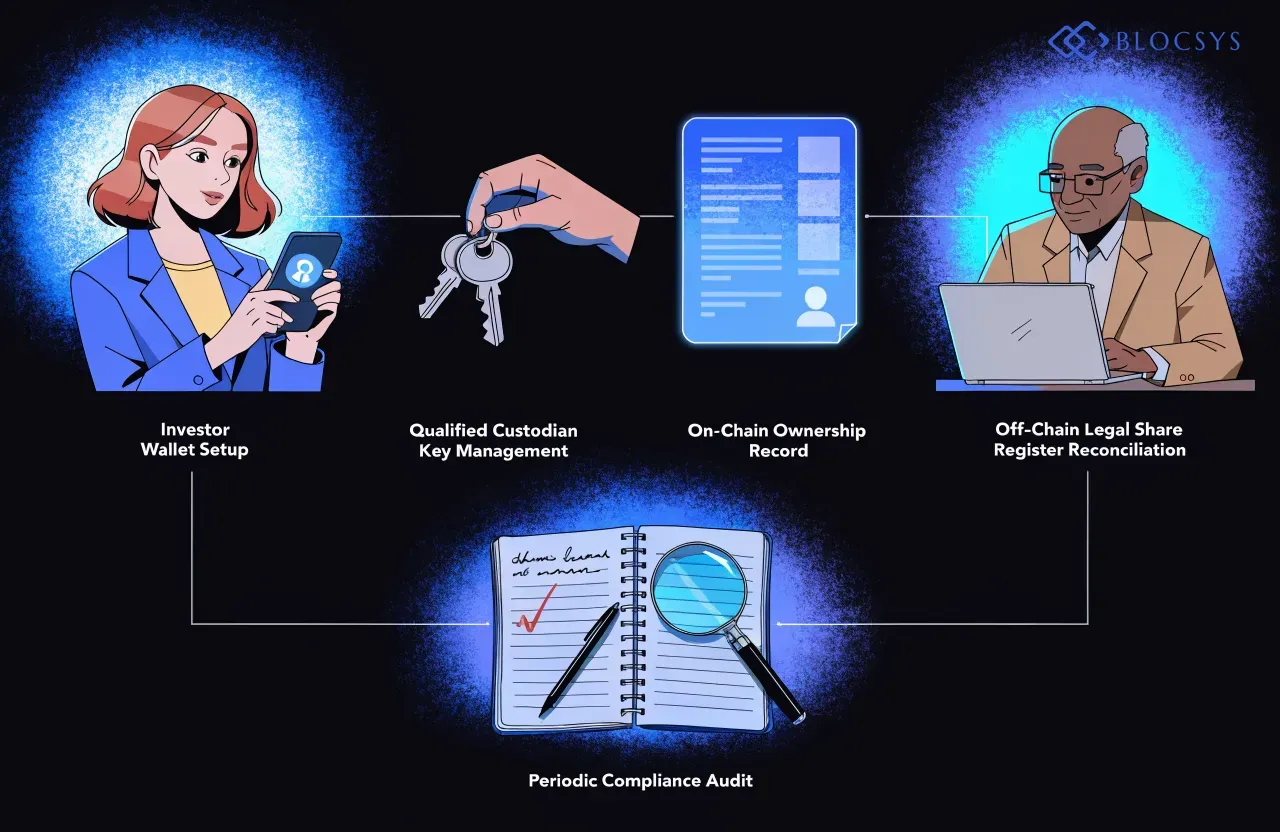
One of tokenization’s real advantages is a cleaner, more auditable ownership record. However, that record still needs to satisfy corporate law requirements around share registers, and in many jurisdictions a company still needs a designated transfer agent or registrar function — even if it’s technically implemented through a smart contract. Custody adds another layer: institutional investors typically expect qualified custodian arrangements for the private keys controlling their tokens, and in the US, investment advisers handling client assets face custody rule obligations under the Investment Advisers Act.
Self-custody isn’t automatically disqualifying, but it raises questions around loss, theft, and inheritance that traditional share registries handled through established legal processes. Tokenized equity compliance frameworks generally need a documented answer for what happens when a private key is lost — because “the shares are gone” isn’t an acceptable outcome for a regulated security.
Smart Contracts and Compliance Controls
Smart contracts can enforce a surprising amount of regulatory logic directly at the token level: investor whitelisting, jurisdiction-based transfer blocks, holding period lockups, and maximum investor caps under certain exemptions. Standards like ERC-1400 and ERC-3643 were built specifically for this — they add permissioning layers on top of standard token transfers so a trade only executes if the receiving wallet passes eligibility checks. That said, smart contracts don’t replace legal agreements or regulated intermediaries; they enforce rules that a lawyer and a compliance officer already defined.
This is a technical decision with legal consequences, so the two teams need to work together from the start. A poorly configured smart contract can either block legitimate transfers or, worse, allow one that violates securities law. Get this wrong, and you’re looking at a compliance failure baked into immutable code — which is a lot harder to fix than a policy update.
Secondary-Market Compliance for Tokenized Securities
Can tokenized equity trade on secondary markets? Yes, but only through channels that are actually licensed to facilitate securities trading. In the US, that generally means an Alternative Trading System (ATS) registered with the SEC and FINRA, since a general-purpose crypto exchange isn’t authorized to trade securities. The UK and EU require Multilateral Trading Facility (MTF) or equivalent licensing for organized secondary trading of tokenized securities. Singapore’s MAS regulates such venues under its Recognized Market Operator framework, and the UAE routes similar activity through VARA-licensed or ADGM/DIFC-regulated venues.
Liquidity is often the pitch for tokenized equity, but secondary-market compliance is where a lot of projects stall. An OTC-style trading venue can work for this, provided it’s built with the licensing and investor eligibility checks the jurisdiction requires — otherwise, you’ve just created a faster way to violate securities law. Comparing structures across asset classes helps here; Corporate Bond Tokenization projects face nearly identical secondary-market licensing questions, since debt and equity tokens both need a regulated venue to trade legally.
Jurisdiction-Specific Regulatory Considerations
Regulatory frameworks for equity tokenization vary enough that treating them as interchangeable is a genuine risk. The table below summarizes the primary regulator and general approach in each major market as of 2026, though issuers should confirm current guidance directly with counsel before relying on any of it.
| Jurisdiction | Primary Regulator | General Approach |
|---|---|---|
| United States | SEC / FINRA | Howey test classification; Reg D, Reg A+, Reg CF exemptions common |
| United Kingdom | FCA | FSMA-based; functional classification, prospectus rules apply |
| European Union | ESMA / national regulators (e.g., AMF) | MiFID II/Prospectus Regulation governs equity tokens; MiCA excludes them |
| UAE | VARA / SCA / ADGM-FSRA / DIFC-DFSA | Zone-dependent; common-law frameworks in ADGM and DIFC |
| Singapore | MAS | Securities and Futures Act; private placement exemptions widely used |
Cross-Border Equity Tokenization
Offering tokenized shares across multiple jurisdictions multiplies the compliance work rather than simplifying it. A token that’s exempt in Singapore might require full registration in the EU, and a US accredited investor exemption doesn’t automatically satisfy UK or UAE eligibility standards. Therefore, cross-border equity tokenization projects typically need jurisdiction-by-jurisdiction legal review, geofencing at the smart contract or platform level, and separate disclosure documents tailored to each market’s requirements. There isn’t a single global framework yet, and treating one jurisdiction’s rules as universal is one of the fastest ways to trigger an enforcement problem.
Common Compliance Challenges in Equity Token Issuance
Issuers run into a handful of recurring problems. Choosing the wrong exemption early on can force a costly restructuring later. Underestimating custody requirements leaves institutional investors unable to participate, since many won’t hold assets without a qualified custodian. Smart contracts deployed before legal terms are finalized often need expensive rework, and weak compliance monitoring means suspicious transfer patterns go unnoticed until a regulator asks about them.
Governance gaps cause trouble too. Who has authority to freeze a token, update the whitelist, or pause transfers during an investigation? These aren’t hypothetical questions — they need documented answers before launch, not during an incident.
Technology and Governance Considerations for Equity Tokenization Compliance
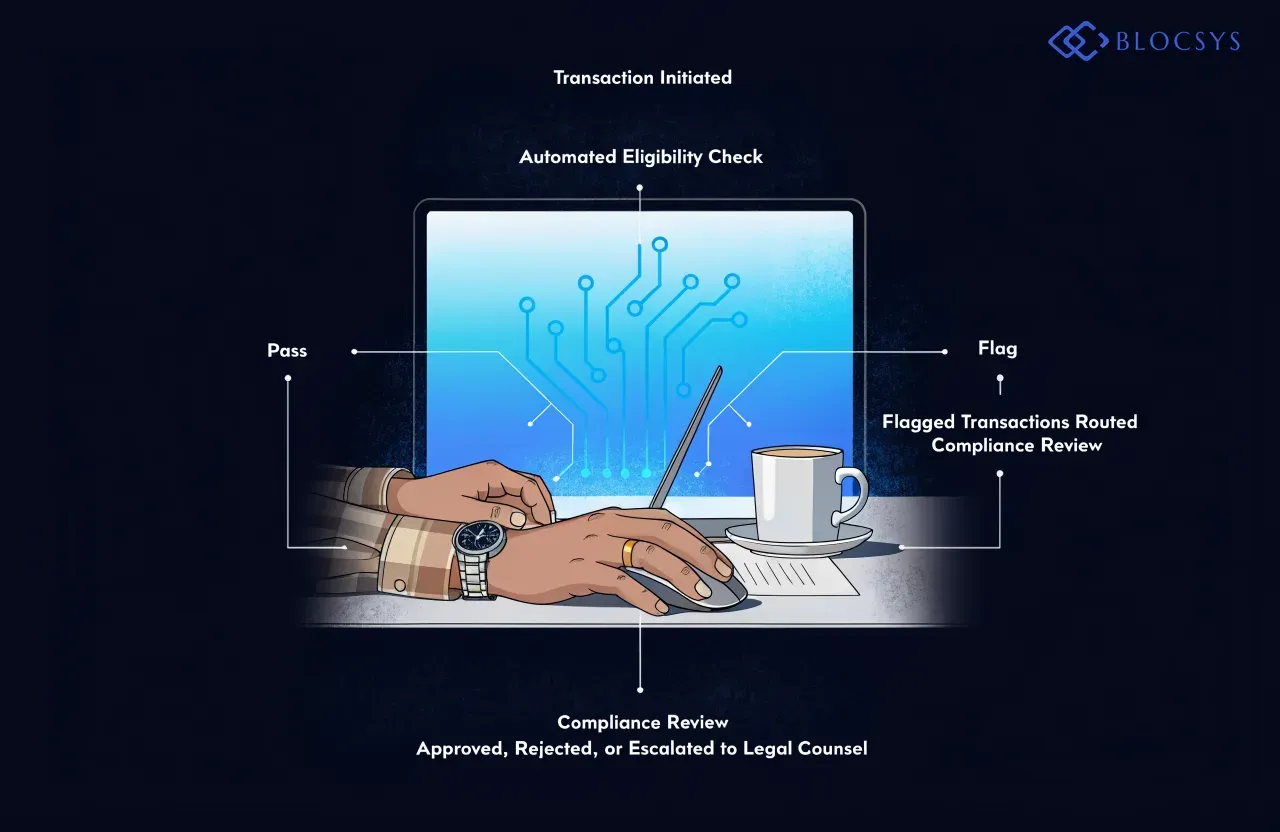
Strong equity tokenization compliance depends on infrastructure choices as much as legal ones. You need audit trails that satisfy regulators, role-based access controls over who can mint or freeze tokens, and integration between on-chain records and off-chain legal documentation. Governance policies should spell out upgrade procedures, emergency pause conditions, and who signs off on smart contract changes after deployment. An Asset Tokenization Platform built with these controls from the start avoids the retrofit problems that plague projects where compliance gets added after the technical architecture is locked in.
Compliance monitoring shouldn’t be a one-time checklist either. Ongoing transaction surveillance, periodic re-verification of investor status, and ownership record reconciliation between the blockchain and the legal share register all need to run continuously. Set this up once, correctly, and it runs quietly in the background.
Future Regulatory Developments in Equity Tokenization
Regulators are actively working through how tokenized securities fit their existing rulebooks, and this space is moving quickly. The SEC’s Crypto Task Force, launched in 2025, has been engaging with industry on clearer digital asset securities guidance, though no final tokenization-specific rule has been adopted as of this writing. The EU is watching how MiCA and MiFID II interact in practice and may issue further guidance. The UK’s FCA has run digital securities sandbox initiatives, including the Digital Securities Sandbox launched in 2024, to test tokenized trading and settlement under real regulatory supervision. Singapore’s MAS continues expanding its Project Guardian initiative, testing tokenized asset frameworks with financial institutions. None of this is final law yet — it’s proposed frameworks, pilot programs, and consultations, and issuers should treat it as directional rather than settled.
Why Compliant Equity Tokenization Infrastructure Matters
Equity tokenization compliance isn’t a box you check once and forget. It’s an ongoing operational discipline that touches your legal structure, your technology stack, and how you onboard every single investor. Get the foundation right, and tokenized shares can genuinely improve transparency, settlement speed, and record accuracy compared to paper-based cap tables. Get it wrong, and you’re looking at regulatory exposure that’s a lot harder to unwind once tokens are already in investor wallets. If you’re evaluating what compliant infrastructure actually looks like for your offering, the Equity Tokenization Platform Development process should start with a legal and regulatory assessment, not a smart contract template.
Frequently Asked Questions
Here are direct answers to the questions we hear most often about equity tokenization compliance.
What is equity tokenization compliance?
Equity tokenization compliance is the practice of issuing and managing digital shares in line with applicable securities laws, including registration or exemption requirements, KYC/AML checks, investor eligibility rules, disclosure obligations, and ongoing reporting. It applies regardless of whether shares exist on paper or on a blockchain, since regulators classify the underlying right, not the technical format. Compliance depends on your jurisdiction, investor base, and offering structure, so it isn’t a one-size-fits-all checklist.
Are tokenized shares regulated securities?
In most major markets, yes. The SEC, FCA, ESMA-aligned regulators, MAS, and UAE authorities generally apply a substance-over-form approach, treating tokenized equity the same as traditional shares if it represents ownership or profit rights. This means securities registration, exemption filings, and investor protection rules typically apply. Tokenization changes how ownership is recorded and transferred, but it doesn’t change the underlying legal classification of the instrument itself.
What regulations apply to equity tokenization?
Applicable rules depend on jurisdiction. In the US, SEC rules and exemptions like Reg D, Reg A+, and Reg CF apply. The UK uses FSMA and FCA prospectus rules, while the EU applies MiFID II and the Prospectus Regulation. Singapore follows the Securities and Futures Act under MAS, and the UAE applies VARA, SCA, or ADGM/DIFC frameworks depending on the issuing entity’s location. No single global regulation covers equity tokenization uniformly.
What are the KYC and AML requirements for tokenized equity?
Issuers must verify investor identity, screen against sanctions and PEP lists, and document source of funds before allocating tokens. These obligations stem from existing frameworks like the US Bank Secrecy Act, the EU’s AMLD5/6, and FATF-aligned rules in Singapore and the UAE. Because tokens can transfer instantly, KYC verification typically happens before wallet whitelisting, with smart contracts enforcing that only verified addresses can receive or send tokens.
Do tokenized shares require securities registration?
Often, yes, unless the offering qualifies for a specific exemption. In the US, issuers commonly rely on Reg D, Reg A+, or Reg CF instead of full registration. The UK and EU require a prospectus above certain thresholds, with private placement exemptions available below them. Singapore and the UAE have their own exemption thresholds. Whether registration is required depends entirely on investor count, offering size, and jurisdiction-specific rules.
What investor eligibility requirements apply to tokenized equity?
Eligibility depends on the exemption used. US Reg D 506(c) offerings require verified accredited investor status, meaning documented proof of income, net worth, or professional credentials. Singapore and the UAE apply their own accredited or institutional investor definitions, which don’t align exactly with US standards. Because thresholds differ by jurisdiction, issuers generally need onboarding logic that applies the correct eligibility test based on where each investor is located.
How are ownership rights managed for tokenized shares?
Ownership is typically recorded on-chain through the token itself, but companies still need a legal share register or transfer agent function to satisfy corporate law requirements in most jurisdictions. Reconciliation between the blockchain record and the off-chain legal register is essential, since regulators and courts generally look to the legal register as authoritative. Custody arrangements for private keys also factor into how securely those ownership rights are protected.
What role do smart contracts play in equity tokenization compliance?
Smart contracts can enforce compliance rules like investor whitelisting, transfer restrictions, holding periods, and jurisdiction-based blocks directly at the token level, often using standards like ERC-1400 or ERC-3643. However, smart contracts don’t replace legal agreements, securities filings, or regulated intermediaries — they execute rules that lawyers and compliance teams define beforehand. Poorly configured contracts can create serious compliance failures, so legal and technical teams need to coordinate closely during design.
Can tokenized equity be traded on secondary markets?
Yes, but only through properly licensed venues. In the US, that generally means an SEC- and FINRA-registered Alternative Trading System, since standard crypto exchanges aren’t authorized to trade securities. The UK, EU, Singapore, and UAE each require equivalent licensed trading venues, such as MTFs or Recognized Market Operators. Trading tokenized shares on an unlicensed platform can expose both the issuer and investors to significant regulatory risk.
How much does it cost to build an equity tokenization platform?
Costs vary widely based on jurisdictional compliance requirements, smart contract complexity, custody integration, and whether you’re building compliance-aware features like investor whitelisting and transfer restrictions from scratch. Rather than relying on generic figures that don’t reflect your specific structure, use the Blocsys Cost Estimator Tool to get an estimate tailored to your offering size, target jurisdictions, and technical requirements.
Conclusion
Equity tokenization compliance isn’t a formality you handle after the technology is built — it’s the foundation everything else stands on. From securities classification and exemption selection to KYC/AML, investor eligibility, custody, and secondary-market licensing, every piece needs to align with the rules of the specific jurisdictions you’re operating in. Tokenization can genuinely improve how digital shares are issued, tracked, and transferred, but it doesn’t grant an exemption from securities law, and no platform can promise regulatory approval on your behalf. If you’re planning a tokenized equity offering, start with a clear-eyed regulatory assessment, then bring in a technology partner who understands how to translate those requirements into working infrastructure. Blocsys works with companies designing compliance-aware Equity Tokenization Platform Development solutions, and can help you think through how your legal structure, investor onboarding, and smart contract controls fit together before you launch.
Ready to move beyond theory and build an intelligent platform that delivers real-world value? Blocsys Technologies specialises in engineering enterprise-grade AI and blockchain solutions for the fintech, Web3, and digital asset sectors. Connect with our experts today to discuss your vision and chart a clear path from concept to a secure, scalable reality.
