
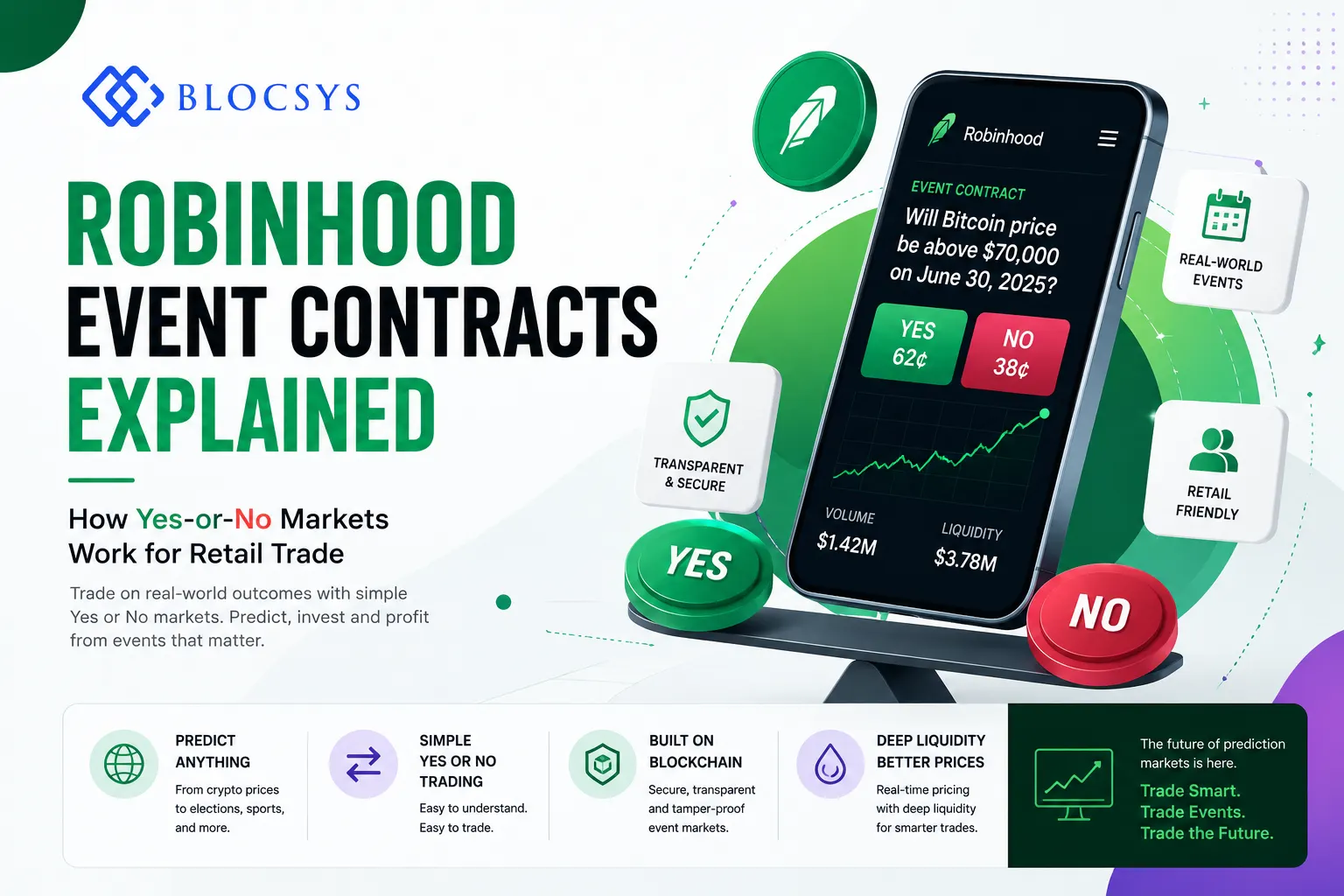
Robinhood event contracts are binary Yes/No derivatives regulated by the CFTC that pay a maximum of $1 per contract if the defined event occurs, and expire worthless if it does not. Their simple payout structure makes them accessible to retail traders, but pricing, settlement rules, and legal classification require careful attention.
For context, 91.1% of retail traders in India’s equity derivatives segment lost money in FY2024, with cumulative losses of about ₹1.05 lakh crore in FY2024-25, according to NISM’s summary of SEBI-linked market data. That figure isn’t about Robinhood event contracts specifically, but it highlights why binary financial products need clear disclosures, disciplined position sizing, and reliable resolution processes.
This guide is for retail traders comparing Robinhood Event Contracts, Robinhood Prediction Markets, and other forms of event-based trading, as well as fintech founders, exchanges, financial institutions, Web3 companies, and product teams evaluating the infrastructure behind compliant Yes-or-No markets. It connects the user experience with the enterprise questions that matter in production, including matching engines, oracle feeds, identity controls, settlement logic, and regulatory scope. Teams exploring the broader future of Robinhood, blockchain, and tokenized capital markets should treat the product as a financial-market design problem, not just a new betting interface.
Table of Contents
- What Are Robinhood Event Contracts and Why They Matter Now
- How Yes-or-No Contract Pricing and Settlement Work
- Event Contracts vs Traditional Betting and Prediction Markets
- Types of Events Available for Retail Trading
- Risks Regulatory Considerations and Retail Protections
- Building Compliant Prediction Market Platforms for Enterprise
- Why Choose Blocsys for Prediction Market Platform Development
- Frequently Asked Questions About Robinhood Event Contracts
- What are Robinhood event contracts?
- How do Robinhood prediction markets work?
- How do Yes-or-No contracts work?
- How are Robinhood event contracts priced?
- How are event contracts settled?
- What types of events can be traded on Robinhood?
- How are prediction markets different from traditional betting?
- What are the risks of trading event contracts?
- Who can trade Robinhood event contracts?
- Are Robinhood event contracts regulated?
- How much does it cost to build a prediction market platform?
- Why should businesses choose Blocsys for prediction market development?
- Can a business launch a white-label Yes-or-No market?
- What technology does a compliant prediction market platform need?
What Are Robinhood Event Contracts and Why They Matter Now
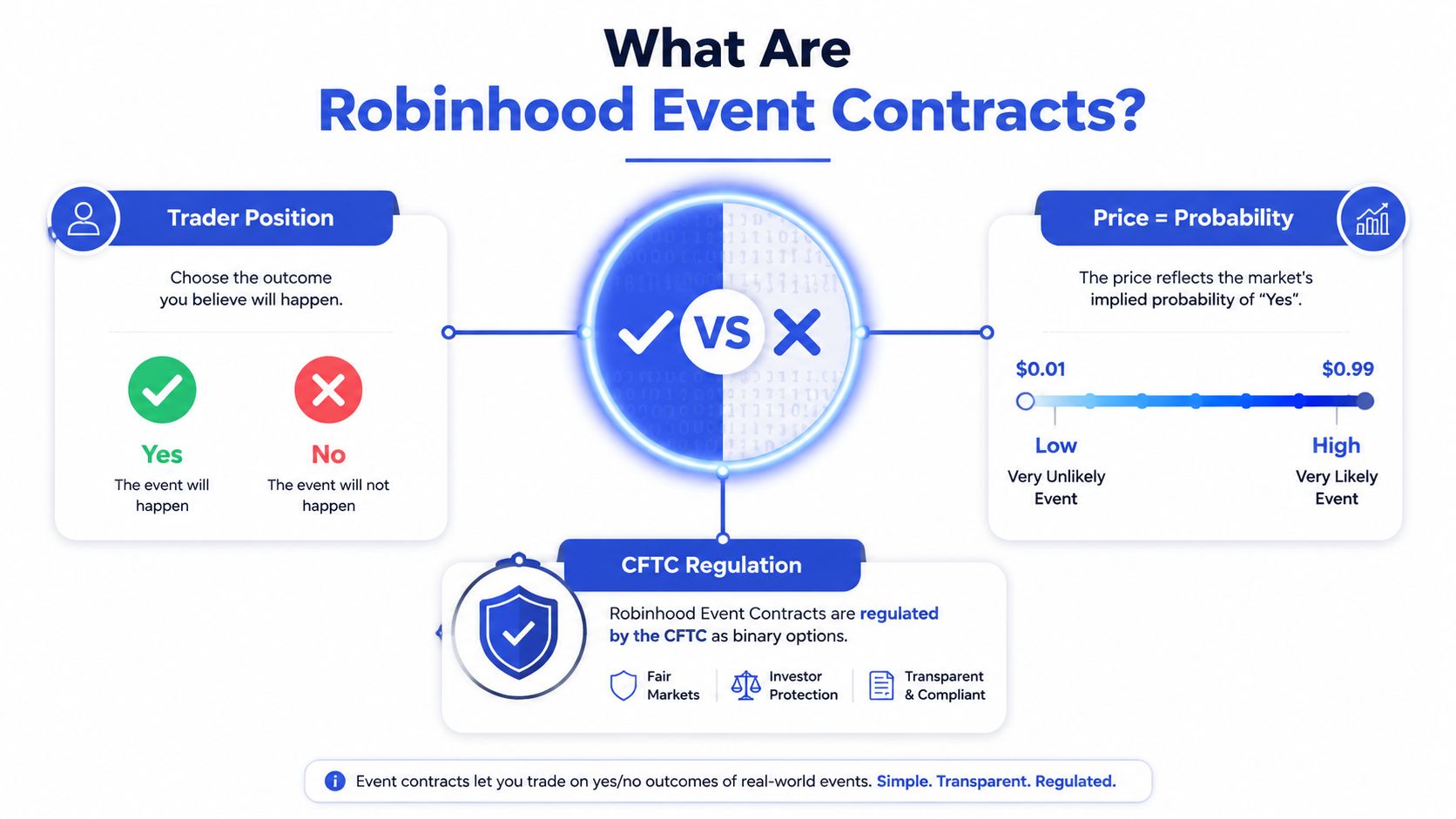
Robinhood event contracts are binary “Yes/No” derivatives tied to a clearly defined future event. A trader buys a Yes contract if they believe the stated outcome will occur, or a No contract if they believe it won’t. Robinhood’s disclosures state that the maximum payout is $1 per contract, with no physical delivery, and that the instrument is a derivative offered through Robinhood Derivatives and partner exchanges regulated by the US Commodity Futures Trading Commission.
The contract question controls everything. A Yes position only wins if the event happens exactly as described, as Robinhood explains in its event-contract learning material. “Will the S&P 500 close above a specified level on a specified date?” is materially different from “Will the market rise this week?” The first has an observable reference point. The second leaves room for disagreement.
Robinhood’s risk disclosure describes these instruments as binary Yes/No derivatives. The price generally sits between $0.01 and $0.99, while the winning side receives $1 at settlement. That makes the product easy to understand at a surface level, although the implied probability isn’t a guarantee. It reflects the market’s current pricing, liquidity, and expectations.
Why the product belongs to derivatives infrastructure
The US framework is relatively established. The CFTC says prediction markets and event contracts have existed in the United States since 1988 and have been regulated by the agency since 2004. Robinhood’s model therefore sits within a federally supervised derivatives environment, rather than being presented as a cash gambling product.
That distinction matters to builders. A compliant product needs more than a front-end question and a buy button. It needs event specifications, approved data sources, account eligibility rules, surveillance, order handling, reporting, and a defensible settlement process. For a retail trader, those systems appear as a clean interface. For an enterprise team, they become the product.
How Yes-or-No Contract Pricing and Settlement Work
A Yes-or-No contract has two complementary outcomes. Consider the question, “Will the S&P 500 close above 5,500 on Friday?” If Yes trades at $0.62, the corresponding No side is priced at $0.38, assuming the two sides together represent the full $1 settlement value. The market price can be read as an implied probability, so $0.62 suggests 62%, but it doesn’t establish that the event has a genuine 62% chance of occurring.
Robinhood’s published pricing range runs from $0.01 to $0.99. A trader who buys Yes at $0.45 pays 45 cents for a potential $1 payout. If the event occurs, the gross payout is $1 and the profit per contract is $0.55 before any applicable costs. If the event doesn’t occur, the Yes contract expires worthless.
The lifecycle of a contract
- Order entry: The trader selects Yes or No, reviews the event definition, checks the current price, and submits an order.
- Matching: The order is matched with an opposing participant or supported liquidity source. The available price depends on supply, demand, and market depth.
- Position management: The trader can monitor the open position and, where the market allows, exit before final resolution. The market value can move as new information arrives.
- Resolution: An authorised data source or defined oracle process determines whether the contract’s event occurred.
- Settlement: The winning side receives the stated payout, while the losing side receives nothing. The account is credited after the applicable resolution process.
A practical example makes the arithmetic clear. Buying 100 Yes contracts at $0.45 costs $45. If Yes wins, the payout is $100, producing a $55 net profit before applicable costs. If Yes loses, the trader loses the $45 paid for the contracts. The maximum loss is the entry cost, while the maximum gain is the difference between the $1 payout and the entry price, multiplied by the number of contracts.
| Entry Price (Yes) | Cost for 100 Contracts | Payout if Yes Wins | Net Profit/Loss | Implied Probability |
|---|---|---|---|---|
| $0.20 | $20 | $100 | $80 profit | 20% |
| $0.45 | $45 | $100 | $55 profit | 45% |
| $0.62 | $62 | $100 | $38 profit | 62% |
| $0.90 | $90 | $100 | $10 profit | 90% |
The difficult part is rarely the payout formula. It’s the contract language and resolution source. A production platform must define what happens if a data feed fails, an event is cancelled, two authoritative sources disagree, or the outcome remains ambiguous. The architecture of event trading systems therefore needs deterministic rules, audit trails, and controlled exception handling. Those same settlement principles also matter in a corporate bond tokenization platform, although the underlying financial instrument is different.
Event Contracts vs Traditional Betting and Prediction Markets
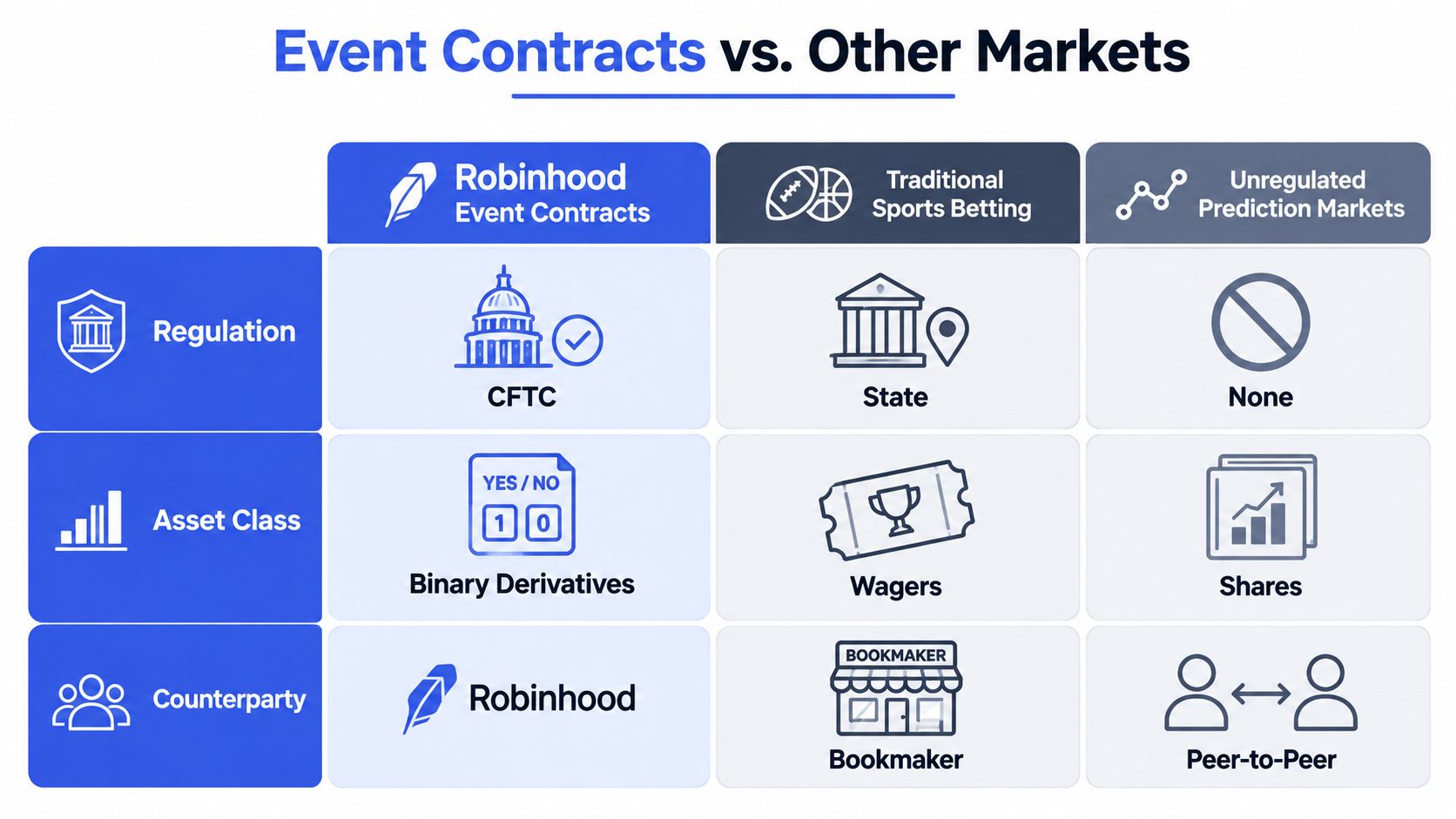
The interface can look similar, but the legal and operational model may be very different. Robinhood event contracts are binary derivatives offered through Robinhood Derivatives and partner exchanges operating within a CFTC-regulated framework. Traditional sports betting generally operates through state gaming regimes, while offshore or decentralised prediction-market products may not have the same US registration, identity, reporting, or consumer-protection structure.
The distinction begins with the counterparty and price formation. A sportsbook typically posts odds and accepts a stake under its house rules. An event-contract market allows participants to trade Yes and No positions, with prices changing as orders interact. A prediction market can use a centralised order book, an automated market maker, or another mechanism, depending on its design.
| Feature | Robinhood Event Contracts | Traditional Betting | Other Prediction Markets |
|---|---|---|---|
| Product form | Binary derivative | Wager | May be a derivative, token, or platform-specific contract |
| Oversight | CFTC-related US framework | State gaming framework | Varies by operator and jurisdiction |
| Price formation | Market trading | Bookmaker-set odds | Order book, AMM, or other mechanism |
| Resolution | Defined event terms and approved sources | Operator rules and event records | Platform-specific oracle or dispute process |
| Maximum exposure | Usually the paid contract cost | Stake under the wager | Depends on collateral and contract design |
Calling a product a “prediction market” doesn’t settle its legal status. In India, the classification remains unsettled because the Indian Contract Act, 1872 generally treats wagering agreements as void, while SEBI warned on 29 April 2025 that opinion-trading platforms fall outside its investor-protection framework. Indian commentary also notes that a similar Yes/No structure may be viewed as derivative-like or as an unenforceable wager, depending on how it’s structured and supervised.
The comparison becomes especially important for teams considering centralised versus decentralised prediction markets. A decentralised architecture may broaden market creation and settlement options, but it also raises questions around jurisdiction, wallet screening, oracle governance, dispute handling, and user protection. A brokerage-integrated product may offer a more familiar account experience, but it still needs precise market controls.
Types of Events Available for Retail Trading
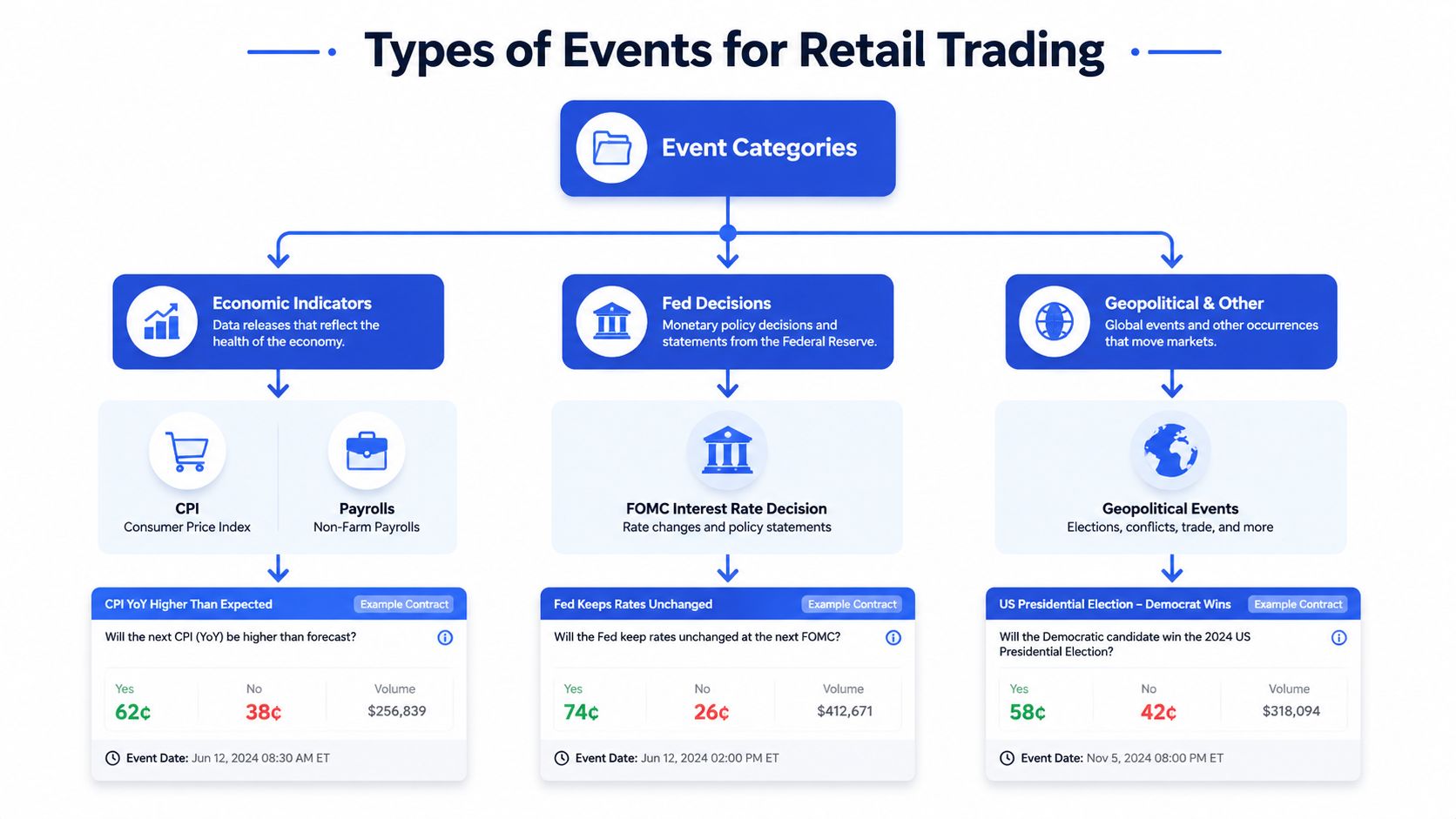
Robinhood’s event-contract offering demonstrates how a binary market can cover more than a conventional financial asset. Categories can include economic indicators, Federal Reserve decisions, cryptocurrency price thresholds, sports, political or geopolitical outcomes, weather, technology, and entertainment, subject to current availability, eligibility, and applicable product rules. The exact catalogue can change, so traders should read the live contract specification rather than rely on a category label.
An economic contract might ask whether an inflation measure exceeds a stated threshold. A central-bank contract could focus on the outcome of a Federal Reserve decision. A crypto example might ask whether Bitcoin exceeds a particular price before a specified date. Equity, weather, technology, entertainment, and geopolitical questions follow the same basic pattern, but each depends on a different source of truth.
A trade from question to settlement
A trader first reviews the event wording, reference data source, expiration time, and settlement conditions. They then choose Yes or No, decide how many contracts to buy, and pay the displayed price between $0.01 and $0.99. The position may be monitored or closed before expiration if the market supports that action.
Time-bound and threshold contracts behave differently. A time-bound question resolves at a specified moment, such as an index close on a particular day. A threshold question may resolve when a condition is met, or at a stated deadline if it hasn’t been met. That distinction affects how long capital remains exposed and how the trader interprets price movements.
For retail trading, category diversification doesn’t remove binary risk. Economic releases may be revised or interpreted differently from the contract’s reference definition. Crypto markets operate continuously and can vary across venues. Political and geopolitical events can involve ambiguous language. A sound workflow keeps each position tied to its own resolution rule instead of treating every market as interchangeable.
Risks Regulatory Considerations and Retail Protections
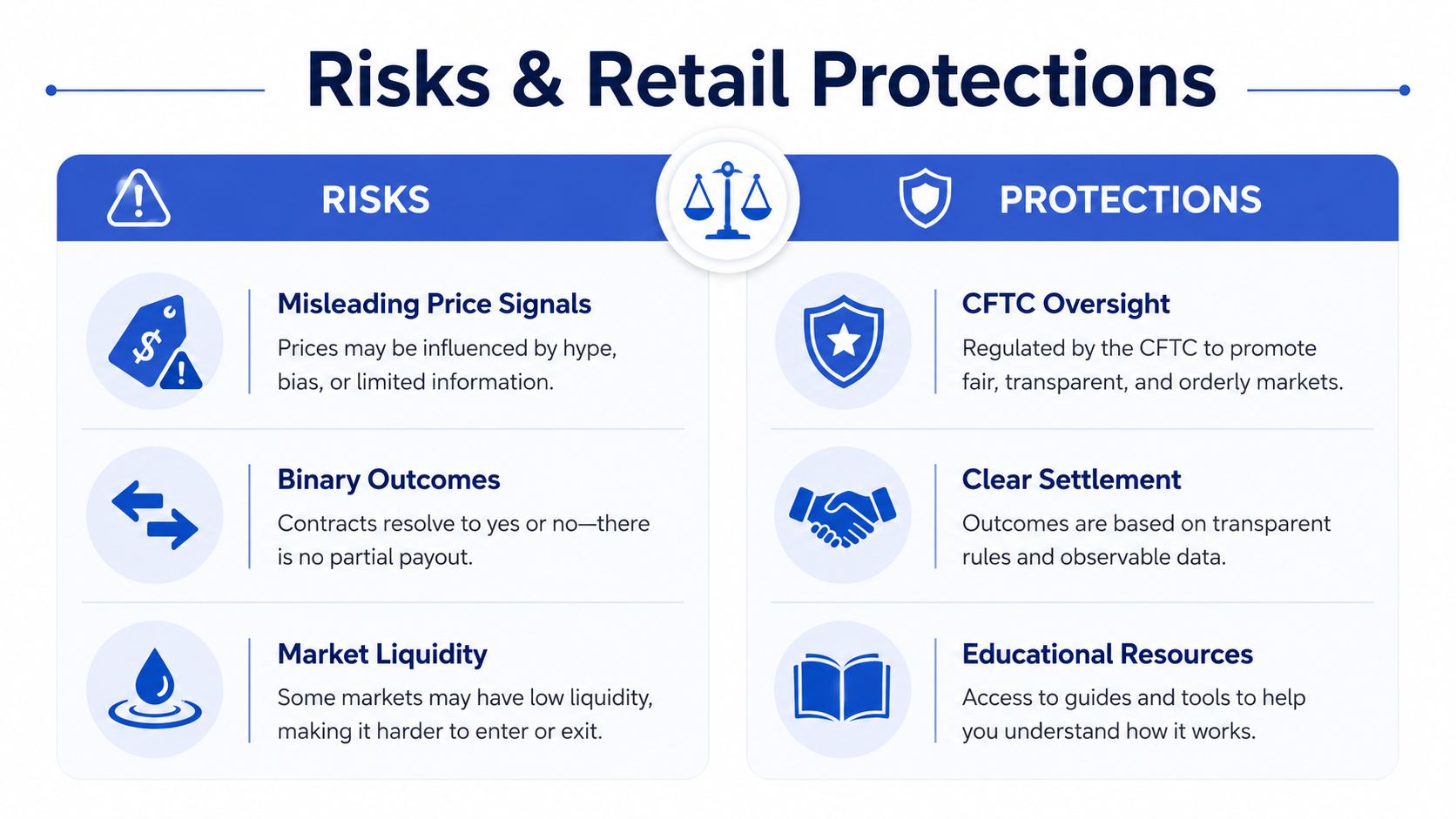
The most common mistake is treating the displayed price as an objective forecast. A Yes contract at $0.90 suggests a high implied probability, but that price can be affected by thin liquidity, one-sided demand, new information, or manipulation. A high price reduces the potential profit while leaving the trader exposed to the full contract cost if the outcome is wrong.
Settlement ambiguity creates a separate risk. “Exactly as described” is a demanding standard. If a question doesn’t identify the relevant source, measurement time, geographic scope, or treatment of revisions, traders may disagree with the final result. A platform’s resolution policy should explain cancellation, unavailable data, conflicting feeds, and disputes before the order is placed.
Practical rule: Read the resolution criteria with the same care you’d give the price. The question is the instrument.
What retail traders should check
- Loss boundary: A losing position can expire at zero, so the trader may lose the entire amount paid for that position.
- Liquidity: A trader may not be able to exit at a favourable price if few participants are willing to take the other side.
- Information quality: A market price reflects trading activity, not certainty or independent verification of the event.
- Jurisdiction: Access and legality can vary by location, product category, and regulatory interpretation.
- Behavioural pressure: Rapid binary outcomes can encourage repeated speculative decisions, especially when users focus on wins rather than cumulative exposure.
US federal oversight doesn’t automatically resolve every state-level or international question. The CFTC framework described in Robinhood’s product materials is US-specific. The UK, European Union, Asia-Pacific markets, and India can apply different financial-services, gambling, consumer-protection, or derivatives rules. Builders serving multiple regions need jurisdiction-aware onboarding and market availability controls, rather than one global switch.
Identity controls are part of that foundation. Teams designing onboarding can study a practical user identity check UI as a reference for how verification steps can be presented clearly. The interface should explain why information is requested, what happens when verification fails, and how restricted users are handled.
Building Compliant Prediction Market Platforms for Enterprise
A Robinhood-style product requires a controlled market system behind a simple retail screen. The first design decision is the legal perimeter. The operator must determine whether the product is a derivative, a wager, a tokenised instrument, or another regulated activity in each target jurisdiction. That decision influences licensing, customer eligibility, KYC, AML monitoring, reporting, custody, and market surveillance.
Settlement should be designed before market launch. Each event needs a canonical definition, an authoritative data source, a timestamp or observation window, and a resolution state. Oracle infrastructure can ingest market prices, scheduled economic releases, or other approved feeds. If the primary feed fails, the system needs a documented fallback. If sources conflict, the platform needs an arbitration or review path that preserves an auditable record.
A production architecture checklist
- Market definition service: Stores event wording, outcome logic, expiration, source hierarchy, and version history.
- Matching and liquidity layer: Supports order entry, matching, cancellations, price updates, and controlled liquidity provision.
- Risk engine: Applies position limits, exposure checks, account restrictions, and monitoring for suspicious trading patterns.
- Oracle and settlement layer: Converts verified external data into a deterministic settlement decision.
- Compliance operations: Handles identity verification, sanctions screening, transaction monitoring, reporting, and record retention.
- Customer experience: Shows probability interpretation, maximum loss, resolution terms, and status changes without obscuring risk.
Teams must also choose what to build and what to integrate. A centralised order book may suit a regulated exchange model. An AMM can support liquidity in markets where order-book depth is limited, but its pricing curve, inventory risk, and manipulation controls require careful modelling. Tokenised or cross-chain designs add wallet custody, smart-contract auditing, bridge risk, and chain-specific finality concerns.
A phased roadmap is more defensible than launching every category at once. Start with licensing analysis and a narrow set of objectively verifiable events. Validate onboarding, surveillance, data ingestion, and settlement operations. Expand only after the team can demonstrate reliable handling of cancellations, corrections, disputed data, and restricted jurisdictions. The Robinhood blockchain development guide provides a useful commercial reference point for teams connecting consumer event trading with broader digital-asset infrastructure.
Why Choose Blocsys for Prediction Market Platform Development
Blocsys Technologies works on financial technology, enterprise blockchain, digital assets, smart contracts, and compliance-oriented platform infrastructure. For prediction-market projects, its scope can include settlement engines, oracle integrations, position-limit controls, market surveillance workflows, centralised or decentralised execution models, and interfaces designed for users who are new to binary products.
The technical brief should remain tied to the product’s regulatory model. A team may need a matching engine, an AMM, a custody layer, smart-contract audits, reporting tools, and jurisdiction-specific access controls. It may also need tokenisation infrastructure for real-world assets, securities, real estate, commodities, and digital assets, as described in Blocsys’ Tokenization Platform Development offering.
Delivery structure matters as much as feature coverage. Teams can review how Blocsys builds dedicated blockchain development teams for enterprise projects when assessing staffing, architecture ownership, security review, and long-term maintenance. For a prediction-market platform, the right partner should translate market rules into testable software, not merely reproduce a trading screen.
Frequently Asked Questions About Robinhood Event Contracts
What are Robinhood event contracts?
Robinhood event contracts are binary Yes/No derivatives tied to defined future events. A winning contract pays a maximum of $1, while a contract on the wrong outcome expires worthless, according to Robinhood’s official event-contract risk disclosure.
How do Robinhood prediction markets work?
Robinhood prediction markets let eligible users trade Yes or No positions on specified outcomes through Robinhood Derivatives and partner exchanges regulated by the CFTC. Prices move as participants trade, and the final payout depends on the contract’s stated resolution criteria.
How do Yes-or-No contracts work?
A Yes contract wins only when the event occurs exactly as the contract defines it. A No contract wins when that condition doesn’t occur, and the losing side receives no payout at settlement.
How are Robinhood event contracts priced?
Robinhood event contracts trade between $0.01 and $0.99. The price can be interpreted as an implied probability, but it isn’t a guarantee because liquidity, sentiment, new information, and order imbalance can influence the market.
How are event contracts settled?
Settlement follows the contract’s defined event criteria and designated reference data. The winning side receives the stated payout, while the losing side expires worthless, subject to the platform’s procedures for data failure, cancellation, corrections, or disputes.
What types of events can be traded on Robinhood?
Available categories can include economic indicators, Federal Reserve decisions, cryptocurrency price thresholds, sports, politics or geopolitics, weather, technology, and entertainment. Availability changes, so users should review the live contract description and eligibility rules.
How are prediction markets different from traditional betting?
Prediction markets use tradeable contracts whose prices can change with participant demand, while traditional betting generally uses bookmaker-set odds and wagering rules. The legal treatment also differs, although classification depends on the product, operator, jurisdiction, and applicable regulator.
What are the risks of trading event contracts?
A trader can lose the full amount paid for a position if the outcome is wrong. Other risks include misleading price signals, limited liquidity, ambiguous resolution language, data-source disputes, rapid price changes, and restrictions based on location or eligibility.
Who can trade Robinhood event contracts?
Eligibility depends on Robinhood’s account requirements, product availability, jurisdiction, and applicable rules. Users should confirm access directly in the Robinhood app and review the relevant disclosures before trading.
Are Robinhood event contracts regulated?
Robinhood states that its event contracts are offered through Robinhood Derivatives and partner exchanges regulated by the CFTC. That US framework doesn’t establish automatic legality or availability in every state or other country.
How much does it cost to build a prediction market platform?
There isn’t a universal build cost. The budget depends on licensing scope, event categories, custody model, oracle requirements, compliance integrations, execution technology, smart-contract use, security testing, and target jurisdictions. A structured estimate can begin with the Blocsys software development cost estimator.
Why should businesses choose Blocsys for prediction market development?
Businesses evaluating Blocsys should assess its ability to connect product design, blockchain development, smart contracts, trading infrastructure, oracle-based settlement, and compliance workflows. The engagement may cover a retail-facing event-contract application, an institutional market, a hybrid trading model, or supporting financial infrastructure.
Can a business launch a white-label Yes-or-No market?
A business can explore a white-label or customised model, but the legal and operational design must come first. The operator still needs appropriate licensing analysis, identity controls, market definitions, settlement governance, surveillance, reporting, and a clear responsibility model for data and disputes.
What technology does a compliant prediction market platform need?
A production platform typically needs account and identity services, a market-definition engine, an order book or liquidity mechanism, risk controls, oracle integrations, settlement logic, audit logs, monitoring, reporting, and secure custody where applicable. Smart contracts may support selected workflows, but they don’t replace regulatory governance or operational controls.
Blocsys Technologies offers prediction market platform development, hybrid trading infrastructure, blockchain and smart-contract development, oracle-based settlement, and financial application engineering for fintechs, enterprises, exchanges, and digital-asset businesses. Visit Blocsys Technologies to discuss a compliant Robinhood-style event-contract product, review the architecture, and plan the next stage of delivery.
